Introduction
Endoscopic stapling of pharyngeal pouches is reported to be quick, less invasive and safe, with shorter hospital stays and fewer complications in comparison to an open approach.Reference Siddiq, Sood and Strachan 1 , Reference Leong, Wilkie and Webb 2 These facts are well established in the peri-operative and short-term follow-up period, but less is known about long-term outcomes.
Materials and methods
This study involved a retrospective review of all our department's cases of pharyngeal pouch surgery from October 2000 to January 2014. Patients were identified using the hospital's electronic database and the Office of Population Censuses and Surveys’ Classification of Surgical Operations and Procedures. The codes used included ‘E23.2’ for pharyngeal pouch operations, ‘Y26.3’ for organ stapling and ‘Y76.3’ for an endoscopic approach to other body cavities.
Case notes, both hard and microfilmed copies, were retrieved, and medical records were reviewed to obtain information regarding demographics, symptoms, treatments, outcomes, complications and revision surgery requirements.
As long as medical fitness permitted, patients were allowed to choose which operative option (endoscopic stapling or an open approach) they preferred. A few patients with significant co-morbidities were advised to undergo endoscopic stapling. Others were counselled on an open approach when the pouch was very small.
Patient demographics are presented for each group. Chi-square tests or Fisher's exact tests were used to compare categorical data between groups (e.g. complication rates), and t-tests were used for continuous data (e.g. operation time). A p-value of less than 0.05 was considered to indicate statistical significance. All analyses were undertaken using SPSS® statistical software (version 22).
Results
A total of 120 pharyngeal pouch procedures were carried out on 97 patients. The age range of patients was 38–102 years, with a mean age of 73.9 years and a male-to-female ratio of 2:1. For the endoscopic stapling group (n = 80), there were 24 females and 56 males, with an age range of 38–102 years and a mean age of 74.63 years. For the open procedure group (n = 40), there were 10 females and 30 males, with age range of 46–87 years and a mean age of 68.68 years. The main presenting complaints are shown in Table I.
Pharyngeal pouch symptoms at presentation

There were 97 patients in total, but some patients presented with a particular symptom more than once over the follow-up period.
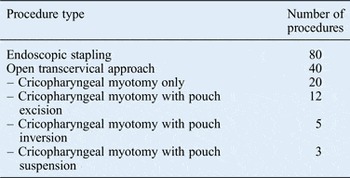
The 97 patients underwent a number of different surgical procedures (Table II). These included endoscopic stapling (n = 80) and open transcervical approaches (n = 40). The open procedures consisted of: cricopharyngeal myotomy only (n = 20), cricopharyngeal myotomy with pouch excision (n = 12), cricopharyngeal myotomy with pouch inversion (n = 5) and cricopharyngeal myotomy with pouch suspension (n = 3). The ratio of endoscopic stapling versus open surgery procedures was 2:1.
Surgical procedures

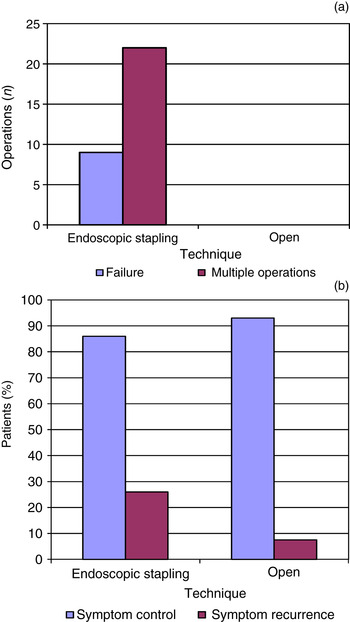
Seven (9 per cent) of the 80 endoscopic stapling procedures were abandoned and the patients had to return at a later date to undergo open procedures. Six procedures were abandoned because of difficult access or a small pouch. One was abandoned because the cricopharyngeal bar (the tissue that needed to be divided) was beyond the reach of the endoscope. This latter case involved a second endoscopic stapling for recurrence of symptoms. None of the 40 open procedures were abandoned (Figure 1a).
Comparison of (a) surgical failure and multiple operations, and (b) symptom (dysphagia) recurrence in endoscopic stapling group versus open procedure group.

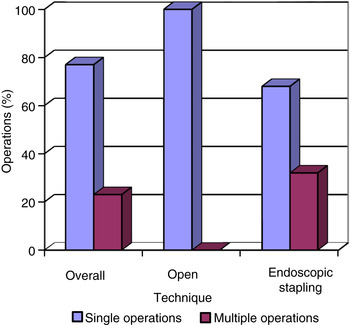
Seventy-five patients underwent a single pharyngeal pouch surgical procedure, 19 patients had 2 operations and 3 patients underwent 3 procedures (Figure 2). Of the 22 patients who had multiple surgical procedures, 11 patients had 1 endoscopic stapling procedure followed by 1 open procedure, 8 patients underwent 2 stapling procedures, 2 patients had 3 stapling procedures and 1 patient had 2 stapling procedures followed by 1 open procedure. The male-to-female ratio for multiple pharyngeal pouch surgery was 10:1.
Comparison of single or multiple operation requirements in endoscopic stapling group versus open procedure group.

The mean operative time was 27 minutes for endoscopic stapling and 106 minutes for the open technique (Table III). Seventy-three of 80 endoscopic stapling patients (91 per cent) had commenced oral feeding by the 2nd post-operative day, while 29 of 40 patients who underwent open surgery (72.5 per cent) had commenced oral intake by the 2nd post-operative day; this finding was statistically significant (p = 0.007; Table III).
Operation times and outcomes for endoscopic stapling versus open approach groups

The length of hospital stay for endoscopic stapling ranged from 1–3 days, with an average stay of 2 days. This duration was the same for the open approach patients if mucosal opening was avoided. With pouch excision or inadvertent mucosal transgression, however, the hospital stay for the open procedure group rose to 5–11 days, with an average of 8 days.
Symptom improvement was reported in 86 per cent of patients who underwent endoscopic stapling and in 93 per cent of those who had open procedures, but this finding was not statistically significant (p = 0.315; Table III). Symptoms recurred in 26 per cent of the endoscopic stapling group and in 7.5 per cent of the open procedure group; this finding was statistically significant (p = 0.015) (Table III, Figure 1b).
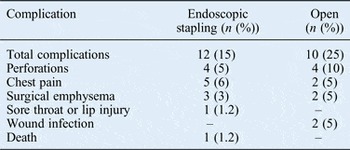
There was no statistically significant difference in the overall post-operative complication rate between the two groups: 12 in the endoscopic stapling group (15 per cent) versus 10 in the open procedure group (25 per cent) (overall complications, p = 0.183; perforations, p = 0.301; chest pain, p = 0.783; and surgical emphysema, p = 0.747) (Table IV).
Complication rates for endoscopic stapling versus open approach groups

Discussion
The surgical options available for pharyngeal pouch management are broadly categorised into two groups. Endoscopic procedures involve division of the septum between the pharynx and the pouch, which anatomically entails a partial cricopharyngeal myotomy. External operations involve cricopharyngeal myotomy alone, but can include pouch excision, inversion or suspension. Prior to the introduction of the endoscopic stapling procedure, most studies showed the external and endoscopic methods to be equally successful,Reference Todd 3 – Reference Parker and Hawthorne 6 whereas a few reported poorer outcomes in the endoscopic diverticulotomy patients.Reference Welch and Stafford 7 , Reference Maran, Wilson and Muhanna 8
Endoscopic stapling has gradually replaced the Dohlman's procedure as the endoscopic procedure of choice and is now established practice in the UK. It is routinely performed by most otolaryngologists because the risks of mediastinitis, salivary fistula, bleeding from wound edges and recurrent laryngeal nerve injury are thought to be reduced with this technique.Reference Leong, Wilkie and Webb 2 The procedure is quick, effective and safe, with most patients commencing oral intake within 6 hours of surgery and being discharged from hospital within 24 hours. Endoscopic stapling offers the patient potential advantages over external excision, including shorter anaesthetic time, less post-operative pain and early discharge.
Our review confirmed these facts. However, it also indicated that although endoscopic stapling takes less time than the open transcervical approach, it has a 9 per cent failure or abandonment rate, while the open technique has no such issues. The 2012 meta-analysis by Leong et al. found an 8 per cent failure rate for endoscopic stapling.Reference Leong, Wilkie and Webb 2 The 2015 systematic review by Verdonck and Morton showed an 18.9 per cent failure rate for endoscopic stapling compared to a 4.2 per cent rate for open surgery.Reference Verdonck and Morton 9 Furthermore, all patients can be managed by an open approach, while only a percentage can be treated endoscopically.
Although the male-to-female ratio for pharyngeal pouch incidence was 2:1 in our study, the male-to-female ratio for undergoing multiple surgical procedures was 10:1. We could find no logical explanation for this.
In our series, 23 per cent of pharyngeal pouch patients required multiple surgical procedures. If endoscopic stapling alone is considered, then the rate of multiple surgical procedures required rises to 32 per cent. Most patients had multiple endoscopic stapling procedures or endoscopic stapling followed by an open procedure, but no patients in our series had multiple open transcervical approaches. Although 7.5 per cent of those who underwent a transcervical open approach had symptom recurrence, the dysphagia was manageable with dietary adjustment alone.
No attempt was made to determine the financial significance of repeated surgical procedures as this was beyond the scope of the present study. It is unlikely, however, that the financial burden will be greater in those undergoing open surgery, despite the increased surgical time, as no patients required revision surgery, no patients died and there was no statistically significant difference in complication rates. There was, however, a statistically significant difference in revision surgery rates.
Swallowing improved to a similar degree with both endoscopic stapling and open methods, with open techniques having a slight advantage, and recurrence was significantly higher with endoscopic stapling. Mirza et al. found that the outcomes of stapling were not as good as those of an open approach, and the rate of symptom recurrence was higher.Reference Mirza, Dutt, Minhas and Irving 10 This finding is in agreement with the 2015 systematic review by Verdonck and Morton, which reported recurrence rates of 18.4 per cent for endoscopic stapling and 4.2 per cent for open techniques.Reference Verdonck and Morton 9 Similar findings by Seth et al. led these authors to conclude that ‘patients treated by an open approach attain a greater resolution of symptoms than with endoscopic treatment and that endoscopic results tend to decline with time’.Reference Seth, Rajasekaran, Lee, Lorenz, Wood and Kominsky 11 A similar recurrence of symptoms over time was noted by Chang et al. in nearly 30 per cent of patients who had undergone endoscopic surgical procedures.Reference Chang, Payyapilli and Scher 12 Our recurrence rates were 26 per cent for the endoscopic stapling group and 7.5 per cent for the open procedure group, and this finding was statistically significant.
Most studies have reported lower morbidity, shorter operation time and shorter hospital stay with endoscopic stapling, as is the case in our study. However, by avoiding pouch resection, the length of stay following an open approach was greatly reduced, equalling that of endoscopic stapling. These open procedure patients also commenced oral intake within 6–24 hours of the operation.
The overall complication rates were higher with the open approach than with the endoscopic approach, but the difference was not statistically significant. Our complication and recurrence rates were slightly higher than those reported in the meta-analysis by Leong et al.Reference Leong, Wilkie and Webb 2 This is most likely because of differences in the patients’ characteristics and the follow-up durations. The ages of our patients ranged from the very young at 38 years to the very old at 102 years, as compared to the narrower age range of patients in the meta-analysis, from 49 to 86 years. The young are likely to live with this pathology for longer, with an increased risk of symptom recurrence, and the very old have a higher risk of complications associated with surgery and anaesthesia. In addition, our follow-up duration was longer than that in the meta-analysis, covering 13 years compared to 6 years in the meta-analysis.
-
• Patients are increasingly receiving endoscopic stapling as first-line pharyngeal pouch treatment
-
• Endoscopic stapling is perceived to be quick, less invasive than open surgery, and effective
-
• In addition, it is associated with fewer peri-operative complications and a shorter hospital stay
-
• In this study, symptom recurrence was higher and more severe in endoscopically stapled patients than in open procedure patients
-
• With long-term follow up, the multiple surgical procedure rate was 23 per cent overall, rising to 32 per cent for endoscopically stapled patients only
-
• The financial implications of these multiple surgical procedures may be substantial
Limitations
The study limitations include its retrospective nature, non-randomised design and lack of an appropriate control group. In addition, it is difficult to accurately compare outcomes given the different case mix and operative experiences of the surgeons.
Conclusion
With long-term follow up after pharyngeal pouch surgery, 23 per cent of patients required multiple surgical procedures for symptom recurrence, and this occurred more after endoscopic stapling than open surgery. The male-to-female ratio for pharyngeal pouch incidence was 2:1, but the male-to-female ratio for multiple surgical procedures was 10:1. Most studies report shorter operation times and shorter hospital stays with endoscopic stapling compared to open procedures, as was the case in our study. However, when pouch resection is avoided during open surgery, the length of hospital stay equals that of the endoscopic stapling technique; in addition, these patients can commence oral intake within 6 to 24 hours of surgery. Taking all these factors into account, it is doubtful whether endoscopic stapling has any overall advantage over open pharyngeal pouch surgery. The financial burden of revision surgery may be substantial; a further study is recommended to assess the financial burdens associated with multiple surgical procedures and complications.
Acknowledgements
We would like to acknowledge the valued contributions made by the audit and medical records staff at Hull and East Yorkshire Hospitals NHS Trust and Victoria Allgar for her invaluable assistance with statistics.