Where there is power, there is resistance.
(Michel Foucault, The History of Sexuality, 1978:95–96)Resistance to pressure and domination is a highly complex phenomenon which employs both passive and active means in its operation. This article based on the Indic Footnote 2 theme of cultural interaction tries to understand the art of resistance of the members of two Muslim minstrel castes, Jogi and Mirasi.Footnote 3 Their resistance is directed against an unwanted religious disciplining by a reform movement in the Mewat regionFootnote 4 of north India. Traditionally, powerless bards were dependent upon a Muslim peasant community called the Meos under the Jajmāni prathā (patron-client system) for everyday subsistence. With gradual disintegration of the patronage system, the landless bards and bards with small holdings were affected most. These Muslim bards, customarily, used to perform Hindu epics and other folktales of religious and cultural importance to their Meo Muslim patrons. However, with the rise and success of the reform organisation, Tablighi Jamaat, the Meos began to view performances of the Jogis and Mirasis as antithetical to Islam.
In the changed circumstances, the bards opted to resist and express anxieties utilising their artistic medium and folk musical compositions. After the loss of traditional audience, current performances include not only issues of identity and cultural heritage but also livelihood concerns. But, what is more significant is the mediaeval Indian themes of Nath, Sufi, and Bhakti religious streams—which conventionally stressed upon the conception of transcending Hindu-Muslim religious divides—are being shifted now from the transcendence notion to the domain and discourse of religious synthesis. Despite the identification with Islam, the bards currently advocate keeping a Hindu-Muslim composite heritage intact. It is worth considering an account of passive resistance. With messages of universal righteousness in their new songs, the Mewati bards indirectly question ascendant Islamic purist ideologies and groups on one hand, and the Hindu-Muslim divisive politics on the otherFootnote 5. However, in such oppositions, the Muslim bards cull for themselves the Indic symbolism of Hinduism to represent a ‘Muslim self’ against the rhetoric and symbolism of a non-familiar Islam representing ‘Muslim other’.Footnote 6
The writing of the subaltern school in India and its claim that it recovers the lost voices of subalterns in history writing confined the idea of challenging domination to its visible and violent forms of resistance only. Excessive focus on visible forms of resistance such as, insurgency, peasant rebellion and tribal revolt qualified the subaltern school's definition of (visible hence real) resistance. Less obvious forms of resistance are overlooked in the writing of the subaltern scholars.Footnote 7 Contrary to the subalterns, since the famous works of James Scott on themes such as ‘weapons of the weak’, ‘domination and resistance’,Footnote 8 much has been written and debated on the passive resistance of marginalised. But in this context too, there is little scholarly engagement with the issue of passive resistance to religious reform ideologies conveyed through the artistic means of folk songs.Footnote 9
The bards of Jogi and Mirasi caste backgrounds passively resist the ideological disciplining by the reform organisation. Doing so is vital for their livelihood. This article relies on a definition of James Scott's description of ‘Hidden Transcripts’,Footnote 10 and considers the lyrics of the songs of these bards constituting their own hidden transcript. The lines of orally performed new songs, thus, act as a strategic plan for them. Their songs are constituted in the alternative domain of art other than in the everyday domain of conversation in the face of power. The performance, thus, helps to express issues of religious identity and concerns of everyday survival through poetic artistry. Scott comments throughout his writings on the passive resistance of subordinate groups (or subalterns) through means of folk songs, gossip, jokes and mimicry. Such domains create a hidden transcript that could be displayed openlyFootnote 11 but often works indirectly behind the back of power.
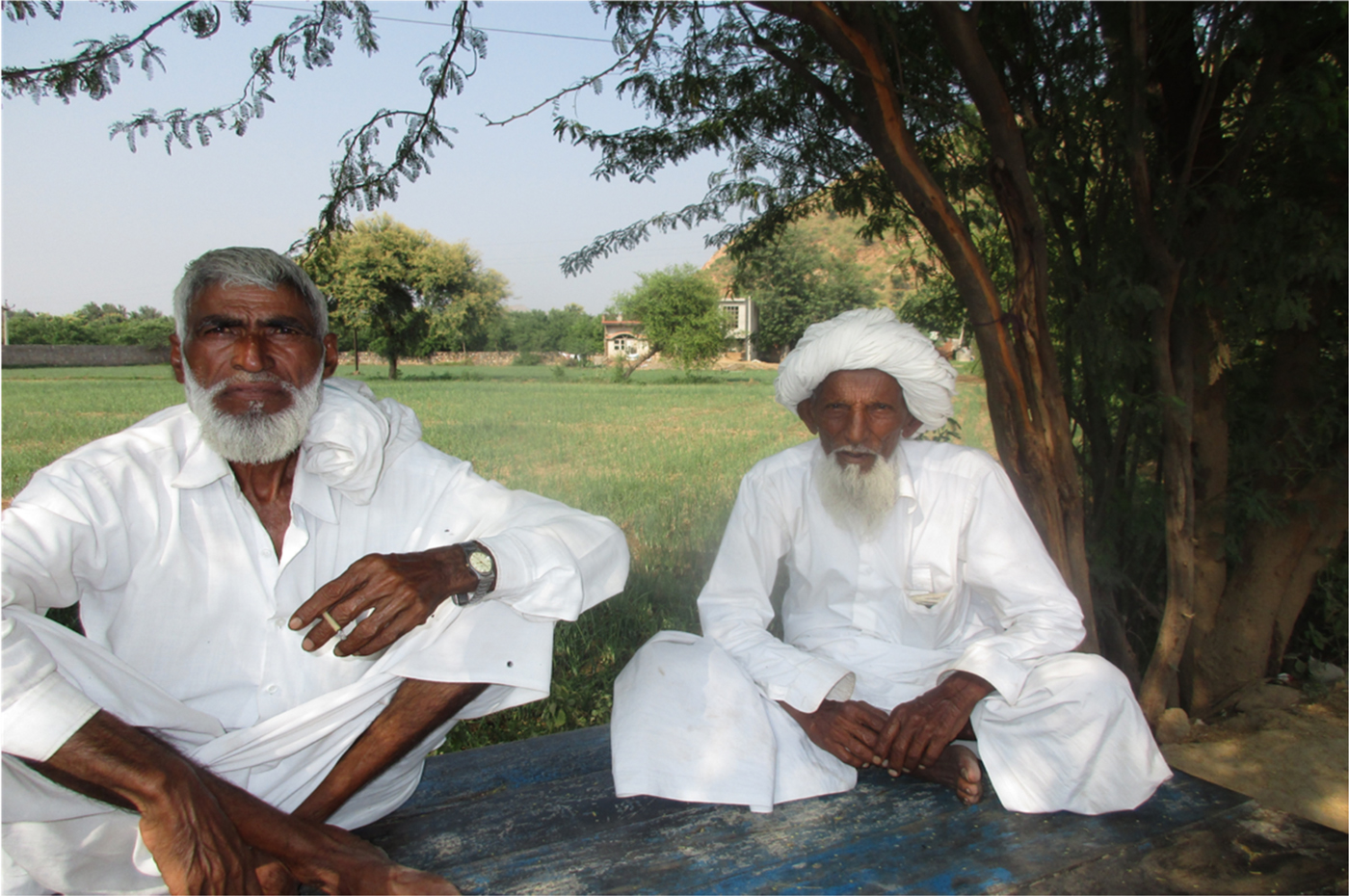
The fundamental concern of resistance is power. Power in a Foucauldian sense is not something which is static; it is an historically evolved and culturally perpetuated phenomenon dispersed through various means. Power relationships are hierarchically organised around groups and individuals in any social-economic set-up.Footnote 12 For contextualising the power relation in Mewat, the understanding of two minstrel castes’ dependence upon the Meo Muslim peasants (Figure 1) is important.
(Colour online) Two elderly Meo peasants sitting next to their fields. Photograph by the author.

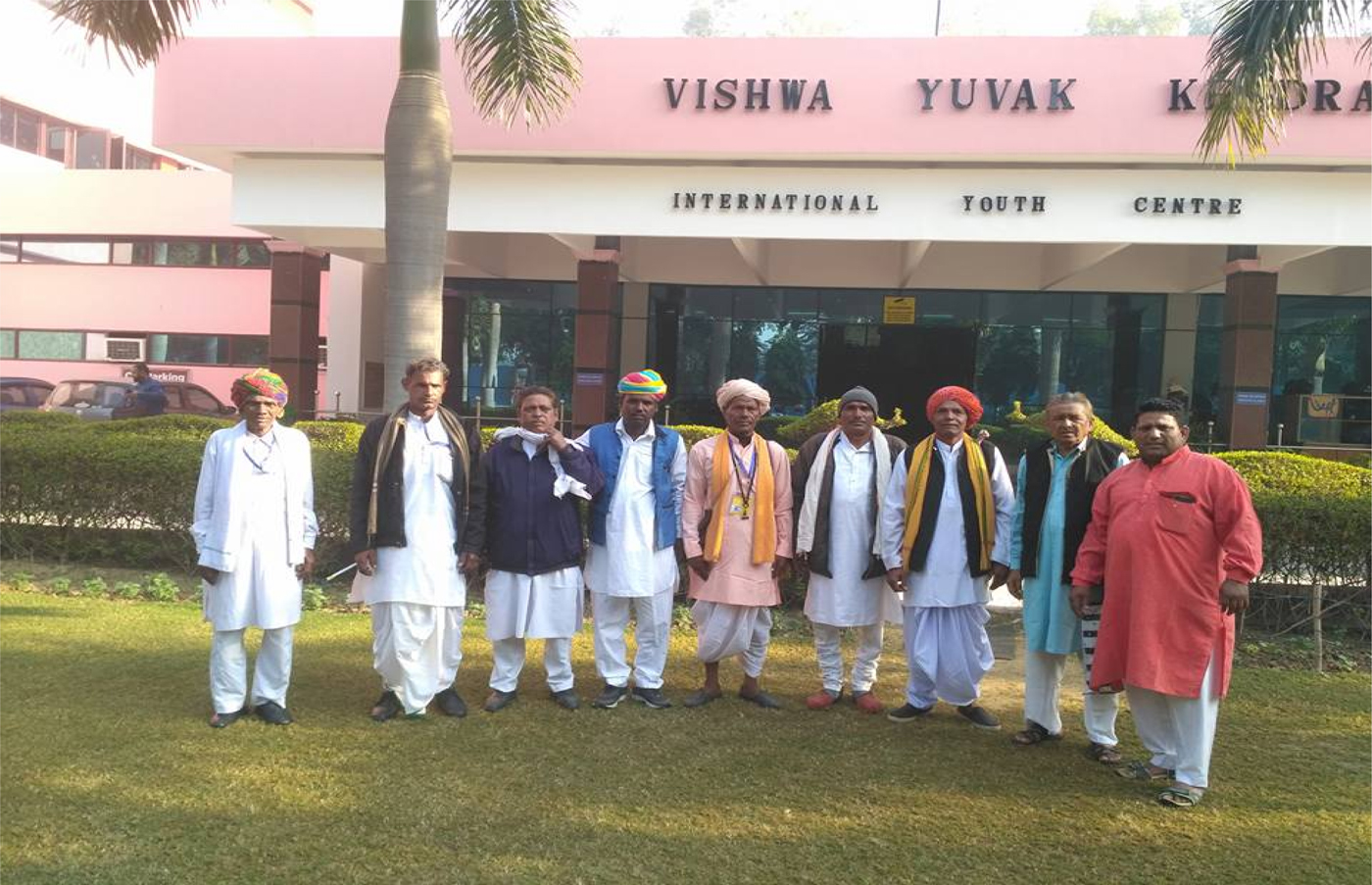
The Meos belong to a comparatively high caste upon whom the bards were dependent under the Jajmāni systemFootnote 13. The Jajmāni system, therefore, engenders circumstances for a power play in this context. More particularly in South Asia, power relations are hierarchically organised around caste structures which go hand in hand with class (in an economic sense) to an extent. The livelihoods of many landless communities’ in India were traditionally premised upon services rendered to the peasant patrons. In the last few decades however, patronage has shrunk considerably. Among other factors, is the impact of the reform movement, Tablighi Jamaat Footnote 14 (hereafter TJ), and the rise of a new market economy. Without patronage, landless (or small landowning) cultural groups like the Jogi and Mirasi were put under the ravages of free labour market forces. Under the new circumstances, due to weakening of the tie between patrons and musicians, their subsistence depends on selling physical labour. Thus, the artistic skills of bards which once flourished under the patronage of the Meos are no longer required in the changed mode of economic production and social relations. This disintegration of the patron-client system did not happen suddenly. It was a long process and some aspects of the relationship like the barbers’ role in a peasant society are still alive in rural areas. Coupled with an already decaying patron-client structure, the situation of the cultural groups has worsened with time: especially when the notion of music as an ‘anti-Islamic tradition’ emerged among the Meos. Most Meos believe in the reformist ideals of the purist organisation (the TJ) currently. Hence, both, the TJ and majority Meos discourage the culture of art and music; thereby, leaving traditional musicians (Figure 2) at the peril of not securing patronage.
(Colour online) A renowned group of Jogi and Mirasi musicians and singers. Source: Yusuf Khan.

Understanding the Bardic tradition of the Jogis and Mirasis among the Meos of Mewat
In the Jajmāni system, the Jogi and Mirasi communities’ main roles were to tell panegyric tales to Meo gatherings. The family's and the public entertainment on occasions such as marriages, festivals, and other amassments of the Meo patrons was their main duty.Footnote 15 As it was their main vocation, successive generations were trained to become oral performers and storytellers. Those tales were passed on to generation after generation either by fathers or grandfathers in the family through memory and recital practices. The oral recitations of Hindu epics the Ramayana and the Mahabharata, singing memories of Meo bravery and grief, and narrating other local folktales made up the main performances. Apart from narrating and recording the Meo community's history, and performance of it, the Jogi and Mirasi castes additionally used to sing accolades for a living person to raise earnings during a particular event. The Mewat's history and important Meo political events have been orally recorded for last several centuries by these groups in the form of what I call ‘Human Archive’.Footnote 16 The faculty of this human archive was entirely dependent upon their ability to recollect folktales and stories spanning several hundred hours of narration.
Most of these folktales belong to a genre called Mewāti bāt Footnote 17, and are the sung form of couplets designed and performed in the manner of having a conversation with an audience. The Mewāti bāt is closer to the prevalent western Indian oral genre vāt widespread across Rajasthan. In Mayaram's words, “the Rajasthani vāt means ‘tale’ or ‘epic’ or prose narrative is rooted in Sanskrit ‘vārtā’ (accounts) traditions”.Footnote 18 In Sanskrit vārtā kāthās (vārtā tales), a story is recited often by a VyasFootnote 19 (pundit) to an audience mostly made of religiously fasting women.Footnote 20 A vārtā (also meaning vow) has a religious significance in South Asia when females take a vārtā to fast in the name of a particular deity, either for well-being of their entire family or most commonly for the longevity of their husband. These fasting ceremonies usually end in the evening by listening to the tale attributed to the particular god in whose name the fasting was observed. The practice of telling vārtā stories contains a reciter (Vyas) and a group of listeners (mainly a group of fasting women). During the narration of the folktale, a vārtā kāthā requires the audience to make active interventions from time to time. This was done simply by nodding or hailing the god's name—a gesture signifying the audience's attentiveness. Likewise, the Mewati bards also employed similar methodsFootnote 21 in most of their folktale renderings in a style of performance known as döhā-dhānī shāīli Footnote 22 (doha dhani style).
In the classical Hindustani music, the rendition of various rāgs conveys the feeling (rasā). While in the folk music of Rajasthan as Shalini Ayyagari shows in Manganiyar's case,Footnote 23 the feeling is expressed through the dohās or ‘the poetic couplets’. In the dohā dhāni style of folk music, the Mewati bards fuse a classical music genre ‘rāg dhāni’ with ‘dohā’ (couplet). Thus, it shares features of both classical and folk music. It, therefore, attains what Manuel terms ‘an intermediate sphere’Footnote 24—a betwixt and between zone neither fully classical nor fully folk music. Almost all the traditional folktales of Mewat including the telling of the Ramayana and the Mahabharata correspond to the dohā dhāni style of folktale renditions. Generally, the couplets (dohās), that is two-lined rhymed verses, are sung by a lead singer first followed by an in-depth description (dhāni) of each couplet. Mayaram shows that “the dohā is a rhyming couplet in which each line consists of half lines made up of feet of 6 + 4+3 and 6 + 4+1”.Footnote 25 Sometimes other metrical forms such the chappā and the sorthā are also used. A chappā usually consists of six lines and the sorthā is a poetic meter in which the first and second half lines contain 11 and 13 metrical instants.Footnote 26
Mixed lexicons of both poetic Rajasthani and Brajbhāsā (Pingal kāvya)Footnote 27 appear in dohās’ verse followed by the explicated prose in colloquial Mewati. The second part (dhāni), which is both sung and narrated description, is always accompanied with instrumental music, melodies and rhythms.
However, the new songs in which ideas of passive resistance surfaced belong to another popular folk music genre called rasiyā. More particularly these songs belong to Mewati style rasiyā—a subgenre. Geographically, the Mewat intersects the Braj region of Mathura and Vrindavan which are the abodes of cowherd god Krishna. The Braj region has also been a centre of numerous folk poetry and folk musical advancement such as rītī poetry and Braj rasiyā. Inspired by the themes of Krishnaite bhakti (devotion) and romantic tropes featuring love of Radha and other peasant girls, the folk art intersected the divine and the profane world.Footnote 28 In the milieu of the love affairs of a god, the Braj folk genre rasiyā (literally means epicure) also spread into adjoining local areas, for instance Mewat, Hathras, Awadh, and Aligarh, in diverse local forms. In modern times, a new form of rasiyā is adopted into saucy and spicy songs depicting mundane feelings for sex, love, teasing, and erotic desires.Footnote 29 Spoken to the heart in sung form, the rasiyā has the evocative power of generating love, romance, and erotic emotions. However, the Mewati bards modelled the prosody in the traditional manner of rasiyā unlike its present use in spicy songs. Performed in such a manner, rasiyā can generate powerful feelings in one's heart. Using the traditional style rasiyā prosody in Mewāti bāt form, the bards perform all the new songs containing messages of universal righteousness.
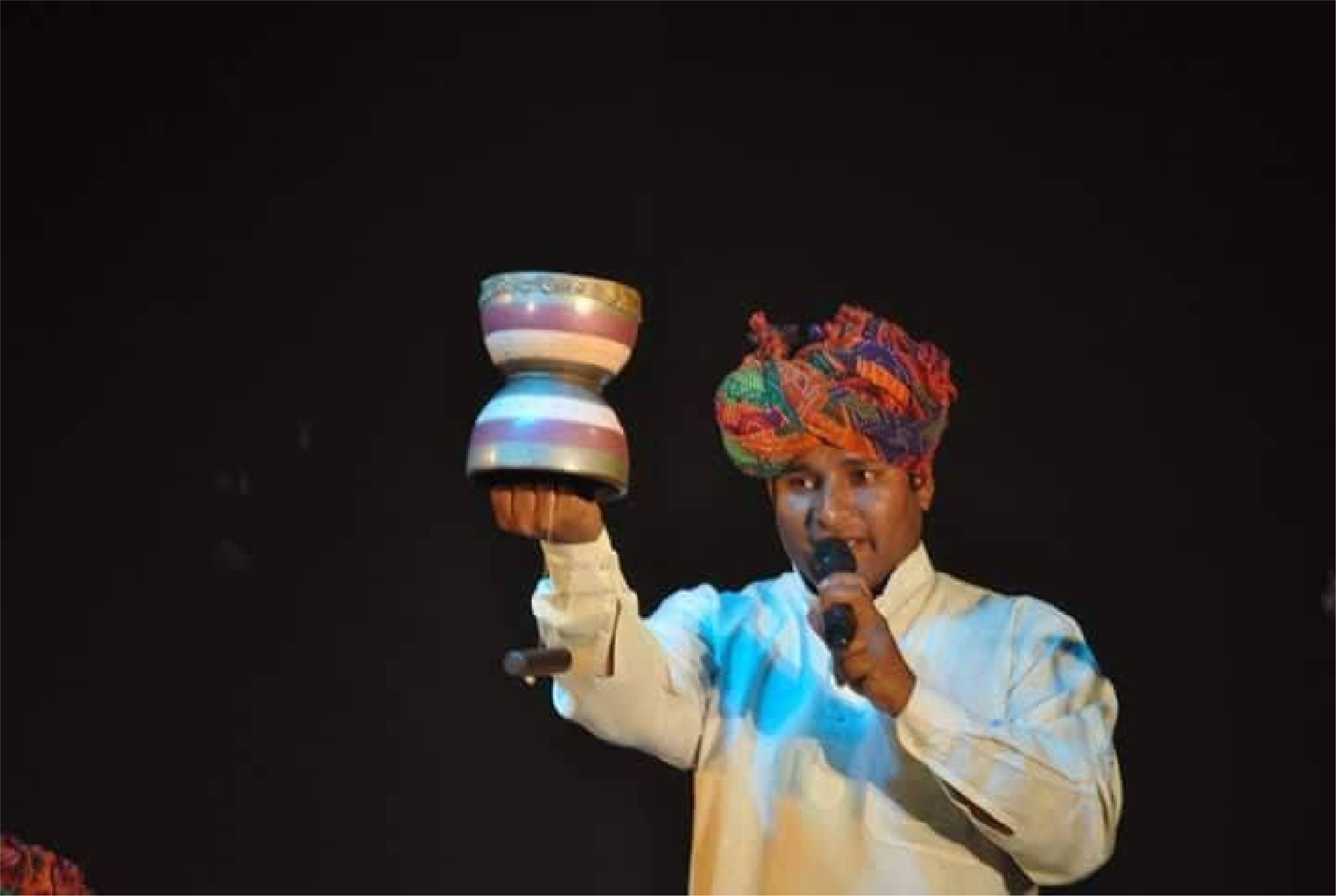
Though the Jogi and Mirasi are two different communities, they used more or less the same oral resources in the folk artistry. Socially different from the Mirasi community (who are untouchables), the Jogi caste enjoys higher caste status. The Jogi community exists across the religious divides unlike the Mirasis, who are only Muslim in identity. Both the Hindu Jogis and the Muslim Jogis, derive their identity after figures of the Nath cult of Shaiva tradition.Footnote 30 In Mewat, the Muslim Jogis traditionally played a particular musical instrument called Bhapang.Footnote 31 While singing in the temples of Shiva on the occasion of his wedding (Mahāshivrātri, the great night of Shiva), the tunes of Bhapang evoked the marriage event of Shiva. Naming this instrument, Bhapang, presents a curious blend of Vaishnava, Shaivite, and Nath panth (cult). The first Hindi word ‘bha’ stands for Bhole (another name of Shiva), ‘pa’ for pundit meaning the god Vishnu and, ‘ga’ for guru Gorakhnath—whom all the Jogis consider their patron saint. The letters used in the naming, thus, carry connotations for various religious traditions.Footnote 32 Another Hindu god Brahma among the trinity of gods is not recognised, and the status of Gorakhnath is elevated to a god-like status. But, more interestingly, elements of both Hinduism and Islam in their performative traditions figure prominently. On the day of Mahāshivarātri, the Muslim Jogis recite the story known as, Shivkathā, for a whole night in the temples of Shivaji.Footnote 33 The beginning of the story itself has a unique significance; in the first couple of verses singers chant the name of Allah to show gratitude to the Islamic almighty. Then, they remember their ustād (master or teacher) for imparting artistic skills, followed by the main attraction of the night–singing, dancing, and reciting god Shiva's wedding story. The only instrument those balladeers use is the Bhapang (Figure 3). It is similar to Shiva's Damru (a small hand drum) in its physical appearance and the melodies that it produces.
(Colour online) A Bhapang in the hand of a famous Muslim Jogi musician, Yusuf Khan. Photograph by the author.

Like the Muslim Jogis, the Mirasis remember the patron Hindu goddess Bhavani (Durga) before the beginning of any performance. The Mirasis still offer homage to goddess Bhavani at her shrine at Dhaulagarh near Lachmangarh in Alwar district of the Mewat region.Footnote 34 Thus, their art derives sacred inspiration from the (Indic) symbolism of Hinduism. Moreover, there are strings of diverse religious traditions: Nath; Shaiva; Vaishnava; and Islam.
The main patrons of these bards, the Meos, are said to have converted to Islam or at least they began to accept Islamic values in their social lives several centuries ago (the process is still going). Despite adhering to Islamic symbols, they did not fully discard previously held local practices of marriage rules, caste endogamy. Those rituals are similar to any other Hindu peasant group in the neighbouring regions of Mewat. Such practices once included observing Hindu rituals as well as worshipping Hindu gods and goddesses. Writing as early as the 1850s, colonial ethnographer, PowlettFootnote 35 (1878) notes that:
Meos are all Musalman in names, but their village deities are the same as those of Hindu Zamindars (landlords). They keep, too, several Hindu festivals. Thus, the Holi (Hindu festival of colours) is with Meos a season of rough play, and is considered as important a festival as the Muharram, Eid, and Shabibarat (all Islamic festivals); and they likewise observe the Janam Asthmi, Dasehara, and, Diwali (another set of Hindu festivals). They often keep Brahmin priests to write pili chitthi, a note fixing the date of marriage. They call themselves by Hindu names, with the exceptions of “Ram” and “Singh” is a frequent affix, though not so common as “Khan”.Footnote 36
Colonial ethnography put the Meos in the category of lax Muslims. Their blended culture created a complex situation to understand the issue of religious identity. Like the Meos, the bardic castes, Muslim Jogi and Mirasi, too have a blended religious history and liminal identity. For instance, as shown previously the Muslim Jogi community, like the Hindu Jogis, worships both, Shiva, and the founder of the Nath cult, Gorakhnath. They consider them their patron god and the lord respectively. Similarly, the Meos still consider themselves as descendants of the Hindu gods and mythological figures.Footnote 37 Therefore, a significant aspect of the histories of the Meo, Jogi, and Mirasi communities is the issue of religious synthesis of Hinduism and Islam in their life world. For that matter, both minstrel castes used to sing and recite the two great Hindu epics, the Mahabharata, locally known as ‘Pandun kā Kadā,’ and the Ramayana called ‘Lankā ki Chadhāi’, for their Meo patrons. It is important to note here that both the performers (Jogi and Mirasi) and the audience (Meo) were Muslims who enjoyed the cultural performances of the two Hindu epics.Footnote 38 Likewise, there are multiple oral recitations of the Meos’ experiences with colonial and pre-colonial states, folk tales of feuds between the local Meo heroes and other symbols of powers, and the relationship with other castes and groups in the area. The bardic castes sang mythic instances of the Meo bravery vis-a-vis pre-colonial, colonial, and princely states.Footnote 39 The Meos were centrally placed in these performances by virtue of being the Jajmāns (patrons).
The Changing trajectory of the Jajmāni relation
Under the caste organisation in Mewat like many other places in India, both lower and upper service castes were tied to the peasant castes for everyday food supply and subsistence. Often, placed under the category of clients, service castes such as, Jatav and Valmiki (cleaners), Dhobi (washer-man), Nai (barber), Shakka (water-carriers), Jogi, Mirasi, Nut, and Bhand (minstrel and singers), received food grains or agricultural products either on a daily basis or annually during the harvest season from the peasant patrons in return for services provided. This entire relationship was culturally mediated and hierarchically organised in the caste system according to the profession (or service), a particular caste group was entitled to perform. In this context, reliance on religious identity to understand the issue of Hindu-Muslim cultural interaction would not hold much ground. A broader category is needed in order to understand complex pattern of religious-cultural interaction at the local level. However, caste seems to function as the organiser of primordial identity more than religion. Caste performs the role of the organiser of not only inter-intra religious relationships among communities but also as a hierarchical determinant of power. The Meos, Jogis, and the Mirasis, despite their adherence to Islam, all uphold hierarchical relationships which reflect notions of caste. On this note, Nandy's viewpoint makes a case for the pan-religious influence of caste arguing that, “castes often cut across religion; they have porous and fuzzy boundaries, complex relationship with each-other, and spill over ethnic boundaries”.Footnote 40 For example, the caste of Mirasi is considered an untouchable group by both the Meos and the Jogis. Drinking water or partaking of food with the Mirasis was strictly forbidden for the Meos and other castes. However, under the rubric of equality before God in Islam, the antagonistic attitude between Muslim castes has decreased to an extent. But the notion of superior or inferior caste status still works in social lives and ritual practices. Before moving into greater detail about acts of passive resistance by singers it is crucial to understand the changing patterns of Jajmāni relationships between the dominant (Meo) and the subordinate (Jogi and Mirasi), then and now, now and then.
As far as the two castes, the Jogi and Mirasi, are concerned, they were traditional oral performers for the Meos under the old system. Their relationship shared the important aspect ‘the sense of duty’ toward each other, despite this being premised upon the hierarchical notion of caste. The relationship was not necessarily always based on the idea of exploitation. For instance, as Gyan Prakash shows regarding the Kāmiyā (labourer) and Mālik (master) relationship in rural colonial Bihar at the moments of distress, draught, or severe famine, the master supplied food for their Kāmiyās.Footnote 41 With the disintegration of this type of traditional rural relationship, landless castes like Jogis and Mirasis are severely affected by irregular subsistence income.Footnote 42 For instance, many of my interviewees from these two communities seasonally migrate to places like Bombay and Gujarat in the hope of generating some extra income until they return in the next cultivation period to work in the area. The necessity to generate a livelihood have transformed them from a community of folk artists into labourers. Although, there are still enough numbers of artists left who survive by relying on their artistic skills, young performers are few.
Many elderly Jogis and Mirasis still remember and recite folktales and folk stories, despite the extent to which it has been reduced. There are several reasons behind this. The Meos as patrons were the main audience in the Mewat region for these castes of folk singers and storytellers. But the majority have now shifted their loyalty to the Islamic reform organisation, the TJ. The TJ, as will be shown in next section, consider music as an anti-Islamic tradition which has no place in Islam. Thus, the bards have lost their traditional audience.Footnote 43 The loss of the audience and also the emergence of other mediums of entertainment such as the growing use of television in the 1990s and similar other mediums have proved to have a negative impact on their profession. Now the profession has very little value, so performers are forced to seek better opportunities or struggle hard to maintain their daily survival. The majority of the next generation do not want to take up the profession as a livelihood. Here, this is illustrated in the experience of one of the interviewees, Harun.Footnote 44
Harun is a young folk artist from the Muslim Jogi caste who has developed his traditional art of story-telling and singing into a professional career by performing in schools, state-sponsored programmes, and at the various national and international forums for traditional art promotion. According to Harun, he was forced to take the art beyond the traditional confine of Meo culture. He used to accompany his father and grandfather in several marriage festivities of the Meos in the late 1990s where they were supposed to perform.Footnote 45 He remembers that it was an acutely distressing experience to see that as soon as they were about to perform, they were stopped continuously in marriage after marriage, by saying, “don't sing, we will give you your share of money”. Harun remembers that a new trend under the influence of the TJ's ideology was being set up that stopped them from performing in the traditional marriage ceremonies of their patrons, Meos. “More than a matter of money, it was a complete disrespect for our profession”, Harun explained. Not being dependent anymore on the Meos or on begging alms for subsistence, Harun believes in using the community art for earning a respectful professional income. However, it is in this context, of the emergence of the TJ in Mewat and under the changed circumstances of the political economy and mode of resource use, that the bards' life needs to be examined. In conjunction with the emergence of puritanical notions, changes in broader socio-economic processes have affected their life.
The Tablighi Jamaat (TJ) and the Issue of Mewati Muslim Reformism
Founded in the 1920s by a DeobandiFootnote 46 ulemā (teacher of a Deoband school), Maulana Muhammad IlyasFootnote 47, the TJ started its missionary activities from the Mewat area. The fundamental concern of the TJ is disciplining the daily life of Muslims rather than converting people of other faiths into Islam. ‘O Muslims! Become Muslims!’Footnote 48 has been the fundamental aim of the organisation.
Though, the Meos still acknowledge their Rajput and Hindu origins to the extent of legitimising connections to space, time and local origins; they are minimally concerned with their mixed origins now. They consider it as bigār (perversion) in the past. The values of Islam, nowadays, have become much more prominent amongst them. Most Meos aspire to go on the Hajj, the spread of dīnī (religious) education is common, and, the discourses of the mullāhs (clergy) is of supreme significance in their behaviour.Footnote 49 Despite this ongoing homogenisation, there are still some cultural resonances left in Meo society. It could serve as a starting point to look back into the Meo as well as the Jogis and Mirasis’ past. The identification, especially of the Meos, with Islam is firmly rooted in the success of the TJ.
The first half of the 20th century was a period of intense Hindu-Muslim antagonism. Historically, the Mewat region served as an experimental space for both Islamic and Hindu purist movements for a variety of reasons: the contested identities of many Muslim castes, an attempt for conversion and reconversion, and challenges to keep the Muslim community intact. Behind a background of poor communal relations, attempts at consolidating sentiments along communal lines found an easy foothold. In the Punjab province alone, numerous political-religious organisations mushroomed. In the late 19th century in Punjab—of which Mewat constituted the southern parts—the Arya SamajFootnote 50 amongst other objectives aimed to reconvert Muslims back into the Hindu fold. The much discussed Shuddhi (purification) campaignFootnote 51 of the Arya Samaj directed initial attention to those Muslim castes who had liminal identities. Apart from individual converts, the Arya Samaj turned attention towards the mass conversion of an entire Muslim caste. In Mewat, the first mass conversion is said to have taken place on the border of Deeg in the Bharatpur princely state in March 1908.Footnote 52 “They reportedly went about poisoning the minds of the ignorant and simple village Muslims, telling them that their ancestors had been forcibly converted to Islam by the Muslim Kings” Sikand notes.Footnote 53 The Meo community as a probable case of conversion attracted the attention of Shuddhi efforts simply because of the community's blended history. Its association with both religions, Hinduism and Islam, was seen as a connection to the Hindu past.Footnote 54
For the Arya Samaj, the Meos, and the Muslim Jogis were ideal shuddhi groups as their practices and beliefs drew on both religions. To run a successful shuddhi programme, the Arya Samaj made Agra, placed at a distance of 100km from Mewat, its headquarter. It was in this context of rising communalism, political consciousness and group competition of the early 20th Century, that the TJ emerged. In 1927, almost fifty years later, after the foundation of the Arya Samaj, the TJ made Mewat its prime area of activity. The TJ's focus remained on disciplining Muslim life based on the Islamic scriptures and the Quran. Initially the ‘faith renewal movement’Footnote 55 in Metcalf's words for the Islamic revival movement, had achieved little success. But, the violence accompanying the Partition of the subcontinent in 1947 exacerbated the life of common Muslims in the region. Many Mewati Muslims were targeted by the Bharatpur and Alwar princely states as both the states had acquired a Hindu communalistic tone by the time.Footnote 56
The then prime minister of the Alwar princely state was an RSSFootnote 57 leaning person who took part in the state pogrom of Mewati Muslims. Copland remarks about the unprecedented numbers of killings executed with state support as ‘ethnic cleansing’.Footnote 58 He writes, “whole villages were razed; scores of mosques desecrated; thousands killed or forced on pain of death to convert to Hinduism, and many more thousands were forced to flee for their lives”.Footnote 59 The Meo community has subsequently undergone experiences of violence by Hindu extremist groups since the time of Partition. Political mobilisation along religious lines at the time of intense public polarisation made it impossible for the Meos to continue with their dual relationship with religions. The sudden success and popularity of the TJ, thus, provides a context for examining its success in a fearful, intimidated, and communally divided environment. However, there is still much work left in the scholarship to determine the importance of theological interpretations to identity construction in an atmosphere of fear and violence.
Currently, the TJ has become a successful transnational movement with influence in over 150 countries with its centre at Nizamuddin Basti in New Delhi. Its annual three-day mass congregation, commonly known as ijtemā near Dhaka in Bangladesh is estimated to have been attended by more than five million people, the largest Muslim gathering after the Hajj.Footnote 60 The success of the TJ has drawn attention from many scholars interested in studying the organisational and working style of the group.Footnote 61 The TJ in Mewat presently functions from large numbers of existing mosques. The concept is voluntary participation of fellow Muslims with their own money and time.
It is important to mention here that a large chunk of the Mewati Muslims and the Meos, in particular, hold the TJ's teachings in high regards. The impact of the TJ works can be seen in all spheres of Mewati life. I would like to cite some examples here from my fieldwork experience in Mewat. They illustrate the obsession of ordinary Mewati Muslims with modelling their life after what Farish Noor describes as ‘prophetic mimesis’Footnote 62. However, there are certain mimetic prototypes which the TJ workers think are appropriate for the Mewati Muslims to adopt, such as Islamic sartorial practices. Though, it is not unique only to the TJ workers to bear a white kurtā-pajāmā with a skull cap, the discourse around it, is important. My landlord, Irman of Tabligh background with whom I stayed for ten months over the course of the fieldwork, was one day enraged at his youngest child's fashionable appearance. Irman had invited me to have dinner with his family. As we were admiring the food and discussing the upcoming marriage of his elder son, he yelled out, first to his wife and then to the younger son, “I see no discipline in this house. One wears what he wants as if this is Bollywood and I am making films here”.Footnote 63 He was pointing at a bracelet, the shiny shirt, and the long hair of the son. In this statement, he appears to have behaved like any father concerned with his child's future. But his explanation afterward was a religious one. “What is the difference there between you and a Hindu? You behave like them by committing acts of vidat Footnote 64 (innovation)”, he said.
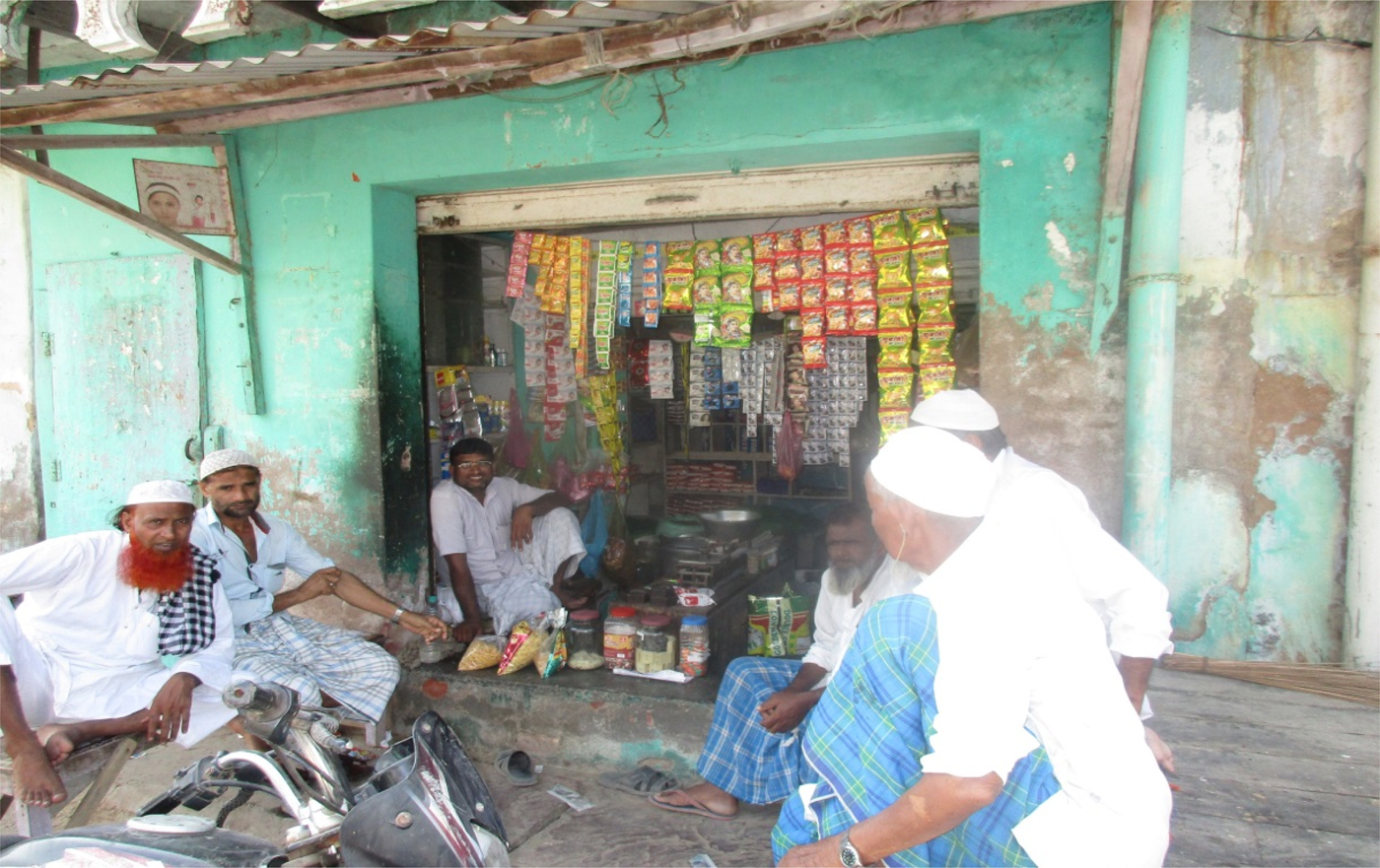
What is interesting here is the extent of obsession with religion and purist discourse in personal lives. Both Hinduism and modernity are regarded as threats to Islamic faith in this instance. Identity and faith-related threats seem to have intensified to a more significant extent. Often, situations like the above example expose the supposed dangers to Islam as present in the minds of TJ adherents. How one thinks could reflect what society feels on a broader level. To further illustrate this point, I will rely on another story, this time of a twenty-year-old drug addicted man, most of the time half-conscious, and an alleged thief. As a motherless child whose father married another woman, he was left alone to battle life's struggles. He used to visit the shop in front of my landlord's house frequently (Figure 4). Every evening the gathering in front of the shop was a lively one with people cracking jokes and laughing. His sudden appearance always added more pun to the gathering. A session of a series of silly questions and answers was directed against his replies. During these cheerful sessions, somebody would suddenly accuse him tauntingly of committing un-Islamic acts like stealing things. The sudden accusations caused him to break into tears. In his defence of the gathering's mocks, his replies were always from religious angles. As if, there is a set model of conduct for an ideal Muslim in Mewati society, he retorted, “I would become a better person, attend the TJ's CillaFootnote 65 (forty days retreat period), and eventually go on the Hajj if Allah wishes so”.Footnote 66 In his confessions, the TJ ordained messages were seen to be the only way to get rid from sins and it has become a new synonym to true Islam.
(Colour online) A gathering in front of my landlord's house. Photograph by the author.

In everyday life, people are aware of ulemās’ (theologians) views and most of the time they like to debate, discuss and repeat them. There is also a sphere of civil society where opinions are formed which function like salons and coffee houses in the day-to-day interaction at places of gossip, chai stalls, shops, mosques, and other domains of life. Although state authorities and government, usually lie outside the purview of the TJ theologians, who focus on religion. TJ volunteers remain on the constant move and invite Muslims for dāwā Footnote 67 work—wherever they go—to read nawāj with them. Munis, a poor scrap worker felt sorry about his inability to read nawāj regularly when he was approached by the TJ workers in his village. His work kept him busy, though, he wanted to pray regularly, he pleaded to the TJ's travellers. Despite not being a regular nawāji, his notions on anti-Islamic/un-Islamic acts (vidat) are in no doubt. His wife put an amulet and a thread in their child's hand and neck as emblems of barkat (a blessing) from a neighbouring Sufi saint. He was angry and warned her that the TJ activists would criticise it as an act worthy of unscrupulous and unauthorised charlatans. When his wife asked, “how do you know it does not work?” his simple response was to pledge his honour. “The power of the saint I do not contest”, he said, it is the reaction of other people in the village he was afraid of.Footnote 68 A range of issues seemed to impact a person's responses in my interactions with them in the field: social class, caste, religion, needs, desires, education, and modernity. But, the fundamental tenet remained, “how are we different from Hindus and what should we do to become ideal Muslims?” on one hand, while being aware of what pure Islam is and its use in daily life, on the other.
The Bardic Castes (Jogi and Mirasi) Experiences with Islamic Reformism
As it is shown previously in this article, the Jogis and Mirasis’ cultural resources for oral performance are drawn from ‘Indic’ historical traditions that emphasise universalism in their songs—an idea beyond the narrow confinement of religious categories. The previous statement suggests an Indic symbolism in the folk artists’ songs and life. What characteristics are ‘Indic’? And how do they help us navigate the pressure of reformism or the politics of Hindutva? The term ‘Indic’ in this context refers to the fluid orientation of religious communities in which religious identities were expressed, shared, omitted, and shaped as much by broad cultural patterns—such as diffusion of Islam and emergence of uniform Hinduism—as by local practices, norms, and social structures. For instance, how the historically hostile characters to Hinduism such as Gaziy Miyan—an eleventh century Muslim iconoclast—transformed into a figure of veneration among Hindus and Muslims is something which represents Indic. Gazi Miyan does not only befriend gwāls (shepherds) but he also bows to protect cows—a quintessentially Krishnaite theme—from Hindu perpetrators in Indo-Gangetic folklores.Footnote 69
Groups like the Jogis and Mirasis were both Hindu and Muslim at the same time while being closely interwoven into the power structure of the caste society. A type of religious universalism among such groups has a long and important history in the subcontinent. The BaulsFootnote 70 of Bengal, for instance, convey in their songs the idea of ultimate reality lying, not in dogmatic creed and doctrines, but within oneself. Central to the Bauls’ religious imagery is divine love common for both Hindus and Muslims.Footnote 71 Similarly, the theme of universalism and divine love finds its way into the Mewati bards’ performance. In one of their poetic songs, they sing a metaphoric Krishnaite song of divine love, human feelings, and universal values:
This song is sung at venues in urban places. It, like the Baul songs, chooses to impart universal messages and the essence of human life. Major changes in the bards’ life have taken place as a result of the changing values of patrons Meos. As the Meos sided with puritanical Islam, the patronage shrunk. However, the reasons behind this, are rooted both in the change of regional political economy as well as in the dynamics of religion, and politics. As Meo patrons no longer entertain or take pride in their syncretic past, it is challenging for these bards to survive with dual religious connections.
In the case of the Bauls, there was a negative construction of the image in the orthodox Muslim and Hindu imaginations, especially among the Muslim reformist group fatwas (legal decisions) were issued against them. Urban writes, “the Bauls were among the most immediate object of this reformist attack. The apparent licentiousness, immorality and religious syncretism, not to mention the unorthodox, seemingly antisocial and antinomian lifestyle of the Bauls represented, for the reformers, the worst corruption of Islamic culture by Hindu polytheism and idolatry”.Footnote 73
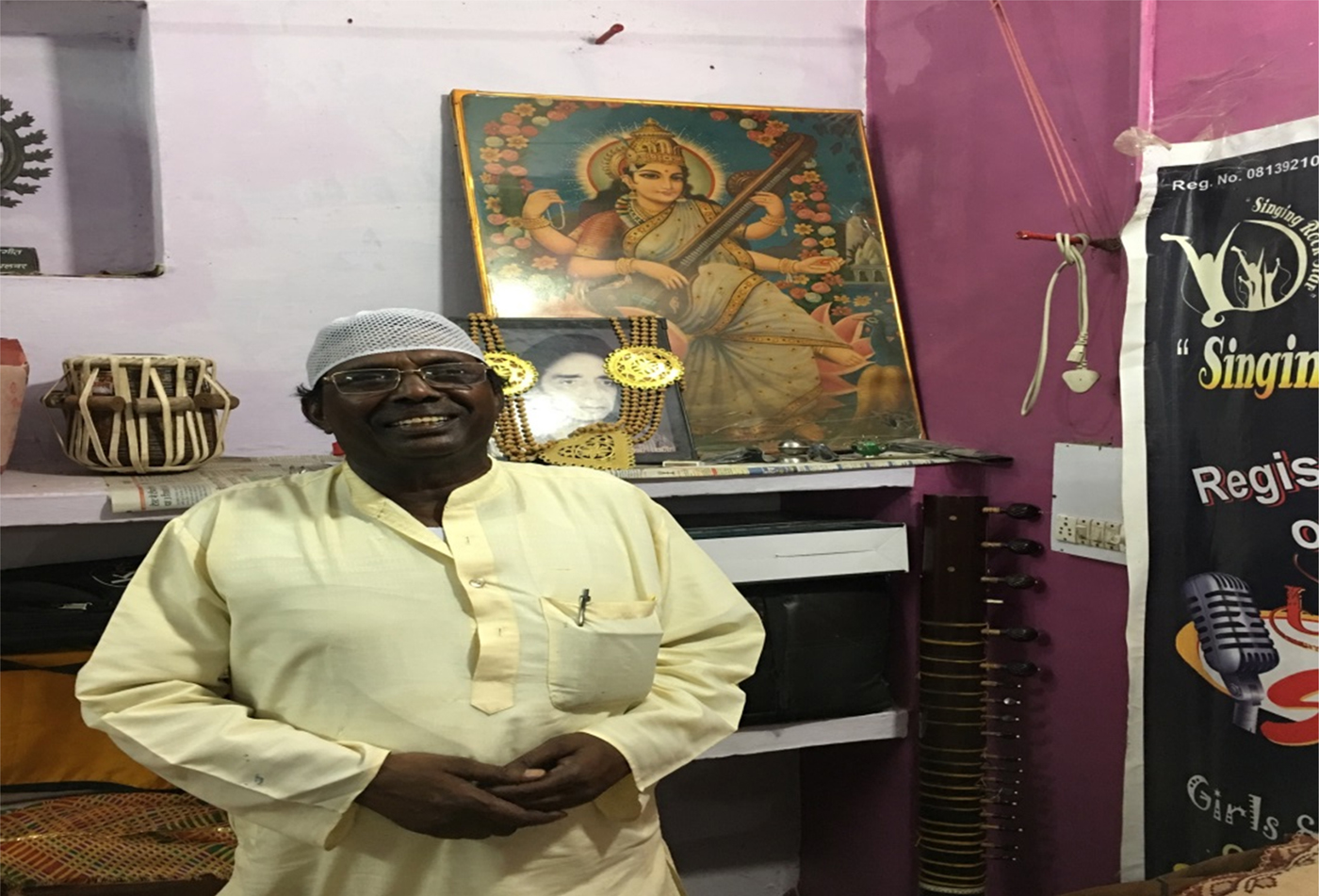
My interviews conducted with numerous bards of Jogi and Mirasi origins open up a window of personal experiences of the Muslims bards vis-à-vis pressure from the reform organisation and the larger fear of Hindutva politics at the moment of renewed Hindu-Muslim political interest. It is significant, one of the stories of a 55-year-old Mirasi musician-Ustād Rammal Khan, from Alwar district of Mewat, who has turned his house into a Sangeet Kendra (music centre) as it reveals various processes.Footnote 74 He teaches harmonium, Veena (an India chordophone), and other instruments, to both Hindu and Muslim children. Hindu musical learners who come to his training centre like to relish his name as Guruji while Muslim children call him Ustād.Footnote 75 However, Hindus especially girls outnumber Muslim learners at his centre. His well-organised and very clean house is located in an urban basti (slum) in Alwar city. As soon as one enters the house, is welcomed by images of musical instrument on the walls. On the day of my meeting with him, his complete Muslim appearance was signified by a skullcap which gave me a sense of his religious beliefs. After offering refreshments, a cup of syrupy tea and snacks, he took me directly to a room filled with various musical instruments. On one wall, a portrait of a collective nawāj offering at a mosque in Mecca was hanging. To my surprise, on the other side of the room, there was a large portrait of the Hindu goddess Saraswati (goddess of knowledge), and below the portrait, incense burnt spreading a pleasant odour. Ustād Rammal Khan believed in both religions as had his Mirasi ancestors. He said to me during an informal discussion that, “this is our heritage and livelihood”.Footnote 76 Every morning, either he or one of his daughters cleaned the room and prayed in front of the goddess image (Figure 5). At the same time, his family offered Islamic prayers too. It is therefore likely that such connections historically exist between faiths and religions across religious divides. An implication of this is the possibility that groups, and castes were traditionally only minimally concerned with Hindu-Muslim identities, unlike the present identification.
(Colour online) Rammal Khan standing in front of the goddess Saraswati's portrait. Photograph by the author.

Enquiring about theologians and Mullahs’ reactions to Rammal's profession revealed that his art is questioned by the Islamic community but more particularly by the TJ workers who try to persuade him from time to time to leave the work in favour of Islam. “This was not the case at least in Mewat. The religious disciplining was a remote concern for the Muslims and the Meos in particular”, he said. The teachings of the TJ, which is good in making one aware of Islamic religious values, in his opinion, have led to the creation of rifts not only between Muslims on Sufi ideology but also have distanced Muslims from Hindus. On this particular note, Rammal Khan recites a couplet of an Urdu shāyar (poet), Shafiq Jaunpuri (1903–63) regarding the implications of the TJ's work:
The couplet quoted above encapsulates Rammal's views on reformist teachings, the knowledge that generates no love in the heart is no knowledge. His anxieties were directed against the unwanted disciplining by the reform organisation. He cannot openly express his views against many Meo Mullahs and members of ummāh (the notion of a community based on the idea of brotherhood in Islam). Whenever a group of the TJ workers approach him, Rammal Khan at some point takes them into the room filled with musical instruments. That is the moment when his disapproval of reformist thinking found expression by immediately designating the room “a place of harām Footnote 78 (prohibited practices in Islam)”. Nonetheless, the discussion at that moment between him and the TJ workers, as I understood from his interpretations of it, revealed a starting point for dialogue. He always positioned a question of livelihood against the reformist ideologies. Rammal Khan used to make the statement that, “this is my work if I leave it, my family and I would die”. Often, as he explained it to me, he said to the group, “supply me with a regular income, and I will leave the work, and join you”.Footnote 79 The rationale behind the arguments was not a theological one but was entangled with everyday life to which the TJ workers could not respond.
Lost and Found: New Patronage Arrangements
To fill the void of patrons when the patronage stopped, the bards looked to other avenues for employment. For instance, in western Rajasthan when the community of Manganiyars lost Rajput patronage, their interaction with NGOs and their introduction to the global music industry helped to maintain the culture.Footnote 80 While other Mewati bards survived by performing at local Hindu cultural-religious events. The jāgrans (all night-awake) programmes, Hindu marriages, and birth of a child like ceremonies provided new performance venues. More renowned artists, though few in numbers, had opportunities to perform on local, national and international platforms. The second-grade artists formed music bands to perform when opportunities came. Unlike the traditional patronage arrangement in which the bards were tied to the Meo families regardless of one's talent, it gained a new pattern. They were hired for social-religious and political events. The performances include singing bhajans (prayer songs) at temples, performing in a palace for foreign tourists and dignitaries, and singing cassette songs for thriving local music industries. It helped sustain the culture and the artists to an extent. These new arenas, however, could only support a tiny number of the bardic castes. They had limited opportunities available to perform, and it also demanded new technical skills.
The songs for local consumption were circulated in audio-visual forms through recordings in mobile chips, pen drives, and CDs. It did not include the resistance theme. The more overt and widely circulated forms of resistance could attract the wrath of the Meo patrons. Therefore, the local music industry also does not record such songs which contain messages of religious unity and passive resistance. And possibly, they may not find consumers for such songs.
For bards, remaining in the Meos’ favour is necessary due to political and social compulsions.Footnote 81 Only the more famous bards could afford to voice passive resistance in the songs. They mostly perform in front of non-Meo gatherings in big cities and urban areas. They begin by displaying the distinctiveness of their culture probably to gain the audience's attention—with a poetic couplet to mark universal righteousness. On such occasions, the singers start by emphasising the unique religious blend. For example, they, often, say, “we are Muslims but also followers of the Hindu god Shiva”. There is no doubt, it may be a well thought out strategy to please a Hindu audience. But it, indeed, also serves as a stage to voice contrary opinions to power.
The former patrons, the Meos, and the TJ are not confronted directly. Moreover, Hindu gatherings cheer as they hear Muslims invoking the name of Shivaji. As far as the critique of the Meo patrons’ version of religious purity is concerned, it is done behind the backs of power. It is performed to a different audience. In practice, the critique does not reach the ears of former patrons. To the Meos, they are still socially, politically, and religiously connected. Irrespective of the change in patrons’ behaviour, the bards respect social-religious relationships. However, contrary to the Meos’ stand, they emphasise religious righteousness that is universal and thus needs no organised religion.
Unless otherwise shared by a documentary film-maker or, given to a researcher like myself, the lyrics of the songs are restricted for personal use only. It is, therefore, used on specific occasions in expressing a special feeling vital for the art, livelihood, religious unity, and above all culture. Feeling pressured at the hands of uniformitarian beliefs, the critique refers to the power under the mask of a poetic language. Anonymous and obscure references made in the couplets are open to multiple interpretations when heard. For gatherings in cities, it could refer to the Hindu-Muslim politics at the national level. To someone familiar with the locality the lyrics could express uneasiness to Tablighi Islamic theology. For bards, as many of them recall in their interviews, it is both a reference to their own plight and a message for both Hindus and Muslims.Footnote 82 Although what is obvious to the common understanding, is the uneasiness reflected in the ideologies of religious extremism, puritanism, and divisive politics.
On one hand, Meo puritanical patrons are dominant, and on the other, unorganised new urban Hindu patrons, so the bards have had to transform their messages to keep them happy. Formerly these dangers of making patrons unhappy did not exist in this present form. Therefore, the messages of transcending religious boundaries drawn from Nath teachings had found an easy expression in highly personalised and self-centric couplets.Footnote 83 This idea of religious transcendence is now replaced by those of religious unity and synthesis in the wake of religious separatism.
New Songs of Hindu-Muslim Composite Heritage
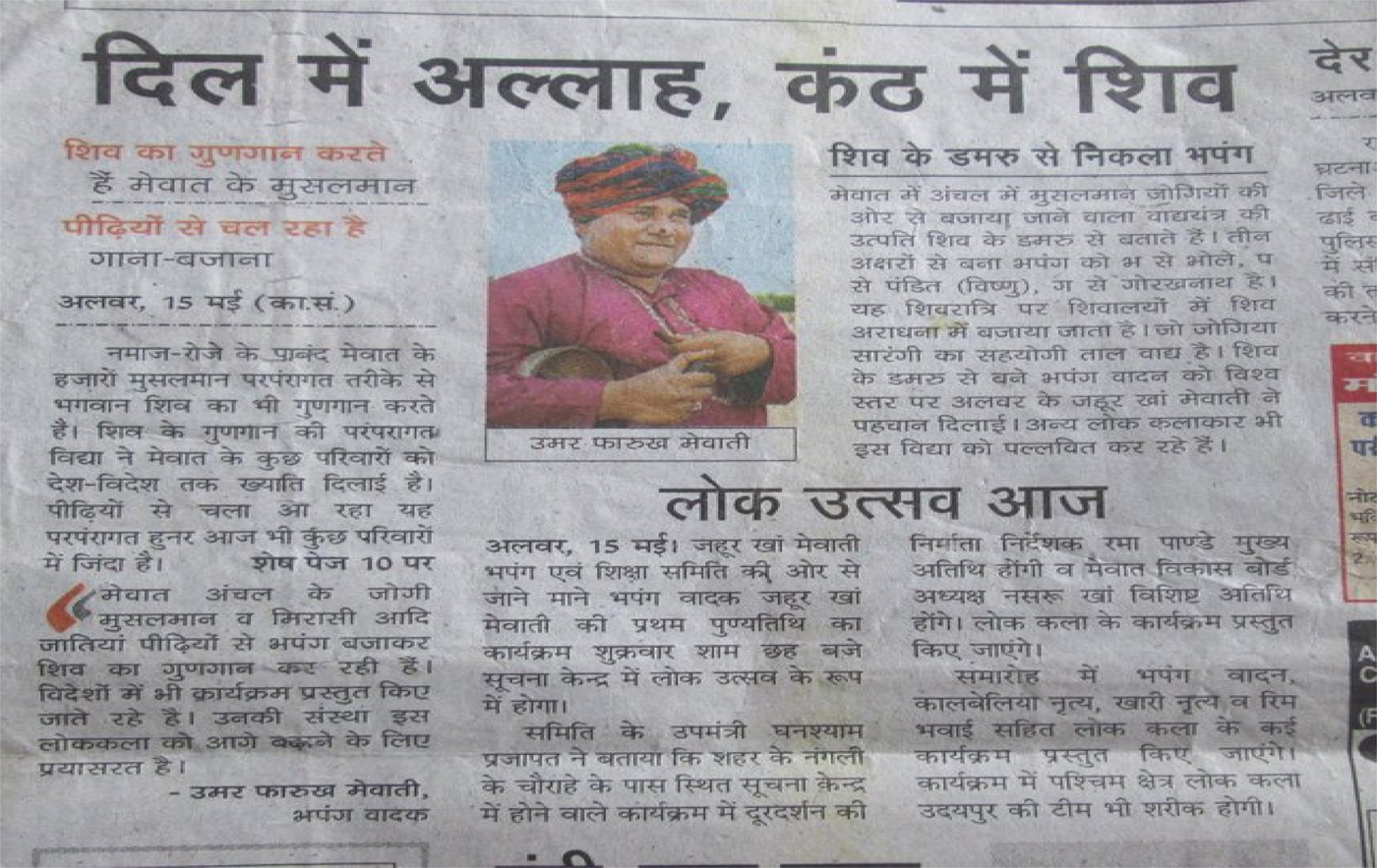
It is shown here, how the songs of the bards have evoked the notion of religious synthesis against a background of Hindu-Muslim antagonism. A very renowned Bhapang artist, Umar Farookh Mewati's interviewFootnote 84 was published in a local edition of a newspaper. The headline reads, “dil me Allah, Kanth me Shiva (Allah in heart, Shiva in voice)” (Figure 6).Footnote 85 Umar belongs to the Muslim Jogi caste. He and his many associates of both Hindu and Muslim Jogi caste backgrounds voice the idea of religious indifference. They advocate a stand of Hindu-Muslim unity through lyrical artistic expression.
(Colour online) Umar Farookh's interview published in a local newspaper.

The lyrics of poetic songs of these bards could be seen as positive resistance and a desire to be attached to a culturally imparted Hindu-Muslim dual heritage. Power does not always culminate in a negative process of generating mere physical resistance. On the other side, it works positively, “by producing forms of pleasure, systems of knowledge, goods, and discourse”.Footnote 86 In the same manner, as discussed by Abu Lila Lughod, the new artworks of the bardic castes produce songs in order to create a discourse based on positive messages. The new songs concern themselves with the question of power. But they also take a high moral position by creating a tone and language that contain harmonious messages in a manner that still represent resistance. They do not openly criticise Muslim reformism or Hindu extremism or opine political behaviour. Their primary attention is concerned with an anti-hegemonic stand and a firm belief in a shared religious culture. For instance, the song cited below puts the issue of artistic resistance eloquently. It respectfully adds a different perspective to the divisive nature of current socio-political processes:
This song is an example of a different world-view not of resistance. But, it refers to a different stance adopted by the bards regarding religion and politics. Having such poetic lines written is also a reflection of didactic response—a kind of first step towards passive disagreement. The objective of the lines suggests a spiritual-philosophical meaning of the oneness of God. Despite symbols of differences, the couplet assumes, there is a fundamental commonness across religious divides. In its articulation, the lines of the couplet have themes similar to mediaeval Bhakti and Sufi traditions which directed attention towards targeting institutionalised religions in favour of presenting a true human essence beyond narrow religious classification.
Sometimes, the tone of a language in an artistic work shows the intensity of the resistance. It may contain higher possibilities of violent verbal demonstration of anger. In the above case, however, the philosophical orientation of the lines does not compromise the civility of the art. Despite an existential danger to the folk art, they maintain a civil discourse. In response to the ideologies of the religious separatists, the Jogis and Mirasis, show passive resistance and acts of dissent through a positive articulation of their worldviews. The religious-politico uniformitarian perspectives represent a perspective of the higher social class in terms of caste, class, and religion contrary to the bards’ world view. The desire to regain a lost audience is not as much present in the songs as the question of shared culture and identity is. The loss of the Meo audience has negatively impacted the bards’ lives. Nonetheless, their main concern within the subsistence economy remains to articulate positive messages of Indic historical tradition.
Surprisingly, bardic singers still uphold the messages of the Indic culture in their songs, writings, and performances. One of the songs written by Umar Farookh, but also widely performed by other minstrels, is helpful in unpacking it. Before reciting a few lines on the tune of Bhapang, he always made a disclaimer “I am from a Muslim Jogi family but a follower of Shiva too. I keep a special feeling in my heart”. Somebody from the group will ask, “what is that special feeling?” and the song in couplet form starts thus:
Among the possible explanations for these lyrics is the contemporary concern of religious unity and brotherhood for the Muslim bards. It is entirely ahistorical to assume a historical past without violence or skirmishes happening. The issue of violence, feuds, and struggles had always been present in all historical epochs, then that is what this promotion of harmony and tolerance through writing new songs is all about. At a very fundamental level, the bards of Mewat reflect a reality of ‘new age religious intolerance’.Footnote 89
This new age of religious intolerance is more exposed in the wake of rising conceptions and consciousness around two fundamental cognate categories of ‘Hindus and Muslims’. Interest in this was renewed after the demolition of the Babri mosque in 1992.Footnote 90 Like all other social identification, religious identification seeks solidarity in what could be called the burden of fundamental commitment created under the impression of false consciousness. I associate ‘false consciousness’ with the broader processes of Hindu-Muslim politics now. Fear for example is predicated on the part of actual violence such as the Partition violence of 1947. And, its supposed implications for social-religious and political groups like the TJ, the Arya Samaj, the Congress, and the Bhartiya Janta Party (BJP) or any other organisation for that matter is that they reap benefits. However, in such situations, false consciousness (created by political and religious elites) makes danger and fear appear all the time in lives of people. The Mewati bards deal with a response to the fear made by political-religious elites. The bards refer to mixed origin of cultures to present a rich complex heritage. Their cultural references show a long tradition of resisting institution and institutional ideas. The couplet mentioned above is not merely a reflection on the past, but also it draws material from the cultural context of mediaeval Indian Bhakti and Sufi themes to resist the ideological and political power domination. It is imperative to cite another full song here written and compiled by the Jogi bards, (recited and made it available to me by Yusuf, the son of Umar Farookh). It evokes a sense of an ideal human (insān). As many mediaeval saints, Kabir, Nanak, Gorakh, Raidas, Tukaram, evoked in their teachings the notion of a ‘human’ neither representing a Hindu nor a Muslim. Similarly, in the bards’ lyrics, the idea of a true human being, who could be anyone, based on good actions is invoked. The lines of the song apparently have a lesson for Hindu-Muslim unity given the current circumstances, as Yusuf revealed to me the song lyrics are thus:
What is more significant in the song is the distinction between ‘we’ and ‘they’ in the form of ‘this side and that side’. It is not articulated along the lines of religious self-identification of the bards with Islam. Despite being Muslims themselves, the Muslim Jogi/Mirasi bards and writers, position themselves as representing Hindu (Indic) religious symbols and culture in comparison to the Islamic self. The symbols of the Arab or Islamic world in the song— ‘Abe-Zamzam, Maryam, Abu Zayd, Khuda, mosques, the Quran’, are put in the category of ‘that side’. The parallel is the symbols of religion and culture of ‘this side’: Ganga's water, Sita, Kans and Ravana, temples, the Gita and so on. The two categories of ‘this side, and that side’ were not being simply made from geographical differences between the Indian and the Arab world. However, it is the result of the Muslim bards’ embeddedness in local religious symbols. It is a culturally deep-rooted Hindu derivative, or more particularly Indic derived phenomenon about notions of “good and bad, sacred-defile, justice-injustice, and honesty”. The bards’ self-identification with ‘this side’ are represented through familiar mythic-historical characters like Kans, Ravana, and Sita. They traditionally used to sing or narrate stories of the virtues of these figures in the cultural performances of Mewati folk tales and folk songs. There is no doubt the bards are proud of their Muslim identity too, but more meaningful action for them is to keep a tradition of Hindu-Muslim synthesis alive for various reasons.
Another noticeable point is the issue of female sexuality in the song. Maryam and Sita were paralleled to each other to compare shameful instances of questioning women's chastity in both religions. ‘Maryam’ is the name Muslims use for the woman Christians call ‘Mary’. She has acquired a meaningful image in representing Islam in this case. The tradition of associating Christian figures with Islam is an old one. But the reform organisation used this plot to associate prophet Mohammed era's (570–632 ce) preceding figures for incorporating claims of other religions under Islam. According to the logic, many gods, pious beings, messengers, and charismatic authorities of any religion are among thousands of prophets sent by Allah before the final one who brought Islam. Therefore, in the Islamic belief, Maryam (Mary) is not a Christian figure but a mother of one of their prophets. The Muslim bards’ conscious choice of Maryam to represent an instance of questioning a woman's chastity in Islam as was the case with Sita in the Ramayana is also rooted in the discursive rationale of Islamic theology. The TJ in Mewat tries to disassociate the claims of the Meos and Jogis as descendants of Hindu gods, Ram, Krishna, and Shiva, by placing these gods in the long list of prophets. Following the same logic, it is made clear that all gods necessarily belong to millions of prophets who were sent before the final messenger of Allah, Mohammed, on the earth. Thus, they are worthy of respect but do not represent the true messages of almighty. For example, the Hindu god Shiva is remembered as bābā Ādam (literally, ‘the grandfather Ādam’ like Christians’ Adam) among the Mewati Muslims. It is believed that Shiva was the first creation to be sent to the earth in Hindu as well as Mewati Muslim creation mythology. Even the TJ theologians suggest avoiding using any remarks of disrespect for Hindu gods as they too are prophets.
The pertinent issue here remains the messages the bards are trying to convey through their songs. Clearly, it is their assumption, that religions are a human construct; therefore, the ultimate truth does not lie in our religious identities but in our actions. In the response of reformists and other seen and unseen pressures at social-political levels, the bards invoke the idea of being a good human first. Hindu and Muslim identities for them are like water from two different sources. As soon as the waters are mixed nobody can tell where its true origins were from. Similarly, the lyrics conclude—Hindus and Muslims are like the waters from the different source of origins but are same in substance. As long as they are separated in bottles, (as society categorises humans) the waters can be identified with the stream of Ganga, or the water from the well of Zamzam. The moment they are mixed nobody can identify the two different sources.
Conclusions
A folk-art such as singing could be an instrument of multiple objectives, not just entertainment. Songs express human emotions and, sometimes may disseminate messages of social and political importance. As suggested in this article, traditional folk singers used their artistry to reflect a past to deal with present circumstances through passive means of disagreement. This article has relied on a passive resistance studies scholar, James Scott, to understand the dynamics of power, and resistance to the power through covert means. Though songs do not always work through hidden mediums in passive resistance, they often might circulate widely. But, the act of thinking, compiling, and performing such songs in artistic minds reflects a concern for a future in the domain of art.
The emergence of a new religious consciousness among Indic groups formerly organised around caste across religions has undergone the experience of hardening religious boundaries. Though caste and religion are inseparable, and caste exists across religions, the concept of monolithic and two separate blocks of Hindu-Muslim religion and religious identity in India has been successful in making its presence felt in the public sphere. Not only the instances of political violence but the discourse around the purity of religion contributed to shaping notions of a distinct religiosity. In such circumstances, many Muslim castes are put in a religious dilemma of longing and belonging as they had many elements in their cultural practices which are beyond religious classification.
The question of daily livelihood further complicated the issue of traditional patronage of the landless cultural castes’ case. When the Meo patrons of bardic castes cherished puritanical Islam, it became an everyday survival issue for these groups. Despite a significant change in the numbers of the folk artist, the artists surviving in the profession uphold the values of Hindu-Muslim cultural interactions as supreme in their artistry. A majority of Meo Muslims believe in the teachings of the reform organisation, Tablighi Jamaat, which discourages folk cultural practices of the Jogis and Mirasis. Thus, an ideological power has made inroads into Mewati Muslim society with the consent of powerful Meo Muslims. Subordinate groups, therefore, are supposed to follow patrons for reasons such as showing Muslim solidarity on one hand and desiring to become an ideal Muslim on the other. This article, thus, makes the point that against unwanted ideological disciplining, the bardic castes express anxieties through the medium of traditional art which is an instance of the passive form of resistance. It, therefore, remains an important point to consider that under pressure, cases of religious synthesis do not succumb to power but find means and ways to negotiate and resist it. The musician castes and cultural groups, Jogi and Mirasi, use their songs to display characteristics of being a good human beyond a narrow Hindu-Muslim religious divide. This idea of transcending religious divides has been a common theme in the Sufi, Bhakti, and Nath cults in Indian mediaeval life upon which the folk artists draw for inspiration. In their resistance to Islamic ideological power, the Muslim bards use an Indic plot and identify themselves more with local Hindu symbolism than a version of reformist Islam.Footnote 92