


I. INTRODUCTION
The 5d transition metal oxides have drawn much interest for their exotic phases arising from the interplay between strong spin–orbit interaction and electronic correlation.Reference Moon, Jin, Kim, Choi, Lee, Yu, Cao, Sumi, Funakubo, Bernhard and Noh1–Reference Erickson, Misra, Miller, Gupta, Schlesinger, Harrison, Kim and Fisher3 These materials, which include the iridates, were originally predicted to be weakly correlated, paramagnetic metals due to the extended nature of the 5d orbitals and a partially filled valence band. However, a few interesting phases have been theoretically proposed for systems exhibiting both strong spin–orbit coupling and strong electron correlation. The iridates are prime candidates for realizing these unusual states, such as topological insulators, unconventional superconductivity, quantum spin-Hall effect, and Weyl semimetals to name a few.Reference Carter, Shankar, Zeb and Kee4–Reference Wan, Turner, Vishwanath and Savrasov7 One system of recent interest is the Ruddlesden–Popper (R–P) series iridates, Srn+1IrnO3n+1, whose electronic structure is tunable from a three-dimensional correlated metal, SrIrO3 (n = ∞), to a two-dimensional J eff = 1/2 Mott insulator, Sr2IrO4 (n = 1).Reference Moon, Jin, Kim, Choi, Lee, Yu, Cao, Sumi, Funakubo, Bernhard and Noh1 The insulating state emerges when an octahedral crystal field splits the degenerate 5d levels into e g and t 2g bands; the partially filled t 2g bands (L eff = 1) are further split into the J eff = 3/2 and J eff = 1/2 bands by the strong spin–orbit coupling inherent in iridium ions. The Mott gap opens in the J eff = 1/2 band if the on-site Coulomb interaction becomes energetically comparable to or larger than the bandwidth. In SrIrO3, there are six nearest neighbor Ir atoms, while in Sr2IrO4 there are only four. This reduction of coordination number of Ir 5d orbitals reduces the bandwidth and opens a gap in the partially filled J eff = 1/2 band in Sr2IrO4. Hence, the metal–insulator transition in the R–P series iridates is driven by a dimensionally controlled decrease in bandwidth.
In this paper, we have investigated whether a metal–insulator transition can also occur in epitaxial SrIrO3 thin films via a strain-induced reduction in bandwidth. While the Ir–O bond length is rigid and difficult to change, the Ir–O–Ir bond angle can be readily affected by lattice strain.Reference Rayan Serrao, Liu, Heron, Singh-Bhalla, Yadav, Suresha, Paull, Yi, Chu, Trassin, Vishwanath, Arenholz, Frontera, Železný, Jungwirth, Marti and Ramesh8,Reference Nichols, Terzic, Bittle, Korneta, De Long, Brill, Cao and Seo9 As schematically illustrated in Fig. 1, when the Ir–O–Ir bond angle is decreased by compressive strain, the electronic hopping integral between Ir 5d orbitals is reduced, and hence the bandwidth decreases. This reduction in bandwidth can induce a metal–insulator transition either by opening a Mott gap, similar to Sr2IrO4,Reference Moon, Jin, Kim, Choi, Lee, Yu, Cao, Sumi, Funakubo, Bernhard and Noh1 or by creating a localized band below the mobility edge due to disorder.Reference Mott, Joannopoulos and Lucovsky10 We have grown epitaxial SrIrO3 (SIO) thin films on various substrates with close lattice mismatch. We find that as in-plane compression increases, the metallic SIO thin films become insulating. Optical absorption spectroscopy indicates that all SIO thin films have a metallic Drude-like response and lack the presence of an optical gap, despite the insulating transport behavior. Transport measurements under magnetic field display a negative magnetoresistance (MR) behavior in the insulating SIO thin films. Hence, the strain-induced metal–insulator transition is due to weak localization. Our results demonstrate that the electronic properties of perovskite SIO thin films can be manipulated by compressive lattice strain.
Schematic diagrams showing the relationship between compressive strain and bandwidth reduction. (Top panel) In-plane compressive strain will cause the Ir–O–Ir bond angle θ to decrease. (Bottom panel) By reducing the bandwidth, the correlated metallic band structure of SrIrO3 (left) can turn insulating either by (upper) a Mott gap opening or (lower) localized states (emphasized in dark gray) forming below the mobility edge.

II. SAMPLE SYNTHESIS
We have grown orthorhombic SIO epitaxial thin films on several substrates with various compressive strains using pulsed laser deposition. The thermodynamically stable phase of bulk SIO crystals is the hexagonal 6H-BaTiO3 structure at ambient conditions, and the orthorhombic phase can be stabilized using a high-pressure synthesis.Reference Longo, Kafalas and Arnott11,Reference Zhao, Yang, Yu, Li, Yu, Fang, Chen and Jin12 However, orthorhombic SIO phases can be stabilized as epitaxial thin films on pseudocubic perovskite substrates.Reference Yong Kwan, Akihiro, Kenji, Shintaro, Shinichi, Takayuki, Kensuke, Satoru, Keisuke and Hiroshi13,Reference Jang, Moon, Jeon and Chung14 Four single-crystal substrates are used: MgO (001), GdScO3 (110) (GSO), SrTiO3 (001) (STO), and (LaAlO3)0.3(Sr2AlTaO6)0.7 (001) (LSAT) with in-plane pseudocubic lattice constants of 4.21, 3.96, 3.90, and 3.87 Å, respectively. During the deposition, the substrate temperature is 700 °C in an oxygen partial pressure of 100 mTorr. The samples are post-annealed and cooled in a 1 Torr oxygen atmosphere.
Figure 2(a) shows θ–2θ x-ray diffraction data for all the SIO thin films used in this study, and all thin films have the correct 00l orientation with respect to the substrate normal. As the in-plane lattice parameters are decreased from MgO to LSAT, the 00l thin film peaks are shifted to lower angles, indicating an out-of-plane (c-axis) expansion of the SIO unit cell. This is consistent with an in-plane compressive strain causing an elongation along the c-axis. The SIO thin film thicknesses are found to be around 20 nm using x-ray reflection fringes. The rocking curves in Fig. 2(b) are taken of the 002 film reflection. The thin films grown on GSO, STO, and LSAT have full widths at half maximum less than 0.08°, indicating high crystallinity. X-ray reciprocal space maps of the (pseudocubic) 103-reflection in Fig. 2(c) show that the SIO thin films on GSO, STO, and LSAT are coherently strained. As the compressive strain increases from GSO to LSAT, the 103 film reflection shifts downward, which is consistent with the θ–2θ scans in Fig. 2(a). The SIO thin film on MgO is relaxed due to the large lattice mismatch (∼5%), and this sample is expected to emulate properties of unstrained (“bulk”) SIO. The lattice parameters are found using the reciprocal space reflection peaks (Q i = 2π/d hkl, where i ≡  $\bot$ or // and d hkl is the spacing between appropriate reflection planes (hkl)). Figure 2(d) shows the change of in-plane (a) and out-of-plane (c) lattice parameters as a function of the substrate in-plane lattice constant. The ratio c/a quantifies the tetragonal distortion due to strain present in the SIO thin films, with c/a > 100% corresponding to compressive strain. Figure 2(e) shows that the thin films grown on LSAT, STO, and GSO are compressively strained with a tetragonal distortion, and the SIO thin film on MgO is relaxed with a cubic structure.
X-ray diffraction scans confirming the epitaxial growth of perovskite SIO thin films on MgO (black), GSO (blue), STO (green), and LSAT (red): (a) θ–2θ diffraction scans show correct 00l oriented film peaks, (b) rocking curve Δω scans about the film's 002-reflection, and (c) reciprocal space maps around the 103-reflection (pseudocubic notation) of the substrates. (d) The out-of-plane c and in-plane a lattice constants of the strained SIO thin films and (e) the ratio c/a as a function of substrate in-plane lattice parameters.
III. TRANSPORT PROPERTIES
Figure 3 shows temperature-dependent resistivity curves ρ(T), which indicate a large dependence on compressive lattice strain. The resistivity of each strained SIO thin film systematically increases with in-plane compression. The resistivity of the SIO films are of the same order of magnitude as the resistivity measured in a polycrystalline, high pressure synthesis study of SIO (∼2 mΩ cm at room temperature) and other SIO thin film studies.Reference Zhao, Yang, Yu, Li, Yu, Fang, Chen and Jin12,Reference Biswas, Kim and Jeong15–Reference Liu, Chu, Rayan Serrao, Yi, Koralek, Nelson, Frontera, Kriegner, Horak, Arenholz, Orenstein, Vishwanath, Marti and Ramesh17 In addition to an increase in resistivity, the SIO films synthesized on STO and LSAT have an upturn in their resistivity curves at 175 and 225 K, respectively. The room temperature-normalized resistivity curves are shown in the bottom panel of Fig. 3. The resistivity of the relaxed SIO on MgO has a positive slope (dρ/dT) for all temperatures from 4 to 300 K, which is expected for metallic behavior. The positive slope is reduced for the thin film grown on GSO and becomes increasingly negative for the thin films grown on STO and LSAT. To gain a phenomenological understanding of the insulating regions, resistivity data (<225 K) of SIO grown on STO and LSAT are fit with
 $$\rho = \rho _0 - \alpha T^{3/4} + \beta T^{3/2} \quad {\rm{,}}$$
where ρ0, α, and β are the fit parameters for remnant resistance, three-dimensional weak localization, and inelastic scattering due to electron–boson interactions, respectively.Reference Gayathri, Raychaudhuri, Xu, Peng and Greene18,Reference Wu, Zhou, Zhang, Chen, Zhang, Gu, Yao and Chen19 Weak localization is a disorder driven effect due to quantum interference of the conducting charge carriers at defect sites.Reference Bergmann20 The weak localization coefficient α for the SIO thin film on LSAT is twice as large as the fit coefficient for the thin film grown on STO, as shown in Table I. Based on the lattice parameters obtained from the x-ray diffraction data, the compressively strained SIO thin films are not oxygen deficient, eliminating a potential source of defect scattering. Although further experimental characterizations are needed to fully understand the defects, one possible mechanism is misfit dislocations caused by compressively straining the SIO films, which would lead to weak localization. The exact physical origin should be explored in future studies. This weak-localization model fit is similar to a previous study of compressively strained SIO perovskite films of similar thickness grown on LaAlO3 substrates.Reference Wu, Zhou, Zhang, Chen, Zhang, Gu, Yao and Chen19
Resistivity versus temperature (upper panel) of SIO films grown on MgO, GSO, STO, and LSAT substrates. The resistivity increases with in-plane compression. The room-temperature normalized resistivity (bottom panel) clearly shows the strain-dependence of the transport, and the insulating regions of SIO on STO and LSAT are fit (dashed lines) with a weak localization model.
SIO thin film summary: tetragonal distortion (c/a) from reciprocal space maps; weak localization α/ρ0 and electron–boson scattering β/ρ0 fit parameters from transport; and plasma frequency ωp, interband absorption ω0,β, and carrier density n from Drude–Lorentz fit of absorption spectra.
IV. OPTICAL PROPERTIES
Optical absorption spectroscopy provides insight into understanding the electronic band structure and free carrier dynamics of thin films. It also offers a method of determining the insulating gap energy by measuring the photon energy of zero absorption coefficient. Optical transmission spectra T(ω) of our samples are taken at room temperature using a Fourier-transform infrared spectrometer (for spectra regions between 50 meV and 0.6 eV) and a grating-type spectrophotometer (for spectra regions between 0.5 and 6 eV). This spectral range is sufficient for measuring transmittance spectra down to the Reststrahlen band of each respective substrate, which is the lowest energy limit for transmission spectra. The optical absorption spectra α(ω) of SIO thin films are obtained using  $\alpha \left( \omega \right) = - {1 \over t}\ln \left[ {{{T\left( \omega \right)_{{\rm{film}} + {\rm{substrate}}} } \mathord{\left/ {\vphantom {{T\left( \omega \right)_{{\rm{film}} + {\rm{substrate}}} } {T\left( \omega \right)_{{\rm{substrate}}} }}} \right. \kern-\nulldelimiterspace} {T\left( \omega \right)_{{\rm{substrate}}} }}} \right]$, where t is the thin film thickness. According to Fermi's golden rule, α(ω) is proportional to the product of the transition probability amplitude and joint density of states. Therefore, the ith interband-transition peak position ω0,i in α(ω) corresponds to the energy difference between bands, and the corresponding peak width γi is proportional to the bandwidth. SIO thin films grown on MgO and GSO substrates are known to show a Drude-like response at energies in the infrared, an interband optical transition ω0,β ∼ 0.8 eV from the J eff = 3/2 band to the J eff = 1/2 band, and a higher energy charge transfer from O 2p bands to Ir 5d bands.Reference Moon, Jin, Kim, Choi, Lee, Yu, Cao, Sumi, Funakubo, Bernhard and Noh1,Reference Jang, Kim, Moon, Choi, Jeon, Yu and Noh16
Despite the compressively strained thin films having a negative dρ/dT behavior, the absorption spectra in Fig. 4 show that all the SIO films have a Drude-like response at low energies, which suggest a metallic behavior. The absorption coefficient α(ω) is proportional to the extinction coefficient k by  $\alpha \left( \omega \right) = {{2k\omega } \mathord{\left/ {\vphantom {{2k\omega } c}} \right. \kern-\nulldelimiterspace} c}$, which is nonlinearly related to the dielectric function by
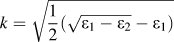 $k = \sqrt {{1 \over 2}\left( {\sqrt {\varepsilon _1 - \varepsilon _2 } - \varepsilon _1 } \right)}$, where c is the speed of light and ε1 and ε2 are the real and imaginary parts of the complex dielectric function, respectively. The absorption spectra for all samples are fit to the Drude model for the low energy metallic response, a Lorentz oscillator for the interband β transition, and a second Lorentz oscillator for the higher energy charge transfer transition. In the Drude model, the complex dielectric function is given by
 $\tilde \varepsilon _{{\rm{Drude}}} \left( \omega \right) = \varepsilon _1 + i\varepsilon _2 = 1 - {{\omega _{\rm{p}} } \over {\omega ^2 + i\omega \gamma }}$, where the two fit parameters are the plasma frequency ωp and the scattering rate γ. As summarized in Table I, the free charge carrier density n for each SIO film is found using
 $\omega _{\rm{p}} = \left( {{{ne^2 } \mathord{\left/ {\vphantom {{ne^2 } {\left( {m^* \varepsilon _0 } \right)}}} \right. \kern-\nulldelimiterspace} {\left( {m^* \varepsilon _0 } \right)}}} \right)^{1/2}$, where e is the elementary charge,
 $m^*$ is the effective mass of an electron, and ε0 is the permittivity of free space. Moon et al. reported a frequency-dependent mass enhancement of SIO's conducting carriers only at low energies, and the effective mass approaches the free electron mass m e around 0.08 eV.Reference Moon, Jin, Kim, Choi, Lee, Yu, Cao, Sumi, Funakubo, Bernhard and Noh1 Therefore, in our spectral range (>0.2 eV), it is assumed that
 $m^* = m_{\rm{e}}$, and the free charge density n is found to be 7.7 × 1022 cm−3, 4.0 × 1022 cm−3, and 4.9 × 1021 cm−3 for SIO grown on MgO, STO, and LSAT, respectively. Although both compressively strained SIO films feature insulating properties, all films have free carrier concentrations of the same order of magnitude, albeit smaller than that of most metals. The carrier density of SIO on MgO is also verified using a room temperature Hall measurement and is found to be 7.3 × 1022 cm−3, which is in agreement with the n found in the optical spectra and supports the assumption
 $m^* = m_{\rm{e}}$. The absorption peak ω0,β around 0.8 eV remains relatively constant for all SIO films; however, the peak width γβ of the relaxed SIO on MgO is larger than γβ of each compressively strained film on STO and LSAT. This is consistent with the expectation of in-plane compressive strain causing a decrease in the Ir–O–Ir bond angle and therefore decreasing the bandwidth, albeit not large enough to open an insulating band gap. If the Ir–O bond length had decreased in compressively strained SrIrO3 films, the peak widths would increase and conduction would be enhanced, which is opposite to the behavior observed in our thin films. Therefore, the Ir–O–Ir bond angle rather than the Ir–O bond length in SrIrO3 thin films is more energetically favorable to alter by epitaxial, compressive strain.
Optical absorption spectra of SIO films grown on MgO, STO, and LSAT substrates. The dashed black lines are Drude–Lorentz fits using the Drude model and two Lorentz oscillators: for the interband β absorption (∼0.8 eV) and for the charge transfer.
V. MR MEASUREMENTS
The SIO thin films grown under compressive strain (on STO and LSAT) exhibit a negative MR behavior at low temperatures while the MR of the SIO thin film grown on MgO shows a positive B 2 behavior [ ${\rm{MR}}\left( \% \right) = 100 \times {{\left( {R\left( B \right) - R\left( 0 \right)} \right)} \mathord{\left/ {\vphantom {{\left( {R\left( B \right) - R\left( 0 \right)} \right)} {R(0)}}} \right. \kern-\nulldelimiterspace} {R(0)}}$, where R(0) and R(B) are thin film resistance for zero and nonzero magnetic field B, respectively]. For each sample, the MR response is qualitatively isotropic in the following field and thin film orientations:
 $B{\parallel} c,\;B \bot I$(Fig. 5) and
 $B \bot c,\;B \bot I$, where I is the in-plane current and c is the out-of-plane film axis. The positive B 2 MR is typical for simple metals and is observed for the unstrained SIO on MgO. The negative MR for the compressively strained thin films grown on STO and LSAT is consistent with the data reported in Ref. Reference Wu, Zhou, Zhang, Chen, Zhang, Gu, Yao and Chen19. The MR data support the picture in Fig. 1 that weak localization causes the insulating behavior of compressively strained SIO thin films. For weak localization, time reversal symmetry must be preserved. By applying magnetic fields, a phase shift occurs in the electronic wave functions. Hence, this asymmetrical phase shift between forward and backscattered electrons suppresses the interference, i.e., weak localization, and results in a decrease in the resistance under magnetic fields, which is a negative MR behavior.Reference Bergmann20
MR versus magnetic field taken at 5, 30, and 175 K for SIO films grown on MgO, STO, and LSAT. The SIO on MgO displays typical metallic B 2 behavior. The compressively strained films grown on STO and LSAT have negative MR, supporting weak localization.
VI. SUMMARY
Epitaxial SrIrO3 thin films have been synthesized on various substrates inducing in-plane compressive strain and film relaxation. Relaxed SIO is metallic for all temperatures while the strained thin films have an increase in their resistivity as a function of compression. Weak localization corrections are fit to the resistivity curves of the SIO thin films with insulating properties. Although the compressively strained films exhibit insulating properties, the optical absorption spectra of all SIO thin films have a Drude-like metallic response at low energies. The J eff = 3/2 absorption peak is centered around 0.8 eV, and the bandwidth decreases with in-plane compressive strain. This implies that compressive strain induces an in-plane rotation of the oxygen octahedra causing a decrease in bandwidth, but fails to open an insulating band gap. The positive, quadratic MR for the relaxed SIO film is typical for metals, and the negative MR of the compressively strained films is indicative for insulating samples due to weak localization. As schematically summarized by Fig. 1, these results demonstrate the effect of lattice strain on the electronic structure of SIO, and the role of weak localization in obtaining insulating states in strongly correlated, metallic systems. This offers an important progression in our understanding of similar 5d transition metal oxide systems and heterostructures with strong spin–orbit coupling and electron correlation.
ACKNOWLEDGMENTS
The authors would gratefully like to thank the National Science Foundation through Grant Nos. EPS-0814194 (the Center for Advanced Materials), DMR-1262261 (JWB), DMR-0856234 (GC), and DMR-1265162 (GC), and the Kentucky Science and Engineering Foundation with the Kentucky Science and Technology Corporation through Grant Agreement No. KSEF-148-502-12-303 (SSAS).



