I INTRODUCTION
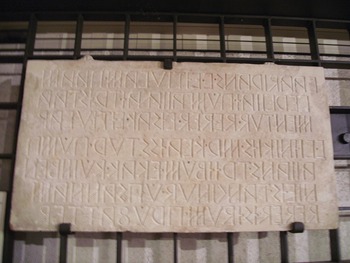
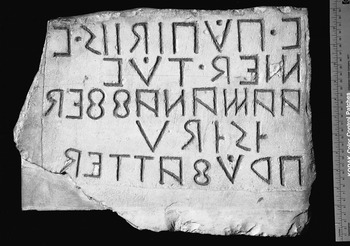
The inscription which commemorates the testament of Vibius Adiranus (Po 3) and its use for the construction of a public building is one of the most attractive and best-known examples of Oscan epigraphy (Fig. 1).Footnote 1 Found in Pompeii in the late eighteenth century, it now seems to have been accepted by many scholars that, following the suggestion of Poccetti and others, there is strong archaeological and epigraphic evidence for considering this inscription to be a first-century a.d. recopying of a second-century b.c. original.Footnote 2
The testament of Vibius Adiranus (Po 3; Crawford Pompei 24; Vetter (1953), 11), now in the Museo Archeologico Nazionale di Napoli. (Photo: author; the author is grateful to the Soprintendenza di Napoli)

For this reason, the inscription has become evidence for the survival of the Oscan language, and a sophisticated Oscan epigraphic tradition, until imperial times. The fact that it was recopied has become widely accepted in the literature, where it has been used as evidence of a profound change in local attitudes to Oscan.Footnote 3 For example, J. N. Adams, building on the idea that Po 3 was recopied, writes in Bilingualism and the Latin Language that, despite communities ostentatiously having changed their public language to Latin (e.g. at CumaeFootnote 4), by the middle of the first century a.d. there was a re-emergence of ‘local pride … antiquarianism or local patriotism’.Footnote 5 Adams sees Po 3 not just as a sign of respect for old inscriptions, but also as ‘consistent with a residual knowledge of Oscan’ well into the imperial period. While there are scattered pieces of evidence for the survival of spoken Oscan into the first century a.d., and perhaps for some local preservation of pre-Roman inscriptions, these are far from conclusive; and it is the recopying of the testament of Vibius Adiranus which has always been made to bear the weight of the argument. Only very recently has anyone begun to question Poccetti's dating and its implications.Footnote 6
Unfortunately, the discussion of Po 3 has become clouded with circular reasoning, in part because of the separation of the archaeological and linguistic evidence.Footnote 7 This contribution aims to untangle the evidence for and against the assertion that the testament of Vibius Adiranus was re-carved in the first century a.d. In the process, I also hope to clarify aspects of the attitude of the Roman colonists and their descendants to the Oscan language. In particular, I will address the visibility of the previous epigraphic cultures of the town at the time of the a.d. 79 eruption, and question whether notions such as local cultural pride and antiquarian interests are appropriate to the first-century a.d. citizens of Pompeii. This is a question which is relevant not just to the history of Pompeii, but to our ideas on the progress of Romanization and Latinization across late Republican Italy: if some Roman citizens of the first century a.d. did feel pride in or identify themselves with Italic speakers of previous centuries, it would be significant for our understanding of negotiations of linguistic and regional identities in the imperial period.
The text of the inscription reads as follows, with an English translation below. Following normal convention in transcribing Italic languages, characters in the Latin alphabet are transcribed in italics, and those in ‘native’ Italic scripts, including the Central Oscan alphabet used in this inscription, are in bold.Footnote 8 Hyphens at the ends of words which continue over two lines are not a feature of the inscription, and are added for clarity only. Characters in brackets do not appear in the original inscription; these are expansions of abbreviations used in the text.
Vibius Adiranus, son of Vibius, gave in his will money to the Pompeian vereiia-. With this money, Vibius Vinicius, son of Maras, Pompeian quaestor, dedicated the construction of this building by decision of the senate, and the same man approved it.
The text is broadly formulaic, and it has a great deal in common with the other twenty or so inscriptions commemorating building projects that have been found in Pompeii. Apart from the doubtful identity of the vereiia- (on which more below), the only peculiarity of this inscription is that it is the only Oscan epigraphic record in Pompeii of money being left in a will for a building project. Elsewhere, when the source of the money is stated, it is either said to be the money of the official (presumably alive), or money taken as fines.Footnote 9 The interest of the inscription, therefore, lies not so much in what it tells us about Samnite Pompeii, as what it might tell us about the course of the shift from Oscan to Latin, and language attitudes during the Roman period.
II ARCHAEOLOGICAL CONTEXT
Accurate contextual information is not always available at Pompeii, particularly where inscriptions have been removed after their discovery. It was unfortunately common in early excavations for finds to be moved, sometimes to suit certain interpretations, and records were patchy; in other cases, the original reports have been misunderstood or mistranslated.Footnote 10 It is all the more important, therefore, to be aware of circular reasoning in matters of dating and identification: in some cases, archaeologists posit a likely date or purpose for a building, which leads epigraphists to date an inscription, on which date later archaeologists base their identification of the building, and so on.
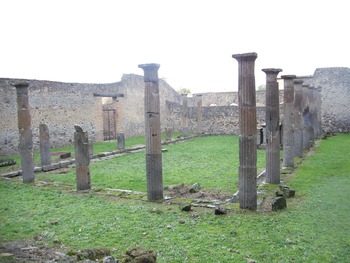
The traditional viewFootnote 11 is that Po 3 was found in the late eighteenth century on a building known as the ‘Samnite Palaestra’ in the (so-called) ‘Triangular Forum’,Footnote 12 and became detached during the course of excavation.Footnote 13 Because the inscription was apparently associated with a palaestra, the vereiia- of Pompeii (the institution to which Vibius Adiranus left his money) was identified as being comparable with the Greek ephebes; such a group might well have built a palaestra in the second century b.c.Footnote 14 The Triangular Forum is thought to have fallen out of use later, and the area was converted into a park with decorative ruins around 30–20 b.c.Footnote 15 The old palaestra was apparently partially destroyed in the earthquake of a.d. 62 and rebuilt to slightly different proportions, allowing an extension of the neighbouring temple of Isis, as shown by the differently executed column capitals and the lack of the eastern portico (Fig. 2).Footnote 16 It is at this stage, well into the first century a.d., that the Vibius Adiranus inscription is said to have been re-carved and deliberately set into the eastern wall.
The ‘Samnite Palaestra’, Pompeii, taken from next to the western portico. Note the three sides of columns (north, west and south) and the wall of the extended temple of Isis (east). (Photo: author; with permission of the Soprintendenza di Pompei)

However, the identification of the ‘Samnite Palaestra’ has been called into serious doubt. It was first identified as a palaestra in the nineteenth century, partly on the assumption that vereiia- could be an association of youths.Footnote 17 More recently, the existence of a better-equipped exercise ground by the Stabian Baths and an even larger Augustan ‘Great Palaestra’ has raised some doubts. There is also no plumbing in the building: a palaestra without a washroom is extremely unlikely for a city as wealthy as Samnite-period Pompeii.Footnote 18 The wording of the inscription itself is non-specific, referring only to trííbúm ekak – ‘this building’. Thus, there are no longer strong archaeological grounds for calling this a palaestra. The identification now rests solely on two things: the interpretation of vereiia- as an association of young men, which is by no means certain linguistically,Footnote 19 and the association of the inscription Po 3 with this particular building. The potential for problems is clear: this meaning of vereiia-, and the association of the inscription with this structure, are still cited without due consideration of the fact that this interpretation rests primarily on archaeological theories of the purpose of the building which are no longer current.
Richardson suggests identifying the building as a temple of Hercules, given the apparent presence of an altar and the popularity of Hercules at Pompeii; this identification does not rule out a connection with the youth of the town, but also does not presuppose it.Footnote 20 In any case, any theories about the provenance or purpose of this inscription which rest on archaeology alone should be treated with suspicion. We cannot even be completely sure that the inscription was built into the wall: early reports have it either at the foot of the wall, or in the wall, and it is perfectly possible that the block was used to build the floor rather than the wall.Footnote 21 Reconstructing the meaning of the inscription from the purpose of the building thus seems unwise. The content of the inscription is more likely to refer to a public building than a private one, but there are multiple public buildings of Samnite-era construction both in the Triangular Forum and at other locations around the town with which the inscription could be associated.Footnote 22
Most tellingly (and, I think, conclusively), in contrast to other scholars including Poccetti who believe the stone to be complete, Crawford has recently noted that it seems to him to be broken, pointing out the two small carvings protruding from the top edge of the stone, clearly visible in Fig. 1.Footnote 23 These he identifies as lions' feet, indicating that there was additional carved decoration on the top of the stone, and therefore that this copy was not carved with the intention of being built into a wall. Rather, it was used as building material in either the wall or the floor, and may not have been treated with particular reverence.
It could be argued that the first-century a.d. reuse of the inscription in a prominent location, in the wall of an important civic building, may be evidence that the inscription was understood and treated respectfully. However, it is not at all clear that the inscription would have been visible once it had been built into the wall. There are multiple examples of Oscan inscriptions being reused as building material (or being dumped with the intention of using them as such), with the inscription covered by plaster or placed facing inwards.Footnote 24 Even if it was visible, it is not clear that the presence or content of the inscription was significant to those building the wall. As sometimes happens in modern structures, the block (which is attractive and relatively undamaged) may have been used as material for a new structure and the text, visible or not, could have been thought decorative but unreadable, or could simply have been ignored.Footnote 25 In Pompeii itself, Oscan inscriptions seem to have been left visible and in situ only where their removal would destroy or remove a useful structure, such as a pavement or a sundial. This suggests that it was the stone itself that was thought worthy of preservation, rather than the inscription.Footnote 26
III EPIGRAPHY
The inscription is written on a limestone slab (0.41 by 0.76 by 0.035 m), right to left, in the Central Oscan alphabet. It is in a good state of repair and, despite a few cracks and some damage to the bottom edge of the stone, none of the letters is obscured.Footnote 27 The epigraphy of the inscription has often been cited as proof that it was recopied; it is time, however, to explore this claim in detail in relation to lesser-known Oscan inscriptions of comparable content and style.
Poccetti claims that the placement of the praenomina (lines 1 and 4) to the right of the line justification, marking not only that the forms are names but also the beginning of a paragraph, is unparalleled in Oscan epigraphy.Footnote 28 This paragraphing is a central feature in his argument for the view that the inscription has been recopied, since the content suggests that its composition was in the mid-second century b.c., based on the similarity of the institutions mentioned and the formulae used in other Samnite-era official inscriptions.Footnote 29 His idea that the recopying was after a.d. 62 seems to be based on the damage to the building, which is consistent with earthquake damage (although we cannot know that this damage happened in a.d. 62), rather than being based on any specific features of the inscription itself.
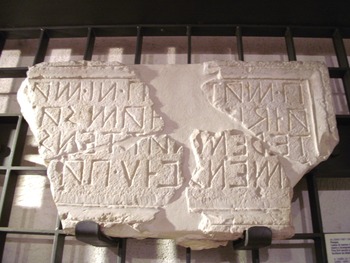
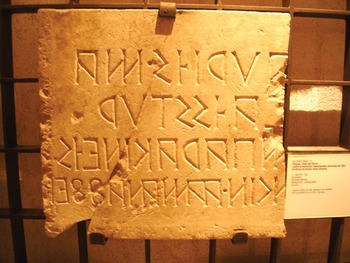
There are several objections to the claim that the epigraphy of the inscription is more like first-century a.d. Latin texts than second-century b.c. Oscan texts. Firstly, the material used, a high quality limestone, is consistent with other second-century b.c. inscriptions. The execution of the letters also seems to suggest an earlier date; the argument that the regularity of the letters must indicate strong Latin influence does not take full account of comparable Oscan inscriptions. If one compares Po 3 to one of the other well-carved Oscan official inscriptions, such as the Cippus Abellanus (Cm 1; Crawford Abella 1), the similarity of the letter forms is striking. The tendency to form ligatures, particularly with a + r, d, m or n and, in the Cippus, with í + various other letters, speaks of a shared origin in a well-developed epigraphic tradition. From Pompeii itself, Samnite-era inscriptions of similar content to the Vibius Adiranus inscription, such as Po 2 and Po 9,Footnote 30 which also record the approval of a building project by a kvaísstur, show markedly similar letter-forms and ligatures (Figs 3–4). Po 3 also shows a clear understanding of specifically Oscan practices, such as the use of word dividers, even though we have examples of Latin-influenced engravers making mistakes with these from an early period.Footnote 31 By contrast, one seems to find epigraphic forms more typical of Roman officialdom in Pompeii in the Latin inscriptions put up after 80 b.c., even those from the early years of the colonization, which have much more rounded lettering and have little in common with the earlier Oscan tradition.
Po 2 (Crawford Pompei 12), official inscription from Pompeii, commemorating the completion of a road by the aedile. Now in the Museo Archeologico Nazionale di Napoli. (Photo: author; the author is grafeful to the Soprintendenza di Napoli)

Po 9 (Crawford Pompei 20), official inscription from Pompeii, commemorating the completion of a project by a magistrate. Now in the Museo Archeologico Nazionale di Napoli. (Photo: author; the author is grateful to the Soprintendenza di Napoli)

Even the paragraphing by offsetting of the praenomina to the right of the margin, which Poccetti thinks so characteristic of later Latin inscriptions, does have parallels in Oscan epigraphy. For example, Po 6,Footnote 32 though it does not mark out the name of the magistrate in the first line, does indent the word ísídu(m) ‘the same man’ by one full letter-width (Fig. 5). This layout both marks the beginning of a new sentence, and re-emphasizes the importance of the magistrate in completing and approving the project. The fact that this layout is uncommon in Latin inscriptions of early date does not necessitate an imperial date for Po 3; this might have been an occasional practice of Oscan epigraphy before it became common in Latin. With so few monumental Oscan inscriptions extant, it is not always possible to know which tradition has influenced which.
Po 6 (Crawford Pompei 8), official inscription from Pompeii, commemorating the completion of a project by a magistrate. (Photo courtesy of the British Museum)

It may be argued, however, that someone recopying an inscription would keep as close to the style of the original as possible, changing very little in the lettering, the layout and the material used, and thus it would be extremely difficult for a modern observer to tell the difference between a second-century b.c. inscription and a copy from the first century a.d. Although there is not a great deal of comparative data, since we have few inscriptions known to be later copies, the Columna Rostrata inscription (CIL 12 25) may provide a useful counter-example. This text celebrates the naval victory of the consul C. Duilius in 260 b.c., and is thought to have been re-cut in the early imperial age.Footnote 33 The reason we know that the Columna Rostrata cannot be the third-century original is because of the style of lettering and because it is on marble, not tufa, as the original inscription almost certainly would have been.Footnote 34 As well as updates to bring the spelling into line with imperial standards, such as regular use of final –m and I-longa, there are false archaisms — all of these indicate changes to the original text, if one ever existed.Footnote 35 It seems, therefore, that on the rare occasions when archaic inscriptions were recopied, the epigraphic style tended to be altered and updated, and even artificially archaized, which cannot conclusively be shown to have been done to Po 3.
IV LINGUISTIC ‘INFLUENCE’ FROM LATIN
It is widely agreed that there is a considerable degree of Latin influence on the Oscan of this text. ‘Influence’ is an inexact term, and can cover a wide range of activity: deliberate borrowing of terms or structures from a second language (L2) to one's first language (L1), the subconscious interference of L1 on L2, and other kinds of behaviour. How we account for the influence of one language on another in any text has a great deal to do with the text's context and apparent intention.Footnote 36 However, as we will see, it is not the case that the Latinate features we find in Po 3 must have originated in the influence of post-colonization Latin, since many have parallels in Oscan texts of the second century b.c.
We have roughly twenty comparable Oscan official inscriptions on stone from Pompeii from the Samnite period of the town, some complete, some very fragmentary. The longest is eleven lines, and the shortest (complete) inscription is one line, but the majority of the complete inscriptions are two to four lines long. They are generally very formulaic, and tend to include a selection of a stock of elements. All of those in which the beginning of the inscription survives start with the name of the magistrate(s) responsible for putting it up, with their official titles. In many cases the magistrates are specifically said to have overseen and approved the project; it is also common to include the phrase kúmbennieís tanginúd, ‘by decision of the council’.Footnote 37 Sometimes the project being commemorated or other circumstances surrounding the commissioning of the inscription are mentioned, but not always. Further details of the usual structures and vocabulary used are found in the discussion below.
Of course, for any of the features detailed below, it would be possible to counter-argue that someone recopying an inscription would not change the features of the inscription materially. However, this is not what we find on the C. Duilius inscription (discussed above), where the language has been changed from the original. In addition, any inscription damaged enough to merit recopying might have had considerable lacunae, where inconsistencies could creep in when the text was rewritten. The fact that the text seems to be so consistent with the Oscan of the second and first centuries b.c. indicates, therefore, that the inscription is probably original.
Phonology
Although difficult to gauge in any written text, there is no evidence of phonological interference from Latin in Po 3. There may be phonological interference in one of the imperial-age inscriptions — the letter o in Po 67 (g. ivdaííeo s) could show a change in the quality of the vowel /ú/ [ɔ] which the writer was unsure how to represent in Oscan.Footnote 38 Confusions of this type do not occur in the Vibius Adiranus inscription, where all vowel signs, including i, í, u and ú, are used in keeping with the practice we find in Oscan inscriptions from the Samnite period of the town.
Lexicon
The word kvaísstur is a clear second-century borrowing from Latin. There was no elected position of kvaísstur in Pompeii after 89 b.c., so this term is likely to have been limited to the pre-Roman phase of the town.Footnote 39 Indeed, this term appears in several other Pompeian inscriptions of the Samnite period of the town (Po 4, 8, 9, 14Footnote 40) and thus is a well-established magistracy of the second century b.c. The gemination of s before t is paralleled in a number of other Oscan words (pússtíst ‘positum est’, passtata ‘porticum’), and indicates that the borrowing has been phonologically incorporated into the language.
The verb prúffated is cognate with Latin probavit, which is used in analogous contexts.Footnote 41 Because the development of a verb from an adverb (Latin probe) is rather unusual, it is usually considered that Oscan practice was influenced by Latin, even if this is a calque based on an existing Oscan adverb (unattested, but see Umbrian profe) rather than a direct borrowing.Footnote 42 However, this is a common word in this position in Oscan public inscriptions from the Samnite period, well attested in second-century inscriptions.Footnote 43
In form, at least, tanginom (abl. tanginúd) is an inherited Italic word,Footnote 44 common in Oscan public inscriptions.Footnote 45 However, it is possible that its semantic range has been influenced by Latin sententia, so that the phrase kúmbennieís tanginúd (or, outside Pompeii, senateís tanginúd) has the same range as senatus sententia. This is an instance in which Latin is likely to have influenced Oscan early; although many of the inscriptions containing this phrase cannot be dated precisely, the Cippus Abellanus and Sa 8 are both from the second century b.c. Also, senatus sententia is a phrase characteristic of early Latin legal texts and need not have come from imperial-period Latin influence.Footnote 46
Although tristaamentud could feasibly be an inherited Italic word, tristaamentud … deded is said to be based on the Latin phrase testamento dare,Footnote 47 and tristaamentud is said to be a borrowing of Latin testamento with influence from the native word trstus ‘witness’.Footnote 48 In the context of a system of law which was apparently heavily influenced by Latin by the second century b.c., this explanation is plausible.Footnote 49 The marking of the double vowel also indicates that this word is likely to have been borrowed: although Oscan often marks long vowels with double letters (e.g. Aadirans, trííbúm, etc.), tristaamentud is the only known case of a vowel being doubled to show length in Oscan script in any position other than the initial syllable.Footnote 50 Since the a in Latin testamento is long, this may indicate a borrowing taken into Oscan after an earlier sound change had shortened all Oscan long vowels in non-initial position. Unfortunately, we have no other examples which allow us to confirm exactly when the Oscan sound change took place. We do, though, have the additional evidence that the extended suffix –men–to– is not characteristic of Oscan derivational morphology, and appears only here and in pavmentúm in Cm 4 (Crawford Cumae 2), which is borrowed from Latin. On that basis, it seems likely that tristaamentud is indeed a borrowing from Latin legal language. Because of the examples above, in which Latin legal lexemes were borrowed into second-century texts, there is no reason that tristaamentud must have been borrowed any later.
Morphology
There are no borrowings from Latin morphology in the inscription. Of course, absence of evidence is not to be equated with evidence of absence; while morphological borrowing may occur at an advanced stage of language shift, it need not occur, and even if it was happening in Oscan during the period when Po 3 was written, it would not necessarily be reflected in the inscription. In fact, Adams lists no clear morphological borrowings from Latin into Oscan at any time,Footnote 51 and so the fact that there is no such borrowing in this particular inscription tells us very little.
Syntax
The relative clause which begins in the first line of the inscription (eítiuvam paam … deded eísak eítiuvad), characterized by so-called attractio inversa, in which the subject and object of the relative clause are both fronted and the antecedent is included in both the matrix clause and the relative clause, is reminiscent of Latin legal texts. In particular, the phrasing eítiuvam paam … eísak eítiuvad … seems to parallel the Latin legal phrase pecunia quae … ea pecunia ….Footnote 52 However, as Adams points out, the construction can also be paralleled in Hittite and Vedic.Footnote 53 It is nevertheless likely that this particular phraseology has been borrowed from Latin legal language, rather than inherited from an earlier common ancestor, because of the exact correspondence of the meaning.Footnote 54 The use of Latin models for Oscan official and legal inscriptions, particularly in their syntax and content, is clear from the last quarter of the second century b.c., and so the Latin influence here should be seen as consistent with a second-century date, probably post-123 b.c. based on the kind of Latin texts this inscription uses as models.Footnote 55
Therefore, not only is the Latin influence on the text datable to the second century b.c., because of parallels with other Oscan texts, but we also do not see the kind of syntactic, morphological and phonetic interference which would be likely if the inscription had been re-copied in the mid-first century a.d. There is also no sign of false archaisms — or false Oscanisms — which, from the comparative evidence of the Columna Rostrata, one might expect in a later copy.
V ATTITUDES TOWARDS OSCAN, 89 b.c.–a.d. 79
As we have seen, there is little epigraphic or linguistic evidence in the Vibius Adiranus inscription which would indicate that it was recopied after the earthquake of a.d. 62, and the archaeological evidence is less than conclusive. However, there are wider implications for the date of this inscription. If, as others have done, we agree that it was copied in the first century a.d., then this leads to some conclusions about the general Roman attitude to Oscan which may be misleading.
The opinion of Poccetti is not only that this inscription has been recopied, but also that this recopying is a sign of Romanized Oscan families taking pride in the achievements of their pre-Roman ancestors.Footnote 56 This has been accepted by Adams as a plausible reading of the evidence, and he even sees it as evidence for the survival of Oscan as a spoken language into the imperial period.Footnote 57 However, I would argue that the idea of élite families which had been Romanized for several generations wanting to ‘mantenere vivo il ricordo delle virtù degli avi’Footnote 58 is inconsistent with the attitude to Oscan which we find elsewhere in the town, and, although a possibility for some residents of Pompeii at some periods, it should not be assumed on the basis of this inscription alone.
The example usually given for a comparable use of Oscan by later residents of the town is Po 8 (Crawford Pompei 19), which was reused in the house of Cornelius Rufus. Poccetti sees this as showing pride in the family's civic achievements, but it is not even clear that this inscription referred to family members. It may have simply been reused as building material, as many of the Oscan inscriptions from Pompeii found in modern times had been, with or without the inscription visible.Footnote 59 A further possible example of the reuse of Oscan inscriptions in élite homes, which Poccetti does not cite, is Po 20 (Crawford Pompei 36), which may have stood in a visible context on an altar in the atrium of the House of the Faun.Footnote 60 Given the overall old-fashioned aesthetic of the house, though, this is more likely to be an example of a desire to be seen as an old family — and perhaps here there is a hint of antiquarianism — rather than pride in particular Oscan-speaking ancestors. Even so, the house was discovered full of bits and pieces of stone for use in rebuilding, and it is not clear that the altar was in fact on display.Footnote 61
In fact, it is rare to find any evidence from Italy of Latin-speaking Roman citizens deliberately marking themselves out as having had non-Latin-speaking ancestors, particularly Italic-speaking ancestors.Footnote 62 Some languages did have these connotations of group identity in imperial Italy: the Jewish community at Venusia continued to use Hebrew tags on funerary inscriptions up to the sixth century a.d., long after they were primarily Latin-speaking.Footnote 63 However, there are obvious religious and cultural motivations in that case which do not have a parallel here; we have no evidence of Oscan as a language of ritual after its loss in other domains, nor was it associated with the continuation of a separate religious identity. With so little evidence of this kind of activity anywhere in Italy, and only a couple of potential examples in Pompeii itself, it seems unwise to assign a motive of ancestral pride to the Pompeian élite without question. It is very difficult to say that any particular importance was attached to these inscriptions at all, since context suggests that they were simply viewed as reusable building material (with the inscription visible or not). As stated above, there are examples both in the modern world and in Pompeii itself of the reuse of ancient inscribed stones in houses and other structures where the text simply goes unnoticed, even if visible.
Conversely, there is evidence that the Roman colonists may have been actively antagonistic towards the Oscan-speaking population of Pompeii after 80 b.c., making it unlikely that by the first century a.d. wealthy citizens would necessarily want to advertise their connection to the earlier life of the town.
Cooley states that there is no evidence of the inscriptions of the town being systematically erased, and that Oscan was not seen as a symbol of the rebellious allies during or after the Social War.Footnote 64 There are two possible objections to this. Firstly, the rebels themselves did set up Oscan as a collective language alongside Latin, and in an aggressive way, issuing coins bearing Oscan legends with symbols of their desire to trample Roman oppression.Footnote 65 There is some evidence that, even after the Social War, Romans felt there to be antagonism between themselves and the Samnites: in 62 b.c., Cicero was still able to speak of considerable tension between the Pompeians and the Roman colonists.Footnote 66 Secondly, there is clear evidence of the removal of Oscan inscriptions from public view, and in some cases Latin replacements. The weights and measures table (mensa ponderaria) still visible in the Pompeian forum not only had its measures altered to the Roman standard, but also had the Oscan characters on it chipped away and replaced with a Latin inscription commemorating the adjustments.Footnote 67 Other inscriptions were plastered over, some of which have only recently been revealed. For example, Po 54 (Crawford Pompei 1), of which only a few letters were visible when Rix brought out his edition, has now had the plaster covering it removed to reveal the whole inscription, which reads l. mummis l. kúsúl.Footnote 68 The message itself could not have been objectionable to the colonists, being the name of a Roman consul, and thus it seems to have been covered up because of its language alone. On the basis of this evidence, it seems unlikely that the élite would associate themselves with a language and a culture which, relatively recently, had been the symbol of a rebel population.
Not only does the idea of an ‘antiquarian’ attitude towards Oscan seem somewhat inconsistent with the attitude of the Roman colonists to the Samnites, although it remains a possibility, but the ‘recopying’ of this inscription is unlikely based on the evidence we have for the knowledge of Oscan at Pompeii in the final years of the town. Although it is extremely difficult to estimate how much the language was spoken, particularly in the lower echelons of society, after the colonization, the evidence we have does not suggest that knowledge of Oscan script continued for long in the great majority of the population.
The three inscriptions in the Oscan alphabet dated to the Empire are Po 66, 67 and 68.Footnote 69 The first, a graffito from a brothel wall, reads markas (or possibly margas).Footnote 70 This is apparently a name, and Rix has it as the genitive of a female name, though it does not correspond to any known female name, and the prostitutes themselves are unlikely to have been literate.Footnote 71 Perhaps more likely is that it is a client's name, and it is a variation on the common Oscan male name Maras, maybe with the influence of Latin Marcus, given the similarity between the Oscan letter <G> and the Roman <C>. Po 67 is another name — g. ivdaííeo s — but, since it contains the Latin letter <O>, it cannot be said even to be fully in the Oscan alphabet. As in Po 66, this does not seem to be a truly Oscan name; it could be an ethnic based on the Latin iudaeus ‘Jew’, though this is speculative. The final example, Po 68, seems to read neṿpús. ieri sal — which is unintelligible as Oscan. In fact, Crawford casts serious doubt on the authenticity of both of the latter two graffiti.Footnote 72
It is problematic, therefore, to place Po 3 in a period when there are so few Oscan-alphabet inscriptions, and those which exist show no real knowledge of the Oscan language or nomenclature, show no professionalism of execution, and could plausibly have been written by non-residents of the town (or, indeed, may not be ancient at all). Rather, it causes less tension with the other evidence of language use in the town to date Po 3 to the pre-colonization period, when all public inscriptions at Pompeii were in Oscan. Of course, this evidence does not preclude the possibility that many people did in fact speak Oscan and that the Oscan script was still known by some stonecutters. We can only speak in terms of probabilities based on the evidence, and thus far evidence for the ongoing use of Oscan in high-end inscriptions has not emerged.Footnote 73
VI POMPEII AS A MODEL FOR ‘ROMANIZATION’ AND LANGUAGE SHIFT IN ITALY
The study of linguistic ‘Romanization’,Footnote 74 ‘Latinization’, and language death in the Italian peninsula will always be hampered by the patchy availability of evidence from many of the languages and communities involved. As a result, those sites which do furnish us with more evidence for the process of language shift tend to serve as models for other areas where this information is lacking. This is particularly true of Pompeii, where the evidence is uniquely rich and well-studied, with an unparalleled range of texts, from expensive officially-sanctioned inscriptions to personal graffiti and dipinti.
Any conclusions based on Pompeian material must therefore be undertaken with particular care, and the dating of Po 3 is no exception. As we have seen, Adams has suggested a connection between the recopying of Po 3 and ‘local pride’ in Oscan, and perhaps ongoing knowledge of the Oscan language in the area. Local pride and the survival of the language are, of course, not the same thing. As stated above, there is little evidence that Roman citizens anywhere in first-century a.d. Italy constructed their identity based on the Italic languages spoken by their ancestors more than a century previously. While local origins and non-citizen ancestors could be celebrated, Roman citizens did not, I suggest, regard Oscan as a language of ongoing historical or cultural significance, unlike Etruscan or Greek.
Other scholars have gone even further — Cooley has argued that ‘the situation at Pompeii perhaps suggests that other local Italic languages too may have persisted for longer than is sometimes supposed’.Footnote 75 This kind of extrapolation from the evidence found in Pompeii to other areas and other languages can be justifiable; but in this case, where a great deal of the burden of proof rests on just one inscription, it may result in unhelpful and misleading generalizations about the date and speed of the death of local languages in Italy. The idea of some knowledge of Oscan persisting into the first century a.d. runs counter to the general picture of a (cross-linguistically speaking) sudden language shift at Pompeii. Language death, as shown by studies of modern languages, typically takes three generations or more;Footnote 76 less than this, which is certainly possible in the case of Pompeii, where Oscan-language epigraphy is relatively plentiful in the mid-second century and almost non-existent after 80 b.c., indicates exceptional pressure of some kind. The duration of language death is an important indication of the enormous economic and social pressure on Italic-speaking populations in the first century b.c.; an accurate estimate of how and when the death of Oscan took place is therefore central to our understanding of the process of ‘Romanization’. Such an estimate relies on a number of factors, and as such is beyond the scope of this article, which seeks to clarify one factor only — the end point of monumental epigraphy in Oscan at Pompeii.
VII CONCLUSIONS
On the basis of this reassessment of inscription Po 3, it does not seem likely that it was recopied after the earthquake of a.d. 62. The linguistic influence of Latin on the text is consistent with the Oscan we find in the second and first centuries b.c. The epigraphy, while of a very high quality, nevertheless shows many more features in common with second-century b.c. Oscan inscriptions than early imperial Latin ones. The archaeological evidence, too, is far less indicative of a first-century a.d. date than we are sometimes led to believe: previous accounts have not always fully explained the uncertainties and misunderstandings surrounding the location in which the inscription was first found, and the new observation that the stone is incomplete seems to confirm that the inscription was not re-carved specially to be fitted into the new wall of the temple of Isis. I would go so far as to question the idea that there were many Oscan inscriptions visible in first-century a.d. Pompeii; and those that were visible, whether reused in new structures or left in their original contexts, may not have been read.
While a change in the dating of this inscription must also change our views on the state of Oscan at Pompeii in the decades before its destruction, it removes several apparent inconsistencies rather than creating more. In particular, the difficulty of the gulf between the level of understanding of Oscan in Po 3 and in the only other first-century a.d. Oscan inscriptions, which are mainly unintelligible graffiti, is no longer an issue. Redating this inscription to the second century b.c. also helps to explain away the apparent contrast between the ‘pride’ of Roman citizens at Pompeii in their Oscan-speaking ancestry with the silence on the matter we find elsewhere in Italy. It also fits better with the general picture of an abrupt end to monumental Oscan epigraphy, and the dating and duration of the death of Oscan. I therefore suggest that the testament of Vibius Adiranus is not a later recopying, but a late second-century original inscription of a similar date to other public and official inscriptions in Oscan from the area.