Citizens are regularly presented with several different types of messages about corruption, particularly in the developing world. In major cities it is not uncommon to see anticorruption billboards, posters and murals. The prominence of these messages reflects the success of the anticorruption awareness-raising agenda. The agenda’s call, codified in Article 13 of the 2004 United Nations Convention Against Corruption, instructs governments to ‘raise public awareness regarding the existence, causes and gravity of and the threat posed by corruption’.Footnote 1 Most anticorruption programs now contain an awareness-raising element. The media also propagates many of their own messages about corruption, of course. A simple search for news stories containing the word ‘corruption’ on Tempo online, a popular news source in Indonesia, returned 10,463 news items. By comparison, the same search for stories containing the word ‘economy’ returned only 6,475.
Several things remain unclear about what effect, if any, different messages about corruption have. I explore whether – and to what extent – different messages about corruption shape perceptions of the corruption environment. This is important because people act based on their expectations and beliefs, and so depending on whether and how they shape perceptions, influential messages could be harnessed as a useful tool in the fight against corruption.
Using data from an original survey experiment – conducted across 1,000 households in Jakarta – I test whether four messages about corruption influenced four types of perceptions. The results raise cause for concerns with respect to the efficacy of anticorruption awareness raising. They show that even messages about government successes in fighting corruption and how citizens can get involved in anticorruption activities can have negative, unintended influences on perceptions.
LITERATURE REVIEW
Experimental political psychology research has established that political messages can significantly influence attitudes and behaviour.Footnote 2 Messages can shape perceptions through at least three different mechanisms. First, attitudes about an issue might shift because a message causes the exposed person to think more about the issue than they would have otherwise (priming). Secondly, new information learned from a message might adjust perceptions (learning). Thirdly, an exposed person could be persuaded to think differently about an issue – for example, because the message was particularly emotive or because it was delivered by a member of a political group the exposed person is sympathetic to (persuasion).Footnote 3
Advocates of anticorruption awareness raising hope that messages will motivate the public to get involved in the fight against corruption and/or reject opportunities to engage in corruption. Others have warned that if priming is the primary mechanism through which messages about corruption shape attitudes, however, anticorruption awareness-raising messages might actually backfire.Footnote 4 This concern stems from research on ‘corruption fatigue’, which is when a belief about corruption being a widespread problem gives way to scepticism that individual efforts to fight or resist corruption will be effective.Footnote 5 In this vein, Peiffer and AlvarezFootnote 6 show that a perception of widespread corruption is associated with an unwillingness to protest corruption, report corruption to the authorities and pay more for a product produced by a company that has not engaged in corruption. Through this critical lens, if all messages about corruption or anticorruption – regardless of tone or content – are priming the issue of widespread corruption, even a seemingly benign message informing people how to get involved in the fight against corruption, for example, might backfire. This is because such a message would make the issue of widespread corruption more salient, and accordingly increase ‘corruption fatigue’.
If perceptions are influenced by persuasion or learning, a message’s tone, content, and source could be extremely influential, by contrast. An expectation here, for example, is that a positively toned message will activate perceptions that are themselves positively charged.Footnote 7 If tone matters, negative news coverage of high-profile corruption scandals might elicit a greater sense of ‘corruption fatigue’, but a persuasive positive message about how other citizens are successfully resisting corruption could inspire a greater sense of personal empowerment.
The issue itself can be influential in determining which of these mechanisms might be at play. Research has shown that on issues that people have thought little about, messages are more likely to influence attitudes through learning or persuasion.Footnote 8 So, if someone had not previously considered reporting corruption and they learn from a message that it is easy and safe to do so, they may form a more positive perception of reporting. However, some have found that on issues that people tend to hold strong views on already, influential messages are more likely to shape attitudes through priming.Footnote 9 This is potentially bad news for anticorruption awareness-raising advocates; in many countries, corruption is a very common topic of conversation, which may reflect the fact that many people already hold strong (and negative) views about it. Therefore, messages about corruption and anticorruption may largely be priming the issue of widespread corruption, and as suggested earlier, such priming could be inspiring resignation, rather than indignation.
Research on Corruption Messaging
Only a handful of scholars have researched how messages about corruption influence attitudes and behaviour. Most studies in this vein examine how messages about corruption influence attitudes towards voting and voting patterns.Footnote 10 Using experimental research designs, these studies tend to expose citizens to messages about a specific corruption scandal, and gauge whether that exposure provokes citizens to punish the implicated politicians at the polls. Corbacho et al.’sFootnote 11 survey experiment in Costa Rica, by contrast, examined how exposure to messages about corruption influenced respondents’ willingness to engage in corruption. They found that citizens exposed to a message about the increasing rate of co-nationals observing corruption were more willing to pay a bribe.
I know of only one study that has researched how messages influence perceptions of the corruption environment. Chong et al.Footnote 12 examined whether information about mayoral corruption in Mexico influenced perceptions of corruption levels (as well as voter turnout). For the most part, Chong et al.Footnote 13 finds that their treatment did not influence the degree to which people thought the municipal government was dishonest.
In contrast, the present study exposes survey respondents to four different messages about corruption and examines how exposure to these messages influences perceptions of four different categories of perceptions – perceptions of the level of corruption, effect of corruption on development, government efforts to fight corruption, and the extent to which an ordinary citizen can easily engage in anticorruption civic activity.Footnote 14This last perception might be the most important. In Panth’sFootnote 15 words, ‘citizens generally must believe that they can actually do something about corruption in order to summon the courage to act upon that belief’.
METHOD
This study uses data from an original survey experiment conducted in Jakarta, Indonesia. Indonesia was a good case for this study for three reasons. First, corruption is thought to be a considerable problem there. Of the 167 countries assessed in Transparency International’s 2016 Corruption Perception Index, Indonesia is ranked in eighty-eighth place for its control of corruption, which is on par with Egypt and slightly worse than Liberia. Secondly, corruption is not a socially taboo topic to discuss in Indonesia. Thirdly, the government’s Corruption Eradication Commission (KPK) has led a very public, and by some accounts successful, fight against corruption, which allows me to test the impact of a message about the government’s success in fighting corruption on perceptions.
The study ran from 8 June 2015 to 7 July 2015. One thousand participants were recruited. Working with the Regional Economic Development Institute, 100 villages in Jakarta were identified. In order to recruit subjects from different socio-economic backgrounds, thirty-five villages were relatively ‘low income’, forty-five were ‘middle income, fifteen were ‘higher income’, and five were of a ‘very high income’. Ten households were selected in each village by choosing every fifth household encountered by an enumerator, walking through the village. The sample was split evenly between males and females and its educational attainment distribution was similar to that of the nation, but the respondents are on average slightly younger than the average Indonesian. More details on the demographic characteristics of the sample are available in Appendix A.
Design
Study participants were randomly assigned to one of five groups: control, grand corruption, petty corruption, government success or civic engagement (n=200 in each). Difference in means tests on basic demographic indicators revealed that there were no significant differences among the five groups with respect to the demographic data collected (Appendix B). Eleven professional enumerators, from the Regional Economic Development Institute, read a short introductory paragraph to the subjects that described the study’s aims as wanting to ‘learn what citizens think about public services and the experiences they have had with public officials’. They explained that the responses to the survey questions would be treated confidentially, and that the subject could stop answering the questions at any time.
The subjects were then asked basic socio-demographic questions. If assigned to the grand corruption, petty corruption, government success or civic engagement groups, the demographic questions were followed by the respective treatment paragraphs (messages). After exposure to the treatment (or not for those in the control group, which proceeded immediately to the next set of questions), the subjects were asked questions gauging their perceptions (the full instrument is available in Appendix C).
Treatments
The grand corruption treatment mentioned scandals that have been the subject of front-page news in Indonesia. The inspiration for this treatment comes from advice given in 2011 by the then-chief of communication and advocacy for the UN Office on Drugs and Crime, Alun Jones. He advised that awareness-raising efforts should call attention to the issue by publicizing big corruption scandals.Footnote 16 The treatment paragraph read:
‘Corruption continues to undermine the economy, the quality of services, and the capacity of the government to reduce poverty in this country. A recent report notes that “never in Indonesian history have there been so many politicians imprisoned for corruption, often together with officials and businesspeople”. Recent corruption cases include a former Chief Justice of the Constitutional Court taking billions of rupiahs in bribes and the Sport Minister being involved in a multi-billion rupiah corruption scandal’.
The petty corruption treatment included statements meant to heighten awareness of the widespread prevalence of ‘local-level’ corruption. This treatment was included because ‘local-level’ corruption is the type of corruption that ordinary people tend to have direct experience of, and ‘corruption fatigue’ is hypothesized as being triggered when people believe that their peers in society are engaging in corruption (not just elites). It read:
‘Corruption continues to undermine the economy, the quality of services, and the capacity of the government to reduce poverty in this country. Local-level corruption is considered to be widespread across all public services and agencies. According to a recent survey, 43 per cent of Indonesians have had to pay a bribe to a government official in the past year and 70 per cent believe that this type of corruption has increased in the last two years’.
The government success treatment mentioned salient achievements made by the Indonesian Government, and specifically the KPK, in fighting corruption. It was tested because Peiffer and AlvarezFootnote 17 found that perceptions of government effectiveness in fighting corruption were positively associated with a greater willingness to fight corruption. It read:
‘The government has received praise from the international community for its recent successes in fighting corruption. The Corruption Eradication Commission (KPK), especially, has an impressive record of attacking corruption. Since the KPK was established it has arrested nearly 400 people on charges of corruption, and has achieved a 100 per cent conviction rate. In the first 6 months of 2014 the KPK recovered 2.8 trillion rupiah of stolen government money’.
The civic engagement treatment included statements to emphasize the many things that citizens can do to join in the fight against corruption. It was included as an attempt to echo messages that some anticorruption campaigns publicize to try to encourage ordinary citizens to get involved. It read:
‘Now, more than ever before, ordinary citizens are finding it easy to get involved in the fight against corruption. If corruption is witnessed, ordinary citizens can either call or text the Corruption Eradication Commission (KPK)’s 1,575 corruption hotline, and those that do are guaranteed to remain anonymous and the information shared confidential. People have the right to access government information and last year the government launched an online data portal to make it even easier for the public to access government budgets and documents. Also, several vibrant anticorruption organizations exist across the country; citizens can get further involved by becoming a member of these organizations or attending their events, like the annual anticorruption week events or rallies held on International Anticorruption Day’.
Arguably, the petty corruption treatment is the most negative in tone. It mentions only statistics about the high levels of perceived and experienced bureaucratic corruption. The grand corruption treatment focuses on negative corruption scandals, but also mentions the fact that several politicians have been imprisoned, which is a positive sign that the government is prosecuting this type of corruption. The government success treatment can similarly be taken both ways. It shines a positive light on the KPK’s efforts to control corruption, but may also make salient the negative facts that hundreds of people have been convicted and that a lot of money has been stolen. The civic engagement message is arguably the most positive because it does not mention the high prevalence of any level of corruption.Footnote 18
Dependent Variables
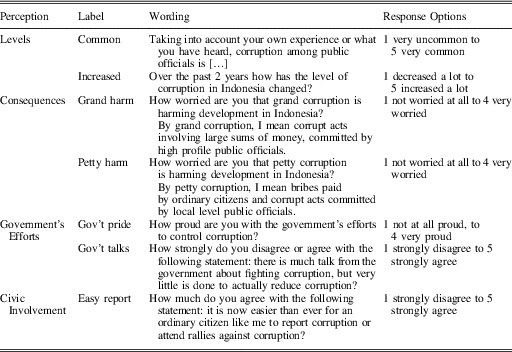
Four categories of perceptions were scrutinized using six dependent variables. Table 1 displays the exact wording of each perception question. Distribution figures of the responses to these questions are provided in Appendix D.
Table 1Dependent Variable Questions
Two dependent variables measure perceptions of corruption levels. The first uses responses to a question about how common corruption is among public officials, and the second uses responses to a question about whether corruption levels have changed in the last two years. The average respondent thought that corruption was common and that corruption levels had stayed the same.
One dependent variable is used to measure concerns about how harmful corruption is to development. Two questions on the survey asked to what extent respondents are concerned over whether grand and petty corruption are harming development in Indonesia. The average respondent expressed that they were ‘somewhat worried’ about the negative consequences of both types of corruption. As these questions were so similar and the responses were highly correlated (71 per cent), a single harm variable was created from the average response across these two questions.
A further two dependent variables assess perceptions of the government’s efforts to fight corruption. One question asked how proud respondents are of government efforts to control corruption, and another asked for an opinion on whether the government is ‘all talk but no action’ on the issue. The average respondent was paradoxically somewhat proud of the government’s efforts and slightly agreed with the idea that the government was ‘all talk’.
The sixth dependent variable is based on responses to a question that asked how easy it is for an ‘ordinary citizen’ to get involved in the fight against corruption. The average respondent agreed that it was easy to get involved.
Estimation Strategy
Pair-wise difference in means (DIM) tests were conducted to determine whether and how exposure to the messages influenced perceptions.Footnote 19 These analyses were used to test whether the mean responses to a dependent variable question given by each group are significantly different to the mean responses given by each of the other groups. A significant difference between mean responses indicates that exposure to the associated treatments had differential impacts on shaping the perception gauged. The use of DIM is appropriate when an assumption can be made that the only differences between the groups are that they received different treatments in the experiment. This assumption is made here because no significant differences were found among the five groups to demographic questions posed at the beginning of the survey (Appendix B).
RESULTS
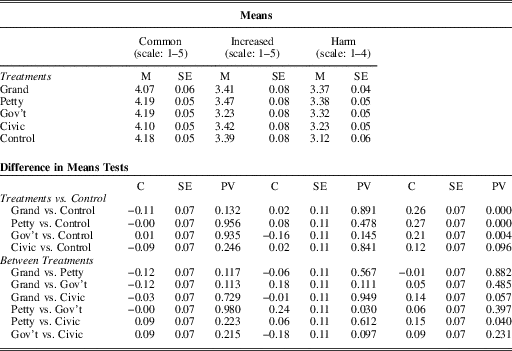
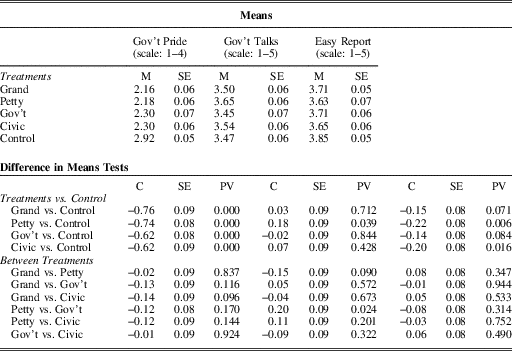
Surprisingly, the DIM tests (Tables 2 and 3) show that, regardless of the different tones or contents of the treatments, all four messages have a strikingly similar impact on three dependent variables. Compared to the control group (‘treatments vs. controls’ in tables), all four treatment groups’ mean responses exhibited a statistically significantly greater degree of worry about the harm that corruption causes to development in Indonesia, a lesser degree of pride in the government’s efforts, and a lesser degree of confidence in the idea that it is easy to report and otherwise get involved in the fight against corruption.
Table 2Pairwise Difference in Means for Levels and Consequences Variables
Table 3Pairwise Difference in Means for Gov’t Efforts and Civic Involvement Variables
Further, the DIM between treatment groups shows that, for the most part, all four of the treatment messages influenced these three dependent variables to the same degree. Between treatment group pairings, there are no statistically significant differences in mean responses to the easy report question, only one statistically significant difference in mean responses to the government pride question (the mean response from civic engagement group is significantly higher than that of grand corruption’s group mean response, p=0.096), and only two statistically significant differences in mean scores on the harm variable (the mean score from the civic engagement group is significantly lower than that of the grand corruption and petty corruption groups’ mean responses, p=0.057 and 0.040, respectively).Footnote 20
In contrast, exposure to the messages did not significantly shape perceptions of levels of corruption. Table 2 shows that there are no statistically significant differences between the mean responses of the treatment groups and the control group to the two corruption levels’ dependent variable questions.
Finally, Table 3’s results also show that exposure to only the petty corruption message caused respondents to be more sceptical of the government’s efforts to fight corruption. Respondents exposed to this treatment were in greater agreement with the idea that the government is ‘all talk but no action’ on anticorruption than those in the control, grand corruption and government success groups. There was no statistically significant difference between the mean response given to this question by those in the civic engagement and petty corruption treatment groups.
DISCUSSION AND CONCLUSION
The results of this study suggest that very different messages about corruption and anticorruption can shape attitudes about the corruption environment in surprisingly similar ways. When influential, all messages tested heightened worries about the ill effects of corruption on development, depressed pride in the government’s fight against corruption, and reduced the extent to which people thought it is easy for ordinary people to fight corruption. These results give credence to the concern that awareness-raising efforts might be backfiring because they are evoking ‘corruption-fatigue’-like attitudes.Footnote 21 These results are most remarkable with respect to the impact of the government success and civic engagement treatments. These messages were crafted with the intent to do the opposite – highlight government successes in fighting corruption and make the case that citizens should find it easy to get involved, respectively.
While surprising, the negative perceptions triggered are not necessarily unexplainable. Research on priming shows that if a positively toned message inadvertently primes a negative issue, the message can prompt people to think more negatively about the issue. Relatedly, others have shown that people tend to discount information that disagrees with certain perceptions that they have already formed.Footnote 22 Taken together, this means that a ‘positive’ message about anticorruption may be dismissed, or by priming the issue of widespread corruption, the message may make people feel worse about how much more the government needs to do or could be doing.
In contrast, none of the messages shaped beliefs about how corrupt the government is, perhaps because beliefs about corruption levels are fairly stable. These findings warn that awareness-raising campaigns hoping to shape these beliefs may be ineffective. In reflecting on similar findings in their study, Chong et al. suggest that messages about corruption confirm, rather than change, pre-existing beliefs about how prevalent corruption is.Footnote 23 This may be why the grand corruption and petty corruption treatments, which explicitly described levels of different types of corruption, were not influential. The other two messages – government success and civic engagement – however, may not have shaped perceptions of levels because they less directly addressed the prevalence of corruption.
Much can be done to build upon this research. Future research should examine the extent to which these findings are generalizable, beyond Jakarta, and beyond the context of a survey experiment. Similar studies could also examine whether repeated or prolonged exposure to messaging influences perceptions in intended (or unintended) ways. Finally, more can be done to gauge the extent to which messages impact anticorruption civic action or the proclivity to refuse to engage in corruption. Such research would explore linkages between messages, perceptions and actions on the ground.
The many limitations of this study mean that the findings should not be read as a definitive statement about the effectiveness of anticorruption awareness campaigns. Instead, the results express a modest warning that awareness-raising efforts may risk triggering or building upon a growing sense of resignation. If future research shows that the findings presented here are generalizable, awareness-raising advocates should radically reconsider their approach to getting citizens more involved. Such research would show that, worse than wasting resources, awareness-raising efforts could be doing more harm than good.







 You have
Access
Citizens are regularly presented with several different types of messages about corruption, particularly in the developing world. In major cities it is not uncommon to see anticorruption billboards, posters and murals. The prominence of these messages reflects the success of the anticorruption awareness-raising agenda. The agenda’s call, codified in Article 13 of the 2004 United Nations Convention Against Corruption, instructs governments to ‘raise public awareness regarding the existence, causes and gravity of and the threat posed by corruption’.Footnote 1 Most anticorruption programs now contain an awareness-raising element. The media also propagates many of their own messages about corruption, of course. A simple search for news stories containing the word ‘corruption’ on Tempo online, a popular news source in Indonesia, returned 10,463 news items. By comparison, the same search for stories containing the word ‘economy’ returned only 6,475.
Several things remain unclear about what effect, if any, different messages about corruption have. I explore whether – and to what extent – different messages about corruption shape perceptions of the corruption environment. This is important because people act based on their expectations and beliefs, and so depending on whether and how they shape perceptions, influential messages could be harnessed as a useful tool in the fight against corruption.
Using data from an original survey experiment – conducted across 1,000 households in Jakarta – I test whether four messages about corruption influenced four types of perceptions. The results raise cause for concerns with respect to the efficacy of anticorruption awareness raising. They show that even messages about government successes in fighting corruption and how citizens can get involved in anticorruption activities can have negative, unintended influences on perceptions.
LITERATURE REVIEW
Experimental political psychology research has established that political messages can significantly influence attitudes and behaviour.Footnote 2 Messages can shape perceptions through at least three different mechanisms. First, attitudes about an issue might shift because a message causes the exposed person to think more about the issue than they would have otherwise (priming). Secondly, new information learned from a message might adjust perceptions (learning). Thirdly, an exposed person could be persuaded to think differently about an issue – for example, because the message was particularly emotive or because it was delivered by a member of a political group the exposed person is sympathetic to (persuasion).Footnote 3
Advocates of anticorruption awareness raising hope that messages will motivate the public to get involved in the fight against corruption and/or reject opportunities to engage in corruption. Others have warned that if priming is the primary mechanism through which messages about corruption shape attitudes, however, anticorruption awareness-raising messages might actually backfire.Footnote 4 This concern stems from research on ‘corruption fatigue’, which is when a belief about corruption being a widespread problem gives way to scepticism that individual efforts to fight or resist corruption will be effective.Footnote 5 In this vein, Peiffer and AlvarezFootnote 6 show that a perception of widespread corruption is associated with an unwillingness to protest corruption, report corruption to the authorities and pay more for a product produced by a company that has not engaged in corruption. Through this critical lens, if all messages about corruption or anticorruption – regardless of tone or content – are priming the issue of widespread corruption, even a seemingly benign message informing people how to get involved in the fight against corruption, for example, might backfire. This is because such a message would make the issue of widespread corruption more salient, and accordingly increase ‘corruption fatigue’.
If perceptions are influenced by persuasion or learning, a message’s tone, content, and source could be extremely influential, by contrast. An expectation here, for example, is that a positively toned message will activate perceptions that are themselves positively charged.Footnote 7 If tone matters, negative news coverage of high-profile corruption scandals might elicit a greater sense of ‘corruption fatigue’, but a persuasive positive message about how other citizens are successfully resisting corruption could inspire a greater sense of personal empowerment.
The issue itself can be influential in determining which of these mechanisms might be at play. Research has shown that on issues that people have thought little about, messages are more likely to influence attitudes through learning or persuasion.Footnote 8 So, if someone had not previously considered reporting corruption and they learn from a message that it is easy and safe to do so, they may form a more positive perception of reporting. However, some have found that on issues that people tend to hold strong views on already, influential messages are more likely to shape attitudes through priming.Footnote 9 This is potentially bad news for anticorruption awareness-raising advocates; in many countries, corruption is a very common topic of conversation, which may reflect the fact that many people already hold strong (and negative) views about it. Therefore, messages about corruption and anticorruption may largely be priming the issue of widespread corruption, and as suggested earlier, such priming could be inspiring resignation, rather than indignation.
Research on Corruption Messaging
Only a handful of scholars have researched how messages about corruption influence attitudes and behaviour. Most studies in this vein examine how messages about corruption influence attitudes towards voting and voting patterns.Footnote 10 Using experimental research designs, these studies tend to expose citizens to messages about a specific corruption scandal, and gauge whether that exposure provokes citizens to punish the implicated politicians at the polls. Corbacho et al.’sFootnote 11 survey experiment in Costa Rica, by contrast, examined how exposure to messages about corruption influenced respondents’ willingness to engage in corruption. They found that citizens exposed to a message about the increasing rate of co-nationals observing corruption were more willing to pay a bribe.
I know of only one study that has researched how messages influence perceptions of the corruption environment. Chong et al.Footnote 12 examined whether information about mayoral corruption in Mexico influenced perceptions of corruption levels (as well as voter turnout). For the most part, Chong et al.Footnote 13 finds that their treatment did not influence the degree to which people thought the municipal government was dishonest.
In contrast, the present study exposes survey respondents to four different messages about corruption and examines how exposure to these messages influences perceptions of four different categories of perceptions – perceptions of the level of corruption, effect of corruption on development, government efforts to fight corruption, and the extent to which an ordinary citizen can easily engage in anticorruption civic activity.Footnote 14This last perception might be the most important. In Panth’sFootnote 15 words, ‘citizens generally must believe that they can actually do something about corruption in order to summon the courage to act upon that belief’.
METHOD
This study uses data from an original survey experiment conducted in Jakarta, Indonesia. Indonesia was a good case for this study for three reasons. First, corruption is thought to be a considerable problem there. Of the 167 countries assessed in Transparency International’s 2016 Corruption Perception Index, Indonesia is ranked in eighty-eighth place for its control of corruption, which is on par with Egypt and slightly worse than Liberia. Secondly, corruption is not a socially taboo topic to discuss in Indonesia. Thirdly, the government’s Corruption Eradication Commission (KPK) has led a very public, and by some accounts successful, fight against corruption, which allows me to test the impact of a message about the government’s success in fighting corruption on perceptions.
The study ran from 8 June 2015 to 7 July 2015. One thousand participants were recruited. Working with the Regional Economic Development Institute, 100 villages in Jakarta were identified. In order to recruit subjects from different socio-economic backgrounds, thirty-five villages were relatively ‘low income’, forty-five were ‘middle income, fifteen were ‘higher income’, and five were of a ‘very high income’. Ten households were selected in each village by choosing every fifth household encountered by an enumerator, walking through the village. The sample was split evenly between males and females and its educational attainment distribution was similar to that of the nation, but the respondents are on average slightly younger than the average Indonesian. More details on the demographic characteristics of the sample are available in Appendix A.
Design
Study participants were randomly assigned to one of five groups: control, grand corruption, petty corruption, government success or civic engagement (n=200 in each). Difference in means tests on basic demographic indicators revealed that there were no significant differences among the five groups with respect to the demographic data collected (Appendix B). Eleven professional enumerators, from the Regional Economic Development Institute, read a short introductory paragraph to the subjects that described the study’s aims as wanting to ‘learn what citizens think about public services and the experiences they have had with public officials’. They explained that the responses to the survey questions would be treated confidentially, and that the subject could stop answering the questions at any time.
The subjects were then asked basic socio-demographic questions. If assigned to the grand corruption, petty corruption, government success or civic engagement groups, the demographic questions were followed by the respective treatment paragraphs (messages). After exposure to the treatment (or not for those in the control group, which proceeded immediately to the next set of questions), the subjects were asked questions gauging their perceptions (the full instrument is available in Appendix C).
Treatments
The grand corruption treatment mentioned scandals that have been the subject of front-page news in Indonesia. The inspiration for this treatment comes from advice given in 2011 by the then-chief of communication and advocacy for the UN Office on Drugs and Crime, Alun Jones. He advised that awareness-raising efforts should call attention to the issue by publicizing big corruption scandals.Footnote 16 The treatment paragraph read:
‘Corruption continues to undermine the economy, the quality of services, and the capacity of the government to reduce poverty in this country. A recent report notes that “never in Indonesian history have there been so many politicians imprisoned for corruption, often together with officials and businesspeople”. Recent corruption cases include a former Chief Justice of the Constitutional Court taking billions of rupiahs in bribes and the Sport Minister being involved in a multi-billion rupiah corruption scandal’.
The petty corruption treatment included statements meant to heighten awareness of the widespread prevalence of ‘local-level’ corruption. This treatment was included because ‘local-level’ corruption is the type of corruption that ordinary people tend to have direct experience of, and ‘corruption fatigue’ is hypothesized as being triggered when people believe that their peers in society are engaging in corruption (not just elites). It read:
‘Corruption continues to undermine the economy, the quality of services, and the capacity of the government to reduce poverty in this country. Local-level corruption is considered to be widespread across all public services and agencies. According to a recent survey, 43 per cent of Indonesians have had to pay a bribe to a government official in the past year and 70 per cent believe that this type of corruption has increased in the last two years’.
The government success treatment mentioned salient achievements made by the Indonesian Government, and specifically the KPK, in fighting corruption. It was tested because Peiffer and AlvarezFootnote 17 found that perceptions of government effectiveness in fighting corruption were positively associated with a greater willingness to fight corruption. It read:
‘The government has received praise from the international community for its recent successes in fighting corruption. The Corruption Eradication Commission (KPK), especially, has an impressive record of attacking corruption. Since the KPK was established it has arrested nearly 400 people on charges of corruption, and has achieved a 100 per cent conviction rate. In the first 6 months of 2014 the KPK recovered 2.8 trillion rupiah of stolen government money’.
The civic engagement treatment included statements to emphasize the many things that citizens can do to join in the fight against corruption. It was included as an attempt to echo messages that some anticorruption campaigns publicize to try to encourage ordinary citizens to get involved. It read:
‘Now, more than ever before, ordinary citizens are finding it easy to get involved in the fight against corruption. If corruption is witnessed, ordinary citizens can either call or text the Corruption Eradication Commission (KPK)’s 1,575 corruption hotline, and those that do are guaranteed to remain anonymous and the information shared confidential. People have the right to access government information and last year the government launched an online data portal to make it even easier for the public to access government budgets and documents. Also, several vibrant anticorruption organizations exist across the country; citizens can get further involved by becoming a member of these organizations or attending their events, like the annual anticorruption week events or rallies held on International Anticorruption Day’.
Arguably, the petty corruption treatment is the most negative in tone. It mentions only statistics about the high levels of perceived and experienced bureaucratic corruption. The grand corruption treatment focuses on negative corruption scandals, but also mentions the fact that several politicians have been imprisoned, which is a positive sign that the government is prosecuting this type of corruption. The government success treatment can similarly be taken both ways. It shines a positive light on the KPK’s efforts to control corruption, but may also make salient the negative facts that hundreds of people have been convicted and that a lot of money has been stolen. The civic engagement message is arguably the most positive because it does not mention the high prevalence of any level of corruption.Footnote 18
Dependent Variables
Four categories of perceptions were scrutinized using six dependent variables. Table 1 displays the exact wording of each perception question. Distribution figures of the responses to these questions are provided in Appendix D.
Dependent Variable Questions
Two dependent variables measure perceptions of corruption levels. The first uses responses to a question about how common corruption is among public officials, and the second uses responses to a question about whether corruption levels have changed in the last two years. The average respondent thought that corruption was common and that corruption levels had stayed the same.
One dependent variable is used to measure concerns about how harmful corruption is to development. Two questions on the survey asked to what extent respondents are concerned over whether grand and petty corruption are harming development in Indonesia. The average respondent expressed that they were ‘somewhat worried’ about the negative consequences of both types of corruption. As these questions were so similar and the responses were highly correlated (71 per cent), a single harm variable was created from the average response across these two questions.
A further two dependent variables assess perceptions of the government’s efforts to fight corruption. One question asked how proud respondents are of government efforts to control corruption, and another asked for an opinion on whether the government is ‘all talk but no action’ on the issue. The average respondent was paradoxically somewhat proud of the government’s efforts and slightly agreed with the idea that the government was ‘all talk’.
The sixth dependent variable is based on responses to a question that asked how easy it is for an ‘ordinary citizen’ to get involved in the fight against corruption. The average respondent agreed that it was easy to get involved.
Estimation Strategy
Pair-wise difference in means (DIM) tests were conducted to determine whether and how exposure to the messages influenced perceptions.Footnote 19 These analyses were used to test whether the mean responses to a dependent variable question given by each group are significantly different to the mean responses given by each of the other groups. A significant difference between mean responses indicates that exposure to the associated treatments had differential impacts on shaping the perception gauged. The use of DIM is appropriate when an assumption can be made that the only differences between the groups are that they received different treatments in the experiment. This assumption is made here because no significant differences were found among the five groups to demographic questions posed at the beginning of the survey (Appendix B).
RESULTS
Surprisingly, the DIM tests (Tables 2 and 3) show that, regardless of the different tones or contents of the treatments, all four messages have a strikingly similar impact on three dependent variables. Compared to the control group (‘treatments vs. controls’ in tables), all four treatment groups’ mean responses exhibited a statistically significantly greater degree of worry about the harm that corruption causes to development in Indonesia, a lesser degree of pride in the government’s efforts, and a lesser degree of confidence in the idea that it is easy to report and otherwise get involved in the fight against corruption.
Pairwise Difference in Means for Levels and Consequences Variables
Note: M: Mean; C: Contrast; SE: Standard error; PV: P-value
Pairwise Difference in Means for Gov’t Efforts and Civic Involvement Variables
Note: M: Mean; C: Contrast; SE: Standard error; PV: P-value
Further, the DIM between treatment groups shows that, for the most part, all four of the treatment messages influenced these three dependent variables to the same degree. Between treatment group pairings, there are no statistically significant differences in mean responses to the easy report question, only one statistically significant difference in mean responses to the government pride question (the mean response from civic engagement group is significantly higher than that of grand corruption’s group mean response, p=0.096), and only two statistically significant differences in mean scores on the harm variable (the mean score from the civic engagement group is significantly lower than that of the grand corruption and petty corruption groups’ mean responses, p=0.057 and 0.040, respectively).Footnote 20
In contrast, exposure to the messages did not significantly shape perceptions of levels of corruption. Table 2 shows that there are no statistically significant differences between the mean responses of the treatment groups and the control group to the two corruption levels’ dependent variable questions.
Finally, Table 3’s results also show that exposure to only the petty corruption message caused respondents to be more sceptical of the government’s efforts to fight corruption. Respondents exposed to this treatment were in greater agreement with the idea that the government is ‘all talk but no action’ on anticorruption than those in the control, grand corruption and government success groups. There was no statistically significant difference between the mean response given to this question by those in the civic engagement and petty corruption treatment groups.
DISCUSSION AND CONCLUSION
The results of this study suggest that very different messages about corruption and anticorruption can shape attitudes about the corruption environment in surprisingly similar ways. When influential, all messages tested heightened worries about the ill effects of corruption on development, depressed pride in the government’s fight against corruption, and reduced the extent to which people thought it is easy for ordinary people to fight corruption. These results give credence to the concern that awareness-raising efforts might be backfiring because they are evoking ‘corruption-fatigue’-like attitudes.Footnote 21 These results are most remarkable with respect to the impact of the government success and civic engagement treatments. These messages were crafted with the intent to do the opposite – highlight government successes in fighting corruption and make the case that citizens should find it easy to get involved, respectively.
While surprising, the negative perceptions triggered are not necessarily unexplainable. Research on priming shows that if a positively toned message inadvertently primes a negative issue, the message can prompt people to think more negatively about the issue. Relatedly, others have shown that people tend to discount information that disagrees with certain perceptions that they have already formed.Footnote 22 Taken together, this means that a ‘positive’ message about anticorruption may be dismissed, or by priming the issue of widespread corruption, the message may make people feel worse about how much more the government needs to do or could be doing.
In contrast, none of the messages shaped beliefs about how corrupt the government is, perhaps because beliefs about corruption levels are fairly stable. These findings warn that awareness-raising campaigns hoping to shape these beliefs may be ineffective. In reflecting on similar findings in their study, Chong et al. suggest that messages about corruption confirm, rather than change, pre-existing beliefs about how prevalent corruption is.Footnote 23 This may be why the grand corruption and petty corruption treatments, which explicitly described levels of different types of corruption, were not influential. The other two messages – government success and civic engagement – however, may not have shaped perceptions of levels because they less directly addressed the prevalence of corruption.
Much can be done to build upon this research. Future research should examine the extent to which these findings are generalizable, beyond Jakarta, and beyond the context of a survey experiment. Similar studies could also examine whether repeated or prolonged exposure to messaging influences perceptions in intended (or unintended) ways. Finally, more can be done to gauge the extent to which messages impact anticorruption civic action or the proclivity to refuse to engage in corruption. Such research would explore linkages between messages, perceptions and actions on the ground.
The many limitations of this study mean that the findings should not be read as a definitive statement about the effectiveness of anticorruption awareness campaigns. Instead, the results express a modest warning that awareness-raising efforts may risk triggering or building upon a growing sense of resignation. If future research shows that the findings presented here are generalizable, awareness-raising advocates should radically reconsider their approach to getting citizens more involved. Such research would show that, worse than wasting resources, awareness-raising efforts could be doing more harm than good.