Introduction
Common seepweed [Suaeda glauca (Bunge) Bunge] is an annual succulent obligate halophyte belonging to the Chenopodiaceae family that exhibits high resistance to saline–alkaline stress and grows well in soils with a salt content >0.5% (Yang et al. Reference Yang, Shi and Wang2008). It is a common agricultural weed that covers the agricultural area of northern China. In China, this weed infests several crops, including cotton (Gossypium hirsutum L.) (Ichizen et al. Reference Ichizen, Han, Wang, Takahashi and Matsumoto1998), spring wheat (Triticum aestivum L.) (Ichizen et al. Reference Ichizen, Kuramochi, Nishio, Sun, Liu and Tadano1999a), sugar beet (Beta vulgaris L.) (Ichizen et al. Reference Ichizen, Nishio, Kuramochi, Liu, Lei and Tadano1999b), and watermelon [Citrullus lanatus (Thunb.) Matsum. & Nakai] (Zhang et al. Reference Zhang, Chen and Zhang2010). Suaeda glauca has been reported to reduce wheat yield by 10% in fields where coverage exceeds 7% (Ichizen et al. Reference Ichizen, Nishio, Sun and Liu2004). In addition, it is also commonly found in saline–alkaline meadows throughout the Songnen plain (Ma et al. Reference Ma, Liang, Lu, Yang and Wang2012), one of the most important grazing and mowing areas in China.
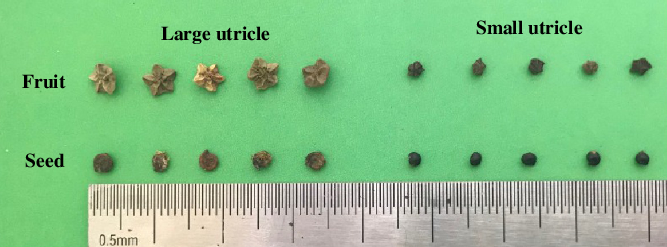
Previous studies have shown that many species of Suaeda may produce dimorphic seeds with different germination characteristics (dormant vs. nondormant), such as Suaeda salsa (L.) Pall. (Song et al. Reference Song, Fan, Zhao, Jia, Du and Wang2008, Reference Song, Shi, Liu, Xu, Sun, Zhou and Feng2017; Wang et al. Reference Wang, Xu, Wang, Shi, Liu, Feng and Song2015), Suaeda acuminata (C. A. Mayer) Moquin-Tandon (Wang et al. Reference Wang, Wang, Tian and Huang2012), seablite [Suaeda aralocaspica (Bunge) Freitag & Shütze] (Wang et al. Reference Wang, Huang, Baskin and Baskin2008), Suaeda corniculata ssp. mongolica (Lomon. & Freitag) (Yang et al. Reference Yang, Baskin, Baskin, Yang, Cao and Huang2015), and Mojave seablite [Suaeda moquinii (Standl.) Standl.] (Khan et al. Reference Khan, Gul and Weber2001). In particular, black seeds of many species of Suaeda are physiologically dormant (Song et al. Reference Song, Fan, Zhao, Jia, Du and Wang2008; Wang et al. Reference Wang, Huang, Baskin and Baskin2008; Yang et al. Reference Yang, Baskin, Baskin, Yang, Cao and Huang2015). Suaeda glauca also produces dimorphic fruits and seeds (Liu Reference Liu1959), with individual plants producing (1) large utricles that are 3.84 to 3.88 mm in diameter, oblate shaped, with a pentagram-shaped persistent perianth, and contain a single brown seed with a soft outer seed coat; and (2) small utricles that are 1.83 to 1.92 mm in diameter, spheroid shaped, with an oblong-shaped persistent perianth, and contain a single black seed with hard and smooth outer seed coat (Figure 1; Table 1). However, little is known about the dimorphic seed germination requirements of S. glauca.
Dimorphic fruits and seeds of large utricles and small utricles of Suaeda glauca.

Morphological characteristics of fruits and seeds of large utricles and small utricles of Suaeda glauca.a

a Data represent the mean ± standard error of the mean (n = 50). For each morphological characteristic, values followed by the different lowercase letters indicate significant differences according to Student’s t-test at P ≤ 0.05.
Seed germination is one of the most important stages in the life cycle of annual plants and is affected by a number of ecological factors, including temperature, light, soil osmotic potential, soil salinity, and soil pH (Awan et al. Reference Awan, Chauhan and Cruz2014; Baskin and Baskin Reference Baskin and Baskin2014; Chauhan Reference Chauhan2016; Wilcut et al. Reference Wilcut, Burke, Thomas and Spears2003). Among these factors, temperature and light are the most important species-specific environmental signals that affect seed germination (Schutte et al. Reference Schutte, Tomasek, Davis, Andersson, Benoit, Cirujeda, Dekker, Forcella, Gonzalez-Andujar and Graziani2014). Soil water availability is a basic requirement for seed germination, and lack of water (water deficiency) will delay or reduce seed germination (Javaid and Tanveer Reference Javaid and Tanveer2014). Soil salinity also influences seed germination (Elsey-Quirk et al. Reference Elsey-Quirk, Middleton and Proffitt2009; Song et al. Reference Song, Fan, Zhao, Jia, Du and Wang2008). It has been demonstrated that increased soil salinity generally decreases germination by causing osmotic stress and/or ionic toxicity (Ahmed and Khan Reference Ahmed and Khan2010). In addition, dormancy may regulate seed germinability and ensures seedling establishment under favorable conditions (Baskin and Baskin Reference Baskin and Baskin1998). However, ecological information on seed germination and seedling emergence of S. glauca is limited.
A better understanding of S. glauca seed germination in relation to ecological factors may contribute to the development of effective managerial practices to control this weed. The primary objectives of this research were to determine: (1) the effect of temperature and light on the germination of both brown and black seeds; (2) whether black seeds are dormant, and if so, what effects cold stratification, seed coat scarification, seed coat removal, gibberellic acid (GA3), and nitrate (NaNO3) might have on germination of black seeds; (3) the effect of salt concentration, solution pH, and osmotic potential on the germination of brown seeds; and (4) the effect of burial depth on seedling emergence of brown seeds.
Materials and Methods
Seed Collection and Preparation
Freshly mature seeds of S. glauca were collected in October 2017 in Dalian, Liaoning Province, China (121.36°E, 38.99°N). Seeds were randomly collected from at least 100 mother plants that produced the same natural population. The seeds were air-dried for 10 d at room temperature, then separated according to their phenotypic characteristics and stored in paper bags at 4 C until the start of all experiments.
Suaeda glauca produces dimorphic fruits and seeds (Figure 1). Morphological characteristics of dimorphic fruits and seeds are given in Table 1. We determined length, width, and height of 50 fruits of each of the two fruit morphs by using a Vernier caliper (MNT-150, Shanghai MNT Tools, Shanghai, PRC). Single fruit mass and seed mass of 50 fruits and seeds were determined by using an electronic analytical balance (Sartorius BP 221S, Sartorius, Germany).
We used dimorphic fruits to complete germination and emergence tests, as the seeds were enclosed tightly by a persistent perianth that was not easily separated. Large utricles (pentagram-shaped fruits) and small utricles (spheroid-shaped fruits) were customarily named as brown and black seeds, respectively.
General Germination Test Protocol
Germination tests were conducted by placing 30 seeds of each seed type in 9-cm-diameter petri dishes containing two layers of Whatman No.1 filter paper (Shanghai Root Biotechnology, Shanghai, PRC) that were moistened with 7 ml of distilled water or test solution. The petri dishes were sealed with Parafilm® PM-996 (Bemis, Neenah, WI) to minimize water evaporation and were placed directly inside incubators (MGC-100P, Shanghai Yiheng Scientific Instrument, Shanghai, PRC) at fluctuating day/night temperatures of 20/10 C under light/dark (12/12 h) conditions, unless otherwise stated. Fluorescent lamps were used to produce a light intensity of 150 μmol m−2s−1 in all experiments. Seeds were considered germinated when the radical length was at least 2 mm. Germinated seeds in each petri dish were counted daily and removed; the dishes were resealed through the end of each test.
Effect of Temperature and Light on Seed Germination
The influence of fluctuating day/night temperatures on germination of dimorphic seeds of S. glauca under a 12-h photoperiod and continuous dark conditions was evaluated. The experiments were conducted in incubators set at alternating day and night temperatures of 15/5, 20/10, 25/15, and 30/20 C (day/night) under a 12-h photoperiod or continuous dark conditions. The dark treatment was administered by immediately wrapping the dishes in two layers of aluminum foil after immersion. These temperature regimes were selected to simulate natural conditions experienced during early spring and summer in the northern cropping region of China. The number of germinated seeds in light conditions was examined daily for 15 d, while the seeds incubated in dark conditions were checked only after 15 d.
Effect of Cold Stratification, Seed Coat Scarification, Seed Coat Removal, GA3, and NaNO3 on Seed Germination
Germination of freshly mature black seeds of S. glauca in all experimental treatments was less than 6%, indicating that a large proportion of black seeds exhibit dormancy. To determine the dormancy type of black seeds, the effects of cold stratification, seed coat scarification, seed coat removal, GA3, and NaNO3 on dormancy-breaking were tested. Cold stratification was achieved according to the method described by Wang et al. (Reference Wang, Huang, Baskin and Baskin2008). The seed coats of black seeds of four replications were carefully scarified with a scalpel on the lenticular seed side, using tweezers under an anatomical microscope. Testa of another four replications were removed carefully. Black seeds of 0-, 4-, and 8-wk cold-stratified (5 C) and testa-treated black seeds (seed coat scarification and testa removal) were incubated at 20/10 C with light/dark (12/12 h) conditions. GA3 solutions of 0, 0.1, 1.0, and 10 mM and NaNO3 solutions of 0.1, 1.0, 10, 50, and 100 mM were prepared and applied.
Effect of Salt Stress on Seed Germination
The effect of different salt concentrations on germination of brown seeds of S. glauca was tested with solutions of 0, 100, 200, 400, 600, 800, 1,000, and 2,000 mM NaCl. Germination percentage was calculated after incubation for 15 d. After 15 d, the nongerminated seeds were rinsed with distilled water for 1 min and were subsequently incubated for 10 d in petri dishes with a two-layer filter paper and containing 5 ml of distilled water. Recovery percentage and final germination percentage were calculated according to the method described by Wang et al. (Reference Wang, Huang, Baskin and Baskin2008).
Effect of Osmotic Stress on Seed Germination
The germination of brown seeds of S. glauca was determined in test solutions with osmotic potentials of 0, −0.1, −0.2, −0.4, −0.6, −0.8, −1.0, and −1.2 MPa. These osmotic solutions were prepared by dissolving 0, 72.5, 112.2, 169.4, 213.6, 284.0, 313.9, and 354.4 g of polyethylene glycol 6000 (Aladdin Manufacturer, Shanghai, PRC) in 1 L of distilled water (Michel and Kaufmann Reference Michel and Kaufmann1973). Germination percentage was calculated after incubation for 15 d. After 15 d, the ungerminated seeds were rinsed with distilled water for 1 min, returned to petri dishes with 5 ml of distilled water, and incubated for 10 d.
Effect of pH on Seed Germination
The germination of brown seeds of S. glauca was investigated under a range of pH values from 4 to 10. Buffer solutions of different pH levels were prepared and applied according to the method described by Chachalis and Reddy (Reference Chachalis and Reddy2000): 2 mM potassium hydrogen phthalate buffer solution was adjusted to pH 4 with 1 N HCl; 2 mM buffer solution of 2-(N-morpholine) ethanesulfonic acid was adjusted to pH 5 or pH 6 with 1 N NaOH; 2 mM solution of N-(2-hydroxymethyl) piperazine-N′-(2-ethanesulfonic acid) was adjusted to pH 7 or pH 8 with 1 N NaOH; 2 mM tricine [N-Tris(hydroxy-methyl) methylglycine] buffer solution was adjusted to pH 9 or pH 10 with 1 N NaOH. Distilled water (pH 7.2) was used as a control. Germination percentage was calculated after incubation for 15 d.
Effect of Burial Depth on Seed Germination
The effect of burial depth of 0, 0.5, 1, 2, 4, 6, and 8 cm on seedling emergence of brown seeds of S. glauca was conducted in an incubator at fluctuating day/night temperature regimes (20/10 C) under light/dark (12/12 h) conditions. Twenty brown seeds were placed either on the soil surface (0-cm depth) or sown in the soil in 10-cm-diameter plastic pots filled with soil according to different burial-depth treatments. Each treatment had four replications. The soil was collected from the location of the mother plant in the natural habitat; it was a gray brown sandy loam with a pH of 7.8. The soil used for the experiment was passed through a 1-mm-mesh metal sieve to remove the background seedbank of S. glauca. Pots were subirrigated with tap water after initial planting to maintain adequate soil moisture, and then watering was repeated weekly. Seedlings were counted as emerged when the cotyledons could be visibly discerned on the soil surface, and the experiment was maintained for 30 d after placement of pots in the growth chamber.
Statistical Analysis
A completely randomized design with four replications was used in all the experiments, and each experiment was repeated at least twice. Data are shown as averages across two experimental runs, because there were no significant treatment by experimental run interactions. Except for morphological characteristics, all data were arcsine square-root transformed before statistical analysis to ensure homogeneity of variance. The data were subjected to ANOVA using SPSS software (v. 19.0, IBM, Armonk, NY). Means were separated using Tukey’s HSD test or Student’s t-test at P ≤ 0.05.
Nonlinear regression analysis was used to determine relationships between brown seed germination and different NaCl concentrations or osmotic potentials. Germination percentage (%) at different NaCl concentrations and osmotic potentials was fit to a functional three-parameter logistic model by using SigmaPlot (v. 12.5, Systat Software, Point Richmond, CA) (Chauhan et al. Reference Chauhan, Gill and Preston2006a). The fitted model was as follows:
 $$G\left( \% \right) = {G_{{\rm{max}}}}/\left[ {1 + {{\left( {x/{x_{50}}} \right)}^G}^{{\rm{rate}}}} \right]$$
In this equation, G is the total germination percentage (%) at NaCl concentration or osmotic potential x, G max is the maximum germination (%), x 50 is the NaCl concentration or osmotic potential required for 50% inhibition of the maximum germination, and G rate indicates the slope.
The seedling emergence value (%) obtained at different burial depths was analyzed by using a three-parameter sigmoid model (Zhao et al. Reference Zhao, Li, Guo, Zhang, Ge and Wang2018). The fitted model was as follows:
 $$E\left( \% \right) = {E_{{\rm{max}}}}/\left\{ {1 + {\rm{exp}}\left[ { - \left( {x - {x_{50}}} \right)/e} \right]} \right\}$$
where E is the ultimate seedling emergence (%) at burial depth x, E max is the maximum seedling emergence (%), x 50 is the depth where 50% of maximum seedling emergence is reached, and e indicates the slope.
Results and Discussion
Effects of Temperature and Light
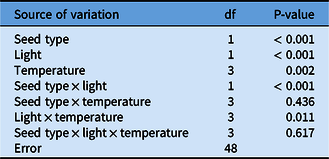
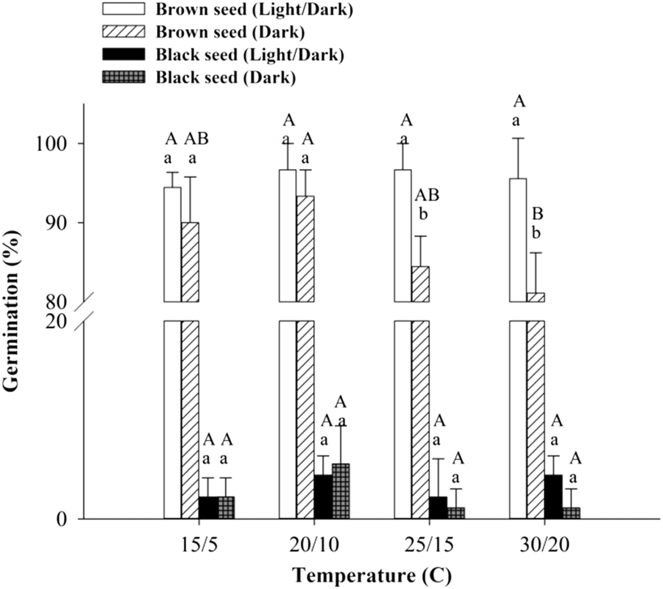
The three-way ANOVA analysis showed that germination was not influenced by the interaction of seed types, temperature regimes, and light conditions (P = 0.617). However, germination was significantly affected by the interaction of seed types and light conditions (P < 0.001) and the interaction of light conditions and temperature regimes (P = 0.011; Table 2). Germination percentage of dimorphic seeds ranged from 1% to 97%, depending on seed types, temperature regimes, and light conditions (Figure 2). Compared with the black seeds of S. glauca, the brown seeds showed higher germination percentages (81% to 97%) in all alternating temperatures and light conditions. This trend has also been observed in the germination characteristics of dimorphic seeds of other Suaeda species, including S. salsa (Song et al. Reference Song, Fan, Zhao, Jia, Du and Wang2008), S. acuminata (Wang et al. Reference Wang, Wang, Tian and Huang2012), S. aralocaspica (Wang et al. Reference Wang, Huang, Baskin and Baskin2008), S. corniculata ssp. mongolica (Cao et al. Reference Cao, Baskin, Baskin, Yang and Huang2012), and S. moquinii (Khan et al. Reference Khan, Gul and Weber2001).
Three-way ANOVA results for effect of seed type, temperature, light condition, and their interactions on seed germination of Suaeda glauca.

Effect of temperature and light on germination of dimorphic seeds of Suaeda glauca. Data represent the mean ± standard error of the mean (n = 8). Different lowercase letters indicate significant differences between light/dark (12/12 h) conditions and continuous dark conditions within each seed type at the same temperature regimes according to Student’s t-test at P≤0.05. Different uppercase letters indicate significant differences across all tested temperature regimes for the same seed type under the same photoperiod conditions according to Turkey’s HSD test at P≤0.05.

In the present study, the germination of brown seeds (P = 0.011) was affected by the interaction of light conditions and temperature regimes. In the light, changes in temperature regimes (P = 0.128) did not affect the germination of brown seeds, which indicates that brown seeds germinated more than 94% in all temperature regimes. Similar thermoperiod responses have also been reported for S. corniculata ssp. mongolica (Cao et al. Reference Cao, Baskin, Baskin, Yang and Huang2012) and S. moquinii (Khan et al. Reference Khan, Gul and Weber2001). In contrast, the germination percentage of brown seeds of S. acuminata (Wang et al. Reference Wang, Wang, Tian and Huang2012) and S. aralocaspica (Wang et al. Reference Wang, Huang, Baskin and Baskin2008) was significantly affected by the different thermoperiod. For example, the germination percentage of brown seeds of S. aralocaspica was more than 87% at higher temperature regimes (25/5, 25/10, 30/15, and 35/20 C) and significantly decreased at a low thermoperiod of 15/5 C (Wang et al. Reference Wang, Huang, Baskin and Baskin2008). In continuous dark conditions, the germination percentage of brown seeds of S. glauca was significantly affected by changes in temperature regimes (P < 0.001). The low thermoperiods (90% and 93% at 15/5 and 20/10 C, respectively) were better for the germination of brown seeds of S. glauca than the high thermoperiods (84% and 81% at 25/15 and 30/20 C, respectively) (Figure 2). These results indicated that freshly matured brown seeds of S. glauca are nondormant and germinated to high percentages in both light and darkness across a wide range of temperature regimes. Furthermore, the results also implied that brown seeds would have high germination under cooler thermoperiods of early spring relative to a warmer time of year.
Germination of black seeds was not influenced by light conditions in all temperature regimes (P = 0.197). The germination percentage of black seeds was less than 6% in light and dark conditions at all temperature regimes. The low germination percentage of black seeds has also been reported for S. acuminata (Wang et al. Reference Wang, Wang, Tian and Huang2012), with germination less than 7%. In contrast, the black seeds of both S. corniculata ssp. mongolica (Cao et al. Reference Cao, Baskin, Baskin, Yang and Huang2012) and S. moquinii (Khan et al. Reference Khan, Gul and Weber2001) had high germination percentages that were affected significantly by different temperature regimes. For example, Cao et al. (Reference Cao, Baskin, Baskin, Yang and Huang2012) observed that freshly matured black seeds of S. corniculata ssp. mongolica germinated at higher percentages (>75%) at high thermoperiods of 15/25 and 15/30 C in light. However, the highest germination percentage (95%) was detected for black seeds of S. moquinii at a low thermoperiod of 5/15 C (Khan et al. Reference Khan, Gul and Weber2001). These results indicated that black seeds of S. glauca are more insensitive to changes in temperature regimes in the light and darkness. Thus, black seeds are dormant and contribute to the formation of a persistent soil seedbank. Based on the germination responses of dimorphic seeds of S. glauca to temperature and light, it is likely that brown seeds contribute to spring seedling establishment and that black seeds play an important role in the formation of a persistent soil seedbank.
Response of Dormant Black Seeds to Cold Stratification, NaNO3 Solutions, Testa Treatment, and GA3 Solutions
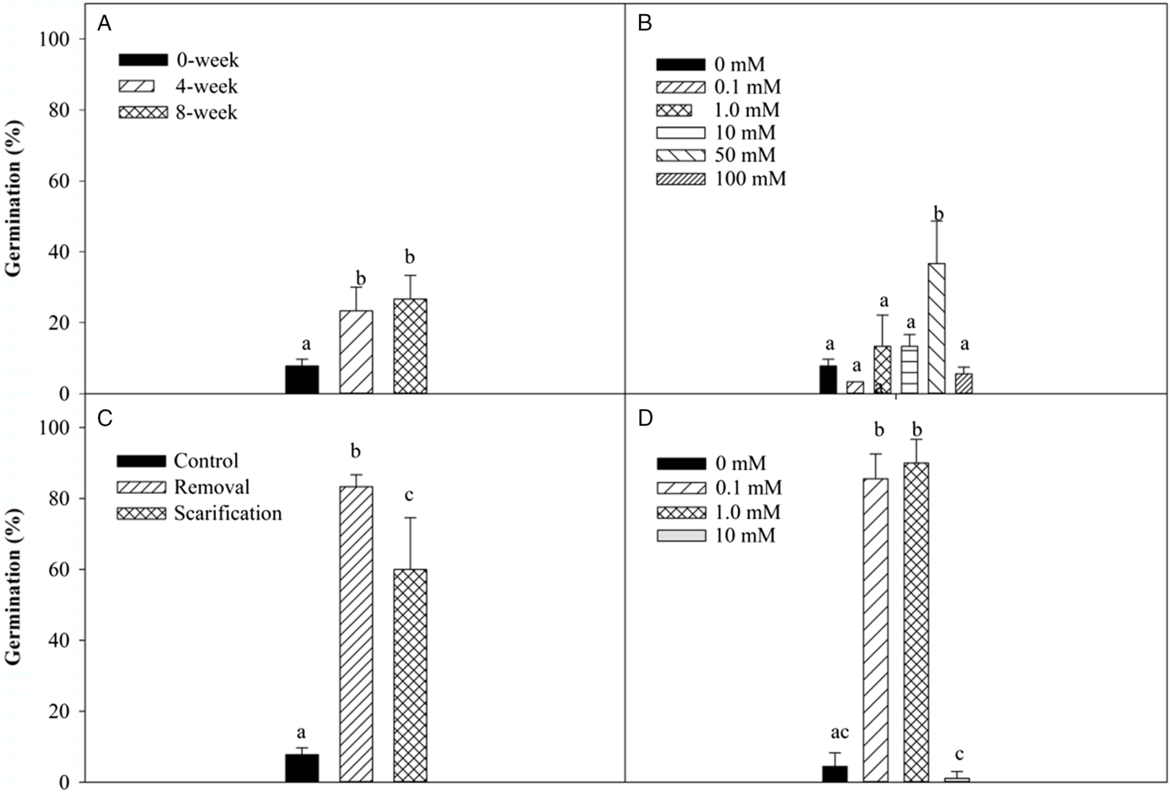
Germination of black seeds was significantly affected by cold stratification (P = 0.006), NaNO3 concentration (P < 0.001), testa treatment (P < 0.001), and GA3 concentration (P < 0.001; Figure 3). The results showed that black seeds that had been stratified for 8 wk germinated to 27% when compared with the control (8%). The treatment with a 50 mM NaNO3 solution increased germination of black seeds to 37%. Although both cold stratification and NaNO3 significantly increased the germination of black seeds, total germination did not exceed 40%. In contrast, scarification and testa removal notably increased germination percentage of black seeds to 60% and 90%, respectively. At GA3 concentrations of 0.1 mM and 1 mM, more than 85% of black seeds germinated. According to our data, we found that the process of 8-wk cold stratification did not break the dormancy of black seeds, whereas the GA3 and testa treatments could significantly promote germination, and excised embryos produced normal seedlings. Based on these characteristics, we concluded that black seeds of S. glauca have an intermediate PD (physiological dormancy) as classified by Baskin and Baskin (Reference Baskin and Baskin2014). Intermediate PD has also been reported for the black seeds of S. acuminata (Wang et al. Reference Wang, Wang, Tian and Huang2012), but the highest germination percentage in that study only reached 16% at a concentration of 1 mM GA3. In addition, the dormancy type of black seeds of S. glauca is also different from that of black seeds of both S. aralocaspica (Wang et al. Reference Wang, Huang, Baskin and Baskin2008) and S. corniculata ssp. mongolica (Cao et al. Reference Cao, Baskin, Baskin, Yang and Huang2012), which exhibit a non-deep type PD and germination that could be significantly promoted by short periods of cold stratification (<8 wk).
Effect of (A) cold stratification, (B) nitrate concentrations, (C) testa treatment, and (D) gibberellic acid concentrations on germination of black seeds of Suaeda glauca. Data represent the mean ± standard error of the mean (n = 8). Different lowercase letters indicate significant differences in the given dormancy-breaking method according to Turkey’s HSD test at P ≤ 0.05.

Effect of Salt Stress
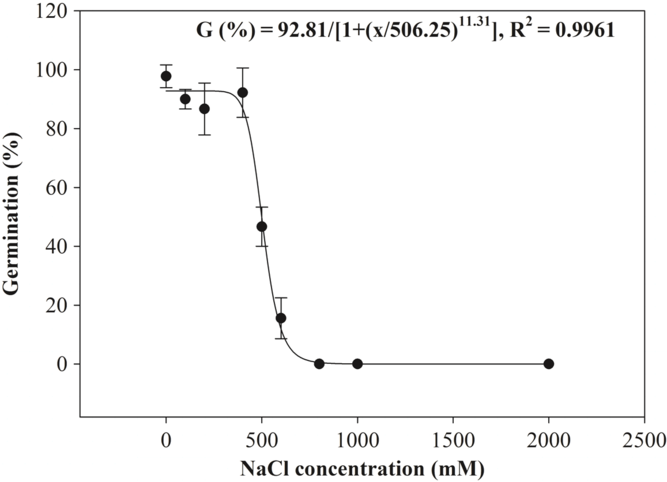
The three-parameter logistic model provided an appropriate fit for the response of seed germination to different NaCl concentrations (Equation 1). The germination percentage of brown seeds decreased with increasing NaCl concentration (Figure 4). At the end of the experiment, germination was more than 85% at <400 mM NaCl and sharply decreased to 16% at 600 mM NaCl. Germination was completely inhibited at 800 mM NaCl. However, it is known that the salt tolerance limits of the halophytes are species specific (Ungar Reference Ungar1995). The limit of salt tolerance of brown seeds has also been reported in dimorphic seeds of other Suaeda species. For example, S. moquinii showed 30% germination at 1,000 mM NaCl (Khan et al. Reference Khan, Gul and Weber2001), S. corniculata ssp. mongolica had 20% germination at 1,200 mM NaCl (Cao et al. Reference Cao, Baskin, Baskin, Yang and Huang2012), and S. aralocaspica was reported to have 10% germination at 1,400 mM NaCl (Wang et al. Reference Wang, Huang, Baskin and Baskin2008). Our results showed that the brown seeds of S. glauca were moderately tolerant to NaCl according to the description of Khan (Reference Khan, Hamdy, Lieth and Todorovis1999), as they could germinate at 500 mM NaCl. In the present study, the parameter x 50, which represents the NaCl concentration for 50% inhibition of the maximum germination, was 506.3 mM NaCl, which is higher than that of other salt-tolerant weeds, such as winged sea lavender [Limonium lobatum (L.f.) Chaz] (Kleemann and Gill Reference Kleemann and Gill2018) and foxtail sophora (Sophora alopecuroides L.) (Nosratti et al. Reference Nosratti, Amiri, Bagheri and Chauhan2018) with x 50 for germination of 230 mM and 220 mM NaCl, respectively.
Effect of NaCl concentration on germination of brown seeds of Suaeda glauca incubated at 20/10 C under light/dark (12/12 h) conditions for 15 d. The line represents a three-parameter logistic model, G (%) = G max/[1 + (x/x 50)Grate], fit to the data. Data represent the mean ± standard error of the mean (n = 8).

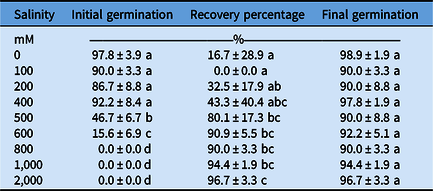
In our study, nongerminated brown seeds under salt-stress conditions were rinsed and transferred to distilled water, and the final germination percentage was more than 90% in all test salt solutions (Table 3). These results suggested that exposure to higher salt solutions for 15 d did not have an adverse influence on brown seed vigor, and the enforced delayed germination was due to the osmotic effect of high salt concentration. Khan and Ungar (Reference Khan and Ungar1997) found that the recovery percentage of ungerminated seeds differed significantly, with variations among species and thermoperiods. Similar to our results, the brown seeds of S. moquinii showed a high recovery percentage after the removal of salt stress (Khan et al. Reference Khan, Gul and Weber2001). In contrast, Wang et al. (Reference Wang, Huang, Baskin and Baskin2008) reported that the brown seeds of S. aralocaspica were not completely germinated after the alleviation of salinity, and the recovery percentage significantly decreased with the increase in pretreatment concentration of NaCl, and about 59% to 97% of brown seeds were recovered. Based on these results, it is likely that the brown seeds of S. glauca showed obvious salt-avoidance characteristics and maintained high germinability when salinity was reduced. Ungar (Reference Ungar1996) reported that seed survival, rather than germination, may be a more appropriate criterion for evaluating the success of plants under hypersaline conditions.
Effects of NaCl on germination and germination recovery of brown seeds of Suaeda glauca incubated at temperature regimes of 20/10 C under light/dark (12/12 h) conditions.a

a Data represent the mean ± standard error of the mean (n = 8). Values followed by different lowercase letters in each column indicate significant differences across all concentrations of NaCl according to Turkey’s HSD test at P≤0.05.
Effect of Osmotic Potential
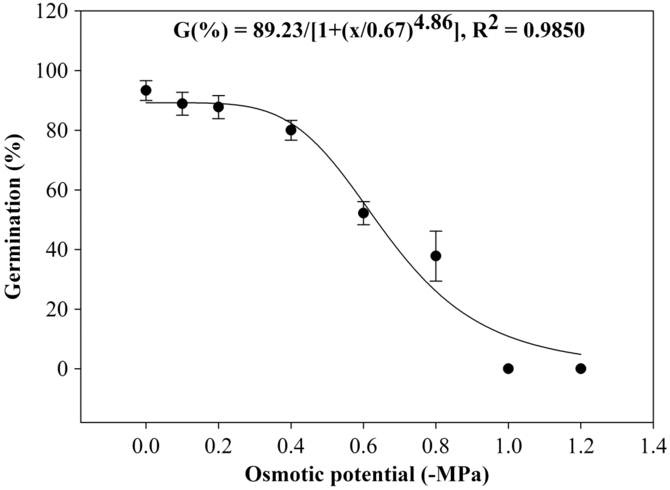
Germination of brown seeds of S. glauca was significantly influenced by the different osmotic potentials (P < 0.001). The three-parameter logistic model was fit to the germination percentage obtained at different osmotic potentials (Equation 1). Seed germination decreased from 93% to 38% with the decrease in osmotic potentials from 0 to −0.8 MPa (Figure 5). Germination was completely inhibited at an osmotic potential of −1.0 MPa or lower. The osmotic potential required for 50% inhibition of maximum germination was −0.67 MPa, which is considerably greater than the values reported for common lambsquarters (Chenopodium album L.) that grow under arid and semiarid climatic conditions (Eslami Reference Eslami2011). These results suggested that brown seeds were highly tolerant to water stress. Therefore, it is likely that S. glauca can adapt to the arid and semiarid environmental conditions of northern China and may spread to larger areas as a consequence of climate change.
Effect of osmotic potential on germination of brown seeds of Suaeda glauca incubated at 20/10 C under light/dark (12/12 h) conditions for 15 d. The line represents a three-parameter logistic model, G (%) = G max/[1 + (x/x 50)Grate], fit to the data. Data represent the mean ± standard error of the mean (n = 8).

When nongerminated brown seeds were transferred from the osmotic potential of −1.2 MPa to distilled water, the germination percentage was 78 ± 9.0%. Similar to our results, tolerance to water stress by maintaining seed quiescence has been reported in some weed species, including shortawn foxtail (Alopecurus aequalis Sobol.) (Zhao et al. Reference Zhao, Li, Guo, Zhang, Ge and Wang2018), feather fingergrass (Chloris virgata Sw.) (Fernando et al. Reference Fernando, Humphries, Florentine and Chauhan2016), spiny amaranth (Amaranthus spinosus L.), slender amaranth (Amaranthus viridis L.) (Chauhan and Johnson Reference Chauhan and Johnson2009), and eclipta [Eclipta prostrata (L.) L.] (Chauhan and Johnson Reference Chauhan and Johnson2008a).
Effect of pH
The one-way ANOVA showed that no significant difference (P = 0.225) was observed in the germination percentage of brown seeds incubated at different pH solutions (data not shown). The germination percentage at all tested pH solutions were >95%. The results showed that pH should not be a limiting factor for the germination of brown seeds in most soil types. Similar results were observed in other weed species, such as American sloughgrass [Beckmannia syzigachne (Steud.) Fernald] (Rao et al. Reference Rao, Dong, Li and Zhang2008), Indian goosegrass [Eleusine indica (L.) Gaertn.] (Chauhan and Johnson Reference Chauhan and Johnson2008b), and Asia Minor bluegrass (Polypogon fugax Nees ex Steud.) (Tang et al. Reference Tang, Xu, Shen and Chen2015). Seeds of the four species germinated well (>80%) in a wide pH range between 4 and 10.
Effect of Burial Depth on Seed Germination
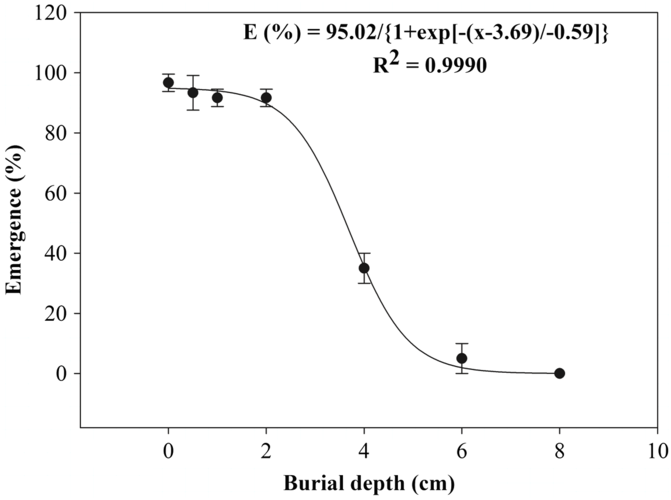
Seedling emergence of brown seeds of S. glauca was significantly influenced by seed burial depth (P < 0.001). Maximum seedling emergence (97%) was obtained for brown seeds placed on the soil surface. Seedling emergence of brown seeds was slightly reduced when seed burial depth increased from 0 to 2 cm, but decreased sharply when the burial depth was >2 cm, and brown seeds failed to emerge at the burial depth of 8 cm (Figure 6). According to the fitted three-parameter sigmoid model (Equation 2), the depth required for 50% inhibition of the maximum seedling emergence was estimated to be 3.7 cm. Similar to our results, a decrease in seedling emergence with increasing burial depth has been reported in many weed species (Schutte et al. Reference Schutte, Tomasek, Davis, Andersson, Benoit, Cirujeda, Dekker, Forcella, Gonzalez-Andujar and Graziani2014; Zhao et al. Reference Zhao, Li, Guo, Zhang, Ge and Wang2018).
Effect of burial depth on emergence of brown seeds Suaeda glauca incubated at 20/10 C under light/dark (12/12 h) conditions for 30 d. The line represents a three-parameter sigmoid model, E (%) = E max/{1 + exp[−(x − x 50)/e]}, fit to the data. Data represent the mean ± standard error of the mean (n = 8).

Light and seed size may be the main limiting factors for restricting seedling emergence from deeper burial depths in the soil (Chauhan et al. Reference Chauhan, Gill and Preston2006b). In temperature and light/dark experiments, the results indicated that light is not necessary for brown seeds germination at low-temperature regimes (15/5 and 20/10 C), as >90% of brown seeds germinated in continuous dark conditions (Figure 2). The results suggested that light was not a limiting factor for brown seed germination in the burial-depth experiment, but its single seed is small, and an average single brown seed weight is only 2.7 mg (Table 1). Baskin and Baskin (Reference Baskin and Baskin1998) reported that small-seeded species with lower carbohydrate reserves have a limited ability to emerge from deeper burial depths compared with species with larger seeds. Similar to our results, it was reported that seedlings could emerge from burial depths of 0 to 4 cm for spear saltbush (Atriplex patula L.) and red goosefoot (Chenopodium rubrum L.), the two species belonging to the Chenopodiaceae family (Galinato and Van der Valk Reference Galinato and Van der Valk1986). Based on the data in the current study, seedling emergence of brown seeds of S. glauca was optimal at shallow burial depths (0 to 2 cm), and it indicated that farming practices that cause seed burial beyond that depth (3.7 cm) in the soil profile would minimize seedling emergence and reduce seedling density.
In conclusion, our results showed that dimorphic seeds of S. glauca significantly differ in the shape of the persistent perianth, fruit size, fruit weight, seed weight, seed coat color, and germination/dormancy traits. Brown seeds are nondormant and achieved a high germination percentage in all temperature regimes from 15/5 to 30/20 C (day/night), with optimum germination at 20/10 C. However, the germination of brown seeds was insensitive to the photoperiod conditions at cold fluctuating temperatures (15/5 and 20/10 C), whereas it was slightly inhibited in darkness at warm fluctuating temperatures (25/15 and 30/20 C). Brown seeds were moderately tolerant to salt stress and highly tolerant to water stress, with germination percentages of 16% and 38% at a concentration of 600 mM NaCl and osmotic potential of −0.8 MPa, respectively. Brown seeds were able to germinate in a wide pH range between 4 and 10. Maximum seedling emergence of brown seeds (>90%) occurred at burial depths of 0 to 2 cm. These findings suggest that the germination of brown seeds of S. glauca occurs primarily at cold alternating temperatures in the early spring.
On the other hand, black seeds have deep dormancy characteristics and exhibited a low germination percentage (<6%) in all incubation conditions. The dormancy was not broken by 8-wk cold stratification but was easily broken by testa removal, scarification, and low-concentration GA3 solutions. These results suggest that black seeds have an intermediate PD, which extends the germination period and forms a persistent soil seedbank.
It is likely that the different germination characteristics of dimorphic seeds allow S. glauca to achieve greater competitive ability than other weed species, minimizing the adverse effects of environmental fluctuations. Previous studies have shown that seed dimorphism provides a mechanism to enable the species to survive and persist in uncertain habitats, such as disturbed agricultural fields (Nurse et al. Reference Nurse, Reynolds, Doucet and Weaver2008). The current study adds valuable information to the understanding of the germination biology of S. glauca, which will be useful in the development of appropriate management practices.
Acknowledgments
This research was funded by the Educational Department of the Liaoning Province (L201683673), the Natural Science Foundation of Liaoning Province (2019-ZD-0466), and the National Natural Science Foundation of China (no. 31400009). We would like to thank Editage (www.editage.cn) for English language editing. No conflicts of interest have been declared.