Introduction
Thyroid gland surgery requires a comprehensive knowledge of the anatomy of the anterior and lateral regions of the neck, the pharyngeal and laryngeal structures, and any anatomical variations. Attention must be paid to the vascularisation of the thyroid gland and to the location of the parathyroid glands and, in particular, the laryngeal nerves. Besides rare haemorrhagic or infective complications, thyroid surgery may also induce voice disorders, which are generally transitory but sometimes permanent. The latter usually occur as a result of nerve lesions. Recurrent laryngeal nerve palsy is a serious complication which can induce significant voice disorders, swallowing difficulties, respiratory disorders and serious social problems.
A number of studies have demonstrated the need to dissect the recurrent laryngeal nerve correctly in order to avoid damage during surgery.Reference Cagnol, Santini and Demard1–Reference Sun, Zhao, Lu, He, Ran and Peng6
Here, we report three cases of a non-recurrent laryngeal nerve, and we discuss this type of anatomical variation, which may well represent a trap for the unwitting thyroid surgeon.
Population and method
From January 1992 to July 2005, 993 patients (773 females and 220 males) underwent thyroid surgery in our ENT and head and neck surgery department. A total of 634 total thyroidectomies and 289 unilateral lobectomies were performed (153 right lobectomies). A total of 1557 recurrent laryngeal nerves were exposed.
The pathological findings were as follows: multinodular goitre, 80 per cent; single nodular goitre, 3 per cent; Grave's disease, 7 per cent; and thyroid cancer, 5 per cent.
Results
A total of 887 right recurrent laryngeal nerves were exposed. Three nerves appeared to be non-recurrent.
Case one
A 65-year-old woman underwent right lobectomy because of a single, suspect nodule in the right thyroid lobe. A non-recurrent laryngeal nerve (type I) on the right side was found during thyroid surgery. It was associated with an atrophic inferior thyroid artery. No recurrent laryngeal palsy or voice disorders occurred following surgery.
Case two
A 59-year-old woman (with no previous history of serious disease) underwent total thyroidectomy because of multinodular goitre. During thyroid surgery, a non-recurrent laryngeal nerve (type I) was found on the right side. No recurrent laryngeal palsy or voice disorders occurred following surgery.
Case three
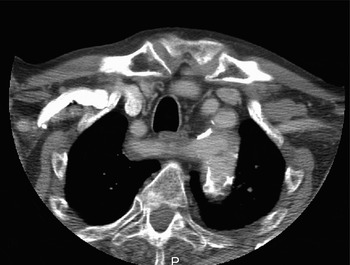
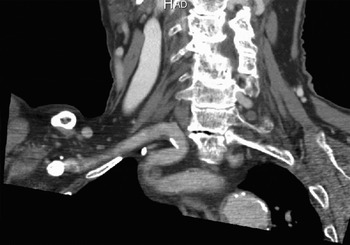
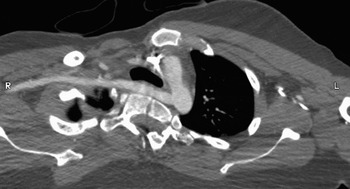
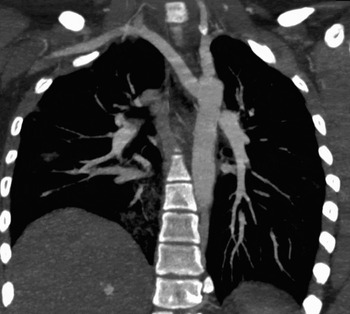
An 80-year-old man underwent total thyroidectomy for benign, multinodular goitre and conservative resection of a sarcoma of the cricoid cartilage. The pre-operative scan showed a retro-oesophageal right subclavian artery. During surgery, a type I non-recurrent laryngeal nerve was found (Figures 1, 2, 3, and 4).
High-resolution cervico-thoracic computed tomography scan; frontal plane reconstruction showing multinodular goitre associated with sarcoma of the cricoid cartilage. The vascular loop of the arteria lusoria is shown.

High-resolution cervico-thoracic computed tomography scan; frontal plane reconstruction showing the ‘aberrant’ arteria lusoria. The left part of the multinodular goitre and the sarcoma of the cricoid cartilage are visible.

High-resolution cervico-thoracic computed tomography scan showing a retro-oesophageal right subclavian artery arising from the dorsal part of the aortic arch.

High-resolution cervico-thoracic computed tomography scan; curved reconstruction showing the route of the arteria lusoria.

Discussion
History
A non-recurrent laryngeal nerve was first described by Stedman in 1823, cited by Avisse et al. Reference Avisse, Marcus, Delattre, Marcus, Cailliez-Tomasi and Palot7 In 1926, Pemberton and BeaverReference Pemberton and Beaver8 emphasised the fact that this variation may represent a surgical risk, especially during thyroid surgery. In 1935, BerlinReference Berlin9 reported this anomaly on the left side in a case of situs inversus (cadaver dissection). Since then, cases of non-recurrent laryngeal nerve have been reported intermittently over the years.
Embryology
The embryonic pathophysiology of this condition is well known.Reference Cagnol, Santini and Demard1, Reference Reeve, Coupland, Johnson and Buddee5, Reference Avisse, Marcus, Delattre, Marcus, Cailliez-Tomasi and Palot7, Reference Ardito, Manni, Vicenzoni, Modugno and Guidi10–Reference Wijetilaka15
In developmental terms, the recurrent laryngeal nerve is the nerve of the sixth branchial arch and is associated with the sixth arch arteries. The ventral part of the sixth arch arteries becomes the pulmonary arteries. The dorsal part of the sixth arch arteries disappears, releasing the recurrent laryngeal nerve, which then has to ascend to the larynx. The fifth arch arteries disappear early on, and so the recurrent laryngeal nerve is hooked by the fourth arch vessels. The fourth arches on the right and left sides become the subclavian artery and the aortic arch, respectively.
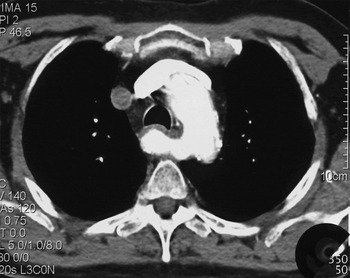
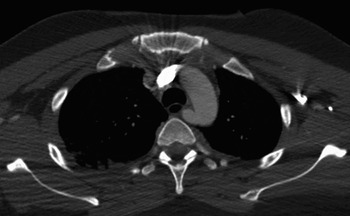
In a few instances, the fourth arch on the right side disappears and the right subclavian artery arises from the dorsal part of the aortic arch.Reference Wijetilaka15 In such cases, the right recurrent laryngeal nerve does not have a recurrent route and directly joins the larynx. Hence, the right subclavian artery follows an abnormal route to the right upper limb, usually passing behind the oesophagus (80 per cent of cases), sometimes between the trachea and the oesophagus (15 per cent of cases), and, exceptionally, in front of the trachea (5 per cent of cases).Reference Cagnol, Santini and Demard1 This condition is called arteria lusoria (Figures 5, 6, 7, and 8).
A routine, high-resolution, thoracic computed tomography scan, showing a retro-oesophageal right subclavian artery arising from the dorsal part of the aortic arch.

A routine, high-resolution, thoracic computed tomography scan, showing the origin of a retro-oesophageal right subclavian artery arising from the dorsal part of the aortic arch.

High-resolution cervico-thoracic computed tomography scan; curved reconstruction showing the route of an arteria lusoria. The retro-oesophagal route is shown.

High-resolution cervico-thoracic computed tomography scan; frontal plane reconstruction showing the route of an arteria lusoria.

Anatomy
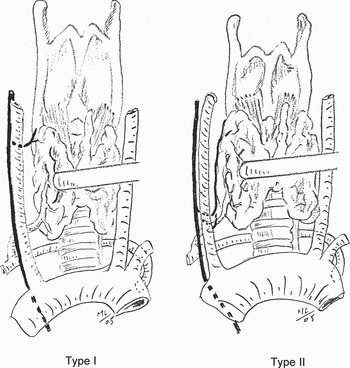
Presentation of the non-recurrent laryngeal nerve may vary. Two main types of trajectory are usually described, as follows (Figure 9). The high type of non-recurrent laryngeal nerve (i.e. type I) arises perpendicularly from the vagal nerve trunk to join the laryngotracheal junction transversally via a short route. The low type of non-recurrent laryngeal nerve (i.e. type II) originates from the vagal nerve trunk (from varying sites) and describes a supero-external concavity before reaching the tracheoesophageal groove. In such an instance, the nerve may meet the inferior thyroid artery rather than passing underneath it, as it usually does.Reference Cagnol, Santini and Demard1
Types I and II non-recurrent laryngeal nerves.

Frequency of occurrence
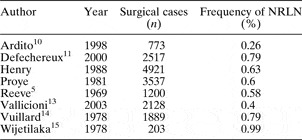
Literature reports of the frequency of cases of non-recurrent laryngeal nerve vary, but it is agreed that the anomaly is rare (0.25–0.99 per cent)Reference Reeve, Coupland, Johnson and Buddee5, Reference Ardito, Manni, Vicenzoni, Modugno and Guidi10, Reference Defechereux, Albert, Alexandre, Bonnet, Hamoir and Meurisse11, Reference Proye, Dumont, Depadt and Lagache12, Reference Vallicioni, Ndiaye, Poissonnet, Dassonville, Converset and Lecoq13, Reference Vuillard, Bouchet, Gouillat and Armand14, Reference Wijetilaka15, Reference Henry, Audiffret, Denizot and Plan16 (Table I). We found three cases out of 887 right thyroidectomies (0.34 per cent).
Reports of frequency of non-recurrent laryngeal nerve (NRLN)

However, this frequency is based on our observation of thyroid surgery patients, and may differ in the general population.
Positive diagnosis
Like other authors, we consider that a non-recurrent laryngeal nerve should be on the right side and should always be associated with an arteria lusoria,Reference Cagnol, Santini and Demard1, Reference Flament, Delattre and Palot2, Reference Avisse, Marcus, Delattre, Marcus, Cailliez-Tomasi and Palot7 as explained by the embryology. Hence, non-recurrent laryngeal nerves on the left side (except in cases of situs inversus) or those with normal supra-aortic vessels are ‘false’ non-recurrent laryngeal nerves. Raffaelli et al. Reference Raffaelli, Iacobone and Henry17 emphasised this fact and demonstrated the existence of sympathetic-recurrent laryngeal anastomotic branches, which may have the same diameter as the recurrent laryngeal nerve and the same route as a non-recurrent laryngeal nerve. In terms of diagnosis, we consider that the rarity of the anomaly means that systematic, pre-operative identification via medical imaging is not relevant, even when technically possible,Reference Deveze, Sebag, Hubbard, Jaunay, Maweja and Henry18, Reference Nagayama, Okabe, Katoh and Furukawa19 and even though it is very helpful when a retro-oesophageal right subclavian artery is discovered (as in case three above).
• This paper highlights the rare anatomical variation of non-recurrent laryngeal nerve, and emphasises the implications for thyroid surgery
• Out of a total of 1557 nerves dissected during thyroid surgery, three non-recurrent laryngeal nerves were found on the right side, associated with a retro-oesophageal subclavian artery
• The recurrent laryngeal nerve must be carefully dissected and totally exposed during thyroid surgery in order to best preserve its function
• The thyroid surgeon must be aware of the existence of anatomical variations
Surgical technique
Complete dissection and exposure of the recurrent laryngeal nerve is an absolute requirement in thyroid surgery. With the exception of the middle thyroid veins, no anatomical structures passing medially from the carotid sheath should be divided or sectioned until the recurrent laryngeal nerve has been identified. If, at this stage, a recurrent laryngeal nerve is not found in the normal position on the right side (and especially when an anomaly of the inferior thyroid artery is found), a non-recurrent laryngeal nerve should be sought.Reference Cagnol, Santini and Demard1, Reference Avisse, Marcus, Delattre, Marcus, Cailliez-Tomasi and Palot7, Reference Defechereux, Albert, Alexandre, Bonnet, Hamoir and Meurisse11, Reference Deveze, Sebag, Hubbard, Jaunay, Maweja and Henry18
In one of our cases, we expected to find a non-recurrent laryngeal nerve; we first attempted to find it at its laryngeal penetration, instead of searching for it at the intersection with the inferior thyroid artery (which was atrophic).
The recurrent laryngeal nerve has several other anatomical variations which should be considered when performing the dissection.Reference Cagnol, Santini and Demard1, Reference Deveze, Sebag, Hubbard, Jaunay, Maweja and Henry18, Reference Nagayama, Okabe, Katoh and Furukawa19 The anatomical relationship between the inferior thyroid artery and the recurrent laryngeal nerve is highly variable on the right (and sometimes even the left) side. Precise, careful dissection must be performed on both sides. Moreover, the recurrent laryngeal nerve may have a number of branches which, ideally, should all be identified and avoided when present.
Conclusion
The recurrent laryngeal nerve must be carefully dissected and totally exposed during thyroid surgery in order to best preserve its function. Moreover, the thyroid surgeon must be aware of the existence of anatomical variations, which are not as rare as one may think.
Acknowledgements
We especially thank Dr Maurice Laude for his helpfulness and the quality of his drawing.