Anaerobic spore-forming bacteria (ASFB) are important spoilage organisms in a variety of dairy foods. Indeed, the anaerobic interior in semi-hard and hard cheeses provides a favorable environment for some Clostridium species that metabolise lactate into hydrogen gas, resulting in ‘late blowing’ defects (Miller et al. Reference Miller, Kent, Boor, Martin and Wiedmann2015). Gas defects in cheese may be caused by Clostridium tyrobutyricum, C. beijerinckii, C. butyricum, and also by C. sporogenes, which can produce gas through proteolysis (Doyle et al. Reference Doyle, Gleeson, Jordan, Beresford, Ross, Fiztgerald and Cotter2015).
Late blowing is seen as cracks and slits in the cheese paste associated with abnormal aroma and flavor. It is a defect that can be found in some types of European cow milk cheeses, many of them made with unpasteurised cow milk, such as Grana Padano, Parmigiano Reggiano, Edam, Saint-Nectaire, Gouda, Emmental, Gruyer, Comte and sheep milk cheese Machengo (Gómez Torres et al. Reference Gómez Torres, Garde, Peirot and Avila2015). In Grana Padano production, late blowing causes a notable loss in cheese production, affecting from 15 to 35% of cheese wheels according to Borreani & Tabacco (Reference Borreani and Tabacco2008). Conversely Garde et al. (Reference Garde, Arias, Gaya and Nuñez2011), in a study on Manchego cheese made with ovine milk, reported that 0·63% of the total summer cheese production was affected by late blowing, despite the fact that 91% of the milk samples showed an MPN spore count above the level recommended to avoid late blowing defect in ovine milk cheese.
A recent study on Grana Padano by Feligini et al. (Reference Feligini, Brambati, Panelli, Ghitti, Sacchi, Capelli and Bonacina2014) showed a highly significant effect of season on the Clostridium spp. population: during winter C. butyricum and C. sporogenes prevailed in curd and milk respectively; during spring the clostridial population was very closely associated with C. tyrobutyricum, while in summer and autumn C. beijerinckii dominated. According to the authors of this study, the species distribution over the seasons suggests that the blowing defect in Grana Padano might not be due to the metabolic activity of a single species, but could depend on the synergistic action of several spore-formers transferred into the milk.
For milk, the most important sources of spore contamination are soil, feed (especially ensiled forages), bedding materials and faeces (Zucali et al. Reference Zucali, Bava, Colombini, Brasca, Decimo, Morandi, Tamburini and Crovetto2015). The transfer of spores from soil to crops during cropping and harvesting results in spore contamination of silage. Moreover, spore concentrations can increase during storage in the silo, this depending on the conditions prevailing in the silage and the requirements of the microorganisms (Driehuis, Reference Driehuis2013). Spores ingested by the animals pass through the digestive tract and are excreted with the faeces, causing contamination of bedding materials and teat skin, with subsequent possible entry into the milk at milking time. Indeed, bedding material can act as a reservoir for ASFB, as shown by Magnusson et al. (Reference Magnusson, Christiansson, Svensson and Kolstrup2006).
Vissers et al. (Reference Vissers, Driehuis, Te Giffel, De Jong and Lankveld2007a) studied the transmission of microorganisms to milk via dirt (i.e., faeces, bedding material, soil, or their combination) attached to the exterior of the teats. They concluded that although spore concentration in faeces is the major factor affecting the butyric acid bacteria spore concentration in bulk tank milk, teat hygiene could considerably reduce the risk of contamination. In a recent review Doyle et al. (Reference Doyle, Gleeson, Jordan, Beresford, Ross, Fiztgerald and Cotter2015) concluded that good quality silage, stringent cleaning routines of shed/cubicle and of parlour/milking equipment, as well as rigorous udder cleaning and teat preparation prior to milking, are all necessary measures to reduce the risk of bulk tank milk contamination by ASFB.
Even though spores are frequently associated with inadequate cow hygiene, the role of udder cleanliness and milking routine in connection with spore contamination of milk has been the subject of only a limited number of studies, In one of these, Zucali et al. (Reference Zucali, Bava, Colombini, Brasca, Decimo, Morandi, Tamburini and Crovetto2015) found that the presence, in the herd, of more than 40% of lactating cows with dirty udders increased the average spore contamination of the milk by 15%. Nadeau et al. (Reference Nadeau, Arnesson and Bengtsson2010) observed that Swedish herds with poor cow cleanliness had higher milk spore counts. Considering the milking routine, Melin et al. (Reference Melin, Wiktorsson, Christiansson, McLean, Sinclair and West2002) showed that good teat cleaning before milking could lead to substantial spore contamination control. Magnusson et al. (Reference Magnusson, Christiansson, Svensson and Kolstrup2006) showed that the most effective method to reduce spore content in milk was the use of a moist towel (washable) followed by drying with a paper towel. Doyle et al. (Reference Doyle, Gleeson, Jordan, Beresford, Ross, Fiztgerald and Cotter2015) reported that milking parlour practices, such as a 20 s dipping/cleansing of teats using individual paper or cotton towels, reduced the bacterial load on a cow's teats and subsequently the ASFB in the milk.
In their conclusions, Miller et al. (Reference Miller, Kent, Boor, Martin and Wiedmann2015) underlined that future research should focus on the importance of bedding material and milking routine to elucidate the role that these factors play in spore transfer from the environment to milk. Also the teat skin is a source of bacteria useful for cheesemaking, such as lactic acid bacteria (LAB) and propionibacteria, and their levels could be affected by milking hygiene and disinfection practices (Vacheyrou et al. Reference Vacheyrou, Normand, Guyot, Cassagne, Piarroux and Bouton2011).
The main purpose of the study was to investigate the effect, on ASFB count in milk, of different in-parlour teat preparation practices (forestripping, pre-dipping and post-dipping). Moreover, the experiment was aimed at studying the effect of milking operations on a number of other microbiological parameters of milk, and to monitor the variation of ASFB along the entire contamination chain: feeds, faeces, bedding materials and teat skin.
Materials and methods
Experimental design
The trial was conducted at the experimental farm of the University of Milan located in Landriano (Pavia, Northern Italy), in the Po plain. The herd was composed of 80 Italian Friesian lactating cows. Lactating animals were housed in loose housing cubicle systems without access to pasture or outside yards and milked twice a day in a herringbone 7 + 7 milking parlour. The cubicle bedding was covered with rubber mats and chopped straw, renewed weekly.
The experiment was repeated in two consecutive years (2013 and 2014) in the same season (autumn), with the same design, and with the same dairy farm staff. The experimental design included the application of three different milking routines in three consecutive 7-d periods:
 $$ \matrix{ {\rm F = forestripping}\;{\rm alone} \hfill \cr {\rm F + Post = forestripping + post - milking}\;{\rm teat}\;{\rm dip} \hfill \cr {\rm Pre + F + Post = pre - milking}\;{\rm teat}\;{\rm dip + wiping \;} + \hfill \cr \qquad\qquad\qquad\quad { forestripping + post - milking}\;{\rm teat}\;{\rm dip}{\rm.} \hfill \cr} $$
During each experimental period, the milking routines were applied on both daily milkings (2 milkings a day for 7 d).
Commercial products were used for the pre and post-milking teat dip: the pre-dipping solution (Predipping foam, Deavit, Milan, Italy) included only detergent and emollient agents, while the post-dipping product (ADVANCE G3, IRCA Service s.p.a. Fornovo San Giovanni – BG, Italy) included glycolic acid. After applying the pre-dipping product, the teats were dried (wiping) with individual paper towels before the forestripping and the attachment of the milking cups.
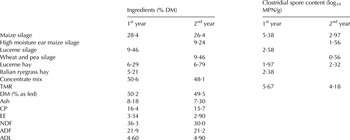
Once a day the cows were fed a total mixed ration (TMR); the composition and chemical analysis of the rations in the two years are shown in Table 1.
Ingredients (% DM), chemical composition (% DM unless otherwise stated) and clostridial spore content (log10 MPN/g) of the total mixed rations (TMR) fed to lactating cows in the two years of experiment

Cow and cubicle cleanliness assessment
During the experimental periods, dairy cow hygiene scores were assessed by direct observation in the milking parlour. In accordance with Schreiner & Ruegg (Reference Schreiner and Ruegg2003), the udder, flanks and legs of each cow were evaluated on a 4-point scale system, where a score of 1 indicates very clean skin and 4 a skin completely covered with dirt. The percentage of animals with scores of 3 and 4 for udder, flanks and legs was calculated.
Cubicle cleanliness was assessed according to a 3-point scheme on a random sample of cubicles, assuming score 1 for clean bedding material, 3 for very dirty bedding material.
Sampling
In the last three days of each experimental period, samples of feed (TMR and forage, n = 1), faeces (n = 2), bedding material (n = 2), teat swabs (n = 10) and milk (n = 3) were collected for microbiological analyses. TMR and forage samples were collected in the morning during ration preparation. Maize silage samples were taken from both the core and peripheral areas of the face of the bunker silo. In year two, additional TMR samples were collected every hour eight times after the first morning distribution, and analysed for ASFB contamination to study the spore variation during the period in which the TMR remains in the manger. Faeces samples were collected during milking; a pooled sample of fresh material was obtained by taking equivalent faeces amounts from 10 random cows. The samples of bedding material were taken randomly from 5 different cubicles and then pooled. Moistened commercial paper towels, with no disinfectant agent, were used as swabs to wipe the whole teat surface after the pre-milking cleaning and before claw attachment, as described by Zucali et al. (Reference Zucali, Bava, Tamburini, Brasca, Vanoni and Sandrucci2011). During milking, swabs were taken on a single teat of 10 cows selected randomly from the herd. The teat swabs were immediately placed in sterile plastic ‘zip-loc’ bags. The bulk milk was mixed in the tank after the morning milking, and samples were collected with a probe. All the samples were transported to the laboratory under refrigeration (4 °C) no later than 12 h after collection, and submitted to microbiological analyses.
Feed chemical analyses
The TMR samples were analysed for chemical composition as follows: dry matter (DM) was determined following the AOAC procedure (AOAC, method 945·15, 1995), and organic matter was calculated as weight lost upon ignition at 600 °C (AOAC, method 942·05, 1995). The crude protein (CP) content was determined by the macro-Kjeldahl technique (AOAC, method 984·13, 1995) using a 2300 Kjeltec Analyzer Unit (FOSS, Hillerød, Denmark). Ether extract was determined following the method 920·29 of the AOAC (1995). Neutral detergent fibre (NDF) was determined according to Mertens (Reference Mertens2002), with the addition of sodium sulphite and α-amylase to the neutral detergent solution. Acid detergent fibre (ADF), determined not sequentially to NDF, and acid detergent lignin (ADL) were calculated according to the method of Van Soest et al. (Reference Van Soest, Robertson and Lewis1991) using the Ankom 200 fibre apparatus (ANKOM Technology Corporation, Fairport, NY). Fibre fractions are reported on an ash-free basis.
Microbiological analyses
Feed, faeces, bedding material, teat swabs and milk were subjected to microbiological analysis to monitor the changes in ASFB, bacterial count and propionibacteria. In addition, coliform and lactic acid bacteria in the milk were evaluated. All the samples were transported to the laboratory under refrigeration (4 °C) and analysed the morning after collection within 12 h.
For the microbiological analysis, the forage samples were chopped for 1 min in a sterile homogeniser, then (10 g) were suspended in a 1 : 10 PSS (peptone salt solution, 1 g of bacteriological peptone and 9 g of sodium chloride per litre), and homogenised twice for 2 min at maximum speed using a Stomacher blender (BagMixer 400, Interscience). Ten grams of faeces were suspended in a 1 : 10 PSS and homogenised twice for 1 min at maximum speed using a Stomacher. For the teat swabs, PSS was added to every bag and samples were homogenised at high speed for 30 s in a Stomacher blender. All the homogenates were serially diluted in quarter-strength Ringer solution.
The anaerobic spore content was obtained through the Most Probable Number (MPN) performed with three 10-fold dilutions with three tubes at each dilution, as reported by Zucali et al. (Reference Zucali, Bava, Colombini, Brasca, Decimo, Morandi, Tamburini and Crovetto2015). In order to determine the Clostridium species in faeces, bedding material, teat swabs and milk (C. tyrobutyricum, C. butyricum, C. beijerinckii, and C. sporogenes) positive tubes were analysed by multiplex PCR according to Morandi et al. (Reference Morandi, Cremonesi, Silvetti, Castiglioni and Brasca2015). Standard plate count (SPC) and coliform count (CC) were determined using Petrifilm (3M, St. Paul, MN, USA), and the plates were incubated at 30 °C for 72 and 24 h, respectively. LAB were determined on de Man Rogosa and Sharpe (MRS) agar (Biolife, Milan, Italy); the plates were incubated anaerobically (Anaerocult A, Merck Millipore, Darmstadt, Germany) at 30 °C for 72 h. P2 agar (peptone 5 g; beef extract, 3 g; yeast extract, 5 g; sodium lactate, 1 g; agar 15 g per litre) incubated anaerobically at 30 °C for 7 d was used for the enumeration of the propionibacteria.
Statistical analysis
Data on microbiological contamination and hygiene score were analysed by Proc GLM (SAS, 2009), using the following model:
 $$Y_{ijk} = \mu + T_i + Y_j + TY_{ij} + e_{ijk} $$
where Y ijk are the dependent variables, μ the general mean, T i the effect of milking routine (i = 1–3; 1, Forestripping; 2, forestripping+post-dipping; 3, pre-dipping+forestripping+post-dipping), Y j is the effect of the year of the trial (j = 1–2; 2013–2014), TY ij is the interaction between treatment and year, and e ijk is the residual error. Data are reported as least squares means of the two years.
Results and discussion
In the two years of the experiment, the total mixed ration (TMR) fed to the lactating cows was characterised by an average forage content of approximately 50% dry matter (DM). The average percentage of maize silage of the total ration DM was high (27·4%), in agreement with the average maize silage inclusion in TMR fed to lactating cows in Pirondini et al. (Reference Pirondini, Malagutti, Colombini, Amodeo and Crovetto2012). Of the feed included in the TMR, the maize silage had the highest spore content in both years of the experiment (Table 1). As recently demonstrated by some studies, maize silage has been shown to have a high spore content (Vissers et al. Reference Vissers, Driehuis, Te Giffel, De Jong and Lankveld2007b; Zucali et al. Reference Zucali, Bava, Colombini, Brasca, Decimo, Morandi, Tamburini and Crovetto2015). The spore content of the maize silage in the first year was much higher (5·38 log10 MPN/g) than in the second (2·97 log10 MPN/g), and both values are higher than those reported by other authors for maize silage from the Po plain (Colombari et al. Reference Colombari, Borreani and Crovetto2001; Borreani & Tabacco, Reference Borreani and Tabacco2008). The spore content of TMR was very high in both years and higher than the single forage spore contents (Table 1). This agrees with the results of Vissers et al. (Reference Vissers, Driehuis, Te Giffel, De Jong and Lankveld2007b) who found that the mixed silage in the barn had a higher spore content than the individual forage components.
For an in-depth analysis of how ASFB contaminates TMR, a short experiment was conducted in year two to investigate the possible growth of anaerobic spore forming bacteria (ASFB) during the period TMR remains in the manger. TMR samples were collected at hourly intervals on eight occasions after the morning TMR distribution, and analysed for ASFB contamination. The results showed no increase in the number of spores in the time interval considered: in the first sample, collected at 10:00, the ASFB content in the TMR was 5·05 log10 MPN while in the last sample collected at 18:00 the ASFB content was 5·04 log10 MPN. Similarly, also Vissers et al. (Reference Vissers, Driehuis, Te Giffel, De Jong and Lankveld2007b) found no growth of butyric acid bacteria in the feed in the barn.
The hygiene scores of the cows and cubicles are reported as means of the two experimental years in Table 2. The animal hygiene scores differed significantly between the years (P < 0·05), there being deterioration in the cleaning condition of udder, leg and flanks in the second year of the experiment. There was an increase in the percentage of leg 3 + 4 scores from 27·1% in the first year to 49·9% in the second (results not shown). In agreement with the findings of Sandrucci et al. (Reference Sandrucci, Bava, Zucali and Tamburini2014), the legs were the dirtiest part of the cows (on average 38·6 ± 3·42% of cows had a hygiene score >3). The cow udders showed, on average, a suboptimal level of cleanliness compared to previous studies (Sandrucci et al. Reference Sandrucci, Bava, Zucali and Tamburini2014), with a slight, but not significant, decrease in the percentage of udders with score >3 in the last experimental period when the complete milking routine was applied (25·8, 28·1 and 17·7% for the three periods, respectively; Table 2). The percentage of animals with dirty udders is an important aspect in ASFB milk contamination, given the positive correlation between spore contaminated bulk milk and the prevalence of lactating cows with dirty udders on the farm (Nadeau et al. Reference Nadeau, Arnesson and Bengtsson2010; Zucali et al. Reference Zucali, Bava, Colombini, Brasca, Decimo, Morandi, Tamburini and Crovetto2015). With regard to cubicle cleanliness, no significant difference was noted in the three experimental periods and, as mentioned above, the bedding was renewed weekly, always in the same manner, throughout the two years.
Cow hygiene and cubicle cleanliness in the three experimental periods expressed as percentages of scores 3 + 4 for cow hygiene and percentage of score 3 for cubicle cleanliness (least squares means of the two years)

F, forestripping; F+Post, forestripping+post-dipping; Pre+W+F+Post, pre-dipping+wiping+forestripping+post-dipping.
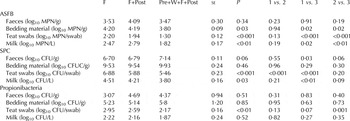
The ASFB faecal content was similar throughout the three periods of the experiment (Table 3) while in the third period the bedding materials showed a limited, but significant ASFB reduction (P = 0·02) compared to the first and second periods. However it was the bedding that showed the highest ASFB and SPC values, suggesting that it is an important source of milk contamination. Thus it is essential that great attention be paid to bedding cleanliness. The number of spores detected on the teat swabs, collected after pre-milking procedures and before cluster attachment, was significantly lower in the last experimental period when pre-dipping, wiping, fore-stripping and post-dipping were adopted (P < 0·001), compared to the other two periods. Thus the decreased teat spore count attests to the positive effect of employing pre-dipping, although it must also be recognised that the parallel reduction in the contamination of bedding materials could have contributed to the abatement. The bacterial count on teat swabs decreased significantly with the introduction of post-dipping, but there was no significant additional response to the inclusion of pre-dipping in the milking routine.
Anaerobic spore forming bacteria (ASFB) and standard plate count (SPC) contamination in faeces, bedding material, teat swabs and bulk tank milk in the three experimental periods (least squares means of the two years)

F, forestripping; F+Post, forestripping+post-dipping; Pre+W+F+Post, pre-dipping+wiping+forestripping+post-dipping.
The concentration of ASFB in milk, estimated within certain confidence limits through the MPN procedure, ranged between 1·82 and 2·79 log10 MPN/L, values similar to those reported by Zucali et al. (Reference Zucali, Bava, Colombini, Brasca, Decimo, Morandi, Tamburini and Crovetto2015). Instead, the ASFB content in the milk was significantly reduced on introducing pre-dipping to the milking routine in the third experimental period (P < 0·01). Indeed, Magnusson et al. (Reference Magnusson, Christiansson, Svensson and Kolstrup2006), comparing different teat-cleaning methods, concluded that the most effective method to reduce the milk spore content (96% reduction) was by using a moist washable towel followed by drying with a dry paper towel, for a total time of 20 s per cow. In general, a longer cleaning time and more vigorous methods were more effective in reducing spore contamination. The adoption of pre-dipping and wiping also determined a significant decrease in SPC contamination of milk in the third period, compared to forestripping alone and forestripping plus post-dipping. The introduction of post-dipping in addition to forestripping did not show any significant effect on milk ASFB and SPC. Concerning forestripping, it must be noted that this practice, according to Miller et al. (Reference Miller, Kent, Boor, Martin and Wiedmann2015), is associated with an increase in mesophilic spore concentration in bulk tank milk, probably as a consequence of teat contamination during cluster attachment, originated by human hands.
Despite the fact that propionibacteria are widespread in nature, and have been identified in hay, in milk and on the teat surface (Vacheyrou et al. Reference Vacheyrou, Normand, Guyot, Cassagne, Piarroux and Bouton2011), scant information is available with regard to their presence in faeces and the barn environment. Propionibacteria were present at a high level in the bedding material (>5 log10 CFU/g) whereas in raw milk their level was low (Table 3). Even if their content in the milk was slightly reduced by the application of post-dipping, and later by pre-dipping, a statistically significant reduction was observed only on the teat surface when pre-dipping was adopted (Table 3).
The coliform and lactic acid bacteria (LAB) counts in the milk did not vary significantly in the three milking routines (Table 4). A low LAB content is of important concern in raw milk cheese making, due to the key role LAB play in the acidification of curd and their contribution to cheese aroma and texture (Tormo et al. Reference Tormo, Lekhal and Roques2015). According to Mallet et al. (Reference Mallet, Guéguen, Kauffmann, Chesneau, Sesboué and Desmasures2012) a decrease in LAB was observed in raw milk associated with reduced SPC. The percentage of LAB on total SPC ranged from 78·5 to 88·1% during the three experimental periods, with a slight increase in using post-dipping and pre-dipping procedures, compared with forestripping alone. These values are comparable with findings reported by Brasca et al. (Reference Brasca, Bava, Zucali, Tamburini, Guerci, Sandrucci, Mattiello, Andreoli, Battini, Decimo, Morandi, Battelli, Povolo, Pelizzola, Passolungo, Sanna and Zanini2014) in raw milk (78–94% of SPC). The result suggests that an accurate milking routine does not necessarily reduce milk LAB, which also originate from the udder native bacterial populations within the mammary gland (Al-Qumber & Tagg, Reference Al-Qumber and Tagg2006).
Microbiological analyses on raw milk (least squares means of the two years)

F, forestripping; F+Post, forestripping+post-dipping; Pre+W+F+Post, pre-dipping+wiping+forestripping+post-dipping.
Clostridium species detected in faeces, bedding materials, teat swabs and milk are shown in Table 5. All the tested species were detected in all the matrices, with exception of Cl. butyricum that was not detected in faeces. C. tyrobutyricum, the most frequently isolated species on cheeses affected by gas defect, seems to be less frequent in faeces and bedding and more frequent on teat skin and in milk than the other Clostridium species. Moreover it is worth noting that C. tyrobutyricum was never detected on teats or in milk when the complete milking routine (including pre-dipping, wiping, forestripping and post-dipping) was applied.
Frequency of different Clostridium species detected in faeces, bedding material, teat swabs and milk

F, forestripping; F+Post, forestripping+post-dipping; Pre+W+F+Post, pre-dipping+wiping+forestripping+post-dipping.
Conclusions
The study underlines the key role of teat hygiene in milk spore contamination, which is of utmost importance in the case of raw milk intended for cheese production. An important source of milk contamination lies in the bedding materials, thus suggesting that farmers should pay great attention to its cleanliness. Pre-milking teat dip with a detergent/emollient solution followed by drying with a paper towel significantly reduced the ASFB count on teat skin, and lowered both ASFB and SPC in milk. The introduction of post-dipping in addition to forestripping did not show any significant effect on milk spore content, but it did reduce the milk standard plate count. Interestingly, the implementation of pre-dipping and wiping in the milking routine did not seem to negatively affect the content in the milk of lactic acid bacteria, which play a key role in cheese-making. The high ASFB and SPC levels in the bedding suggest the potential usefulness of more frequent cubicle cleaning and bedding replacement. The study on the Clostridium species has suggested that different patterns of species characterise different matrices. Further studies are needed to investigate the dynamics of the Clostridium species throughout the entire spore contamination chain.
The research was supported by Ministery of Agricolture and Forestry ‘Filigrana – Valorizzazione della produzione del Grana Padano DOP tramite il controllo di filiera e l'ottimizzazione dei processi produttivi’. The authors are grateful to the personnel of the dairy farm ‘A. Menozzi’ of the Università degli Studi di Milano, for the support given during the experiment. Some of the results were presented at the International Conference of Animal Science held in Milan, June 2015.