The debate about what constitutes problematic use of Internet-related technologies has continued for nearly 2 decades, as has the exploration of possible treatments.Reference Starcevic and Aboujaoude1, Reference Kuss and Lopez-Fernandez2 Both psychopharmacological and psychotherapeutic interventions have been tested, inspired by established treatments for conditions to which Internet-related psychopathology has been linked, such as obsessive-compulsive disorder, substance use disorders, behavioral addictions, and attention-deficit and hyperactivity disorder.Reference Aboujaoude3 As such, cognitive behavioral therapy,Reference Young4 selective serotonin reuptake inhibitors,Reference Dell’Osso, Hadley and Allen5 mu receptor antagonists,Reference Bostwick and Bucci6 stimulants,Reference Han, Lee and Na7 and residential detoxification and rehabilitation programsReference Sakuma, Mihara and Nakayama8 have received research attention, with some promising results but no definitive treatment algorithm emerging. Meanwhile, concern about the psychological, cultural, and sociopolitical consequences of a heavily Internet-reliant lifestyle has only grown, contributing to the rise of a new industry and an altogether different family of interventions being adopted by legions of users. Promoted by nonprofits,9 the tech sector,10 and media groups,11 new apps that are designed to help wean users off apps have ushered in a new era that goes beyond traditional psychopharmacology and psychotherapy. Seemingly more aligned with mobile therapy and other telepsychiatry solutions,Reference Aboujaoude12 these interventions have received little formal testing by mental health researchers and only minimal scientific scrutiny. At 20, “Internet addiction” has paradoxically become a condition whose treatment is being sought online, with precious little evidence-based guidance available.
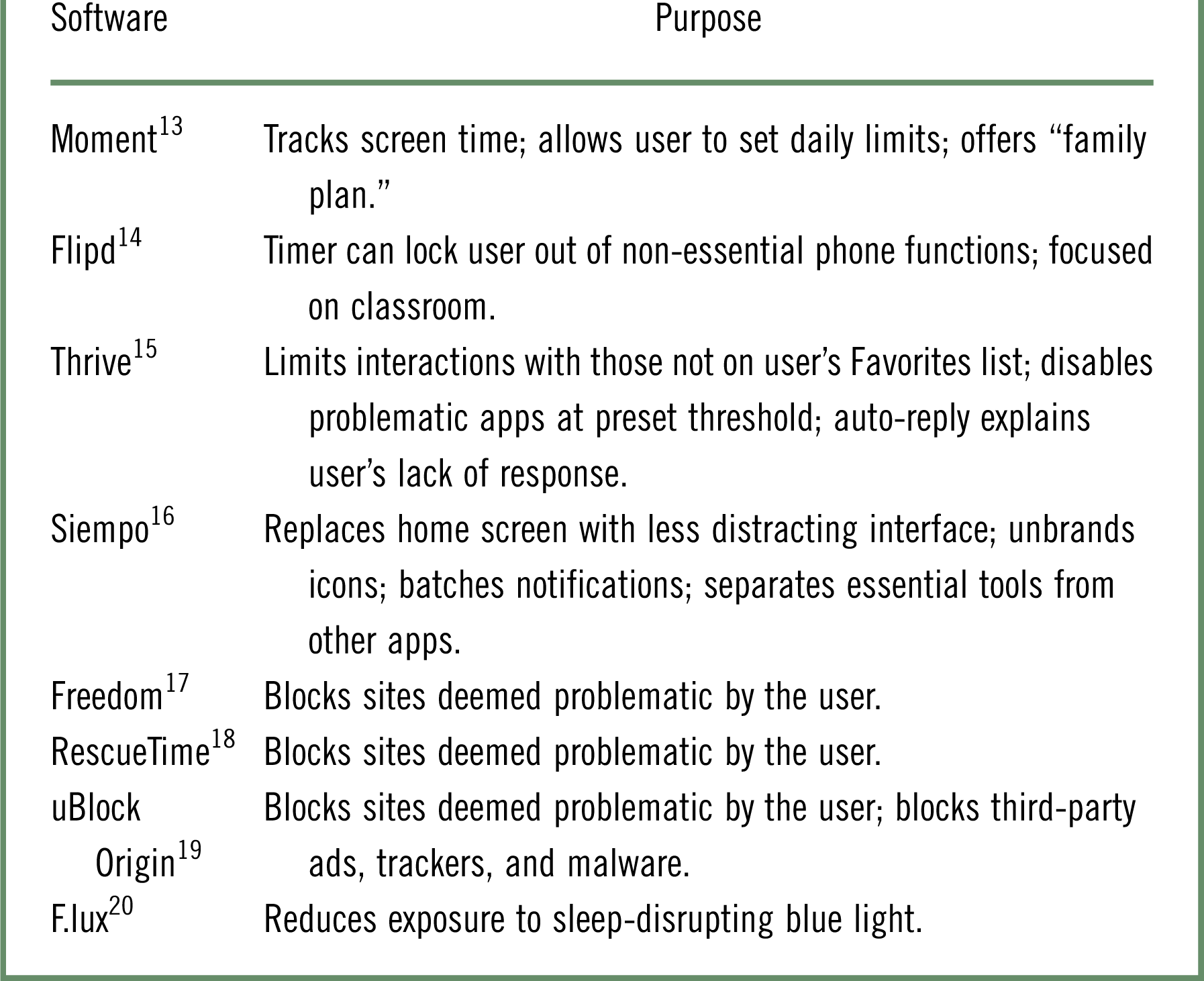
Several products purport to curtail unnecessary online activity, with choices that cover various operating systems and platforms. Purveyors also vary from nonprofits offering free software to technology startups whose business model is to bring to the market anti-technology products. Moment 13 is a smartphone app that tracks the time spent on popular apps, allowing the user to establish daily limits and be notified when those limits are exceeded. A family plan gives the option of setting up screen-free family meal times during which device use by any family member will result in an “annoying alert” that all plan members hear. A small, one-time fee unlocks special features, such as setting up a daily limit and screen-free time.
Flipd 14 is another mobile app that restricts phone use, in part by setting a timer that locks the user out of all functions except essential calls and text messages. For a modest annual fee, it claims to have helped adopters spend “100 million minutes distraction-free” and is seeking a foothold in the classroom by marketing directly to educators and students.
The app Thrive 15 also aims to curb phone use. Enabling the app’s Thrive Mode blocks all apps, notifications, calls, and texts, except from individuals on a “VIP list” that is synced with the user’s Favorites contacts list. An Auto Reply function explains that the person is taking time away from the phone, and when to expect a response. A blocking function allows the user to disable problematic apps once a preset threshold is reached, and until 12AM the following day.
Still in beta testing, Siempo 16 is an app that replaces the standard phone home screen with a less distracting interface, unbrands icons to make them less recognizable, batches notifications to send at a user-determined time interval, and uses a menu that separates important tools (eg, calendar, maps, notes) from potentially time-wasting social media and other non-essential apps.
Freedom,17 which boasts over 650,000 users, and RescueTime 18 both temporarily block specific websites deemed problematic by the user, and the free browser extension uBlock Origin 19 prevents distracting third-party ads, as well as trackers and malware, from accessing the browser. A harm reduction approach can be said to inspire F.lux,20 software that matches display brightness with circadian rhythm, ostensibly making late-night exposure to screen light less disruptive to the sleep cycle.
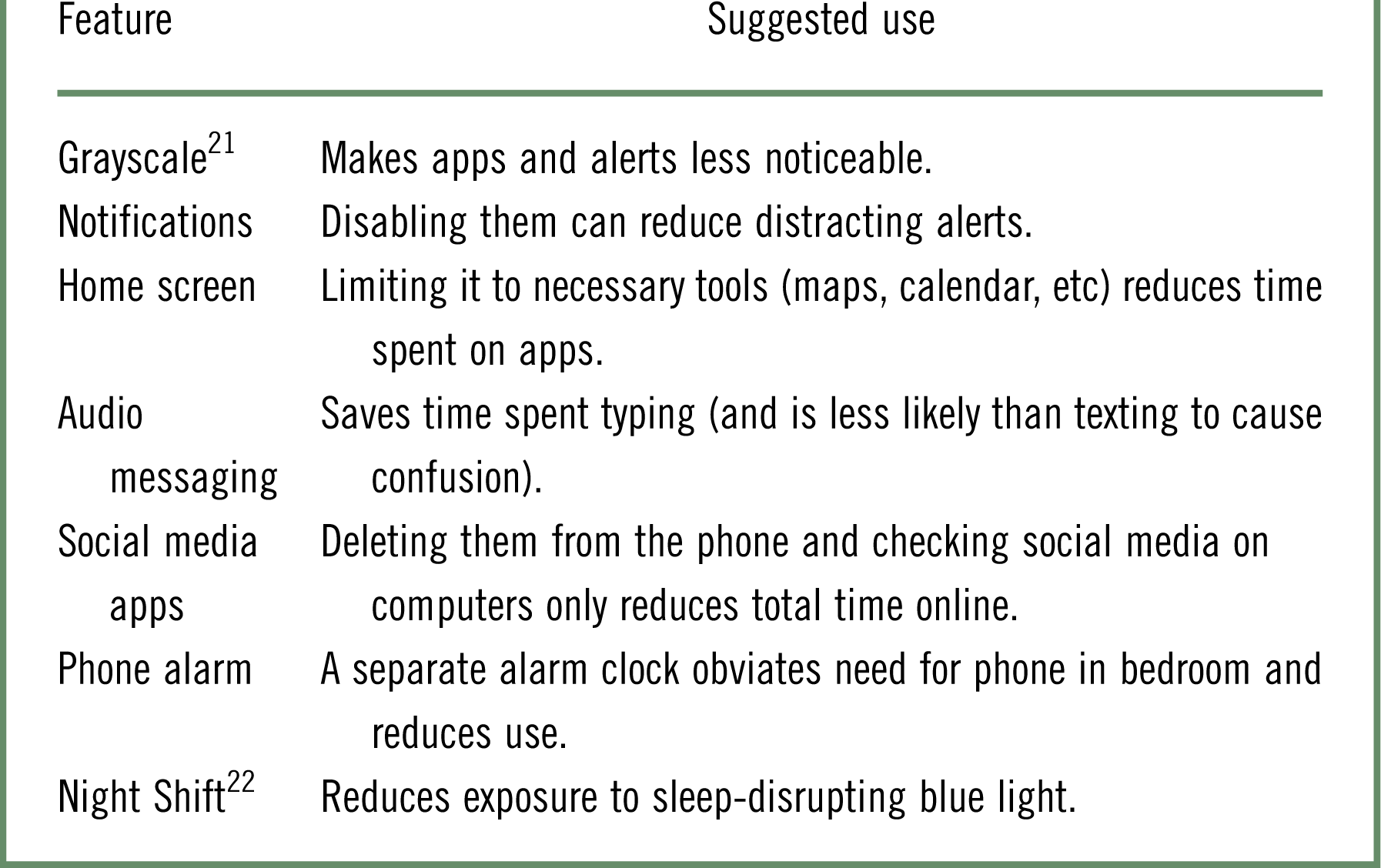
While the most popular apps, software add-ons, and program extensions (Table 1) vary in operating system (iOS, Android, Mac, Windows), browser (Internet Explorer, Chrome, Safari, Firefox), and device (desktop, tablet, phone) compatibility, they share an important feature. Collectively, they represent novel ways in which technology is being used against itself, with an ultimate goal that is consistent with that of early psychopharmacological and psychotherapeutic trials in the field—controlling excessive use of Internet-related technologies and limiting the associated negative impact, including time loss; distractibility; interference in professional, personal, or academic life; and isolation. They also represent more sophisticated and deliberate tools than the leveraging of already built-in features to limit screen time (eg, using a phone’s grayscale functionality,Reference Bowles21 which is meant to preserve battery power, to make colorful app icons less noticeable; disabling notifications, banners, and badges to get rid of attention-commanding alerts; and turning Nigh Shift modeReference Gould and Loria22 on, which moves an iOS phone’s display colors to the warmer end of the color spectrum, considered less disruptive to sleep) (Table 2). The popularity of these tools suggests recognition by many online users of Internet-related distractibility or other psychological problems, and a willingness to leverage technology to mitigate problems borne out of a technology-saturated lifestyle. Compared to traditional psychotherapy or psychopharmacology, these tools may possess some advantages, including scalability, cost savings, convenience, reduced stigma, and a lack of side effects. They are also easier to target to the audience of online users who may benefit from them. However, as a group, they lack serious scrutiny in the form of rigorous clinical trials. Such scientific exploration would seem warranted in light of the potential advantages, but also to ascertain safety, given that these tools already seem to be in wide use. To that end, Apple’s recent announcement10 of a digital health initiative centered on an app that promises to provide time tracking, a “do not disturb” function, and parental controls, is likely to produce a further mainstreaming of these tools. While it would be unlikely for an app blocker to be “unsafe,” marketing it without sufficient clinical testing risks causing individuals with serious internet-related mental health problems to eschew traditional evaluation and treatment in favor of inadequately tested software. And that could pose safety risks.
Downloadable apps and other software to limit screen time or mitigate its effects9

Leveraging smartphone features to limit screen time or mitigate its effects 9
The telepsychiatry revolution has brought computerized cognitive behavioral therapy, online video-based therapy, virtual reality exposure therapy, and mobile text-based therapy to the treatment of mood disorders, anxiety disorders, and phobias.Reference Aboujaoude12 If clinically proven, apps that wean individuals off apps might be similarly considered successful examples of telepsychiatry, succinctly defined as the technology-mediated delivery of mental health care.Reference Aboujaoude12 Although many would not have seen problematic Internet use as a logical target for telepsychiatry, “Click here if you are addicted to the Internet” might prove a legitimate strategy. Research is clearly needed to settle this question via studies that test these tools on their own as they are being advertised, or as part of a larger behavioral or other “traditional” intervention.
Meanwhile, keen attention to conflicts of interest and motives should accompany the assessment of anti-technology products released by technology companies. A digital company’s financial health often correlates with the amount of time consumers spend in front of the screen engaging with its products, so initiatives that aim to help users disconnect would seem to pose an inherent conflict that deserves to be dissected. Finally, with consumers,Reference Quirk and St. John23 shareholders,Reference Brian24 and regulatory bodiesReference Hsu and Kang25 now demanding more oversight of technology companies in light of privacy and other violations, vigilance is required regarding possible public relations maneuvers masquerading as health campaigns.