Introduction
Care for persons with dementia is challenging (Cummings et al., Reference Cummings, Mega, Gray, Rosenberg-Thompson, Carusi and Gornbein1994). Declining cognitive function and impaired activities of daily living (ADL) are distressing for caregivers, but it must be more stressful for them to cope with psychiatric symptoms such as aggression and agitation (Coen et al., Reference Coen, Swanwick, O'boyle and Coakley1997). Psychiatric symptoms are the strongest predictor of caregiver burden and depression (Gaugler et al., Reference Gaugler, Davey, Pearlin and Zarit2000). Behavioral and psychological symptoms of dementia (BPSD) are usually treated on an outpatient basis. However, from our clinical experience, the treatment of severe BPSD on an outpatient basis is often disrupted, resulting in a need for treatment on an inpatient basis.
In Japan, a survey of 27 hospitals showed that the average length of hospitalization for the treatment of BPSD is 355.2 ± 211.6 days (Yoshie and Shiraishi, Reference Yoshie and Shiraishi2007). Such a long hospitalization might be associated with the system of Japanese medical and care insurance, which is premised on a universal insurance system. Japanese medical insurance is used to fund clinical services, including hospitalization. Patients pay 10%–30% (the ratio is decided by patient's age and income) of the total expenses and the payment fund pays the balance. Consequently, all Japanese patients can receive medical care at a relatively low cost. On the other hand, with Japanese care insurance, patients pay 10% of the total expenses, but unlike medical insurance, an upper limit of benefit is determined in accordance with patients’ degree of impairment. If patients use care services over the prescribed medical care, the care insurance does not apply and patients pay any excess expenses. Patients with severe BPSD often exceed care insurance limits, and hospitalization can provide a less expensive alternative. Thus, long hospitalization sometimes occurs due to socioeconomic reasons, but long hospitalization can place heavy demands on hospital resources.
There are a number of reasons why reducing the length of hospital stay is important. First, hospitalization is a trying time for patients whose cognitive impairment and psychiatric symptoms make it difficult to adapt to an unfamiliar environment (Mace and Rabins, Reference Mace and Rabins1999). Second, in Japan demand for hospital services to treat severe BPSD exceeds supply, and dementia patients usually have to wait for a long time at home before admission. This results in a heavy burden for family caregivers (Van Exel et al., Reference Van Exel, De Ruiter and Brouwer2008), and accidents, such as falls and missing of patient, often occur. Third, public finances are strained and costs for the treatment of severe BPSD are escalating. Shortening of hospitalization helps to reduce medical costs. Other countries with aging populations face similar problems (Ferri et al., Reference Ferri2005).
To our knowledge, there have been no studies to determine the factors related to long hospitalization for the treatment of BPSD. The medical status of patients, such as presence of a severe disease or complications, was reported to lead to long hospitalization in an acute geriatric unit for physical treatment (Lim et al., Reference Lim, Doshi, Castasus, Lim and Mamun2006). Social issues, such as caregiver's poor cooperativeness and financial problems, also extended the length of stay (Falcone et al., Reference Falcone, Bolda and Leak1991; Lim et al., Reference Lim, Doshi, Castasus, Lim and Mamun2006). A study done by Draper et al. (Reference Draper2000) found that factors such as severity of behavioral disturbances, dementia severity, inability to carry out ADL, and social isolation were related to increased referral psychogeriatric services among vocally disruptive patients in nursing homes. Therefore, we assumed that the more severe forms of BPSD and financial problems would contribute to long hospitalization. Other factors, such as age, sex, causal disease for dementia and patient's ADL, caregiver's burden, and years of experience of doctors in charge of treating dementia, might also affect the length of hospitalization for the treatment of BPSD, although effects of these factors have not been examined yet.
The aim of this study was to identify factors related to prolonged hospital stay by conducting a cohort study in several units of different hospitals for patients with BPSD, and to estimate the appropriate length of hospital stay by following neuropsychiatric symptoms over time after admission.
Methods
Participants
This study was approved by the ethical committee of Osaka University and was carried out in accordance with the ethical standards of the 2008 Declaration of Helsinki. We surveyed all the patients who were hospitalized in the neuropsychiatric units of three different hospitals (a university hospital, a general hospital, and a core psychiatric hospital) to treat BPSD from 11 May 2009 to 30 November 2010. Only patients with reliable family caregivers at home were included in this study. We obtained an agreement from all of the registered patients’ caregivers. During hospitalization, all patients received pharmacological therapy decided by their attending doctors as well as non-pharmacological therapy such as psychotherapy and recreation therapy. Family caregivers received education about behavioral management techniques and social resources, as needed.
Clinical assessment
We collected patient data (including age, sex, years of education, diagnosis, residence before admission, and amount of pension) and primary caregiver data (including age, sex, years of education, and relationship with patients). We also recorded the time the doctors in charge had spent treating dementia prior to the beginning of this study. The diagnosis of dementia was made according to the Diagnostic and Statistical Manual of Mental Disorders, 3rd edition-revised (American Psychiatric Association, 1987); the diagnosis of Alzheimer's disease (AD) was made by fulfilling the criteria for probable AD of the National Institute of Neurological, Communicative Disorders and Stroke-Alzheimer Disease and Related Disorders Association (NINCDS-ADRDA; McKhann et al., Reference McKhann, Drachman, Folstein, Katzman, Price and Stadlan1984); the diagnosis of vascular dementia (VaD) was made according to the Neuroepidemiology Branch of the National Institute of Neurological Disorders and Stroke-convened international workshop with support of the Association Internationale pour la Recherche et l'Enseignement en Neurosciences (Roman et al., Reference Roman1993); the diagnosis of Dementia with Lewy bodies (DLB) was made by fulfilling the McKeith criteria for probable DLB (McKeith et al., Reference McKeith1996); and the diagnosis of frontotemporal lobar degeneration (FTLD) was made according to consensus criteria for the diagnosis of FTLD (Neary et al., Reference Neary1998).
The patient's cognitive status was assessed by the Mini-Mental State Examination (MMSE; Folstein et al., Reference Folstein, Folstein and Mchugh1975). Severity of dementia was evaluated by clinical dementia rating (CDR; Hughes et al., Reference Hughes, Berg, Danziger, Coben and Martin1982) at the time of admission.
The family caregiver's burden was evaluated at the time of admission with the Zarit Burden Interview (ZBI; Zarit et al., Reference Zarit, Reever and Bach-Peterson1980; Hirono et al., Reference Hirono, Kobayashi and Mori1998), a 22-item self-rating inventory in which each item is rated on a 5-point scale, with the total score ranging from 0 to 88. The patient's neuropsychiatric symptoms were evaluated at the time of admission with the Neuropsychiatric Inventory (NPI) (Cummings et al., Reference Cummings, Mega, Gray, Rosenberg-Thompson, Carusi and Gornbein1994; Hirono et al., Reference Hirono1997), a widely accepted tool for assessing cognitive disorders, including dementia (Lyketsos et al., Reference Lyketsos, Lopez, Jones, Fitzpatrick, Breitner and Dekosky2002). The NPI consists of a fully structured interview in which a family caregiver rates patient's symptoms on 12 domains (delusions, hallucinations, agitation/aggression, depression, anxiety, euphoria, apathy, disinhibition, irritability, aberrant motor behavior, sleep, and eating). The NPI-Nursing Home version (NPI-NH; Wood et al., Reference Wood2000; Shigenobu et al., Reference Shigenobu, Hirono, Tabushi and Ikeda2008) was developed for use in extended care facilities for residents with dementia. The domains of neuropsychiatric symptoms in NPI-NH and its total score are the same as those of NPI. We used NPI-NH to follow up neuropsychiatric symptoms of the patients during their hospitalization at three occasions: one week after admission, one month after admission, and at the time of discharge. Our observation lasted for 180 days (six months) so that patients whose hospitalization continued for more than the said period were given NPI-NH when observation ended. In this study well-trained doctors and experienced nurses carried out NPI and NPI-NH.
Activities of daily living were evaluated with the Hyogo ADL Scale (HADLS; Hirono et al., Reference Hirono1997), which is designed to assess functional abilities in AD subjects. It is designed for a comprehensive assessment of functional abilities in AD subjects. It consists of 18 questions related to everyday basic activities and complex instrumental activities related to social activity, housekeeping, physical maintenance, self-hygiene, and switch-manipulation. Based on the main factorial analysis, weights were assigned to the subscale of each item. The total score ranged from 0 to 100, and higher scores indicate worse symptoms.
Data analysis
We first conducted univariate Cox proportional hazard analyses to assess the effect of clinical features on the length of stay. Explanatory variables were patient data (including age, sex, years of education, diagnosis, residence before admission, and amount of pension), primary caregiver data (including age, sex, years of education, and relationship with patients), doctor data (period of treating dementia), and evaluations (MMSE, CDR, HADLS, NPI total score and subscores of 12 symptoms at the time of admission, and ZBI).
We next conducted a multivariate Cox proportional hazard analysis to assess the effect of clinical features on the length of stay. Explanatory variables, which were substantially the same as in the univariate Cox proportional hazard analyses, were chosen to select the best fitting model, considering potential issues with multi-collinearity. Concerning the NPI, only the total score was planned to be used in the multivariate Cox proportional hazard analysis unless any NPI sub-symptoms are analyzed in the multivariate Cox proportional hazard analysis according to the results of the univariate Cox proportional hazard analyses. We considered all possible combinations of variables listed above based on the Akaike Information Criterion (AIC) to select the best fitting model. The hazard ratios (HRs) with 95% confidence intervals (CI) were calculated.
The statistical significance level was set at p < 0.05. All statistical analyses were performed using JMP, version 9.0 (SAS Institute, Cary, NC, USA) except model selection of the multivariate Cox proportional hazard analysis, which was performed with modified R (The R Foundation for Statistical Computing, Perugia, Italy) software programs.
Results
Participants
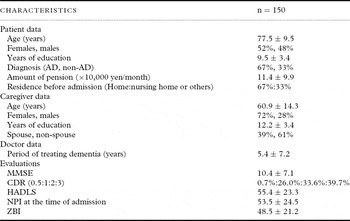
Of the initial 154 patients registered for the study, four patients were dropped from the study (one patient passed away and three patients were transferred to another hospital because of physical illness). Of the remaining 150 patients, 104 patients were discharged from the hospital within 180 days and 46 patients were hospitalized for more than 180 days. Average length of stay for patients was 110.4 ± 58.1 days (patients who were hospitalized for more than 180 days were counted as 180 days). Characteristics of the participants are given in Table 1.
Patient and caregiver demographic data, doctor experience, and clinical evaluations

Note: Unless otherwise indicated, data are presented as the mean ± standard deviation.
AD: Alzheimer's disease, MMSE: Mini-Mental State Examination, CDR: clinical dementia rating, HADLS: Hyogo Activities of Daily Living Scale, NPI: Neuropsychiatric Inventory, ZBI: Zarit Burden Interview.
Measurements
The patients’ mean age was 77.5 ± 9.5 years, 52% were females, the mean period of education was 9.5 ± 3.4 years, and the mean pension was 11.4 ± 9.9 × 10⁴ yen per month (US$ 1,270 ± 1,100 per month). Primary caregiver's mean age was 60.9 ± 14.3 years, 72% were females, mean period of education was 12.2 ± 3.4 years, and 39% were spouses. Thirty-six doctors participated in the study and the mean period of treating dementia was 5.4 ± 7.2 years. Of the 150 patients, 88 (60%) had AD, 21 (14%) had VaD, 10 (7%) had a mixture of AD and VaD, 10 (7%) had DLB, 6 (4%) had FTLD, and 11 (8%) had other types of dementia. The various test scores are shown in Table 1.
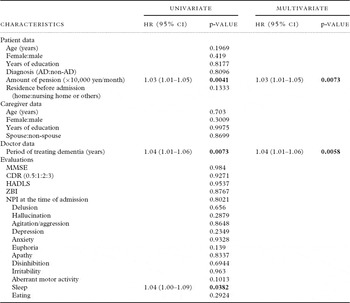
In the univariate Cox proportional hazard analyses (Table 2), two factors were found to significantly contribute to prolonged hospitalization: a small pension received by the patient (HR = 1.03, 95% CI = 1.01–1.05, p = 0.0041) and doctor's fewer years of experience in treating dementia (HR = 1.04, 95% CI = 1.01–1.06, p = 0.0073). Neither the ZBI score nor the HADLS score obtained at the time of admission was significant (ZBI, p = 0.9620; HADLS, p = 0.9068). The total NPI score at the time of admission was also not significant (NPI, p = 0.9819), although the NPI subscore of sleep disturbance was significant (HR = 1.04, 95% CI = 1.00–1.09, p = 0.0382). However, it was a paradoxical result that low score of sleep disturbance was related to long hospitalization.
Results of univariate and multivariate Cox proportional hazard analyses associated with long hospitalization

Note: All possible combinations of variables are considered based on Akaike Information Criterion (AIC) to select the best fitting model of multivariate Cox proportional hazard analysis.
Unless otherwise indicated, data are presented as the mean ± standard deviation.
AD: Alzheimer's disease, MMSE: Mini-Mental State Examination, CDR: clinical dementia rating, HADLS: Hyogo Activities of Daily Living Scale, NPI: Neuropsychiatric Inventory, ZBI: Zarit Burden Interview. OR: odds ratio, CI: confidence interval.
Statistically significant p-values appear in boldface.
For the multivariate Cox proportional hazard analysis, we selected the total NPI score instead of the scores of the NPI sub-symptoms. As a result, the same two factors were found to significantly contribute to prolonged hospitalization: a small pension received by the patient (HR = 1.03, 95% CI = 1.01–1.05, p = 0.0073) and doctor's fewer years of experience in treating dementia (HR = 1.04, 95% CI = 1.01–1.06, p = 0.0058) (Table 2).
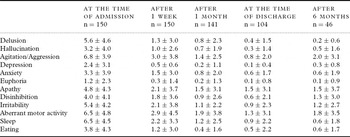
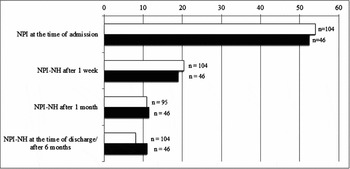
Changes in neuropsychiatric symptoms following admission are shown in Figure 1. For both patients discharged before and after 180 days, the total NPI score decreased considerably after one week but changed little between one month and the time of discharge/six months. The score of each NPI sub-symptom following admission is shown in Table 3. At the time of admission the scores of euphoria and depression were low, while the scores of delusion, agitation/aggression, irritability, aberrant motor activity, and sleep were high. All scores of NPI sub-symptoms improved after one week of admission.
Scores of NPI symptoms following admission

Note: Data are presented as the mean ± standard deviation.
Change of neuropsychiatric symptoms following admission. □ Length of hospitalization; ≦180 days; ■ length of hospitalization > 180 days. NPI: Neuropsychiatric Inventory, NPI-NH: NPI-Nursing Home version.

Discussion
We conducted a cohort study in three hospitals to examine the association of several factors with long hospitalization for the treatment of severe BPSD. Long hospitalization for the treatment of BPSD was found to be significantly associated with a lower pension received by the patient and fewer years of experience in treating dementia by the doctor. Contrary to our assumption, the severity of neuropsychiatric symptoms was not a significant factor contributing to long hospitalization. Other factors, such as age, sex, and causal disease for dementia, were also not significant.
A lower pension received by the patient is a significant factor of long hospitalization. A previous study showed that economic poverty of the patients is a powerful predictor of delayed discharge in an acute geriatric unit for physical treatment (Falcone et al., Reference Falcone, Bolda and Leak1991). We did not determine the presence or absence of economic poverty, but determined the amount of patients’ pension, because the latter is more objective and reliable. As a result, we obtained the same result. A lower pension can be an obstacle to smooth discharge, regardless of where the patient is discharged. When the patient is discharged for his or her home, a lower pension restricts the amount of care services and it takes time for a primary caregiver to make careful selection of care services. When the patient is discharged for a nursing home, again a lower pension is an obstacle. A patient who is not wealthy enough to settle in an expensive nursing home will wait for a longer period to settle in a low-cost nursing home because most of low-cost nursing homes are usually occupied. Another reason is that in Japan the cost of stay in expensive nursing home is often more than that of a hospital. Consequently, some extent of social hospitalization would occur.
Fewer years of experience in treating dementia by the doctor is also a significant factor for long hospitalization. Our results showed that the NPI score was improved quickly regardless of whether the patient was discharged within 180 days or not. It may be possible that the difference in ability between an experienced and a less-experienced doctor is not a necessary skill for treating BPSD, it might be the skill of discharge planning. The doctor in charge establishes goals of treatment and makes a prediction of the patient's condition after treatment. He works with multidisciplinary staff and the primary family caregiver to determine the best post-discharge life of the patient. This approach should be started as early as possible. A recent review indicated that discharge planning should not start after treatment but at the time of admission (Dainty and Elizabeth, Reference Dainty and Elizabeth2009). Less-experienced doctors may not have enough of such skills resulting in longer hospitalization.
Although we assumed that psychiatric symptoms influence the length of hospitalization, the severity of psychiatric symptoms was not a significant factor. We do not have exact data of average length of stay for patients because we discontinued our observation at 180 days after admission. The length of stay for patients who were hospitalized for more than 180 days was counted as 180 days and then the average length of stay was 110.4 ± 58.1 days (real mean stay will be much longer). Not particularly long, it is rather short compared to the average stay in Japan (Yoshie and Shiraishi, Reference Yoshie and Shiraishi2007). However, all subscores and the total score of NPI decreased considerably in the first week of this study. The results indicate that for patients in this study, the total and all subscores of NPI decreased significantly over the first week. There was some further improvement until one month. Little additional improvement was found after the first month. As the average length of stay was much more than a month, this might have been the reason that severity of psychiatric symptoms did not emerge as a factor contributing to long hospitalization. Namely, the average length of hospitalization in our study was far longer than a month, which is about the time needed for psychiatric symptoms to improve, and this might be the reason why severity of psychiatric symptoms did not make a significant contribution to long hospitalization. Previous studies in the United States and France showed that the average length of hospitalization in acute geriatric units for treating physical symptoms in patients with dementia was only about ten days (Fillenbaum et al., Reference Fillenbaum, Heyman, Peterson, Pieper and Weiman2000; Soto et al., Reference Soto2008). If the discharge support, such as coordination of care services, was done and the average length of hospitalization was less than a month, the severity of psychiatric symptoms could be a predictive factor.
Treatment-resistant BPSD is characterized by different symptoms such as vocally disruptive behavior and inappropriate sexual behavior (Draper et al., Reference Draper2000; Tucker, Reference Tucker2010). On the other hand, different symptoms of BPSD, such as delusions, hallucinations agitation, and irritability, are improved in parallel (Gauthier et al., Reference Gauthier, Loft and Cummings2008). All types of psychiatric symptoms in NPI improved considerably and rapidly in this study. We considered two reasons for this. First, a shift in treatment environment could explain rapid improvement. On an outpatient basis, some patients become anxious because they are left alone at home. Delusion, aggression, and irritability are sometimes caused by inappropriate care by family caregivers. Medication is adjusted step by step to avoid adverse effects and moderation of a dosage usually takes much time. On the other hand, on an inpatient basis the staff delivers round-the-clock observation and new treatment regimes can be instituted rapidly. Second, our sample might include patients whose symptoms were not severe. If psychogeriatric consultation or outreach were adequately available, they might not be hospitalized. Brodaty et al. (Reference Brodaty, Draper and Low2003) classified severity of neuropsychiatric symptoms into seven tiers and showed the treatment environment required at each tier for mental disorders in late life on the basis of an evidence-based approach. Patients with the most severe neuropsychiatric symptoms, such as agitation with delirium, severe psychosis, and violence (classified as equal to or more than 6 on a scale of 7), need to be managed in psychogeriatric or neurobehavioral units. Our sample, which consisted of average Japanese patients admitted to a neuropsychiatric unit for BPSD treatment in Japan, included patients who were classified as 5 on a scale of 7, in which patients were recommended to be managed by a multidisciplinary psychogeriatric outreach team. In other words, patients who were hospitalized in neuropsychiatric units in Japan were less severe than in other countries.
This study has some limitations. First, because of small sample size, the number of explanatory variables that we could evaluate was limited. Evaluation of other factors, such as physical complications and some specific problematic symptoms such as inappropriate sexual behaviors and allotriophagy, will require a larger sample size. Second, patients with severe physical complications and those who had no reliable relatives were excluded from the study, and hence selection bias might have occurred. Third, no structured interview was used for diagnosis and there is no inter-rater reliability for the use of NPI rating in doctors and nurses. Fourth, DSM-III-R was used instead of DSM-IV-Text Revision.
In conclusion, a lower pension received by the patient and fewer years of experience in treating dementia by the doctor are the factors that are significantly associated with long hospitalization. The period required for BPSD treatment is between one week and one month and it is important to make the public aware of the fact that patients with severe BPSD can usually be treated and released within a month and that the role of psychiatric wards is not for long-term hospitalization. In addition, cooperation in the community, such as psychogeriatric consultation and outreach, should be encouraged.
Conflict of interest
None.
Description of authors’ roles
H. Sugiyama, H. Kazui, K. Shigenobu, Y. Masaki, N. Hatta, K. Tabushi, and M. Takeda participated in the conception of the study and study design. H. Sugiyama, H. Kazui, K. Shigenobu, Y. Masaki, D. Yamamoto, T. Wada, K. Nomura, and K. Yoshiyama participated in data collection and data analyses. H. Sugiyama and H. Kazui participated in the interpretation of this study. H. Kazui organized this study and was responsible for all the results and their interpretation. H. Sugiyama wrote the first draft of the paper, and all authors contributed to revising it critically for important intellectual content. All authors have seen and approved the final version to be published.
Acknowledgments
This study was supported in part by the Research Grant-in-Aid for Scientific Research from the ministry of Education, Culture, Sports, Science and Technology of Japan (No. 21591514) and in part by the Research Grants for Research on Dementia (Dementia-General-003) from the Ministry of Health, Labor and Welfare of Japan. We thank Dr. Noriyuki Hayashi for support of statistical analyses.