I. INTRODUCTION
Lanthanum hexaboride, LaB6, has an extremely low work function and high melting temperature, which have long-time facilitated applications to the thermionic source of electron optical instruments among other applications. Reference Trenary1 Recently a combination of near-infrared (NIR) absorption and visible transparency has been found for LaB6 nanoparticles (NPs), Reference Takeda, Kuno and Adachi2 which has initiated their studies for solar-control filters Reference Takeda, Kuno and Adachi3–Reference Tang, Su, Tan, Hu, Gong and Xiao8 as well as photothermal conversion material for medical applications. Reference Chen and Chen9,Reference Lai and Chen10 In the field of solar control NPs, LaB6 gains advantages over widely known indium–tin oxide (ITO), antimony-doped tin oxide (ATO), and aluminum-doped zinc oxide (AZO) in the shorter absorption wavelength of NIR, which enables shielding of high-intensity NIR waves in the solar spectrum. Moreover, LaB6 has significantly larger absorption coefficient than ITO and ATO, which leads to two-orders-of magnitude less amount of LaB6 required for an identical shading coefficient, and hence practically feasible for the less cost and less detrimental effect on matrix resins.
LaB6 NPs do not have a complete visible transparency which is manifested by the transparent conductive oxides, but offer a practical level of transparency, so they may be considered as one of the nearly-transparent plasmonic compounds. Conductive materials with abundant free electrons assume in many cases black color as a powder, while LaB6 NPs present transparency in greenish tone gradually as the particle size is diminished. This partial transparency has recently been clarified Reference Yoshio, Maki and Adachi11 to originate from the unique energy band structure of LaB6. That is, LaB6 possesses a wide band gap except around the X point in the Brillouin zone, where the free-electron-like band in the conduction band minimum (CBM) is hybridized with La-5d and B-2p, so that the significant portion of the electronic transitions between the B-2p band in the valence band maximum and the hybridized band in CBM becomes prohibited by the Fermi's golden rule. On the other hand, LaB6 is of a metallic character with electron density of 1.45 × 1022 cm−3, Reference Kauer12 which leads to a strong localized surface plasmon (LSP) resonance at 1.3 eV since there exist almost no interband transitions around this frequency. Reference Adachi, Miratsu and Asahi5 Therefore, the origins and characteristics of the concurrent appearance of optical transparency and NIR absorption of LaB6 NPs have been fairly well understood, except for the small 1.8 eV subpeak observed in the plasmon band.
According to the thorough reflectivity measurement of lanthanide hexaborides by Kimura et al., Reference Kimura, Nanba, Tomikawa, Kunii and Kasuya13 LaB6 possesses low-energy optical absorptions at 3.5 and 5.3 eV derived from B-2p → La-5d transitions, but no transitions lower than 3.5 eV (including 1.8 eV). This is confirmed by the recent precise ab initio calculations of LaB6 dielectric functions. Reference Yoshio, Maki and Adachi11 Although the rare-earth hexaboride, RB6, is reported to undergo f-electron-related infrared absorption at 0.6 eV, Reference Kimura, Nanba, Kunii and Kasuya14 this absorption is obviously unrelated since La has no f-electrons.
Previously, we have reported Reference Takeda, Kuno and Adachi3 LaO reflections in the x-ray diffraction (XRD) patterns of bead-milled specimens, and interpreted LaO as produced in high-temperature and high-pressure during bead-milling. Since LaO is reported to have low resistivity, 2.7 × 10⁻⁴ Ω cm, Reference Leger, Aimonio, Loriers, Dordor and Coqblin15 it was assumed to induce localized surface plasmon resonance (LSPR) and cause the 1.8 eV subpeak. However, there are no reports on optical properties of LaO at low energies. On the other hand, we have found another candidate for the cause of the 1.8 eV subpeak, i.e., the LSPR peak-splitting due to the nonspherical NP shape and its ensemble effect. Reference Machida and Adachi16 Small-angle x-ray scattering measurement and transmission electron microscopy (TEM) observation have disclosed the disk-like shape with widely varying aspect ratios, and the observed average aspect ratio and its distribution agreed very well with the calculated values and profiles.
In the present work, the origin of the 1.8 eV subpeak is investigated by examining the presence of LaO in bead-milled LaB6 nano-powders. Dielectric functions of LaO are derived by the first-principles calculations and the optical response of LaO NPs at low energies is analyzed by Mie calculations. In seeking the presence of LaO, the oxidation behavior of LaB6 NPs at 200–850 °C are examined and clarified, which is an important subject for the application of LaB6 NPs. With the clarification of the 1.8 eV subpeak, all the optical response of LaB6 NPs at low energies should become reasonably understood and a further expansion of applications is expected.
II. EXPERIMENTAL
Lanthanum oxide and boron carbide powders were mixed well and heated in vacuum at 1500 °C for 3 h, to produce a LaB6 powder. This LaB6 powder was moderately crushed by hummer mill and jet mill, mixed with isopropyl-alcohol (IPA), and then milled with either 0.3 mm yttria-stabilized zirconia (YSZ) beads, 0.8 mm stainless-steel (SS) beads, or 0.3 mm alumina beads, in either circulated bead-mill or a paint shaker. Dispersed particle size during dispersion runs was monitored by XRD Scherrer diameter that gave 28.8 nm for YSZ-beads, 41.7 nm for SS-beads, and 22.3 nm for alumina-beads, respectively, in the finished dispersion. On milling with the SS-beads, the dispersion run was stopped after pulverization efficiency has been decreased significantly for a near-saturation. The respective dispersion liquids were filtered, dried in air, and coarsely ground to obtain solid LaB6 nano-powders.
The obtained LaB6 nano-powders were subject to heating in a tubular furnace in air at temperatures between r.t. and 850 °C at the rate of 400 °C/h. Post-heat-treatment samples were measured by XRD (model D2 PHASER, Bruker AXS K.K., Yokohama, Japan) using Cu Kα radiation and selectively observed using TEM (model HF-2200, Hitachi High-Technologies Corp., Tokyo, Japan).
To observe optical properties after the heat treatment, YSZ-beads-dispersed LaB6 dispersion liquids were diluted by IPA, flow-coated onto 3 mm-thick quartz substrate, dried at ambient temperature, to obtain LaB6-dispersed quartz plate samples. They were heated in air in an alumina boat in a tubular furnace at various temperatures between RT and 800 °C for 1 h. Optical measurements were made for each sample using spectrophotometer, U-4100 (Hitachi Hightechnologies Corp., Tokyo, Japan).
To derive dielectric functions of LaO, first-principles calculations have been performed with Vienna ab initio simulation package
Reference Kresse and Furthmüller17–Reference Kresse and Joubert19
on the plane-wave basis using projector augmented wave method. Within the framework of density functional theory (DFT), generalized gradient approximation (GGA) was used on the Perdew–Burke–Ernzerhof (PBE) scheme
Reference Perdew, Burke and Ernzerhof20
as the exchange correlation functional. In addition to DFT-GGA, “screened exchange” method in the local density approximation (sX-LDA)
Reference Bylander and Kleinman21,Reference Seidl, Görling, Vogl, Majewski and Levy22
has been used for deriving density of states (DOS), energy–band diagram, and dielectric functions. Since Lorentz term of dielectric functions is derived from interband transitions, sX-LDA was utilized, which was demonstrated recently to precisely reproduce the band gap for LaB6.
Reference Yoshio, Maki and Adachi11
Cut-off energy of plane wave was set at 520 eV. Structural optimization was made until the maximum force decreased below 0.01 eV/Å. The irreducible k-points were set as 18 × 18 × 18 for DFT-GGA and 8 × 8 × 8 for sX-LDA. For plasma frequency, the value of DFT-GGA was adopted since DFT-GGA has higher point density around E
F than sX-LDA. Valence electrons of La were taken as 5s
2, 5p
6, 5d
1, 6s
2, and those of O as 2s
2 and 2p.
Reference Fisher4
Calculations were made for LaO of NaCl-type, cubic structure, and space group of
 $Fm\bar 3m$
. Since the energy band structure exhibits an obvious metallic character with abundant free electrons, the Drude term was derived by calculating relaxation time following the previous work,
Reference Yoshio, Maki and Adachi11
and incorporated in the dielectric function.
With the derived dielectric functions and an assumed refractivity 1.5 of the surrounding medium, Mie scattering calculations have been made, following Bohren and Huffman. Reference Bohren and Huffman23 Extinction cross sections have been derived from the calculated absorption and scattering cross sections for spherical particles of various sizes and for oblate-shaped and prolate-shaped particles of various aspect ratios. For calculations of nonspherical particles, particle volume was assumed equal to the volume of sphere of 20 nm diameter under quasistatic approximation. Furthermore, an ensemble inhomogeneity effect was taken into account by calculating the case of the depolarization factor L 1 = 0.125 and its standard deviation s = 0.1 for 100,000 particles according to the method shown in Ref. Reference Machida and Adachi16.
III. RESULTS AND DISCUSSION
A. Oxidation and decomposition of LaB6 NPs on heating
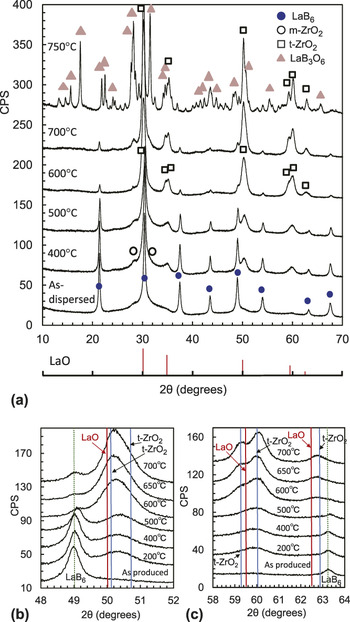
Although it is possible to produce LaB6 NPs via routes of thermal plasma, CVD, and wet synthesis, Reference Ji, Zhang, Xu and Zhao24,Reference Mattox, Agrawal and Milliron25 breakdown method is industrially considered as advantageous due to its high productivity and the enhanced ensemble inhomogeneity effect for band-broadening. Reference Machida and Adachi16 Since LaB6 has extremely high hardness, 27.2 GPa, Reference Samsonov26 a milling usually utilizes YSZ beads. XRD profile of LaB6 NPs dispersed with YSZ beads is shown in the bottom profile of Fig. 1(a). All the reflection peaks are indexed as LaB6, where a broad background showing around 2θ = 28–32, 35, 50, and 60° belongs to very fine YSZ-beads-derived contaminants of tetragonal-ZrO2 (t-ZrO2) and monoclinic-ZrO2 (m-ZrO2). The main phase of YSZ-beads is t-ZrO2, which is partially transformed to m-ZrO2 during millings under high local shear stress and high temperature. These ZrO2 contaminants are known not to interrupt the optical performance of LaB6 NPs except for a slight absorption in the UV range. Reference Takeda, Kuno and Adachi3 The expected peak locations of LaO are shown at the bottom, indicating that all of them locate in the proximity of t-ZrO2 peaks to make identification difficult. Therefore, samples were heated in air in anticipation of the growth of LaO, if it existed.
(a) XRD patterns of zirconia-beads-dispersed LaB6 nano-powders as-dispersed and heated in air at 200–750 °C for 5 h. (b) and (c) Enlarged proportions around 2θ = 50 and 60°, showing overlap of reflections from LaO and t-ZrO2. Profiles except for “as-dispersed” are displaced along ordinate. Most of the smaller peaks without symbols in (a) belong to LaB3O6 except for a few of LaBO3.

LaB6 NPs derived from YSZ-beads have been heated in air at temperatures 200–850 °C for 5 h. Resulting XRD profiles are shown in Fig. 1(a). LaB6 reflections do not show a large change until the heating temperature of 400 °C, but show an abrupt decrease during heating at 500–600 °C to lose intensity above 600 °C. On the contrary, t-ZrO2 peaks are eminent as low as 200 °C and gradually intensified up to the heating as high as 850 °C. Reflections from m-ZrO2 are observable broadly at 2θ = 28 and 31° in the as-dispersed sample, which slightly grow at 400–500 °C and then decrease. These zirconia contaminants are initially of low crystallinity and nanometer-size, as observed in TEM, producing a broad background in XRD patterns. Thus, upon high-temperature heat treatment it is considered that advances in crystallization and the Ostwald-type growth have intensified the XRD reflections of the thermodynamically-stable t-ZrO2 phase, while the m-ZrO2 phase initially rearranged thermally but gradually destabilized since it is not an equilibrium phase. At above 700 °C, LaB3O6 crystallizes abundantly. At 750 °C, most of the peaks are indexed as the LaB3O6 phase, including the smaller peaks which are not indicated by symbols. A few small peaks are from LaBO3. Throughout the heating temperatures, the presence of LaO has not been established because of the close locations of reflections as shown in Figs. 1(b) and 1(c).
To avoid overlapping of peak locations, different bead species other than YSZ were examined. SS beads have high specific weight but low surface hardness, so lots of iron contamination is produced. Alumina beads have low specific weight, 0.84 times that of LaB6, and take longer time to pulverize LaB6. In Fig. 2(a) are shown XRD profiles for LaB6 NPs as-dispersed with SS beads, and those heated at 400 °C and 650 °C. The as-dispersed sample contains a reflection from Fe0.947Cr0.053 around 2θ = 45°. At 400 °C, boron component of LaB6 already starts to react with this iron to form Fe2B to become the major phase. Fe2B then transforms to hematite, Fe2O3, by heating at 650 °C. LaB6 is almost completely oxidized at 650 °C, and LaBO3 is crystallized instead of LaB3O6 probably because of the less B available at the time of nucleation. In SS-bead-milled samples neither LaO nor La2O3 have been detected.
XRD patterns of LaB6 nano-powders, dispersed with media beads of (a) stainless steel and (b) alumina, as-dispersed and heated in air at 400–750 °C for 5 h.

In Fig. 2(b) is shown XRD profiles of LaB6 NPs milled with alumina beads. Only LaB6 reflections are observed in samples as-dispersed and heated to temperatures less than 650 °C, while LaB3O6 crystallizes abundantly at 750 °C. A small amount of LaB6 remains unoxidized at 750 °C, but no reflections have been observed of LaO and La2O3.
Throughout these observations, crystalline LaO and La2O3 have not been detected by XRD, either as-dispersed or heat treated at high temperatures. In case of alumina-bead-milling, the impact suffered by LaB6 may not have been strong enough to invoke transformation to LaO. However, the impact should be strong enough in case of SS beads since both their density and weight are greater than those of YSZ beads. Therefore, we can conclude that crystalline LaO phase is not produced during bead-milling of LaB6, unlike the previous report. Reference Takeda, Kuno and Adachi3
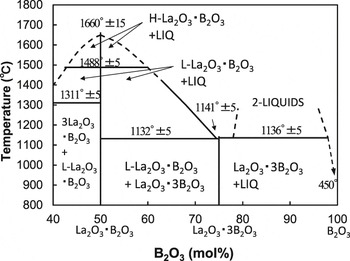
From the XRD measurement and past literature, we may understand the oxidation behavior of LaB6 on heating, as follows. The phase diagram by Levin et al. Reference Levin, Robbins and Waring27 of the system La2O3–B2O3 is reproduced in Fig. 3. This provides the lanthanum triborate, La2O3·3B2O3 = 2LaB3O6, as a B-rich lanthanum oxide. The B-rich La–B–O composition decomposes into LaB3O6 and B2O3 (liquid) at temperatures lower than 1136 °C and higher than 450 °C. It is inferred that when LaB6 is heated under presence of oxygen, its oxidization product would immediately be facilitated decomposition into these two phases. Wen et al. Reference Wen, Wu and Wu28 studied the oxidation behavior of LaB6 bulk surface, and observed in TEM that LaB6 does not directly produce crystalline LaB3O6 on heating, but oxidizes and transits through a glassy phase, La–B–O (glass), at 700 °C, before starting crystallization to LaB3O6 at 945 °C. The XRD result of Figs. 1 and 2 confirm the observations of Wen et al. Reference Wen, Wu and Wu28 except for the lowered transformation temperatures.
B-rich side of the La2O3–B2O3 phase diagram after Levin et al. Reference Levin, Robbins and Waring27

The oxidation/decomposition scheme of LaB6 NPs on heating suggested from Figs. 1 and 2 is delineated as follows:
 $${\rm{La}}{{\rm{B}}_{\rm{6}}}{\rm{\ NP\ }} + {\rm{\ }}{{\rm{O}}_{\rm{2}}}\buildrel {450-600\;^\circ {\rm{C}}} \over \longrightarrow {\rm{a}} - {\rm{La}} - {\rm{B}} - {\rm{O\ }} + {\rm{\ a}} - {{\rm{B}}_{\rm{2}}}{{\rm{O}}_{\rm{3}}}\buildrel {650-750\;^\circ {\rm{C}}} \over \longrightarrow {\rm{La}}{{\rm{B}}_{\rm{3}}}{{\rm{O}}_{\rm{6}}}{\rm{\ }} + {\rm{\ a}} - {\rm{La}} - {\rm{B}} - {\rm{O\ }} + {\rm{\ a}} - {{\rm{B}}_{\rm{2}}}{{\rm{O}}_{\rm{3}}}\quad {\rm{.}}$$
The temperatures of oxidation to amorphous La–B–O (a-La–B–O) and amorphous B2O3 (a-B2O3) and of crystallization to LaB3O6 are lower than a bulk surface by 100–300 °C, which is apparently a size effect, but may depend on how the temperature change is read from the measurement. Somber et al. Reference Sonber, Sairam, Murthy, Nagaraj, Subramanian and Hubli29 made a thermogravimetric measurement of LaB6 bulk square pillar sample and reports that oxidation starts at 500 °C and accelerates at 700 °C.
According to Wen et al., Reference Wen, Wu and Wu28 the process of oxidation of LaB6 to a-La–B–O and a-B2O3 is diffusion-controlled and proceeds parabolically with an activation energy of 195 ± 15 kJ/mol. When Fe element is present, the oxidation of LaB6 is considered to be accelerated by the formation of Fe2B at 400 °C.
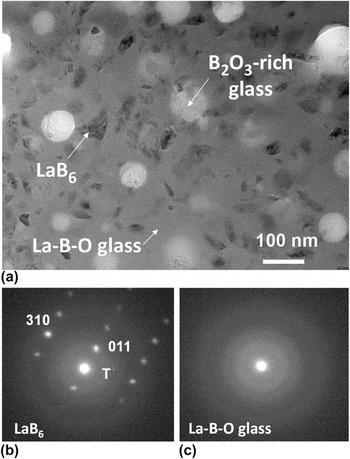
TEM observation of the alumina beads-derived LaB6 NPs sample heated at 650 °C has revealed nano-sized LaB6 phase, dark matrix a-La–B–O, and spherical area in light contrast, as shown in Fig. 4. Micro-diffraction patterns taken from the nanometer-sized phase and the dark matrix phase confirm the respective phases as shown. In this sample, LaB3O6 and LaO phases have not been detected in the selected-area diffraction ring patterns taken from the whole view. Energy dispersive x-ray spectrometry analysis indicated that the spherical area contains significantly less La than the dark matrix, suggesting the segregated B2O3-rich phase. This amorphous phase is considered to be formed by phase separation from a-La–B–O. In the sample of heating at 750 °C, the B2O3-rich phase was observed to increase, and a new crystalline phase LaB3O6 has grown as the major phase, while a small amount of LaB6 remained. LaO was not observed in this sample either.
(a) TEM micrograph of alumina-beads-dispersed LaB6 nano-powder heated in air at 650 °C for 5 h, and corresponding micro-diffraction patterns taken from (b) LaB6 and (c) La–B–O phases, respectively.

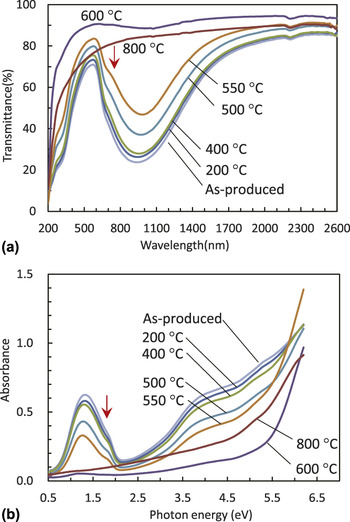
With these oxidation/decomposition processes in mind, changes in the optical properties of LaB6 NPs on heating can be well understood. Figure 5 shows transmittance and absorbance of LaB6 dispersion on quartz substrate heated in air at temperatures between 200 °C and 800 °C. Only minute changes are seen for samples heated at below 400 °C, while an appreciable change is observed initiated at 500 °C, strongly accelerated at 550 °C, and led to nullification of LSPR at 600 °C. These changes occur as a result of the oxidation of LaB6, and are in complete agreement with the XRD and TEM result. A notable change in absorbance is that the 1.8 eV subpeak (shown by arrow) decreases with increasing heating temperature in conjunction with the 1.3 eV main peak. If the 1.8 eV subpeak were originated from LaO, it must be a phase that destabilizes with increasing temperature in air.
Changes in optical transmittance and absorbance of LaB6-dispersion on quartz substrate, heated in air at 200–800 °C for 1 h. The arrow indicates the 1.8 eV subpeak.

LaO has been shown by thermodynamical analysis by Leger et al. Reference Leger, Yacoubi and Loriers30 to be stable at high pressure but instable at normal pressure with positive Gibbs free energy. Therefore if LaO were formed by the local high temperature and pressure during milling by the collision of beads, it is questionable if LaO can stably exist around surface of LaB6 NPs. On the other hand, it is indicated that a molecular species to desorb from LaB6 bulk surface at high temperature in the O2 partial pressure of 1–50 langmuir is LaO. Reference Trenary1 Thus a presence of nanoscale LaO on LaB6 surface, left ungrown after produced by milling, cannot be completely denied.
B. First-principles and scattering analysis of LaO
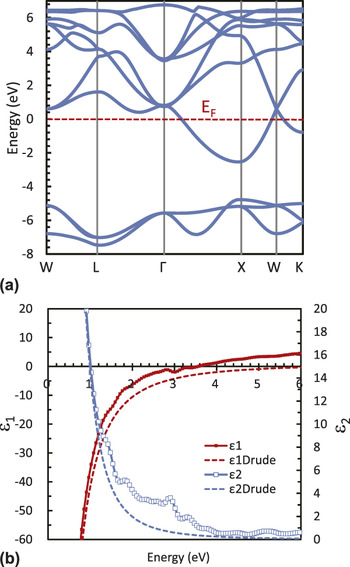
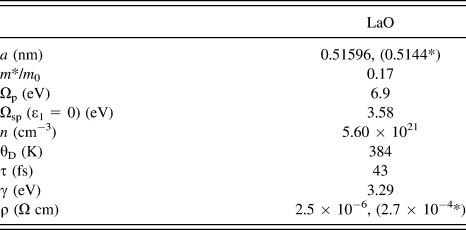
Since optical properties of LaO at low enegies have not been reported, we have conducted first-principles calculations to derive its dielectric functions. Correct evaluation of the band gap is a significant prerequisite for a meaningful evaluation of low-energy optical properties. Since it is demonstrated recently Reference Yoshio, Maki and Adachi11 that the dielectric functions can be reproduced excellently in LaB6 by following the sX-LDA method and incorporating the Drude term, we have followed the same procedure to apply to LaO. The resulting energy band diagram is shown in Fig. 6(a). It dictates that LaO is metallic since the Fermi energy E F crosses the lowest conduction band, which is partially filled by electrons. Physical properties derived from the band diagram are listed in Table I. Lattice constant a = 0.51596 nm agrees with the experimental value Reference Leger, Aimonio, Loriers, Dordor and Coqblin15 a = 0.5144 nm. Free electron density was calculated from the volume of ellipsoid traced by Fermi surface about the X point in the Brillouin zone, giving n = 5.60 × 1021 cm−3, suggesting a high conductivity. Relaxation time τ was derived from Gruneisen–Bloch equation, assuming only acoustic phonons as a scattering source. The details of the calculation procedure are to be referred to Yoshio et al. Reference Yoshio, Maki and Adachi11 The derived value τ = 43 fs is apparently overestimated since the electrical resistivity ρ = 2.5 × 10⁻⁶ Ω cm derived from this τ is nearly two orders-of-magnitude greater than the reported experimental value Reference Leger, Aimonio, Loriers, Dordor and Coqblin15 ρ = 2.7 × 10⁻⁴ Ω cm. This implies that La-d electrons make a complex binding contribution in LaO and thus electron–electron interaction and optical phonons are not to be ignored in the evaluation of τ. Nevertheless, we have adopted the calculated τ to obtain the Drude term since the absolute value of τ does not affect ε greatly while the incorporation of the Drude term is vitally important.
(a) Energy band diagram of LaO calculated by sX-LDA. (b) Dielectric functions of LaO obtained from (a).


a θD: Debye temperature, γ: relaxation constant.
b *Experimental, Leger et al. Reference Leger, Aimonio, Loriers, Dordor and Coqblin15
The derived dielectric functions of LaO are shown in Fig. 6(b). The real part and the imaginary part diverge upon ε → 0 to negative and positive infinity, respectively, imposed by the Drude term. Screened plasma frequency, given by the energy at ε1 = 0, is 3.6 eV in the UV range. In the medium of refractive index 1.5, the resonant condition is displaced to ε1 = −4 and lowers the LSPR frequency to 2.2 eV. This is relatively close to the 1.8 eV subpeak. The Lorentz term of ε2 may be traced by subtracting the Drude contribution in Fig. 6(b), which indicates the presence of many interband transitions in 1.2–4.0 eV encompassing the visible range.
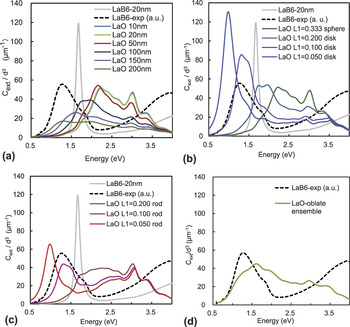
To see the optical performance of NPs, Mie scattering calculations Reference Bohren and Huffman23 have been made using the derived dielectric functions and the assumed refractivity of medium 1.5. The result is shown in Fig. 7(a) for various sizes of spherical particles, and in Figs. 7(b), 7(c) for various aspect ratios of oblate (akin to disk-like) and for prolate (akin to rod-like) particles, respectively. For comparison, extinction cross section, C ext, of spherical LaB6 particles of diameter 20 nm and experimental extinction profile of LaB6 NPs dispersion are shown. The LSPR peak of LaB6 is modified by the permittivity of medium from the calculated plasma frequency 1.9 eV at ε1 = 0–1.6 eV at ε1 = −4. In addition, the actual bead-milled LaB6 NPs in dispersion are modified in shape toward disk-like largely, whose a/c is scattered in the ensemble, and therefore the LSPR peak red-shifts as well as broadened considerably. Reference Machida and Adachi16 The plasmon peak of LaO is found at 2.1 eV, which coincides with 2.2 eV predicted from ε1 = −4. Plasmon peaks are shifted to lower energies with band broadening as particle size increases, while the location of the interband absorptions hardly changes. As for the changes in particle shape, plasmon peaks are shifted to lower energies as a/c increases (L 1 decreases) [Fig. 7(b) and 7(c)]. At very high a/c, plasmon peak tends to split.
Mie theory results of Cext/d3 for LaO nanoparticles, relative to LaB6, for (a) spherical particles of various sizes, (b) oblate and (c) prolate particles of various aspect ratio, and (d) for an ensemble of oblate particles of L 1 = 0.125 and s = 0.1.

These theoretical calculations of LaO foresee that LaO has a very broad absorption band exceeding 2 eV FWHM in the visible ∼ UV range since LSPR absorption is combined with strong interband absorptions present at 1.2–4.0 eV. This bandwidth is further broadened by the particle nonsphericity if it existed and the associated ensemble effect. Assuming the shape inhomogeneity distribution to be similar as for LaB6, i.e., L 1 = 0.125 and s = 0.1, the absorption by the hypothetical LaO NPs ensemble is calculated and shown in Fig. 7(d). This band is excessively broadened over the entire visible ∼ UV range that it is obvious that it cannot provide the origin of the 1.8 eV subpeak.
The ab initio calculation has been similarly made on the lanthanum triborate phase LaB3O6 which crystallizes after the oxidation of LaB6. The result indicated that LaB3O6 is an insulator with a wide band gap and does not contribute to the NIR absorption.
The above observations and discussions clarify that the origin of the 1.8 eV subpeak is not LaO nor interband transitions of LaB6. As analyzed in Ref. 16, it is pertinent to interpret the 1.8 eV subpeak as the absorption by an ensemble of oblate-shaped particles of varied a/c.
IV. CONCLUSION
Possibility of the nonequilibrium phase LaO as the origin of the 1.8 eV subpeak in the plasmon band of solar-control LaB6 films have been examined with oxidation behaviors of LaB6 NPs on heating.
The XRD peaks of LaO overlap those of t-ZrO2, and prevent the LaO identification. In LaB6 NPs dispersed with SS-beads and alumina-beads, LaO peaks have not been found. LaB6 NPs are found to oxidize to produce La–B–O and B2O3-rich glasses at around 450 °C, followed by the precipitation of LaB3O6 phase at 700 °C. Both the plasmon-band main peak and the 1.8 eV subpeak decrease intensity on heating, particularly at T > 500 °C, and vanish at 600 °C. LaO and La2O3 have not been detected by XRD in any heating samples.
First-principles calculation of dielectric functions of LaO indicated the LSPR absorption at 2.1 eV but with abundant interband absorptions in 1.2–4.0 eV. Mie scattering calculations for spherical, disk-like, and rod-like particles and their ensemble effect have concluded that LaO NPs cannot be the origin of the 1.8 eV subpeak. The most likely origin is therefore ascribed to the ensemble inhomogeneity effect of disk-like particles of LaB6 as reported recently. Reference Machida and Adachi16
ACKNOWLEDGMENTS
The authors wish to show their sincere appreciation to Mr. Hideaki Fukuyama and Mr. Takehide Morimoto for experimental assistances.