I. INTRODUCTION
Magnesium and its alloys are attracting much attention as structural light metallic materials for reducing environmental load by improving the fuel efficiency of vehicles, airplanes, and so on.
Reference Hakamada, Furuta, Chino, Chen, Kusuda and Mabuchi1
It is desirable to improve the ductility and strength of Mg for more applications in automotive and aerospace components, and so on. In crystals five independent slip systems are required to accommodate general homogeneous deformation according to the von Mises criterion. However, Mg has fewer slip systems because of its anisotropic hexagonal close packed (hcp) structure, in which basal 〈a〉 slips with only two independent slip systems are rather active. Fewer slip systems result in enhanced twinning deformation.
Reference Yoo2
Mg has three major twinning modes:
 $\left\{ {10\bar 12 } \right\}\left\langle {10\bar 11} \right\rangle$
,
 $\left\{ {10\bar 11} \right\}\left\langle {10\bar 12} \right\rangle$
and
 $\left\{ {10\bar 13} \right\}\left\langle {30\bar 32} \right\rangle$
.
Reference Yoo2–Reference Chapuis and Driver6
In particular, the
 $\left\{ {10\bar 12} \right\}$
twin and the
 $\left\{ {10\bar 11} \right\}$
twin strongly affect the mechanical properties of Mg.
Reference Barnett4,Reference Braszczyńska-Malik, Lityńska and Baliga7–Reference Yuasa, Masunaga, Mabuchi and Chino10
The
 $\left\{ {10\bar 12} \right\}$
twin is known as the 〈c〉-axis extension twin and easily occurs when a grain is deformed in tension along the 〈c〉 axis, while the
 $\left\{ {10\bar 11} \right\}$
twin is called the 〈c〉-axis contraction twin and occurs when a grain is deformed in compression along the 〈c〉-axis.
 $\left\{ {10\bar 12} \right\}$
twins increase uniform elongation and cause work hardening.
Reference Barnett4,Reference Braszczyńska-Malik, Lityńska and Baliga7,Reference Barnett, Keshavarz, Beer and Atwell8
 $\left\{ {10\bar 11} \right\}$
twins absorb dislocations
Reference Serra and Bacon9,Reference Yuasa, Masunaga, Mabuchi and Chino10
and
 $\left\{ {10\bar 11} \right\} - \left\{ {10\bar 12} \right\}$
double twins cause premature fracture.
Reference Barnett5,Reference Braszczyńska-Malik, Lityńska and Baliga7–Reference Ando, Koike and Sutou11
Thus, the twins affect the mechanical properties of Mg, and it is important to understand the twinning characteristics for development of high-performance Mg alloys. Experimental investigations have shown that twinning strongly depends on the grain size
Reference Barnett, Keshavarz, Beer and Atwell8,Reference Jain, Duygulu, Brown, Tomé and Agnew12,Reference Barnett13
and the Schmid factor.
Reference Xin, Wang, Huang, Guo and Liu14,Reference Jiang, Jonas, Mishra, Luo, Sachdev and Godet15
However, Beyerlein et al.
Reference Beyerlein, Capolungo, Marshall, McCabe and Tomé16
showed that the grain boundary (GB) misorientation angle strongly influences twin nucleation and growth, while twinning does not exclusively occur in grains with high twin Schmid factors or in relatively large grains. Thus, the nucleation and growth of twinning in Mg are still under debate.
Recently, twin nucleation and growth in Mg have been investigated by molecular dynamics (MD) simulations.
Reference Serra, Pond and Bacon17–Reference Ostapovets and Serra30
Multiple dislocations (zonal dislocations) simultaneously glide on the twin plane for the zonal twinning mechanism.
Reference Mendelson31
Wang et al.
Reference Wang, Hirth and Tomé19
showed that a
 $\left\{ {10\bar 12} \right\}$
twin forms by the glide of zonal dislocations consisting of a partial dislocation and multiple twinning dislocations, and the zonal twinning mechanism is energetically favorable relative to the normal twinning mechanism. Li and Ma
Reference Li and Ma21
investigated the zonal mechanism of
 $\left\{ {10\bar 11} \right\}$
twinning and showed that
 $\left\{ {10\bar 11} \right\}$
twinning is related to incomplete dislocations on the twin plane. Recently, simulations and experiments have suggested that a GB can be a source of twin nuclei,
Reference Wang, Beyerlein and Tomé22,Reference Beyerlein, McCabe and Tomé32
because partial and twinning dislocations can be emitted from a GB. If this is correct, additional elements segregated at GBs can affect the twinning characteristics. There have been some studies of the effect of additional elements on the twinning characteristics in Mg.
Reference Stanford and Barnett33–Reference Chino, Kado and Mabuchi38
For example, twinning was suppressed by addition of Y.
Reference Stanford, Marceau and Barnett34–Reference Chang, Nakagaida, Hong, Shin and Sato36
In addition, the concentration of rare earth elements affected the stress for activating twinning.
Reference Agnew a, Mulay, Polesak, Calhoun, Bhattacharyya and Clausen37
Stanford et al.
Reference Stanford, Marceau and Barnett34
suggested that the larger atomic size of Y compared with Mg inhibits atomic shuffling, resulting in suppressed twin formation in the Mg–Y alloy. On the other hand, solute Zn had no effect on the stress required to propagate twins.
Reference Stanford and Barnett33
It has been reported that there is little difference in twinning between pure Mg and the Mg–Ce alloy.
Reference Chino, Kado and Mabuchi38
Thus, there is insufficient understanding of the effect of segregation elements on twinning in Mg.
Recently, Kim et al.
Reference Kim, Manuel, Ebrahimi, Tulenko and Phillpot39,Reference Kim, Ebrahimi, Manuel, Tulenko and Phillpot40
performed a MD simulation on the twinning of nanocrystalline Mg with the
 $\left[ {11\bar 20} \right]$
-textured two-dimensional (2-D) polycrystalline model. A 2-D model enables simulations of nanocrystallites with a larger grain size to be performed, compared with three-dimensional models such as the random Voronoi polycrystal model.
Reference Yamakov, Wolf, Phillpot, Mukherjee and Gleiter41,Reference Yamakov, Wolf, Salazar, Phillpot and Gleiter42
Hence, MD simulations with 2-D models are effective to investigate the effect of an additional element on twinning. Recently, accurate potentials for the interaction between Mg and additional elements have been developed for MD simulations.
Reference Jelinek, Groh, Horstemeyer, Houze, Kim, Wagner, Moitra and Baskes43
The aim of the present work is to investigate the twinning behavior of pure Mg and Mg–Al alloys by MD simulations with state-of-the-art potentials. Al is a typical additional element in Mg alloys. In the present work, MD simulations of pure Mg, Mg–0.1 at.%Al, and Mg–1.0 at.%Al models were performed at 5 and 300 K.
II. SIMULATION METHODS
The 2-D polycrystalline model developed by Kim et al.
Reference Kim, Manuel, Ebrahimi, Tulenko and Phillpot39,Reference Kim, Ebrahimi, Manuel, Tulenko and Phillpot40
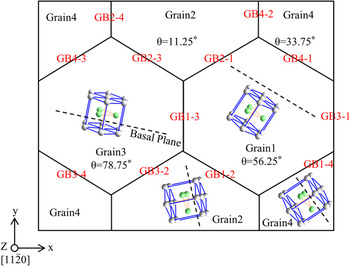
was used in the present work. Figure 1 shows a schematic illustration of the 2-D polycrystalline model used for the simulations. The simulation model consisted of four hexagonal grains. In the 2-D model, the
 $\left[ {11\bar 20} \right]$
directions of all of the grains were parallel to the z direction. The simulation cell contained 488,625 atoms and the size of the cell was about 100 nm in the x direction, 71.2 nm in the y direction, and 1.6 nm in the z direction. The grain size of this model was 50 nm. The angle between the c axis and the x direction was 56.25° for Grain1, 11.25° for Grain2, 78.75° for Grain3, and 33.75° for Grain4. Compression in the x direction was loaded on the model. In this case, the 〈c〉-axis tensile stress was applied to Grain3 and 〈c〉-axis compression stress was applied to Grain2. Periodic boundary conditions were applied in the x, y, and z directions to eliminate any surface effects. Dislocations whose lines were along the
 $\left[ {11\bar 20} \right]$
direction had infinite length because of the 2-D model. The 2-D model with 1.6 nm in the z direction may impose strict constraints on the mobility of dislocations.
Schematic illustration of a 2-D polycrystal model for molecular dynamic simulation. θ is the angle between the x direction and the c axis of the grain.

The models of pure Mg, Mg–0.1 at.%Al, and Mg–1.0 at.%Al were used to investigate the effect of Al on twinning. Al tends to segregate at GBs in Mg. Reference Teng, Zhang, Zhang, Li and Cockcroft44 The driving force for segregation can be divided into an elastic size effect and an excess cohesion effect. Reference Duparc, Larere, Lezzar, Khalfallah and Paidar45,Reference Wynblatt and Ku46 The elastic effect is likely to be the most effective factor to segregate Al in Mg because the radius of the Mg atom (about 160 pm) is larger than that of the Al atom (about 143 pm). Reference Duparc, Larere, Lezzar, Khalfallah and Paidar45 Hence, Al atoms tend to be located at the compression sites of a GB to reduce the elastic energy. Reference Zhang, Dou and Zheng47 In the present simulations, the initial locations of the Al atoms were determined by calculating the Voronoi volume, Reference Voronoi48 where the Voronoi volume is defined as the volume of the cell consisting of the space that is closer to the specific atom than any other atom. For the Mg–Al models, Mg atoms whose Voronoi volumes were the smallest were substituted by Al atoms after relaxation at 5 K.
The parallel MD code LAMMPS
Reference Plimpton49
was used to perform the MD simulations. The MD simulations were performed using modified embedded-atom method (MEAM) potentials,
Reference Jelinek, Groh, Horstemeyer, Houze, Kim, Wagner, Moitra and Baskes43
by which the interactions of Mg–Mg, Mg–Al and Al–Al atoms were calculated. The twin boundary (TB) energies were calculated to investigate the validity of the MEAM potentials. The
 $\left\{ {10\bar 12} \right\}$
and
 $\left\{ {10\bar 11} \right\}$
TB energies were 133.2 and 73.3 mJ/m2, respectively. These values are in good agreement with those obtained by first-principles calculations.
Reference Wang, Chen, Liu and Mathaudhu50
The NPT ensemble with a cutoff distance of 5.0 nm was used. The time step of the simulations was 1 fs.
After removing a small number of atoms that were unnaturally close to the nearest atoms (∼2 Å), relaxation simulations were performed to obtain the stable GB structures at 5 and 300 K. The models were relaxed at 5 K for 1 ns. Then, they were annealed from 5 to 300 K for 1 ns and relaxed at 300 K for 1 ns. The temperature was controlled using the Nosé–Hoover thermostat technique. Reference Melchionna, Ciccotti and Holian51
The relaxed models were compressed at 5 and 300 K by imposing a constant engineering strain rate (108 s−1) along the x direction. The strain rate of 108 s−1 is much higher than usual experimental deformation rates of 10−5 to 10−4 s−1. The high speed deformation will lead to easy formation of twins. However, MD simulations at the high strain rate can give an insight to fundamental understanding of twinning because the nature of twinning does not depend on the strain rate. The model cell was allowed to relax perpendicular to the x direction. The compression test simulations at a low temperature of 5 K help us to deeply understand the twinning mechanisms because the disturbance of thermal vibration is limited. The models were compressed to 10% strain at 5 K for 1 ns and to 20% strain at 300 K for 2 ns. AtomEye software Reference Li52 was used for visualization of the MD simulation results. In the illustrations according to common neighbor analysis, Reference Honeycutt and Anderson53 light blue atoms are atoms with hcp structure, deep blue atoms are those with face-centered cubic (fcc) structure, and red atoms are those with neither hcp nor fcc structure.
III. RESULTS
A. Slip and twinning in the pure Mg model
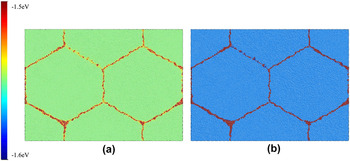
Figure 2 shows the structure of the pure Mg model after relaxation at 5 K, where (a) is color-coded according to the potential energy and (b) is color-coded according to the common neighbor analysis. All of the GBs, except for GB2-3, in the model were high angle tilt GBs.
Structure of pure Mg model after relaxation at 5 K: (a) color-coded according to potential energy and (b) color-coded according to common neighbor analysis. In (b), light blue atoms are hcp, deep blue atoms are fcc, and red atoms are neither hcp nor fcc.

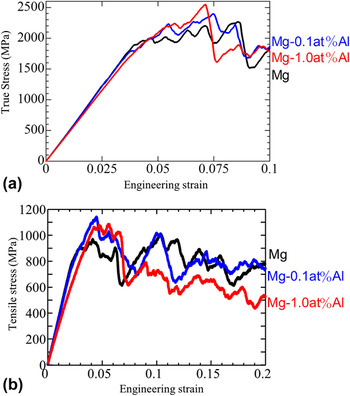
The stress–strain curves obtained by the compression test simulations at 5 and 300 K are shown in Fig. 3. The Mg models showed stress–strain curves like an elastic perfectly plastic solid showing no strain hardening. This tendency agrees with the experimental result of a nanocrystalline Mg whose grain size was almost the same as that of the pure Mg model. Reference Choi, Kim, Shin and Bae54 However, the flow stress calculated with the Mg models was much larger than that obtained by experiment. This is partly because the strain rate in the MD simulations was much larger than that in the experiment.
Stress–strain curves obtained by compression test simulations for pure Mg and Mg–Al models: (a) 5 and (b) 300 K.

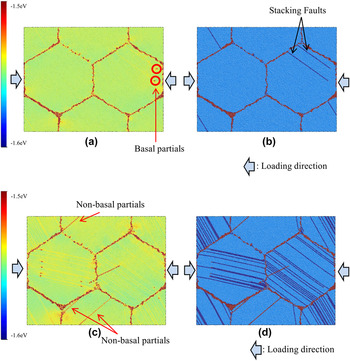
Figure 4 shows snapshots of the pure Mg model when 4 and 6% compression strains were applied at 5 K. As shown in Figs. 4(a) and 4(b), basal slips were activated upon application of 4% compression strain. That is, basal partial dislocations whose Burgers vector was
 ${a \sol\mathord{\left{\vphantom {a 3}} \right\kern-\nulldelimiterspace} 3}\left\{ {0001} \right\}\left[ {01\bar 10} \right]$
(a is the lattice constant in the a axis) nucleated at GB2-1 and glided on the basal plane (BP), resulting in the formation of stacking faults. When 6% compression strain was applied, non-basal slips were found in Grain1 and Grain2, as shown in Figs. 4(c) and 4(d). The non-basal slips resulted from the glide of 〈c + a〉 partial dislocations whose Burgers vector was
 ${1 \sol\mathord{\left{\vphantom {1 6}} \right\kern-\nulldelimiterspace} 6}\left\{ {10\bar 11} \right\}\left[ {\bar 2023} \right]$
, where the slip direction was calculated by Burgers circuit analysis (Fig. 5) and the slip plane was determined to be
 $\left\{ {10\bar 11} \right\}$
plane because atomic movements were parallel to
 $\left[ {1\bar 102} \right]$
and normal to
 $\left[ {11\bar 20} \right]$
and these two directions were on the
 $\left\{ {10\bar 11} \right\}$
plane.
Reference Kim, Ebrahimi, Manuel, Tulenko and Phillpot40
The pyramidal 〈c + a〉 partial dislocation, that is, the first pyramidal slip, has been well investigated
Reference Kim, Ebrahimi, Manuel, Tulenko and Phillpot40,Reference Li and Ma55
because this deformation mode leads to enhanced ductility of Mg by accommodating the 〈c〉-axis strain. The pyramidal dislocations were activated most in Grain2. The basal slip can hardly accommodate the x-direction strain in Grain2 because the x direction is almost perpendicular to the BP of Grain2. This stimulated the pyramidal slip to accommodate the x-direction strain in Grain2.
Snapshots of pure Mg model at 5 K upon application of (a) and (b) 4% compressive strain, and (c) and (d) 6% compressive strain. (a) and (c) are color-coded according to potential energy, and (b) and (d) are color-coded according to common neighbor analysis. In (b) and (d), light blue atoms are hcp, deep blue atoms are fcc, and red atoms are neither hcp nor fcc.

(a) Structure of the nonbasal partial dislocation on the
 $\left\{ {1011} \right\}$
plane, and (b) the Burgers vector of the non-basal partial dislocation.

When 7.75% compression strain was applied, a
 $\left\{ {10\bar 11} \right\}$
twin nucleated in Grain2, as shown in Fig. 6. It should be noted that formation of the
 $\left\{ {10\bar 11} \right\}$
twin was the result of the movement of pyramidal 〈c + a〉 dislocations on the
 $\left\{ {10\bar 11} \right\}$
plane. The nucleation mechanism of the
 $\left\{ {10\bar 11} \right\}$
twin will be discussed later. Also, it is of interest to note that a
 $\left\{ {10\bar 11} \right\}$
twin nucleated before formation of a
 $\left\{ {10\bar 12} \right\}$
twin. This does not agree with the experimental fact that
 $\left\{ {10\bar 11} \right\}$
twins nucleate after formation of
 $\left\{ {10\bar 12} \right\}$
twins at room temperature.
Reference Barnett4
It will be shown later that in the simulations at 300 K, a
 $\left\{ {10\bar 11} \right\}$
twin nucleated after formation of a
 $\left\{ {10\bar 12} \right\}$
twin.
Snapshots of pure Mg model at 5 K upon application of (a) 7.75% compression strain, and (b) and (c) 8.0% compression strain. A
 $\left\{ {10\bar 11} \right\}$
twin formed by movement of pyramidal 〈c + a〉 dislocations on the
 $\left\{ {10\bar 11} \right\}$
plane.

When about 8.6% compression strain was applied, a
 $\left\{ {10\bar 12} \right\}$
twin nucleated from GB3-1 and grew into Grain3 (Fig. 7). Thus, a
 $\left\{ {10\bar 12} \right\}$
twin nucleated after formation of a
 $\left\{ {10\bar 11} \right\}$
twin for simulations at 5 K. The
 $\left\{ {10\bar 12} \right\}$
twin nucleated by the zonal mechanism, as shown in Figs. 7(a) and 7(b). A
 $\left\{ {10\bar 12} \right\}$
twin is characterized by its misorientation between the BP of the twin area and that of the matrix area, and its twin boundary has a BP/prismatic plane interface.
Reference Xu, Capolungo and Rodney25,Reference Barrett and El Kadiri28
The BP interface was found for the nucleated
 $\left\{ {10\bar 12} \right\}$
twin, as shown in Figs. 7(a) and 7(b). The nucleated
 $\left\{ {10\bar 12} \right\}$
twin grew through movement of the PB interface, which resulted from the glide of zonal twinning dislocations.
Snapshots of pure Mg model at 5 K upon application of (a) 8.58%, (b) 8.59%, and (c) 10.0% compression strain. A
 $\left\{ {10\bar 12} \right\}$
twin formed by zonal dislocations.

Figures 8 and 9 show snapshots at 300 K. When 4% compression strain was applied, a
 $\left\{ {10\bar 12} \right\}$
twin nucleated from GB1-3 [Fig. 8(a)] and grew into Grain3 [Fig. 8(b)]. A
 $\left\{ {10\bar 12} \right\}$
twin nucleated before formation of a
 $\left\{ {10\bar 11} \right\}$
twin in the simulation at 300 K, unlike the simulation at 5 K. The easier formation of a
 $\left\{ {10\bar 12} \right\}$
twin agrees with experimental results.
Reference Koike3
The nucleated
 $\left\{ {10\bar 12} \right\}$
twin rapidly grew with strain. As a result of the rapid growth, the twin covered almost all of Grain3 [Fig. 8(d)]. In addition, when 6% compression strain was applied, 〈c + a〉 partial dislocations were emitted into Grain2 [Fig. 8(c)].
Snapshots of pure Mg model at 300 K upon application of (a) 4%, (b) 5%, (c) 6%, and (d) 10% compression strain. A
 $\left\{ {10\bar 12} \right\}$
twin rapidly grew.

Snapshots of pure Mg model at 300 K upon application of (a) 15% and (b) 20% compression strain. Intense shearing occurred along the
 $\left\{ {10\bar 12} \right\}$
twins.

Figure 9 shows snapshots upon application of 15 and 20% compression strains at 300 K. As shown in Fig. 8, the
 $\left\{ {10\bar 12} \right\}$
twin covered almost all of Grain3, and Grain3 rotated by about 90° upon application of 10% compression strain. The lattice rotation stimulated formation of
 $\left\{ {10\bar 11} \right\}$
twins in Grain3 and Grain2 [Fig. 9(a)]. Inspection of Fig. 9 reveals that large shearing deformation occurred along the
 $\left\{ {10\bar 11} \right\}$
twin.
 $\left\{ {10\bar 11} \right\}$
twins locally cause intense shearing, resulting in premature fracture.
Reference Barnett5
Therefore, the shearing related to the
 $\left\{ {10\bar 11} \right\}$
twins is suggested to be responsible for the intense shear deformation.
Kim et al.
Reference Kim, Manuel, Ebrahimi, Tulenko and Phillpot39
showed by MD simulations with the 2-D model that not only
 $\left\{ {10\bar 11} \right\}$
and
 $\left\{ {10\bar 12} \right\}$
twinning, but
 $\left\{ {10\bar 13} \right\}$
twinning also occurred. However, no
 $\left\{ {10\bar 13} \right\}$
twinning occurred at least with the present simulation conditions, although the reason for this is unknown.
B. Effect of Al segregation
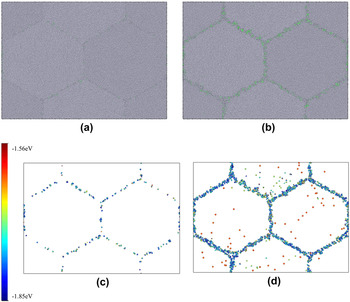
Figures 10(a) and 10(b) show the location of Al atoms in the Mg–Al models after relaxation at 5 K, where light green atoms are Al atoms and gray atoms are Mg atoms. Al atoms did not diffuse into the grain interiors but were located at the GBs. Figures 10(c) and 10(d) show the energy distribution in the Mg–Al models, where only atoms with low potential energies are shown. The GB energies tended to decrease with addition of Al, which indicates that segregated Al stabilizes Mg GBs. This is partly because suitable substitution with Al atoms reduced the free volume of the GBs.
Structures of the (a) and (c) Mg–0.1 at.%Al model, and (b) and (d) Mg–1.0 at.%Al model after relaxation at 5 K. In (a) and (b), light green atoms are Al atoms and gray atoms are Mg atoms. (c) and (d) are color-coded according to potential energy and only atoms with low potential energies are shown.

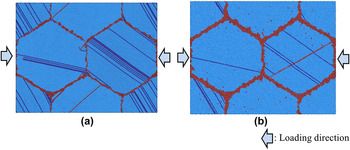
Figure 11 shows snapshots of the Mg–Al models upon application of 6% compression strain. There were fewer stacking faults along the BP in the Mg–Al models than in the pure Mg model, and the number of stacking faults decreased with increasing Al concentration. This indicates that the emission of basal partial dislocations from the Mg GBs was suppressed by Al atoms segregated at the GBs.
Snapshots of the (a) Mg–0.1 at.%Al model and (b) Mg–1.0 at.%Al model at 5 K upon application of 6% compression strain.

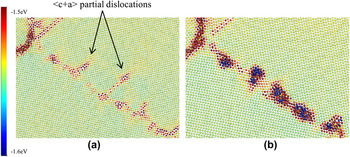
Figure 12 shows the dislocation nucleation from GB2-3 for the pure Mg and Mg–0.1 at.%Al models upon application of 6.18% compression strain. Some 〈c + a〉 partial dislocations nucleated from GB2-3 in the pure Mg model. In the Mg–Al model, however, nucleation of 〈c + a〉 partial dislocations was suppressed. This trend of the 〈c + a〉 partial dislocation is the same as that for the basal partial dislocation, suggesting that segregated Al atoms have the potential to suppress dislocation emission from Mg GBs.
Nucleation of 〈c + a〉 partial dislocations from GB2-3 at 5 K upon application of 6.18% compression strain: (a) pure Mg model and (b) Mg–0.1 at.%Al model.

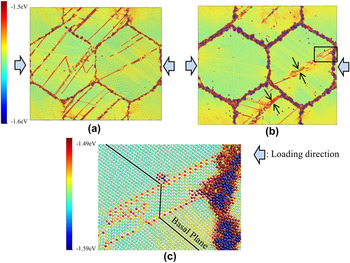
Figure 13 shows snapshots of the Mg–0.1 at.%Al and Mg–1.0 at.%Al models upon application of 10% compression strain. There were a larger number of stacking faults for the Mg–0.1 at.%Al model than for the Mg–1.0 at.%Al model. This agrees with the view that nucleation of 〈c + a〉 partial dislocations was suppressed by Al atoms segregated at the GBs. However, the stacking faults were thicker for the Mg–1.0 at.%Al model than for the Mg–0.1 at.%Al model, as shown by the pairs of arrows in Fig. 13(b). The emission of 〈c + a〉 partial dislocations was suppressed at the sites around the Al atoms, resulting in fewer stacking faults for the Mg–1.0 at.%Al model, while the emission of 〈c + a〉 partial dislocations concentrated at the sites away from the Al atoms, resulting in thicker stacking faults for the Mg–1.0 at.%Al model. As a result,
 $\left\{ {10\bar 11} \right\}$
twin nucleation was suppressed at the sites around the Al atoms, but
 $\left\{ {10\bar 11} \right\}$
twin growth was enhanced at the sites away from the Al atoms. On the other hand,
 $\left\{ {10\bar 12} \right\}$
twins were not formed for both the Mg–Al models in the simulations at 5 K.
Snapshots of Mg–Al models at 5 K upon application of 10% compression strain: (a) Mg–0.1 at.%Al model, and (b) and (c) Mg–1.0 at.%Al model. Thicker stacking faults in the Mg–0.1 at.% model are indicated by pairs of arrows in (b). (c) An enlarged view of the square part in (b).

Figures 14 and 15 show snapshots of the Mg–0.1 at.%Al and Mg–1.0 at.%Al models upon application of compression strain at 300 K. A
 $\left\{ {10\bar 12} \right\}$
twin formed in Grain3 for the Mg–0.1 at.%Al model. However, a
 $\left\{ {10\bar 12} \right\}$
twin did not form even with application of 20% compression strain for the Mg–1.0 at.%Al model. In addition,
 $\left\{ {10\bar 11} \right\}$
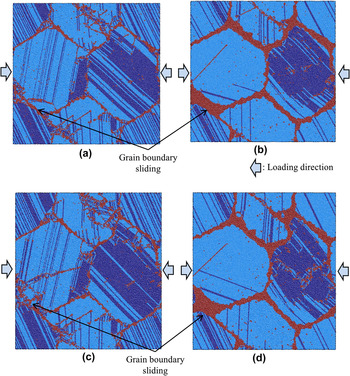
twins did not form for both the Mg–Al models. Thus, twinning was suppressed at 300 K for the Mg–Al models. This is because GB-mediated deformation, that is, GB sliding, occurred at GB3-4 for the Mg–Al models, as shown in Figs. 15(c) and 15(d). Therefore, it is suggested that the segregated Al atoms enhance GB-mediated deformation of Mg. It is accepted that deformation crossover occurs from dislocation-mediated deformation to GB-mediated deformation for very small grain sizes (<∼10 nm).
Reference Yuasa, Hayashi, Mabuchi and Chino56,Reference Di Tolla and Jacobsen57
However, Choi et al.
Reference Choi, Kim, Shin and Bae54
showed that GB sliding occurs for Mg with a grain size of 60 nm. The enhanced GB sliding for Mg may be related to the significant GB diffusional flow.
Reference Yamakov, Wolf, Phillpot, Mukherjee and Gleiter58
Snapshots of Mg–Al models at 300 K upon application of 10% compression strain: (a) Mg–0.1 at.%Al model and (b) Mg–1.0 at.%Al model.
 $\left\{ {10\bar 12} \right\}$
twinning occurred in the Mg–0.1 at.% Al model.

Snapshots of Mg–Al models at 300 K upon application of (a) 15% compression strain for the Mg–0.1 at.%Al model, (b) 15% compression strain for the Mg–1at%Al model, (c) 20% compression strain for the Mg–0.1 at.%Al model, and (d) 20% compression strain for the Mg–1 at.%Al model. GB sliding occurred.

IV. DISCUSSION
As shown in Fig. 7,
 $\left\{ {10\bar 12} \right\}$
twins formed through zonal dislocations. Hence,
 $\left\{ {10\bar 12} \right\}$
twinning can be explained by the zonal twinning mechanism reported by Wang et al.
Reference Wang, Hirth and Tomé19
However, the
 $\left\{ {10\bar 11} \right\}$
twinning mechanism is still under debate. Li et al.
Reference Li and Ma21
reported the zonal
 $\left\{ {10\bar 11} \right\}$
twinning mechanism, where
 $\left\{ {10\bar 11} \right\}$
twinning is related to the simultaneous glide of multiple dislocations (zonal dislocations) whose Burgers vector (b
t
) is
 ${1 \sol\mathord{\left{\vphantom {1 4}} \right\kern-\nulldelimiterspace} 4} \times {1 \sol\mathord{\left{\vphantom {1 2}} \right\kern-\nulldelimiterspace} 2}\left\langle {10\bar 1\bar 2} \right\rangle$
. They noted that 2b
t
matrix dislocations spread over two
 $\left\{ {10\bar 11} \right\}$
layers to accomplish the twinning relationship across the twin boundary. Kim et al.
Reference Kim, Manuel, Ebrahimi, Tulenko and Phillpot39
suggested that
 $\left\{ {10\bar 11} \right\}$
twinning is related to interactions between dislocations, or between a GB and dislocations, and possibly contains contributions from either basal 〈a〉 or pyramidal 〈c + a〉 dislocations. There are first-order pyramidal 〈c + a〉 dislocations with
 ${1 \sol\mathord{\left{\vphantom {1 3}} \right\kern-\nulldelimiterspace} 3}\left\{ {10\bar 11} \right\}\left[ {\bar 1\bar 123} \right]$
and second-order pyramidal 〈c + a〉 dislocations with
 ${1 \sol\mathord{\left{\vphantom {1 3}} \right\kern-\nulldelimiterspace} 3}\left\{ {11\bar 22} \right\}\left[ {\bar 1\bar 123} \right]$
. The first-order pyramidal 〈c + a〉 dislocation occurs with
 ${1 \sol\mathord{\left{\vphantom {1 6}} \right\kern-\nulldelimiterspace} 6}\left[ {\bar 2023} \right]$
partial dislocations or
 ${1 \sol\mathord{\left{\vphantom {1 9}} \right\kern-\nulldelimiterspace} 9}\left[ {0\bar 113} \right] + {1 \mathord{\left{\vphantom {1 {18}}} \right\kern-\nulldelimiterspace} {18}}\left[ {\bar 6234} \right] + {1 \sol\mathord{\left{\vphantom {1 6}} \right\kern-\nulldelimiterspace} 6}\left[ {0\bar 223} \right]$
extended dislocations.
Reference Kim, Ebrahimi, Manuel, Tulenko and Phillpot40
Li and Ma
Reference Li and Ma55
showed that the pyramidal slip is mediated on the
 $\left\{ {10\bar 11} \right\}$
plane by two independent dislocations: the first dislocation with an effective Burgers vector of
 ${1 \sol\mathord{\left{\vphantom {1 2}} \right\kern-\nulldelimiterspace} 2} \times {1 \sol\mathord{\left{\vphantom {1 2}} \right\kern-\nulldelimiterspace} 2}\left[ {01\bar 12} \right]$
and the second dislocation with an effective Burgers vector of
 ${1 \sol\mathord{\left{\vphantom {1 2}} \right\kern-\nulldelimiterspace} 2} \times {1 \sol\mathord{\left{\vphantom {1 2}} \right\kern-\nulldelimiterspace} 2}\left[ {01\bar 12} \right] + {1 \sol\mathord{\left{\vphantom {1 2}} \right\kern-\nulldelimiterspace} 2} \times {1 \sol\mathord{\left{\vphantom {1 2}} \right\kern-\nulldelimiterspace} 2}\left[ {2\bar 1\bar 10} \right]$
. The present work revealed that
 $\left\{ {10\bar 11} \right\}$
twins formed by the glide of
 ${1 \sol\mathord{\left{\vphantom {1 6}} \right\kern-\nulldelimiterspace} 6}\left[ {\bar 2023} \right]$
partial dislocations on the
 $\left\{ {10\bar 11} \right\}$
plane. The
 $\left[ {\bar 2023} \right]$
direction is close to the
 $\left[ {10\bar 12} \right]$
shear direction of
 $\left\{ {10\bar 11} \right\}$
twinning, and there is only a small difference between the 〈c + a〉 partial dislocation of
 ${1 \sol\mathord{\left{\vphantom {1 6}} \right\kern-\nulldelimiterspace} 6}\left\{ {10\bar 11} \right\}\left[ {\bar 2023} \right]$
and the partial dislocation for
 $\left\{ {10\bar 11} \right\}$
twinning (see Fig. 16). Hence, the
 $\left\{ {10\bar 11} \right\}$
twin can be formed by the glide of the 〈c + a〉 partial dislocation followed by atomic shuffling. Syed et al.
Reference Syed, Geng, Mishra and Kumar60
experimentally investigated the
 $\left[ {0001} \right]$
compression response of single-crystal Mg, and showed that
 $\left\{ {10\bar 11} \right\}$
twinning followed on 〈c + a〉 slips. Although they reported that the observed 〈c + a〉 dislocations were second-order pyramidal dislocations, first-order pyramidal dislocations may have been activated to some extent. Thus, the formation of
 $\left\{ {10\bar 11} \right\}$
twins is suggested to be related to pyramidal dislocations.
Schematic illustration of the 〈c + a〉 partial dislocation of
 ${1 \mathord{\left/ {\vphantom {1 6}} \right. \kern-\nulldelimiterspace} 6}\left\{ {10\bar 11} \right\}\left[ {\bar 2023} \right]$
and the partial dislocation for
 $\left\{ {10\bar 11} \right\}$
twinning.

One of interesting simulation results in the present work is that a
 $\left\{ {10\bar 11} \right\}$
twin formed before
 $\left\{ {10\bar 12} \right\}$
twinning in the simulations at 5 K, while a
 $\left\{ {10\bar 11} \right\}$
twin formed after
 $\left\{ {10\bar 12} \right\}$
twinning in the simulations at 300 K. Not only nucleation/glide of partial dislocations but also atomic shuffling plays an important role in twinning for Mg.
Reference Syed, Geng, Mishra and Kumar60
Wang et al.
Reference Wang, Yadav, Hirth, Tomé and Beyerlein26
showed that atomic shuffling at a GB stimulates formation of the twinning disconnections required for
 $\left\{ {10\bar 12} \right\}$
twinning. In the case of the low temperature of 5 K, the formation of zonal dislocations at the GB was suppressed. This is suggested to be responsible for the suppressed formation of the
 $\left\{ {10\bar 12} \right\}$
twin at 5 K. Chapuis and Driver
Reference Chapuis and Driver6
showed that
 $\left\{ {10\bar 12} \right\}$
twinning was temperature-independent, while
 $\left\{ {10\bar 11} \right\}$
twinning was temperature-dependent in a temperature range at and above the room temperature. In the present work, however, the Schmid factor and corresponding CRSS of
 $\left\{ {10\bar 11} \right\}$
twinning were 0.2 and 369 MPa at 5K for the Grain2, and were 0.46 and 380 MPa at 300K for the Grain3 (after grain rotation), and those of
 $\left\{ {10\bar 12} \right\}$
twinning were 0.47 and 881 MPa at 5K for the Grain3, and were 0.47 and 441 MPa at 300K for the Grain3, respectively. These results in the present work indicate that
 $\left\{ {10\bar 12} \right\}$
twinning is temperature-dependent, while
 $\left\{ {10\bar 11} \right\}$
twinning is temperature-independent. Thus, the trends in the present work are different from those in the work by Chapuis et al. The density functional theory (DFT) result
Reference Syed, Geng, Mishra and Kumar60
showed that the unstable stacking fault energy for
 $\left\{ {10\bar 12} \right\}$
slip is larger than that for
 $\left\{ {10\bar 11} \right\}$
slip. However, the experimental fact
Reference Koike3
revealed that the CRSS for
 $\left\{ {10\bar 12} \right\}$
twinning was lower than that for
 $\left\{ {10\bar 11} \right\}$
twinning at room temperature. This means that the rate-controlling process for twinning at room temperature is the atomic shuffling. On the other hand, the present work showed that at low temperature of 5 K, a
 $\left\{ {10\bar 12} \right\}$
twin was formed after a
 $\left\{ {10\bar 11} \right\}$
twin was formed because the nucleation/glide of partial dislocations occurred on the
 $\left\{ {10\bar 12} \right\}$
plane after the nucleation/glide of partial dislocations occurred on the
 $\left\{ {10\bar 11} \right\}$
plane, indicating that the rate-controlling process for twinning at 5 K is the nucleation/glide of partial dislocations. Therefore, it is suggested that the rate-controlling process at low temperature of 5 K is different from that at (and above) room temperature, which leads to the present results against the ones by Chapuis et al.
As described above,
 $\left\{ {10\bar 11} \right\}$
twinning is closely related to 〈c + a〉 partial dislocations. Hence, the effect of Al on 〈c + a〉 dislocation emission is critical. The dislocation emission from GBs depends on the stacking fault energy.
Reference Swigenhoven, Derlet and Froseth61
Recently, Yuasa et al.
Reference Yuasa, Chino and Mabuchi62
reported the chemical bonding effect and mechanical size effect of Al on the generalized stacking fault energy of Mg. The chemical effect is short range, while the mechanical effect is long range. The chemical effect of Al can be understood from the simulation results of 〈c + a〉 dislocation emission in the present simulations at 5 K. Al atoms were located at the defect sites of the GBs and reduced the GB energy. This means that segregated Al stabilized the defects. The present simulations showed that the emission of 〈c + a〉 partial dislocations was suppressed at the sites around the Al atoms. Recently, Ghazisaeidi et al.
Reference Ghazisaeidi, Hector and Curtin63
investigated the solute strengthening of twin dislocation motion along a twin boundary in Mg–Al and Mg–Zn alloys by using a new Labusch-type weak pinning model and they pointed out the importance of the misfit and chemical contributions of solute atoms on twin growth. Also, Luque et al.
Reference Luque, Ghazisaeidi and Curtin64
developed a new model for thermally activated, stress-driven growth of twin boundaries and they showed that segregation of Al strongly increases the energy barrier and suppresses twin growth. The present simulations showed that the emission of 〈c + a〉 partial dislocations was suppressed at the sites around the Al atoms. The segregation energy and the biding energy of Al in grain boundaries for the Mg–0.1 at.%Al model were −0.51 and −1.53 eV, respectively. Thus, the presence of Al atoms can stabilize Mg grain boundaries. The Mg–Al bond has covalent-like characteristics.
Reference Yuasa, Chino and Mabuchi62
The strong Mg–Al bond suppresses the atomic shuffling required for dislocation emission. This leads to the suppressed emission of the 〈c + a〉 partial dislocation at the sites around the Al atoms. On the other hand, the emission of 〈c + a〉 partial dislocations was enhanced at the sites away from the Al atoms. The strong Mg–Al bond can be classified as the chemical effect, which is short range. Therefore, the strong Mg–Al bond has no effect on the sites away from the Al atoms. The 〈c + a〉 slip is needed to accommodate the c-axis strain when the load is applied to the c-axis direction. Hence, the emission of 〈c + a〉 partial dislocations was enhanced at the sites away from the Al atoms.
Although the effect of Al is complicated for
 $\left\{ {10\bar 11} \right\}$
twinning, the effect of Al is simple for
 $\left\{ {10\bar 12} \right\}$
twinning, namely, Al necessarily suppresses
 $\left\{ {10\bar 12} \right\}$
twinning.
 $\left\{ {10\bar 12} \right\}$
twinning requires the simultaneous glide of multiple dislocations (zonal dislocations). In this case, atomic shuffling occurs on a broad scale, and the Mg–Al bonds always affect large-scale shuffling. This is responsible for the suppressed
 $\left\{ {10\bar 12} \right\}$
twinning by segregated Al. Thus, the difference in the effect of Al on
 $\left\{ {10\bar 11} \right\}$
and
 $\left\{ {10\bar 12} \right\}$
twinning is related to the twinning mechanisms.
The formation of
 $\left\{ {10\bar 11} \right\}$
twins at 300 K was suppressed by Al segregation. This was because of GB sliding, as previously mentioned. The GB sliding along GB3-4 accommodates the strains along the x and y directions. GB sliding is one of the main deformation modes of nanocrystals. Segregation atoms can accelerate GB sliding.
Reference Du, Qi, Krajewski and Bower65–Reference Somekawa, Watanabe and Mukai67
Therefore, it is suggested that the stress required for GB sliding is lower than that for
 $\left\{ {10\bar 11} \right\}$
twinning by adding Al, resulting in the suppressed formation of
 $\left\{ {10\bar 11} \right\}$
twins in the Mg–Al models. If simulations are performed with a larger size model, no GB sliding will occur and different results may be obtained.
V. CONCLUSIONS
MD simulations of compression deformation of
 $\left[ {11\bar 20} \right]$
-textured 2-D polycrystalline pure Mg and Mg–Al models were performed to understand the effect of Al on the twinning of Mg. The results are summarized as follows:
-
(1) For the pure Mg model, when compression strain was applied at 5 K, a
 $\left\{ {10\bar 11} \right\}$
twin nucleated before formation of a
$\left\{ {10\bar 12} \right\}$
twin. The formation of a
$\left\{ {{10\bar 11}} \right\}$
twin was the result of the glide of pyramidal 〈c + a〉 partial dislocations of
${1 \mathord{\left/ {\vphantom {1 6}} \right. \kern-\nulldelimiterspace} 6}\left[ {\bar 2023} \right]$
on the
$\left\{ {10\bar 11} \right\}$
plane. The
$\left[ {\bar 2023} \right]$
direction is close to the
$\left[ {10\bar 12} \right]$
shear direction of
$\left\{ {10\bar 11} \right\}$
twinning. Hence, a
$\left\{ {10\bar 11} \right\}$
twin formed by the glide of 〈c + a〉 partial dislocations followed by atomic shuffling.
-
(2) In the simulations at 300 K for the pure Mg model, a
$\left\{ {10\bar 12} \right\}$
twin nucleated before formation of a
$\left\{ {10\bar 11} \right\}$
twin. The nucleated
$\left\{ {10\bar 12} \right\}$
twin rapidly grew with strain, and the twin covered almost all of a grain. This twinning behavior at 300 K agrees with experimental results at room temperature. -
(3) The number of stacking faults formed by 〈c + a〉 partial dislocations was larger for the Mg–0.1 at.%Al model than for the Mg–1.0 at.%Al model. However, the stacking faults were thicker for the Mg–1.0 at.%Al model than for the Mg–0.1 at.%Al model. As a result,
$\left\{ {10\bar 11} \right\}$
twin nucleation was suppressed at the sites around the Al atoms, but
$\left\{ {10\bar 11} \right\}$
twin growth was enhanced at the sites away from the Al atoms. -
(4) The strong Mg–Al bond suppresses the atomic shuffling required for dislocation emission. This led to suppressed emission of dislocations at the sites around the Al atoms. On the other hand, because the strong Mg–Al bond is short range, the strong Mg–Al bond has no effect at the sites away from Al atoms. Hence, the emission of 〈c + a〉 partials was enhanced at the sites away from the Al atoms.
-
(5)
$\left\{ {{10\bar 12}} \right\}$
twinning requires the simultaneous glide of multiple dislocations (zonal dislocations). In this case, the Mg–Al bond always affects large-scale shuffling. Hence, Al suppressed
$\left\{ {10\bar 12} \right\}$
twinning.


ACKNOWLEDGMENTS
One of the authors (M.M.) acknowledges financial support by The Light Metal Educational Foundation.