INTRODUCTION
For most of the last century the sex of a neogastropod snail could be readily distinguished (see Fretter, Reference Fretter1941), but in the early 1970s females of various species worldwide were reported as having rudimentary penis outgrowths: these included Nucella lapillus (L.) (Blaber, Reference Blaber1970), Ocenebra erinacea (L.) (Poli et al., Reference Poli, Salvat and Strieff1971), Thais emarginata (Deshayes) (Houston, Reference Houston1971) and Ilyanassa obsoleta (Say) (Smith, Reference Smith1971). This curious phenomenon was accorded a discrete identity by Smith (Reference Smith1971) who coined the term ‘imposex’ to describe a superimposition of male characters on to females. The significance of this anomaly remained unexplained for nearly a decade when Smith (Reference Smith1981) demonstrated that the antifouling agent tributyltin (TBT) was responsible for inducing female masculinization. Subsequent work showed the extreme sensitivity of the response, less than 1 ng Sn l−1 being sufficient to initiate development of a penis and sperm duct (vas deferens), higher concentrations producing sterilizing effects leading to population extinctions (summarized in Gibbs & Bryan, Reference Gibbs, Bryan and de Mora1996).
At present N. lapillus is the most widely used of European species for monitoring TBT pollution, but before 1986 O. erinacea was the focus of attention, including surveys of the occurrence of penis-bearing females (Féral, Reference Féral1976a, Reference Féralb), neuroendocrine studies (Féral, Reference Féral1978, Reference Féral1979, Reference Féral1980) and finally a demonstration confirming the link between masculinization and TBT exposure (Féral & Le Gall, Reference Féral and Le Gall1982). Nucella lapillus and O. erinacaea have similar sensitivity to TBT (Huet et al., Reference Huet, Fioroni, Oehlmann and Stroben1995; Gibbs et al., Reference Gibbs, Bebianno and Coelho1997). In both, the masculinization of the female includes development of a penis and a vas deferens but the mode of sterilization is different in the two species. In the former the oviduct becomes blocked by invasive male tissue preventing the release of egg capsules (Gibbs et al., Reference Gibbs, Bryan, Pascoe and Burt1987); in the latter the edges of the developing oviduct fail to fuse so that a gutter-like structure appears in the adult female: being open to the pallial cavity the formation of egg capsules is inhibited since material normally secreted to manufacture capsules would spill into the pallial cavity thus disrupting the transfer of packages of eggs to the exterior through the vulva (see Gibbs et al., Reference Gibbs, Bryan, Pascoe and Burt1990; Figure 3). This non-fusion of the oviduct can be traced back to the juvenile stage when the developing oviduct fails to fuse; young O. erinacea that are sterilized before reaching breeding age are identifiable in field samples whilst young that were laboratory-reared to one-year-old at a TBT concentration of 3 ng Sn l−1 were found to be similarly sterilized (Gibbs, Reference Gibbs1996). For O. erinacea, as for N. lapillus, adolescence is probably the most sensitive period to the disruptive effects of TBT. The discovery in the mid-1980s of a population of O. erinacea just outside the mouth of the Fal estuary in Cornwall (Figure 1) provided an opportunity to study the degree of TBT pollution, and its effects, over a period of 20 years covering various legislations (UK from 1987) first curtailing, then banning, TBT usage in European waters and now increasingly worldwide.
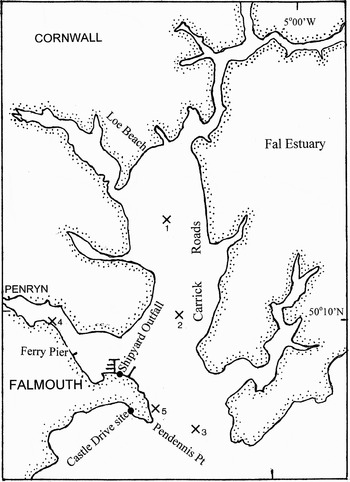
Map of the Fal estuary showing locations mentioned in the text and positions of sampling stations.

MATERIALS AND METHODS
Nucella lapillus has proved to be the subject of choice for most routine TBT monitoring on north-east Atlantic rocky shores, largely because it is widely distributed, common around the level of low water neap tides and easily identified. However, distinguishing sterile and fertile females can be confounded because the invasion of the oviduct by prostatic tissue may result in an internal blockage such that the vulva may appear to be open and the female regarded as fertile when, in fact, the female is sterile. Ocenebra erinacea has a more southerly distribution and is most frequent around the level of low water spring tides (Fretter & Graham, Reference Fretter and Graham1994); although the species is thus less available, using it has the advantage of sterility being easier to recognize through the splitting of the oviduct. In the present study any female exhibiting non-fusion of a part of the oviduct was regarded as being sterile; in some cases only the anterior section forming the bursa copulatrix was open to the pallial cavity but typically the split extended from the anterior of the bursa to a point near the posterior of the capsule gland. This phenomenon was discovered in 1986 and has been used as a marker from that year. Penis lengths were measured to the nearest 0.1 mm: the penis of O. erinacea is recurved and thus was partially straightened during measurement.
Imposex in O. erinacea was investigated at 19 sites around south-west England during the late 1980s (see Gibbs et al., Reference Gibbs, Bryan, Pascoe and Burt1990). One of these sites (Station 5: Castle Drive (OS Grid Reference SW 822 317)) was chosen for long-term surveillance due to its proximity to the Fal estuary, an extensive inlet accommodating the shipyard/port of Falmouth and several large marinas. Samples were collected at intervals of one or two years between September 1986 and August 1996 and again in September 2006. The abundance of O. erinacea at the site varied greatly: in some years a sample of 50 or more individuals could be readily obtained whilst in other years samples were restricted to 20 to 30.
Tributytin concentrations in one-litre subsurface water samples (unfiltered) collected at the same time as the animals were determined by the method given in Bryan et al. (Reference Bryan, Gibbs, Hummerstone and Burt1986); the detection limit was around 0.5 ng Sn l−1. Amounts of TBT are expressed as ng Sn l−1: these values can be converted to TBT concentrations by multiplying by 2.44.
RESULTS AND DISCUSSION
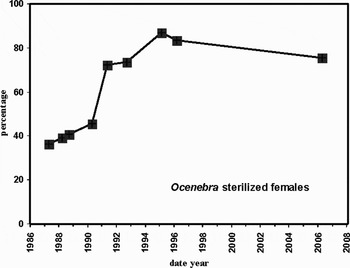
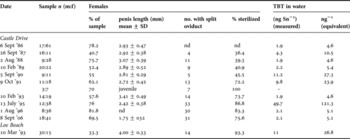
The lengths of most adult specimens were within the range of 25–35 mm. In all samples except one (September 1987), females outnumbered males, often by a margin as much as three to one (Table 1). Without exception all females were heavily masculinized: mean penis lengths of females remained fairly constant at around 3.0 mm, decreasing to 1.75 mm in the latest sample. Frequency of malformation of the oviduct (i.e. split) showed a consistent increase from 1987 to1995, reaching a maximum of 87% before levelling at around 80% (Figure 2). With such a high percentage of sterilized females it seems likely that breeding, if occurring at all, would be at a very low level.
Ocenebra erinacea. Percentage of females in the Castle Drive population exhibiting ‘split’ oviduct, a sterilizing developmental abnormality caused by exposure to low levels of TBT during adolescence.

Ocenebra erinacea populations at Castle Drive and Loe Beach, Falmouth area: details of samples, condition of females and TBT concentrations in surface water (m, male; f, female; nd, not determined).

No juveniles were found at this site except in October 1991 (Table 1) when ten were retrieved. In all three males (length 20–24 mm) a developing testis could be detected. All of the seven females (length 19.5–25.5 mm) showed no sign of development of chief female characteristics, i.e. capsule gland, sperm-ingesting gland and ovary; however, the fact that all had fully-split gonoduct showed them to be female. These juveniles are thought to have originated from one or more neighbouring less-affected populations. Ocenebra erinacea larvae escape from capsules as veligers; these have a planktonic existence lasting up to five days (Gibbs, Reference Gibbs1996). This time period is sufficient to allow dispersion and colonization over a wide area including contaminated localities. Populations close to TBT sources, such as that at Castle Drive, could be sustained by recruits from adjacent, less-contaminated areas but the general lack of juveniles in the population indicates this does not appear to have happened in recent years. The longevity of O. erinacea is not known but many individuals appear old and a life span in excess of ten years seems likely, comparable to N. lapillus.
Laboratory rearing experiments have shown that TBT concentrations as low as 3 ng Sn l−1 cause abnormal development of the female genital system, notably non-fusion of the gonoduct (Gibbs, Reference Gibbs1996). Measurements of subsurface water TBT concentrations at the study site (Table 1) vary greatly: generally a background level of around 2 ng Sn l−1 (= ~5 ng TBT l−1) prevailed but higher values approaching 10 ng Sn l−1 (24 ng TBT l−1) were measured, the peak being near 50 ng Sn l−1 (121 ng TBT l−1) in July 1995.
The Fal estuary is a broad expanse of sheltered water and thus is a popular arena for boating activities. Numerous leisure boats all using TBT antifouling coatings would have contributed significantly to the overall TBT pollution until curbed by legislations forbidding the use of TBT paints on boats less than 25 m in length (UK 1987; Europe 1990). This action has resulted in a decline in both the extent and intensity of imposex at monitored sites around England, e.g. north Cornwall and Plymouth Sound (Gibbs, in preparation). At the study site no appreciable drop in the level of both TBT pollution and of imposex is detectable from 1986 to 2006. Thus shipping activities associated with Falmouth docks appear to have made, and continue to make, the major contribution to the TBT pollution of the estuary. In September 2006 the TBT level in the water off Ferry Pier, Falmouth (Figure 1), was significantly high at 44.5 ng Sn l−1 (= 109 ng TBT l−1). The UK Environment Agency carries out routine monitoring of TBT (measured as the cation) at a number of stations in the Carrick Roads and also the dockyard. Data for the period January 2004 to February 2006 show the Roads stations (Figure 1; Stations 1–3) to have mean TBT levels of 1.5 to 5.1 ng TBT l−1 (i.e. sufficient to induce moderate to severe imposex in the neogastropod fauna); however, TBT in surface water from the Falmouth dockyard combined outfall (SW 819 326) varied from 8 to 3150 ng TBT l−1 with a mean of 672 ng TBT l−1. TBT concentrations in Penryn marina (Station 4) had a mean of about 12 ng TBT l−1. Undoubtedly, tidal movements distribute this contaminant throughout the estuary and the immediate region outside. The O. erinacea study site is just 2 km distant from the dockyard and would be subject to pulses of high TBT water on the ebb tide. Below Pendennis Castle (Station 5) a mean of around 13 ng TBT l−1 was recorded.
Advanced imposex abnormalities such as split oviduct are irreversible; thus the rate of decrease in the level of imposex in any population is dependent on the longevity of the species, i.e. in a long-lived species such as O. erinacea five or more years may have to elapse before any amelioration in ambient TBT is reflected in lowered imposex levels through population turnover. The imposex data for O. erinacea do not show any appreciable decline in the level of TBT over the past 20 years despite legislations. The fact that no change is detectable between 1996 and 2006 is particularly significant in this respect.
The Fal estuary supports an important oyster fishery. In the past O. erinacea was recognized as a major pest in the region (Orton, Reference Orton1927; Hancock, Reference Hancock1960). Given the level of sterility in populations it is doubtful whether this pest has any impact nowadays: in March 1993 over 90% of females in a sample obtained at Loe Beach (OS Grid Reference SW 822 378) within the estuary were sterile (at the time of sampling, water TBT measured 11 ng Sn l−1 (= 27 ng TBT l−1)) (Table 1). These were large specimens and had probably settled before TBT levels had reached sterilizing values; whether the species is extant within the estuary is unknown but seems unlikely.
ACKNOWLEDGEMENTS
Thanks are due to Philip Pascoe for assistance in the collection of samples; to Gary Burt for TBT determinations; to William Langston for comments on an early draft of the paper; and to Peter Jonas for permission to publish data collected by the Environment Agency.