The nineteenth century is widely regarded as the golden age of music criticism, a period during which the sheer number of critics and reviews increased sharply, and the geographic coverage of music criticism expanded vastly. While musicologists have focused on close readings of particular musical works, often looking to criticism to inform these readings, quantitative approaches offer alternate methodologies to study nineteenth-century music. One such approach is ‘distant reading’. Coined by literary theorist Franco Moretti, the term refers to research employing quantitative methods to process the content of large datasets.Footnote 1 Queries range widely, often featuring patterns which could include the geographic distribution of a particular genre, changes in vocabulary or semantics, or character-networks in dramatic works, among others.Footnote 2 Whereas ‘distant listening’ of scores requires music encoding,Footnote 3 rendering this scholarship extremely rare thus far, substantial amounts of nineteenth-century music criticism are already digitized and at least partially encoded, making it, at first glance, an obvious target for computational analysis. But what might distant reading of nineteenth-century music criticism yield?
Quantitative methods are most productive when they execute tasks that humans, unaided, are unable to complete. Distant reading is based on the premise that it is impossible for a single scholar to read an entire corpus of literature, whether it be nineteenth-century novels or music criticism. Indeed, it means that scholars employing distant reading do not actually read the texts, as this task is delegated to technology; it is precisely this facet of his method for which Moretti has been most sharply criticized.Footnote 4 While comprehensive readings of entire corpora are certainly attractive, the ideal remains at least somewhat fleeting. As Moretti quickly learned, what became clear
was the enormous difference between the archive of the Great Unread, and the world of the canon. You enter the archive, and the usual coordinates disappear; all you can see are swarms of hybrids and oddities, for which the categories of literary taxonomy offer very little help. It's fascinating, to feel so lost in a universe one didn't even know existed; but it's hard to extract a rational picture from the Walpurgisnacht of discordant voices. And then, to make matters worse, there is the opposite problem, too: working with large quantities, the average becomes an inevitable presence—and the average means loss of distinction, slowness, boredom … Too much polyphony, and too much monotony.Footnote 5
As Moretti aptly sums up, large corpus analysis, in which every text is theoretically treated as equal, is fraught with challenges and rewards. While his nod to ‘entering the archive’ suggests moving beyond the canon, it should be made clear from the outset that technology does not remove bias. To be sure, human judgement is inherent in how queries are constructed, results are visualized, and conclusions are drawn. Yet the allure of delving into larger data sets does present an opportunity to gain novel perspectives on a particular corpus. Standing back allows one to see patterns previously unnoticed. Quantitative methods can verify trends or quantify the presence of themes and ideas that scholars observe anecdotally through close reading. Implicitly, in a distant reading, these patterns or themes require technology to come to the fore. Often, it also requires technology to make sense of the results, lending credence to Moretti's frustrations with a simultaneous lack of anchors as well as a myriad of apparently monotonous results.
This essay offers a series of experiments with distant reading in nineteenth-century French music criticism. My main corpus is limited to the Revue et gazette musicale de Paris (1831–1877), in part for technical reasons.Footnote 6 Based on this weekly journal covering musical life in Paris, the corpus contains some 22,437,997 words. For my analyses and visualizations I have used a tool named Voyant, built by Geoffrey Rockwell and Stéfan Sinclair and featured in their book, Hermenuetica.Footnote 7 Readers may wish to explore the visualizations via the weblinks, as the figures are interactive; that is, more information is revealed by hovering over a particular word or image, or clicking through. The tools associated with distant reading thus also present new implications of what we consider to be knowledge.Footnote 8 Figures have long supplemented scholarly articles, but these have traditionally been still. Playfully titled ‘There's a Toy in My Essay’, Rockwell and Sinclair devote an entire chapter to problems of hermeneutical widgets embedded in scholarship.Footnote 9 As readers will realize, this essay's interactive visualizations invoke new ways of producing, communicating and experiencing knowledge. The complete ‘picture’ is not captured in the Figures; instead, they represent a starting point from which readers can explore the data more fully.
My experiments involve areas where quantitative methods are particularly well suited to generating new knowledge: corpus-wide visualizations and queries, moving beyond traditional text searching, investigations of music critics’ authorial styles and detecting sentiment in reviews, and finally, to geographies of music criticism. Since Voyant is a tool primarily intended for scholars of literature, it is worth noting from the outset the particularities of music periodicals as objects for quantitative methods. Periodicals are written by multiple authors, which makes computational investigations of a particular reviewer's aesthetic or political views more complicated than, for instance, a novelist; this would involve training the computer to recognize the beginnings and endings of each periodical section along with authorship for each section. For investigations of a single-author's contributions (e.g. Berlioz's music reviews in the Journal des débats), creating a separate corpus is the preferred approach.
One of the underlying currents in this experimental exploration is how tools shape the research questions or even approaches particular to musicology. As one digital humanities team remarked, ‘tools are not just tools. They are cognitive interfaces that presuppose forms of mental and physical discipline and organization. By scripting in action, they produce and transmit knowledge, and, in turn, model a world’.Footnote 10 Musicologists like me who are accustomed to close reading in reception studies have developed strong text-search skills to navigate an ever-increasing body of reviews dealing with music, among other reception documents. We are trained to then generate nuanced arguments with the evidence gathered. The aim of these experiments is to explore new ways of gathering evidence and, by extension, new ways of interpreting musicological evidence.Footnote 11 Navigating the proverbial archive of nineteenth-century music criticism with a range of new tools at hand may serve as a critical introduction to the relevant practical and conceptual issues and inspire future work in the field of quantitative musicology.
Entering the Archive
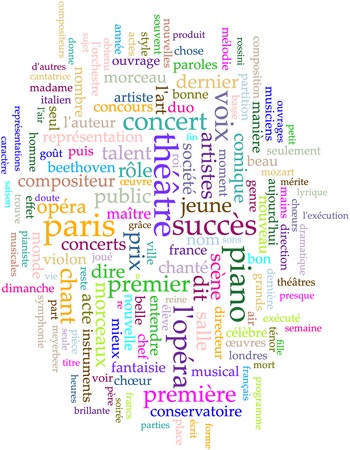
We begin by exploring the Revue et gazette musicale de Paris from 1831 to 1877 – a room in the ‘Great Unread’ of nineteenth-century French music criticism. The aim, ideally, is to simply experience some first impressions; to see what catches one's eye. One of the simplest and widely used visualizations is a word cloud.Footnote 12 Having selected French as language and implemented some stop words (a list of words that the computer should omit in the visualization, normally words that do not carry significant meaning such as and, the, from and so forth), we are left with a glimpse of the most frequently recurring words in the journal. Figure 1 is a word cloud of the Revue musicale de Paris corpus.
Word cloud of the Revue musicale de Paris corpus, http://bit.ly/ncmr-fig1.Footnote 13

Theatre, opera and the piano are clearly at the centre of musical life in nineteenth-century Paris. The ‘drastic’ qualities of musical sound, to borrow Carolyn Abbate's phrase, come to the fore in terms such as sons, moment, brilliante, effet and grâce, while verbs such as voir and entendre signal the predominant sensory modes of engaging with musical sound.Footnote 14 That terms such as terms sociéte and public are markedly larger than roi points to the fading social and political influence of the Ancien Régime. Results such as produit, francs, obtenu and prix betray nineteenth-century consumer culture concomitant with laudatory terms such as succès, nouveau/nouvelle, talent, célèbre and artiste. The cult of the individual also emerges in words such as compositeur, directeur, seule, chef, cantatrice, pianiste and l'auteur. Only four names enter the word cloud and are all are composers: Beethoven dominates the corpus, appearing no fewer than 10,359 times, a result that may deserve closer examination given the 250th anniversary of the composer's birth; he is followed by Mozart (6,973 results), Meyerbeer (6,552 results) and Rossini (6,360 results). Given the centrality of theatre and opera in Paris as confirmed by this word cloud, the absence of famous performers along with the prominence of ‘great composers’, who have reigned supreme in histories of music, is, at the very least, provocative.
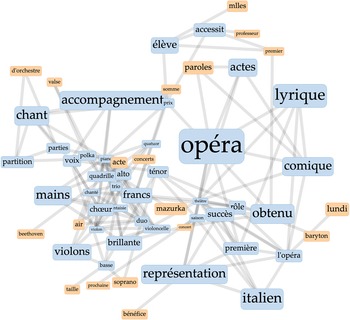
Broadly speaking, the strength of the word cloud is that it provides a rich array of people, places, objects and ideas that feature prominently in a large corpus and are thus believed to characterize musical life in a particular time and place. A major shortcoming of this visualization lies in that it provides a seemingly static snapshot of music in Paris. The dangers of ‘static slices’ and ‘unconnected dots’ in recreating music history are manifold, and recent attempts by scholars such as Ben Piekut to reorient music history in terms of actors and varying kinds of relationships are one way to move beyond the static nature of the word cloud, which is not dissimilar from musicological approaches that reconstruct history by works and composers most often performed.Footnote 15 To this end, Voyant provides a relatively primitive but nevertheless intriguing ‘links’ option, allowing the user to convert their word cloud (or a portion thereof) to a network diagram. Figure 2 represents a network graph of higher frequency terms in the Revue musicale corpus.
Network graph of higher frequency terms in the Revue musicale corpus, http://bit.ly/ncmr-fig2.Footnote 16

In the context of the diagram, it becomes clear then that brilliante is connected specifically to mains, piano, fantaisie, concert and théâtre. Conservatoire is connected only to concerts, and sociéte is also connected only to concerts. Thus, what seemed at first glance to be merely a collection of words could be rendered as a host of social, political, artistic and economic threads, intimately connected and driving musical culture in nineteenth-century Paris.Footnote 17
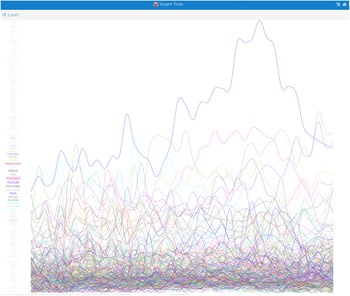
Voyant also offers the possibility of graphing the frequency of terms, and here, overlaying terms is most productive so as to produce comparative studies. As seen in Figure 3, the ‘Loom’ function produces some of the busier frequency visualizations and is best explored interactively as hovering over the line will reveal the term, or the terms are listed alphabetically in the left margin.
Frequency of word over time using the ‘Loom’ function for the Revue musicale corpus, http://bit.ly/ncmr-fig3.

In essence, ‘Loom’ shows frequency of word over time; it allows the scholar to see words whose frequency changes over time (these words can be distinguished from those that whose frequency remains fairly static). For instance, valse appears to be part of the ‘noise’ below, but then spikes and dips dramatically toward the end. Voix is among the more frequently mentioned terms, and its frequency varies a great deal, though the overall trajectory across the nineteenth century seems to decline. This is curious, in view of the overall increase of théâtre, clearly one of the most frequently cited terms in this journal.
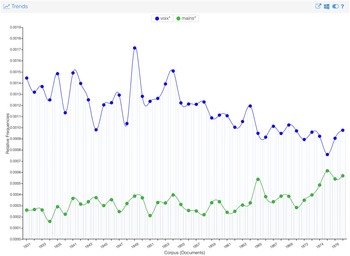
While the ‘loom’ function might initially seem overwhelming, it does provide a means of exploring a particular corpus, particularly when one knows little about it and when a sense of the major overarching themes coupled with the comparative frequency of their appearance is desired. However, scholars might well have more specific research questions to explore across a global corpus, in which case, a less busy frequency visualization such as the ‘trends’ function may be preferred. For instance, given recent interest in the physicality of the body in musical performance,Footnote 18 one might wish to pit voix against mains. Figure 4 is a line graph comparing the appearance of these two terms across time.
Line graph comparing voix and mains in the Revue musicale corpus, http://bit.ly/ncmr-fig4.

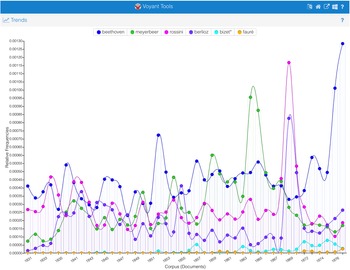
The human voice is clearly the dominant instrument for nineteenth-century Parisian audiences, yet interest in the voice declines over the decades while interest in the hands increases. Or, returning to the question of canonicity, visualizing trends of when particular composers are mentioned, it useful to see both relative fame, measured by how often music critics mention their names, as well as peaks and troughs of celebrity. Figure 5 is a line graph comparing the relative frequencies of Beethoven, Meyerbeer, Rossini, Berlioz, Bizet and Fauré.
Line graph comparing the relative frequencies of six composers’ names in the Revue musicale corpus, http://bit.ly/ncmr-fig5.

Notably, Beethoven might be the dominant composer in the Revue et gazette musicale de Paris, but his fame spikes dramatically towards the end of the nineteenth century. At times, Meyerbeer, Rossini and Berlioz receive more discussion that Beethoven. Fame is thus dynamic, ever changing in response to an infinite range of factors. Yet even these trends have limitations, most notably, the question of connectedness: what is their fame connected to? It is a published work, a performance, a performer, a particular event, a political moment, or a specific aesthetic of sound? For this, it is necessary to search much purposefully within the archive, which in turn, demands a different set of tools and methods.
Search 2.0
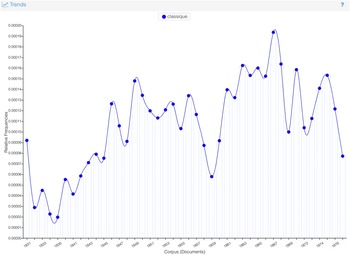
Musicologists have long been interested in studying music in various contexts, and the obvious scholarly technique when it comes to database research is to begin by searching for key terms in music criticism. Computational approaches need not replace this time-tested technique. In fact, they can enhance and extend it. Consider, for example, the term classique, a concept central to Christopher Moore's article in this issue, albeit in a period slightly later than this present corpus. The search term classique occurs 2,437 times in this corpus. This simple query can of course easily be undertaken in databases such as Gallica, ANNO or RIPM.Footnote 19 Text analysis is designed to move beyond search results to display findings in ways that offer greater insight into when and how the term was used across decades of music criticism. One might begin with the trends function for the term in order to get a sense of when the term was used in the journal. Figure 6 is a line graph showing the frequency of the term classique in the Revue musicale corpus.
Line graph illustrating the frequency of the term classique in the Revue musicale corpus, http://bit.ly/ncmr-fig6.

As Figure 6 reveals, the term classique was most often used in 1867, followed by 1849 and 1836. At first glance, the peaks and troughs do not correspond to any particular performance or political event, except perhaps the Exposition Universelle of 1867.
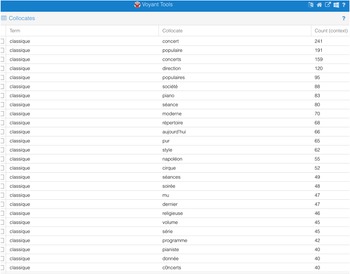
The ‘Collocate’ tool reveals words most often found in close proximity to classique. Figure 7 is a table showing terms most frequently found with number of occurrences in proximity to the term classique.
Table displaying terms most frequently found in proximity to the term classique, http://bit.ly/ncmr-fig7.

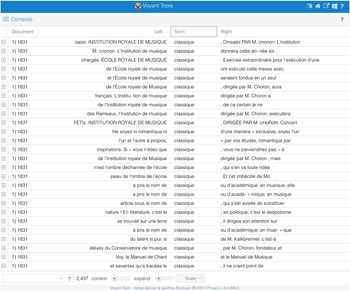
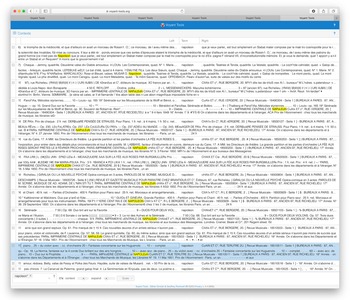
Glancing at the top ten terms – concert/s, populaire/s, direction, sociéte, piano, séance, moderne, répertoire, aujourd'hui, pur – it is evident that the term classique was not associated with a timeless canonic work, though it does seem to be closely associated with instrumental music, at least in this corpus. The person's name in closest proximity to the term classique is Napoleon; this finding deserves closer examination. Diving deeper into how the term was used, the ‘Contexts’ function in Voyant may be employed to reveal the text to the left and right of each occurrence of the word. Figure 8 is a table showing the word classique in context throughout the corpus.
Table showing the word classique in context through the Revue musicale corpus,Footnote 20 http://bit.ly/ncmr-fig8.

It is also possible to search for Napoleon in the corpus, and expanding the results allow for a clearer understanding of this connection. Figure 9 shows the results for ‘Napoleon’ in using the ‘Contexts’ function with most of the results expanded to reveal a significant portion of the preceding and following text.
Results for ‘Napoleon’ using the ‘Contexts’ function in Voyant. The results are expanded to reveal a larger portion of the preceding and following text for the term.

It quickly becomes clear that very few results are mentions of the political figure. Instead, our text analysis is catching the place of print: Imprimerie centrale de Napoléon. This illustrates one of the potential pitfalls of quantitative methods: the computer will catch details that humans would likely (correctly) ignore. Nevertheless, there is a valuable lesson here: results are best verified through close contextual analysis, even if it is just glancing to see whether they make sense. Put another way, the veracity of distant reading, in some instances, still benefits from close contextual study.
Yet this is not a reason to downplay the strengths of quantitative methods. As Matthew L. Dockers has remarked, ‘massive corpora offer us unprecedented access to the literary record and invite, even demand, a new type of evidence gathering and meaning making’.Footnote 21 He advocates for moving beyond ‘anecdotal evidence’, often used to support close readings. To be sure, the dangers of selective evidence gathering both by music critics and scholars have already been identified by Ralph Locke in this volume.Footnote 22 One way to address some of Locke's concerns surrounding bias and innuendo is to employ quantitative methods unlocking new kinds of evidence and by extension, new kinds of interpretive work.
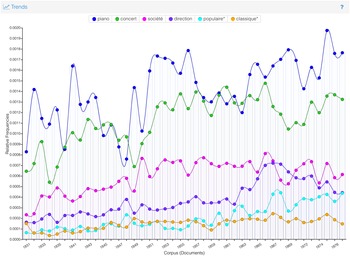
Moreover, as is the case in experimental science, positive and negative evidence are equally valid. For instance, in our quest to more fully understand the use of the term classique in this corpus, one might visualize the frequency of the term alongside the top five words identified to be in close proximity: sociéte, direction, populaire, concert and piano. Figure 10 is a line graph showing the relative frequency of the aforementioned terms.
Line graph showing the relative frequency of the terms sociéte, direction, populaire, concert and piano in the Revue musicale corpus, http://bit.ly/ncmr-fig10.

Immediately evident is the relatively low frequency of change in the appearance of the classique. Also, the dramatic outlier in terms of contour is piano – this term does not seem to ‘track’ classique in any way. What this means is that even though piano occurs in close proximity to classique, discussions of the instrument are not concomitant or dependent on the notion of the classic; its appearance in the Revue musicale de Paris is unrelated to the piano. While classique and populaire have more similar trend trajectories, they still crisscross as much as they move in parallel. Thus, although the term ‘classic’ might have a more similar overall trend trajectory to the idea of the popular (suggesting that these two ideas might indeed be co-dependent), they also finish in the inversion of the position in which they began: in 1831 classique was used more frequently, but by 1866 the idea of the popular clearly breaks away and becomes more widely used in the Revue musicale de Paris. Moretti's aforementioned lament about large datasets comes to mind here: ‘the average becomes an inevitable presence—and the average means loss of distinction, slowness, boredom … Too much polyphony, and too much monotony’.Footnote 23 In this instance, one kind of bias (that of a scholar selecting various bits of evidence in support of a particular argument) has been removed, in so far as all the appearances of the term classique are weighted equally in the visualizations. In this particular instance we haven't yet found terms that track very closely with classique (and readers may try out their own ideas in the search box). But quantitative approaches engage in questions of bias in other ways, most notably, as we shall see, not by eliminating it but rather by bringing it to the fore.
Content, Sentiment, Critical Style
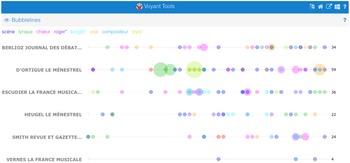
Thus far this investigation has focused on decades of a particular music journal with multiple authorship. One strategy in producing meaningful data visualization is to create a corpus with a constant: a collection of reviews of a particular composer or work, for example. I shall use six 1859 reviews of Félicien David's Herculanum as case study.Footnote 24 Six authors – Berlioz, D'Ortigue, Escudier, Heugel, Smith and Vernes – react to performances of the same work in a very short time span: 6–13 March 1859. As illustrated in Figure 11, the ‘Bubblelines’ function in Voyant shows the distribution of eight of the most frequently cited words across these six reviews: scène, lyrique, choeur, Roger, Borghi, voix, compositeur and style. The name of the critic and journal is stipulated on the left-hand side and each term is distinguished by a unique colour. The size of the bubble represents the frequency of appearance for each term. Hovering over each bubble reveals the term and the number of times that it appears at that point in the review.
The ‘Bubblelines’ function in Voyant displays seven terms found in each of the six reviews, specifying the point in the review at which they appear,Footnote 26 http://bit.ly/ncmr-fig11.

The term lyrique shows the complications of a distant reading as it can refer both to an oeuvre lyrique, a musical work for the stage, and it forms part of théâtre lyrique, a term for an opera house.Footnote 25 Voyant will not distinguish between the two, though a sophisticated machine-learning training model would have this capacity. For now, we have to work with the Voyant results. The term is briefly mentioned either at the beginning of the review (Berlioz, Escudier, Smith) and/or at the end (Escudier, Heugel, Smith). Yet d'Ortigue devotes considerable attention to the term around a third of the way through his review (he mentions it seven times altogether). It is both the scope and placement of the discussion on lyrique that sets him apart from the others. Moreover, near the end of his exploration of lyrique, he segues into a discussion of the scene, much like Heugel does toward the end of his review. A close reading of all of the reviews suggests that d'Ortigue's focus on the term does indeed concern the lyrical oeuvre of the work, setting him apart from the others, whose use of the term predominantly refers to the opera theatre. In this example, an idiosyncrasy was detected with a distant reading, though a close reading was required to interpret this result.
The presence and function of the chorus is the most frequently mentioned musical feature covered in the six reviews. Yet their distribution and placement are worth exploring further. Berlioz discusses the chorus throughout his review and the most extensive discussion is in the middle. D'Ortigue leaves his discussion of the chorus to the end of the review, though he devotes considerable space to it. The chorus is also discussed alongside the performer, Borghi. Escudier's coverage of the chorus occurs sporadically throughout the first two-thirds of his review; one discussion located around the middle of his review sandwiches comments on the chorus between a discussion about the composer and the singers. Heugel and Vernes do not mention the chorus at all. The relative brevity of Vernes’ review means that his does not contain much content, which is reflected in this visualization. Heugel's lack of interest in the chorus, however, is unusual. He seems much more focused on the scene and the performers (Roger and Borghi). His, it would seem, veers toward an analysis of drama as opposed to sound. Overall, visualizations such as this allows one to compare authorial preferences in terms of what critics cover, the relative size of such coverage, and whether or not it stands isolated or is connected to other key musical features that emerged across the entire corpus.
It is worth acknowledging the silences, or white space. These are areas in which the discussion features either unique terms (a comparison to another composer, perhaps), or there may be terms that may not seem to carry much meaning, but in fact could convey irony or sentiment. While this current tool is not capable of advanced natural language processing (NLP), a custom machine-learning algorithm would be able to analyse irony, innuendo, allusion and sentiment (elements that arose in Lesley Wright's article in this issue) in a large corpus (ideally tens of thousands) of music reviews. This would involve training an algorithm to process music-specific terminology in a particular (historic) language.
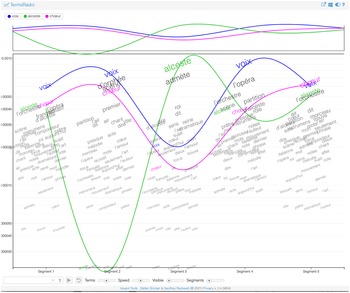
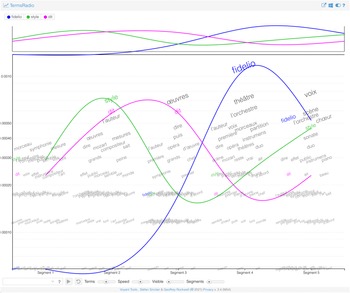
In the meantime, other approaches lend further insight into the authorial styles and ‘signatures’ of music critics. Consider, for example, Berlioz's music reviews for the Journal des Débats, a treasure trove for scholars in search of a clean corpus to examine a single music critic's aesthetic preferences and style.Footnote 27 Does Berlioz cover composers differently? Do his reviews follow stylistic patterns depending on genre (i.e. opera versus symphony)? To answer the first question, I built a corpus of Berlioz's Gluck and Beethoven reviews published in the Journal des Débats. The ‘TermsRadio’ function in Voyant exhibits Berlioz's treatment of the two respective composers over time. Figure 12 illustrates Berlioz’ treatment of Gluck's operas over the course of the Journal des Débats, while Figure 13 illustrates the composer-critic's treatment of Beethoven's works in the same corpus. In each of the illustrations, the collective ‘mini-corpus’ of composer-specific criticism is divided into distinct segments, thereby charting the ebbs and flows of terms over time.
A visualization of Berlioz's Gluck criticism in the Journal des Débats, http://bit.ly/ncmr-fig12.

A visualization of Berlioz's Beethoven criticism in the Journal des Débats, http://bit.ly/ncmr-fig13.

Beginning with Figure 12, it becomes evident that, as perhaps is to be expected, the most important elements in Berlioz's assessment of Gluck's operas are the voice, chorus and orchestra. It is also clear that some reviews of Alceste are briefly interrupted by a review or two of Orphée, returning again to Alceste. One of the interesting changes over time is Berlioz's interest in branding Gluck a French composer – the français line begins high but declines over time. Moreover, opera is a musico-dramatic genre, and critics tend to lean one way or the other in their criticism. In Berlioz's writing on Gluck's operas, dramatique reaches high point around the middle of the 16 reviews, creating an inverse relationship with l'orchestre and instruments, which begin and end high but slump in the middle. Berlioz's Beethoven reviews, when viewed through the ‘TermsRadio’ function speak to the prevalence of the critic's attention to style, oeuvre, authorship and the orchestra in covering the German composer (Fig. 13). The most dramatic change in his series of reviews on Beethoven emerges in some Fidelio reviews about two-thirds from the end. His focus on ‘effects’ remained constant in his Beethoven coverage, which is curious, because his interest in the orchestra dips down before it rises around the same time as Fidelio gets a lot of coverage. This substantially muddies our understanding of timbral effects during the nineteenth centuryFootnote 28 and also suggests that Berlioz's interest in Beethoven's orchestral writing featured prominently in his writings on the composer's only opera. Quantitative studies are well-suited to studies of authorial style, as this is a dimension of the field that is especially well developed by literary scholars. As such, further inquiries into the style of a particular music critic such as Berlioz would yield great dividends, even if it is beyond the scope of this present study.
Geographies of French Music Criticism
Transnational studies of literature lie at the core of Moretti's vision for quantitative methods. In fact, one of the goals of his 2013 Distant Reading was the ambitious pursuit of studying ‘World Literature’.Footnote 29 Naturally, once the barrier of human limitations in reading novels has been removed (a lifetime is an insufficient amount of time to read all the literature of the world, not to mention foreign language competence), it then becomes theoretically possible to study world literature. The questions one might imagine include: are there stylistic and syntactical particularities to national literary traditions? How do genres differ, and can computers classify literature into various genres? For music criticism, similar questions arise: can one detect national and transnational trends in musical taste? Do musical genres receive similar critical treatment across national borders? Did criticism surrounding canonic works differ from non-canonic works? Is it possible to map the critical reach of music critics? These (and many more) questions require large transnational corpora of Open Access content in a consistent and easy-to-process format (text files) and with a consistently high-quality of OCR (Optical Character Recognition). While global corpora of music criticism are not yet ready for this kind of inquiry,Footnote 30 it is possible to explore some smaller-scale questions related to geographies of nineteenth-century French music criticism.
In her article on Fauré in Boston, Heather de Savage offers a comparative statement on the musical scene in New York as compared to Boston in the early twentieth century: ‘while New York was staunchly devoted to Austro-German instrumental works, Wagner's music dramas, and Italian operas (as was the case in other American cities), Boston moved to an aesthetic that would also embrace French music as a complement to the other repertoire’.Footnote 31 There is no reason to dispute this assertion, as it is likely based on years of close reading and an intimate study of musical life in those two major American centres. At the same time, it might be interesting, at the very least, to quantify evidence in support of such statements. The main corpus for reviews in America is the Library of Congress’ Chronicling America, an Open Access resource which currently contains over 140,000 bibliographic title entries from 1789–1963.Footnote 32 As is the case with most digital resources, data is continuously added, and the Boston titles are not yet available. Thus, de Savage offered the most accurate and up-to-date information, given the resources available at present.
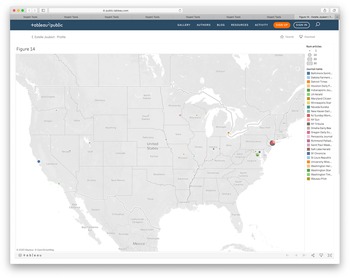
The kinds of issues that de Savage raises – to what extent Boston embraced French music more than any other American capital, for example – are well suited to quantitative methods, if the data is available. And while we are not able to give much insight into Boston at this time, it is possible to look at the reception of Fauré's music in other American cities and towns. Creating a new corpus of Fauré reviews in America using the Chronicling America site reveals some 23 centres that published local newspapers mentioning Gabriel Fauré. Since Voyant's geographic capabilities are still under development, I mapped the findings using Tableau. Figure 14 maps Fauré results by journal and number of results from the Chronicling America corpus. Hovering over each hub reveals the name of the journal and number of articles with results for Gabriel Fauré.
Map of journal articles with results for Gabriel Fauré in the Chronicling America corpus between 1890 and 1910, http://bit.ly/ncmr-fig14.

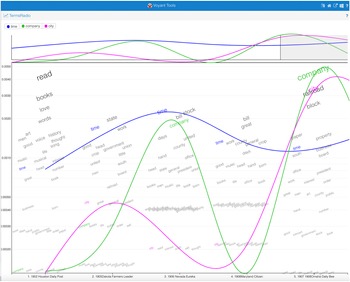
Indeed, the French composer's music was performed or at least known from Omaha to South Dakota, Nevada to Salt Lake City, as well as major centres such as Washington DC, San Francisco and of course New York. This shows a ‘bird's eye view’ perspective of the geographies of Fauré reception in America. But it is also possible to uncover the ‘Great Unheard’, metaphorically entering into some of the more unusual milieus in which Fauré's music was heard in early twentieth-century America.Footnote 33 Having created a sub-corpus of more remote locations with coverage that mentions Fauré (all mention him at most twice), the ‘TermsRadio’ function in Voyant displays the relative frequency of common words in these issues, this time divided into different segments representing each journal. Figure 15 illustrates the varying local contexts in which the music of Gabriel Fauré was known in America. Journal names, revealing their locations, are on the x-axis.
A comparative visualization of other topics of local interest in journals with reviews on Fauré in America from 1890–1910, http://bit.ly/ncmr-fig15.

In effect, one gets a glimpse of the key political, social and artistic issues particular to each location, thereby, in a sense, painting the varied contexts in which Fauré's music was known. Since all the terms visualized appear in all five newspapers, one might argue that these are issues common to America, though varying in importance depending on location. In Houston in 1902, leisure activities such as books, reading, art, song and music are near the top of the curve, underpinned by business, government, county and state. By contrast, crops are near top of mind for the Dakota Farmers Leader of 1905 and the Maryland Citizen of 1906, a seemingly unlikely context for Fauré's music. Whereas the Nevada Eureka of 1906 is focused on stock, companies and time, the Omaha Daily Bee of 1907 and 1908 zeros sharply in on the railroad company, though still carving out time for art, song, music and reading.
Concluding Remarks
These experiments with distant reading in nineteenth-century French music criticism represent starting points for the kinds of evidence-gathering and interpretation possible with quantitative methods. One of the undercurrents in this investigation has been one of Moretti's long-standing interests: the canon/archive dichotomy.Footnote 34 Whereas distant reading has the allure of being able to remove bias when needed, weighing all authors equally (even outside the canon, and notably composers and performers from equity-seeking groups), it is striking that global (that is, corpus-wide) queries did not ‘undo’ the canon. Rather, it seemed to reinforce it. Discussions of Beethoven, as we might recall, dominate the Revue musicale de Paris. This result is sobering, and some reflection seems prudent. It might be that our ‘Great Unread’ – a corpus of nineteenth-century French music criticism has already filtered the ‘Great Unheard’ – works composed and performed in the nineteenth century. In other words, while many musical works and performances were left out of the canon for complex reasons, it is perhaps difficult to underestimate the weight of bias in music criticism. The urgent opportunity for future quantitative work in music criticism, I suspect, lies in developing sufficiently nuanced machine-learning algorithms capable of uncovering bias, sentiment, irony, and allusion, amongst other stylistic traits. On the flip side, distant reading did uncover some ‘outliers’ in Fauré reception in America. This reinforces the fortunate truth that tools can be used precisely for the tasks that scholars require, if they are properly designed (and in the case of machine-learning and AI), trained. Another strong undercurrent pertains to expanding research techniques beyond complex text-searching in digitized documents. The extent to which our discipline has been shaped by this simple and powerful, yet still limited technique, has yet to be fully assessed. Finally, readers might have been struck by the number of times at which this study seemed to push against the limits of large corpus databases and visualization tools. Offering musicologists an Open Access periodical database of music-related reviews from around the world with an API (Application Program Interface) designed from the outset for quantitative studies is a worthwhile collective pursuit. Now that we've entered into the archive with a new set of tools in hand, it might soon be bustling with new discoveries.