Introduction
Ventilator-associated events (VAE) result in respiratory deterioration in patients receiving mechanical ventilation and include ventilator-associated pneumonia and ventilator-associated tracheobronchitis. Ventilator-associated events have many negative patient outcomes, including longer duration of intensive care unit (ICU) stay, longer mechanical ventilation, more antimicrobial exposure, and increased risk of mortality. 1,Reference Klompas, Branson and Cawcutt2 There is no standard clinical definition for VAE. Likewise, there are no guidelines for the management or diagnosis of pediatric VAE. Tracheal aspirate cultures (TA) are utilized often to assess the microbiology of the lower respiratory system in pediatrics. Reference Tsukahara, Johnson and Klimowich3 Obtaining a TA is a multistep process with many opportunities for variation in collection technique and microbiologic processing. Reference Prinzi, Parker, Thurm, Birkholz and Sick-Samuels4–Reference Sick-Samuels, Koontz and Xie7 Diagnostic interpretations of TAs including repeated TAs are subjective, and therefore, their utility is questioned.
When evaluating TAs, distinguishing between colonization and infection is difficult leading to unnecessary antibiotic use and the development of antibiotic resistance. 8–Reference Prinzi and Baker10 There is a paucity of information about how often a patient receives a repeat TA and the impact of repeat TAs on clinical care. Given TAs can be labor-intensive for microbiologic processing, we evaluated the use of repeat TAs in pediatric ICU patients and their clinical application.
Methods
Study setting
We performed a retrospective cohort study of patients admitted to the pediatric medical intensive care unit (PICU) or pediatric cardiac intensive care unit (CICU) at a freestanding tertiary children’s hospital. Children’s Mercy Hospital-Kansas City (CMKC) is licensed for 338 inpatient beds including 43 PICU and 24 CICU beds resulting in more than 2,300 annual intensive care admissions.
Sample collection and processing
The order for a TA was placed, and a sample was collected by either the nurse or respiratory therapist and sent to the microbiology lab for processing. A Gram stain was generated, and the sample was then plated in triplicate on blood agar, chocolate agar, and MacConkey agar. Susceptibility testing was then performed on all identified pathogens. During the study period, there were no decision support tools utilized to inform TA collection. Nor were there quality improvement initiatives to modify the frequency of TA collection. There was no standardized procedure for obtaining the sample and no formalized protocol for first-pass suction or utilization of normal saline. There were no rejection criteria utilized by the microbiology lab during this time that deemed a sample inappropriate.
Data collection
Patients were eligible for inclusion if they were <18 years of age at the time of ICU admission and had ≥2 TAs obtained during the study period within a single ICU stay. The microbiology laboratory created a report of all patients with a TA during the study period and excluded patients with a single TA from further analysis; Bronchoalveolar lavage and sputum samples were not included. Additionally, TAs obtained for organ donation purposes were excluded. A comprehensive chart review was performed on all patients. Demographic information, antibiotic duration/indication, ICU admission/discharge dates, microbiologic details of all TA cultures including susceptibility profiles, and clinician-documented reasoning for obtaining a TA were collected.
The type of artificial airway was captured via manual review of physician and respiratory therapy documentation. Antibiotic days, calculated as days of therapy (DOT) via manual review of start and stop dates, were included if the antibiotic was administered for at least 24 hours with concerns of an acute bacterial process, including oral, inhaled, and intravenously administered antibiotics. Reference Stanic Benic, Milanic and Monnier11 Antibiotics used for prophylaxis were excluded. An organism was identified as multidrug-resistant if it was resistant to >3 antibiotic classes or had a ≥4-fold increase in minimum inhibitory concentration (MIC) value for an antibiotic used to treat a prior TA result. Reference Tamma, Turnbull, Milstone, Lehmann, Sydnor and Cosgrove12
Additionally, a modified clinical pulmonary infection score (mCPIS) was calculated for each TA based on clinically available data up to 24 hours prior to TA collection. This included temperature data, serum white blood cell count, quality of tracheal secretions, chest radiograph results, TA white blood cell count, TA growth characteristics, and respiratory factors including escalation of respiratory support. Reference da Silva, de Aguiar, de Carvalho and Machado Fonseca13 The mCPIS score was calculated retrospectively by our study team to assess antibiotic days and the corresponding score. These scores have correlated with the likelihood of a VAE with resultant treatment recommendations developed at our institution based on the available literature. For a mCPIS score <6 with no or few bacteria, there was no indication for continued antibiotics. For a score ≤6 with moderate bacterial growth or >6, treatment should have been completed at 5 or 8 days, respectively. Reference Tamma, Turnbull, Milstone, Lehmann, Sydnor and Cosgrove12–Reference American Thoracic14
Finally, the Pediatric Complex Chronic Care Conditions Classification System, a validated system to assess the medical complexity of children, was calculated utilizing all available ICD-10 coding on patients. Reference Feudtner, Feinstein, Zhong, Hall and Dai15 All data were recorded in a secure Research Electronic Data Capture (REDCap) database with subsequent analysis. Reference Harris, Taylor, Thielke, Payne, Gonzalez and Conde16 This study was classified as exempt research by the CMKC Institutional Review Board.
Analysis
Quantitative data were analyzed with descriptive statistics, including frequencies and percentages, using Microsoft Excel. Endotracheal tube (ETT) days were counted if an ETT was present and the child received mechanical ventilation. Each day a tracheostomy tube (TT) was in place following surgical placement was counted as a tracheostomy day. This includes patients who were mechanically ventilated via the TT but also those who no longer required mechanical ventilation with a TT in place. To understand the influence of an artificial airway being present (ETT or TT), regardless of the need for mechanical ventilation, these two groups were combined and labeled “artificial airway days.”
The total antibiotic DOT that was documented as treatment for TA was calculated for each culture. The summary distribution of DOT was then compared across the 3 mCPIS scores using the Wilcoxon rank sum test. Lab results from each repeat culture were compared with lab results from the prior culture to categorize whether the repeat culture yielded new results; identical lab findings were categorized as “same findings,” whereas any new findings, including a previously identified pathogen now being no longer detected, were categorized as “new findings.” The time between repeat cultures was then compared between the “same findings” and “new findings” groups using the Wilcoxon rank sum test. Lastly, Fisher’s exact test was used to compare select categorical demographic/clinical factors between the MDRO and non-MDRO groups.
Results
A total of 73 patients were included for review. Two patients were excluded because they were >18 years old at the time of hospital admission. One patient was excluded because their repeat TAs occurred during different ICU stays within the same hospitalization. Another patient was excluded due to multiple ICU hospitalizations during the study period. Six patients were excluded because the repeat TA was obtained for organ donation purposes. In total, 63 patients were included for the study analysis. During the study period, there were 1,740 total TAs obtained in the PICU/CICU. The 63 patients with repeated TAs accounted for 252 (14.5%) of the total TAs obtained.
Patient characteristics
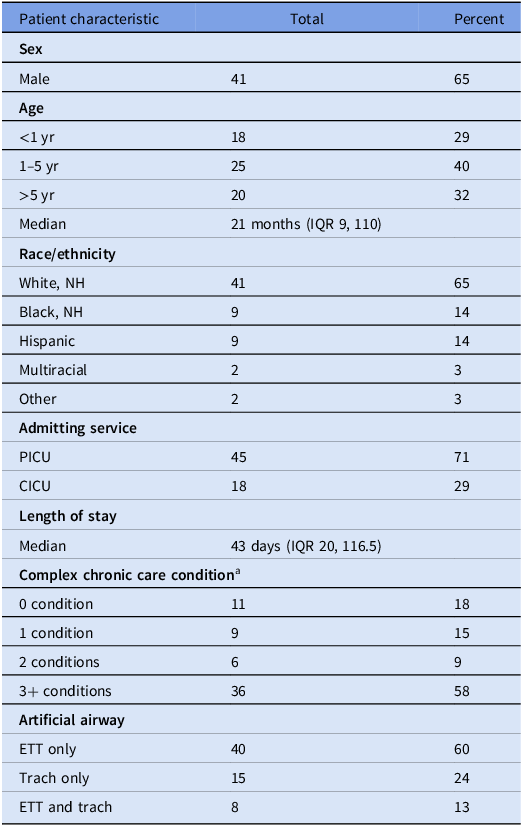
Sixty-five percent (n = 41) of patients were male with a median age of 21 months (IQR 9, 110), and 65% of patients identified as white, non-Hispanic (Table 1). Most patients were admitted to the PICU with a median length of stay of 43 days (IQR 20, 116), and 60% (n = 38) of patients exclusively had an ETT as their artificial airway during their ICU stay. Most patients were medically complex. There was a median of 3 TA cultures (IQR 2, 5) per patient who had repeat TAs.
Patient characteristics of PICU patients with ≥2 tracheal aspirates during a single hospitalization

Note. IQR, interquartile range; PICU, pediatric medical intensive care unit; CICU, cardiac intensive care unit; ETT, endotracheal tube.
a Pediatric complex chronic care conditions classification system.
Tracheal aspirate collection
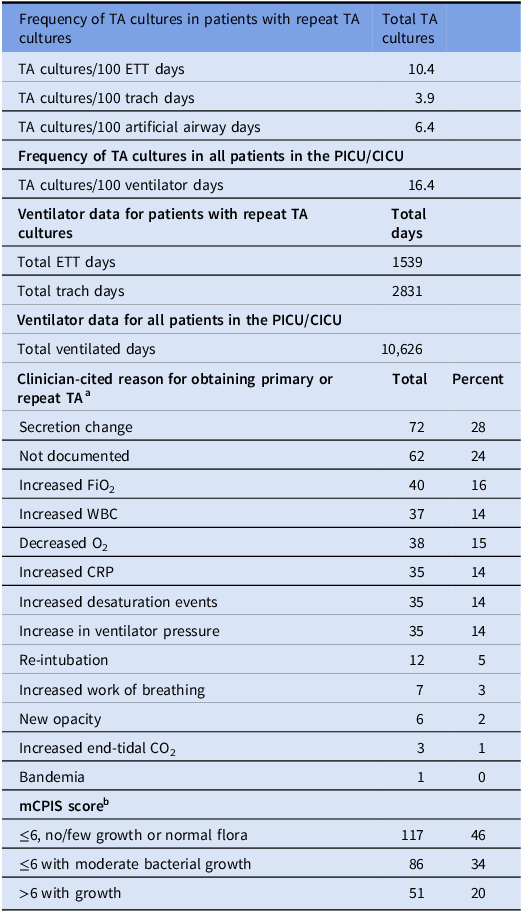
Approximately two-thirds of repeat cultures (n = 160) were obtained from an ETT, while the remaining 92 (34%) were obtained from a TT. There were 6.4 TAs of 100 artificial airway days (Table 2) in those with repeated cultures. There were 16.4 TAs of 100 ventilator days among all ventilated patients in the ICU during the study period including those with repeat TAs. Fifty percent of repeat cultures were obtained within 7 days from the prior TA (Figure 1). Fever was the primary indication for TA collection (n = 108; 42%), followed by a change in respiratory secretions (n = 72; 28%) (Table 2).
Length of time between repeated tracheal aspirate cultures in pediatric patients admitted to the intensive care unit between 2018 and 2019.

Characteristics of tracheal aspirates from patients who had ≥2 tracheal aspirate cultures during a single PICU hospitalization

Note. PICU, pediatric medical intensive care unit; TA, tracheal aspirate; CICU, cardiac intensive care unit; ETT, endotracheal tube; mCPIS, modified clinical pulmonary infection score; WBC, white blood cell count; CRP, c reactive protein
a More than 1 reason could be cited for each aspirate.
b Two tracheal aspirate cultures did not have this score calculated and are removed from the denominator.
Tracheal aspirate microbiology
From the 252 cultures obtained during the study period, 326 organisms were isolated. The most frequent organisms were Pseudomonas aeruginosa, methicillin-susceptible Staphylococcus aureus, and Stenotrophomonas maltophilia (Figure 2). Pseudomonas aeruginosa, Klebsiella oxytoca, methicillin-susceptible Staphylococcus aureus, and Proteus mirabilis were present more often on cultures from a TT than an ETT (P value <.05; Supplemental Table 1) Forty-seven initial cultures were positive (74.6%), and 151 repeat cultures were positive (79.9%). Though not statistically significant, there was a trend toward the same pathogen being isolated with a median of 7 days between cultures and a new pathogen being isolated after 9 days (P value .051). Most patients (n = 42; 66%) had the same organisms isolated ≥2 times on repeated cultures.
Most frequently cultured pathogens from repeat tracheal aspirate cultures in pediatric patients admitted to the intensive care unit between 2018 and 2019.

Antibiotic use and bacterial resistance
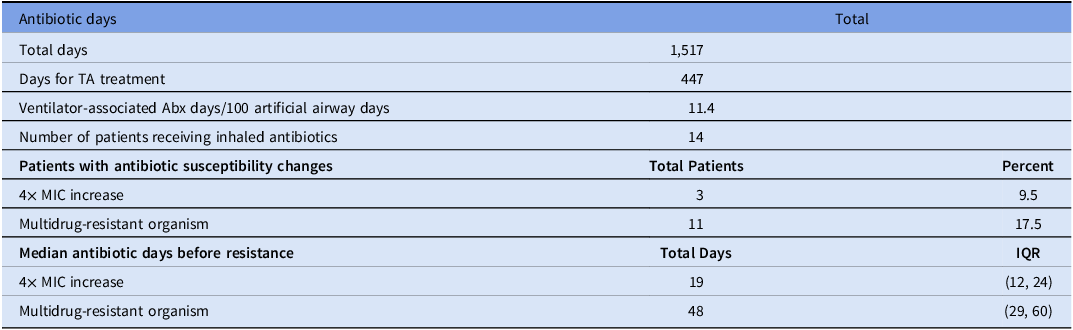
A total of 1,496 antibiotic days were administered with 430 days (29%) cited by the clinician as directly treating the results of the TA (Table 3). Twenty-four (38%) initial TAs and 56 (29.6%) repeat TAs were treated with antibiotics based on TA results. A mCPIS score >6 was calculated for 51 cultures (20%), while a mCPIS score ≤6 with moderate growth or no growth was calculated on 86 cultures (34%) and 117 cultures (46%), respectively. There was no correlation between the mCPIS score and corresponding days of antibiotic therapy as all scores were associated with a median of either 6 or 7 days of antibiotics to treat the TA result (P value .116). Three patients who had TA-isolated organisms developed a >4-fold increase in the MIC of an antibiotic they had received for treatment (Table 3). This occurred after a median of 19 days (IQR 12, 24) of antibiotic exposure. Seven patients (11%) developed a multidrug-resistant organism during their ICU stay. This occurred after a median of 48 (IQR 29, 60) antibiotic days. There was no statistically significant difference in clinical features among patients who developed an MDRO.
Antibiotic usage and antibiotic stewardship interventions in PICU patients with ≥2 repeat TA cultures during a single ICU stay

Note. PICU, pediatric medical intensive care unit; TA, tracheal aspirate; ICU, intensive care unit; MIC, minimum inhibitory concentration; IQR, interquartile range.
Discussion
We performed a retrospective cohort analysis of patients admitted to the pediatric intensive care setting who had ≥2 TAs obtained during their ICU stay. We found repeat cultures grew the same pathogen in most cases, and most antibiotic use was initiated when TAs were obtained, but not modified or continued to treat the results of the TA. Antibiotic resistance did occur in some patients.
First, repeat cultures grew the same organisms at least 2 times on repeated culture 66% of the time. These organisms illustrate the presence of commensal respiratory flora in a patient with an artificial airway. Reference Albin, Pogue, Petty and Kaye17 Distinguishing between colonization and infection is challenging in these patients. The artificial airway provides a nidus of bacterial growth even in the most optimal settings and may not represent the microbiology of the lower respiratory tract. Reference Tsukahara, Johnson and Klimowich3,Reference Willson, Kirby and Kicker18–Reference Steuart, Ale and Woolums21 Emerging evidence, that is further corroborated in this study, shows repeat cultures in close timing to prior TAs offer limited clinically actionable information. Reference Feldman, Shah and Ahn22 By encouraging the clinician to critically question the utility of a repeat TA, the unnecessary initiation of empirical antibiotics may be prevented. Reference Willson, Conaway, Kelly and Hendley19,Reference Kenaa, O’Hara and Richert23
Several criteria, including mCPIS and Ventilator-Associated INfection (VAIN) guidelines, have been proposed to determine the probability of a TA representing infection versus colonization. Reference da Silva, de Aguiar, de Carvalho and Machado Fonseca13,Reference Shein, Karam and Beardsley24,Reference Willson, Hoot and Khemani25 These scoring systems are challenging to implement in the clinical setting as they are cumbersome to calculate at the bedside, are not used consistently, and require the result of the TA to fully calculate. Reference Sick-Samuels, Koontz and Xie7 These scoring systems, even when used appropriately, have variable success at discontinuing antibiotics once they have been initiated. Reference Chiotos, Marshall and Kellom26,Reference Karsies, Tarquinio and Shein27 This suggests that preanalytical diagnostic stewardship measures focusing on order and collection processes and decision support tools or algorithms to determine the pretest probability of a pulmonary infection and the need for a TA could improve antibiotic use more than postanalytic measures such as those described.
Second, more than two-thirds of antibiotics were not modified or continued to specifically treat the TA results. We found most antibiotics were initiated empirically at the time of culture obtainment, proximal to the time of clinical change in the patient. However, these same antibiotics were not often modified or continued to treat the results of the TA. Diagnostic stewardship efforts strive to mindfully use and optimize testing practices for maximal clinical impact and overall best value. Reference Fabre, Davis and Diekema28,Reference Sick-Samuels and Woods-Hill29 Successful improvement efforts are emerging; for example, reducing test frequency has not resulted in increased length of stay, 7-day readmissions, or in-hospital mortalities. Reference Ormsby, Conrad and Blumenthal30–Reference Muszynski, Sartori and Steele32 Our study exemplifies that repeat TAs are not often utilized in antibiotic decision-making for the patient with an artificial airway and are not relevant to the clinical care provided.
Third, antibiotic overuse has many negative outcomes including increased risk of morbidity and mortality, increased hospital length of stay, and overall increased cost. 9 We identified that drug resistance occurs in less than a month of antibiotic exposure which has been observed previously. Reference Tamma, Turnbull, Milstone, Lehmann, Sydnor and Cosgrove12 The development of resistance took a median of 19 days of antibiotic therapy; thus, repeating a culture within 2 weeks due to concerns of developed resistance is unnecessary.
Our study does have limitations. First, the single-center design may limit the generalizability of these findings though it is well-known TAs have immense variability across the United States. Reference Prinzi, Parker, Curtis and Ziniel5 As a tertiary-referral, freestanding pediatric institution, these findings provide a benchmark of frequency of repeated TAs and the effect they have on clinical care. Second, the small sample size of patients limited statistical significance testing for specific clinical features associated with positive TAs or treatment with antibiotics and clinical outcomes. Third, artificial airway days are not a validated metric which could impair the broader applicability of those results. Future work with multiple sites could be helpful to further evaluate outcomes.
Overall, this study is one of the first to evaluate repeated TAs in the pediatric intensive care setting. We found most repeated TAs grew the same pathogen as prior cultures, especially within 7 days. Suggesting repeating a culture within that time often will not yield new organisms. It took a median of 19 days of antibiotic exposure to see MIC increases or MDRO development; therefore, repeating a TA quickly to look for resistance is also likely unnecessary. Future directions should include collaboration with critical care colleagues to develop standard processes utilizing the recent literature, including this study, to determine TA utility and impact on patient care.
Supplementary material
To view supplementary material for this article, please visit https://doi.org/10.1017/ice.2024.96.
Acknowledgments
The authors would like to thank Megan Gripka and Heather Bushnell for their help gathering the relevant information from the microbiology laboratory. Additionally, we would like to acknowledge the Children’s Mercy Hospital Institutional Review Board and Research offices for their institutional support of research endeavors.
Financial support
This research was not supported by outside funding.
Competing interests
The authors have no relevant conflicts to disclose.