Introduction
Antipsychotic treatments for psychosis have traditionally targeted the dopaminergic and glutamatergic neurotransmitter systems. Recently, there has been considerable interest in the antipsychotic potential of cannabidiol (CBD), a non-intoxicating component of the cannabis plant, based on preclinical and early clinical findings (Leweke et al., Reference Leweke, Piomelli, Pahlisch, Muhl, Gerth, Hoyer and Koethe2012; McGuire et al., Reference Mcguire, Robson, Cubala, Vasile, Morrison, Barron and Wright2018; Rohleder, Muller, Lange, & Leweke, Reference Rohleder, Muller, Lange and Leweke2016). However, the mechanisms underlying the potential antipsychotic effect of CBD remain unclear.
An influential preclinical model of the pathophysiology of psychosis suggests that prefrontal GABAergic interneuron dysfunction leads to hippocampal over-activity (Lewis & Hashimoto, Reference Lewis and Hashimoto2007), with the hippocampus driving the subcortical dopamine system via projections to the striatum (Lodge & Grace, Reference Lodge and Grace2011). In turn, this dysfunction is thought to result in the positive symptoms associated with the disorder. Consistent with this, a sizeable body of neuroimaging evidence has identified associations between the onset of psychosis and prefrontal GABAergic dysfunction (Modinos et al., Reference Modinos, Simsek, Azis, Bossong, Bonoldi, Samson and Mcguire2018), increased resting hippocampal blood flow (Allen et al., Reference Allen, Chaddock, Egerton, Howes, Bonoldi, Zelaya and Mcguire2016) and metabolism (Schobel et al., Reference Schobel, Chaudhury, Khan, Paniagua, Styner, Asllani and Small2013), and elevated striatal dopamine function (Howes et al., Reference Howes, Bose, Turkheimer, Valli, Egerton, Stahl and Mcguire2011). Accordingly, these systems are of great interest in antipsychotic research. However, whether CBD modulates prefrontal, mediotemporal, and striatal function in patients with psychosis has never been tested.
Previously, using functional magnetic resonance imaging (fMRI) in healthy volunteers, we have shown that CBD opposed the acute psychotomimetic effects of Δ-9-tetrahydrocannabinol (THC), the main psychotogenic component of cannabis, whilst also opposing the effects of THC on functional activation in the striatum, parahippocampal gyrus, and prefrontal cortex during verbal memory, and salience processing (Bhattacharyya et al., Reference Bhattacharyya, Morrison, Fusar-Poli, Martin-Santos, Borgwardt, Winton-Brown and Mcguire2010, Reference Bhattacharyya, Crippa, Allen, Martin-Santos, Borgwardt, Fusar-Poli and Mcguire2012b). In a subsequent parallel-group study involving individuals at clinical high risk (CHR) for psychosis, we found that CBD attenuated abnormal function in mediotemporal, striatal, and midbrain regions during the same verbal memory task, such that activation in the group treated with CBD was intermediate to that of the placebo (PLB) treated group and that of the healthy controls (HC) (Bhattacharyya et al., Reference Bhattacharyya, Wilson, Appiah-Kusi, O'neill, Brammer, Perez and Mcguire2018). Aside from their key roles in psychosis psychopathology, the mediotemporal and prefrontal cortices are also critical substrates for learning and memory (Buckner & Wheeler, Reference Buckner and Wheeler2001; Wagner et al., Reference Wagner, Schacter, Rotte, Koutstaal, Maril, Dale and Buckner1998), while the striatum has been shown to play a key role in supporting the encoding and updating of contextual information in memory (Landau, Lal, O'neil, Baker, & Jagust, Reference Landau, Lal, O'neil, Baker and Jagust2009 Mcnab & Klingberg, Reference Mcnab and Klingberg2008). As deficits in verbal learning and memory remain one of the most consistently reported impairments in patients with psychosis (Mesholam-Gately, Giuliano, Goff, Faraone, & Seidman, Reference Mesholam-Gately, Giuliano, Goff, Faraone and Seidman2009), we employed the verbal paired associates (VPA) learning task, which engages these processes and brain regions (Bhattacharyya et al., Reference Bhattacharyya, Fusar-Poli, Borgwardt, Martin-Santos, Nosarti, O'carroll and Mcguire2009, Reference Bhattacharyya, Atakan, Martin-Santos, Crippa, Kambeitz, Prata and Mcguire2012a), in conjunction with an acute CBD challenge and fMRI, to investigate the acute neurophysiological effects of CBD in patients with psychosis.
We expected psychosis patients to display altered functioning of the mediotemporal and prefrontal cortices and striatum, relative to HC, and that a single dose of CBD would partially normalize these abnormalities. We also examined whether, consistent with current models (Lodge & Grace, Reference Lodge and Grace2011), there was greater functional connectivity between the hippocampus and striatum in patients with psychosis relative to HC, and whether CBD attenuated this functional connectivity.
Methods and materials
Participants
Informed consent was obtained from all participants, as approved by the National Research Ethics Service Committee London (Camberwell, St. Giles, Ethics reference: 14/LO/1861).
Patients with psychosis in the early stages of illness were recruited from psychiatric services in the South London and Maudsley NHS foundation trust, in London, UK. Fifteen patients attended both study days, and 13 completed both scanning sessions (two patients requested to end the scanning session). Psychosis diagnosis was confirmed by an experienced research psychiatrist using the Structured Clinical Interview for DSM-IV (American Psychiatric Association., 2000). Briefly, inclusion criteria are as follows: (1) diagnosis of psychotic mental illness (meeting criteria for schizophrenia, schizophreniform, or brief psychotic disorder – but no other Axis I diagnoses), (2) within 5 years of onset of illness (additional inclusion criteria in online Supplementary Material). Nineteen HC were recruited by local and internet advertisements.
Exclusion criteria for both groups are as follows: (1) a history of neurological disorder (e.g. epilepsy), severe co-morbid illness or pregnancy, (2) alcohol and other current substance dependence (excluding cannabis in the patient group), (3) acute intoxication with any other psychoactive substance on the day of experimentation, (4) an IQ of less than 70 or lack of capacity to consent, (5) urine drug screen positive for other known psychotogenic and psychedelic substances such as PCP, amphetamine, or MDMA (past use that does not result in a positive urine drug screen result on study days and also does not satisfy criteria for dependence did not result in exclusion), and (6) any contraindications to MRI scanning. Additional exclusion criteria for the HC group included diagnosis of mental illness; current/past recipients of psychiatric treatment; a first degree relative who had experienced psychosis; or more than 10 instances of cannabis use throughout their life time.
Study design
A power calculation was performed to determine the appropriate sample size necessary to examine the effect of CBD on functional brain activation (online Supplementary Material). Psychosis patients were studied over two sessions in a double-blind, PLB-controlled, repeated-measures, within-subject, crossover design, with at least a one-week interval between scans to allow for the washout of CBD. Patients were allocated to one of two orders of drug administration (PLB followed by CBD v. CBD followed by PLB) via a randomization sequence generated by a research pharmacist at the South London and Maudsley NHS foundation trust.
On each study day, patients had a light standardized breakfast. One hundred and twenty minutes after the breakfast, patients were given a gelatin capsule containing either CBD 600 mg (approx. 99.9% pure, THC-Pharm, Frankfurt, Germany), or a visually identical PLB capsule containing flour. One hundred and eighty minutes after drug administration, participants underwent fMRI, while they performed the VPA task (Bhattacharyya et al., Reference Bhattacharyya, Fusar-Poli, Borgwardt, Martin-Santos, Nosarti, O'carroll and Mcguire2009; Bhattacharyya et al., Reference Bhattacharyya, Atakan, Martin-Santos, Crippa, Kambeitz, Prata and Mcguire2012a) lasting approximately 12 min. Blood samples were obtained via intravenous cannulation in the non-dominant arm to assay CBD levels at three time points: 60 min before drug administration (T1), 60 min after drug administration (T2), and 270 min after administration (T3). The dose of CBD and the interval between CBD administration and acquisition of neuroimaging data (180 min after drug administration) that we employed in the present study were chosen based on previous evidence showing the effect of this dose (600 mg) on brain activation (Bhattacharyya et al., Reference Bhattacharyya, Morrison, Fusar-Poli, Martin-Santos, Borgwardt, Winton-Brown and Mcguire2010, Reference Bhattacharyya, Crippa, Allen, Martin-Santos, Borgwardt, Fusar-Poli and Mcguire2012b; Fusar-Poli et al., Reference Fusar-Poli, Allen, Bhattacharyya, Crippa, Mechelli, Borgwardt and Mcguire2010) as well as evidence that the symptomatic effects and plasma levels of CBD peaked about 3 h following oral administration (Agurell et al., Reference Agurell, Carlsson, Lindgren, Ohlsson, Gillespie and Hollister1981; Bergamaschi, Queiroz, Zuardi, & Crippa, Reference Bergamaschi, Queiroz, Zuardi and Crippa2011; Bhattacharyya et al., Reference Bhattacharyya, Morrison, Fusar-Poli, Martin-Santos, Borgwardt, Winton-Brown and Mcguire2010; Fusar-Poli et al., Reference Fusar-Poli, Allen, Bhattacharyya, Crippa, Mechelli, Borgwardt and Mcguire2010; Martin-Santos et al., Reference Martin-Santos, Crippa, Batalla, Bhattacharyya, Atakan, Borgwardt and Mcguire2012) (Study Design in online Supplementary Material).
HC were studied once, under identical conditions, but without any drug administration.
Psychopathology was rated in patients using the Positive and Negative syndrome scale (PANSS) (Kay, Fiszbein, & Opler, Reference Kay, Fiszbein and Opler1987), and the State Trait Anxiety Inventory state subscale (STAI-S) (Spielberger, Gorsuch, & Lushene, Reference Spielberger, Gorsuch and Lushene1970), administered at T1 (before drug administration), and again at T3 (following the fMRI scan).
All participants were advised to avoid alcohol intake for 24 h and caffeine intake for 12 h before the study. Additionally, all participants were asked to avoid using any recreational drugs (apart from cannabis amongst the patient group) for 2 weeks before the study day. A urine sample was obtained on each study day to screen for use of amphetamines, barbiturates, benzodiazepines, cocaine, methamphetamine, morphine, methadone, phencyclidine (PCP), tricyclic antidepressants, and THC, using the Alere™ Drug Screen Urine Test Cup. Carbon monoxide breath levels were also measured using the Bedfont™ Smokerlyzer.
Verbal paired associate learning task
While inside the scanner, participants performed a VPA learning task, which we have used previously in conjunction with fMRI and cannabinoid (including CBD) challenge (Bhattacharyya et al., Reference Bhattacharyya, Fusar-Poli, Borgwardt, Martin-Santos, Nosarti, O'carroll and Mcguire2009, Reference Bhattacharyya, Atakan, Martin-Santos, Crippa, Kambeitz, Prata and Mcguire2012a) (online Supplementary Fig. 1). The task consisted of three conditions (encoding, recall, and baseline), with stimuli presented visually during each condition. During the task, stimuli (eight pairs of words/pairs of blank rectangles) were visually presented to the participants at a rate of 5 s per pair, in 40 s blocks. Each 40 s block comprised one of the three conditions, always presented in the same order (encoding followed by recall followed by baseline condition), on four occasions. During the encoding and recall conditions, the order of the word pairs was randomized. At the beginning of each encoding block, presentation of word pairs was preceded by a visual prompt (‘Do these words go well together?’). Following this, words were presented in pairs, and the participants were required to say ‘yes’ or ‘no’ aloud after each pair, to indicate whether they thought the words were related (intended to promote encoding). At the beginning of each recall block, presentation of word pairs was preceded by a visual prompt (‘Which word was associated with this?’). Following this, one word at a time from each of the previously presented pairs was presented, next to a question mark, and the participants were required to articulate the word that it was previously associated with. If they could not recall the missing word, participants were asked to say ‘pass’. Pairs of blank blue rectangles of identical dimensions as in the encoding/recall conditions were presented to the participants during the baseline condition, with no preceding prompt.
The accuracy of responses during each condition was recorded in real-time. The words presented were taken from the Medical Research Council Psycholinguistic Database (Wilson, Reference Wilson1988), and were similar in terms of the number of letters, familiarity, written frequency, concreteness, image-ability, and meaningfulness. All participants were familiarized with the task during an offline training session, with a set number of trials, using different words from those presented during scanning.
The blood oxygen level-dependent (BOLD) response of the brain during each encoding and recall block, measured using a 3T magnetic resonance imaging system (GE Medical Systems, Milwaukee, Wisconsin), was contrasted with that during the baseline condition for each participant.
Data acquisition
Images were acquired on a GE SIGNA HDx 3.0T MR scanner system. T2*-weighted images were acquired parallel to intercommissural (AC-PC) plane using a gradient-echo axial sequence, with the following parameters: TE = 30 ms; flip angle = 90°; 39 × 3 mm slices; 3.3 mm slice gap; FoV = 24 × 24 cm; 64 × 64 matrix; compressed acquisition with TR = 2 s and 3 s silence (when the scanner remained silent). Visual stimuli for the task were presented to the participant at the beginning of each silent period, with an asynchronous onset for each stimulus (5 s between onsets), to allow for each trial to be performed and verbal response to be recorded without the interference of scanner noise. High resolution T1-weighted images were acquired with parameters: TR/TE = 3000/30 ms; flip angle = 90°; and 128 × 128 matrix.
Data analysis
fMRI data were analyzed using XBAM v4.1, a non-parametric analysis software developed at the Institute of Psychiatry, King's College London (https://www.kcl.ac.uk/ioppn/depts/neuroimaging/research/imaginganalysis/Software/XBAM.aspx) (Brammer et al., Reference Brammer, Bullmore, Simmons, Williams, Grasby, Howard and Rabe-Hesketh1997) (a more detailed description of the methodological issues and steps of image processing and analysis are included in the online Supplementary Material). A region of interest (ROI) analysis approach was taken, and in line with our hypothesis, a single bilateral composite ROI mask was created using XBAM v4.1, including the prefrontal cortex (middle and inferior frontal gyri), mediotemporal lobe (hippocampus and parahippocampal gyrus), and the whole striatum/pallidum (encompassing caudate, putamen, and globus pallidus). Regions included in the mask were identified and the mask generated using the standard Talairach Daemon atlas (Talairach & Tournoux, Reference Talairach and Tournoux1988). The first three volumes were discarded prior to analysis, to allow for steady-state magnetization to be established. Images were corrected for head motion, and smoothed using a 5 mm full width at half maximum Gaussian filter. Individual brain activation maps were created using 2 gamma-variate functions to model the BOLD response. A sum of squares ratio statistic (SSQ) was estimated at each voxel, as the ratio of the sum of squares of deviations from the mean image intensity (over the whole time series) due to the model component to sum of squares of deviations due to the residuals. Permutation testing was then performed to identify significantly activated voxels specific to each condition (Bullmore et al., Reference Bullmore, Long, Suckling, Fadili, Calvert, Zelaya and Brammer2001). Activated voxels were grouped into clusters using a method shown to give excellent cluster-wise type I error control, described previously (Bullmore et al., Reference Bullmore, Suckling, Overmeyer, Rabe-Hesketh, Taylor and Brammer1999). For each individual, the SSQ ratio and BOLD effect-size maps were transformed into Talairach space (Talairach & Tournoux, Reference Talairach and Tournoux1988), and group activation maps were created for each drug treatment condition, and the controls, by determining the median SSQ ratio at each voxel (over all individuals) in the observed and permuted data maps. Null distributions of SSQ ratios were then derived using the distribution of median SSQ ratios over all intracerebral voxels from the permuted data, allowing group activation maps to be thresholded at the desired voxel or cluster-level type I error rate. These maps were compared using non-parametric, repeated-measures analysis of variance (ANOVAs), at a voxel-wise threshold of p = 0.05, and a cluster-wise threshold adjusted to obtain less than one false positive cluster across the brain volume (regions that survived this critical statistical threshold and their corresponding p values are reported). Cluster level testing confers greater sensitivity by simultaneously incorporating information from multiple voxels in the test statistic. It also substantially reduces the search volume (number of tests) required for a whole-brain analysis, thereby alleviating the multiple comparison problem.
For all the participants, BOLD responses were modeled using only trials associated with responses confirming attention to the task during the encoding condition and trials with correct responses during the recall condition. All other trials were modeled as a nuisance regressor and ignored thereafter. Differences in brain activation between the CBD and PLB treatment conditions in the psychosis patients were investigated by contrasting the group activation maps for these treatment conditions using a within group, non-parametric ANOVA with the search volume restricted to within the ROI mask. Psychosis patients under placebo (PSY-PLB) and the HC participants were compared similarly using a between-group, non-parametric ANOVA. To test the hypothesis that brain activation in the PSY-CBD condition would be intermediate to that of the PSY-PLB condition and HC participants, a non-parametric ANOVA was performed, examining whether a linear relationship existed within the ROI mask, where PSY-PLB > PSY-CBD > HC or PSY-PLB < PSY-CBD < HC. The statistical analyses used type I error control to obtain less than one false-positive cluster within the ROI mask.
Repeated-measures ANOVAs comparing task performance, and the matched pairs sign test comparing symptom ratings of the different participant groups were performed using SPSS v22 (IBM Corp., 2013). Exploratory Spearman's correlation analyses exploring associations between the change in PANSS total symptoms and activation and FC measures were also performed using SPSS v22. Greenhouse-Geisser adjustment was applied where the assumption of sphericity was violated.
Choice of regions of interest
ROIs (also see online Supplementary Material for ROI figures) were chosen a priori, based on evidence strongly implicating them in both the pathophysiology of psychosis and in memory processing – specifically, the medial temporal lobe (Achim & Lepage, Reference Achim and Lepage2005; Lewis & Hashimoto, Reference Lewis and Hashimoto2007; Lodge & Grace, Reference Lodge and Grace2011), prefrontal cortex (Lewis & Hashimoto, Reference Lewis and Hashimoto2007; Ragland et al., Reference Ragland, Laird, Ranganath, Blumenfeld, Gonzales and Glahn2009), and striatum/pallidum (Landau et al., Reference Landau, Lal, O'neil, Baker and Jagust2009; Lodge & Grace, Reference Lodge and Grace2011; Mcnab & Klingberg, Reference Mcnab and Klingberg2008). Regions of interest investigated included prefrontal cortex (middle and inferior frontal gyri), mediotemporal lobe (hippocampus and parahippocampal gyrus), and the whole striatum/pallidum (encompassing caudate, putamen and globus pallidus) (online Supplementary Material). For the prefrontal gyrus mask, we focused mainly on the middle frontal and inferior frontal gyri, as previous research has more consistently demonstrated abnormal function of these regions in the context of psychosis (Bonner-Jackson, Haut, Csernansky, & Barch, Reference Bonner-Jackson, Haut, Csernansky and Barch2005; Hutcheson et al., Reference Hutcheson, Reid, White, Kraguljac, Avsar, Bolding and Lahti2012; Ragland et al., Reference Ragland, Gur, Valdez, Loughead, Elliott, Kohler and Gur2005; Ragland et al., Reference Ragland, Ranganath, Harms, Barch, Gold, Layher and Carter2015). For the striatum/pallidum ROI, we focused on the whole striatal/pallidal region to ensure that we did not miss any effects that may cross the boundaries of striatal sub-divisions that have been investigated in positron emission tomography (PET) imaging studies (Bossong et al., Reference Bossong, Mehta, Van Berckel, Howes, Kahn and Stokes2015), which also allow the examination of more specific predictions based on Grace's model (Lodge & Grace, Reference Lodge and Grace2011).
Functional connectivity analysis
For the functional connectivity analysis, we employed a hippocampal cluster as the seed ROI, as hippocampal alteration seems to be the key driver in the model proposed by Grace and colleagues (Lodge & Grace, Reference Lodge and Grace2011). We investigated the effect of CBD on its connectivity with the striatum/pallidum ROI given that the downstream effect on subcortical dopaminergic function seems to be driven by hippocampal-striatal relationship as per Grace's model which is also consistent with other evidence. Striatum is also of particular interest in the context of the antipsychotic effect, because of the centrality of striatal D2 receptor blockade in the antipsychotic effect of most currently licensed antipsychotic medications. The hippocampal cluster that was identified during the recall condition in the within-group comparison of activation (PSY-PLB v. PSY-CBD) was selected as a seed (peak TAL: −25, −22, −16, cluster size = 27 voxels) (details of the time series extraction for the seed and computation of group connectivity maps in the online Supplementary Methods). An ROI mask of the striatum was created with XBAM v4.1, using Talairach labels and region definitions. Between group ROI-to-ROI hippocampal-striatal functional connectivity comparisons were then performed, using non-parametric ANOVAs, through the XBAM v4.1 platform, with a voxel-wise threshold of p = 0.05, and a cluster-wise threshold adjusted to obtain less than one false positive cluster across the brain volume, as before.
Results
Demographics and behavioral findings
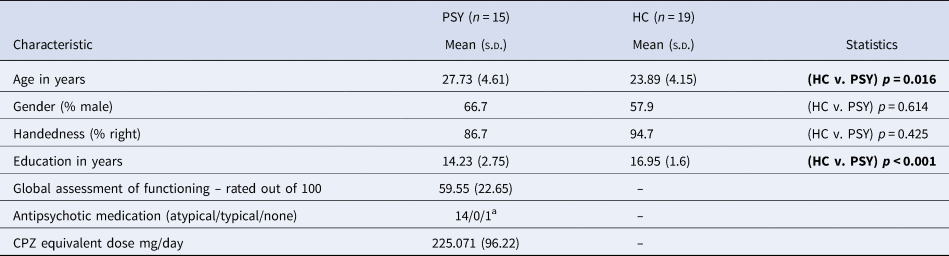
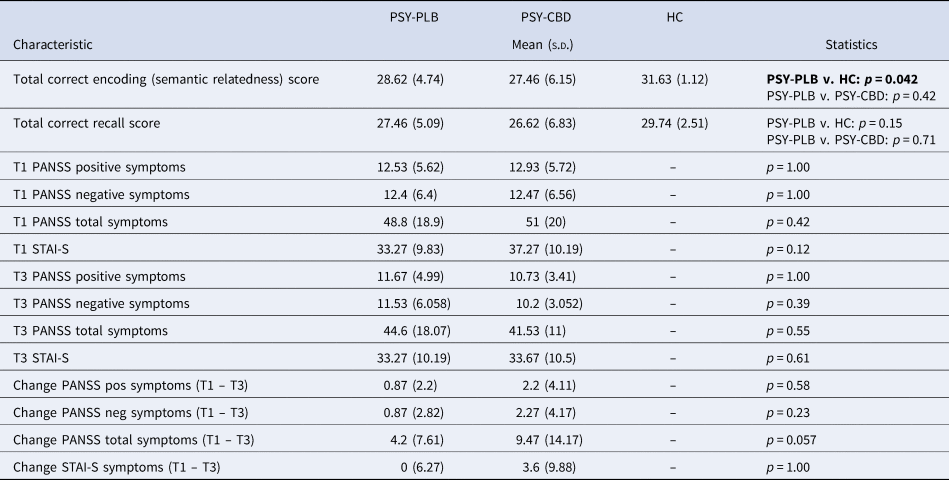
After randomization, seven patients received PLB on the first study day, and eight received CBD on the first study day. Socio-demographic and clinical data are shown in Table 1 and in eTable 2 (Supplementary Material). CBD plasma levels and associations with its effects on brain activation are reported in the online supplementary material. Symptom ratings at T1 change following drug administration, and total performance scores on the VPA task are shown in Table 2. Following the urine drug screening, one patient tested positive for PCP on both occasions. However, this finding was disregarded as the patient was receiving concurrent venlafaxine treatment, known to cause false positive results for PCP (Santos et al., Reference Santos, Lopez-Garcia, Navarro, Fernandez, Sadaba and Vidal2007). All patients were on antipsychotic medications, excluding one who had discontinued taking their prescribed medication (Olanzapine).
Participant socio-demographic and clinical characteristics at baseline

a Patient was prescribed olanzapine, but was not taking it. All HC individuals had a lifetime cannabis use of less than 10 times. Significant differences are indicated in bold.
Symptom scores for PSY patients at baseline, and post-drug, and performance scores on the VPA task for both study days

PSY-PLB, psychosis patients under placebo condition; PSY-CBD, psychosis patients under cannabidiol condition; PANSS, Positive and Negative syndrome scale; STAI-S, State Trait Anxiety Inventory state subscale. T1 = time point at 60 min before drug administration, T3 = time point at 270 min after drug administration. Significant differences are indicated in bold.
At T1 (pre-treatment), PANSS, and STAI-S ratings were not significantly different between the two study days (PSY-CBD and PSY-PLB). The change in median PANSS total scores following drug treatment displayed a trend level difference between PSY-PLB and PSY-CBD, such that there was a greater decrease in median total symptom scores from T1 to T3 under CBD treatment (p = 0.057).
In terms of task performance, the HC group scored significantly higher on judgment of semantic relatedness during encoding than the psychosis patients under both PLB (t = −2.254, p = 0.042) and CBD (t = −2.419, p = 0.032), whilst HC recall scores were empirically higher than patient scores under both PLB and CBD, though this did not reach significance. Encoding and recall performances were not significantly different between the psychosis patients under CBD and PLB conditions.
Main effect of encoding and recall in HC group is reported in the supplementary results
Between group comparison: difference in brain activation between HC and PSY-PLB
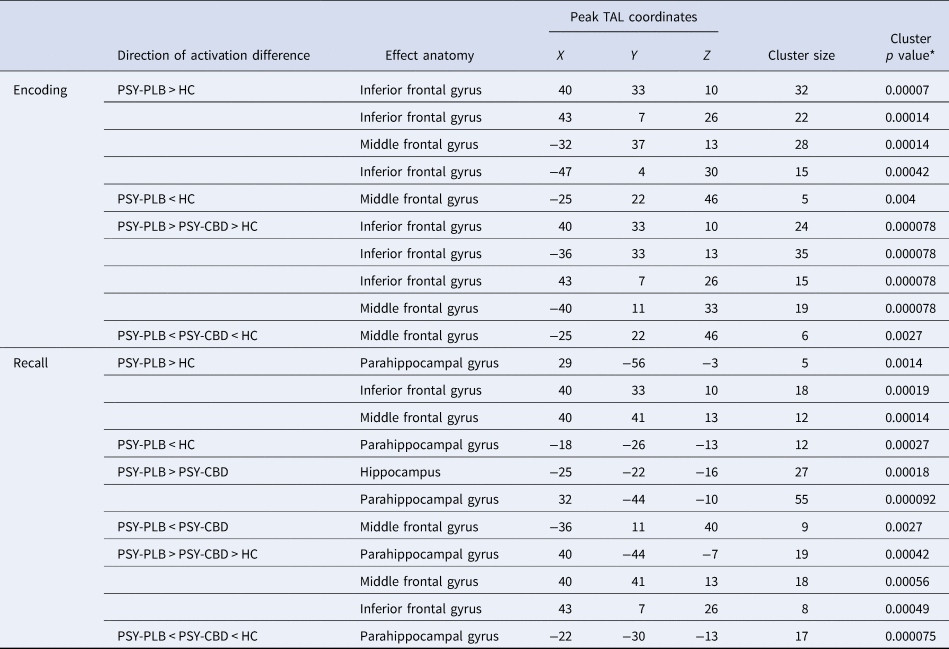
Encoding: During the encoding condition, PSY-PLB displayed increased activation, relative to HC, in two clusters in the right inferior frontal gyrus, and clusters in the left inferior and middle frontal gyri (Table 3, online Supplementary eFig. 3); and decreased activation in a separate cluster also in the left middle frontal gyrus (Table 3, online Supplementary eFig. 3).
Clusters displaying between or within group differences in activation, during the encoding or recall conditions
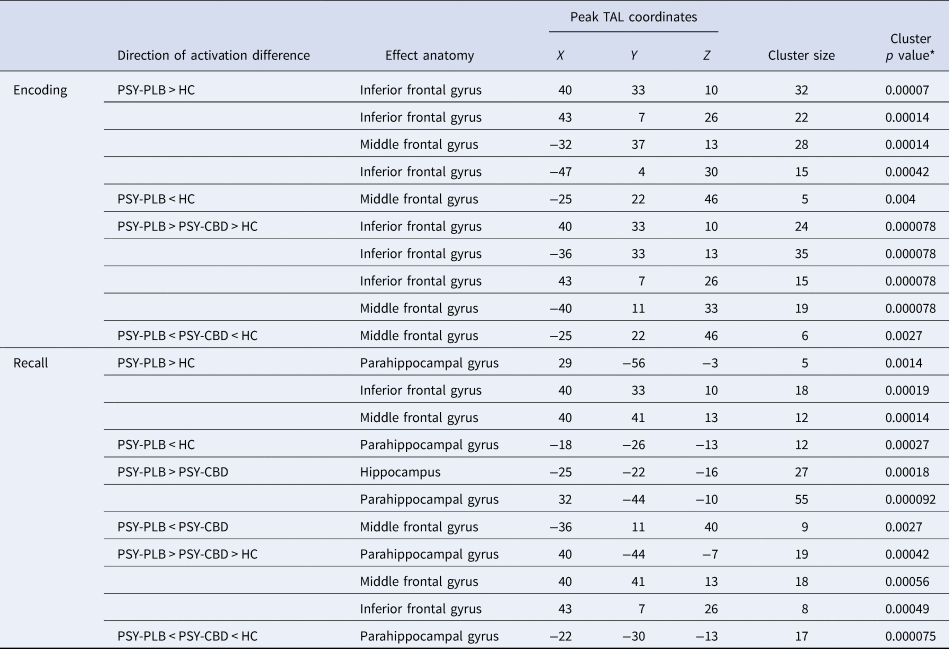
PSY-PLB, PSY group on the placebo treatment day; PSY-CBD, PSY group on the CBD treatment day; HC, healthy controls; TAL, Talairach coordinate system. *Corrected to yield less than one false positive cluster per map.
Recall: During the recall condition, activation was increased in PSY-PLB, compared to HC, in clusters in the right parahippocampal, middle frontal, and inferior frontal gyri (Table 3, online Supplementary eFig. 4), and decreased in a left parahippocampal gyrus cluster (Table 3, online Supplementary eFig. 4).
Within-subject, repeated measure comparison: effect of single dose of CBD on brain activation, relative to PLB condition, in psychosis patients
Encoding: Relative to the PLB condition, a single dose of CBD did not significantly modulate brain activation in psychosis patients during the encoding condition.
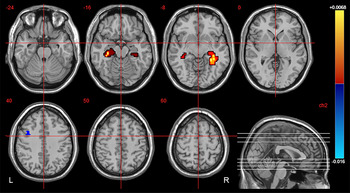
Recall: Relative to the PLB condition, a single dose of CBD significantly attenuated activation in the left hippocampus and the right parahippocampal gyrus in the psychosis patients during the recall condition (Table 3, Fig. 1). This right parahippocampal gyrus cluster overlapped with a similar cluster observed in the PSY-PLB v. HC contrast, where PSY-PLB > HC. Conversely, relative to the PLB condition, a single dose of CBD significantly increased activation in a cluster in the left middle frontal gyrus in the psychosis patients during the recall condition (Table 3, Fig. 1).
Significant acute effects of CBD on brain activation (as indexed by the mean SSQ ratio) in the psychosis patients during the recall condition. Brain clusters showing greater activation under PLB compared to CBD are red/yellow, and those showing less activation under PLB compared to CBD are depicted in blue/green. Slice numbers (in terms of z coordinate) are displayed above each slice. The right side of the brain is shown on the right side of the images. The SSQ ratio refers to the ratio of the sum of squares (SSQ) of deviations from the mean image intensity due to the model component over the whole-time series to the SSQ of deviations due to the residuals.

Between group linear analysis
This analysis revealed clusters within the ROIs where there was a linear pattern of activation across the three conditions, such that activation in the psychosis patients under CBD was intermediate to that in the psychosis patients under PLB, and the HC individuals.
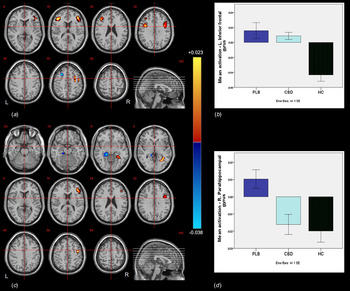
Encoding: A linear between-group relationship in activation, where PSY-PLB > PSY-CBD > HC, was observed in similar clusters to those that showed increased activation in the PSY-PLB condition, relative to HC, in the PSY-PLB v. HC analyses. This was such that encoding related engagement in the two right inferior frontal gyrus clusters previously identified in a pairwise comparison of HC and PSY-PLB was greatest in the PSY-PLB condition, and lowest in HC, with activation in the PSY-CBD condition lying intermediate to that of the other two groups (Table 3, Fig. 2a). Linear between-group relationships in this same direction were also observed for clusters in the left inferior frontal gyrus and middle frontal gyrus (Table 3, Fig. 2a). In the opposite direction, where PSY-PLB < PSY-CBD < HC, a linear between-group relationship in activation was observed in the same left middle frontal gyrus cluster for which activation was greater in HC than in the PSY-PLB condition, in the PSY-PLB v. HC analyses (Table 3, Fig. 2a, and 2b).
Significant acute effects of CBD on brain activation (as indexed by the mean SSQ ratio) in the psychosis patients, in relation to both PLB condition in the psychosis patients, and HC, during (a) the encoding condition, and (c) the recall condition. Brain clusters displaying a significant linear relationship in condition-related engagement, with activation being greatest in PSY-PLB, lowest in HC, and intermediate in PSY-CBD, are in red/yellow (PSY-PLB > PSY-CBD > HC). Clusters in blue/green display the opposite pattern of activation (PSY-PLB < PSY-CBD < HC). Mean activation for the PSY-PLB, PSY-CBD, and HC groups demonstrating significant linear relationships in (b) the left inferior frontal gyrus during encoding, and in (d) the right parahippocampal gyrus during recall. Slice numbers (in terms of z coordinate) are displayed above each slice. The right side of the brain is shown on the right side of the images. The SSQ ratio refers to the ratio of the sum of squares (SSQ) of deviations from the mean image intensity due to the model component over the whole-time series to the SSQ of deviations due to the residuals.

Recall: Under the recall condition, three clusters exhibited a linear between-group relationship in activation, such that it was greatest in PSY-PLB, lowest in HC, and intermediate in PSY-CBD (Table 3, Fig. 2c). These clusters were in the right middle and inferior frontal gyri, and right parahippocampal gyrus, overlapping with clusters with identical peaks found in PSY-PLB > HC. Furthermore, the parahippocampal cluster also overlapped partially with the parahippocampal cluster that showed CBD attenuated activation relative to the PLB condition in the earlier paired PSY comparison. One cluster displayed a linear between-group relationship in activation in the other direction, such that PSY-PLB < PSY-CBD < HC. This was located in the left parahippocampal gyrus, overlapping with a similar cluster found in the PSY-PLB < HC comparison (Table 3, Fig. 2c, and 2d).
Hippocampal-striatal functional connectivity during recall
Compared to the HC group, the patients under PLB condition displayed significantly increased functional connectivity between the hippocampus seed and clusters with peaks in the right caudate head, and left caudate body (online Supplementary eTable 3). CBD appeared to partially normalize functional connectivity in the patient group relative to PLB, and the HC group, between the hippocampus seed and clusters in the right caudate head, left caudate body, and left putamen (overlapping with those identified in the PSY-PLB v. HC comparison) (online Supplementary eTable 3).
Exploratory analyses of relationship between change in total symptoms and fMRI findings
In PSY-CBD, activation in the right inferior frontal gyrus (posterior cluster) identified in the between group linear encoding analysis (where PSY-PLB > PSY-CBD > HC) displayed a significant positive association with the change in PANSS total scores from T1 to T3 (ρ = 0.57, p = 0.042), such that the CBD induced a decrease in activation in the inferior frontal gyrus was associated with an increase in PANSS total scores. No other significant associations were observed between the fMRI findings and the change in total symptoms in the psychosis patients on the CBD treatment day.
Discussion
As predicted and largely consistent with previous evidence of altered prefrontal (PFC) and mediotemporal (MTL) cortex function in psychosis (Bonner-Jackson et al., Reference Bonner-Jackson, Haut, Csernansky and Barch2005; Hofer et al., Reference Hofer, Weiss, Golaszewski, Siedentopf, Brinkhoff, Kremser and Fleischhacker2003; Jessen et al., Reference Jessen, Scheef, Germeshausen, Tawo, Kockler, Kuhn and Heun2003; Ragland et al., Reference Ragland, Gur, Raz, Schroeder, Kohler, Smith and Gur2001; Ragland et al., Reference Ragland, Gur, Valdez, Turetsky, Elliott, Kohler and Gur2004), we observed altered activation of the PFC during verbal encoding, and in both the PFC and the MTL during verbal recall, in psychosis patients under PLB condition, compared to HC. Furthermore, consistent with our main prediction, altered activation in these regions in psychosis patients appeared to be partially normalized by a single dose of CBD. These acute effects of CBD on prefrontal and mediotemporal function were complemented by a strong trend toward improvement in psychopathology (as indexed by the total PANSS score). Contrary to our predictions, we did not find an acute effect of CBD on striatal activation in our participants, nor did striatal activation differ between psychosis patients under PLB compared to HC. However, we observed increased hippocampal-striatal functional connectivity in psychosis patients under PLB compared to HC, which was attenuated by a single dose of CBD.
These findings are broadly in accordance with previous findings that a single dose of CBD had opposite effects to that of THC in healthy volunteers on PFC activation during the same verbal learning task (Bhattacharyya et al., Reference Bhattacharyya, Morrison, Fusar-Poli, Martin-Santos, Borgwardt, Winton-Brown and Mcguire2010) as well as on mediotemporal and prefrontal activation during attentional salience, response inhibition, and emotional processing tasks (Bhattacharyya et al., Reference Bhattacharyya, Morrison, Fusar-Poli, Martin-Santos, Borgwardt, Winton-Brown and Mcguire2010; Bhattacharyya et al., Reference Bhattacharyya, Crippa, Allen, Martin-Santos, Borgwardt, Fusar-Poli and Mcguire2012b).
Both over and under activation in the prefrontal (Bonner-Jackson et al., Reference Bonner-Jackson, Haut, Csernansky and Barch2005; Hutcheson et al., Reference Hutcheson, Reid, White, Kraguljac, Avsar, Bolding and Lahti2012; Ragland et al., Reference Ragland, Gur, Valdez, Loughead, Elliott, Kohler and Gur2005; Ragland et al., Reference Ragland, Ranganath, Harms, Barch, Gold, Layher and Carter2015) and mediotemporal cortices (Jessen et al., Reference Jessen, Scheef, Germeshausen, Tawo, Kockler, Kuhn and Heun2003; Pirnia et al., Reference Pirnia, Woods, Hamilton, Lyden, Joshi, Asarnow and Narr2015; Ragland et al., Reference Ragland, Gur, Valdez, Loughead, Elliott, Kohler and Gur2005) have been reported in individuals with psychosis, as well as in those at risk (Allen et al., Reference Allen, Chaddock, Egerton, Howes, Bonoldi, Zelaya and Mcguire2016; Allen et al., Reference Allen, Azis, Modinos, Bossong, Bonoldi, Samson and Mcguire2018). In the current study, psychosis patients under PLB had greater activation compared to HC during both encoding and recall conditions in the inferior and middle frontal gyri, which serve distinct but complementary roles during encoding into memory (Blumenfeld & Ranganath, Reference Blumenfeld and Ranganath2007). Greater encoding-related lateral prefrontal activation was associated with worse performance in psychosis patients compared to HC during the encoding task that required participants to state whether the word pairs were semantically related. This may suggest that prefrontal regions, particularly dorsolateral prefrontal cortex that supports the processing of associations during encoding (Murray & Ranganath, Reference Murray and Ranganath2007), function less efficiently in psychosis patients, and this may underlie their worse performance while making semantic relatedness judgments, compared to HC.
In contrast, patients displayed greater activation than the HC group in the posterior part of the parahippocampal gyrus, a region involved in the processing of contextual and relational information (Davachi, Reference Davachi2006; Ranganath et al., Reference Ranganath, Yonelinas, Cohen, Dy, Tom and D'esposito2004). As this was associated with comparable cued recall performance in both groups, the additional recruitment of the posterior parahippocampal regions in the psychosis patients under PLB could be supporting their cued recall function and enabling them to perform at the same level as HC. On the other hand, HC showed greater activation than psychosis patients during recall in more anterior parahippocampal regions, which support the encoding and recognition of item-specific information (Davachi, Reference Davachi2006; Kirwan & Stark, Reference Kirwan and Stark2004; Montaldi, Spencer, Roberts, & Mayes, Reference Montaldi, Spencer, Roberts and Mayes2006; Ranganath et al., Reference Ranganath, Yonelinas, Cohen, Dy, Tom and D'esposito2004). These results may suggest that, while psychosis patients under PLB had to recruit brain regions involved in the relational binding of information to a greater extent than HC in order to recall word-pairs at a comparable level, the latter were able to perform a relatively easy VPA learning task by employing simpler strategies. Administration of a single dose of CBD partially attenuated these alterations in prefrontal and mediotemporal engagement in psychosis patients.
Notably, we did not identify any differences in striatal activation between the PLB treated psychosis patients, and the HC group, nor did CBD affect activation in this region within the psychosis patients. This is in contrast with the findings of our study of THC/CBD in healthy volunteers (Bhattacharyya et al., Reference Bhattacharyya, Crippa, Allen, Martin-Santos, Borgwardt, Fusar-Poli and Mcguire2012b), and our study of the effects of CBD in clinical high-risk for psychosis patients (Bhattacharyya et al., Reference Bhattacharyya, Wilson, Appiah-Kusi, O'neill, Brammer, Perez and Mcguire2018). Whether this may reflect methodological differences (e.g. study design) between the two studies including in terms of sample power or may indeed reflect brain activation differences between patients with psychosis (who took part in the present study) and those at CHR of psychosis (who took part in the previous study remains to be tested).
Previous studies in established psychosis generally report significant CBD related reductions in psychotic symptoms only following sustained treatment (Leweke et al., Reference Leweke, Piomelli, Pahlisch, Muhl, Gerth, Hoyer and Koethe2012; McGuire et al., Reference Mcguire, Robson, Cubala, Vasile, Morrison, Barron and Wright2018). This is consistent with effects of currently available antipsychotic medications, as their antipsychotic effects also become evident following sustained treatment. As such, CBD-induced changes in symptom severity were not considered a primary outcome measure and the study was powered only to detect its effect on brain activation. Nonetheless, we observed a strong trend-level reduction in total psychopathology. Exploratory analyses investigating any association between CBD-induced change in total symptom scores and its effect on functional activation and connectivity in patients under CBD treatment resulted in inconclusive findings. The lack of association between the effects of CBD on symptoms and its effects on functional activation and connectivity may be considered to argue against the possibility that the neural effects of CBD observed in the present study underlie its antipsychotic effects. However, it is worth noting that even in patients receiving sustained treatment with antipsychotic medications that provided symptom relief, studies have not consistently shown an association between the effect of treatment on brain activation and symptoms (Blasi et al., Reference Blasi, Popolizio, Taurisano, Caforio, Romano, Di Giorgio and Bertolino2009; Nielsen et al., Reference Nielsen, Rostrup, Wulff, Bak, Broberg, Lublin and Glenthoj2012). Therefore, further investigation of the effects of sustained CBD treatment in patients with psychosis is needed to examine definitively any associations between CBD-induced neural changes and symptom reduction.
Nevertheless, collectively, these findings suggest that a single dose of CBD may partially attenuate dysfunctional prefrontal and mediotemporal activation thought to underlie the subcortical dopaminergic drive leading to psychotic symptoms (Lewis & Hashimoto, Reference Lewis and Hashimoto2007; Lodge & Grace, Reference Lodge and Grace2011). These effects in conjunction with the trend-level reduction in psychosis symptoms suggest that normalization of altered prefrontal and mediotemporal function and mediotemporal-striatal connectivity may underlie the antipsychotic effects of CBD in established psychosis (Leweke et al., Reference Leweke, Piomelli, Pahlisch, Muhl, Gerth, Hoyer and Koethe2012; McGuire et al., Reference Mcguire, Robson, Cubala, Vasile, Morrison, Barron and Wright2018).
Our results should be considered in the context of certain limitations, the main one being the relatively modest sample size. It is possible that with a larger sample the trend-level reduction in psychopathology may have reached significance, or that the hypothesized effects of CBD on striatal activity may have been observed. Related to this issue, it is also worth noting that in our analyses, we focused only on certain aspects of the predictions based on the model proposed by Grace and colleagues and especially adopted a parsimonious approach informed by our data with regard to investigating the interactions between other brain regions relevant to the model, including between midbrain and striatum. Therefore, future studies in larger samples that accord greater statistical power are needed to comprehensively investigate the predictions based on Grace's model and the effect of CBD treatment thereof. Nevertheless, the within-subject design enabled us to detect the significant effects of CBD on functional brain activation, and limit the confounding effects of concomitant antipsychotic medications as well as comorbid drug use (further discussed in Supplementary Limitations). Additionally, the lifetime cannabis use of the patients and the controls was different (whereas in the HC lifetime use was less than 10 times). Ideally, we would explore any differential effects of the cannabis use by also including a cannabis using control group. Furthermore, it may be argued that a parallel comparison of the effects of CBD v. PLB in the HC may have also shed light on potential PLB effects, and provided additional context to the potential ‘normalizing' effects of CBD in the psychosis patients. However, as our primary objective was to investigate the effects of CBD on brain function relative to PLB in psychosis patients, any effect of CBD in healthy volunteers during the same task was not central to the main objectives of this study. The HC arm that we have included served as a comparator group to help demonstrate whether or not the effects of CBD on brain activation and functional connectivity in psychosis patients overlapped with the brain activation and connectivity alterations that differentiated those very same patients from HC participants. Therefore, we did not consider a concurrent CBD v. PLB trial in healthy volunteers as being within the scope of this study. Finally, it is currently unclear how CBD might affect brain function and connectivity at the molecular level. It is well-accepted that CBD may have direct or indirect effects on a number of signaling pathways (Bisogno et al., Reference Bisogno, Hanus, De Petrocellis, Tchilibon, Ponde, Brandi and Di Marzo2001; Iseger & Bossong, Reference Iseger and Bossong2015; Katona, Reference Katona2015; Pertwee, Reference Pertwee2008), with suggestions that its antipsychotic effects may be related to an effect on hydrolysis of the endogenous cannabinoid anandamide (Fogaca, Campos, Coelho, Duman, & Guimaraes, Reference Fogaca, Campos, Coelho, Duman and Guimaraes2018; Leweke et al., Reference Leweke, Piomelli, Pahlisch, Muhl, Gerth, Hoyer and Koethe2012). Nonetheless, future studies would benefit from exploring this, and the additional limitations, further.
To our knowledge, this is the first study to demonstrate that a single dose of CBD may partially attenuate mediotemporal and prefrontal dysfunction and altered mediotemporal-striatal connectivity, as well as symptoms, in people with established psychosis. Future studies need to investigate its effects following sustained dosing.
Supplementary material
The supplementary material for this article can be found at https://doi.org/10.1017/S0033291719003519.
Acknowledgements
This work was supported by grants from the Medical Research Council (MRC), UK (MR/J012149/1 and MC_PC_14105 v.2 to S.B.). S.B. has also received support from the National Institute for Health Research (NIHR) (NIHR Clinician Scientist Award; NIHR CS-11-001), and from the NIHR Mental Health Biomedical Research Centre at South London and Maudsley National Health Service (NHS) Foundation Trust and King's College London. A.O'N. was supported by the NIHR Collaboration for Leadership in Applied Health Research and Care South London, at King's College Hospital NHS Foundation Trust. We certify that this article is not being considered for publication elsewhere, and has not been published previously. The views expressed are those of the author(s), and not necessarily those of the NHS, the NIHR, or the Department of Health. All the authors contributed in a substantial way to the study and approved the manuscript content. The authors have no other biomedical financial interests or potential conflicts of interest related to this publication.