Truth and Reconciliation Commissions (TRC) are one of the most widely used transitional justice (TJ) measures to move from a climate of violence, produced by internal armed conflicts or military dictatorships, to living peacefully together. These commissions can be understood as transitional rituals whose goal is to implement a series of mechanisms designed to address human rights abuse. They are intended to consolidate norms and strengthen social cohesion in order to avoid future violence and recover institutional trust lost during periods of political violence (Beristain, Páez, Rimé, & Kanyangara, Reference Beristain, Páez, Rimé and Kanyangara2010). Thus, the aim is peaceful and harmonious life among groups, leaving no room for impunity, in an attempt to repair the harm done to victims and society as a whole by dictatorships or internal armed conflicts. There is evidence supporting the negative intra-and interpersonal effects of traumatic events such as collective violence (Rimé, Finkenauer, Luminet, Zech, & Philippot, Reference Rimé, Finkenauer, Luminet, Zech, Philippot, Stroebe and Hewstone1998).
TRCs have been established in many countries to deal with serious human rights violations committed by dictatorship regimes or during internal armed conflicts. Since the 1970s, more than 30 official commissions have been set up in different parts of the world (Avruch, Reference Avruch2010). TRCs are temporary bodies created to investigate, but not necessarily judge, human rights violations perpetrated by state agents and/or armed opposition forces (Hayner, Reference Hayner2001). The common functions of TRCs are: (a) to make efforts to find out the truth about the period of collective violence; (b) to recognize and validate victims’ suffering; (c) to compensate those affected, both materially and symbolically; (d) to contribute to the creation of an inclusive social memory oriented toward the future; (e) to avoid new violent events; and (f) to seek justice. These functions can help to avoid revenge cycles and other war crimes while preventing the emergence of collective violence (Sikkink & Bott-Walling, Reference Sikkink and Booth Walling2007), above all in cases where there is support for the TRC and appropriate institutional organizations (Brahms, Reference Brahms2009).
The National Truth and Reconciliation Commission in Chile
The National Truth and Reconciliation Commission (NTRC) was created in April 1990 to discover the truth about human rights violations by Chilean state agents between September 11th, 1973 (day of the military coup) and March 1990 (beginning of the transition to democracy). Its report was published in 1991. The purpose of the NTRC was to create as complete a picture as possible of the most serious human rights violations committed by state agents (people detained-disappeared, executed for political reasons, and tortured to death). Its aim was to collect data in order to identify victims and discover their fate, and recommend measures to avoid future human rights violations (NTRC, 1991); it was not allowed to take legal action pertaining to courts of justice. Its report was made public by the President of the Republic at the time, who apologized for the abuses committed. The NTRC reported that 3197 people were killed in Chile for political reasons (this figure includes cases later accepted by the National Reparation and Reconciliation Commission), and that the armed forces and police were responsible for most of them (NTRC, 1991). After the report was released, a wide-ranging compensation plan was implemented, including pensions for victims’ relatives, scholarships for students, and mental and physical health programs (for a detailed analysis, see Lira, Reference Lira2011). Regarding collective memory and its symbols, memorials and monuments have been built (most of them thanks to the initiatives of victims’ relatives; Jelin & Langland, Reference Jelin and Langland2003). As far as justice is concerned, more than 600 agents of the dictatorship have been tried, and most of those responsible for the most serious human rights violations have been sent to jail (Lira, Reference Lira2010).
Psychosocial factors associated with intergroup forgiveness
This study deals with predictors of favorable attitudes toward belief in forgiveness, that is, the belief that it is possible to reduce the feelings of revenge, anger, and mistrust toward the perpetrator group. Intergroup forgiveness has been defined as a willingness to abandon one’s right to resentment. In other words, it would be an internal transformation in the motivation toward a perceived perpetrating out-group that is context dependent (van Tongeren, Burnette, Boyle, Worthington, & Forsyth, Reference van Tongeren, Burnette, O’Boyle, Worthington and Forsyth2014). Forgiving the other group’s members means no longer feeling angry or resentful (Baumeister, Exline, & sommer, 1998). These negative feelings must be addressed in promoting more positive intergroup relations (Wohl & Branscombe, Reference Wohl and Branscombe2005). A series of variables or measures were selected that were relevant in other studies and theoretically important. These variables were divided into four groups: socio-demographic variables and closeness to violence events (including characteristics such as political identification, age, religiousness, and being a victim of violence or a victim’s relative); emotional expression and social sharing (emotions arising from remembering the NTRC report, and the extent to which people speak socially about the NTRC’s work); support for NTRC functions and reparation measures (reading the NTRC report, participation in victims’ commemoration rituals, perception of the NTRC’s contribution to revealing the truth and doing justice, to creating a comprehensive history and to future violence prevention, and agreement with reparation measures); and institutional factors (positive perception of social climate, institutional trust, and perceived sincerity and efficacy of official apologies). On the whole, these four groups refer to variables that help us to understand the beliefs about forgiveness held by victims toward perpetrators.
Sociodemographic variables
Aim to identify the differences between individuals’ positions – that is, to detect whether, 20 years after the release of the NTRC report, personal proximity to violence events is relevant to their appraisal. Part of the sample is made up of individuals who were not born when the violence events occurred, or even when the report was published, so that age differences may be an important element in understanding beliefs about victims’ forgiveness of perpetrators. Moreover, in the context of the Chilean dictatorship, participants’ political ideas may be an important predictor of the belief in forgiveness, given the dictatorship’s identification with right-wing ideas and victims’ identification with left-wing ideas. Support for these beliefs may be attributable to previous symbolic identification with the victims of violence or with its perpetrators (Manzi, Reference Manzi, Carretero, Rosa and González2006). In any case, previous studies (Cárdenas, Páez, & Rimé, Reference Cárdenas, Páez, Arnoso and Rimé2013) have shown the existence of differences between right-wing and left-wing people on a set of variables, such as institutional trust, assessment of TRCs, and emotions like fear and guilt. On the other hand, victims were more critical of apologies and more reluctant to forgive (Cárdenas, Páez, Rimé, Bilbao, & Asún, Reference Cárdenas, Páez, Rimé, Bilbao and Asún2014), which is relevant because in Chile victims and left-wing political ideas often overlap. Furthermore, religiousness may strengthen a person’s willingness to forgive, in line with the Catholic tradition, which is strongly rooted in Chile. Various studies show that religiousness plays an important role in intergroup forgiveness (Staub, Pearlman, Gubin, & Hagengimana, Reference Staub, Pearlman, Gubin and Hagengimana2005). Finally, individuals from traumatized families or those directly affected by the violence would be expected to support transitional justice measures more strongly (Aguilar, Balcells, & Cebolla, Reference Aguilar, Balcells and Cebolla2011), with the extent of violence exposure (ranging from being a direct victim to having relatives or friends who were affected by it) influencing the strength of this factor as a predictor of beliefs in victims’ forgiveness of perpetrators.
However, traumatic events affect not only individuals or their families, but also intermediate groups. For this reason, the second group – emotional expression and social sharing – included variables such as the extent to which people speak socially about the NTRC work and report. This variable is probably associated with believing in forgiveness. In addition, emotions arising from the memories of the period of violence are fundamental to understanding people’s actions. A large variety of outgroup behaviors may be explained by different emotions (Mackie & Smith, Reference Mackie and Smith2002). It is well known that emotions such as guilt and shame encourage the acknowledgement of responsibility and support for reparation measures (Dresler-Hawke & Liu, 2006), and that others, such as pride and hope, are linked to post-traumatic growth (Vázquez & Páez, Reference Vázquez, Páez, Weiss and Berger2011). Collective guilt can facilitate reparation and the acknowledgment of offenses (Brown & Cehajic, Reference Brown and Cehajic2008), and lack of remorse leads to justifying offenses and creates a barrier to forgiveness (Morton & Postmes, Reference Morton and Postmes2011; Noor, Brown, & Prentice, Reference Noor, Brown and Prentice2008). The negative emotions have been associated with intergroup forgiveness (Tam et al, Reference Tam, Hewstone, Kenworthy, Cairns, Marinetti, Geddes and Parkinson2008). Research reveals that anger is often a key barrier to intergroup forgiveness (Fehr et al, Reference Fehr, Gelfand and Nag2010; Manzi & González, Reference Manzi and González2007), while fear has been shown to be a strong inhibitor of trust and empathy between groups (Tam et al, Reference Tam, Hewston, Cairns, Tausch, Maio and Kenworthy2007; van Tongeren, Burnette, O’Boyle, Worthington, & Forsyth, Reference van Tongeren, Burnette, O’Boyle, Worthington and Forsyth2014). Fear predicts avoidance tendencies (Devos, Silver, Mackie, & Smith, Reference Devos, Silver, Mackie, Smith, Mackie and Smith2002), although some studies show that fear predicts increased outgroup forgiveness (Tam et al, Reference Tam, Hewston, Cairns, Tausch, Maio and Kenworthy2007). In any case, truth commission activities produce emotional activation (Kaminer, Stein, Mbanga, & Zungu-Dirwayi, Reference Kaminer, Stein, Mbanga and Zungu-Dirwayi2001; Kanyangara, Reference Kanyangara2008; Kanyangara, Rimé, Philippot, & Yzerbit, Reference Kanyangara, Rimé, Philippot and Yzerbit2007; Rimé, Kanyangara, Yzerbyt, & Páez, Reference Rimé, Kanyangara, Yzerbyt and Paez2011) and emotional effects in individuals identified as both victims and perpetrators (Brounéus, Reference Brounéus2008). Several studies show the important role of emotional sharing in overcoming emotional trauma (Tam et al, Reference Tam, Hewston, Cairns, Tausch, Maio and Kenworthy2007; Wohl, Hornsey, & Bennett, Reference Wohl, Hornsey and Bennett2012), so that it might be a good predictor of the belief in intergroup forgiveness (Zech, Rimé, & Nils, Reference Zech, Rimé, Nils, Philippot and Feldman2004).
Believing in social forgiveness will also depend on knowledge about the commission’s work and the extent to which it fulfills its functions and achieves its goals. These beliefs are related to the commission’s contribution to revealing the truth and doing justice, and whether it has created a comprehensive history and helped to prevent future cycles of violence. Furthermore, agreement with reparation measures is estimated to strengthen beliefs in forgiveness, indicating behavioral agreement with social reconciliation. These variables have been grouped as support for NTRC functions and reparation measures. This category also includes knowledge about the NTRC’s activities and report and the extent to which the person participates in rituals for honoring victims, since this participation may result in greater support for intergroup forgiveness (Nadler & Schnabel, Reference Nadler, Schnabel, Nadler, Malloy and Fisher2008; Stroebe & Stroebe, Reference Stroebe, Stroebe, Higgins and Kruglanski1996).
Finally, the aim of variables labeled as institutional factors is to detect how the perception of the social climate can condition beliefs in forgiveness (Cárdenas, Páez, Arnoso, & Rimé, Reference Cárdenas, Páez and Rimé2013a; Páez, Reference Páez2010). Thus, a degree of institutional trust is relevant, as it may reveal the conviction that group relations depend on institutions functioning properly (Cárdenas, Páez, & Rimé, Reference Cárdenas, Páez, Rimé, Cabecinhas and Abadia2013b). Such trust can also aid the credibility of a comprehensive or inclusive history, which in turn helps to make future violence less likely. Also included in this category are variables evaluating the sincerity and effectiveness of official apologies, since, as stated in other studies (Nadler, Malloy, & Ficher, Reference Nadler, Malloy and Fisher2008; Páez, Reference Páez2010; Philpot & Hornsey, Reference Philpot and Hornsey2008), this may be an important requirement for reconciliation and forgiveness among groups as an indicator of the recognition of norm transgression (Bar-Tal, Reference Bar-Tal2011).
Using these independent variables may help predict beliefs about forgiveness. For this reason, step-by-step multiple linear regression models are proposed to identify how this prediction works.
Method
Sample and Procedure
The sample consisted of 1276 volunteer participants, 623 men (49.1%) and 644 women (50.8%) with an age range from 18 to 90 years old (M = 39.55 years and SD = 17.34). Data were collected in the urban areas with the highest population densities: Santiago (26.4%), Valparaiso (30.7%), Concepción (14.5%), and Antofagasta (28.4%). Participants were unqualified blue collar workers (8.1%), qualified blue collars and white collar workers (14.9%), executives or self-employed people (22.7%), retired people (4.3%), housewives (7.8%), students (24.6%), or other (17.6%). The instrument was applied by specially trained university students. Although this was not a random sample, it was stratified in order to reflect the population ratios for sex and different age groups in each city (Instituto Nacional de Estadística, 2003). Once participants had agreed to participate in the study and signed a consent letter informing them of its goals and guaranteeing confidentiality and anonymity, they completed the paper-and-pencil questionnaire individually. Data were collected between October 2010 and July 2011.
Instrument and variables
To identify the factors determining belief in forgiveness, a continuous dependent variable was used (“do you consider that people who were affected by past violence can forgive those who inflicted this violence on them?” Response options ranged from 1=”not at all” to 7=”completely”). Although this question is very general, we consider it appropriate to simultaneously measure the general population and victims. A more direct question would only be appropriate for one group and not the other. It is well-known that people usually respond differently if they are asked about themselves than if they are asked about their group. This would also occur in the case of intergroup forgiveness (Baumeister et al., Reference Baumeister, Exline, Sommer and Worthington1998).
As stated above, independent variables were divided into 4 groups related to socio-demographic variables and closeness to events, such as age (how old the individual was at the moment of answering the questionnaire), religiousness (importance assigned to their religious ideas; response options ranged from 1 = “not important” to 7 = “very important”), political ideas (a 7-level variable, from extreme left to extreme right), and exposure to violence (“Do you consider yourself a victim of violence by the State or its agents in the period 1973 to 1989?” and “Were any of your relatives or close friends victims of violence by the State or its agents in the 1973–1989 period?)”. For both questions, response options were “Yes” or “No”. Participants who responded affirmatively to the first question or to both questions were categorized as direct victims, those who responded affirmatively only to the second question were considered indirect victims, and those who responded negatively to both questions were considered “unaffected”.
The second group of variables included emotions elicited by the memories of the NTRC report and the period of violence in Chile (eight basic emotions: sadness/pain, guilt, shame, anger, fear, happiness, pride, and hope; their values ranged from 1 = “None” to 7 = “Very much”). Reliability in the current study was acceptable (α =.78). Additionally, we asked about the degree to which one speaks about the events included in the report (social sharing) and related to the human rights violations that occurred in Chile between 1973–1989, using two questions (values ranging from 1 = “not at all” to 4 = “a great deal”). Reliability in the current study was (α = .85).
The third group included variables related to participants’ knowledge about the NTRC report (“Did you read the NTRC report or part of it?”; response options were “Yes” or “No”), and variables pertaining to appraisals of how much the NTRC contributed to relatives’ knowledge about the truth about their loved ones, meted out justice to human rights violators, created a comprehensive history, and prevented future violence (response options ranged from 1 = “not at all” to 4 = “a great deal”). Reliability in the current study was acceptable (α = .79).
Regarding institutional trust (trusting institutions such as the government, political parties, courts of justice, etc.; response options ranged from 1 = “nothing” and 7 = ”a lot”), reliability in the current study was good (α = .84). For positive social climate perception, the 4 items on the CEPN scale (De Rivera & Páez, Reference De Rivera and Páez2007) were used (A Likert-type response scale was used, with anchors 1 = “Not at all/None” to 5 = “A great deal”). Reliability in the current study was good (α = .82). Finally, sincerity and effectiveness attributed to official apologies were measured (“Do you think these declarations and apologies were sincere?” and “Do you think these declarations and apologies helped society to understand the suffering of groups affected by violence?” The response options ranged in each case from 1 = “Not at all/None” to 4 = “A great deal”). Reliability in the current study was good (α = .82).
Results
Descriptive data and correlation tests
The data indicate that only 28.2% of participants believe that victims can forgive the perpetrators, 76% consider that institutional apologies are not sincere, and 84.3% think such apologies are ineffective for improving group relations. In addition, most participants have not spoken with other people about the content of the NTRC report (84.7%). Regarding political ideas, participants report belonging to the center (34.4%), center-left (24.2%), and left (18.9%). People defining themselves as center-right account for 11%, and those calling themselves right-wing total 3.8%. Those who trust institutions account for 45.2% of the sample, while 55.6% claim to be non-religious (55.6%). Based on answers to the two preliminary questions examining exposure to past violence, 304 respondents (24%) considered themselves to be direct victims of human rights violations, while 424 respondents (33.4%) reported having victims among their family or close friends, and could therefore be categorized as indirect victims. The remaining 541 (42.6%) had not been affected by political violence and were put in the “unaffected” category for the comparisons to follow.
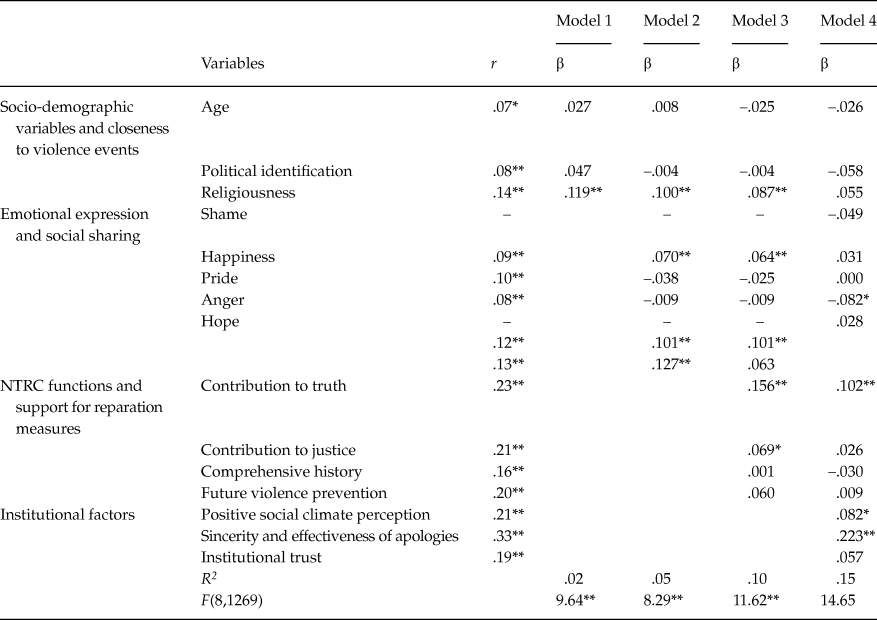
Before including independent variables in the regression model, several correlation tests were carried out among continuous independent variables and the dependent variable in order to empirically support the inclusion of each. Table 1 shows the association coefficient values obtained by crossing independent variables with belief in victims’ forgiveness. Almost all the variables are significantly related to belief in forgiveness (zero-order correlations), except those referring to exposure to violence, pain, guilt, fear, social sharing, and degree of information about NTRC. These variables will not be included in the regression model, since they are not associated with the dependent variable.
Multiple linear regression analysis
Once the relations among variables had been identified, a step-by-step multiple linear regression analysis was conducted for the variable “belief in forgiveness”. As Table 1 shows, Model 1 includes the set of socio-demographic variables and those referring to proximity to the events; Model 2 adds variables related to the expression of emotions; Model 3 incorporates knowledge about and appraisal of the truth commission’s achievements and support for reparation measures; and Model 4 brings in institutional factors.
Linear Multiple Regression Model

Note: *p < .05; **p < .001; Effect Size f 2=.18 (medium) and statistical power (1-β)=1.0.
Model 1 highlights the importance of religiousness. The results indicate that those who give more importance to religious ideas also believe in social forgiveness. This variable tends to lose relevance as a predictor in the subsequent models.
In Model 2, religiousness is still relevant. Three emotions seem to be relevant: hope, shame and anger. Thus, reporting these emotions may be a good predictor of beliefs in victim’s forgiveness. Higher levels of hope and low levels of anger and shame would be good predictors of belief in forgiveness.
Model 3 confirms expectations about the importance of religiousness, shame, and anger. In addition, it reveals the relevance of two other aspects: the fact that the NTRC revealed the truth about what happened to victims and its contribution to justice and punishing those responsible for human rights violations.
Model 4 incorporates variables dealing with institutional factors, including official apologies and positive social climate perception. Anger maintains its relevance, but shame and hope disappear in the model; religiousness also disappears from the model. Only the NTRC’s contributions to finding the truth still have considerable weight. The institutional factors are highly relevant, with perception of a positive social climate and perceived effectiveness and sincerity of official apologies being significant in understanding belief in victims’ forgiveness of perpetrators.
Discussion
Although the models tested provide a poor explanation of the variance, some results show some interesting clues for future research.
On the one hand, being on the left politically, older, and religious predict beliefs in intergroup forgiveness in the first model. The first two results are coherent with those from other studies (Aguilar et al., Reference Aguilar, Balcells and Cebolla2011). However, these variables are not significant in Model 4, being replaced by less distal variables, although religiousness maintains its predictive capacity in a more stable fashion. Thus, when institutional variables are excluded, a call for reconciliation may evoke restitution in a moral community (reconciliation is the name of a Catholic sacrament), probably based on interpersonal forgiveness parameters (conflict recognition, regret accompanied by the firm intention not to commit sins again, and reciprocal forgiveness based on reparation and expiation of the harm done; Mullet, Nann, Kandiangandu, Neto, & Pinto, Reference Mullet, Nann, Kandiangandu, Neto, Pinto, Páez, Beristain, González, Basabe and de Rivera2011). The fact that institutions connected to the Church, such as Solidarity Vicarage (CNVR, 1991), denounced and documented human rights violations is relevant, since they protected and helped victims. Public recognition of the Catholic Church’s role may make identification with this category highly relevant and strengthen the positive social identity of religious people as they support ethical measures supported by their group.
On the other hand, certain emotions appear to play a highly relevant role in predicting beliefs in intergroup forgiveness. Feeling sadness and pain about events, but tinged with hope, seems to be a good predictor of beliefs in intergroup forgiveness. Sadness is associated with loss-assimilation behaviors and cognitive re-elaboration, while hope involves actively seeking a better future (Fredrickson, Reference Fredrickson2009). Unlike in studies on collective guilt (Etxeberría, Conejero, & Pascual, Reference Etxeberría, Conejero, Pascual, Páez, Beristain, González, Basabe and de Rivera2011), guilt was found to have a negative effect, which may indicate that when it is present, people do not consider forgiveness as an option. That is, although other research identifies guilt as an emotion that produces reparation (Brown, González, Zagefka, Manzi, & Cehajic, Reference Brown, González, Zagefka, Manzi and Cehajic2008; Manzi et al., Reference Manzi, Ruiz, Krause, Meneses, Haye and Kronmüller2004), this study shows instead that it may be a barrier to support for intergroup forgiveness. Since guilt is linked to responsibility for terrible events that nobody wants to accept due to possible effects on their own identity, it may lead to denial and avoidance of facing a collective traumatic past. This does not occur with sadness, which, although a negative emotion, refers to positive aspects of ourselves insofar as we are able to empathize with victims, showing sensitivity to their misfortune or tragedy.
Speaking about past violence is a good predictor of positive appraisal of the possibilities of forgiveness. People who feel the most need to speak and have spoken most about a traumatic past probably see the NTRC report as a compendium of horror that allows them to validate their position or inform themselves about the extent of the violence. People who speak the most about the report may be those with the most knowledge about it, but they may also perceive its content as validated through the confirmation of facts and events by a “moral authority” in the form of the commission. Thus, speaking with others and remembering the period of violence may predispose people to accepting the need for intergroup forgiveness. Emotions such as sadness/pain and hope are brought out, leading to a belief in intergroup forgiveness (Bellelli, Leone, & Cursi, Reference Bellelli, Leone and Cursi1999), to the degree that they arise from talking about the content of the Truth and Reconciliation Commission report. The TRC’s reports provide support material that reaffirms the previously-denied reality of human rights violations. Therefore, official recognition can be considered a step forward in questions of intergroup forgiveness. It is an experience that validates the victims, who were able to systematically review what happened, leading to higher levels of elaboration of the experience and, therefore, a greater willingness to forgive. In the general population, the recognition provided by the reports could encourage an encounter with the others, fostering the belief that intergroup forgiveness between groups in conflict is possible.
Those who most value the NTRC’s work also think it contributed to revealing the truth about what happened to victims and to creating a comprehensive history that includes the different positions of the actors involved in the conflict. Its contribution to imparting justice is considered substantial, although less relevant than the previous two contributions. Fulfilling certain social functions of collective memory and, to a lesser extent, justice, are important factors that predict belief in intergroup forgiveness.
Perceiving the social climate as positive and trusting in institutions are both excellent predictors of belief in intergroup forgiveness. People who think that institutions work properly and that the social climate is positive also believe that intergroup forgiveness is possible. Thus, transitional justice activities are more relevant within contexts where public trust is not severely harmed and institutions operate properly, so that the impartiality of research into the past can be ensured. A TRC can only be successful if the population firmly believes that it can do a serious and honest job, and this is only possible in a climate of institutional trust. If institutions are discredited, TRCs have no chance of being supported (Beristain et al., Reference Beristain, Páez, Rimé and Kanyangara2010). Belief in intergroup forgiveness is also related to the effectiveness attributed to institutional apologies as a reflection of understanding victims’ pain. These apologies may provide a measure of the extent to which authorities are seen to be truly willing to advance in the quest for truth and become aware of victims’ suffering. Without effective apologies, victims do not believe in forgiveness (Mullet et al., Reference Mullet, Nann, Kandiangandu, Neto, Pinto, Páez, Beristain, González, Basabe and de Rivera2011).
Thus, belief in intergroup forgiveness depends on the confluence of different variables. The most relevant variable appears to be the emotions evoked, with sadness/pain and hope being good predictors of these beliefs. Guilt would be related to rejecting intergroup forgiveness, showing that such work does not always support reparation and may be associated with denial. Belief in forgiveness is also based on the TRC’s contribution to revealing the truth and creating a comprehensive history, along with its perceived success in punishing the guilty. Likewise, social sharing of the past is a significant predictor of supporting forgiveness between groups. Lastly, perceiving the social climate as positive, believing that apologies have been effective, and trusting that institutions operate properly are highly relevant factors in belief in intergroup forgiveness.
The results of the present study provide evidence that the people in the sample do not believe in the possibilities of social forgiveness, regardless of their political position or age. Neither the victims nor the affected people manifest the belief that the victims can forgive the perpetrators, which explains the low explanation provided by the different models together. Therefore, it is important to focus on the variables that were shown to be significant in this study. Reducing anger, reaching the most complete understanding possible of the truth (it is important to recall that in Chile there are still detained people who were never found and family members who fight to recover them), carrying out rituals recognizing the victims and their suffering, and advancing measures to recognize the horror caused (mainly by State institutions involved in human rights violations), which would involve giving appropriate and sincere apologies, can contribute to creating a climate of greater safety and trust. These seem to be key tasks of a post-conflict society. Twenty-five years after the end of the military dictatorship, Chile continues to be a segmented country that is far from reaching social reconciliation. People in general, and not only the victims, do not believe in the possibility of forgiveness by the victims. This situation, whether we like it or not, reflects the society we have been creating: a society where distrust between groups reigns, where the victims feel anger not only toward the perpetrators, but also toward a State that makes them invisible and denies them recognition, where every once in a while we still uncover victims’ remains, and where the perpetrators go unpunished.
Preparation of this paper was facilitated by FONDECYT 1110776 and postdoctoral fellowship granted from Chilean National Funds of Scientific research (CONICYT).