Introduction
Prosody – patterns of speech melody and rhythm – is an essential component of successful speech communication. Adult speakers encode a wide variety of lexical, semantic, pragmatic, and affective information in prosody. Along with learning native rhythm and pitch patterns, children must also acquire the complex system for how meaning maps onto intonational contours and how it is expressed via the speech acoustics. Specifically, in English, young children must learn to use the prosodic system to mark the information status of a referent: that is, whether or not it is ‘new’ to a discourse context. Here, we asked how toddlers at age 2;6 produce referents with varying information status in a natural context. Specifically, we analyzed their prosodic distinctions of information status at both the phonological and the acoustic-phonetic level.
Information status and prosody
Information structure refers to how a speaker bundles discourse information when presenting material to a listener (Chafe, Reference Chafe and Li1976; Clark & Haviland, Reference Clark, Haviland and Freedle1977). Traditionally, a sentence can be partitioned into two primary components: the part that anchors the sentence to the previous discourse (or the hearer's mental model of the world), and the part of the sentence that contributes or adds information to the discourse (or hearer's mental model of the world). These dichotomous components have been labeled in a variety of ways, each with a slightly varied meaning, including topic-comment, subject-predicate, known-unknown, theme-rheme, background-focus, and relational givenness-newness (Bolinger, Reference Bolinger1965; Von der Gabelentz, 1869, cited in Gundel, Reference Gundel and Müller2003; Gundel & Fretheim, Reference Gundel and Fretheim2004; Halliday, Reference Halliday1967; Mathesius, 1928, cited in Lambrecht, Reference Lambrecht1996; Steedman, Reference Steedman1991; among others).
A related aspect of information structure is information status. Information status refers to whether or not information (or a discourse referent) is contextually new or given to the discourse context (also known as referential givenness-newness, Gundel & Fretheim, Reference Gundel and Fretheim2004; Vallduví & Engdahl, Reference Vallduví and Engdahl1996). Information structure is expressed cross-linguistically via syntactic processes, morphological markers, and/or prosody. For example, information status can be marked by the choice of the lexical expression (e.g., an indefinite noun phrase vs. a pronoun), as well as by prosody via unique pitch accent structures on accented information and/or decreased prominence on given information (Arnold, Reference Arnold2008; Chen, Reference Chen2011; Grünloh, Lieven & Tomasello, Reference Grünloh, Lieven and Tomasello2015). Developmentally, children aged 2;6 are able to use syntax to mark information structure relations, while morphological marking of these relationships may take until age 7 or later (Hickmann, Hendriks, Roland & Liang, Reference Hickmann, Hendriks, Roland and Liang1996; Scollon, Reference Scollon, Ochs and Schieffelin1979). For prosodic marking of information status in English, new information is typically accented and given information deaccented in adult speech (Gussenhoven, Reference Gussenhoven and Jun2005; Ladd, Reference Ladd1996). Information structure and information status are logically independent, but the information status can be reflected via the information structure with new information generally realized as the focal element (or focus) and given information as the non-focal element (or topic) (Gundel & Fretheim, Reference Gundel and Fretheim2004).
Other ways that referents are typically analyzed in the literature are as “accessible” and “contrastive” (Chen, Reference Chen, Serratrice and Allen2015). A referent is accessible if it has been previously activated in the discourse or if the referent is inferable from a previously mentioned referent. A referent may be contrastive when it is uttered in contrast to a limited set of alternatives, and in this case, it can be either referentially new or given (Chafe, Reference Chafe and Li1976; Chen, Reference Chen, Serratrice and Allen2015; Halliday, Reference Halliday1967). For this study, we analyze child productions of new and given discourse referents (i.e., referential givenness-newness) as well as referents that are uttered as corrections, similar to the aforementioned definition of contrast. Following Gussenhoven (Reference Gussenhoven, Lee, Gordon and Büring2008), corrective information is focused information that is uttered in “a direct rejection of an alternative, either spoken by the speaker himself (‘Not A, but B’) or by the hearer” (p. 91; also referred to as contrastive by Chafe, Reference Chafe and Li1976).
The short dialogue presented in (1) exemplifies the three-way distinction of referring expressions as used in the current study: new, given, and corrective in their information status relative to the discourse context. In (1a), the referent ‘cat’ is new and is uttered for the first time in an out of the blue, broad focus utterance. In (1b), the referent ‘cat’ is given in the discourse as it has been recently mentioned, while the referent ‘dog’ is new. For (1c), ‘cat’ remains given in the discourse context and the speaker makes a correction of the desired referent from the previously mentioned ‘dog’ to ‘horse’.
1a) Speaker 1: There is the [cat]new.
1b) Speaker 2: There is the [cat]given and [dog]new.
1c) Speaker 1: No, that is a [cat]given and [horse]corrective.
Phonological and acoustic realizations of information status in English
A commonly used framework for analyzing prosody is the Autosegmental-Metrical (AM) approach and the corresponding Tones and Break Indices (ToBI) transcription system for phonological categorization and labeling (Beckman & Ayers, Reference Beckman and Ayers1997; Brugos, Veilleux & Shattuck-Hufnagel, Reference Brugos, Veilleux and Shattuck-Hufnagel2006; Ladd, Reference Ladd1996; Pierrehumbert, Reference Pierrehumbert1980). The ToBI transcription system annotates intonation using a series of high (H) and low (L) targets. These targets are anchored to particular portions of an utterance, such as the accented syllable, and are called pitch accents (denoted with a *, e.g., H*). Phrase accents and boundary tones are also expressed in this system with high and low targets (final boundary tone marking with %, e.g., L-L%).
Research has been mixed regarding which particular pitch accents under the ToBI system are associated with different information statuses. Pierrehumbert and Hirschberg (Reference Pierrehumbert and Hirschberg1990) considered the H* monotonal accent to represent new information, the L+H* bitonal accent to represent contrastive information (related to the corrective category in the current study), and no accent to represent given information. Similarly, Steedman (Reference Steedman, Lee, Gordon and Büring2007) assigned the H* pitch accent to his notion of rheme, or the part of the utterance that constitutes the speaker's novel contribution to that question or topic (similar to focus following Gundel & Fretheim, Reference Gundel and Fretheim2004). In turn, he assigned the L+H* pitch accent to the counterpart contrastive theme, or the part of the sentence corresponding to a question or topic that is presupposed by the speaker (similar to contrastive focus). In line with this view, Ito, Speer, and Beckman (Reference Ito, Speer and Beckman2004) showed that L+H* is more typically associated with contrastive meaning in discourse than the H* pitch accent.
Although initial research hypothesized that H* and L+H* were discrete and bimodal in their usage, other studies show mixed distributional patterns (Arvaniti & Garding, Reference Arvaniti, Garding, Cole and Hualde2007; Ito et al., Reference Ito, Speer and Beckman2004; Taylor, Reference Taylor2000; Watson, Tanenhaus & Gunlogson, Reference Watson, Tanenhaus and Gunlogson2008b). For example, Watson et al. (Reference Watson, Tanenhaus and Gunlogson2008b) shows that these two pitch accents have overlapping distributions in comprehension, with H* understood as both new and contrastive and L+H* as primarily contrastive. Arvaniti and Garding (Reference Arvaniti, Garding, Cole and Hualde2007) show that certain dialects of English may or may not distinguish H* from L+H*, with Southern California English speakers moving from H* to L+H* as emphasis increases. This is in contrast to Minnesotan English where the distinction may not exist between these two pitch accents, with speakers using the L+H* regardless of emphasis. Corpus studies on the acoustics of these two pitch accents reveal that in production they can be difficult to distinguish relative to meaning (Calhoun, Reference Calhoun2006; Hedberg & Sosa, Reference Hedberg, Sosa, Lee, Gordon and Büring2007).
In the case of given information, comprehension research indicates that listeners verify words more quickly when given information is deaccented and new information is accented (Dahan, Tanenhaus & Chambers, Reference Dahan, Tanenhaus and Chambers2002; Terken & Nooteboom, Reference Terken and Nooteboom1987). Similarly, Birch and Clifton (Reference Birch and Clifton1995) showed that listeners give higher acceptability ratings when this is the case. Noting that these distinctions are present in comprehension, a corpus analysis found that while deaccented words were likely to be given, words that were given were only deaccented roughly half of the time (Hirschberg, Reference Hirschberg1993). Overall, research in varieties of American and British English has shown that while given information is less prominent than new information in adult speech, it is not always deaccented (accentuation is also related to phrasing; see Wagner & Watson (Reference Wagner and Watson2010) for a review of prosodic prominence and phrasing).
Languages vary cross-linguistically in how they realize information structure and status categories, whether phonologically or acoustic-phonetically. For example, phrasing distinctions are used in Seoul Korean to distinguish focus, while peak alignment distinctions signal narrow versus broad focus in Madrid Spanish (Face, Reference Face2001; Jun, Reference Jun2006). In English and Dutch, there are both phonological and phonetic distinctions for expressing focus (Hanssen, Peters & Gussenhoven, Reference Hanssen, Peters and Gussenhoven2008; Katz & Selkirk, Reference Katz and Selkirk2011; Sityaev & House, Reference Sityaev and House2003). In addition to the phonological differences in information status discussed (e.g., whether accented; pitch accent type), English-speaking adults differentiate categories via acoustic-phonetic means (e.g., pitch range variations; pitch peak maximum height). Studies vary in the specific acoustic measures analyzed and in the information structure or status categories of interest (e.g., Katz & Selkirk, Reference Katz and Selkirk2011 for contrastive-focus vs. discourse-new; Sityaev & House, Reference Sityaev and House2003 for broad, narrow, and contrastive focus). In general, the primary acoustic correlates of prosody in English are fundamental frequency (F0, acoustic correlate of perceived pitch), duration, amplitude/intensity (acoustic correlate of perceived loudness), and segmental quality (Bolinger, Reference Bolinger1989; Lehiste, Reference Lehiste1970; Shattuck-Hufnagel & Turk, Reference Shattuck-Hufnagel and Turk1996). Studies that have looked at discourse-new versus focused constituents have identified similar acoustic measures such as duration, size of pitch excursion, and/or intensity to distinguish acoustic prominence between categories (Breen, Reference Breen2007; Breen, Fedorenko, Wagner & Gibson, Reference Breen, Fedorenko, Wagner and Gibson2010; Cooper, Eady & Mueller, Reference Cooper, Eady and Mueller1985; Eady & Cooper, Reference Eady and Cooper1986; Xu & Xu, Reference Xu and Xu2005).
In the information structure literature for varieties of American English, many studies have shown that focused elements (new and contrastive) receive increased acoustic prominence relative to given elements. Cooper et al. (Reference Cooper, Eady and Mueller1985) found durational lengthening of contrastively stressed words as well as a drop in F0 following a focal element. Breen (Reference Breen2007) showed that duration, F0, and intensity all contribute in signaling focus. Interestingly, she found that speakers do not use these acoustic features to systematically differentiate between the categories of new versus contrastive, but that they do use them to differentiate focus location (subject, object, verb). Further work by Breen et al. (Reference Breen, Fedorenko, Wagner and Gibson2010) used discriminant modeling to identify specific acoustic features to distinguish focus location (subject, object, verb), focus breadth (narrow object focus vs. broad focus), and focus type (contrastive vs. noncontrastive). The focus type results showed that when participants were made aware of prosodic ambiguity they demonstrated longer durations, greater intensity values, and lower mean and maximum F0 values (versus higher F0 values, which might have been expected) for contrastively-focused versus noncontrastively-focused information.
The two pitch accents H* and L+H*, which have been linked with new and contrastive information, are difficult to differentiate in the ToBI transcription system. This is true for both labeler agreement (Pitrelli, Beckman & Hirschberg, Reference Pitrelli, Beckman and Hirschberg1994; Syrdal & McGory, Reference Syrdal and McGory2000) and for whether or not the distinction between these two pitch accents is gradient or categorical (Ladd, Reference Ladd1996; Ladd & Morton, Reference Ladd and Morton1997; Steedman, Reference Steedman2014). Thus, it has been argued that it is important to consider phonetic realizations in addition to phonological category membership (Arvaniti & Garding, Reference Arvaniti, Garding, Cole and Hualde2007; Calhoun, Reference Calhoun2004; Syrdal & McGory, Reference Syrdal and McGory2000). For example, Calhoun (Reference Calhoun2004) showed that H* and L+H* are perceptually differentiated by the maximum height of the F0 peak. Calhoun (Reference Calhoun2012) further analyzed the phonetic realization of the notions of theme and rheme in New Zealand English, where it had been claimed that the L+H* marks theme and H* marks rheme. By analyzing the phonetics, she found that relative metrical prominence was a more reliable signal to information structure than pitch accent type, with rhemes as relatively more prominent than themes. F0 peak was found to be the primary discriminating factor between the two, with duration and intensity exhibiting smaller differences. The acoustic correlates most commonly analyzed for the information status of referents and pitch accent structure include duration, F0, and intensity (Chen, Reference Chen, Krifka and Musan2012, Reference Chen, Serratrice and Allen2015).
Acquisition of information status
Children must learn to express information status categories at both phonological and acoustic-phonetic levels to effectively express the mappings between referential category and intonational realization. Hornby and Hass (Reference Hornby and Hass1970) conducted one of the earliest studies on the production of reference. They used a picture description task to ask how English-speaking four-year-olds produce new referents that were either contrastive or noncontrastive. Results were based on the perceptual judgments of a single coder as to whether ‘contrastive stress’ was present. They concluded that the ‘contrastive stress’ accent type was distinct from the noncontrastive one, but it remains unclear which additional factors influenced this selection. Similarly, MacWhinney and Bates (Reference MacWhinney and Bates1978) found that children began to be able to mark contrastive referents by age three and that these abilities continued to increase until age six. Both studies used perceptual judgments to distinguish the categories analyzed.
To analyze spontaneous speech, Wieman (Reference Wieman1976) recorded play sessions for five two-year-old children learning English. The children's two-word utterances were analyzed and it was found that the semantic relationship between the two words drove stress patterns. For example, the locative was stressed in all verb-locative two-word constructions. It was concluded that by age two children could use stress to distinguish new from contrastive information, with the semantic relationship between the two words as a determining factor for stress placement over the syntactic categories of the words. Like Hornby and Hass (Reference Hornby and Hass1970) and MacWhinney and Bates (Reference MacWhinney and Bates1978), perceptual judgments were used to determine whether or not a word carried stress. The categories used by Wieman (Reference Wieman1976) reflect information structure categories rather than information status, since the larger discourse context was not reported.
In addition to the work on information structure and status in English, a considerable amount of work has been conducted in the related languages of German and Dutch. Research in these two languages shows that by age two children may stress both words in a two-word utterance (Behrens & Gut, Reference Behrens and Gut2005; Chen & Fikkert, Reference Chen and Fikkert2007). As a follow up, Chen (Reference Chen2011) reanalyzed the Dutch data from Chen and Fikkert (Reference Chen and Fikkert2007) to show that children actually use non-downstepped pitch accents to realize focus, and downstepped pitch accents to realize topic (the relational new-given distinction), and that children are not stressing each word to an equal degree as previously suggested in Dutch. She concluded that Dutch-acquiring children are able to realize topic and focus, but that their immature vocal system may impede them from fully deaccenting.
With slightly older children, Chen (Reference Chen2010) found that four- to five-year-old Dutch-speaking children (like adults) nearly always accented focused information. Using a question-answer task, children were asked to reconstruct a robot's flat response to a question (controlled for intonation and rhythm) in their own natural prosody. Results showed that participants accented given information when it was not in focus but rather in sentence-final position. This was the case for both children and adults, with children demonstrating an even stronger pattern of accenting in this sentence location. This work demonstrates how sentence position may influence the realization of the topic-focus distinction. Importantly, Chen (Reference Chen, Serratrice and Allen2015) highlights the need for continued research in how children use intonation in reference, and particularly that the account needs to be at the phonological and phonetic levels.
De Ruiter (Reference de Ruiter2014) and Grünloh et al. (Reference Grünloh, Lieven and Tomasello2015) analyzed the intonational patterns of German-acquiring children. De Ruiter (Reference de Ruiter2014) found that five- and seven-year-old German-speaking children follow adult patterns of information status to intonation marking when the adults’ speech sample is unscripted (vs. scripted). This study showed that German children and adults do not have a one-to-one mapping between pitch accent selection and information status. Children and adults tend to deaccent given information (but not always), and use comparable sets of pitch accents for new and accessible referents (de Ruiter, Reference de Ruiter2014). De Ruiter (Reference de Ruiter2015) assessed differences in the intonational realization of information status of discourse referents between spontaneous versus read speech. Notable differences were observed between the two speaking styles. Her results showed that children accented new and accessible information in spontaneous speech, but they only deaccented given information in about a third of the cases. This unanticipated result echoes findings where repeated mentions of a referent do not always result in deaccentuation (Terken & Hirschberg, Reference Terken and Hirschberg1994).
Grünloh et al. (Reference Grünloh, Lieven and Tomasello2015) conducted phonological and phonetic analyses to study German child productions. Using a story book paradigm, they elicited new, given, and contrastive information from German-acquiring children at ages 2;6 and 3;0. Results from their first experiment showed that children behave similarly to adults when expressing new information by using H*. For contrastive information, adults performing the same task produced an equal number of H* and L* productions, whereas the two child groups used predominantly H*. Finally, children accented given information much more often than adults (~70% versus ~35%, respectively). Across all three information status conditions, children favored the H*, possibly indicating that they are not yet clearly differentiating these three categories phonologically.
For the phonetic component, Grünloh et al. (Reference Grünloh, Lieven and Tomasello2015) analyzed pitch range for each information status category. Adults exhibited a larger pitch range than both child age groups for new information, and a larger pitch range for new over given information. In contrast, the children at age 2;6 did not use pitch range to differentiate the three information categories. Again, this may indicate that German-acquiring children at this age are not differentiating the three information status categories along this phonetic measure. The question remains if German children are signaling differences using a different phonetic correlate other than pitch range. A limitation of the approach used by Grünloh et al. (Reference Grünloh, Lieven and Tomasello2015) is that the pitch accent types were collapsed when analyzing each information status category, making it difficult to interpret exactly how children were acoustically varying individual pitch accents (e.g., collapsing low with high). In their second experiment, Grünloh et al. (Reference Grünloh, Lieven and Tomasello2015) hypothesized that differences between children and adults may be due to the input that children receive from child-directed speech (CDS), where the younger children are reflecting patterns observed in CDS, such as less deaccentuation of given material.
In English, Wonnacott and Watson (Reference Wonnacott and Watson2008) analyzed English-speaking four-year-olds’ productions of referents that varied in discourse accessibility and whether they were an agent or the recipient of an action. They analyzed the acoustic features of duration, pitch range, and intensity to determine if referents varied phonetically. To translate their accessibility categories into information status categories, Chen (Reference Chen, Serratrice and Allen2015) re-categorized their design in terms of referential givenness-newness and contrast. Chen's reanalysis of Wonnacott and Watson (Reference Wonnacott and Watson2008) shows that children demonstrate acoustic prominence for all three conditions (given-noncontrastive, given-contrastive; and accessible-contrastive). In comparison to work with adults, children only used pitch range and intensity (not duration) to differentiate the given versus accessible-contrastive referents, but they were not able to do so reliably for given versus new alone (Watson, Arnold & Tanenhaus, Reference Watson, Arnold and Tanenhaus2008a). Chen (Reference Chen, Serratrice and Allen2015) notes that Dutch-acquiring children exhibit difficulties with the phonetic implementation of the relational and referential givenness-newness distinction (for subject-referents) in comparison to English- and German-acquiring children. This is perhaps due to differences in contrastivity between the referents across studies.Footnote 1
As noted in the previous discussion, cross-linguistic differences exist in how children phonetically express information structure and status differences. Müller, Höhle, Schmitz, and Weissenborn (Reference Müller, Höhle, Schmitz, Weissenborn, Belletti, Bennati, Chesi, DiDomenico and Ferrari2005) examined the acquisition of focal referents in German-acquiring four- to five-year-olds, using a question-answer elicitation procedure during a picture description task. Phonetic results showed that children were able to modify their average pitch to distinguish given from contrastive referents (that were either new or previously mentioned in the discourse). Müller et al. (Reference Müller, Höhle, Schmitz, Weissenborn, Belletti, Bennati, Chesi, DiDomenico and Ferrari2005) concluded that children's focus marking is in place by this point in development in German. No phonological analyses were included, so it is not known if there were accent placement differences between categories. While pitch is used in German as a distinguishing cue, Dutch-acquiring children have been shown to use pause lengthening before an element to indicate focus as a possible compensatory strategy as they develop the phonetic cues to signal focus (Romøren & Chen, Reference Romøren and Chen2015). Additionally, Mandarin-acquiring children exploit duration as a cue to focus in an adult-like way by age 4;0–5;0, with pitch-related cues continuing to develop until 7;0 or 8;0 due to possible interactions with the lexical tone system (Yang & Chen, Reference Yang and Chen2018). These studies exemplify how languages vary in their implementation of unique acoustic cues to signal types of information, and how this is reflected in learning patterns.
There are several possibilities as to why children produce specific prosodic patterns that are different from adults to reflect information status categories during learning. One possibility is that children are still learning physiological control and that this continues to fine tune over development. For example, it has been hypothesized that raising pitch when mentioning something new or important is a ‘physiological reflex’ for younger speakers (Bolinger, Reference Bolinger1983), but cross-linguistic research that shows differences between languages does not fully support this viewpoint (Chen, Reference Chen, Serratrice and Allen2015; Prieto, Estrella, Thorson & Vanrell, Reference Prieto, Estrella, Thorson and Vanrell2012). A second possibility is that children reflect patterns from the adult CDS input, which may differ from those in adult-directed speech (ADS). Studies have shown that caregivers speaking to children will decrease acoustic prominence on the second mention of a referent, exhibiting shorter duration, lower intensity, and decreased pitch range in comparison to the first mention (Fisher & Tokura, Reference Fisher and Tokura1995), and increase prominence on focused elements with regards to pitch range when a child is younger than two-years-old (Sanchéz-Alvarado, Arias, Fernández, McAlister & Armstrong, Reference Sanchéz-Alvarado, Arias, Fernández, McAlister, Armstrong and MacDonald2018). Furthermore, repeated mentions of a target referent by caregivers using English CDS show an alternating pattern of prominence with decreased pitch and duration on both the second and fourth mentions (Bortfeld & Morgan, Reference Bortfeld and Morgan2010). Similarly, German adults deaccent given information less often in CDS than in ADS, a pattern that was then reflected in the child speech productions of new, given, and contrastive information (Grünloh et al., Reference Grünloh, Lieven and Tomasello2015). Thus, the complex interaction between prominence and reference in CDS may impact learning during language acquisition.
In sum, there has been a robust literature addressing how prosody is used to express both information structure and status categories. Varying approaches have been used to define the categories of interest, elicit productions, and analyze productions (both phonologically and acoustic-phonetically), and studies have looked at both adults and children in a variety of languages. Using perceptual measures, early studies showed that children are able to use accentuation to mark the information category of a word in their speech, with discourse newness and contrastiveness attracting accentuation in the speech of children entering the two-word period (MacWhinney & Bates, Reference MacWhinney and Bates1978; Wieman, Reference Wieman1976). Additionally, children as young as four years old were also reported as being able to prosodically mark contrastive elements in their productions (Baltaxe, Reference Baltaxe1984; Hornby & Hass, Reference Hornby and Hass1970). Limitations of these earlier studies included the perceptual nature of the analyses, which lacked a more fine-grained acoustic component, and the limited sample sizes. More recently, studies have refined their analyses in an effort to uncover how children make information structure and status distinctions at both the phonological and phonetic levels (Chen, Reference Chen, Krifka and Musan2012; de Ruiter, Reference de Ruiter2015; Grünloh et al., Reference Grünloh, Lieven and Tomasello2015). As reviewed, research to date has also varied in how adult and child speech productions are obtained (e.g., spontaneous, picture descriptions, elicited production), and which features are analyzed (phonological or phonetic). Few studies in English have specifically looked at phonological and phonetic realizations of information status in children, with none looking at both together.
The current study
Our understanding of how English-acquiring children learn to signal information status differences via prosody is not yet complete. Gaps include a lack of phonological analyses as well as joint phonological and phonetic analyses. Additionally, while some studies have collected spontaneous speech data, others use more controlled elicitation methods. Although spontaneous speech lacks the control that other methods may offer, it is the more ecologically valid task. It offers a way to observe a child's natural responses and can be used at young ages.
In the current study, we sought to determine how young toddlers intonationally differentiate information status in American English. Both acoustic and phonological approaches were utilized to analyze the speech of toddlers at age 2;6 in a spontaneous and ecologically valid speech communication task. The aims of this study were three-fold: 1) to analyze how adults phonologically make information status distinctions during a spontaneous speech task (new, given, and corrective), establishing a baseline of comparison for toddler productions; 2) to examine how these same categories are signaled in toddlers’ spontaneous speech; and 3) to analyze the three primary acoustic correlates of prosody (F0, intensity, duration) for the three information status categories as well as the preferred pitch accent types utilized by both the adults and children. Altogether, these aims address if and how American English-acquiring toddlers use prosody to distinguish information status categories in a natural context.
Our specific hypotheses were the following: 1) adults phonologically differentiate the three information status categories, using primarily H* for new information and a mix of H* and L+H* for corrective information, while most often deaccenting given information (although perhaps not all of the time; Hirschberg, Reference Hirschberg1993; Pierrehumbert & Hirschberg, Reference Pierrehumbert and Hirschberg1990; Wagner & Watson, Reference Wagner and Watson2010; Watson et al., Reference Watson, Tanenhaus and Gunlogson2008b); 2) children show phonological patterns for each of the three information status categories consistent with the adult model as in Grünloh et al. (Reference Grünloh, Lieven and Tomasello2015); and 3) adults and children use at least one of the primary acoustic correlates of prosody to differentiate information status categories (Breen et al., Reference Breen, Fedorenko, Wagner and Gibson2010; Wonnacott & Watson, Reference Wonnacott and Watson2008). To test these hypotheses, we created a novel speech production task that used a game-like interaction to collect spontaneous productions of noun phrases by adults and toddlers aged 2;6.
Methods
Participants
Data were analyzed for 12 American English-acquiring toddlers (6 female). Participants’ age ranged from 902–973 days (M = 933 days or 2;6.19). Data from five additional child participants were discarded due to inattentiveness (3) or equipment malfunction (2). The goal was to select an age where we could analyze prosody at the earliest point where toddlers reliably produce 2+ word combinations. Past research shows that children typically enter the two-word stage between 27 and 30 months (Brown, Reference Brown1973). The 2;6 age point was selected for this study since it falls just after this range. By 2;6, toddlers are usually reliably combining words for 2+ word utterances, yet still relatively early in the process of word combination. Data were also analyzed for 6 monolingual American English-speaking adults (3 female). These participants’ age ranged from 20–51 years (M = 34 years). All participants were from Providence, RI, and surrounding areas. Child participants received a small gift for their participation. Adult participants received either course credit or a small monetary stipend for their participation.
Stimuli
Stimuli consisted of 16 items, with images depicting recognizable objects representing target words. An effort was made to select stimulus items that had names made up of primarily sonorant segments to ensure a more reliable and smoother F0 track for subsequent pitch analysis (e.g., ball, moon). Additionally, a range of vowels were included in the stimulus item names that varied by length. All items/words used in the procedure are commonly known at age 2;6 and were selected from the MacArthur-Bates Communicative Development Index (MCDI) Words and Gestures (Fenson, Marchman, Thal, Dale, Reznick & Bates, Reference Fenson, Marchman, Thal, Dale, Reznick and Bates2007). Toddler comprehension and production of the words and referents used in the experiment were verified with the caregiver before the study began. Objects/items were paired for presentation, to give eight pairs. A balance based on semantic relatedness was attempted given the words available. Five of the eight object pairings were not semantically related while three were semantically related. Table 1 lists all item pairs. See Figure 1 for a sample of four of the visual stimulus items.
Example visual stimulus items used during the spaceship task.

Full list of paired stimulus items.

Data collection
Speech was collected during a spontaneous production task. The task was designed as an interactive game to collect speech that was as natural as possible while still controlling for the named referents. Target stimuli (Table 1) were elicited during the task for three categories: new, given, and corrective. A target referent was new if it had not been previously mentioned in the discourse and was uttered for the first time by the participant. A referent was given if previously uttered at least once by the participant or experimenter. Finally, an item was corrective if uttered in direct rejection to a previously mentioned referent in the context (Gussenhoven, Reference Gussenhoven, Lee, Gordon and Büring2008). In this study, given information was restricted to recent mentions, defined as referents produced within three utterances from the original (new) mention (regardless of speaker). If uttered more than three utterances later in the discourse, the word was still considered given but not recently mentioned. Words that were given but not recently mentioned were not included in the present analysis to ensure that givenness referred only to information that was active and accessible for both speaker and listener (Gundel, Hedberg & Zacharski, Reference Gundel, Hedberg and Zacharski1993).
All recordings were made in a soundproof booth. Participants were recorded using a Blue Yeti freestanding omnidirectional microphone. The microphone was suspended using an extendable arm and was maintained at a distance of 18 inches from the mouth of the participant. All recordings were sampled at a rate of 44.1 kHz and were analyzed in Praat (Boersma & Weenink, Reference Boersma and Weenink2014).
Materials and procedure
The participant and experimenter engaged in an interactive matching game, hereafter referred to as the ‘spaceship task’. During the task, stimuli were elicited naturally for the three information-status categories. The materials used in the game included a large spaceship (3 × 1.5 feet), 16 laminated pieces with Velcro™ on the back each depicting one of the 16 target items/referents (~3 × 3 inches), and a smaller version of the spaceship (8 × 5 inches) that pictured the target items/referents on the spaceship in designated locations (referred to as ‘the map’).
The participant was first given one of two versions of the map, each with a different seating configuration. Maps were counterbalanced across participants. The directions given to the participants stated that their job was to help the other player (experimenter) put the passengers and their belongings on the spaceship so that they could ‘blast off to space’. Participants were told that the spaceship could not leave until all passengers were on board with their belongings, encouraging them to label each target item before it could be put on the spaceship. Participants were asked to put the laminated items on the big spaceship the same way they appeared on the spaceship map that they had been given. After all of the items were placed on the big spaceship, the participant would help in the ‘cleanup game’ by taking the pieces off of the spaceship and putting them away. During this time, the participants were again encouraged to use the names of the target items as they were taken off the spaceship.
The experimenter made sure to refer to each referent during the task in order to provide as many opportunities to label the items as possible. To encourage saying the full names of the items, the experimenter asked questions about who might go where on the spaceship (e.g., asking broad focus questions like What goes next? while pointing to the spaceship to elicit a new production). To elicit corrective utterances, the experimenter would make purposeful mistakes when suggesting items to put on the big spaceship (this was done for each item even though this did not always result in a child corrective response). The majority of the given utterances were naturally produced when the child referred to a previous referent (often while they referenced a new one as well). Three example interactions between the experimenter and a child participant are provided in (2–4), exemplifying responses that contain either new, given, or corrective information.
(2) Experimenter: What do we have over here?
Participant: That's the [sun]new.
(3) Experimenter: Hmm, what else is on here?
Participant: This is [sun]new. [Sun]given go down and see [moon]new.
(4) Experimenter: Oh, was this the bee?
Participant: No, that's [sun]corrective.
The interaction between the participant and experimenter continued until all items were ‘on board’. During the interaction, an effort was made to elicit at least one production of each of the 16 stimulus items. Due to the nature of spontaneous speech, it was not always possible to collect an utterance of every information status category for a specific referent, particularly for the corrective category. As a result, the categories of new and given had higher numbers of tokens than corrective. An imbalance between categories was anticipated and accepted in favor of more natural speech. In cases where the participant used pointing or a pronoun to refer to an item, the experimenter would probe for the full noun phrase by asking clarification questions. Nearly all of the participants understood this aspect of the game within the first several turns and would name the items in full without prompting. All participants engaged in the task using their typical speaking voice, including the adult participants (versus a CDS register).
Data analysis
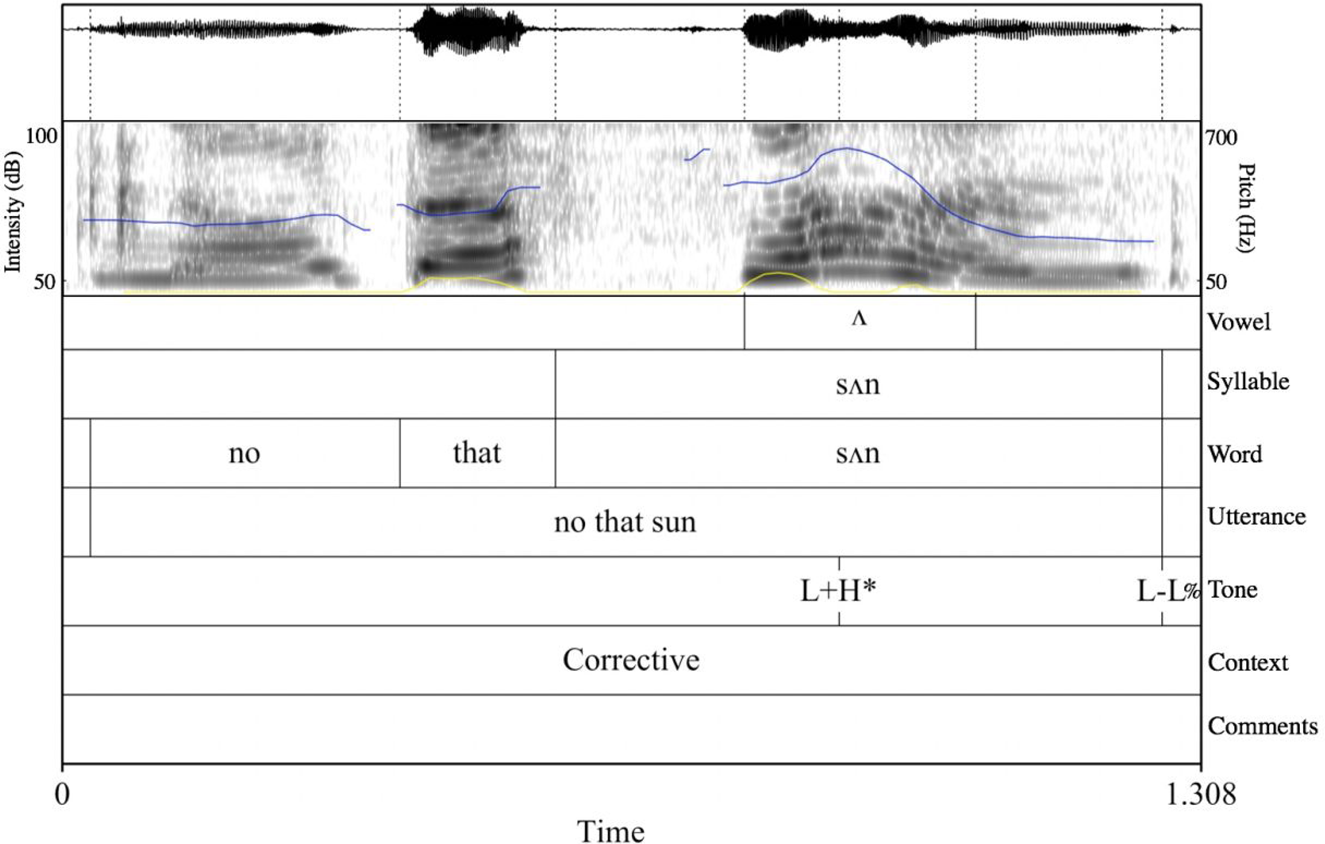
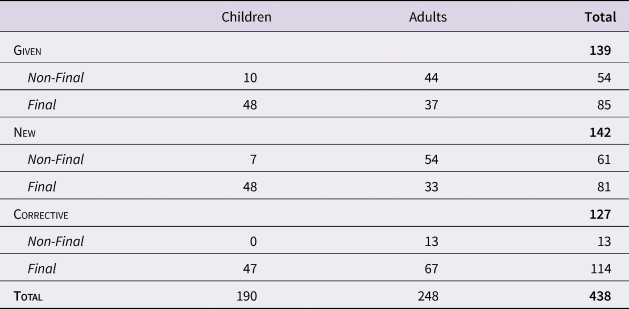
Both phonological and acoustic analyses of the productions elicited during the task were conducted. Each target word mention was categorized by information status category (new, given, corrective) according to the criteria described above. Category membership was determined from the original recordings of the full interaction, since discourse information is required to identify category membership. All utterances containing a target mention were excised for analysis. Only target items that occurred in utterances of two or more words were used in the analysis, because deaccentuation is not possible in a one-word utterance. Target items that occurred in one-word utterances made up 16% of the original child data set and 18% of the adult. As noted, given referents not recently mentioned were also not included for analysis; these included 91 instances in the adult data and 120 in the child data. The final totals for inclusion were 190 target items for the children and 248 target items for the adults (438 total). Target words were further broken down by whether they occurred in utterance-final position (Table 2). Adult and child data were analyzed separately following the same method. See Figure 2 for an example utterance in Praat with seven tiers of analysis.
Praat waveform, spectrogram, and textgid of the target utterance ‘No that sun,’ target underlined. Tiers depict target vowels, target syllables, words, utterance, tone, information status (context), and transcriber comments.

Summary of participant data totals separated by group (children, adults), information status category (given, new, corrective), and utterance position of target word (non-final, final).

Phonological analysis and reliability
Target words were phonologically labeled following the ToBI transcription system guidelines for Mainstream American English (MAE_ToBI; Beckman & Ayers, Reference Beckman and Ayers1997; Brugos et al., Reference Brugos, Veilleux and Shattuck-Hufnagel2006). In this system, target words either receive a pitch accent label (accentuation: H*, L+H*, etc.) or are not labeled as pitch accented (deaccentuation). There were 20 instances of the downstepped H* (!H*) for adults and 19 for children. This downstepped variety was collapsed into the H* category for the phonological analysis, and removed for the acoustic analysis due to possible differences in acoustic realizations between the two types. An experienced transcriber of MAE_ToBI analyzed all of the utterances in the manner described. In addition, a second trained transcriber independently analyzed 15% of the data. Although the two transcribers were able to refer to the entire utterance to select the pitch accent (not solely the word in isolation), they analyzed each utterance independently and did not receive further contextual information that might bias them towards a particular pitch accent. Cohen's κ was used to assess agreement between the transcribers’ judgments of pitch accent type. There was high agreement (85% overall) between the two transcribers’ judgments, κ = .707, p < .001. Pitch accent frequencies and distributions for each information status category were calculated and compared across groups.
For statistical analyses, pitch accent responses were converted into binary responses (yes or no) for each of the primary pitch accent types (deaccentuation, H*, L+H*) and for each information status category (new, given, corrective). Analyses were run for each pitch accent type separately. Generalized estimating equations (GEE) were used to analyze differences in the between-subjects variable of group (children, adults) and the within-subjects variable of information status category (Hardin & Hilbe, Reference Hardin and Hilbe2002). GEEs are used to estimate the parameters of a generalized linear model when it is unknown if there are correlations between outcomes (Hardin & Hilbe, Reference Hardin and Hilbe2002). This type of analysis was selected since it allows for correlated, repeated measures of dichotomous dependent variables, permits missing data, and is robust to cells with unequal sample sizes. In addition, GEEs fit marginal models (population-average estimates versus subject-specific). Since our research questions seek to identify group differences between children and adults, this type of model more closely aligns with our hypotheses.
Working correlation matrices were selected using a priori assumptions and evaluation of the Quasi-Likelihood under Independence Model Criterion (QIC). Each GEE model converged (deaccentuation, H*, and L+H*). The models specified logit for the link function and a binomial distribution. A random intercept was used to allow for unique intercepts for each participant. Unstructured working correlation matrices were first selected, since they are the most conservative, efficient, and make no assumptions. Since the unstructured matrix can sometimes be too conservative, independent working correlation matrices were also considered. Goodness of fit was then assessed using QIC, where smaller is better. The QIC was used to determine the preferable working correlation matrix for each analysis. An independent working correlation matrix was shown to be better than an unstructured one for the deaccentuation (QIC of 219.76 vs. 232.61) and H* models (QIC of 495.65 vs. 608.28). For the L+H* model, an unstructured working correlation matrix produced the best fit with a QIC of 321.44 (vs. 328.69 for an independent working correlation matrix).
Acoustic analysis
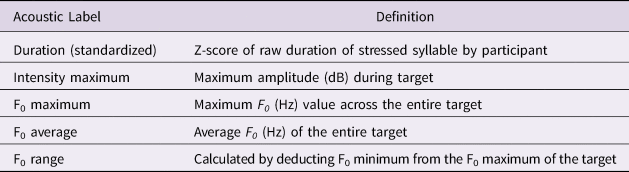
Five variables were measured to test the acoustic realizations of the observed phonological pitch accent categories, including duration (standardized z-scores), maximum intensity, maximum F0, average F0 and F0 range (Table 3). The values for each of these measurements were extracted from the stressed syllable of each target word analyzed. For duration, we extracted and then converted raw durations to a normalized unit (via z-score), and then measured the mean standardized stressed syllable duration for each target word. For example, a high score on this measure would reflect that the stressed syllables that occurred in the target words were on average longer relative to comparable stressed syllables that appeared in other target words spoken by the same speaker. For pitch, because the Hertz scale is linear and does not directly map onto the perception of pitch, F0 values were converted from Hertz (Hz) to a psycho-acoustic scale (semitones, ST) using 1 Hz as the reference category. Converting to a logarithmic scale like semitones ensures that the scale corresponds to equal perceptual intervals and better represents pitch perception. This conversion also aids in alleviating some of the inherent acoustic differences between individuals due to size, sex, and age.
List of acoustic measurements taken for each target stressed syllable.

Acoustic analyses were conducted separately on the utterance-final target tokens, to control for any effects of phrase final lengthening and the fact that there were significantly more utterance-final tokens for the child participants. Two sets of mixed ANOVAs were conducted for each of the acoustic variables: information status category as a within-subjects variable with three levels (given, new, corrective), and pitch accent (PA) type as a within-subjects variable with three levels (H*, L+H*, deaccented). Age group (adults, children) served as a between-subjects variable in both analyses.
Results and discussion
Phonological results and discussion
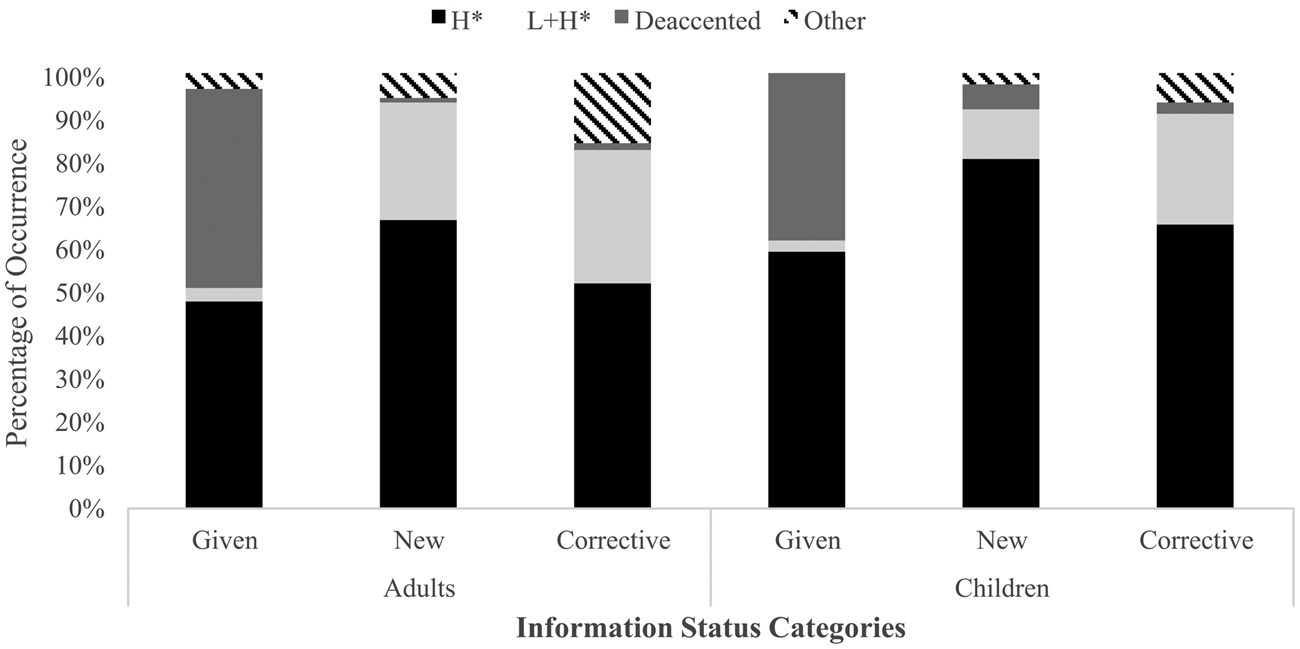
Pitch accent frequency and distribution were calculated for each information status category for the adult and toddler participants separately. Figure 3 shows the percentage for each pitch accent that occurred during the task for the three categories of given, new, and corrective for the adults and toddlers. In the adult data, the H* pitch accent was the most frequently used to express new information, representing 66% of the data. The second most frequent type was the L+H* pitch accent with 27% of the data. For the corrective information, H* made up 51% and L+H* made up 31%. Roughly half of the given items were deaccented (49%), but 51% were accented and labeled with H*. Several other pitch accents were recorded for each of the information status categories (e.g., L* and H*+L), with frequencies not exceeding 6% for the given and new categories. These other types did occur more frequently for the corrective category, representing 16% of the total.
Percentage of occurrence of each pitch accent type for the three information status categories for the adult and child groups.

In the toddler data, the H* pitch accent was used for 80% of new information. For the remaining new information, L+H* made up 11% and deaccentuation made up 6% of the category. For the corrective category, the H* pitch accent represented 65% and L+H* represented 26%. For the given category, 39% of the targets were deaccented, 59% carried an H*, and 2% carried an L+H*. The other pitch accent types (for the toddlers, only L*) made up only 2% of the new information, 7% of the corrective information, and none of the given information.
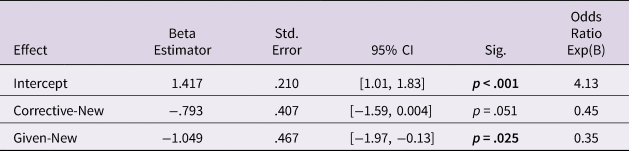
As described above, statistical analyses were run to determine if there were any significant differences in the patterns of phonological results between information status categories and child and adult groups. First, a GEE analysis was conducted for the response variable of deaccentuation across the two independent variables. Table 4 shows the significant parameters from the deaccentuation GEE analysis. There was only a significant model effect for information status category (Wald χ 2(2) = 56.534, p < .001). It was more likely for a given stimulus item to be produced as deaccented across groups, and the odds were almost 10 times greater for an item to be deaccented if it was given rather than new (Odds Ratio (OR) = 9.67). The effect of age group was not significant (Wald χ 2(1) = 0.286, p = .593) nor was the interaction (Wald χ 2(2) = 2.430, p = .297). This reflects the finding that deaccentuation was primarily observed in the given condition for both children and adults.
Significant parameters for Deaccentuation Model.

Notes: Statistically significant statistics are in bold.
The significant parameters for the H* GEE analysis are shown in Table 5. Like the deaccentuation model, the H* GEE analysis also showed a significant effect of information status category (Wald χ 2(2) = 11.578, p = .003). A stimulus item was more likely to be produced with an H* pitch accent when produced in the new category than when produced in the corrective or given categories. This is reflected in both the adult and child data, where it is evident that both groups typically use an H* pitch accent to express new material. Neither the effect of age group nor the interaction was significant (Wald χ 2(1) = 2.699, p = .100 and Wald χ 2(2) = 0.123, p = .940, respectively). Visible in Figure 3, the pattern of H* responses is similar across the two groups, with children producing H* more on average for each category. All six of the adults demonstrated a pattern of a mixture of accenting and deaccenting given information.
Significant parameters for H* Model.

Notes: Statistically significant statistics are in bold.
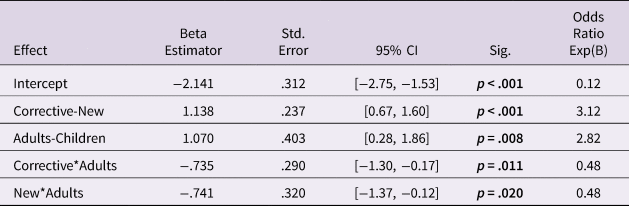
Finally, for the L+H* model, effects of information status category and age group were both significant (Wald χ 2(2) = 83.346, p < .001 and Wald χ 2(1) = 4.095, p = .043, respectively). The interaction of information status by age group was also significant (Wald χ 2(2) = 9.964, p = .011). Table 6 shows the significant parameters for the L+H* GEE analysis. For information status category, participants were three times as likely to produce an L+H* pitch accent for a corrective category item versus a new item across participants. This effect is most likely driven by the child participants using less of the L+H* accent than the adults to express new information. Overall, adults are also two times more likely to produce L+H* than the child participants. The significant interaction parameter shows that there is a difference between adults and children for at least one category. Pairwise comparisons for the interaction reveal that adults used the L+H* significantly more often than children for new information (mean difference (M) = .15, 95% CI [.04, .26], p = .008), and that there were no significant differences between adults and children in their L+H* usage for the given or corrective categories (M = .02, 95% CI [−.02, .07], p = .320; M = .07, 95% CI [−.02, .16] p = .130, respectively).
Significant parameters for L+H* Model.

Notes: Statistically significant statistics are in bold.
A critical aspect of the phonological results is that they show that both participant groups display preferences for particular pitch accents across information status categories. Deaccentuation and the H* pitch accent are both used for the given category, H* is the primary choice for the new category, and both L+H* and H* are chosen for the corrective category. In the case of L+H*, adults used this pitch accent more often than children did, particularly when expressing new information. Importantly and in line with findings from de Ruiter (Reference de Ruiter2014), this pattern of responses highlights the variability of pitch accent selection in a spontaneous speech task, and illustrates that there is unlikely to be a one-to-one correspondence between information status category and pitch accent type. In line with related work in German, toddlers followed the adult pattern for many of the information status categories (Grünloh et al., Reference Grünloh, Lieven and Tomasello2015). Even though the toddlers show an ability to vary their pitch accent selection and produce a range of types, they displayed an overall preference for the H* pitch accent across information status categories, which also closely mirrors findings by Grünloh et al. (Reference Grünloh, Lieven and Tomasello2015).
Acoustic results and discussion
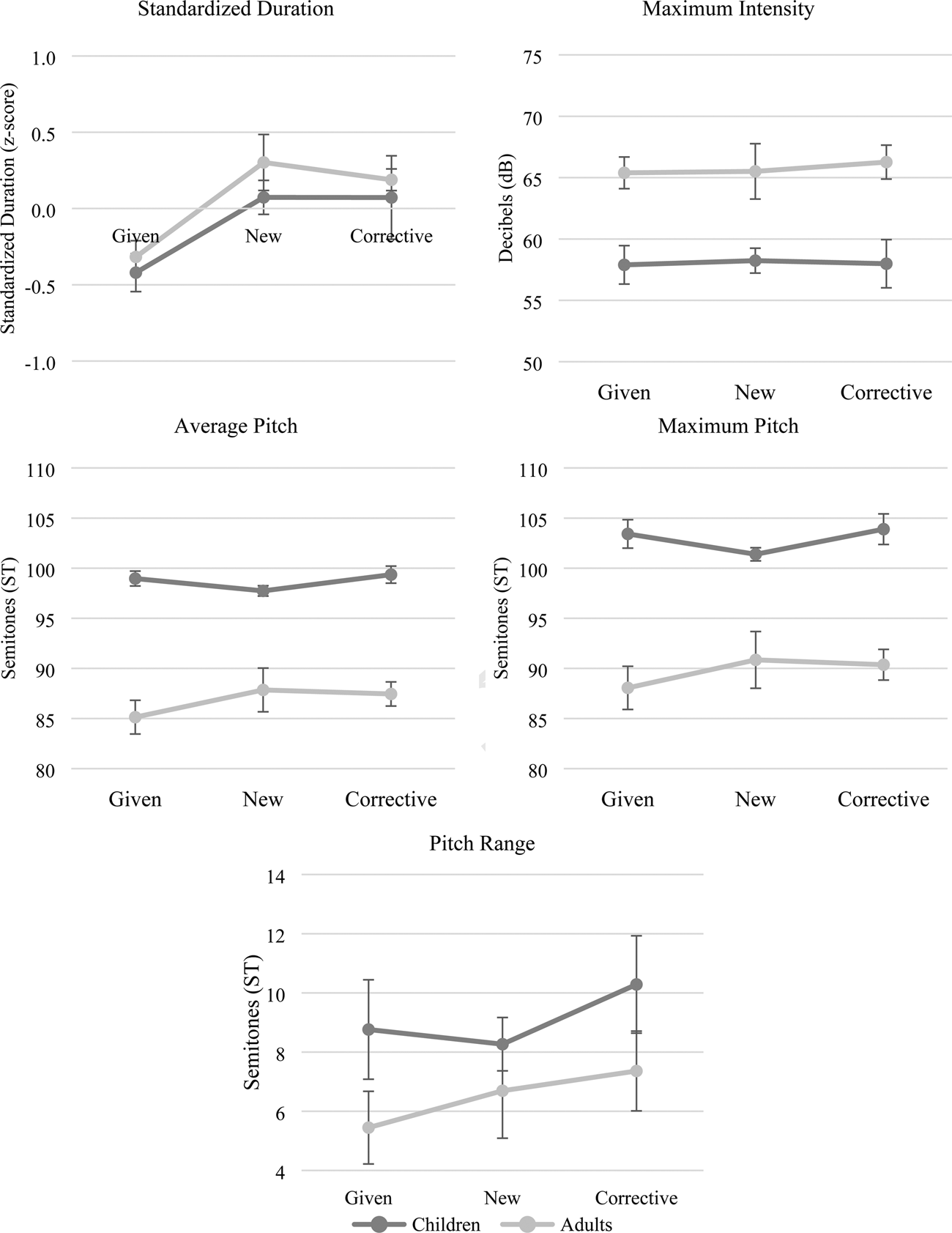
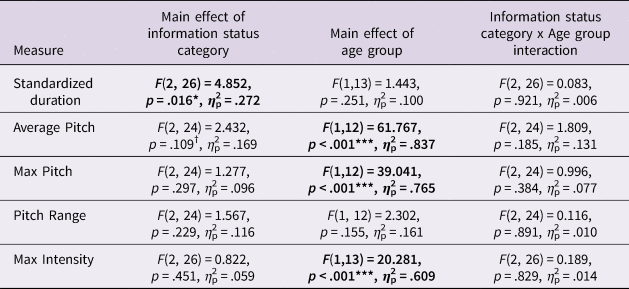
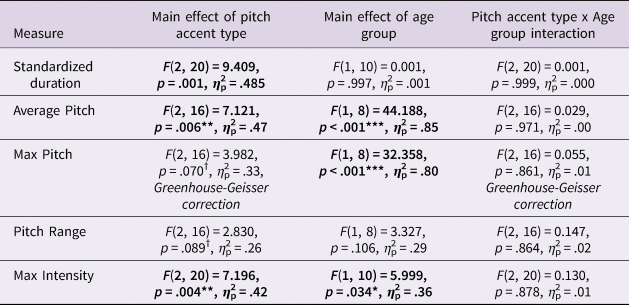
The first set of analyses examined if there were any differences in the primary acoustic correlates of information status category (new, given, corrective) for target words in utterance-final position. Because the children tested were producing only short utterances, few targets appeared in non-final position (Table 2). The five acoustic correlates analyzed were standardized duration, average pitch (ST), maximum pitch (ST), pitch range (ST), and maximum intensity (dB). Figure 4 shows line graphs of the means and standard errors of each group for each acoustic correlate analyzed by information status category. Mixed ANOVAs were run for each acoustic variable to reveal any group differences in information status production (Table 7). For any significant main effects, pairwise comparisons were run and reported with Bonferroni-adjusted 95% confidence intervals and p-values.
Group means for standardized duration (top left), maximum intensity (top right), average pitch (ST) (middle left), maximum pitch (ST) (middle right), and pitch range (ST) (bottom) for each information status category. Error bars show standard error, light gray lines represent adults, and dark grey lines represent children.

Mixed ANOVA results for information status categories (utterance-final tokens only).

Notes: †p ⩽ .10; * p < .05, ** p < .01; *** p < .001. Statistically significant statistics are in bold.
Importantly, toddlers and adults used a range of stimulus words (and thus vowels that varied by length) for each category analyzed, limiting a possible bias of syllable type (open vs. closed) and vowel length on durational measures. For the standardized duration values, the unweighted marginal means for the given, new, and corrective categories were −.36 (SE = .100), .21 (SE = .102), and .07 (SE = .178), respectively. The new category was 0.57, 95% CI [0.13, 1.02], significantly greater than the given category (p = .011). The corrective category approached statistical significance for being longer than the given category with a mean difference score of 0.43, 95% CI [−0.04, 0.90], p = .075. The difference between the new and corrective categories was not significant (M = 0.15, p = .100).
The children exhibited overall higher average (M = 11.99 ST, 95% CI [8.67, 15.31]) and maximum pitch values (M = 13.08 ST, 95% CI [8.52, 17.64]) than the adults, reflecting the generally higher pitch levels found in children over adults. Pitch range did not reveal any information status or age group differences. For maximum intensity, the adults exhibited higher values than the toddlers with a mean difference of 7.51 dB, 95% CI [3.91, 11.12]. Overall, the children mirrored adult productions for each of the five acoustic measures, but only duration showed statistically significant differences across information status categories.
Since there were varying types of pitch accents found for the different information status categories, a secondary analysis of the acoustic measures of the most frequent pitch accent type for each information status category was performed. As with the information status category analysis, these acoustic analyses were conducted on the utterance-final tokens. This led to a comparison of H*, L+H*, and deaccented target word productions across adult and child groups. Figure 5 shows line graphs of the means and standard errors of each group for each acoustic correlate analyzed by pitch accent type. Mixed ANOVAs were run for each acoustic variable to examine if any group differences exist between pitch accent types (Table 8). All post hoc pairwise comparisons are presented with Bonferroni adjustments. For standardized duration, L+H* was significantly longer than both H* (M = 0.84, 95% CI [0.04, 1.64], p = .040) and deaccented tokens (M = 1.13, 95% CI [0.19, 2.06], p = .018). The H* pitch accent was not significantly longer in duration than the deaccented ones (M = 0.29, 95% CI [−0.24, 0.82], p = .441).
Group means for standardized duration (top left), maximum intensity (top right), average pitch (ST) (middle left), maximum pitch (ST) (middle right), and pitch range (ST) (bottom) for each pitch accent. Error bars show standard error, light gray lines represent adults, and dark grey lines represent children.

Mixed ANOVA results for pitch accent type (utterance-final tokens only).

Notes: †p ⩽ .10; * p < .05, ** p < .01; *** p < .001. Statistically significant statistics are in bold.
For average pitch, L+H* had significantly higher average pitch than both the H* (M = 3.19, 95% CI [0.98, 5.40], p = .007) and deaccented tokens (M = 5.39, 95% CI [0.18, 10.57], p = .043), but H* was not significantly higher than the deaccented ones (M = 2.19, 95% CI [−2.73, 7.11], p = .649). For age group differences, child productions were on average 11.51 semitones higher than adult productions (95% CI [7.52, 15.50], p < .001).
For maximum pitch, children exhibited average values 12.59 semitones higher than the adults (95% CI [7.49, 17.69], p < .001). The main effect of pitch accent type approached but did not reach significance for both maximum pitch and pitch range (Table 8). Pitch range did not exhibit any other statistically significant differences between pitch accent types. Lastly, results for the maximum intensity of the different pitch accents showed that L+H* tokens were on average 6.28 decibels louder than deaccented ones (95% CI [1.29, 11.28], p = .014). The difference between the H* and L+H* (M = 2.76, 95% CI [−1.33, 6.84], p = .244) and the H* and the deaccented tokens (M = 3.53, 95% CI [−1.62, 8.67], p = .233) did not reach significance. Additionally, adult productions were on average 8.00 decibels louder than child productions (95% CI [0.72, 15.28], p = .034). As with the information status category analysis, the children and adults followed similar overall patterns in the acoustic measures between pitch accent types.
General discussion
In the current study, we explored how adults and toddlers at age 2;6 intonationally signal the information status categories of new, given, and corrective when referring to referents in a live discourse setting. During this natural and spontaneous speech task, adults and toddlers produced a set of target nouns that were coded for both their information status and their pitch accent type. Additionally, the primary acoustic correlates of the most frequent pitch accents were analyzed. There were three primary aims and hypotheses, with the overall objective to both phonologically and acoustically investigate the prosody of information status in mature and developing English.
The first aim was to establish a baseline by analyzing how adults phonologically represent the three information status categories. We hypothesized that adults would phonologically differentiate the three categories with H* used primarily for new information, H* and L+H* for corrective information, and deaccentuation for given information (although likely not all of the time based on previous research). Our hypothesis was largely upheld, though with a couple of deviations. Adults showed a preference for the H* pitch accent for new material, but they also used L+H*. This may have been partially a residual effect of the task, where the adults may have had similar prosodic contours due to its more repetitive nature. For corrective information, adults used H* and L+H* as predicted, but not to an equal degree (51% and 31%, respectively). This pattern was similar to what they showed for new information. For the given category, adults deaccented in about half of the productions. This pattern resembles previous data where adults may in fact choose to accent given material due to factors such as a change in syntactic role and discourse saliency (Dahan et al., Reference Dahan, Tanenhaus and Chambers2002; Hirschberg, Reference Hirschberg1993; Terken & Hirschberg, Reference Terken and Hirschberg1994). Thus, one possible reason for why adults show a pattern of accenting given material is that there likely exists a more complex interaction between givenness and accentuation than suggested by initial explanations in the field (Wagner & Watson, Reference Wagner and Watson2010).
As discussed in the introduction, this pattern of less deaccentuation of given information has also been shown for English and German CDS. Grünloh et al. (Reference Grünloh, Lieven and Tomasello2015) showed that German-speaking adults deaccent to a lesser degree when using CDS and that this pattern was reflected in child productions. This is in line with previous research from Bortfeld and Morgan (Reference Bortfeld and Morgan2010) that reported less deaccentuation of repeated noun phrases in English CDS. As a consequence, English-acquiring children may be receiving CDS and ADS inputs that do not consistently deaccent given information.
The second aim was to investigate how toddlers at age 2;6 prosodically mark information status in comparison to the adult population. We hypothesized that toddlers would reflect adult phonological patterns for information status marking. However, children showed an overall tendency to accent all three categories, primarily employing the H* pitch accent – a pattern also observed in German-acquiring children at a similar age (Grünloh et al., Reference Grünloh, Lieven and Tomasello2015). In comparison to adults who used both H* and L+H*, the H* pitch accent was the most commonly used pitch accent for both new and corrective information by toddlers. In line with past research on adult production and comprehension patterns, children reserved the L+H* pitch accent almost exclusively for corrective information (Pierrehumbert & Hirschberg, Reference Pierrehumbert and Hirschberg1990; Watson et al., Reference Watson, Tanenhaus and Gunlogson2008b). Deaccentuation occurred more frequently for given information than for the new or corrective categories, supporting the claim that given referents are typically less acoustically prominent overall, but that they are not necessarily always deaccented (Hirschberg, Reference Hirschberg1993; Wagner & Watson, Reference Wagner and Watson2010). Similar to the adults, children accented given information in a majority of their utterances. Limited deaccentuation by toddlers may reflect the adult input pattern, but it may also be due in part to immature abilities in controlling prosody.
Under one account, early child speech contains more accented words in general. It has been reported that early two-word combinations may consist of two accented elements (Behrens & Gut, Reference Behrens and Gut2005; Chen & Fikkert, Reference Chen and Fikkert2007), and that children may lack the ability to deaccent due to the more complex articulatory control necessary in two-word combinations (Bolinger, Reference Bolinger1983; Gussenhoven, Reference Gussenhoven2002). Later work by Chen (Reference Chen2011) amended this argument for Dutch and proposed that children downstep their topics, but that they may be unable to fully deaccent due to a developing vocal system. Alternatively, toddlers may mimic the patterns that they hear in the input. Following recent findings from English and German, an increased pattern of accentuation of given material may be attributed to a reflection of what children hear from ADS and CDS (Bortfeld & Morgan, Reference Bortfeld and Morgan2010; Grünloh et al., Reference Grünloh, Lieven and Tomasello2015; Hirschberg, Reference Hirschberg1993). Bortfeld and Morgan (Reference Bortfeld and Morgan2010) showed that adults alternate accentual patterns of repeated mentions of a word, demonstrating less acoustic reduction in CDS than in ADS. They proposed that this type of accentual pattern is useful for calling attention to certain elements in a context, aiding in early word recognition and learning. It is possible that toddlers in the current study are reproducing patterns from their input. Since the toddlers use deaccentuation at a similar rate as accentuation for the given cases, it is unlikely that this trend is due solely to articulatory limitations. Grünloh et al. (Reference Grünloh, Lieven and Tomasello2015) further supports this hypothesis by showing that German-acquiring children at 2;6 and 3;0 exhibit deaccentuation patterns found in German CDS. In the current study, the phonological analyses show the use of the H* and L+H* pitch accents in addition to deaccentuation as the primary accent types to represent the three information status categories. Importantly, and as reported in German child and adult productions by de Ruiter (Reference de Ruiter2014), there was no one pitch accent type used to solely express one information status category. Previous studies have classified information structure and status categories along different sets of criteria, which may begin to pull apart further differences in context.
Studies vary in how they classify information status and how variability in deaccenting occurs cross-linguistically. Herbst (Reference Herbst2007) acoustically and phonologically labeled the productions of German-acquiring five-year-olds. This study analyzed productions of referents of different information statuses (new, given, accessible-immediate, and accessible-distant), showing that the new and accessible-distant referents carried a pitch accent in a majority of cases. In contrast, the given and accessible-immediate conditions were accented less frequently, demonstrating that by age five children are able to intonationally discriminate new from given information. De Ruiter (Reference de Ruiter2014) further noted that German child production patterns reflect that of adults’ unscripted speech, and that while they both tend to deaccent given information, it is not required. Dutch four- and five-year-olds were also shown to be able to mark information structure (topic and focus), even though they were not yet able to exhibit complete adult-like control for the specific pitch accent type (Chen, Reference Chen2010, Reference Chen2011). Children in the current study similarly distinguish the three information status categories, but they are not yet completely adult-like in their phonological productions.
Grünloh et al. (Reference Grünloh, Lieven and Tomasello2015) concluded that three factors may influence child markings of information status in German: intonational input, motor control, and cognitive factors. The first two of these have been discussed, but in addition, cognitive factors such as referent accessibility and understanding intention may also come into play. Most likely, a combination of these factors affects early prosodic patterns with more research needed to tease these apart in German, English, and other languages.
Our final aim concerned how toddlers and adults compare in the acoustic correlates of prosody, analyzing standardized duration, average pitch, maximum pitch, pitch range, and maximum intensity across information status categories and pitch accent types. We predicted that both groups would use at least one of these cues to differentiate information status categories (Breen et al., Reference Breen, Fedorenko, Wagner and Gibson2010; Wonnacott & Watson, Reference Wonnacott and Watson2008). Of the five acoustic measures analyzed, only duration significantly differentiated some of the information status categories. Specifically, new information was significantly longer than given information, and corrective information tended to be longer than given information for both groups. However, duration did not distinguish new from corrective. Important to note is that this analysis collapsed all pitch accent types into each information status category during the analysis, potentially washing out significant differences between categories. For example, the given category had roughly half accented tokens and half deaccented tokens.
In comparison to previous work, the current study showed that duration was the only acoustic measure that partially distinguished information status. Wonnacott and Watson (Reference Wonnacott and Watson2008) found that pitch range and intensity, but not duration, reliably differentiated given from accessible contrastive referents, but not given from new, for English-speaking four-year-olds. In the adult literature, the acoustic correlates that have been shown to differentiate contrastively focused information are duration, intensity, and mean and maximum F0 (Breen et al., Reference Breen, Fedorenko, Wagner and Gibson2010). One interpretation of the current data in reference to the adult research is that children aged 2;6 are able to use duration distinctively for these information status categories while the other correlates of pitch and intensity continue to develop. Differences in how studies break up information categories and how they collect data (e.g., spontaneous versus elicited) may contribute to this variation in results in the adult literature as well. For example, data from theme/rheme analyses in New Zealand English have claimed that relative prominence – specifically peak F0 – and not pitch accent type is the distinguishing factor, arguing for the importance of analyzing phonetic realizations alongside phonological ones (Calhoun, Reference Calhoun2012). Additionally, as Chen (Reference Chen, Serratrice and Allen2015) points out, it is critical to analyze the phonetic realizations of pitch accents due to possible differences in how these labels are assigned between coders and studies.
In an effort to reveal differences in how children and adults phonologically realized pitch accent types, part of aim three was to conduct an acoustic-phonetic analysis of the most frequent pitch accents. As predicted, the vast majority of pitch accents produced were H* and L+H*, as well as deaccentuation. Duration, average pitch, and maximum intensity were each found to differentiate at least one contrast between deaccented, H*, and L+H* tokens (maximum pitch and pitch range both approached, but did not reach, significance). Overall, the deaccented tokens were shorter and had lower average pitch values than the L+H* but not the H* tokens. In addition, L+H* tokens were overall louder than the deaccented tokens, but not the H* ones. The L+H* and H* tokens were also differentiated by duration and average pitch, with the L+H* tokens exhibiting longer duration and higher average pitch. These results demonstrate that the two acoustic cues of duration and average pitch were best at differentiating pitch accents in these populations. None of the five acoustic measures reliably differentiated deaccented from H* tokens. Overall, child and adult productions of the three pitch accent types were comparable.
A strength and limitation of the dataset was the spontaneous nature of the task. While this task allows more naturalistic data to be observed, it also introduces variability due to its less controlled nature. For the current study, the advantage of analyzing prosody that most closely conveyed a realistic setting outweighed these other factors. Future work may trade the spontaneous nature of the task in order to introduce increased control over the stimuli. Other limitations related to the spontaneity of the task include unequal sample sizes in each information status category and an acoustic analysis limited to utterance-final tokens.
Conclusions
In summary, this study analyzed the early prosodic abilities of toddlers in comparison to adults, incorporating phonological and acoustic analyses of spontaneous speech. Patterns show no clear one-to-one correspondence between information status category and pitch accent type, yet preferences for particular pitch accents were observed for the different information statuses. Overall, while children displayed a preference for the H* pitch accent across categories, the majority of their deaccented tokens were produced for given information and L+H* for corrective information. Both adults and children accented given information to a certain degree, demonstrating that given information does not need to be deaccented as earlier accounts had maintained. Instead, prominence patterns may play a role, as well as factors such as accessibility of the referent. Additionally, this study showed that toddlers at age 2;6 behave similarly to adults in the phonetic realizations of both information status category and pitch accent production. Duration was found to be the primary cue for information status category membership, and duration, average pitch, and intensity for differentiating pitch accent type for both groups.
Using a more ecologically valid speech sample enables observation of the impressive abilities of toddlers learning the prosodic system of their native language. Future research should explore the realization of other information status categories and pitch accent types while continuing to consider the critical role of methodological choice in prosodic data collection. Importantly, the relationship between prosody and information status should continue to be explored in CDS and ADS across languages in order to observe what patterns are present in the input to young children.
Supplementary Material
For supplementary material accompanying this paper, visit http://dx.doi.org/10.1017/S0305000920000434
Acknowledgements
The authors would like to thank the anonymous reviewers whose comments improved this manuscript. Special thanks to the participants and their families. Thank you also to Laura Kertz, Pilar Prieto, Lori Rolfe, Emily Davis, Glenda Molina-Onario, and the Metcalf Infant Research Lab at Brown University. Additional thanks to Stefanie Shattuck-Hufnagel and Rachel Burdin who provided feedback on earlier versions of this paper. Data collected at Brown University supported by NIH grant R01HD068501 awarded to Dr. James L. Morgan.