1. Introduction
According to Paul Horwich (Reference Horwich and Savitt1995; Reference Horwich1987, chapter 7) even if our universe had a spacetime structure containing a closed time-like curve, on which we live, we still should not expect time travel into the local past because that would involve improbable, inexplicable coincidences such as those between attempts to shoot one's grandfather and the existence of factors which frustrate such attempts. Nick Smith (Reference Smith1997) rejects this claim for two reasons: first because arguments which derive time traveling coincidences do so only because they assume similar coincidences, and second given the de facto nature of the uniform lack of such coincidences in our region of the universe, to expect no such coincidences on the grounds that we haven't seen any falls foul of problems of projectibility (i.e., the generalization of correlations which hold in our experience). I argue (Section 4) that Smith is mistaken about the first point, but (Section 5) right about the second. I consider a possible response on the part of Horwich (Section 6), and show why that fails (Section 7). The reason is particularly instructive, for I show that in fact the coincidences of time travel are not inexplicable in the relevant sense. I therefore conclude that if the account of the explanation of coincidences implicit in Horwich's argument—essentially a Reichenbachian account—is complete then there is nothing about time travel that cannot be explained satisfactorily.Footnote 1
2. Horwich's Argument against Time-Travel
A common argument against time-travel runs like this. If time travel is possible then contradictions of the following sort are possible: you could shoot your grandfather before your father was conceived, a state of affairs which entails both (1) that your father was not conceived (because grandfather is dead) and (2) that your father was conceived (because you are there) (Horwich Reference Horwich1987, 117). Horwich rejects this argument on the grounds that it presumes that any causal chain in an open timelike line can also be located on a closed timelike curve, which is false: a causal chain must satisfy consistency conditions imposed by its surroundings. (118–119) In fact time travel is possible, but if it occurs then for whatever reason attempts to kill one's grandfather will always fail.
In its place Horwich offers the following argument:
Suppose [time travelers] try over and over again to commit autoinfanticide. On every attempt something happens to frustrate their plans—guns are constantly jamming, poisons spilling, etc. but there is no causal connection between decisions to commit autoinfanticide and the guns’ jamming so often. Neither one causes the other, nor is there any common cause. Thus Gödelian time travel would imply massive (indeed, limitlessly extendable) coincidence: a phenomenon we know from experience to be absent from our world. We can infer, therefore, that Gödelian time travel will not take place. (Horwich Reference Horwich and Savitt1995, 263)
Horwich's argument is that since time travel into the local past will lead to improbable coincidences, we should expect time travel into the local past to be rare or non-existent (see also Horwich Reference Horwich1987, 93–99, 122–124). Horwich argues further that if we are in a Gödel spacetime (one kind of spacetime that allows closed time-like curves), then, since Gödel spacetime permits time travel into the local pastFootnote 2, we would need to explain why time travel is rare or non-existent. He claims that the reason may not be that Gödel spacetime is impossible, it may be for more mundane reasons, such as the fact that it would require more fuel than is technologically possible (1987, 122). This wouldn't rule out time travel into the nonlocal past, where in fact such coincidences would not arise.
The crucial concept in Horwich's argument, that of an ‘improbable coincidence’, is explicated as a set of events with a certain statistical structure of a sort which we do not observe in our world. In fact Horwich follows a roughly Reichenbachian program of explanation (Reichenbach Reference Reichenbach1956), as follows.
First, the Principle of V-Correlation (Horwich Reference Horwich1987, 97) states that if there is a correlation between two events of types A, B respectively such that
(i) P(A.B) > P(A)P(B)
then unless there is a direct causal connection between A and B
(ii) there is an event C which “screens off” the correlation, i.e., such that P(A.B|C) = P(A|C)P(B|C)
and
(iii) C occurs before A and B.
Here and throughout this paper such probabilities may be taken as relative frequencies. A “direct” causal connection would be where A caused B or vice versa; which, supposing causation to be transitive, entails that if A causes C and C causes B, then A is a direct cause of B. Thus a direct causal connection is in contradistinction to the kind of causal connection which obtains between A and B in virtue of the fact that A and B have a common cause or effect. (In other words, we do not mean “direct” in the alternative sense of “has no intermediate causes.”)
The Principle of V-Correlation has the status of contingent fact, as a matter of fact in our world it is extremely rare that correlations such as (i) are screened off by a later event, unless there is also an earlier event, which also screens it off. Patterns of events A, B, C which fit (i)—(ii) but where C occurs after A and B must therefore be deemed “improbable”. This is Horwich's sense of “improbable” in his claim “time travel into the local past will lead to improbable coincidences.”
Second, the Principle of Causal Correlation (Horwich Reference Horwich1987, 97) says that correlations such as in (i) always admit of a causal explanation. For example, what enables C to explain the correlation between A and B is that C is the common cause of A and B. (Alternative possible causal explanations of the correlation are that A causes B and that B causes A.) If a correlation has no causal explanation it may be called “inexplicable”. This would also make it a coincidence on one standard way of understanding that term (Owens Reference Owens1992). We do not expect inexplicable coincidences in our world, according to the Reichenbachian program.
For the purposes of this paper we shall make no assumptions about what causation is, and therefore we cannot comment on the connection between Horwich's two principles. On some probabilistic theories of causation the past screening off event will be by definition the cause. Horwich himself, who takes causation to be “basic nomological determination”, says that the Principle of V-Correlation together with the Humean assumption of priority (causes are earlier in time to their effects) gives the Principle of Causal Correlation. However, we can leave this question aside.
So, to summarise the Reichenbachian account of explanation: to explain a correlation between two events not explained by a direct causal connection, one firstly looks for a past event which screens off the correlation. One then must identify this event as the common cause of the two correlated events to complete the explanation. Throughout this paper I will use the label “Reichenbachian program”Footnote 3 to refer to this approach.
For example, suppose a time traveler attempts to shoot his paternal grandfather before the conception of his (the time traveler's) father. Then something will happen to prevent this—perhaps he slips on a banana skin or his gun jams or some such thing. This can plausibly happen once, of course, but it's when we have numerous attempts at impossible events that things seem particularly strange. Many repeated attempted grandpatricide will involve inexplicable improbable coincidences, Horwich claims, namely the correlation between such attempts (A) and the existence of fortuitously placed banana skins (B) or the like. The set of events A, B and C (the attempt fails) is an improbable coincidence, since although it fits (i) and (ii), C, a common effect, occurs after A and B. Call a correlation between A and B in such circumstances a “Horwich-coincidence”.
In Section 3 we turn to a detailed example, and in Sections 4 and 5 to Smith's objections to Horwich's argument.
3. Sexual Cloning
In this section I will consider a detailed example which will serve to illustrate some key points to be made later in the paper. Suppose Adam travels back in time 30 years to 1970, where he meets his mother Betty, mates with her and has a child which is himself. Is this possible biologically? Yes, sexual cloning is biologically possible, as follows—if we may call this case “cloning” on the grounds that we have total replication of Adam's genome (Reference Dowe and EvansDowe and Evans unpublished).
In sexual reproduction the father passes on to the offspring one allele for every polymorphous gene site, the other being provided by the mother. For simplicity suppose each gene site contains two alleles, one derived from the father and one from the mother. To clone, the mother has to give the offspring the other allele which the father had but didn't pass on, so that the son ends up with a set which is a completely identical to the father's.

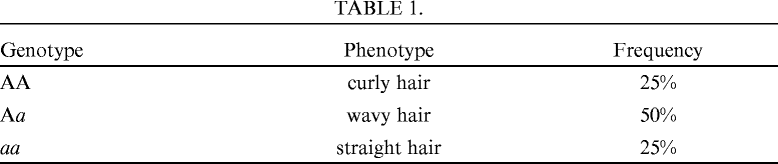
| Genotype | Phenotype | Frequency |
|---|---|---|
| AA | curly hair | 25% |
| Aa | wavy hair | 50% |
| aa | straight hair | 25% |
For example, suppose there is a gene which determines how curly hair is as follows:
Suppose Adam has the AA pair. Then, step one, Betty must have either AA or Aa, with probability 75%. Say she has Aa. Then additionally, step 2, Betty must pass on her A in reproduction, probability 50%, so that young Adam has the AA pair like his father.
If Adam then attempts to do something that didn't happen, such as kill baby Adam, his younger self, we will get a Horwich coincidence—something happens to prevent it. But we don't need attempts to do the impossible, or what doesn't happen. There are remarkable coincidences in this example without such attempts. For cloning to happen, two improbable coincidences are necessary—first the mother must share with the father at least one allele for every gene site, and second, the parents must pass on the right allele at every site. The chance of both steps happening in our example is 37.5%, but, of course for this to happen at every gene site is very improbable. It has been calculated that for the human genome the probability of the first step is 0.77530000; while the probability of the second step is 0.520000 (Reference Dowe and EvansDowe and Evans unpublished).
So, in Adam's case, let A be the fact that the reproducing father has genome i and let B be that Betty has genome j, and such that i and j share at least one allele at every gene site. Then condition (i) holds: P(A.B) > P(A)P(B), since the frequency of this happening amongst male time travelers who are in fact their own fathers is one, yet P(A)P(B) = 0.77530000. Condition (ii) also holds: P(A.B|C) = P(A|C)P(B|C), where C is the fact of Adam being born with genome i. But C occurs after A and B, and there is no event in the past of A and B which screens off (i). So we have a Horwich coincidence.
Or let A be the fact that Adam supplies the set of alleles x and B the fact that Betty supplies set y. Then again, P(A.B) = 1, but in this case P(A)P(B) = 0.520000. Again, P(A.B|C) = P(A|C)P(B|C) where C is the fact of Adam being born with genome i. In particular, if we suppose there are large numbers of people traveling back in time to give birth to themselves, we have a Horwich-coincidence without any attempt to do the impossible.
4. Do Coincidences Assume Coincidences?
Nick Smith has provided a sustained critique of Horwich's argument (Smith Reference Smith1997). In this section and in Section 5 I shall consider two of Smith's arguments, the first of which I reject, but the second of which I think is valid. In Section 6 I will present a proposal for boosting Horwich's argument to avoid this latter argument, but show in section 7 why this does not work.
First, Smith has argued, contra Horwich, that backward time travel does not entail unusual numbers of coincidences:
… backward time travel, in itself, does not entail slips on banana peels and other such coincidences. Rather, each argument which purports to derive such coincidences as output, given backward time travel as input, also uses as input—in addition to backward time travel itself—occurrences which are themselves as rare and apparently improbable as long strings of slips on banana peels… (Smith Reference Smith1997, 381)
To get a correlation between attempts to kill grandfathers and the fortuitous existence of banana skins or the like, Smith claims one must assume that there is a correlation between those with opportunity for time travel into the local past (T) and those who would do what they know is impossible (I). But what an amazing coincidence that such an unusually large number of time travelers reason so fallaciously as to suppose they can do the impossible! (Smith Reference Smith1997, 381–382).
But Smith is mistaken. Suppose there is no correlation between I and T, i.e., that a time traveler is no more likely to think she can do the impossible than is anyone else. So P(I.T) = P(I)P(T) and so P(I|T) = P(I). Suppose P(I) = 0.5. Then perhaps about half of all time travelers attempt to do something like kill their grandfathers before their parents’ conception. Those attempts will be correlated with things like the fortuitous existence of banana skins in just the way Horwich envisages. Therefore you do not need to assume correlations in order to derive correlations.
But perhaps Smith means that since P(I) is very low (there can't be many so crazy as to seriously contemplate doing the impossible), unless there is a correlation between T and I, the chances of getting many attempted grandfather killings is very small, as P(I|T) is very small. Then local time travel may well be frequent, but that won't mean there are many improbable coincidences because there still won't be very many attempts. To get the frequency of attempts necessary to “see” the correlation, you would need a very large number of local time travelers indeed. Therefore Horwich can at most conclude that there will not be a very large number of local time travelers.
This argument assumes P(I|T) is very small. Smith perhaps thinks people are unlikely to be so irrational. Horwich, on the other hand, thinks it is likely people will be curious enough to want to try such things. I will not attempt to adjudicate on these psychological theses. However we should note that we must not confuse Smith's thesis with the psychological thesis that few would want to kill their grandfathers. “A” could just as well be cases of attempts to help one's young grandparents win a lottery they didn't win.
In any case, as we saw in Section 3, there can be Horwich-coincidences even when people don't attempt to do the impossible. Sexual cloning involved two such coincidences. To give another example, suppose a time traveler meets her grandparents, shakes their hands, but doesn't tell them who she is. Then some strange things might happen. Grandfather goes to war as a young man, as yet unmarried, and every time enemies sees him and attempts to shoot, they slip on a banana skin or something. Meeting the time traveling relative (A) is correlated with the existence of such banana skins or the like (B) and is screened off by the attempt's failure (C) according to (i) and (ii), but C occurs after A and B.
So, in general, the Horwich-coincidences that we saw are associated with causal loops such as Adam giving birth to himself do not require Smith-type correlations to get them going. Smith's argument that to derive an improbable correlation you need to assume an improbable correlation seems to be mistaken, so Horwich's argument withstands this criticism. However, Smith has a second argument, which I believe does tell against Horwich's argument.
5. Are Improbable Coincidences to Be Expected?
According to Horwich the fact that we don't see cases where C occurs after A and B (given the statistical correlations in (i) and (ii)), and that time travel would lead to that sort of scenario, is reason enough to expect that time travel into the local past will not occur very often. We should expect that such cases will continue to be absent to just the extent that they have been in our experience.
First, it's worth asking whether it is possible that we have the “improbable” correlations already, because in that case the correlations time travel would bring couldn't even be called “improbable”. We think we do not have the relevant correlations, and so in that sense we do not see them. But is it possible that such exist without our knowledge? We need to ask whether we know on the grounds that we haven't seen them that there haven't been time traveler-induced correlations in our experience. In the case of the correlation between attempts to kill grandfathers and slips on banana skins, the correlation is only “visible” because we have partitioned on the fact that he is a time traveler. If we just take attempted shootings in general, we won't expect a correlation with banana skins. But if unknown to us there were time travelers in our midst, sometimes attempting grandfather shootings, then there would be a correlation between attempts in general and bananas or the like. But unless there were extremely high incidences of time travelers, the effect would be slight, so we probably wouldn't notice it. Without independent evidence of time traveling, we wouldn't notice the correlations it brought. Then it may be that such correlations do already occur, and if so they cannot be called improbable in Horwich's sense.
But let's grant that the correlations are improbable in the way that Horwich says. We can show that this is not grounds for expecting that time travel to the local past will be at best rare.
The argument is due, again, to Nick Smith (Reference Smith1997, Sec. 4). The fact that the “improbable” structures are rare and the “probable” structures are common is a mere de facto feature of our region of the world, which is to say it has the status of accidental regularity rather than law of nature. If time travel to the local past were common, then such correlations wouldn't be improbable, they would be a common feature of the world. Even if such regularities can be expected to continue under relevantly similar conditions, there will be no grounds for expecting them to in relevantly different contexts. The relevant difference in our case, Smith argues, is simply that there is time travel. We have good reason to think there are no visitors from the future among us at the moment. The question is, should that fact alone make us think that they will not begin to arrive? No, if such visitors should begin to arrive, it's reasonable to think that we might see kinds of effects that we are not accustomed to seeing. So Horwich seems open to a problem of projectibility, namely that he assumes that we can project features of our experience onto another region when that region may be relevantly different to ours.
It seems that Smith is right—we should indeed expect a world of time travelers to be relevantly different. The following two soups example makes this clear. Suppose that John has a rare disease spread by sneezing, and that as he cooks some soup he unwittingly sneezes on it. Suppose he puts the soup into two sealed vacuum flasks, and sends them via separate time ships back to the days of his parents’ childhood. Suppose one flask is sent to his mother, the other to his father, before they ever met, such that there is no contact between the two missions. Suppose both parents catch the disease from the eating the soup. It seems obvious that John's sneezing on the soup is the common cause of the fact that his mother and father both catch the disease. This correlation—that a couple who are to marry both catch the same rare disease—is improbable in Horwich's sense. We have two correlated events which are screened off only by a future event, in violation of the Principle of V-Correlation.
Intuitively, it would seem clear that we should not rule out time travel on the grounds that it almost certainly will involve correlations of this sort. This is exactly the kind of correlation that we would expect if there were time travel, and to rule it out is simply to beg the question against time travel.
Thus the Reichenbachian program of explanation needs to be modified if it is to account for causal explanation in a world involving time travel. As we might have expected, the priority condition in the Principle of V-Correlation needs to be dropped. According to the Modified Reichenbachian program, to explain a correlation between two events not explained by a direct causal connection, one firstly looks for an event past or future which screens off the correlation. One then must identify this event as the common cause of the two correlated events to complete the explanation.
A further problem worth noting is that Horwich's argument seems to rule out time travel to any past, and not just the local past. Recall that according to Horwich the coincidences will only arise if there is travel to the local past, while travel to a remote past will not involve such coincidences since there is no possibility there of causal loops. It's true that remote time travel does not allow for causal loops or for attempting to do the impossible, but it's not true that there would be no improbable sets of events. For suppose John sends his soup back in time to living beings unrelated to those on earth, and on other sides of the universe respectively. If living beings F and M are the ones who catch the disease, then their both catching it is explained by John and his sneeze. Again we have an improbable correlation, explained by the future common cause. So Horwich's claim that his argument applies only to time travel into the local past is wrong, and hence so also is his explanation of why time travel into the local past won't occur in Gödel universes.
We can conclude on the strength of these arguments that Horwich's claim is fallacious that time travel to the local past is not to be expected on account of the improbability of the coincidences it would involve.
6. Improbable versus Inexplicable Correlations
But perhaps we have not done justice to Horwich's argument. This suspicion arises because the two soups case, which is explicable if improbable, seems less problematic than the kind of Horwich coincidences on which Horwich's argument is based. Perhaps he intends to argue that it is on account of their inexplicability that these correlations tell us that there won't be time travel into the local past. To see the difference this makes, we need to look a little more carefully at the distinction between improbable and inexplicable correlations.
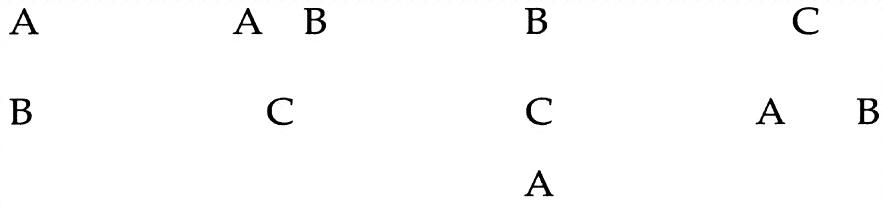
Recall that Horwich's sense of “improbable” as opposed to probable refers to sets of events which are rare or non-existent, as opposed to sets which are common. Figure 1 shows some structures of events which are probable and some which are improbable, where A, B and C fit relations (i) and (ii) in Section 2 (i.e., C screens off a correlation between A and B).
Probable (left two) and improbable (right two) structures.

Probable structures include cases where correlations are screened off by an event in the past, or by an event occurring between the times of A and B. Improbable, or extremely rare structures include the cases in which correlations are screened off by an event in the future, and not also by one in the past.
By “inexplicable coincidence” Horwich means a correlation which has no causal explanation (Reference Horwich1987, 93–4). This in itself makes no reference to time. Indeed the Principle of Causal Correlation (all correlations have causal explanations) does not by itself demand that correlations are explained by a past event. That demand only arises when one also brings in the Principle of V-Correlation, in particular clause (iii), or a theory of causation according to which effects do not precede their causes.
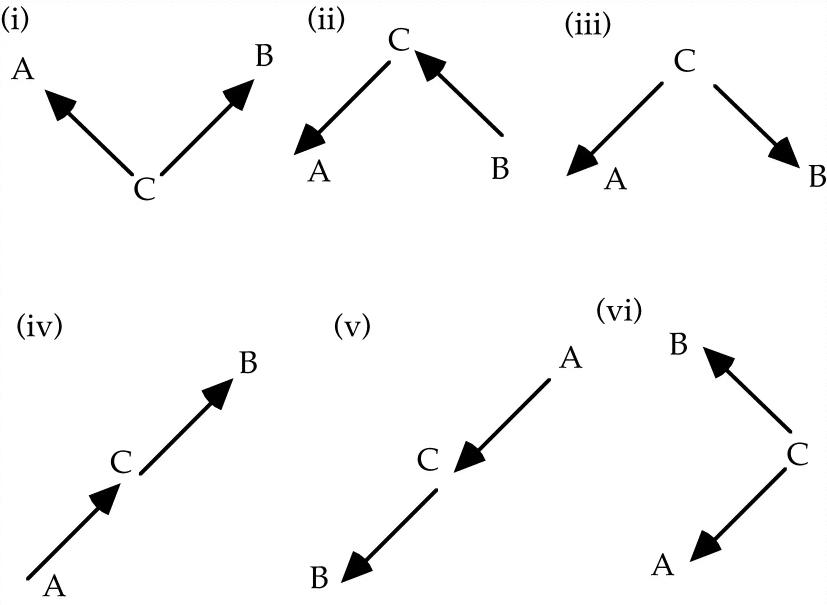
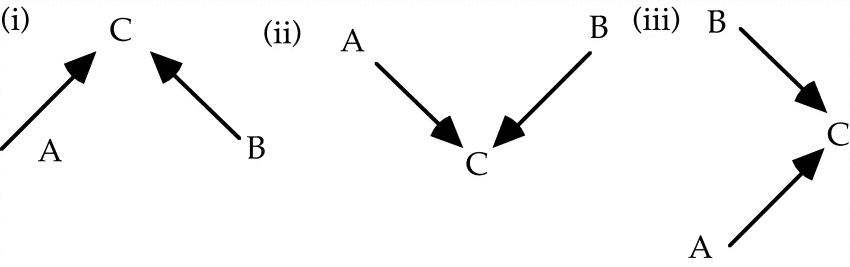
For example, a correlation which has a common cause, either in the past or the future, is explicable, whereas one that has only a joint effect, either in the past or the future, is inexplicable. Figure 2 depicts some explicable correlations, Figure 3 some inexplicable ones, again where in both cases A, B, C are related according to (i) and (ii). Standard cases of explanation by a common cause are represented by 2(i), Horwich's time traveling coincidences are represented by 3(i), while the two soups case is represented by 2(iii).
An AB correlation is explicable if it has a causal explanation of one of these forms.

An AB correlation is inexplicable if the only relevant causal connections are of one of these forms.

So one way of expressing the Reichenbachian program is that to explain a correlation we first identify a past event that stands in the appropriate statistical relation, and second make sure the causal connections point the right way (on the Modified program we drop the word “past”).
Notice that there can be probable inexplicable, and improbable explicable correlations. In Figure 2 (ii) and (iii) are improbable and (i) and (iv) are probable, while in Figure 3 (i) is improbable and (ii) and (iii) are probable. In fact, Horwich himself points out that not all inexplicable correlations are improbable (Reference Horwich1987, chapter 6, section 3). If A and B have a joint effect C which occurs after A but before B (and there is no other event which screens off the correlation between A and B), then this is not an improbable structure of events, although it is inexplicable since nothing causes the correlation (Figure 3(iii)). Horwich calls this “non-humean” causation, apparently because the B-C causal relation violates Hume's priority condition for causation.
The explicability of Horwich-coincidences represented (i) in spacetime and (ii) schematically.

Some of these possible structures were disallowed by Reichenbach, because he held that all causal processes connected in a single net had the same direction (see Dowe Reference Dowe1996). However, Horwich doesn't have this restriction; as we have just seen, he has Figure 3(iii) as his example of a probable but inexplicable, “non-humean” structure.
Our new version of Horwich's argument can be expressed in terms of these diagrams: time travel into the local past should not be expected even in a world with closed timelike curves because it would involve causal structures of the form in Figure 3(i), which are both inexplicable and improbable. The two soups case given in the previous section—the son's sneeze being the common cause of his young parents each getting the disease—is a case of an explicable, but improbable correlation (Figure 2(iii)). That may explain our intuition that this is just what we would expect if time travel into the local past occurred. However, we may feel, the kind of correlation Horwich has in mind is an inexplicable improbable correlation, and the intuition is not so clear here.
So, if as we are supposing in this section, Horwich means to rule out local time travel on account of the improbability and inexplicability that it entails, and the correlations he has in mind are both inexplicable and improbable, then perhaps the argument of the previous section is not to the point. In the next section, however, we will see that the kind of correlations Horwich has in mind are after all explicable, so the argument of the previous section is to the point after all.
7. Does Time Travel Entail Inexplicable Coincidences?
Consider again the correlation between attempts (A) to kill one's grandfather before one's father's conception, and the fortuitous existence of banana skins or the like (B). There is a strong correlation between A and B, viz., P(B|A) = 1, yet without time travel there would be no correlation between attempts to kill people and banana skins. Thus P(A.B) > P(A)P(B). This correlation is screened off by C, the later fact that the attempt fails.
To recap Horwich's argument: A doesn't cause B, and there's no common cause in the past of A and B which screens off the correlation. Therefore this is an improbable, inexplicable correlation. This looks like the usual kind of Horwich-coincidence, screening off by a common effect.
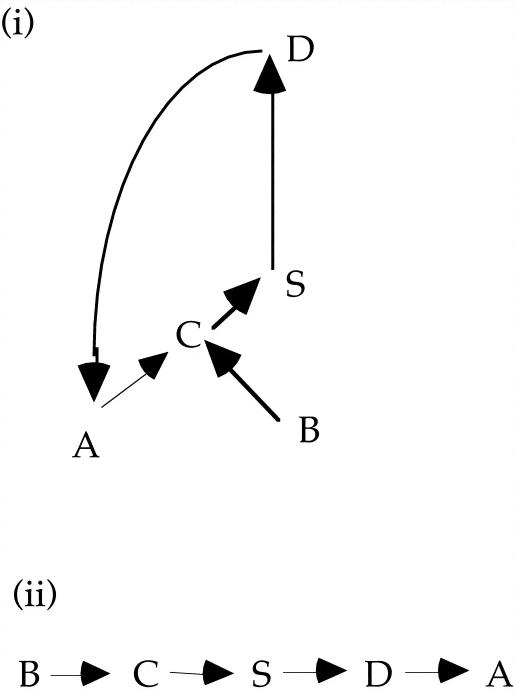
However, and this is the key point, the Principle of V-Correlation only says there is a past screener-off in cases where there is no direct causal connection between A and B. Recall that by direct cause we mean that A causes B rather than that A and B have a common cause. (Again, we do not mean “direct” in the sense of “has no intermediate causes”.) But there is a direct causal chain in our Horwich-coincidence case—B is part of the causal history of A! Take the chain B-C-S-D-A, where S is grandfather's survival, and D is the grandson's decision to travel back in time. There is a direct causal connection between B and A, via this chain, as follows. There is no doubt that the banana skin was one of the causes of the killer's slipping. There is no doubt that the killer's slipping was one of the causes of the grandfather's surviving that day. There is no doubt that the grandfather's surviving that day was one of the causes of the grandson's ever being there to make the decision to go back in time. And there is no doubt that the grandson's making the decision to go back in time was one of the causes of the attempt to kill. In other words, B causes C, C causes SFootnote 4, S causes D, and D causes A. So there is causal chain between B and A, so assuming the (largely non-controversial) transitivity of causation, B causes A. B is therefore a cause of A according to at least some theories of causation. According to the counterfactual theory it is, since A counterfactually depends on B (if we grant semantics appropriate to time travel) since had B not occurred, A would not have occurred.Footnote 5 According to the process theory it is, since B and A are also linked by a string of causal processes and interactions, viz. the slip on the banana skin, grandfather's existence from S on, father's birth, father's existence, time traveler's life, including the time trip, and ending with A.
This is intuitively what we would expect if this string of events were laid out forwards in time. Suppose someone attempts to shoot Hitler's grandfather before his father's conception, but that due to a fortuitous banana skin (B) the attempt failed (C). Consequently Hitler's grandfather survived that day (S), and consequently years later Hitler was in a position to decide to shoot some innocent person. This decision leads to an attempt (A) to kill the victim. It seems reasonable, providing one believes in causal transitivity, to say that the banana skin (B) was a (partial, remote) cause of Hitler's attempt (A) to shoot the victim. So also in the time traveling case: B causes A.Footnote 6
So the AB correlation is explicable, although improbable, according to the Reichenbachian program. It is represented crudely in Figure 2(ii). (I am not claiming that there are no conceivable structures that can occur with time travel and which constitute inexplicable, improbable correlations, just that the sort that Horwich is appealing to are not generally of that sort.Footnote 7) B causes A in the same way that without time travel a banana skin might cause a gunman to slip, preventing a death which enabled a birth which enabled an offspring to attempt to shoot someone.
For example, take the case of time traveling Adam, who mates with his mother Betty and has a child who is himself, a clone. The first improbability that we considered was that Adam and Betty should share at least one allele at every gene site, which, when taking a partner at random, is prohibitively improbable. We noted in Section 3 that the correlation is screened off by the fact that young Adam is born with the particular genome that he is. But really there is nothing unexplained at this point. Adam and Betty must share one allele at every gene site, because Betty is Adam's mother. Anyone who commits this kind of incest will overcome that improbability.
Since the correlation is therefore explicable according to the Modified Reichenbachian program, it cannot be claimed that it is on account of both their improbability and inexplicability together that such correlations rule out time travel to the local past. It can only be on account of their improbability, so the objection of Section 5 still stands.
8. Conclusion
According to the Modified Reichenbachian program of explanation a correlation is explained if it reflects a direct causal relation or if it can be shown to be screened off by a common cause. The unmodified program further insists that the common cause is in the past of its joint effects, on the strength of the fact that de facto this is what always happens.
However, entertaining the possibility of backwards causation seems to be tantamount to entertaining the possibility that an event has past effects which are correlated, and which it screens off. So to say that time travel into the local past is improbable seems to say no more than since we haven't yet seen any, there won't be any (Section 4).
Time travel does seem to entail Horwich-coincidences, but these admit a straightforward causal explanation: there is a direct causal connection not via anything approximating the shortest spacetime path between the two events, but via a causal chain which extends forward into the future then back into the past (Section 7). If the Modified Reichenbachian program is accepted, and there is no more to causal explanation than finding the right kind of set of events related by the right kind of probability and causal relations, then the Horwich-correlations are adequately explained.
Alternatively, if we find that there is something unusual, still requiring explanation, in cases of Horwich correlations then perhaps we should prefer to conclude that the Modified Reichenbachian program for the explanation of coincidences is incomplete. Nothing I have said rules this out.
For example, some may find that the fact that young Adam has the genome he does (C) does not adequately explain the fact that he passes on exactly the right genes that complement the genes his mother gave in reproduction (A). It is true that A is certain given C, they may feel, but that doesn't tell us how C brings about A, something that is inexplicable on current biological knowledge. The advantage of the example in Section 3, such people may point out, is that one coincidence is nicely explained (why Adam and Betty have the right genes to allow cloning), but the other (why Adam passes on exactly the right genes) is not. The problem, they may argue, is that you may well have probability raising between C and A, both may be part of a single causal process, and the direction of causation may be from C to A, but this does not guarantee that C actually is a cause of A, despite what the Reichenbachian program may say. Therefore the Reichenbachian program needs supplementing, at best, to handle time travel cases.
It is beyond the scope of this paper to enter that debate. Instead the conclusion here can be expressed as a disjunction. Either the modified Reichenbachian program is complete and there is nothing remaining to be explained about time travel, or since there is something about time travel which the Modified Reichenbachian program does not explain, it cannot be complete.