INTRODUCTION
The earliest attestations of writing in Europe are still a debated issue in the scholarship on ancient scripts. The controversy pivots on what specific script is earliest (see, for instance, the marks belonging to the Neolithic Vinča culture in south-eastern Europe), or in more theoretical terms, on what we should define as writing proper. Herein lies an open-ended question: if the earliest script is, in fact, the Cretan Hieroglyphic, dated to the beginning of the second millennium bce, as Arthur Evans (Reference Evans1894) first suggested, what should we make of signs that are dated slightly earlier, which closely resemble the signs of the Hieroglyphic script?
The question subsumes an even more structural issue concerning iconic writing: when does it begin to record sound, namely written language? When does it stop being decoration and become a specific sound-recording feature? Can we locate, in time, in place, such a fundamental turning point, from image to sign, in the history of our continent? To address these questions, the ‘Archanes formula’ is brought under close scrutiny, vis-à-vis the graphic repertoires of Cretan Hieroglyphic and, in parallel, Linear A.
First, however, it is important to explain what we refer to when we talk about iconic writing and iconicity. By ‘iconic’ we refer to written signs which formally stem from icons and images, namely having more or less clear referents in a largely figurative repertoire or, to quote Robertson (Reference Robertson2004, 25, after Peirce Reference Peirce, Hartshorne and Weiss1931), a relationship ‘that shows a similarity between the object and the written sign’.Footnote 1 This definition can be applied to most (if not all) scripts that represent new inventions, namely scripts which show novel shapes in the repertoires of their signs: early Sumerian cuneiform, Egyptian, Anatolian Hieroglyphic, Old Chinese, Maya and Nahuatl or Aztec (Houston Reference Houston2004). This, however, does not imply that all writing that is created anew is iconic in its entirety, nor that it is devoid of any abstract or geometric shapes in the repertoire, nor that it displays a deterministic, predictable, and measurable evolution into schematisation or basic linearity in shapes.
It has been long suggested that the Cretan Hieroglyphic script had a close connection to icons and decorations on seals (Sbonias Reference Sbonias, Vasilakis and Branigan2010, 218; Flouda Reference Flouda, Piquette and Whitehouse2013, 148‒55; Ferrara Reference Ferrara2015, 31‒2; Reference Ferrara and Steele2017, 15; Decorte Reference Decorte, Ferrara and Valério2018a, 40‒2). Indeed, the relationship between writing and art is suggestive: various Cretan Hieroglyphic signs can be correlated with motifs on Minoan glyptic, especially with seals mostly dated to the MM II period.Footnote 2 In what follows we draw a picture of these relationships (i.e. between images or icons with specific signs and their shapes) from the beginning of writing on Crete.
The earliest Cretan Hieroglyphic writing appears on a type of object, namely engraved sealstones, which bear a number of images, making its exact moment of emergence difficult to grasp. Small and ornate, these seals provided the first trail that Arthur Evans followed in his quest for Minoan civilisation (Evans Reference Evans1894). On them we find clues that images ceased to be mere designs of iconography and acquired a formal structure that carried another message, in what likely was a string of sound values. And so, in a large and important cemetery not far from Knossos, Archanes Phourni, lay the beginning of writing. But how we should frame this start, its close palaeographical ‘reading’, its relation to the Cretan Hieroglyphic script, and its connection to Linear A, is where lies the crux of the problem, still enveloped, as it is to this day, in a murky quicksand of definitions.
STATUS OF THE EARLIEST WRITING IN THE AEGEAN
The first published assemblage of early Cretan seal motifs was labelled as ‘the Archanes script’, after the cemetery of Archanes Phourni (Yule Reference Yule1980, 169‒72). Their archaeological context dates to the end of the EM II and the beginning of MM IA (Grumach and Sakellarakis Reference Grumach and Sakellarakis1966, 111–12). Further studies have narrowed the date to the MM IA–B period, around 2000–1900 bce (Sbonias Reference Sbonias1995, 58–9, 108): the cusp of the transition to the emergence of the first palaces. The seals show two groups of signs, respectively catalogued as 042-019 
 and 019-095-052

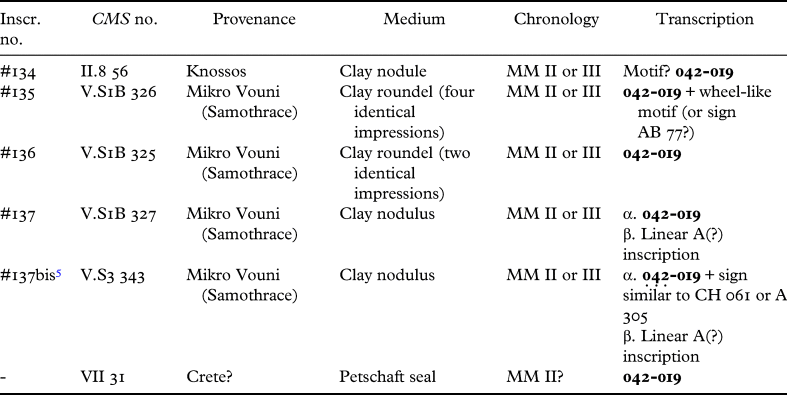
 (Olivier and Godart Reference Olivier and Godart1996).Footnote 3 Given their repetition on separate seals, they are generally referred to as ‘the Archanes formula’, even though they are also attested on Protopalatial seals and sealings from several other sites, including one from outside Crete (Tables 1 and 2).
Seals and sealings featuring the ‘Archanes formula’ (in bold). Inscription numbers according to Olivier and Godart Reference Olivier and Godart1996.

Seal impressions featuring only the first sign group of the ‘Archanes formula’ (in bold). Inscription numbers according to Olivier and Godart Reference Olivier and Godart1996.

The term ‘formula’ fits these signs better than ‘script’, since they do not form a complete system of writing. But how each of these signs should be defined, and thus to what script these signs belong, is still an open question. A forerunner of the Cretan Hieroglyphic (Sbonias Reference Sbonias1995, 108; Olivier and Godart Reference Olivier and Godart1996, 18 n. 59; Younger Reference Younger1996–7, 380‒1; Perna Reference Perna, Nakassis, Gulizio and James2014, 252; Karnava Reference Karnava, Alram-Stern, Blakolmer, Deger-Jalkotzy, Laffineur and Weilhartner2016, 352), or of Linear A (Godart Reference Godart, Betancourt, Karageorghis, Laffineur, W. and Niemeier1999; Anastasiadou Reference Anastasiadou2016, 177‒82), or of both (Schoep Reference Schoep1999, 266, 270‒3)? Or do they represent separate examples of an altogether different script, a predecessor connected to Cretan Hieroglyphic (Decorte Reference Decorte2018b)? To address these questions, we need to reassess the ‘Archanes formula’ vis-à-vis the graphic repertoires of Cretan Hieroglyphic and Linear A. This can help us trace not just the beginning of writing on the island, but also its future path, in terms of continuity, disruption and overall diachronic development. In particular, we shall address an important ongoing controversy, namely the long-standing association made between the ‘Archanes formula’ and the Linear A syllabic sequence 08-31-31-60-13/a-sa-sa-ra-me. To what extent is this connection tenable? In later Linear A, as attested in the Neopalatial period (MM III–LM I), the a-sa-sa-ra-me sequence is found on inscriptions incised on stone vessels and on other objects likely used in religious or cultic rituals (readable in full only on IO Zb 10, PK Za 11b–c, and PR Za 1c). The tie to Archanes, first suggested by Bossert (Reference Bossert1931, 318‒20) and further developed by others (Grumach Reference Grumach1968; Hooker Reference Hooker1992, 106–8; Weingarten Reference Weingarten, Pini and Poursat1995, 303‒4 n. 23; Schoep Reference Schoep2006, 46 n. 74; Anastasiadou Reference Anastasiadou2016; Civitillo Reference Civitillo2016a; Karnava Reference Karnava, Alram-Stern, Blakolmer, Deger-Jalkotzy, Laffineur and Weilhartner2016; Perna Reference Perna2019), hinges mainly on palaeographical arguments. But other, overlooked palaeographical details may help here, making the connection of the ‘Archanes formula’ with Cretan Hieroglyphic more compelling.
Although Olivier and Godart (Reference Olivier and Godart1996, 19) have demonstrated the correspondence in terms of shapes in the Archanes and Linear A between signs CH 042 and AB 08/a, CH 019 and AB 31/sa, and CH 052 and AB 24/ne,Footnote 4 one problematic feature remains: the graphic configuration of sign CH 095 , which was classed as Cretan Hieroglyphic, but is present only in the ‘Archanes formula’. This sign has been often made to correspond to the Linear A AB 60/ra (Brice apud Brice and Henle Reference Brice and Henle1965, 67; Olivier Reference Olivier, De Miro, Sacconi and Godart1996, 107; Younger Reference Younger1996–7, 387; Godart Reference Godart, Betancourt, Karageorghis, Laffineur, W. and Niemeier1999, 300; Perna Reference Perna2019, 52), but the shapes of the two signs appear to be more different than hitherto assumed. This uncertainty urges a revisiting of the ‘Archanes formula’ and its status.
POINTS OF DEPARTURE: BODY OF EVIDENCE
A close-up on the ‘Archanes formula’
The ‘Archanes formula’ is a standard combination of two sign-groups (Grumach Reference Grumach1968, 12–13), respectively catalogued as CH 042-019 and 019-095-052 (Olivier and Godart Reference Olivier and Godart1996). It is attested on seals and seal impressions, all dated to the transition from the Pre- to the Protopalatial Period (Table 1). They either appear on different seal faces (#202, #203, #251, #252, #292, #313, #315) or on the same one, but separated by a horizontal or vertical line (#205 and #179). It was posited, therefore, that the two sign groups were independent of one another (Karnava Reference Karnava1999, 197); this hypothesis was proved by the attestation of the sign group CH 042-019 on its own directly on a single seal face (Table 2). At present, we cannot ascertain whether sign groups starting CH 042-019-, such as 042-019-009-070 (on #222.β and perhaps #201) and 042-019-031 (#301.δ), are variants of the ‘Archanes formula’ or not.
Some seals bearing the ‘Archanes formula’ also have one or more additional faces engraved with other motifs, which may be considered either decorations or ‘icons’ (Civitillo Reference Civitillo2016b) when they are figurative (as the quadrupeds on #313 and #315), as fillers when they are smaller or geometrical, or as isolated signs (as the hand and the leg on sealstone #315, which recall signs CH 008 and 010 respectively). Some of these elements may be part of the script as either phonographic or sematographic signs (Decorte Reference Decorte2018b), but there is no reason to ascribe them to an altogether separate script. The presence of additional elements, beyond the ‘formula’, makes these seals comparable with many other Cretan Hieroglyphic seals, which include both writing stricto sensu and decorative motifs.
How these signs should be read, and the nature of their internal structure and meaning, are more than marginal problems, not just for the ‘Archanes formula’, but for the Cretan Hieroglyphic signs on sealstones as well: are they to be read only phonetically, which implies proper phonography, or not? Some scholars accept the possibility of logographic or ideographic readings (Evans Reference Evans1909; Grumach Reference Grumach1963–4; Brice apud Brice and Henle Reference Brice and Henle1965; Reich Reference Reich and Gallavotti1968), while others posit a close phonetic reading only (Olivier and Godart Reference Olivier and Godart1996; Karnava Reference Karnava1999, 35‒6; Perna Reference Perna2019, 54). Comparative evidence indicates that newly created iconic scripts (cited above) spelt words logo-phonetically at least sometimes, and especially at their earliest stages of development (Boltz Reference Boltz1994; Reference Boltz2000; Trigger Reference Trigger2004; Valério and Ferrara Reference Valério and Ferrara2019). In these writing systems, words could be spelt with combinations of semantic signs (logograms or determinatives) and phonetic signs.
Thus, if we are dealing with a highly iconic, newly invented script, as seems the case (Powell Reference Powell2009, 170; Ferrara Reference Ferrara and Steele2017), one may expect to find words spelled logographically as well as phonetically. With this in mind, we can take into consideration the possibility that at least one of the signs of the ‘Archanes formula’, namely the double axe sign, may not have been used phonetically, but rather as a determinative categorising a word expressed by nearby sign(s), or as a logogram standing for a complete word. This can be inferred by the general behaviour of the double axe sign (CH 042 ) in Cretan Hieroglyphic inscriptions, where it is separated from sign-groups by means of dividers or, alternatively, emphasised by a 90-degree rotation (Ferrara Reference Ferrara2018, 97‒9).
So, if the identification and nature of the signs of the ‘Archanes formula’ are thus still problematic, this is not the case for the Linear A a-sa-sa-ra-me, which can be recognised as a syllabic sequence, well embedded within the so-called ‘libation’ formulas. To assess the extent to which we can compare the ‘Archanes formula’ to this sequence, we should recall its essential characteristics, as well as its variants and contexts of use.
Linear A a-sa-sa-ra-me in the ‘libation’ formulas
The Linear A ‘libation’ formulas are ordered sequences of several syllabic groups (i.e. phrases) attested in Cretan sites and on the island of Kythera during the Neopalatial period. Carved on about 50 stone vessels and receptacles (the so-called ‘libation tables’), these sequences were used in religious contexts in peak and cave sanctuaries. Medium-size examples could have contained offerings to deities (Davis Reference Davis2014, 99‒107), whereas miniature examples from the Iouktas and Syme sanctuaries might have been votive offerings themselves (Karnava Reference Karnava, Alram-Stern, Blakolmer, Deger-Jalkotzy, Laffineur and Weilhartner2016, 349).
Recurrent sign groups in the inscriptions on the vessels can be detected, even though most are fragmentary: a-ta-i-*301-wa-ja/e or, in alternative, ta-na-i-*301-, groups which point to a place, sanctuary or divine names (e.g. se-ṭọ-i-j̣ạ, i-da, -di-ki-te-), and sequences such as ja/a-sa-sa-ra-me, u-na-ka-na-si or u-na-ru-ka-na-ti, i-pi-na-ma, and si-ru-te. There appears to be a pattern in these sequences. According to whether a sequence is present or not, and their ordering, these inscriptions have been grouped into primary and secondary ‘libation’ formulas (Karetsou, Godart and Olivier Reference Karetsou, Godart and Olivier1985, 134). They appear to represent variations of a dedicatory formula, possibly containing a verb like ‘consecrate’, the name of the dedicant, the item(s) offered, and the name(s) of the deity or deities recipients of the offer (Pope Reference Pope1961; Brice Reference Brice, Heubeck and Neumann1983; Finkelberg Reference Finkelberg1990‒1; Owens Reference Owens1996; Monti Reference Monti2005; Davis Reference Davis2014).
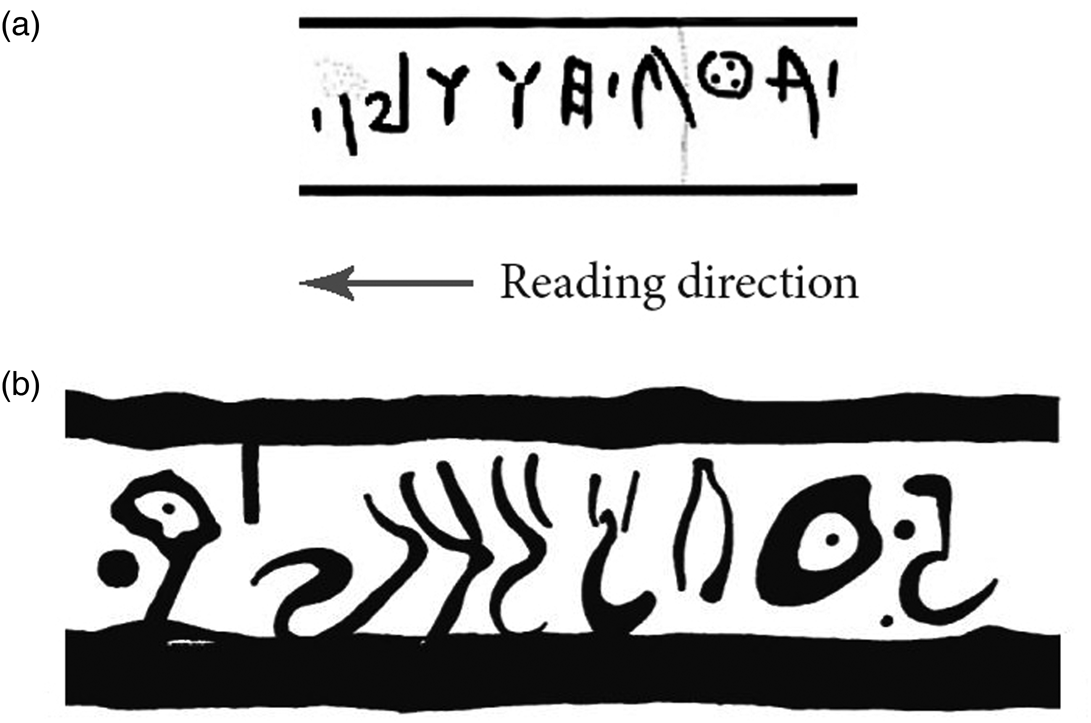
The Linear A syllabic sequence a-sa-sa-ra-me, which has long been compared with the ‘Archanes formula’, is a variant of the more frequently attested ja-sa-sa-ra-me (Table 3). Both variants appear as a middle component in the primary ‘libation’ formula, and as a final component in the secondary one (PR Za 1, IO ZA 6). Moreover, this syllabic group also appears on two retrograde inscriptions which do not show any other component of the ‘libation’ formulas, but could still have a dedicatory function. This might support the idea that this syllabic sequence indicates the offered object or the act of offering (Davis Reference Davis2014, 270). These inscriptions are PL Zf 1 and POR Zg 1 (Fig. 1). The former, incised on a broken LM I silver pin found in a tomb (Alexiou and Brice Reference Alexiou and Brice1976), comprises at least six sign groups divided by short vertical strokes, the third and the fourth of which are u-qe-ti, ja-sa-sa-ra-ṃẹ (Fig. 1a). The latter is painted on a clay figurine dated to the LM IIIA1 period without a context of use (Olivier, Rethemiotakis and Dimopoulou Reference Olivier, Rethemiotakis and Dimopoulou1993). This complete inscription consists of a sequence of eight signs (Fig. 1b), which was read as ṛị-qe-ti-ạ-sa-sa-ra-*3̣2̣5̣ (Olivier, Rethemiotakis and Dimopoulou Reference Olivier, Rethemiotakis and Dimopoulou1993, 509‒13).
(a) Drawing of a part of inscription PL Zf 01 (after GORILA 4); (b) drawing of inscription POR Zg 1 (after Olivier, Rethemiotakis and Dimopoulou Reference Olivier, Rethemiotakis and Dimopoulou1993, 510, fig. 8). Not to scale.

Attestations of the Linear A sequence 08-31-31-60-23 / a-sa-sa-ra-me and variants (after GORILA 4 and 5, and Knappett, Del Freo and Zurbach Reference Knappett, Del Freo and Zurbach2017, 78). The reading of the sequence in POR Zg 1 corresponds to the one argued by the authors in the text.

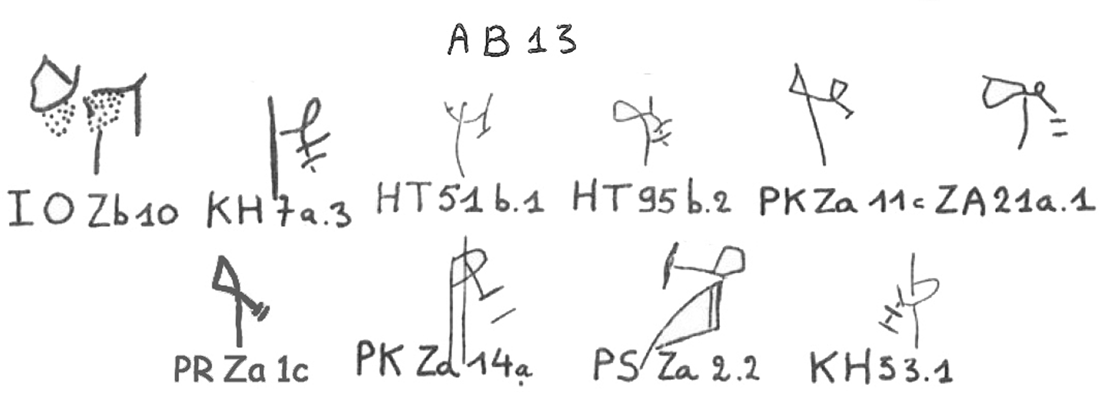
A peculiar palaeographical feature of POR Zg 1 is the cursive shapes of the signs, with straight traits executed as curves. Keeping in mind the stark difference in ductus between these painted shapes and those we normally see incised, we can hypothesise that the dot in both the first and the last sign stood for a horizontal stroke crossing a vertical one. This would allow the comparison of signs AB 10/u Footnote 6 and AB 13/me with the first and last signs of POR Zg 1 respectively, bringing the whole inscription even closer to PL Zf 1. In fact, the final sign of POR Zg 1 differs from the currently accepted A 325  in two ways: first, it has two extra dots and, second, its vertical stroke is not centred with respect to the upper circle. Conversely, AB 13/me might be a preferable reading because its upper part is sometimes also a simple loop (see the instances in PS Za 2.2, PK Za 14 and KH 53.1; Fig. 2), and it has strokes that could have been simplified as dots when written in ink. We therefore propose to read POR Zg 1 tentatively as two sequences: ụ-qe-ti a-sa-sa-ra-ṃẹ. The close similarity to PL Zf 1, the fact that A 325 is a very rare sign,Footnote 7 and the consistent spelling of (j)a-sa-sa-ra-me with final -me (Table 3), all converge towards this reading.
Range of palaeographical variation of Linear A sign AB 13/me (after GORILA 5, xxx).

Moreover, Linear A a-sa-sa-ra-me is never attested on its own, without other specifications, on an intact inscription. The two only possible instances may be PK Za 4 and IO Zb 10, but both are fragmentary.
DECONSTRUCTION: REASSESSING SIMILARITIES BETWEEN THE ‘ARCHANES’ AND THE LINEAR A ‘LIBATION’ FORMULAS
The ‘Archanes formula’ and Linear A a-sa-sa-ra-me have been closely associated in the scholarship, to the point of becoming generally accepted as a match (e.g. Bossert Reference Bossert1931, 318‒20; Brice apud Brice and Henle Reference Brice and Henle1965, 56‒68; Grumach Reference Grumach1968; Hooker Reference Hooker1992, 106‒8; Weingarten Reference Weingarten, Pini and Poursat1995, 303‒4 n. 23; Schoep Reference Schoep2006, 46 n. 74; Perna Reference Perna, Nakassis, Gulizio and James2014, 253; Anastasiadou Reference Anastasiadou2016; Karnava Reference Karnava, Alram-Stern, Blakolmer, Deger-Jalkotzy, Laffineur and Weilhartner2016, 352‒4). Upon close inspection, however, the evidence appears to be tenuous. In terms of function and epigraphical features, the two sets are comparable only to an extent: the ‘Archanes formula’ is found uniquely on seals, namely on objects worn for personal display as well as for administrative activities, while the Linear A sequence a-sa-sa-ra-me is mainly attested on stone vessels, in a clear dedicatory context. While context of use may not be an absolutely determinative principle, the difference is nevertheless quite stark. And whereas the silver pin PL Zf 1 is clearly a high-status object worn on the body and highly individualised, it is difficult to prove that the Archanes seals were perceived as luxury items in the same category.Footnote 8 Also, Linear A a-sa-sa-ra-me is usually part of a longer dedicatory formula, and this difference from the ‘Archanes formula’ ought not to be discounted, because we cannot be certain whether it could stand on its own.
The discrepancies do not end here. Although both comprise five signs, in terms of arrangement and layout, the Linear A signs always form a single sequence, while the ‘Archanes formula’ is disjointed in two groups (Fig. 3). In addition, the final sign in a-sa-sa-ra-me does not match the final sign of the ‘Archanes formula’, as already mentioned above. Yet several explanations have been proposed to support the match, despite the sequence split and different final sign. Godart (Reference Godart, Betancourt, Karageorghis, Laffineur, W. and Niemeier1999, 299) suggests that they are two variants of the same Linear A word, which differ because of chronological development or a morphological change. Under this hypothesis, we should envisage two initial words, which ended up merging, at a later stage, in compound formation. Karnava (Reference Karnava, Alram-Stern, Blakolmer, Deger-Jalkotzy, Laffineur and Weilhartner2016, 352‒3) explains the differences in terms of linguistic development, or in terms of scribal idiosyncrasy. Despite the ingenious linguistic interpretations, the implication is that all Archanes signs are to be read phonetically as in Linear A and B, which (as indicated above) is far from proven.
Palaeography of the signs (CH 042, 019, 095 and 052) that compose the ‘Archanes formula’ (adapted from CMS and Sbonias Reference Sbonias, Vasilakis and Branigan2010, pl. 61, no. S35).

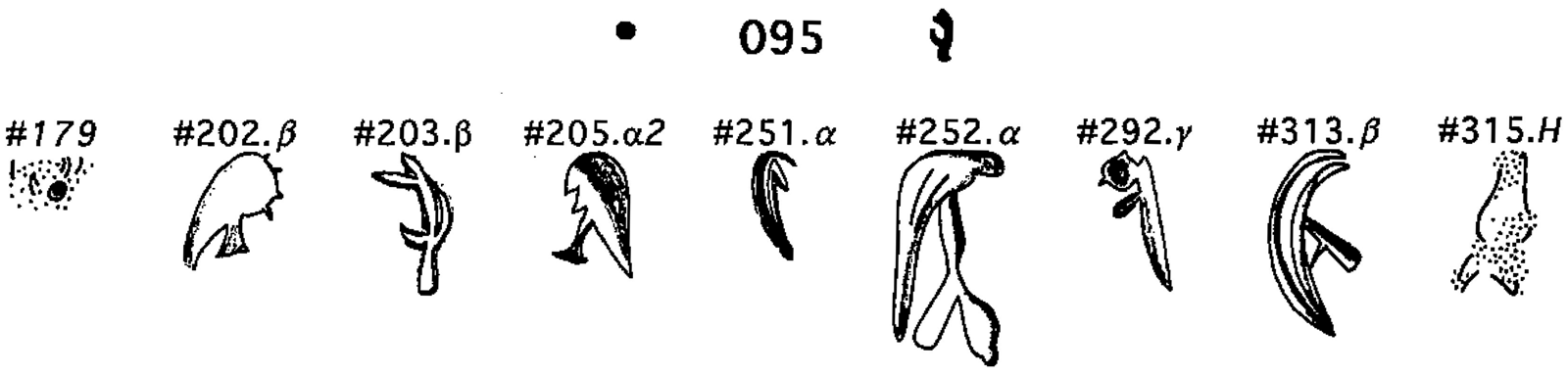
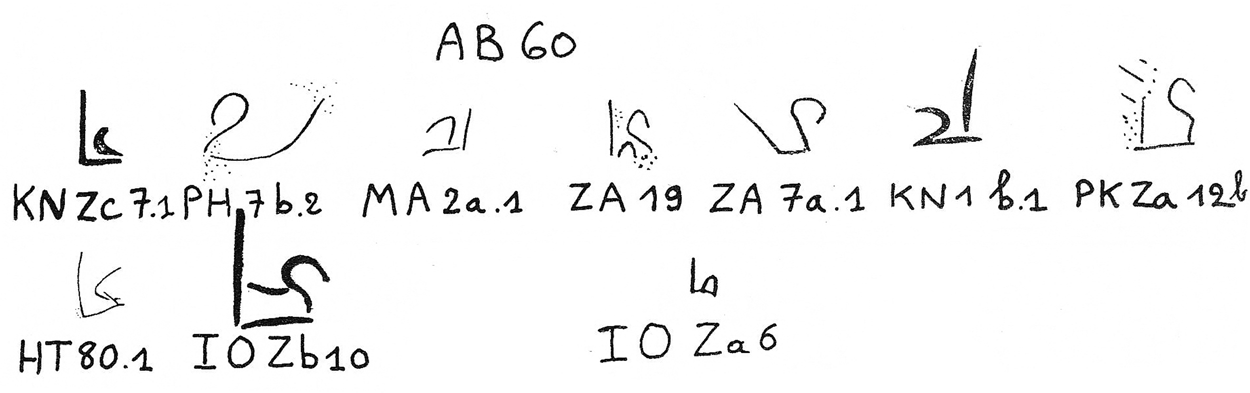
Let us focus on the palaeography. As stated above, the fourth sign of the ‘Archanes formula’, catalogued by Olivier and Godart (Reference Olivier and Godart1996) as CH 095, is generally made to correspond to AB 60/ra (e.g. Olivier Reference Olivier, De Miro, Sacconi and Godart1996, 107; Younger Reference Younger1996–7, 387; Godart Reference Godart, Betancourt, Karageorghis, Laffineur, W. and Niemeier1999, 300; Perna Reference Perna2019, 52). Olivier and Godart (Reference Olivier and Godart1996, 421) list nine occurrences of CH 095, including two badly eroded ones (#179, #202.β, #203.β, #205.α2, #251.α, #252.α, #292.γ, #313.β, #315.H), shown in Fig. 4. Here the complications start; because when we compare its palaeographical variations with those for the Linear A sign AB 60/ra (Fig. 5), we struggle to find diagnostic traits in common, even considering processes of schematisation, cursivisation or handwriting style.
Attestations of CH 095 according to Olivier and Godart (Reference Olivier and Godart1996, 421). The instances in #252.α and #315.H have been vertically flipped to show them with the same orientation.

Range of palaeographical variation of Linear A sign AB 60/ra (after GORILA 5, xxxviii).

Probing into the Linear A sign repertoire proves instructive, as a more fitting comparandum than AB 60/ra can be identified. If we look at the variants of the Linear A syllabogram AB 10/u, we can find a closer match to sign 095 (Fig. 6). In several instances, sign AB 10/u is drawn with an emphasised curve or angular shape, and with a smaller stroke or inverted ‘T’ trait pointing downwards. The curved or angular shape is consistent with the main body of sign CH 095, and both signs have a protruding feature. These attestations of the Linear A sign are dated mainly to the MM II and III phases. We have also considered an instance in the dubious Cretan Hieroglyphic inscription #019, KN Ha (03) 04, which Olivier and Godart (Reference Olivier and Godart1996, 78‒9) read as possibly Linear A. This brings us closer to Cretan Hieroglyphic also in terms of chronology.
Attestations of Linear A sign AB 10/u belonging to MM or early LM I periods (adapted from Olivier and Godart Reference Olivier and Godart1996, 78; GORILA 5, xxx; and Karetsou, Godart and Olivier Reference Karetsou, Godart and Olivier1985).

This is just a palaeographical similarity that should in no way induce us to read the ‘Archanes formula’ by applying the phonetic values conventionally assigned to Linear A. The fact that we can see better-fitting matches should not lead us into reckless reading practices. There is an inherent danger in transposing phonetic values: such an exercise implies that every sign ought to be read phonetically, and this, as is worth reiterating, might well not be the case for the ‘Archanes formula’.
Caution notwithstanding, this revisitation encourages us to modify our view of the ‘Archanes formula’ and its legacy. Because if our analysis is correct, it would be striking that two out of three signs in the second group of the ‘Archanes formula’ do not appear to correspond with the signs of the Linear A sequence a-sa-sa-ra-me, as they should if they were to be a match. And without that correspondence, we are left with little to support a close relationship with Linear A. This in turn compels us to rephrase the question in the title of this article: to what writing system does the ‘Archanes formula’ belong?
RECONSTRUCTION: THE ‘ARCHANES FORMULA’ IN THE CRETAN HIEROGLYPHIC MILIEU
If the association with Linear A is tenuous, we need to turn to the possible evidence tying Archanes to the Cretan Hieroglyphic script. A crucial point of departure is the idea that sign CH 095 is the only sign in the ‘Archanes formula’ that is not attested elsewhere in the Cretan Hieroglyphic inscriptions (Karnava Reference Karnava1999, 197; Decorte Reference Decorte2018b, 347). This very sign and its chance discovery among the signs of the script is one minute detail upon which hinges the argument that the ‘Archanes formula’ is a self-standing writing tradition.
At the outset, we may question the validity of a method that relies on the absence or presence of specific signs to claim affiliation. A sign limited to a rare, if repeated attestation cannot be singled out and used as proof of difference, as the extant corpus of Cretan Hieroglyphic comprises only about 400 inscriptions, most of which are very brief, and is replete with unique attestations (hapax) and rare signs (Olivier and Godart Reference Olivier and Godart1996, 386‒431). Thus, it would be far-fetched to posit that rare signs like CH 095 appear exceptional or different due only to accidents of archaeological preservation. Yet it is no less dangerous to argue that, by virtue of one single sign looking different, we must deduce that it belonged to a different script. We should consider the possibility that sign CH 095 may have been embedded in the Cretan Hieroglyphic system of signs instead of dismissing it as absent. And if we look at how the sign has been classified in the scholarship, we find instructive indications.
When Evans published Scripta Minoa I (Reference Evans1909), he had access to only two of the seals today considered as examples of the ‘Archanes formula’ (Jasink Reference Jasink2009, 107): P.41 = #205 = CMS VII 35 and P.49 = #203 = CMS VI 13. These bear two instances of sign CH 095, which at that time had been identified as ‘a bird seated’ (Evans’ sign no. 80 ) in inscription #205, but as a ‘hand in profile’  (Evans's sign no. 10) in inscription #203 (Figs 3 and 4). Olivier and Godart (Reference Olivier and Godart1996, 16, 421) normalised sign CH 095 as , based on the hand-like instance on #203.b, even though this differs significantly in shape from most of its other attestations (Jasink Reference Jasink2009, 107). However, they did not classify the sign as a ‘part of the human body’, but rather as ‘linear’, hinting at the difficulties in interpreting its iconicity.
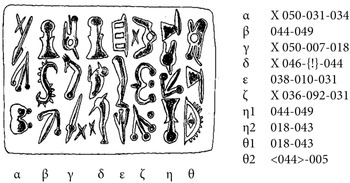
Taking a different perspective, Brice (apud Brice and Henle Reference Brice and Henle1965; Brice Reference Brice1997) and Jasink (Reference Jasink2009, 50, 107) recovered Evans’ interpretation of the instance in #205 () as a ‘seated’ or ‘crouched bird’. In doing so, they proposed to identify two additional instances of sign CH 095, one on sealstone #314, and another, much more doubtful, on sealstone #141. We shall focus on the clearer example from inscription #314, the well-known eight-sided prism from Neapolis (Fig. 7). The fourth column of the prism, δ, contains three signs (

 ): the middle one, considered merely a decorative symbol by Olivier and Godart, is the one that Brice and Jasink reinterpreted.
Cretan Hieroglyphic inscription #314 and its transcription after Olivier and Godart (Reference Olivier and Godart1996, 290‒1).

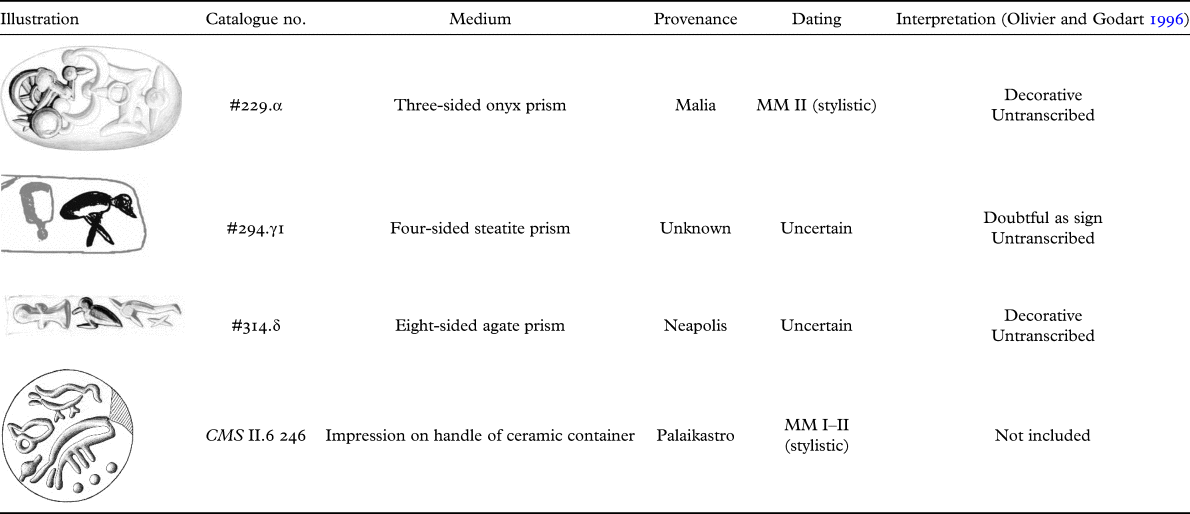
Another bird, described by Evans (Reference Evans1909, 210, no. 82) as ‘duck sign’, appears on a sealing from Palaikastro (CMS II.6 246) alongside two other motifs or signs, a one-handle spouted jug and a possible sea animal (Table 4). Brice (apud Brice and Henle Reference Brice and Henle1965, 64), followed by Jasink (Reference Jasink2009, 50), suggested that this was yet another variant of sign CH 095 alongside . Other iconic birds may have been used as signs of writing; note also the full-body creatures on inscriptions #229.α and #294.γ1. All these instances shown in Table 4 bring to the fore the long-debated problem of what constitutes a proper sign as opposed to a mere decorative symbol. This is more apparent on seals, on which the iconic, figurative nature of the signs emerges more readily (Olivier Reference Olivier, Duhoux, Palaima and Bennet1989, 43; Olivier and Godart Reference Olivier and Godart1996, 12; Jasink Reference Jasink2009; Ferrara Reference Ferrara2015; Civitillo Reference Civitillo2016b, 29‒55; Decorte Reference Decorte and Steele2017). Indeed, on the Neapolis prism (Fig. 7), all graphic elements are executed in a very homogeneous manner, even if sizes and orientations vary. All are arranged in a linear configuration and separated clearly. This applies also to the ‘crouched bird’ in column δ and the notched spiral  in column β.
Attestations of the bird sign as a possible more iconic variant of CH 095 and their contextual information (images adapted from CMS and Olivier and Godart Reference Olivier and Godart1996, 276).

Thus, it is plausible that all these are signs meant to be ‘read’ as sequences, even though the iconic, figurative character is largely and intentionally preserved. This can be seen also on the two birds on #229.α and #294.γ: they blend in the layout (Table 4) and, as such, should be treated as proper signs like the other elements.
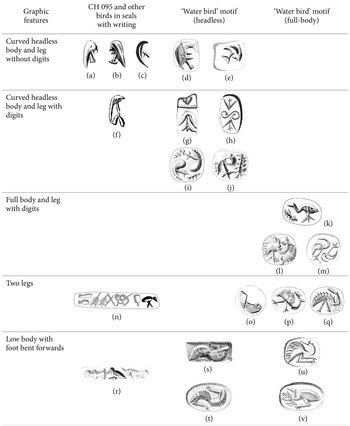
Yet it is one thing to identify full-bodied birds on seals #229.α, #294.γ1, #314, and possibly CMS II.6 246 as proper signs of writing, but quite another to demonstrate that they are variants of the standing headless bird sign CH 095 . The shapes of such full-body birds cannot be simply described as CH 095 with the addition of a bird's head, nor do they alternate with CH 095 in the same sequence. Nevertheless, shared graphic features show that CH 095 can be compared with both headless and full-body versions of the Wasservogel or ‘water bird’ motif found in Minoan seal imagery from the Protopalatial phase (Fig. 8). Water birds on seals (with and without head) were depicted with similar features and in analogous arrangements: with extended or bent feet, marked or unmarked toes, optional representation of feathers or wings, and doubling in symmetric positions sometimes with ornamental dividers. In their most schematic version, with a curved headless body with one leg and denticulations that evoke feathers, these motifs are identical to some instances of sign CH 095 as we see it attested in the ‘Archanes formula’ (Fig. 8a‒j). In more iconic variants, with their long feet bent forwards (a typical gesture for many species of water birds) and lowered body, they are comparable with the sign we see on seal #314 () (Fig. 8r‒v).
Iconographic variation of the ‘water bird’ motif in Pre- and Protopalatial Minoan seal imagery and comparable variants of CH 095 and bird ‘motifs’ on seal inscriptions: (a) #202 = CMS II.1 394b (dated to MM I); (b) #205 = CMS VII 35a (MM II); (c) #313 (MM I); (d) CMS III 212a (MM II); (e) CMS XII 22b (MM II); (f) #252a = CMS II.1 393c (MM I); (g) CMS XII 67b (MM II); (h) CMS II.2 121 (MM IIB); (i) CMS III 152a (MM II); (j) CMS VI 69b (MM II); (k) CMS III 200c (MM II); (l) CMS VS1A 326a (MM II); (m) CMS XIII 79c (MM II); (n) #294.γ1 (date uncertain); (o) CMS II.1 184 (EM II‒MM IA); (p) CMS VI 63c (MM II); (q) CMS III 164b (MM II); (r) #314.δ (MM II); (s) CMS IX 17d (MM II); (t) CMS II.2 104a (MM IIB); (u) CMS XII 62c (MM II); (v) CMS II.2 184a (MM IIB) (adapted from CMS; Olivier and Godart Reference Olivier and Godart1996; and Sbonias Reference Sbonias, Vasilakis and Branigan2010, pl. 61, no. S35). While drawings inevitably entail an interpretative element, here they were preferred to the available photographs of the actual objects because on the latter the contours are not always easy to make out.

To sum up, although the available evidence does not allow us to prove or disprove that the full-body birds on #229.α, #294.γ1, #314, and CMS II.6 246 represent sign CH 095, we do have variants of CH 095 which show features suggestive of a tail, a leg and feathers (Fig. 4). In this respect, a principle is at play in other Cretan Hieroglyphic signs that may be observable here too: signs depicting animals can represent the full body (CH 019‒022) or just the head of the animal (CH 011‒017). In the latter cases, we can often recognise the same animals but in full body in the glyptic repertoire (e.g. goats and bovines). This same pars pro toto principle could also work in the case of CH 095, although here we would have a headless body instead of a head for the full animal.
Seeing things in this light, that sign CH 095 of the ‘Archanes formula’ and the full-body birds on inscribed seals #229.a, #294.g1 and #314.d may be variants of the same Cretan Hieroglyphic sign is just a hypothesis. At present, we lack alternations of these two sign shapes in similar inscriptions, or attestations of the full-body animal contemporary with the earliest instances of the ‘formula’ (MM IB or earlier). Yet this is only a point of detail. Even from a more minimalist stance, whereby the full-body birds represent a sign independent from CH 095, the latter is still impressively similar to the headless ‘water-bird’ motif found on MM II seals (Fig. 8d‒e,g–h,s‒t). Conversely, the relationship with seal imagery is not characteristic of Linear A, which was not typically carved on seals.
Sign CH 095, far from being aberrant or unique in its development, could be seen as moving along the same path as the other signs of the Cretan Hieroglyphic repertoire. In the ‘Archanes formula’, the other signs find matches that are even more readily recognisable and prove that it is embedded not only in Cretan Hieroglyphic as a script but also within the existing Cretan iconography and material culture (Karnava Reference Karnava2015).
The double axe sign is sure to be identified with sign CH 042  . It is on the Archanes material itself that we find the earliest examples of this sign, namely on six seals (#202, #203, #251, #252, #313, #315). This is significant, because the symbol is part of an important tradition. Indeed, the double axe appears also on seal iconography of the later Protopalatial phase, most often as a single attestation, be it a proper sign or just a decoration.Footnote 9 This connection with iconography is particularly strong, and ties with the problem we have already highlighted, namely the way we interpret isolated attestations of icons (perhaps to be ‘read’ as potential logograms?) such as these.
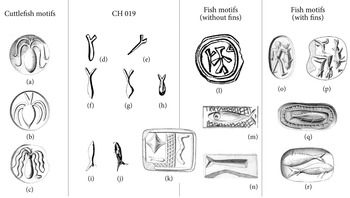
Equally accepted is the match between the sign found once in each of the two groups of the ‘formula’ and sign CH 019 of the Cretan Hieroglyphic script. Moreover, we can also reconstruct ties to the seal iconography. Sign CH 019 has been interpreted as a cuttlefish since Evans (Reference Evans1909, 205). However, this is unlikely, as is shown on Protopalatial seals with cephalopods (Fig. 9a‒c). Cuttlefish have eight short arms and two long tentacles, and even though these details are schematic on seal imagery, they are not as minimal as on sign CH 019. Evans (Reference Evans1909, 204) himself gives us a more plausible interpretation. On seal #134 he classified a sign, that is now accepted as an attestation of CH 019 (Fig. 9i), as ‘tunny fish’ (of the Scombridae family) rather than cuttlefish. This description suits CH 019 as a whole, tying well with Protopalatial iconographic depictions of fish (Fig. 9m‒r): the two protruding traits would represent the caudal fin and the rest a schematic depiction of the body of the animal. The fish tail is generally oriented upwards in CH 019 (though Cretan Hieroglyphic signs could be rotated), whereas the position of fish as decorations on seals is usually horizontal or ambiguous. However, the vertical ‘hanging fish’ perspective can be observed on CMS II.2 174a and III 156a (Fig. 9o‒p). Finally, #313.γ, a seal whose faces α and β contain the ‘Archanes formula’, shows a person and probably another instance of sign CH 019 (see Fig. 9l; Sbonias Reference Sbonias, Vasilakis and Branigan2010, pl. 61, no. S35a). This combination is remarkably similar to the depiction of a person grabbing a fish on seal CMS II.2 174a.
Comparison between sign CH 019 (d‒j) and representations of cuttlefish (a‒c) and fish (k‒r) on Protopalatial seal iconography: (a) CMS II.5 302 (MM II); (b) CMS II.5 312 (MM II); (c) CMS VII 219 (MM II); (d‒e) #313.β‒α (MM I); (f) #135 = CMS VS1B 326 (MM II‒III?); (g) #136 = CMS VS1B 325 (MM II‒III?); (h) #205 = CMS VII 35a (MM II); (i) #134 = CMS II.8 56 (MM II‒III?); (j) #251.β = CMS VI 14c (MM IA); (k) CMS VS3 343 (MM II); (l) #313.γ (MM I); (m) #290.α = CMS I 73a (MM II); (n) CMS II.2 185 (MM IIB); (o) CMS II.2 174a (MM IIB); (p) CMS II.2 185 (MM IIB); (q) CMS II.2 185 (MM IIB); (r) CMS II.2 261a (MM II) (drawings after CMS and Sbonias Reference Sbonias, Vasilakis and Branigan2010, pl. 61, no. S35).

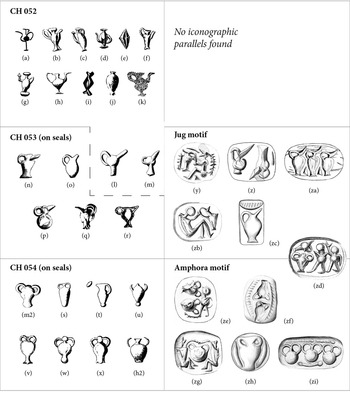
The development of sign CH 052  is more difficult to place. First, the sign is mainly found in the ‘Archanes formula’. In total, Olivier and Godart (Reference Olivier and Godart1996, 409) count 12 possible attestations, to which we need to add the one painted on pottery published by Militello (Reference Militello1990, 341). These include schematic versions, down to a lozenge (Fig. 10a‒k), recognisable only because of their context in the formula. Most often, instead, the sign takes the clear depiction of a vessel, diagnostic of a foot, a handle, a neck, and a spout stemming from the body at mid height. Two instances (#125, #130) depict a neckless vessel, with its spout at the height of the mouth, a version that corresponds closely to one variant of sign CH 053 (
 ), as attested on #296.β and #309.β (Fig. 10q–r). Thus, only 11 specimens of sign CH 052 are identical, eight of which occur in the ‘Archanes formula’ (Fig. 3). Second, in the iconography on seals, vessel motifs converge into two generic types, a jug or pitcher and a two-handled jar or amphora, roughly corresponding to CH 053 () and CH 054 (
 ). Conversely, outside the ‘Archanes’ group, we never see a jug with a spout at mid height depicted on seals.
Comparison between Cretan Hieroglyphic signs CH 052 (a‒k), CH 053 (j‒r) and CH 054 (m2, rs‒x, h2), and Protopalatial glyptic representations of spouted jugs (y‒z, za‒zd) and two‒handled amphoras (zd‒zi): (a) #031.a (MM II); (b) #202.β = CMS II.1 394b (MM I); (c) #203.β = CMS VI 13b; (d) #205.α2 = CMS VII 35a (MM II); (e) #251.α = CMS VI 14b (MM I); (f) #252.α = CMS II.1 393c (MM I); (g) #292.γ = CMS II.2 217.d (MM II); (h, h2) #306.α = CMS II 234b (MM II?); (i) #313.β (MM I); (j) #315.H = CMS II.1 391h (MM I); (k) inscribed sherd inv. F 5822 published in Militello 1990 = PH Yc 01 (MM IIA); (l) #125 = CMS II.8 84 (LM IIIA2); (m, m2) #130 = CMS II.6 181 (MM II); (n) #128 = CMS II.6 182 (MM II); (o) #151 = CMS II.5 239 (MM II); (p) #187 = CMS II.1 27 (MM II); (q) #296.β = CMS VI 104c (MM II); (r) #309.β (MM II); (s) #152 = CMS MS II.7 213 (MM II); (t) #153 = CMS II.7 214; (u) #155 = CMS II.6 143 (MM II); (v) #273.α = CMS X 312a (MM II); (w) #293.γ = CMS II 256c (MM II); (x) #303.β = CMS II 109c (MM II); (y) CMS VI 29a (MM II); (z) CMS III 165c (MM II); (za) CMS XI 265a (MM II); (zb) CMS XII 28a (MM II); (zc) CMS II.5 240 (MM IIB); (zd) CMS II.2 159a (MM II); (ze) CMS VI 33a (MM II); (zf) CMS II.2 2b (MM II); (zg) CMS II.2 241 (MM I‒II); (zh) CMS II.6 166 (MM I‒II); (zi) CMS II.2 79b (MM II) (drawings adapted from CMS; Militello Reference Militello1990, 341; Olivier and Godart Reference Olivier and Godart1996; and Sbonias Reference Sbonias, Vasilakis and Branigan2010, pl. 61, no. S35).

This lack of iconographic counterparts indicates that the trajectory of sign CH 052 differed from the other signs in the ‘Archanes formula’, but this does not necessarily imply that it is at odds with the Cretan Hieroglyphic repertoire. In fact, evidence shows that it was equally embedded in it: CH 052 is attested in the Cretan Hieroglyphic documents inscribed on clay; certain Cretan Hieroglyphic signs lack corresponding seal icons, like CH 052, and may have been designed ad hoc as representations inspired directly by their physical referents. This tie to material culture is possibly the case for sign CH 044  , strikingly similar to a seal type called Petschaft, or sign CH 057
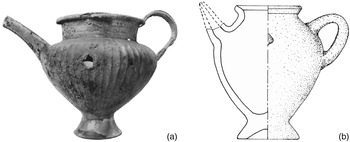
 , which is probably recognisable as a plough (Ferrara, Montecchi and Valério, Reference Ferrara, Montecchi and Valérioforthcoming). Along these lines, we might also identify a close material counterpart to sign CH 052. Its referent can be traced to a footed teapot, a shape known on Protopalatial Crete with only few clay examples attested and originated perhaps from a metal prototype. Similar silver spouted vessels from tombs at Byblos, dated to c. 1830‒1770 bce (Montet Reference Montet1929, pls CXI, CXII; Bouillon Reference Bouillon2015, 6‒7), provide a parallel (Fig. 11). We cannot discount the possibility that the Cretans encountered these vessels and drew inspiration from them for the shape of sign CH 052, without its ever appearing as a seal motif. This exercise in reconstructing the source of the ‘Archanes formula’ suggests that it is only under a close and broad examination calling in palaeographical criteria and correlations with icons and material culture that we can see proper affiliations emerge. For three of the four signs in the formula, we can retrace close counterparts on seal imagery from the MM II phase. This phenomenon is more associated with the Cretan Hieroglyphic script than with Linear A and its tradition as a whole.
(a) Silver spouted vessel from Middle Bronze Age Byblos (after Montet Reference Montet1929, pl. CXI); (b) MM IIA clay footed teapot from Phaistos (after Levi and Carinci Reference Levi and Carinci1988, pl. 44.e). Not to scale.

IMPLICATIONS
We have indicated that beginnings are difficult to place, in time, in place, but especially in their nature. The earliest attestations of writing on the island of Crete, from the Archanes Phourni cemetery, are no less vague, especially in their definition, as samples belonging to a specific, yet still debated, script. The tendency to give beginnings specificity, complete with a proper name, and placed within a frame, can lead us into error. In the case of these early inscriptions, attributions may have been made in an effort to tie things together, to give them continuity and lifespan, despite the glaring differences, or the tenuous chains that bind scripts together. This is why we have thought it worthwhile to revisit old claims and long-standing views, positions that may have been accepted more at face value and less on the strength of close scrutiny.
Our close scrutiny has led us to the following claims: in its palaeography, the ‘Archanes formula’, rather than a form of Linear A or a self-contained Archanes ‘script’, is embedded in Cretan Hieroglyphic. In its iconicity, the ‘Archanes formula’ is more at home in Cretan seal iconography than in any other tradition. In its archaeology and materiality, the ‘Archanes formula’ finds close referents present in physical objects that may have provided inspiration, connection and grounding for the repertoire of its signs. In brief, in all its manifestations, at the very earliest phases or at a later stage, the ‘Archanes formula’ fits into a Cretan Hieroglyphic milieu much better than into an imperfect reading of a Linear A religious sequence.
Moreover, the signs which, it is claimed, find no perfect match with their alleged counterparts in Linear A a-sa-sa-ra-me (signs CH 095 and 052) are exactly where Hieroglyphic creativity abounds. In them we see a wide range of palaeographical variation, including many different ways of depicting the same object. Their iconicity, with close material referents, matches that of seal motifs especially from the MM II phase – the time when the Cretan Hieroglyphic script begins to bloom. We should not be led astray by the schematic look of some of the Archanes signs (for instance on seals #202, #251 and #315) to stress and justify a close connection to the ‘linearity’ of Linear A. As is apparent, sign CH 052 is closest to Linear A sign AB 24/ne when the two are most iconic with clear depictions of vessels, whereas the simplified CH 052 on #251 is a terse lozenge (Fig. 3), hence very different from the simpler versions of AB 24/ne ( ). The greater schematism of these Archanes instances of CH 052 may be due to the seals’ early chronology, marking a somewhat more linear, coarse phase predating their ‘iconic’ full boom during MM II, when script and a variety of icons thrive in parallel.
The implications do not end here. This investigation encourages a reconsideration of how we draw regional lines in the use of Linear A and Cretan Hieroglyphic scripts. Some instances of the ‘headless water bird’ motif that supplied parallels for sign CH 095 are linked to Malia and eastern Crete (Fig. 8g‒j), a connection which has ramifications for our understanding of the origins of writing on Crete. It blurs the great divide drawn between Malia and eastern Crete, purported home of Cretan Hieroglyphic, and Knossos and central Crete, home of the ‘Archanes formula’, suggested as the earliest form of Linear A (Anastasiadou Reference Anastasiadou2016). Under this interpretation, Malia and Archanes would be tied together by Cretan Hieroglyphic, in a view less sharply divided with a ruler.
Ultimately, we see no plausible reason to divorce the ‘Archanes formula’ from the Cretan Hieroglyphic script and its milieu. This implies that no other script tradition on the island should be preferred as an alternative. If, then, the ties that bind Archanes with Linear A are to be loosened, and a close phonetic reading through the latter made unlikely, the opportunity to start from scratch becomes suggestive, to call the earliest signs in the Aegean what they, from our perspective, appear to be: a manifestation of the Cretan Hieroglyphic script.
ACKNOWLEDGEMENTS
The research contained in this article is part of the ERC Project ‘INSCRIBE Invention of Scripts and their Beginnings’. The project has received funding from the European Research Council (ERC) under the European Union's Horizon 2020 research and innovation program (grant agreement no. 771127). We are also grateful to the anonymous reviewers for their comments.