It is a fact that some people become discouraged in the face of significant difficulties (no matter the age) whereas others bounce back when finding difficulties: they are resilient. Given the importance of being able to bounce back, one question arises: how to help people to recover and not to remain sunk, that is, to be resilient? Olsson, Bond, Burns, Vella-Brodrick, and Sawyer (Reference Olsson, Bond, Burns, Vella-Brodrick and Sawyer2003) reviewed and summarized different types of factors which could affect resilience during adolescence. According to them, resilience may depend, among other variables, on personal factors. In the same line, Masten (Reference Masten, Wang and Gordon1994) had previously distinguished between resiliency and resilience, considering the first as a characteristic including the set of personal factors underlying resilience -the capacity to bounce back from significant adverse situations- (Luthar, Reference Luthar, Cicchetti and Cohen2006). However, evidence supporting the supposition that the so called “resiliency factors” underlie “resilience”, at least when this variable is assessed through self-reports, showing “subjective resilience” -the degree of resilience perceived by the own subject- is scarce. Moreover, the relationship between resiliency and resilience is not only a theoretical question, but an empirical one, that is, it is necessary to demonstrate with empirical evidence such theoretical relation. Being this so, we decided to gather evidence on the relationship between resiliency factors and resilience. We also decided to focus the research in the adolescent population, in order to identify aspects which could be useful in designing future prevention programs for this developmental period.
Different lines of research have tried to identify resiliency factors affecting resilience in front of different relevant adverse situations, either acute or chronic (Masten & Narayan, Reference Masten and Narayan2012). However, if we want to progress in understanding the relations between resiliency and resilience, it may be useful to build an explicit model of these relations and to test its validity. For reasons that will be exposed soon, the Prince-Embury model (Prince-Embury, Reference Prince-Embury2007) seemed to be a good choice. However, the scales assessing the variables included in her model have not been previously adapted to the Spanish population. Hence, it was needed to adapt them before studying the resiliency-resilience relationship. Besides, as one of the factors that -according to Prince-Embury- configures resiliency is Sense of Relatedness, a factor favoring social integration, it might be that this variable mediated the effect of resilience.
The aims of this work are: 1) to adapt the Prince-Embury scales to the Spanish population, studying in an adolescent sample whether the structure of resiliency factors fits the one proposed originally; 2) to test whether the relationships between resiliency factors and resilience match the ones that could be expected according to their intended nature (Alonso-Tapia, Rodríguez-Rey, Hernansaiz-Garrido, Ruiz, & Nieto, Reference Alonso-Tapia, Rodríguez-Rey, Hernansaiz-Garrido, Ruiz and Nieto2017), and 3) to test the possible mediating role of social integration of effects of resiliency on resilience.
However, in order to achieve the aforementioned goals, it is necessary, first, to determine what “being resilient” involves, since the way resilience is conceptualized will condition how to assess it; and second, to establish which are the main personal variables configuring resiliency that could influence the degree of resilience. Both points will be examined next.
Theoretical framework
Resilience
According to Leipold and Greve (Reference Leipold and Greve2015), Luthar (Reference Luthar, Cicchetti and Cohen2006), Masten and Narayan (Reference Masten and Narayan2012), Olsson et al. (Reference Olsson, Bond, Burns, Vella-Brodrick and Sawyer2003), and Rutter (Reference Rutter2013), most researchers agree that resilience is a phenomenon, that is, the outcome -or the set of outcomes- of a dynamic process that makes possible the attainment of positive adaptation within the context of significant adversity. Luthar (Reference Luthar, Cicchetti and Cohen2006) have contributed to clarify the concept distinguishing it from related concepts such as ego-resilience, competence and hardiness, as well as Masten’s (1994) distinction between resiliency and resilience.
Once resilience has been defined, how can it be assessed? Olsson et al. (Reference Olsson, Bond, Burns, Vella-Brodrick and Sawyer2003) have pointed that, in order to assess resilience, “emotional well-being” cannot be used as a marker, since considerable data exist suggesting that many adolescents functioning well under high stress -resilient adolescents- experience a high level of emotional distress, compared to their low stress peers. Adequate measures, then, should include a reference to both, the adverse situation experienced and the positive adaptation outcome. There are several instruments that have been designed for assessing resilience (Windle, Bennet, & Noyes, Reference Windle, Bennett and Noyes2011), but most of them do not have adequate psychometric properties or do not assess resilience conceived as a positive adaptation (or recovery) despite experiences of significant adversity (Luthar, Reference Luthar, Cicchetti and Cohen2006). Other good instruments such as, the Healthy Kids Resilience Assessment (Constantine, Benard, & Diaz, Reference Constantine, Benard and Diaz1999), or the Healthy Kids Survey (Hanson & Kim, Reference Hanson and Kim2007), have been developed for assessing mainly protective external or internal factors favoring resilience, but not subjective resilience. Recently, however, several authors have developed measures for adolescents and adults with adequate psychometric properties and a design tailoring the above mentioned definition of resilience (Alonso-Tapia, Nieto, & Ruiz, Reference Alonso-Tapia, Nieto and Ruiz2013; Alonso-Tapia & Villasana, Reference Alonso-Tapia and Villasana2014; Rodríguez-Rey, Alonso-Tapia, & Hernansaiz-Garrido, Reference Rodríguez-Rey, Alonso-Tapia and Hernansaiz-Garrido2016). They are measures of “subjective resilience” (the awareness of own experiences of resilience) and, consequently, they can be used as indirect proxies of positive adaptation.
Resiliency
Concerning personal attributes which can configure resiliency, Olsson et al. (Reference Olsson, Bond, Burns, Vella-Brodrick and Sawyer2003) have reviewed and summarized those most frequently mentioned ones: tolerance for negative affect, self-efficacy, self-esteem, foundational sense of self, internal locus of control, sense of humor, hopefulness, strategies to deal with stress, and an enduring set of values among others. However, there is no assessment instrument including all of them. Fortunately, Prince-Embury (2007) and the set of works recently published related to her own studies (Prince-Embury & Saklofske, Reference Prince-Embury and Saklofske2013; Reference Prince-Embury and Saklofske2014), represent a good line of research on resiliency undergone with children and adolescents. This line of research has allowed the development of a resiliency assessment instrument that, without being exhaustive, includes a good set of personal characteristics whose combined effect are supposed to operate not only under adverse circumstances, but also in normal ones. These characteristics are organized in a resiliency model including the following three factors (whose nature needs to be considered in order to understand how they can affect resilience):
A) Sense of Mastery (SM) would provide the opportunity for children and youngsters to interact with, and enjoy from, the experience of being the cause of different effects on the environment. It could be understood as their expectation of being able to do or achieve something, an expectation based on the experience of having enough resources or on the perception of having that ability. All children need experiences in their lives that challenge them just the right amount, so that they can master a situation or do something successfully. Three indicators are proposed:
A1) Optimism. It consists on positive attitudes towards the world/life in general and about one´s own life specifically (Prince-Embury, Reference Prince-Embury2007); focusing on the positive part that any situation might have, no matter how adverse it is, it is an efficient coping strategy which consequently can make a person not to sink, that is, to be resilient (Villasana, Alonso-Tapia, & Ruiz, Reference Villasana, Alonso-Tapia and Ruiz2016).
A2) Self-efficacy. It is the sense that one can deal with problems in an effective way. Bandura (Reference Bandura1997) and Milioni et al. (Reference Milioni, Alessandri, Eisenberg, Castellani, Zufiannò, Vecchione and Caprara2015) have already pointed out the impact that children´s expectancies of their own efficacy may have on how they interact with circumstances. A high self-efficacy generates positive expectancies that can sustain efforts, even if circumstances are adverse. Self-efficacy can be expected to be positively related with resilience.
A3) Adaptability. It is conceived as the capacity to consider different options when facing a problem and, from a theoretical point of view, it would be intrinsically linked to resilience: learning from mistakes would be the best way of taking advantage of problems, and being able to ask for help and letting others help oneself when needed would prove the ability to adapt to the new situations.
B) Sense of relatedness (SR). Four specific personality characteristics were considered as fundamental for SR in the Resiliency Scales:
B1) Trust is the confidence one has in other people. If a person has developed a deep trust in people surrounding him/her, it will be easier for him/her to ask for help in front of adversity and, maybe, to find it. It is possible that trust contributes positively to resilience. However, if the first and main strategy that a person uses to confront adversities is asking for help due to the perception of social resources availability and of personal lack of own competence, then it would be possible to find not only a positive contribution from trust to resilience, but also a negative one, or at least, a null one.
B2) Support intends to measure perceived access to help from others. It matches the feeling of having people to turn to in case of need, and of being socially supported. If a person’s strategy to solve his/her problems is asking for help, as long as he or she has a good supporting social network, he or she may enjoy proper well-being. However, as many times coping implies to confront difficulties without real external help, perceiving that one has support does not imply to be able to cope with difficulties in a resilient way. Therefore, it would be possible to find not only a positive relationship between support and resilience, but also a negative or, at least, a null one (Alonso-Tapia et al., Reference Alonso-Tapia, Rodríguez-Rey, Hernansaiz-Garrido, Ruiz and Nieto2017).
B3) Comfort with others is assumed to reflect one´s experience in the presence of others resulting from past experience with them. (Prince-Embury, Reference Prince-Embury2007). The fact that a person can easily interact with others may influence his/her help-seeking ability, if necessary, when confronted with an adverse situation. Comfort may favor resilience, if asking for help is not the first and main strategy used to cope with problems. However, if it were the main and almost exclusive coping strategy of a person due to his/her lack of ability to look personally for solutions, it would be possible to find not only a positive relationship between comfort and resilience, but also a negative one or, at least, a null one (Alonso-Tapia et al., Reference Alonso-Tapia, Rodríguez-Rey, Hernansaiz-Garrido, Ruiz and Nieto2017).
B4) Tolerance refers to the capacity of having differences and still being in good relationships with others, with the ability of expressing the way they are, without any fear to rejection, and to be assertive.
Summarizing, trust, support, comfort and tolerance (the different dimensions of Sense of Relatedness) have been considered to have a great impact on the ability to overcome a complicated situation. As Prince-Embury asserts, though, if the suppositions above stated are correct, it may happen that SR does not have any effect on resilience, or even that the effect is negative.
C) Emotional reactivity (ER). This characteristic seems to be negatively related to self-regulation, which in turn refers to a set of tools that allow children to regulate their own attention, emotions and behavior (Cicchetti & Tucker, Reference Cicchetti and Tucker1994; Pennington & Welsh, Reference Pennington, Welsh, Cicchetti and Cohen1995; Prince-Embury & Saklofske, Reference Prince-Embury and Saklofske2014; Rothbart & Bates, Reference Rothbart, Bates, Damon and Eisenberg1998). It can be expected that, to the extent that adolescents are able to voluntarily inhibit their impulses, to focus their attention in order to plan for the future, and to carry out those plans, they will be able to get what makes them happy and vice versa. ER summarizes -according to Prince-Embury-the combined effect of three personal characteristics:
C1) Sensitivity. This concept refers to the intensity and quickness for getting upset due to an adverse situation or stimulus that can affect to and interfere with daily life. To the extent that adolescents cannot control their emotions, they will not be able to find the adequate way of dealing with adversity, and so, they will not be resilient, and vice versa.
C2) Recovery. This term alludes to the duration of the feeling of being upset: the time that a person needs to get over a traumatic experience. Though considered by some authors a resiliency factor (Davidson, Reference Davidson2000; Prince-Embury, Reference Prince-Embury2007), other authors (Smith et al., Reference Smith, Dalen, Wiggins, Tooley, Christopher and Bernard2008), with whom this study agrees, consider it a direct measure of resilience.
C3) Impairment. It is the consequence -cognitive or behavioral- of getting upset due to a high sensitivity. However, according to Marusak, Martin, Etkin, and Thomason (Reference Marusak, Martin, Etkin and Thomason2015), emotions can be controlled in some degree. The distinction made by Prince-Embury may be correct, given that both variables do not correlate perfectly. Nonetheless, it can be expected that both variables will be related to resilience in a negative way.
Although other instruments exist for assessing personal factors affecting resilience, such as the Baruth Protective Factors Inventory (BPFI; Baruth & Carroll, 2002), it was decided that the best way to assess the mentioned factors contained in the Prince-Embury model (2007) was to use the own author’s instrument, given the support found in other research studies (Prince-Embury & Saklofske, Reference Prince-Embury and Saklofske2013; Reference Prince-Embury and Saklofske2014).
Social integration
The third goal of this study is to analyze the relationship between resiliency, social integration (SI) and resilience. It is a fact that positive peer-relationships are a stable predictor of long-term adjustment (Gulay, Reference Gulay2011). Besides, prosocial behaviors with peers are significantly related to decreased aggression, asocial behavior, exclusion, anxiety, hyperactivity, and victimization. In line with this, it would be expected a high correlation between SR and social acceptance and integration (SAI). However, though being socially adapted, accepted and integrated may help to achieve well-being, it does not warrant that, when confronted with adverse situations, people will act in a resilient way, because social help may not be available. It might depend on personal factors responsible of social acceptance and integration. It seems important to study the relationship between resiliency (particularly, SR), SAI and resilience.
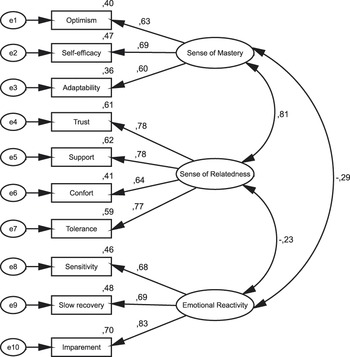
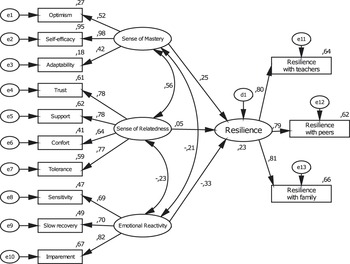
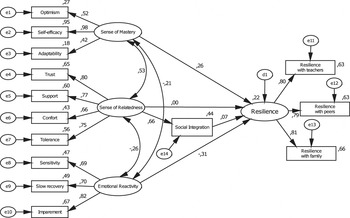
Integrating all the above relations, a path model with latent variables is proposed in which it is expected that: 1) resiliency factors will adjust to the Prince-Embury model, organized in three predictive resiliency dimensions: SM, SR and ER (See Figure 1); 2) SM will relate positively to resilience and ER will relate negatively, SR (contrary to the Price-Embury model) will not relate positively to other resiliency dimensions; 3) SR will relate positively to SAI, but we do not have any clear hypothesis about the direction an degree in which this variable will predict resilience. Therefore, it will be tested whether SAI mediates the effect of sense of relatedness on resilience will be tested (see figures 2 and 3).
Resiliency Scales for Children & Adolescents measurement model in Spanish population (CFA-1). (N = 544). Standardized estimates.

Standardized estimates for the path analysis model explaining resilience (PALV-1).

Standardized estimates for the path analysis model explaining resilience (PALV-3).

Method
Participants
A total of 1,083 Spanish students from three public schools and one charter school participated in this study. From them, 492 were females (45.4%) and 591 males (54.6%), distributed in different levels of Secondary Education and High School: 38% belonged to the First Cycle of Secondary School (ages 13–14), 41.4% to the Second Cycle (ages 15–16) and 20.7% were High School Students. Ages were comprised between 12 and 18 years old (Mean: 14.10 years; SD: 1.69). The sample, chosen in an incidental way, was divided randomly into two subsamples, half used in the initial estimation, and the other half used for cross-validation purposes.
Materials
Resiliency Scales for Children & Adolescents (RSCA)
Originally developed by Prince-Embury (Reference Prince-Embury2007), they were culturally adapted to be used with the Spanish population. The questionnaire is composed of 64 items, grouped in ten specific scales which are organized in three general dimensions: 1) Sense of Mastery Scale (SM), which includes optimism, self-efficacy and adaptability scales; 2) Sense of Relatedness Scale (SR), which includes trust, support, comfort and tolerance scales; and, 3) Emotional Reactivity Scale (ER), which includes sensitivity, recovery and impairment scales. Items are answered in a 5-level Likert scale, ranging from 0 (never) to 4 (almost always). Scale reliabilities in the American population were greater than .80 or .90, depending on the index used and age group. These scales were subjected to a double process of translation –English to Spanish and Spanish to English- by native experts in order to secure the fidelity of the translation. Once the initial and final redactions of each item were similar, the Spanish translation was accepted for the study.
Subjective Resilience Questionnaire (SRQ; Alonso-Tapia et al., Reference Alonso-Tapia, Nieto and Ruiz2013)
This questionnaire measures overall Subjective Resilience (SR) structured in three specific dimensions assessing the perceived degree of resilience when facing adverse events that students confront in their relationships with: teachers (RT), peers (RP) and parents/family (RF). It includes positive and negative worded items such as: “My teachers sometimes tell me that what I do or say is not correct, without trying to understand what is that I find difficult, but that doesn’t decrease my effort to learn.”, “Sometimes my friends criticize me for not doing something well instead of trying to help me, but that doesn’t decrease my effort to improve myself”, “If my parents ignore me when I need them to help me with a problem, I get discouraged and stop striving to solve it” (negative item). Reliability indexes for the overall SR scale and for the specific scales were good enough (SR: α = .85, RT: α = .74; RP: α = .64; FR: α = .65.
Social Integration Questionnaire (SIQ; Alonso-Tapia & Rodríguez-Rey, Reference Alonso-Tapia and Rodríguez-Rey2012)
It is a questionnaire with a 12-item single scale, six positively and six negatively worded, assessing the degree of subjective social integration of the student, that is, the extent to which a student considers that: 1) he/she is accepted or rejected by his/her peer group, 2) his/her peers may ask or not for help if they need him/her, and 3) he/she would count on them or not. The degree of agreement with each item content is assessed using 5-level Likert scales ranging from 1 (complete disagreement) to 5 (complete agreement). The original reliability of the scale was Cronbach alpha = .80. Examples of positive and negative items are: “My peers usually count on me to whatever they need” (positive) and “At school they speak badly about me behind my back” (negative).
Procedure
The Ethical Committee of the Universidad Autónoma de Madrid approved the study. All participating schools, parents and students gave their informed consent. Questionnaires included a ciphered code to identify the questionnaires belonging to a same student, ensuring that anonymity was preserved. Students filled in the questionnaires in 40 minute sessions, distributed into the groups and courses to which they belonged. One of the researchers, present during the completion of the questionnaires, provided participants with precise instructions on how to fill in the questionnaires.
Data analyses
Two series of models were estimated: first, the dimensional structure of the RSCA questionnaire was assessed; second, the effect of resiliency factors on explaining resilience was assessed.
In order to determine whether the RSCA data gathered in Spanish population fitted the structure originally found by Prince-Embury (Reference Prince-Embury2007), two confirmatory factor analyses (CFA) were carried out using data split at random into two subsamples: estimation and validation.
-
a) The structure suggested originally by Prince-Embury (Reference Prince-Embury2007) was used as baseline model (CFA-1). This structure assumed the existence of ten basic factors grouped in three second order ones (SM, SR and ER). Confirmatory factor analysis estimates were obtained using the maximum likelihood method, after examining whether data were adequate for the analysis (Mardia coefficient: 21.82 < 70; Mardia, Reference Mardia1970; Rodríguez & Ruiz, Reference Rodríguez and Ruiz2008). In order to assess model-fit, absolute fit indexes (χ2, χ2/df, GFI) , relative fit index (IFI) and non-centrality fit indexes (CFI, RMSEA) were used, as well as criteria for acceptance or rejection based on the degree of adjustment suggested by Hair, Black, Babin, and Anderson (Reference Hair, Black, Babin and Anderson2010): χ2/df < 5; GFI, IFI and CFI > .90; RMSEA < .08.
-
b) A multi-group confirmatory factor analysis (CFA-2) was performed for cross-validating the structure, using both the estimation and validation subsamples, and imposing different sets of equality restrictions. The estimation method, adjustment indexes and criteria for acceptance or rejection were the same as those for the CFA-1.
In order to know to what extent the Resiliency Scales and dimensions included in the model were capable of predicting resilience, two path analyses with latent variables (PALV-1 and PALV-2) were performed, PALV-1 using the estimation subsample, and PALV-2 cross-validating the model using both subsamples. After examining whether data were adequate for the analysis (Mardia: 33.29 < 70), the estimation method, the adjustment indexes and the criteria for acceptance or rejection were the same used to estimate CFAs.
Finally, in order to know whether social integration mediated the effect of SR on resilience, two additional path analyses with latent variables were performed, PALV-3 using the estimation subsample, and PALV-4 cross-validating the model using both subsamples. After examining whether data were adequate for the analysis (Mardia: 41.15 < 70), the estimation method, the adjustment indexes and the criteria for acceptance or rejection were the same used to estimate CFAs.
All models were estimated using IBM AMOS 22 software.
Results
Missing data
Missing data were substituted by central item score. This happened to 4% of subjects. Subjects with more than 3% of unanswered items were eliminated (1% of cases).
Confirmatory factor analyses (CFA)
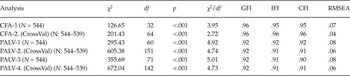
Figure 1 shows the standardized estimates of the confirmatory model as well as the squared multiple correlations. All the weights (λ) were statistically significant (p < .001). Table 1 shows the fit statistics for the proposed model (CFA-1). Chi-square statistic was significant, probably due to the sample size (Hair et al., Reference Hair, Black, Babin and Anderson2010), but the ratio χ2/df = 3.95 < 5, and the remaining indexes were well inside the limits that allowed the model to be accepted (GFI =.96, IFI =.95, and CFI =.95; RMSEA = .07).
Goodness-of-fit statistics for CFA of base model, of multi-group cross validation analysis and for Path Analysis with latent variables

CFA = confirmatory factor analysis; PALV = path analysis with latent variables.
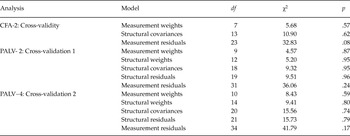
In order to see whether the model could generalize to other samples, a cross-validation analysis was carried out. Table 1 shows the fit statistics of the proposed model (CFA-2). In this case, again chi-square statistic was significant, probably due to the sample size, but the adjusted ratio χ2/df = 2.72 < 5 and the remaining indexes fell again well inside the usually accepted cut-off points (GFI = .96; IFI = .96; CFI = .96; RMSEA = .04 < .08). Comparison statistics included in Table 2 show that fit was not reduced significantly even if restrictions on measurement weights, structural weights, structural covariances, structural residuals and measurement residuals were imposed. Therefore, it may be concluded that strict measurement invariance and structural invariance hold in the two samples used.
Goodness-of-fit statistics for CFA and PALV cross-validation analyses

CFA = confirmatory factor analysis; PALV = path analysis with latent variables; df = degrees of freedom.
Path-analysis model of the effect of resiliency scales on resilience
Figure 2 shows the standardized estimates for the proposed path model (PALV-1). All the regression weights (λ, γ) were statistically significant (p < .001). Table 2 shows goodness-of-fit statistics for the proposed model. Concerning the degree of fit, the chi-square statistic was significant, probably due to the sample size, but the ratio χ2/df = 4.92 < 5, and the remaining indexes (GFI = .92; IFI = .92; CFI = .92; RMSEA = .08) were well inside the limits that allowed the model to be accepted. However, in this model the main concern was focused on γ regression coefficients, assessing the relation between SM, SR, and ER factor scores and SRS scores. As it can be seen, SM regression weight was γ = .25 (p < .001), SR regression weight was γ = .05 (p = .358), and ER regression weight was γ = –.33 (p < .001). Resilience did depend on the level of sense of mastery and emotional reactivity of individuals, and this two factors were negatively related with each other, in a significant way (ϕ = –.21; p < .001). However sense of relatedness did not show any predictive effect on resilience, additional to effects exhibited by other resiliency factors. The cross-validation model (PALV-2) showed that fit was not deteriorated when imposing equality restrictions between estimation and validation samples (Table 2).
Path-analysis of the effect of resiliency scales on resilience through social integration
Figure 3 shows the additional mediating effect of social integration on the effect of sense of relatedness over resilience. Table 1 shows the goodness-of-fit statistics for the proposed model (PALV-3). Chi-square statistic was significant, and the ratio χ2/df = 5.00 < 5, fell on the standard limit that allowed the model to be accepted. The remaining adjustment indexes were inside the proposed limits: GFI = .92; IFI = .91; CFI = .91; RMSEA = .08. All the measurement weights (λ) were significant (p < .001). The direct effect of sense of mastery (γ = .26, p < .001) and emotional reactivity (γ = –.31, p < .001), both resiliency dimensions, on resilience did not differ substantially from the previous model. The direct effect of sense of relatedness on resilience (γ = .00, p < .001) was not statistically significant, while the direct effect on social integration was positive and significant (γ = .66, p < .001). The direct effect of social integration on resilience was small and not-significant (β = .07, p = .255) giving a non-significant indirect effect of sense of relatedness on resilience.
Within the multi-group cross-validation model (PALV-4) chi-square statistic was significant, but the adjusted ratio χ2/df = 4.73 < 5, and the remaining fit indexes (GFI = .92, IFI = .91, and CFI = .91, RMSEA = .06) were inside the limits allowing the model to be accepted.
Discussion and conclusions
The main objectives of this research were, first, to study whether the structure of the RSCA in our Spanish sample fitted the Prince-Embury Model, being this the first adaptation of this questionnaire to the Spanish population; second, to test the predictive relationships of resiliency variables SM, SR and ER with resilience; and, third, to study the role that social integration plays. What kind of contributions has this study made in relation to these objectives?
In the first place, our results have provided evidence supporting the initial expectancies on the structure validity and reliability of the Resiliency Scales in the Spanish sample. A stable and good fitting structure was found supporting its use among Spanish adolescents.
In the second place, regression analyses have shown that SM and ER are capable of predicting the level of resilience as expected: the higher SM, the higher resilience, and the lower ER, the higher resilience. Nevertheless, the results have also shown that SR does not predict resilience beyond the variance explained by SM and ER, as the Prince-Embury model implied, a fact that can be explained as follows. If a boy or a girl are surrounded by people who constantly help them -a protective environment-, they will probably overcome the difficulties that life presents them as long as help is available; but if help is not available, the result will depend, first, on whether they have learned to take the initiative of looking for solutions or, on the contrary, on whether they have learned to use a help seeking behavior as the first and main strategy; and second, on whether they have learned to self-regulate their own emotions. In the first case, the important point is that, besides having a supporting environment (SR), they are able to solve problems by “themselves” -they are high in SM - and so, they would not ask for help until having tried to solve the problem by themselves has proved to be unsuccessful. This way of coping makes them “resilient”. Therein lies the high importance of strengthening SM. Nevertheless, if the first strategy is asking for help, children do not learn to cope with adverse situations in the absence of social help. In a similar way, the fact that SM and ER correlate negatively implies the possibility of controlling and self-regulating the own emotional response: the higher SM, the lower ER, and the higher resilience.
The fact that SR exhibits a high effect on social acceptance and integration (SAI) and that, at the same time, SAI does not have an effect on resilience also supports our point of view. It is a fact that positive peer relationships are a stable predictor of long-term adjustment. Prosocial behaviors with peers are significantly related to decreased aggression, asocial behavior, exclusion, anxiety, hyperactivity, and victimization (Gulay, Reference Gulay2011). In line with this, it would be expected a high correlation between sense of relatedness and social acceptance and integration, as it has happened. However, though being socially adapted, accepted and integrated may help to achieve well-being, it does not warrant that, in the absence of social help, people will be able to bounce back from significant adverse situations.
The above explanation runs against Luthar’s point of view when she states that: “Resilience rests, fundamentally, on relationships” (Luthar, Reference Luthar, Cicchetti and Cohen2006, p. 780). Relationships are good and necessary, as they make well-being easy. Nonetheless, many times people have to confront alone adverse situations and so, it is better to strengthen SM and emotion self-regulation if we want our children, adolescents and youngsters to act in a resilient way.
Our results go in line with those of Werner and Smith (Reference Werner and Smith1992). They found that resilient children were not especially popular or apart of the crowd. Their research suggested that, in the face of adversity, the internal mechanisms that help people to be able to relate to others in a meaningful and long-lasting way are the key to be resilient, and not only the fact of having supportive relationships.
Our results have theoretical and practical implications, as well as limitations. First, from a theoretical point of view, the explanation to our data is a plausible hypothesis that needs to be tested further, given that all supporting evidences have been raised using correlational techniques. Second, as long as our explanation is correct, children should be allowed to confront challenges and difficulties by themselves before helping them, and they should be taught to ask for help once they have tried to solve the difficulty for themselves, since overprotection seems to be an obstacle to resilience. Additionally, according to Olsson et al. (Reference Olsson, Bond, Burns, Vella-Brodrick and Sawyer2003), other personal characteristics exist that can configure resiliency and have not been studied.