1. Introduction
Peraluminous leucogranites form a small but genetically important component of granitic intrusions in most orogenic belts of various ages (e.g. Barbarin, Reference Barbarin1996; Williamson et al. Reference Williamson, Shaw, Downes and Thirlwall1996; Nabelek & Bartlett, Reference Nabelek and Bartlett1998; Frost et al. Reference Frost, Barnes, Collins, Arculus, Ellis and Frost2001). Numerous studies on various types of peraluminous leucogranites worldwide reveal that they are genetically diverse and can be produced from various sources and through different evolutionary processes (e.g. Frost et al. Reference Frost, Barnes, Collins, Arculus, Ellis and Frost2001). Given the fact that the only consistent features they share are their high silica content and strongly peraluminous nature, any attempt at classifying them as one specific type under any genetic or tectonic geochemical classification schemes seem unlikely. However, applying an additional constraint like REE tetrad patterns, such peraluminous leucogranites can be useful geodynamic tracers, due to their similar characteristics to A-type granitoids and their consistent occurrence within a post-orogenic extensional tectonic setting (Sibel, Hohndorf & Wendt, Reference Sibel, Hohndorf and Wendt1995; Williamson et al. Reference Williamson, Shaw, Downes and Thirlwall1996; Förster et al. Reference Förster, Tischendorf, Trumbull and Gottesmann1999; Monecke et al. Reference Monecke, Kempe, Monecke, Sala and Wolf2002; Jahn et al. Reference Jahn, Wu, Capdevila, Martineau, Zhao and Wang2001, Reference Chen and Jahn2004a; Wu et al. Reference Wu, Sun, Jahn and Wilde2004; Sun et al. Reference Sun, Zhou, Chen, Li, Zhou, Wang and Shen2005). Their recognition may allow the determination of the tectonic setting of ancient orogens.
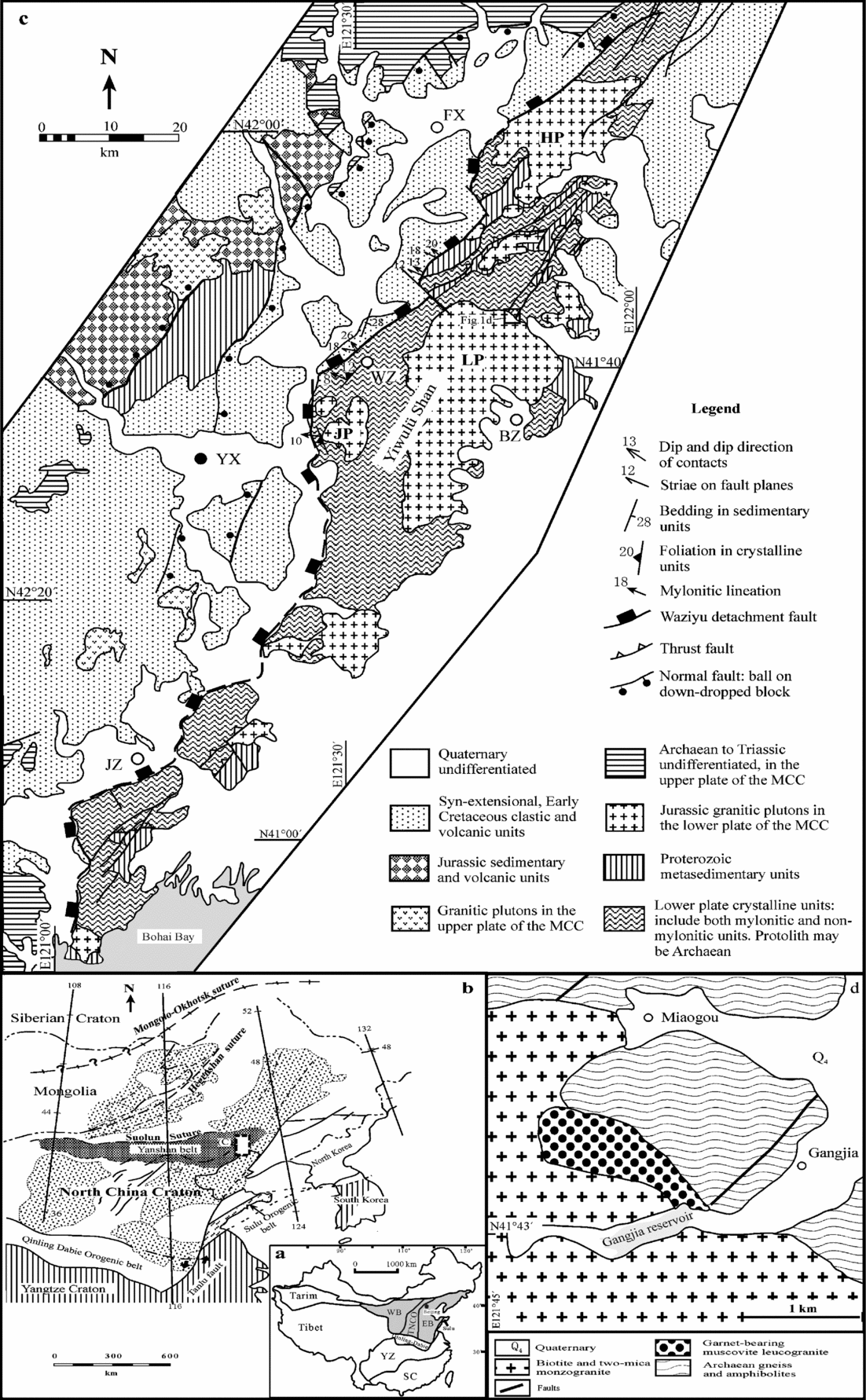
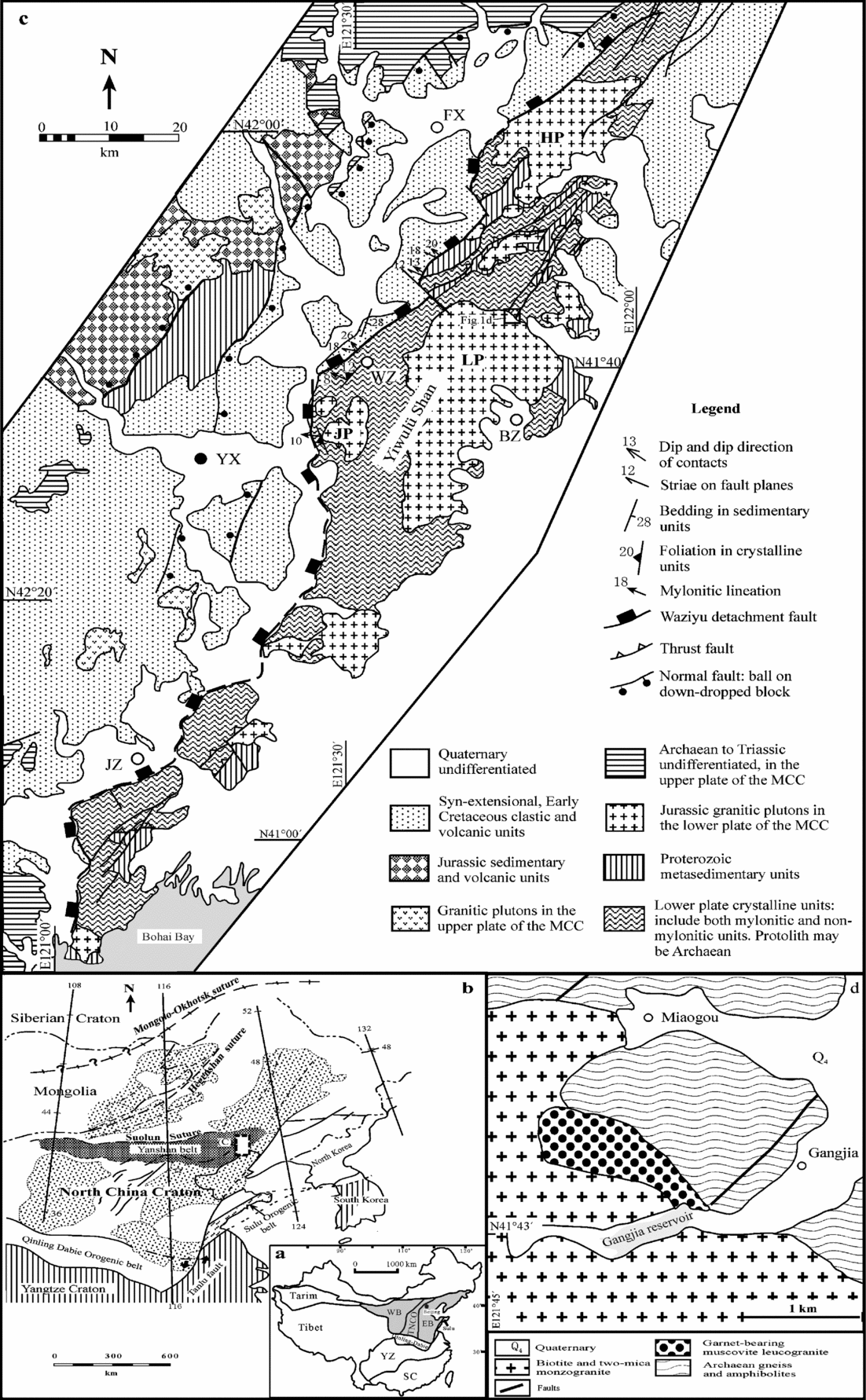
The Yiwulüshan range lies in Western Liaoning Province, which constitutes the eastern segment of the Yanshan orogenic belt in the North China craton (Fig. 1a, b). It is occupied by voluminous Mesozoic granitoid plutons (Fig. 1c). Recent zircon U–Pb geochronological studies focusing on Yiwulüshan and Western Liaoning (Wu, Yang & Zhang, Reference Wu, Yang and Zhang2006) indicate that the Yiwulüshan batholiths were mainly emplaced during middle to late Jurassic times. Geochemically, the Yiwulüshan granitoids display many close compositional similarities to high-silica adakites (Liu et al. Reference Liu, Sun, Liu and Zhai2002). In this paper, we present new age, geochemical and Sr–Nd isotopic data for a peraluminous leucogranite pluton, the Gangjia stock, that intruded into the Lüshan pluton from the Yiwulüshan batholiths (Fig. 1d). The stock shows spectacular tetrad-like REE patterns and other non-charge-and-radius-controlled trace elements. Zircon U–Pb SHRIMP dating shows a late Jurassic emplacement time. The first documentation of such unusual magmatism in Yiwulüshan carries important implications for further constraining the controversial tectonic setting of the prolonged Jurassic magmatism in Western Liaoning.
(a) Major tectonic divisions of China, where YZ and SC denote the Yangtze craton and South China orogen. Also shown are the subdivisions of the North China craton (Zhao et al. Reference Zhao, Wilde, Cawood and Sun2001), where EB, TNCO and WB denote the Eastern block, Trans-North China orogen and Western block, respectively. (b) Simplified geological map showing the major tectonic units of the North China craton and its surrounding areas, with the study area indicated by a rectangle (modified from Davis et al. Reference Davis, Zheng, Wang, Darby, Zhang, Gehrels, Hendrix and Davis2001). Stippled fields denote the Mesozoic sedimentary basins. Dashed lines within the Mesozoic sedimentary basins are the trends of Jurassic–Cretaceous extensional faults. Between the Suolun Suture and the Mongolo–Okhotsk suture is the Central Asian Orogenic Belt. (c) Simplified tectonic map of the Yiwulüshan, western Liaoning province (adopted from Darby et al. Reference Darby, Davis, Zhang, Wu, Wilde and Yang2004), showing major structures and plutons. LP – Lüshan pluton; JP – Jianlazishan pluton; HP – Hengshan pluton. BZ – Beizhen; FX – Fuxin; YX – Yixian; JZ – Jinzhen; WZ – Waziyu. MCC – metamorphic core complex. (d) Geological sketch map of the Gangjia leucogranitic stock (modified from LBGMR, 1998).
2. Geological setting
The Yanshan belt is located along the northern margin of the North China craton (Fig. 1a, b), which is bounded on the south by the Palaeozoic to Triassic Qinling–Dabie–Sulu orogenic belt (Meng & Zhang, Reference Meng and Zhang2000) and on the north by the Central Asian Orogenic Belt (Davis et al. Reference Davis, Zheng, Wang, Darby, Zhang, Gehrels, Hendrix and Davis2001).
As evidenced by the presence of ≥3.6 Ga crustal remnants exposed at the surface or in the lower crustal xenoliths (Liu et al. Reference Liu, Nutman, Compston, Wu and Shen1992; Zheng et al. Reference Zheng, Griffin, O'Reilly, Lu, Wang, Zhang, Wang and Li2004), the North China craton has been regarded as one of the world's oldest cratons. It consists of two Archaean continental blocks, namely, the Eastern and the Western, separated by a Proterozoic orogenic belt (Fig. 1a; Zhao et al. Reference Zhao, Wilde, Cawood and Sun2001). The basement of the North China craton is composed of amphibolite to granulite facies Archaean grey tonalitic gneisses and greenstones and Palaeoproterozoic khondalites and an overlying unmetamorphosed sedimentary cover from the Mesoproterozoic onwards (Zhao et al. Reference Zhao, Wilde, Cawood and Sun2001, Reference Zhao, Sun, Wilde and Li2005). It was widely believed that the Eastern and Western Blocks developed independently from the late Archaean to early Palaeoproterozoic and collided to form a coherent craton at c. 1.85 Ga (Zhao et al. Reference Zhao, Wilde, Cawood and Sun2001, Reference Zhao, Sun, Wilde and Li2005).
Unlike other Archaean cratons, the North China craton experienced widespread tectonothermal reactivation during and after the Palaeozoic, mainly due to the compound evolutionary history of the circum-cratonic orogenic belts. To the north of the craton, the generally EW-trending Central Asian Orogenic Belt was formed through south-directed subduction and arc–arc, arc–continent, and continent–continent collision, mainly during the Palaeozoic (Davis et al. Reference Davis, Zheng, Wang, Darby, Zhang, Gehrels, Hendrix and Davis2001; Xiao et al. Reference Xiao, Windley, Hao and Zhai2003). During this time, multiple Ordovician to Permian oceanic arcs and the Mongolian micro-continent were amalgamated to the active margins of the North China craton (Davis et al. Reference Davis, Zheng, Wang, Darby, Zhang, Gehrels, Hendrix and Davis2001). The widespread occurrence of Palaeozoic ophiolites, Palaeozoic to Triassic blueschists, and synchronous igneous rocks suggest that southward subduction commenced in the early Palaeozoic and that collision was completed in the early Triassic (Davis et al. Reference Davis, Zheng, Wang, Darby, Zhang, Gehrels, Hendrix and Davis2001, Reference Darby, Davis, Zhang, Wu, Wilde and Yang2004; Buchan et al. Reference Buchan, Pfänder, Kröner, Brewer, Tomurtogoo, Tomurhuu, Cunningham and Windley2002). The Solonker suture records the termination of the Central Asian Orogenic Belt (Xiao et al. Reference Xiao, Windley, Hao and Zhai2003). With the gradual exhaustion of the palaeo-Asian Ocean Realm (Wang & Mo, Reference Wang and Mo1995), the North China block and the southern Mongolia terranes were amalgamated and behaved as a combined North China–Mongolian plate (Davis et al. Reference Davis, Zheng, Wang, Darby, Zhang, Gehrels, Hendrix and Davis2001).
Following early Mesozoic crustal extension of still uncertain origin (Meng, Reference Meng2003), as documented by the synchronous occurrence of alkali igneous intrusions (Yan et al. Reference Yan, Mu, Xu, He, Tan, Zhao and He2000), late Triassic metamorphic core complexes (Davis et al. Reference Davis, Xu, Zheng and Zhang2004) and early Jurassic rifted basins (Ritts, Darby & Cope Reference Ritts, Darby and Cope2001), the North China–Mongolian plate became the locus of the Yanshanian orogeny during middle Jurassic to earliest Cretaceous time, in response to the continental collision of Siberia and the North China–Mongolian plate along the Mongol–Okhotsk suture (Yin & Nie, Reference Yin, Nie, Yin and Harrison1996; Zorin, Reference Zorin1999). The resulting fold-thrust deformation is well-documented in the Yanshan belt (Davis et al. Reference Davis, Wang, Zheng, Zhang, Zhang and Gehrels1998, Reference Davis, Zheng, Wang, Darby, Zhang, Gehrels, Hendrix and Davis2001). Subsequent to this period of crustal shortening, another intensive extensional deformation developed in the North China–Mongolian plate during early Cretaceous time, as manifested by development of extensional basins and metamorphic core complexes, and widespread alkali volcanism and plutonism (Meng, Reference Meng2003, and references therein).
Western Liaoning represents the eastern segment of the Yanshan belt and experienced a complex history during Mesozoic time. Middle Jurassic contractional deformation is evidenced by well-developed thin-skinned thrusts (Davis et al. Reference Davis, Zheng, Wang, Darby, Zhang, Gehrels, Hendrix and Davis2001; Zhang et al. Reference Zhang, Wang, Wang, Wu, Zhang and Sun2002). In the Cretaceous, the area underwent extensional deformation, resulting in the development of a number of rift-related basins (e.g. the Fuxin basin: Xu et al. Reference Xu, Middleton, Xue and Wang2000), the Waziyu metamorphic core complex (Zhang, Wang & Ma, Reference Zhang, Sun, Zhou, Zhou, Fan and Zheng2003; Darby et al. Reference Darby, Davis, Zhang, Wu, Wilde and Yang2004) and widespread alkali volcanism (Zhang et al. Reference Zhang, Wang and Ma2003).
As shown in Figure 1c, the Waziyu metamorphic core complex has an east–west dimension of 25 km and a north–south dimension of 60 km. The core consists predominantly of Mesozoic granitoid plutons and their country rocks, which include high- to medium-grade migmatitic orthogneiss and amphibolites of the Archaean crystalline basement. Plutons are granodioritic to granitic and grade outward into augen gneiss or migmatite. At structurally higher levels is the well-developed NNE-trending Waziyu ductile shear zone that, together with the related normal fault above it along the eastern margin of the Fuxin basin, separates the core of the dome (the lower plate) from the upper plate of the unmetamorphosed to low-grade metamorphosed middle–late Proterozoic Changcheng System and the Mesozoic volcano-sedimentary rocks.
As compiled by Wu, Yang & Zhang (Reference Wu, Yang and Zhang2006), Mesozoic intrusions from Western Liaoning appear to occur in four episodes: the first episode of rare Triassic dioritic magmatism (221±2 Ma); the second and third episodes of voluminous granitic magmatism represented by the Jurassic Jianchang (175–190 Ma) and Yiwulüshan batholiths respectively; and the fourth episode of the limited early Cretaceous granitic magmatism. Therefore, Middle to late Jurassic times saw the most voluminous plutonism in Western Liaoning.
As part of this voluminous magmatism, the Lüshan pluton crops out in the core of the Yiwulüshan as a north–northeast elongate dome (Fig. 1c) and covers an area of over 250 km2. The pluton is mainly composed of monzogranite and granodiorite. For the age of this composite pluton, we obtained a TIMS zircon U–Pb age of 164±9 Ma (Zhang et al. unpub. data). Wu, Yang & Zhang (Reference Wu, Yang and Zhang2006) also reported two zircon U–Pb ages based on the LA-ICPMS method: a monzogranite sample yields an emplacement age of 163±3 Ma (n=11) and an inherited age of 206±4 Ma (n=2), while another granodiorite sample gives an emplacement age of 153±2 Ma (n=14) and two inherited ages of 216±7 Ma (n=7) and 187±6 Ma (n=6). The pluton bears a remarkable geochemical resemblance to the high-silica adakites, such as low abundances of garnet-compatible elements (Y and HREE), high contents of plagioclase-compatible Sr and Ba, high ratios of Sr/Y and La/Yb, absence of significant Eu anomalies, and concave-upward shapes of chondrite-normalized HREE patterns (Liu et al. Reference Liu, Zhai and Liu2002).
3. Petrology
The Gangjia granite stock, named after Gangjia village, is exposed near the Gangjia reservoir and intrudes the Lüshan pluton (LBGMR, 1998) (Fig. 1d). It is mainly composed of garnet-bearing muscovite leucogranite, including near-equigranular granite (samples FX18-20 and LX13-14) and microgranite with very fine-grained matrix and phenocrysts (samples FX11-1 to FX11-8). The mineral assemblage includes quartz (30–40%), alkali-feldspar (30–55%), albite (5–20%), muscovite (1–8%) and garnet (1–5%). Quartz is present both as rounded phenocrysts and as small grains in the matrix. K-feldspar phenocrysts are commonly rounded and partially or totally exsolved into microcline. Albite commonly occurs as euhedral to subhedral laths, but it also forms small anhedral grains in the matrix of microgranites. Primary muscovite is present as large anhedral crystals and commonly found between quartz and feldspar grains, but never occurs as inclusions within them. Secondary symplectic muscovite is locally found in the matrix of microgranites. Garnet occurs both as large anhedral interstitial grains in the granites and small euhedral grains in the matrix of microgranites. It also occasionally occurs as inclusions within phenocrysts of K-feldspar and albite. The presence of primary muscovite and magmatic garnet and absence of biotite indicate the highly fractionated nature of the rocks.
4. Analytical techniques
Zircons were separated using conventional heavy liquid and magnetic techniques and by hand-picking under a binocular microscope. Zircon U–Pb analyses were performed using the Sensitive High-Resolution Ion Microprobe (SHRIMP II) at the Institute of Geology, Chinese Academy of Geological Sciences, Beijing. Zircons, together with grains of the Temora zircon standard (TEM: see Black et al. Reference Black, Kamo, Aleiikoff, Davis, Korsch and Foudoulis2003), were mounted in epoxy and the grains sectioned by grinding and polishing. Zircons were studied using transmitted and reflected light photographs and cathodoluminescence (CL) images at the Institute of Geology and Geophysics, Chinese Academy of Sciences (IGGCAS), and the mount was vacuum-coated with a 50 nm layer of high-purity gold. Detailed analytical procedures are similar to those described by Williams (Reference Williams, Mckinbben, Shanks and Ridey1998). Interelement fractionation in ion emission of zircon was corrected relative to the RSES references, using SL13 (572 Ma, 238 ppm) for the final calibration. Due to the small amount of 207Pb present in young zircons, which results in low count rates and high analytical uncertainties, the 206Pb/238U ratios are generally considered to be the most reliable for concordant Phanerozoic zircons (Compston et al. Reference Compston, Williams, Kirschivink, Zhang and Ma1992). The SHRIMP analytical data presented in Table 1 are the mean values of five cycle analyses of each zircon spot. Data were processed using SQUID (1.02) and ISOPLOT (Ludwig, Reference Ludwig2001). The common Pb corrections were made using the measured 204Pb. Uncertainties quoted in the data table are ±1σ, whereas the weighed mean ages are quoted at ±2σ.
SHRIMP U–Pb zircon data for the Gangjia leucogranites

1f 206 = percentage of common 206Pb in the total measured 206Pb.
For elemental and isotopic analyses, samples were ground in an agate mill to ∼200 mesh. Major oxides were analysed using a Phillips PW 2400 X-ray fluorescence spectrometer (XRF) and the trace element abundances were obtained on a VG-PQII ICP-MS at IGGCAS. Samples were dissolved in distilled HF+HNO3 in 15 ml Savillex Teflon screw-cap beakers at 120°C for six days, dried and then diluted to 50 ml for analysis. A blank solution was prepared and the total procedural blank was <50 ng for all trace elements. Indium was used as an internal standard to correct for matrix effects and instrument drift. Analytical uncertainty (2σ) is estimated to be ±5% for trace elements with abundances ≥10 ppm, and ca.±10% for those ≤10 ppm.
For Sr–Nd isotopic analyses, sample powders were dissolved in Teflon bombs after being spiked with 84Sr, 87Rb, 150Nd and 147Sm tracers prior to HF+HNO3 dissolution. Rb, Sr, Sm and Nd were separated using conventional ion exchange procedures and measured using a Finnigan Mat 262 multicollector mass spectrometer at IGGCAS. Procedural blanks were <100 pg for Sm and Nd and <500 pg for Rb and Sr. 143Nd/144Nd were corrected for mass fractionation by normalization to 146Nd/144Nd = 0.7219, and 87Sr/86Sr ratios normalized to 86Sr/88Sr = 0.1194. Repeated analyses yielded 87Sr/86Sr of 0.710253±0.000015 for the NBS-987 standard and 143Nd/144Nd of 0.5511853±0.000009 for the La Jolla standard. The decay constants used in age computation are 87Rb = 0.0142 Ga−1 and 87Sm = 0.00654 Ga−1.
Sm–Nd model ages were calculated in two ways. The one-stage model age (TDM1) is calculated assuming a linear Nd isotopic growth of the depleted mantle reservoir from ϵNd = 0 at 4.56 Ga to ϵNd = +10 at the present:
![\begin{eqnarray}
{\rm T}_{{\rm DM}1}&=&1/\lambda \,\ln \{1 + [(^{143} {\rm Nd}/^{144} {\rm Nd})_{{\rm sample}} ] \,{-}\, 0.51315\} /\\
&&[(^{147} {\rm Sm}/^{144} {\rm Nd})_{{\rm sample}} - 0.21317],\end{eqnarray}]](https://static.cambridge.org/binary/version/id/urn:cambridge.org:id:binary:20180417041825710-0201:S0016756807004311:S0016756807004311_eqnUn1.gif?pub-status=live)
where s = sample and λ = decay constant of 147Sm (0.00654 Ga−1).
Since TDM1 ages depend strongly on the 147Sm/144Nd ratios, the highly fractionated nature of the Gangjia granites has resulted in increasing Sm/Nd and thus caused inaccurate and diverse TDM1 ages (Table 3). Therefore, we adopt a refined equation similar to that of Liu et al. (Reference Liu, Siebel, Li and Pan2005) for calculating the depleted mantle model age, TDM2, instead of TDM1:
![\begin{eqnarray}
&&{\rm T}_{{\rm DM}2} \,{=}\, 1/\lambda \,{\times}\, \ln \left\{1 \,{+}\, [(^{143} {\rm Nd}/^{144} {\rm Nd})_{{\rm sample}} \,{-}\, ({\rm e}^{{\rm \lambda t}} \,{-}\, 1)\right.\nonumber\\
&&\quad \left.\times\,[(^{147} {\rm Sm}/^{144} {\rm Nd})_{\rm sample}\,{-}\,(^{147} {\rm Sm}/^{144} {\rm Nd})_{\rm s} ]\,{-}\,(^{143} {\rm Nd}/\right.\nonumber\\
&&\quad \left.\times\,^{144} {\rm Nd})_{{\rm DM}} ]/[(^{147} {\rm Sm}/^{144} {\rm Nd})_{\rm s} - (^{147} {\rm Sm}/^{144} {\rm Nd})_{{\rm DM}} ]\right\}\end{eqnarray}]](https://static.cambridge.org/binary/version/id/urn:cambridge.org:id:binary:20180417041825710-0201:S0016756807004311:S0016756807004311_eqnUn2.gif?pub-status=live)
where the subscripts S and DM refer to the source rock and the depleted mantle, respectively, and t is the emplacement age of the granite stock. The lowest 147Sm/144Nd value was chosen from the samples to represent the (147Sm/144Nd)s value in order to offset Sm/Nd fractionation to a minimum.
5. Results
5.a. Geochronology
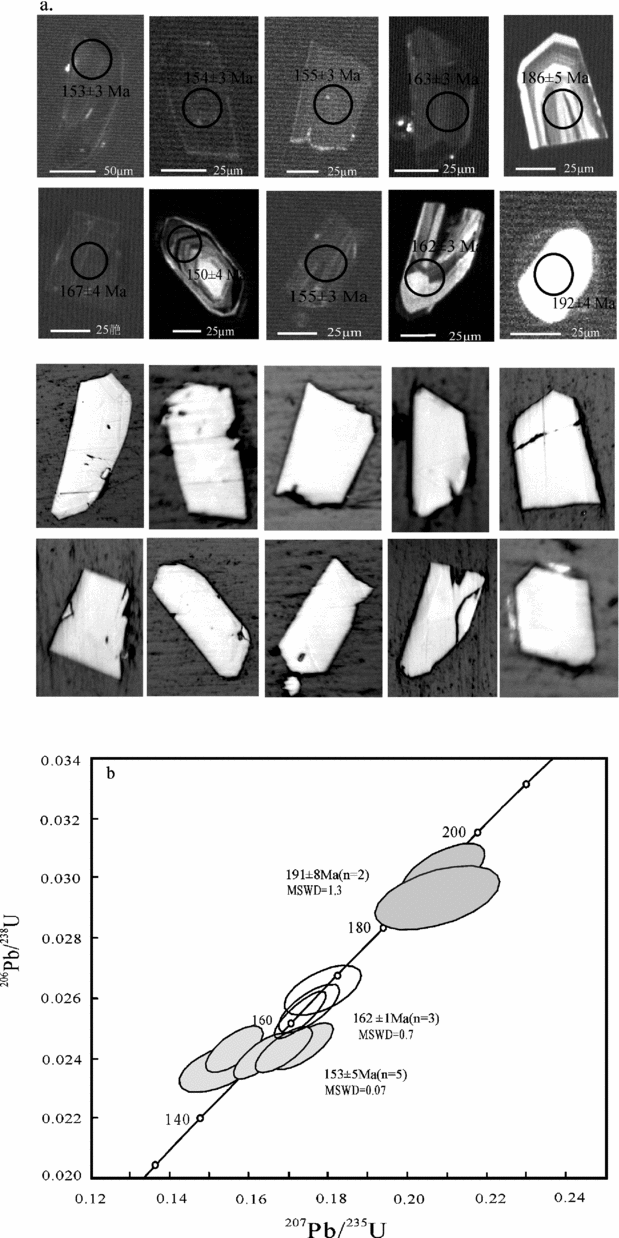
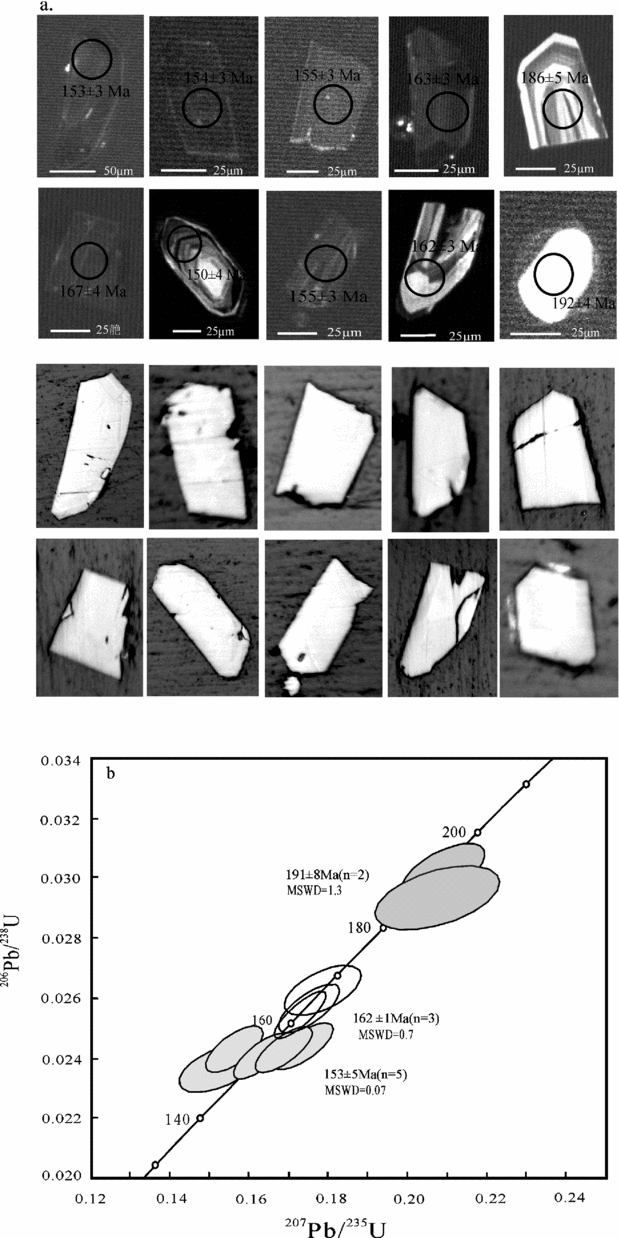
Zircons from sample FX18 are light yellow, 40–110 μm in length (length/width ratios between 3:1 and 1.5:1), transparent and locally with few inclusions and fractures (Fig. 2a). They are mostly sub-euhedral columnar crystals. Because of the rarity and small size of zircons, we only managed to conduct analysis on ten zircons. As shown in Figure 2b, the main population comprises five analyses forming a nearly concordant group and has a weighted mean age of 153±5 Ma with an MSWD of 0.07. This age is taken to represent the crystallization age of the Gangjia stock. In addition, the other five analyses of zircons give two inherited concordant ages of 191±8 Ma (n=2) and 162±1 Ma (n=3) (Fig. 2b), which are consistent with the inherited and emplacement ages of the host Lushan pluton, respectively.
(a) Cathodoluminescence (CL) and transmitted light (TL) images of the dated zircons and (b) SHRIMP U–Pb isotope analyses of zircons from the Gangjia leucogranites.
5.b. Major and trace element chemistry
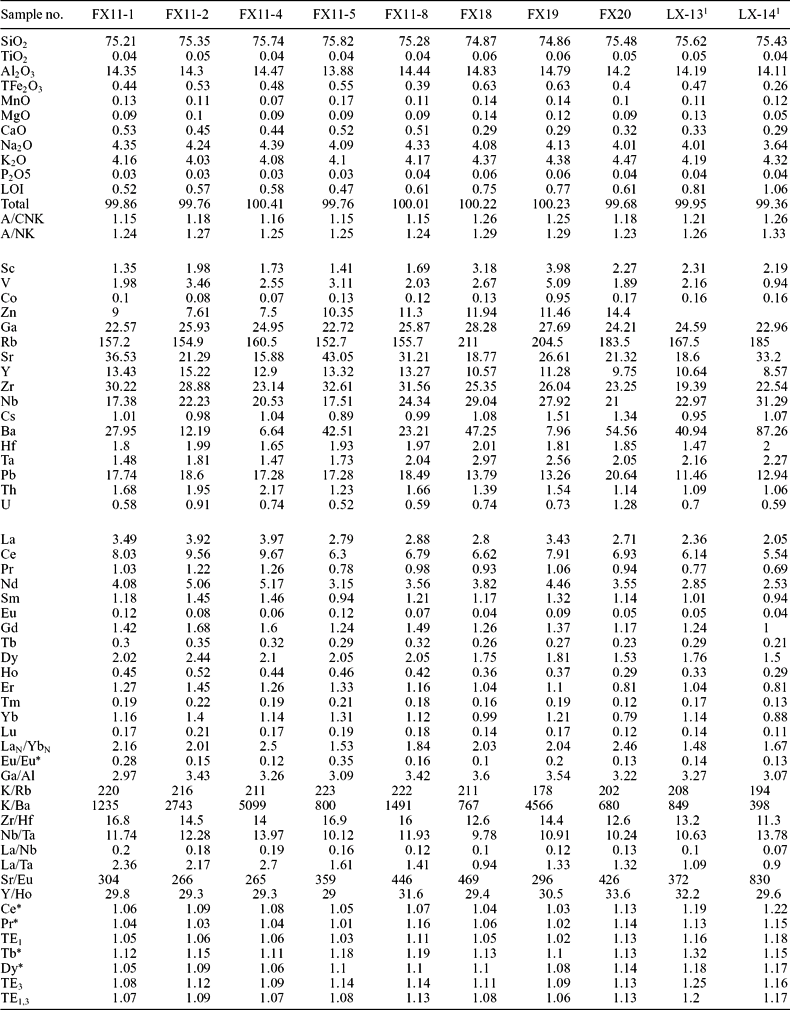
Major and trace element compositions of the Gangjia stock are given in Table 2. The Gangjia granites are highly siliceous with a narrow SiO2 range from 74.86 to 75.82%. They have relatively high contents of alkalis, with total K2O+Na2O varying from 7.96 to 8.51%. They have low abundances of Fe2O3t (0.26–0.63%), MnO (0.07–0.17%), MgO (0.05–0.13), CaO (0.29–0.53), TiO2 (0.04–0.06%) and P2O5 (<0.1%), while Al2O3 contents range from 13.9% to 14.8%. Their bulk composition shows a strongly peraluminous character with A/CNK>1.14.
Major and trace element data for the Gangjia leucogranites
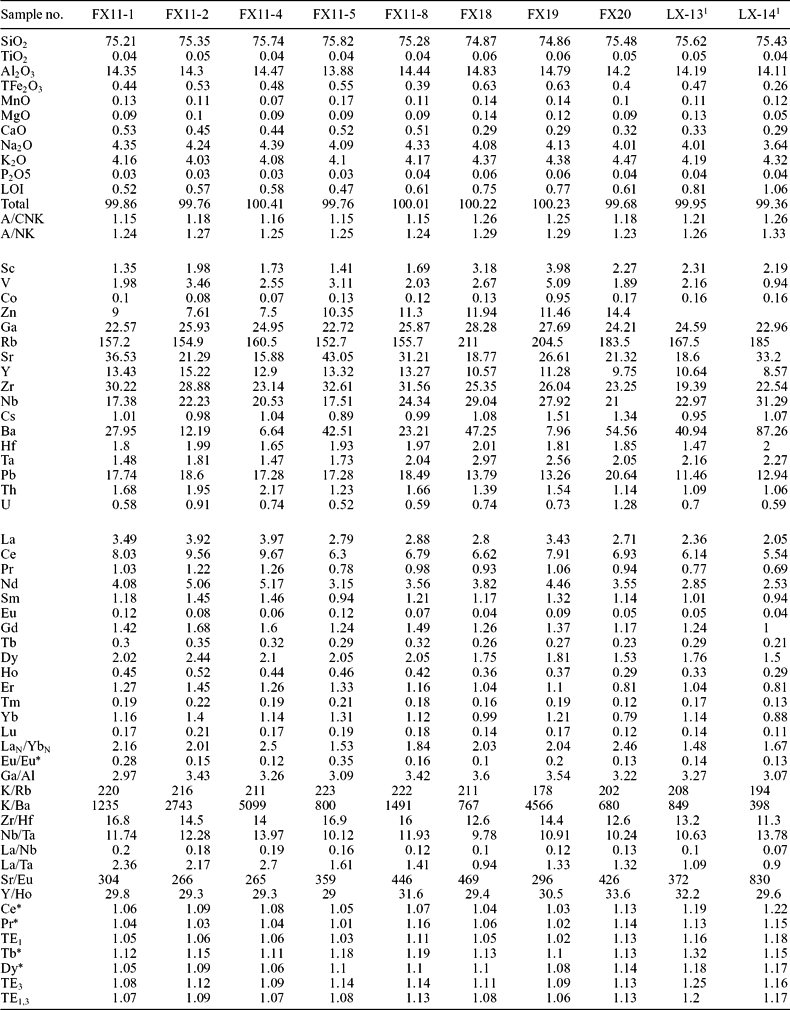
(1) Data from Liu, Zhai & Liu (Reference Gao, Rudnick, Carlson, McDonough and Liu2002).
(2) Ce*=CeN/(LaN2/3×NdN1/3), Pr*=PrN/(LaN1/3×NdN2/3), TE1=(Ce*×Pr*)1/2, Tb*=TbN/(GdN2/3×HoN1/3), Dy*=DyN/(GdN1/3×HoN2/3), TE3=(Tb*×Dy*)1/2, TE1,3=(TE1*×TE3*)1/2, Eu*=EuN/(SmN×GdN)1/2.
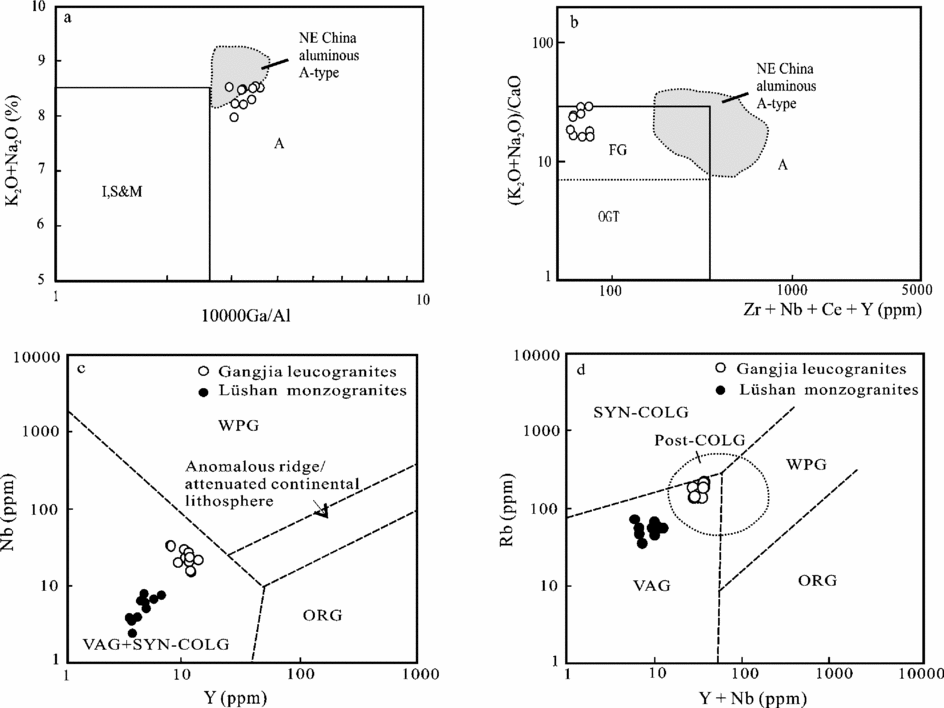
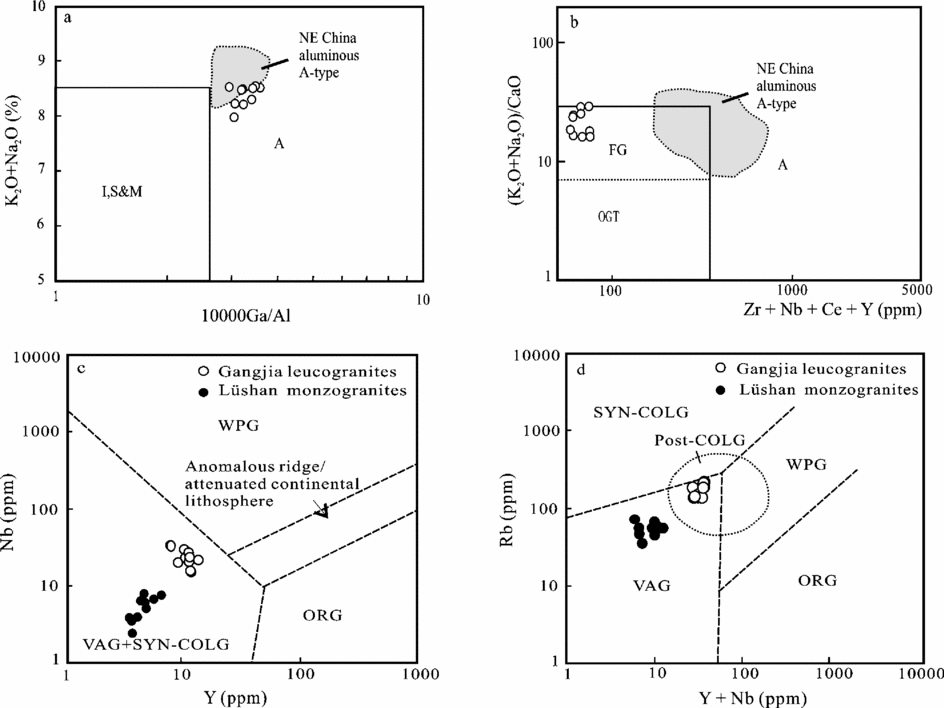
In terms of trace elements, the Gangjia granites are characterized by low abundance in Ba and Sr, high Rb/Sr ratios and high concentrations in Ga, Nb, Ce and Y. Their 10000 × Ga/Al ratios range from 2.97 to 3.54, which are slightly lower than the global average of 3.75 for A-type granites (Whalen, Currie & Chappell, Reference Whalen, Currie and Chappell1987), but comparable to the aluminous A-type granites in NE China (e.g. Wu et al. Reference Wu, Sun, Li, Jahn and Wilde2002). In the discrimination diagrams of Whalen, Currie & Chappell (Reference Whalen, Currie and Chappell1987), the Gangjia granites plot on the A-type granite field in the K2O+Na2O v. 10000 Ga/Al diagram (Fig. 3a), but on the fractionated felsic I-type granite field in the (K2O+Na2O)/CaO v. (Zr+Nb+Ce+Y) diagram (Fig. 3b). In the Nb v. Y and Rb v. Y+Nb tectonic discriminator diagrams of Pearce, Harris & Tindle (Reference Pearce, Harris and Tindle1984) (Fig. 3c, d), they plot in the VAG (volcanic arc granite) field and also exclusively fall in the post-collisional field of Pearce (Reference Pearce1996), which suggests the beginning of the transition from calc-alkaline to alkaline magmatic series in orogenic to post-orogenic tectonic settings (Barbarin, Reference Barbarin1999).
(a) K2O+Na2O v. 10000 Ga/Al and (b) (K2O+Na2O)/CaO v. (Zr+Nb+Ce+Y) discrimination diagrams of Whalen, Currie & Chappell (Reference Whalen, Currie and Chappell1987), showing both A-type and fractionated nature of the Gangjia granites. OGT – orogenic granite types: unfractionated I- and S-type granites; FG – fractionated felsic I- and S-type granites; (c) Nb v. Y and (d) Rb v. Y+Nb tectonic discrimination diagrams of Pearce, Harris & Tindle (Reference Pearce, Harris and Tindle1984). VAG – volcanic arc granites; WPG – within-plate granites; syn-COLG – syn-collisional granites; COLG – collisional granites, ORG – oceanic ridge granites, fields are from Pearce, Harris & Tindle (Reference Pearce, Harris and Tindle1984) and post-COLG (post-collisional granites) from Pearce (Reference Pearce1996). Data for the Lüshan pluton are from Zhang et al. (unpub. data).
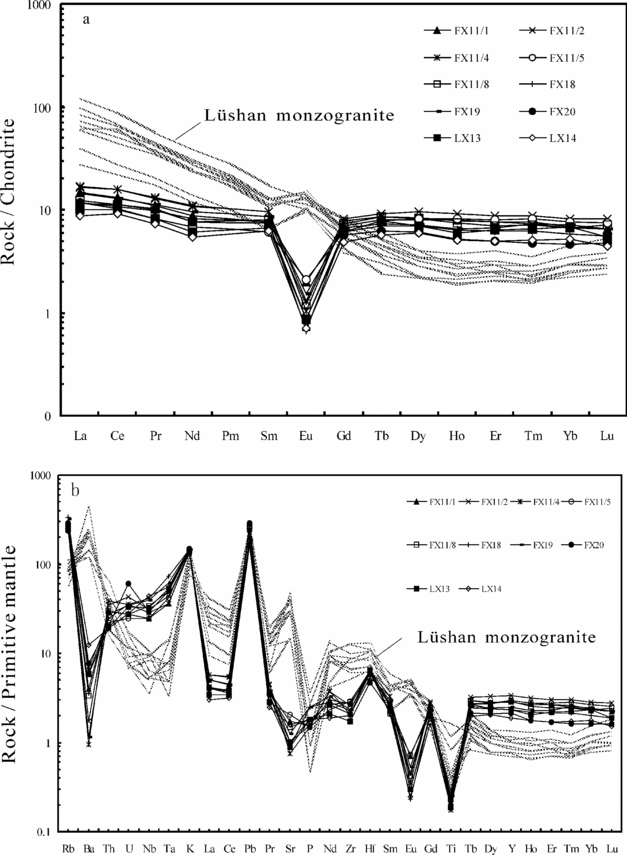
Chondrite-normalized REE patterns are shown in Figure 4a. All the samples show REE tetrad patterns with large negative Eu anomalies (Eu/Eu*=0.10–0.35; Table 2), similar to the Woduhe and Dongqing leucogranites from the Central Asian Orogenic belt (Jahn et al. Reference Jahn, Wu, Capdevila, Martineau, Zhao and Wang2001; Wu et al. Reference Wu, Sun, Jahn and Wilde2004), but in contrast with the LREE-enriched patterns displayed by the high Sr/Y monzogranites from the host Lüshan pluton. In all individual patterns, four elemental groups (La–Nd, Nd–Ga, Gd–Er, Er–Lu) form four distinct convex patterns. This is the characteristic REE tetrad pattern, well demonstrated in highly differentiated rocks with strong hydrothermal interactions (Jahn et al. Reference Jahn, Wu, Capdevila, Martineau, Zhao and Wang2001). In the primitive-mantle-normalized spidergrams (Fig. 4b), the Gangjia granites show enrichment in Rb, Th, U, K and Pb, but strong depletion in Ba, Sr, P, Eu and Ti.
(a) Chondrite-normalized REE patterns and (b) primitive mantle-normalized trace elements spidergram for the Gangjia granites. Data for the Lüshan pluton are from Zhang et al. (unpub. data). Normalization values are from Sun & McDonough (Reference Sun, McDonough, Saunders and Norry1989).
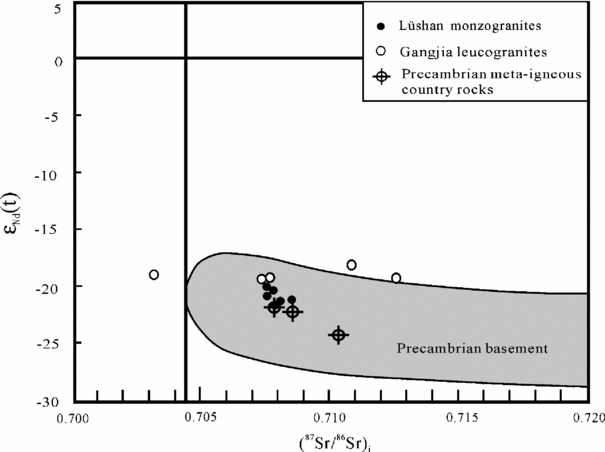
5.c. Sr and Nd isotopic data
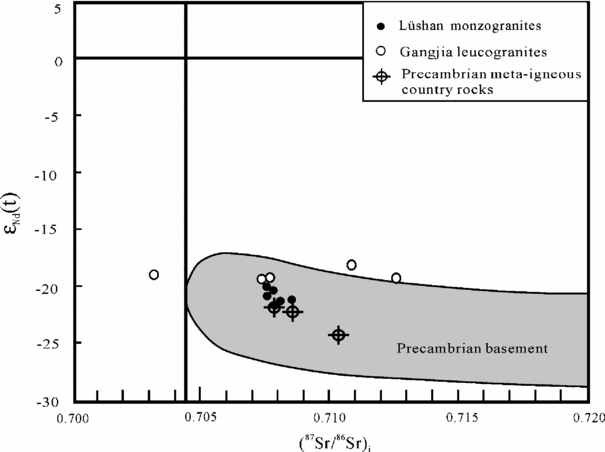
The results of Sr–Nd isotope analyses are given in Table 3. The initial isotopic ratios were calculated based on the age of 153 Ma. As shown in a plot of ϵNd(T) versus (87Sr/86Sr)i (Fig. 5), the Gangjia granites have strongly negative ϵNd(t) values (−13.8 to −19.4) and a rather large range of initial 87Sr/86Sr ratios, from 0.6875 to 0.7124. Such a large variation in these age-corrected ratios is probably due to the very high 87Rb/86Sr ratios of the rocks (Jahn et al. Reference Jahn, Wu, Capdevila, Martineau, Zhao and Wang2001). As has been widely suggested, initial 87Sr/86Sr values for such high Rb/Sr rocks should not be used in petrogenetic discussions (e.g. Jahn et al. Reference Jahn, Wu, Capdevila, Martineau, Zhao and Wang2001). The samples show a large range of T DM1 because of the variation of fSm/Nd resulting from the REE tetrad effect. Using the refined model, the resultant model ages (T DM2) would have a meaningful range from 2183 to 2276 Ma, with the exception of the sample FX-20, which has a lower model age of 1864 Ma (Table 3). This range of model ages is similar to that (2.2–2.4 Ga: Zhang et al. unpub. data) for the host Lüshan monzogranites.
Rb–Sr and Sm–Nd isotopic compositions for the Gangjia leucogranites

Chondrite Uniform Reservoir (CHUR) values (87Rb/86Sr=0.0847, 87Sr/86Sr=0.7045, 147Sm/144Nd=0.1967, 143Nd/144Nd=0.512638) are used for the calculation. λRb=1.42×10⁻¹¹ yr−1 (Steiger & Jäger, Reference Steiger and Jäger1977); λSM=6.54×10⁻¹² yr−1 (Lugmair & Harti, Reference Lugmair and Harti1978).
(87Sr/86Sr)i v. ϵND(t) plot. Data for the Lüshan pluton and Precambrian meta-igneous rocks are from Zhang et al. (unpub. data). Fields for Precambrian basement of the eastern North China craton are after Wu et al. (Reference Wu, Jahn, Wilde, Zhang and Yang2005a).
6. Discussion
6.a. Petrogenesis
The origin of peraluminous leucogranites has been a subject of much debate. They are generally considered to be formed by partial melting of metasedimentary rocks, mostly as a result of thermal relaxation and/or exhumation of an orogen (e.g. Le Fort, Reference Le Fort1981; Chappell & White, Reference Chappell and White1992; Barbarin, Reference Barbarin1996; Nabelek & Bartlett, Reference Nabelek and Bartlett1998). However, for those peraluminous leucogranites with the tetrad effect, several workers have proposed that they are highly fractionated products from dominantly mantle-derived parental calc-alkaline magmas (e.g. Jahn et al. Reference Jahn, Wu, Capdevila, Martineau, Zhao and Wang2001, Reference Chen and Jahn2004a; Wu et al. Reference Wu, Sun, Jahn and Wilde2004).
Chondrite-normalized REE patterns with tetrad effect are characterized by the subdivision into four segments called tetrads (Masuda et al. Reference Masuda, Kawakami, Dohmoto and Takenaka1987). As briefly reviewed by Jahn et al. (Reference Jahn, Wu, Capdevila, Martineau, Zhao and Wang2001) and Liu & Zhang (Reference Liu and Zhang2005), the first documentation of the lanthanide tetrad effect can be traced back to the late 1960s, when two chemists conducted a study of the partitioning of REE between two liquid phases in liquid–liquid extraction (Fidelis & Siekierski, Reference Fidelis and Siekierski1966; Peppard, Mason & Lewey, Reference Peppard, Mason and Lewey1969). Since then, tetrad effect-like REE patterns have been successively observed in natural samples from marine and terrestrial geochemical systems (Masuda & Ikeuchi, Reference Masuda and Ikeuchi1979; Masuda & Akagi, Reference Masuda and Akagi1989; Lee, Masuda & Kim, Reference Lee, Masuda and Kim1994; Kawabe, Kitahara & Naito, Reference Kawabe, Kitahara and Naito1991; Kawabe, Reference Kawabe1995; Bau, Reference Bau1996).
In recent years, discussion about the tetrad effect has focused on highly evolved igneous rocks (Bau, Reference Bau1996, Reference Bau1997; Pan, Reference Pan1997; Irber, Reference Irber1999; Zhao, Xiong & Han, Reference Zhao, Xiong and Han1999; Jahn et al. Reference Jahn, Wu, Capdevila, Martineau, Zhao and Wang2001, Reference Chen and Jahn2004a; Wu et al. Reference Wu, Sun, Jahn and Wilde2004). Since highly evolved granitic rocks are commonly interpreted to represent the transition from a silicate melt to a high-temperature hydrothermal system, the geochemical behaviour of the isovalent incompatible elements in them is controlled mainly by chemical complexation with a variety of ligands (Bau & Dulski, Reference Bau and Dulski1995; Bau, Reference Bau1996, Reference Bau1997; Dostal & Chatterjee, Reference Dostal and Chatterjee2000) and the origin of the REE tetrad effect is thus ascribed to the interaction between fluorine-bearing fluid and silicate melt phases (e.g. Irber, Reference Irber1999). By now, as well-confirmed by many studies on the REE tetrad effects in the highly evolved magmatic systems and their constituent mineral separates (Zhao, Xiong & Han, Reference Zhao, Xiong and Han1999; Zhao et al. Reference Zhao, Xiong, Han, Wang, Wang, Bao and Jahn2002; Jahn et al. Reference Jahn, Wu, Capdevila, Martineau, Zhao and Wang2001; Monecke et al. Reference Monecke, Kempe, Monecke, Sala and Wolf2002; Wu et al. Reference Wu, Sun, Jahn and Wilde2004; Liu & Zhang, Reference Liu and Zhang2005), a consensus has been reached that the tetrad effect and the fractionation between the chemically coherent isovalent elements represent intrinsic features of all highly evolved peraluminous magmatic melts. Moreover, interaction of an external fluid with parent materials of the highly evolved granitic rocks before melting would be favourable for producing the REE tetrad effects in highly evolved granitic rocks (e.g. Liu & Zhang, Reference Liu and Zhang2005).
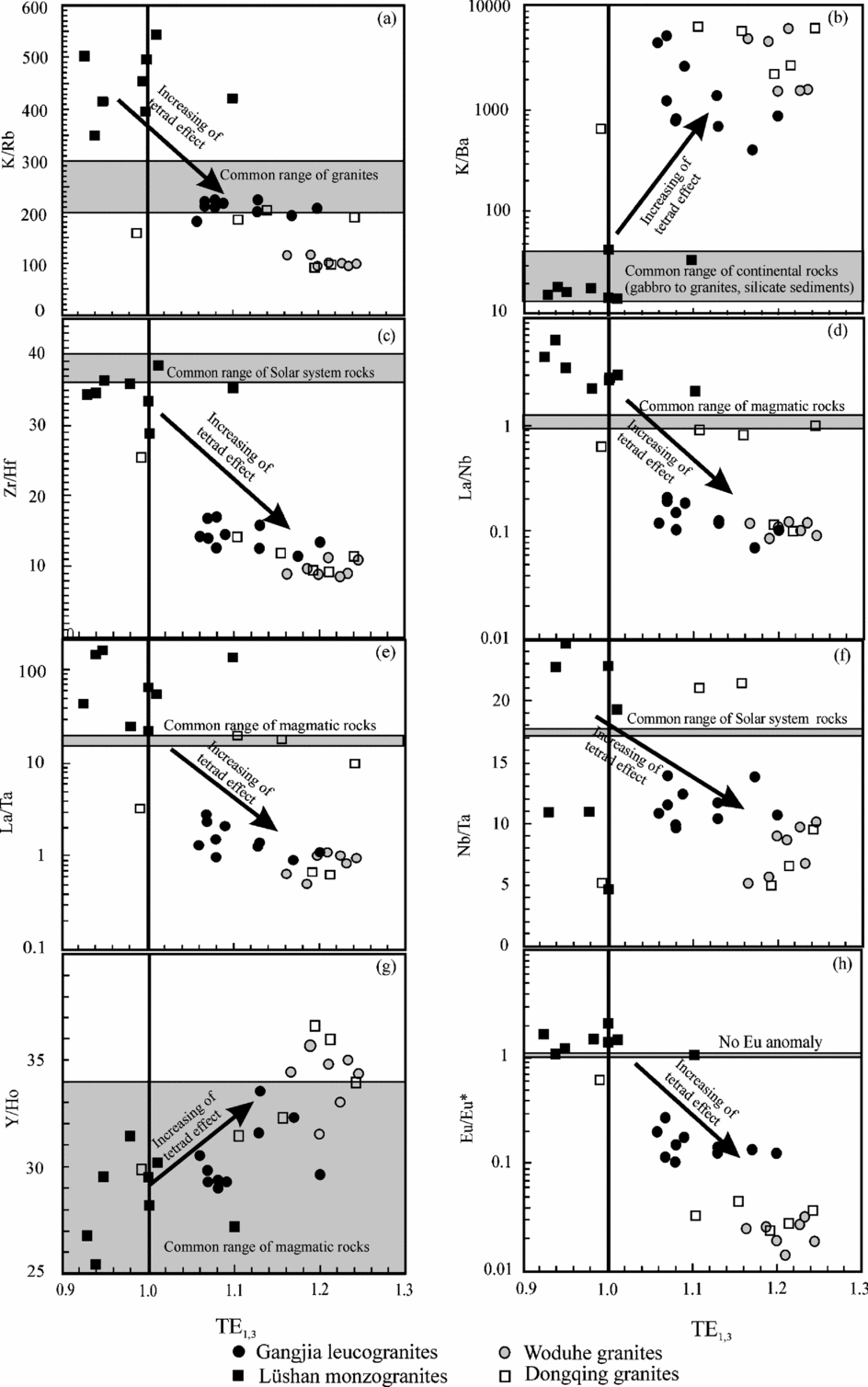
In order to evaluate the degree of the REE tetrad effect and the accompanied non-charge-and-radius-controlled elemental behaviour in the Gangjia granites, the TE1,3 values, the degree of the REE tetrad effect, are plotted versus the geochemically coherent element pairs for the Gangjia samples, together with those from other typical peraluminous leucogranites, such as the Woduhe and Dongqing granites from the Central Asian Orogenic belt (Jahn et al. Reference Jahn, Wu, Capdevila, Martineau, Zhao and Wang2001; Wu et al. Reference Wu, Sun, Jahn and Wilde2004), and those of the monzogranites from the host Lüshan pluton in Figure 6. K/Rb ratios in the Gangjia granites are 178–223, similar to those of the Dongqing granites but lower than the host Lüshan pluton (Fig. 6a), whereas K/Ba ratios are remarkably high (398–5099), similar to those for the Dongqing and Woduhe granites but much higher than those for the host Lüshan pluton (Fig. 6b). For Zr/Hf ratios, which are known to be highly constant at 39 in common granites due to closest geochemical behaviour of Zr and Hf, the Gangjia granites have very low ratios between 11 and 17 (Fig. 6c). Moreover, as in the case of the Woduhe and Dongqing plutons, the Gangjia granites show much lower La/Nb, La/Ta and Nb/Ta ratios in comparison with common values of magmatic rocks (Fig. 6d, e, f), whereas Y/Ho ratios display little deviation from the common range of magmatic rocks (Fig. 6g). In addition, Eu/Eu* ratios in the Gangjia granites are higher than those for the Dongqing and Woduhe granites but much lower than those for the host Lüshan pluton (Fig. 6h).
Variation of key elemental ratios as a function of the tetrad effect (TE1,3 of Irber, Reference Irber1999). Reference data for the Woduhe, Dongqing and Lüshan granites are from Jahn et al. (Reference Jahn, Wu, Capdevila, Martineau, Zhao and Wang2001), Wu et al. (Reference Wu, Sun, Jahn and Wilde2004) and Zhang et al. (unpub. data), respectively.
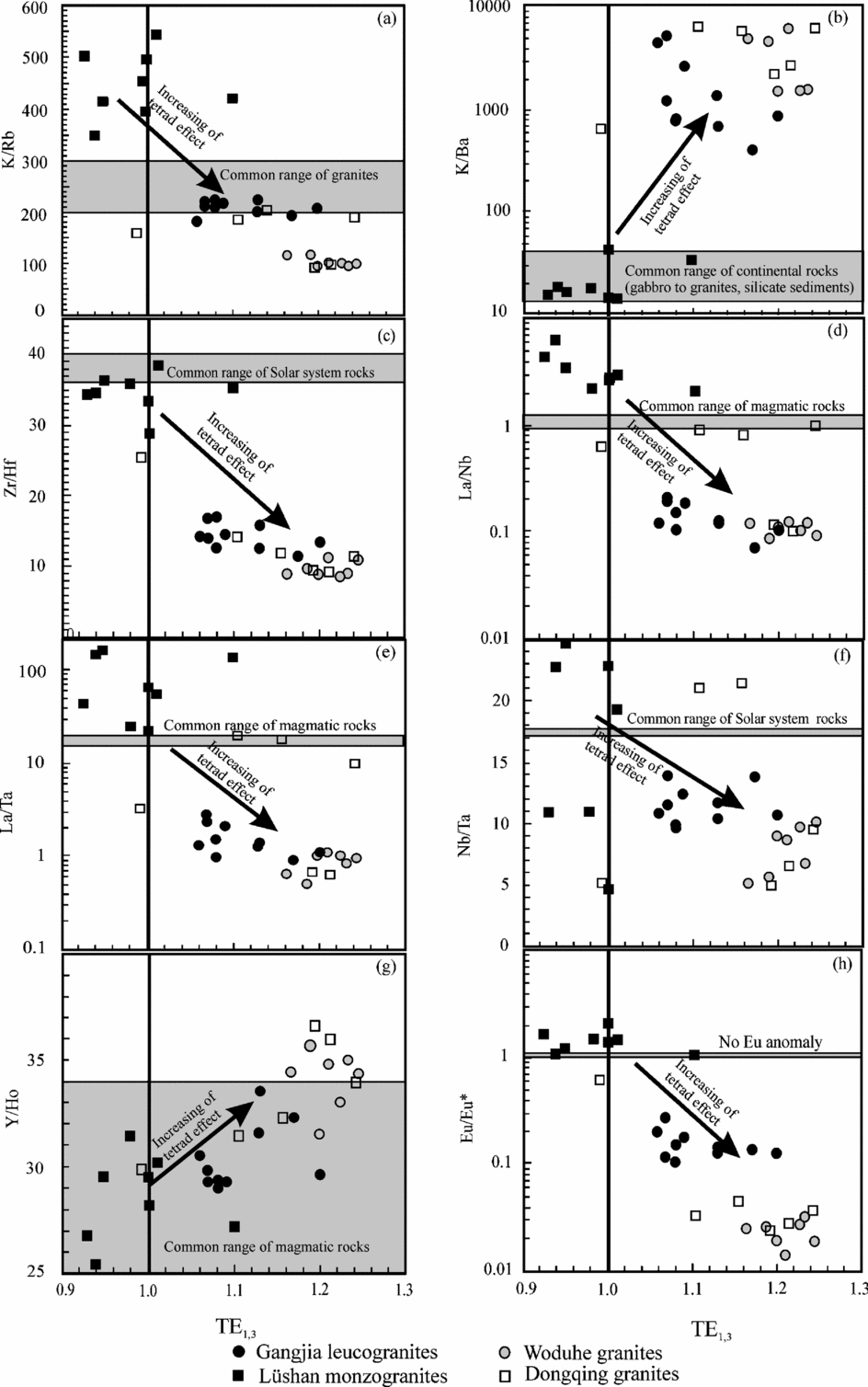
These peraluminous granites display generally positive or negative correlations between the TE1,3 values and the elemental ratios in Figure 6; the TE1,3 values increase with increasing K/Ba and Y/Ho but with decreasing La/Nb, La/Ta, Zr/Hf and Eu/Eu* ratios. This is in good accordance with the general variation trend of the lanthanide tetrad effect degree in the evolution of typical peraluminous magmatic systems (Liu & Zhang, Reference Liu and Zhang2005). Therefore, we suggest that the REE tetrad effect and non-charge-and-radius-controlled elemental features developed due to the intense interaction between residual melt and a coexisting aqueous high-temperature fluid.
The existence of an aqueous high-temperature fluid is also indicated by the extremely low Th/U ratios (0.07–0.09) of most of the dated zircons, as the zircons that precipitated from fluid generally have Th/U ratios lower than 0.1 (Hoskin & Schaltegger, Reference Hoskin, Schaltegger, Hanchar and Hoskin2003). For instance, Rubatto & Hermann (Reference Rubatto and Hermann2003) documented a zircon age of 45±1 Ma in an eclogite-facies vein from the Western Alps, with Th/U ratios of 0.01–0.086, much lower than those of host eclogites at 0.1–1.6. They explained that the vein zircons with low Th/U ratios formed from aqueous fluid. Xie, Gao & Chen (Reference Chen and Jahn2004) also obtained both Triassic and early Cretaceous ages from overgrown zircons with Th/U ratios of lower than 0.1, and they regarded these zircons as genetically related to fluids of uncertain origin. The reason for low Th/U ratios is that U is more soluble than Th and more easily enters fluids (Dobson & Tilton, Reference Dobson, Tilton and Crawford1989), which results in fluids with lower Th/U ratios (Xie, Gao & Chen, Reference Xie, Gao and Chen2004). In addition, the radius of Th4+ is about 4% greater than that of U4+ (Hoskin & Black, Reference Hoskin and Black2000), so that it is easier for the latter to enter the crystal lattice, leading to a decrease in the Th/U ratio.
Although the large uncertainties in age-corrected initial 87Sr/86Sr values due to high 87Rb/86Sr ratios make it difficult to constrain the petrogenesis of the Gangjia granites, the similarity in ϵNd(t), model ages, age patterns and volcanic arc source material (Fig. 3c, d) between most Gangjia granite samples and the host Lüshan monzogranites, all suggest their comagmatic relationship. For the Lüshan monzogranites, their peraluminous mineralogy, adakite-like trace element signature, low initial Sr isotopic ratios and strongly negative ϵNd(t) values argue for a felsic magma source that originated from partial melting of ancient meta-igneous lower crust, possibly in response to underplating of mafic mantle-derived magmas (Liu et al. Reference Liu, Sun, Liu and Zhai2002). Therefore, the parental magma for the Gangjia granites could be a calc-alkaline magma differentiated from the host Lüshan pluton, as is the case with the Woduhe and Dongqing granites (Jahn et al. Reference Jahn, Wu, Capdevila, Martineau, Zhao and Wang2001; Wu et al. Reference Wu, Sun, Jahn and Wilde2004).
6.b. Tectonic implications
Given the highly differentiated nature of the Gangjia granites, it is difficult to classify them. The reasons may be twofold: on one hand, their highly differentiated character obliterates many geochemical signatures possibly related to a particular source rock or tectonic setting. On the other hand, there is no a priori reason that would restrict any particular granitoid type to any particular tectonic environment, as pointed out by Frost et al. (Reference Frost, Barnes, Collins, Arculus, Ellis and Frost2001). However, with the REE tetrad effect as the intrinsic feature of all highly evolved peraluminous magmatic melts and the indicator for interaction of an external fluid with the parental magma or the parental materials before melting, the physiochemical conditions necessary for their genesis are by no means ubiquitous in the tectonic evolution of an orogenic belt. They are generally related to post-orogenic extensional regimes, as evidenced by the general features of post-orogenic and anorogenic magmatism (e.g. Liégeois, Reference Liégeois1998; Bonin, Reference Bonin2004) and specific examples worldwide (Sibel, Hohndorf & Wendt, Reference Sibel, Hohndorf and Wendt1995; Williamson et al. Reference Williamson, Shaw, Downes and Thirlwall1996; Förster et al. Reference Förster, Tischendorf, Trumbull and Gottesmann1999; Monecke et al. Reference Monecke, Kempe, Monecke, Sala and Wolf2002; Jahn et al. Reference Jahn, Wu, Capdevila, Martineau, Zhao and Wang2001, Reference Chen and Jahn2004a; Wu et al. Reference Wu, Sun, Jahn and Wilde2004; Sun et al. Reference Sun, Zhou, Chen, Li, Zhou, Wang and Shen2005). For instance, the two-mica leucogranites from the Massif Central in France are considered to be formed during Hercynian extensional orogenic collapse (Williamson et al. Reference Williamson, Shaw, Downes and Thirlwall1996). The peraluminous leucogranites in the Variscan Erzgebirge of Germany were associated with extension during post-orogenic collapse (Förster et al. Reference Förster, Tischendorf, Trumbull and Gottesmann1999). The Mesozoic peraluminous leucogranites from the Central Asian Orogenic belt, as represented by the early Cretaceous Woduhe and Ongonites granites (Jahn et al. Reference Jahn, Wu, Capdevila, Martineau, Zhao and Wang2001, Reference Chen and Jahn2004a) and the Jurassic Dongqing granites (Wu et al. Reference Wu, Sun, Jahn and Wilde2004), are emplaced in post-orogenic and intra-continental settings (Wu et al. Reference Wu, Sun, Li, Jahn and Wilde2002; Jahn et al. Reference Jahn, Capdevia, Liu, Vernon and Badarch2004b).
Therefore, it seems that peraluminous leucogranites with the REE tetrad effect can take on a distinctive tectonic implication for post-orogenic or intra-continental extensional settings. It is not by accident that most of such peraluminous leucogranites plot in the field of A-type granites in the geochemical discriminant diagram of Whalen, Currie & Chappell (Reference Whalen, Currie and Chappell1987), since many A-type granites are also inherently highly fractionated and display characteristic REE tetrad patterns (e.g. Wu et al. Reference Wu, Sun, Li, Jahn and Wilde2002; Chen & Jahn, Reference Jahn, Windley, Natal'in and Dobretsov2004; Liu et al. Reference Liu, Siebel, Li and Pan2005).
In our case, as stated above, Western Liaoning experienced the most voluminous magmatism during middle to late Jurassic times. However, it is still not certain what caused this prolonged magmatism. Consistent with the prevalent dual geodynamic models put forward for the Mesozoic magmatism in Eastern China (Wu et al. Reference Wu, Yang, Wilde and Zhang2005a, and references therein), some authors advocate post-collisional magmatism developed in an intra-continental extensional regime (Liu, Zhai & Liu, Reference Gao, Rudnick, Carlson, McDonough and Liu2002; Zhang et al. Reference Zhang, Sun, Zhou, Zhou, Fan and Zheng2003), while others relate the events to the subduction of the palaeo-Pacific slab (Wu et al. Reference Wu, Yang, Wilde and Zhang2005a; Wu, Yang & Zhang, Reference Wu, Yang and Zhang2006).
For all such uncertainty, it is the thermal regime and source rocks that played an essential role in determining the chemical and petrological characteristics of granites. For the Mesozoic tectono-thermal state of the North China craton, a well-established consensus is that considerable lithospheric thinning took place beneath the eastern North China craton (Menzies, Fan & Zhang, Reference Menzies, Fan, Zhang, Prichard, Alabaster, Harris and Neary1993; O'Reilly et al. Reference O'Reilly, Griffin, Poudjom Djomani and Morgan2001; Zhang et al. Reference Zhang, Sun, Zhou, Zhou, Fan and Zheng2003). Extensive Mesozoic magmatism, large-scale basin formation and the development of metamorphic core complexes in eastern North China craton were commonly considered to be related to the lithospheric mantle removal which most likely took place during Jurassic–Cretaceous time (Gao et al. Reference Gao, Rudnick, Carlson, McDonough and Liu2002, Reference Gao, Rudnick, Carlson, McDonough and Liu2004; Wilde et al. Reference Wilde, Zhou, Nemchin and Sun2003). These typical mantle and crustal signatures also attest to a prevalent intraplate extensional tectonic regime for the Early Cretaceous in the Yanshan belt (Meng, Reference Meng2003) and Eastern China (e.g. Wu et al. Reference Wu, Yang, Wilde and Zhang2005b).
As reviewed by various authors (e.g. Liegeois, Reference Liégeois1998; Vanderhaeghe & Teyssier, Reference Vanderhaeghe and Teyssier2001; Bonin, Reference Bonin2004), an orogenic cycle generally comprises a pre-collisional period characterized by subduction leading to oceanic basin closure and terrane docking, a period of arc–continent or continent–continent collision accommodated by crustal thickening and post-collisional to post-orogenic periods. Corresponding to the successive collision, post-collisional, post-orogenic and within-plate settings, four stages of mantle unrooting process are identified, including orogenic growth, initiation of gravitational instability until lithospheric failure, sinking of the detached lithosphere and relaxation of the system (Marotta, Fernandez & Sabadini, Reference Marotta, Fernandez and Sabadini1998; Bonin, Reference Bonin2004). Based on the comparison of the first-order features displayed by various orogenic belts, Vanderhaeghe & Teyssier (Reference Vanderhaeghe and Teyssier2001) also suggest that the thermal and mechanical evolution of the continental crust during an orogenic cycle can be generalized into such stages as crustal thickening, thermal maturation, partial melting, and syn- to post-convergence gravitational collapse.
When evaluated within the context of this general thermal and mechanical evolution of the continental crust during orogenesis, the Yanshan orogen-scale features of both mantle and crustal levels during the early Cretaceous are typical of lithospheric and crustal signatures at the very end of the post-collisional stage (Bonin, Reference Bonin2004), corresponding to the third stage, that is, sinking of the detached lithosphere, in terms of mantle unrooting process (Marotta, Fernandez & Sabadini, Reference Marotta, Fernandez and Sabadini1998). Therefore, we suggest that the Yanshan belt might be in a post-collisional geodynamic setting associated with the northern Solonker and Mongol–Okhotsk sutures in the Jurassic, with a corresponding mantle unrooting process as characterized by lithospheric stacking and initiated gravitational instability (Bonin, Reference Bonin2004). This agrees with the conclusion reached by recent in situ U–Pb dating and Hf isotopic analyses on detrital zircons from Palaeozoic to Late Mesozoic strata in the Xishan west of Beijing, which states that the Yanshan belt experienced a rapid uplift from 205 to 158 Ma under a transitional geodynamic setting from a post-collisional to an intraplate extensional setting (Yang et al. Reference Yang, Wu, Shao, Wilde, Xie and Liu2006).
Under such a post-orogenic tectonic regime favourable for producing Chinese C-type (high potassium) adakites (Xiao & Clemens, Reference Xiao and Clemens2006), upwelling of hot asthenosphere due to lithospheric removal caused mantle-derived magma underplating and partial melting of ancient lower crust (Gao et al. Reference Gao, Rudnick, Yuan, Liu, Liu, Xu, Ayers, Wang and Wang2004; Wang et al. Reference Wang, Zhao, Zou, Li, Liu, Wu, Xu and Zhang2007). This subsequently led to the formation of voluminous Mesozoic adakitic magmatism in the eastern North China craton (Jiang et al. Reference Jiang, Liu, Zhou, Yang and Zhang2007), and more specifically, the voluminous Jurassic adakite-like magmatism as represented by Lüshan pluton in Western Liaoning (Liu et al. Reference Liu, Sun, Liu and Zhai2002). Given the consistent occurrences of peraluminous leucogranites with the REE tetrad effect under post-orogenic extensional settings, our documentation of such distinctive peraluminous magmatism as represented by the Gangjia leucogranites in Yiwulüshan provides further diagnostic constraints for supporting a post-orogenic extensional tectonic regime for the Jurassic magmatism in Western Liaoning. At the very end of this prolonged magmatic evolution, extensive fractionation of most probably ferromagnesian phases and plagioclase from a calc-alkaline magma parental to the host Lüshan pluton, with overprint of the magmatic hydrothermal fluid, produced highly evolved peraluminous parental magmas for the Gangjia granites.
7. Conclusions
SHRIMP U–Pb zircon dating and geochemical analyses document an episode of late Jurassic peraluminous magmatism in Yiwulüshan in western Liaoning Province, North China craton. The peculiar geochemical characteristics, including REE tetrad effect, non-charge-and-radius-controlled trace element behaviour and zircons with low Th/U ratios, suggest an origin that is consistent with the interaction between a residual melt and coexisting high-temperature aqueous fluid. The similarity in ϵNd(t), model ages and age patterns between the Gangjia granites and the host Lüshan pluton and their common volcanic arc signature in source material indicate their comagmatic nature. The first documentation of such unusual peraluminous magmatism in Western Liaoning provides an exceptional hallmark for indicating that the prolonged Jurassic magmatism most likely took place under a post-orogenic extensional tectonic regime. Extensive fractionation from a calc-alkaline magma parental to the host Lüshan pluton, coupled with the magmatic hydrothermal fluid, led to the formation of the highly evolved peraluminous parental magmas for the Gangjia granites.
Acknowledgements
This study was financially supported by the Knowledge Innovation Program of the Chinese Academy of Sciences (Grant no. KZCX2-YW-103), the National Natural Science Foundation of China (Grant no. 40534022) and the Major State Basic Research Program of the People's Republic of China (Grant no. 2006CB403504). The authors thank Mr Z. Q. Yang for help in U–Pb analyses, Mr H. Li and Ms X. D. Jin in major- and trace-element analysis, Dr Z. Y. Chu in Sr–Nd isotope analyses. We are also grateful to Dr D. Pyle and two anonymous reviews for their constructive suggestions and Mrs J. Holland for editorial handling. This is The Institute for Geoscience Research (TIGeR) publication no. 64.