1. Introduction
In the last twenty years, there has been extensive research on gender, and Bloomfield's (1933:280) position that “[t]here seems to be no practical criterion by which the gender of a noun in German, French or Latin could be determined” is no longer unanimously accepted (if it ever was; see, for example, Corbett 1991:7–69, Köpcke & Zubin 1996, Trosterud 2001, Nesset 2006, Thornton 2009.)
A particularly clear generalization that has emerged in this recent research is that nouns high on the Animacy Hierarchy have their gender assigned semantically (Corbett 1991, Dahl 1999, Nesset 2006). Thus, it is no surprise, against the background of a familiar Germanic three-gender system—that is, masculine/feminine/neuter—that German Vater ‘father’ is masculine, and Mutter ‘mother’ is feminine. There is no noun more typically feminine and animate than that denoting a mother; nor is there any noun more typically masculine and animate than that denoting a father.
1.1. Initial Norwegian Data
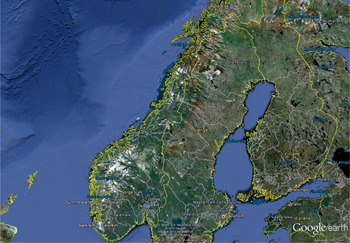
As with German, one is not surprised to learn that in the Sunnhordland dialect of Norwegian, the nouns mamma ‘mum, mother’ in 1 and pappa ‘dad’ in 3 are feminine and masculine, respectively. Genders are “classes of nouns, reflected in the behavior of associated words” (Hockett 1958: 231, Corbett 1991), and in this traditional three-gender dialect of the well-known Germanic type, there is ample evidence from associated words (namely their agreement) showing the gender of these nouns. Examples 1–3 are from the Sunnhordland dialect of Norwegian.Footnote 1Figure 1 shows the locations for this and other dialects in Norway.
(1)

(2)
(3)

Like most other Norwegian dialects, this is a three-gender dialect, with masculine, feminine, and neuter. However, in Norwegian, the masculine and feminine have a lot in common and differ from the neuter. The majority of adjectives do not have separate masculine and feminine forms. The adjective liten ‘small’, used for illustration in 1c and 3c above, stands out in this respect. In some dialects, there are many adjectives like liten; in some, liten may be the only one distinguishing masculine and feminine, while in others, no adjective distinguishes the two. As we show below, the three-gender system may, in at least some varieties, be moving toward a two-gender system where the masculine and feminine have merged, as in written Danish and Swedish (see, for example, Braunmüller 1999).
Distribution of Norwegian dialects.

Nouns usually inflect for definiteness and number, so that the standard noun paradigm contains four cells (indefinite singular, definite singular, indefinite plural, definite plural). As is typically the case with grammatical features, morphological marking of definiteness does not fully match definiteness as defined for purposes of information structure.Footnote 3
For simplicity, we leave out the plural in most of this paper. The reason is that in the plural, the gender opposition is neutralized in Norwegian (essentially in the same way as it is in German), and so the plural is irrelevant for present purposes. In the singular, there is an intriguing relation between declension and gender. Some other typical paradigms from Sunnhordland may be helpful for comparison (see 4–6).
(4)
(5)
(6)
The glossing in 1–6 needs a comment, as it involves a vexed analytical issue, namely, should the suffix in the definite singular (for example, /o/ in /mamo/) also be taken as an exponent of gender? Strictly speaking, it is not an exponent of gender, since it is not found on associated words but only on the noun itself. At the same time, the suffix does, in this dialect as in many other varieties of Scandinavian, correlate 100% with gender, so it is perhaps unsurprising that different opinions have been voiced in the literature. In the Norwegian reference grammar, Faarlund et al. (1997) treat the suffix as an exponent of gender, without much discussion. Wurzel (1986) claims that, in general, exponents on the word itself should count. Dahl (1999) argues that one should simply rephrase Hockett's (1958) definition as reflected in the behavior of asso-ciated morphemes.
In this paper, we show that the stricter definition based on evidence from associated words is preferable (see Hockett 1958). It allows us to account for the surprising Norwegian data, and it also allows for a clearer view of the syntax-morphology interface, according to which inflectional exponence is a matter of morphology, while gender agreement is a matter of syntax.
We, therefore, indicate the values of the morphosyntactic features gender and number in our glosses. That is, we do not give /o/ in /mam-o/ the same status as that of the marking on associated words. Similarly, since the degree of coincidence of the definiteness forms with gender in particular dialects is of considerable relevance here, we note the expected gender in { }. That is, we note in the gloss that -o usually occurs with feminine nouns, -en with masculine nouns, and -e with neuter nouns. We give the same information for the other dialects discussed.
The Sunnhordland example is as expected, then. The noun mamma is feminine, by all accounts, just as pappa is masculine. Furthermore, as a rule, most nouns have the same gender in different Norwegian dialects (although occasional exceptions can be found; see, for example, Beito 1954). To the best of our knowledge, the noun meaning ‘dad, father’, in most dialects pappa, is never anything but masculine.
1.2. Outline
The structure of the rest of this paper is as follows. In section 2, we look at a surprising example from the Oslo dialect, in which the gender of the noun mamma ‘mother, mum’ is not as expected; mamma triggers masculine agreement within the noun phrase. We then show that once the Agreement Hierarchy has been introduced, mamma in the Oslo dialect behaves as we expect from a hybrid noun, as illustrated through a comparison with Dutch meisje ‘girl’. Section 3 is devoted to an even more intriguing example involving mamma, this time in the Nordreisa dialect, where this noun triggers masculine agreement within the noun phrase only in the definite (not in the indefinite). The unusual properties here are brought out by comparing the Nordreisa noun with two nouns from Bosnian/Croatian/Serbian. Section 4 presents other examples from Norwegian dialects of this unusual phenomenon, namely, gender mixture based on (in)definiteness. The examples are few and admittedly peri-pheral, but they show that mamma in Nordreisa is not an entirely isolated case. In section 5, we present a comparison with nouns inflected for definiteness in Bulgarian. We argue that the facts surveyed conform to the Agreement Hierarchy, and that the definition of gender based on as-sociated words is to be preferred over the definition based on associated morphemes. We suggest a tentative account of why gender mixture is linked to definiteness, involving both (morphological) form and (seman-tic/pragmatic) meaning. Section 6 contains our conclusions.
2. The Oslo Dialect and the Relevance of the Agreement Hierarchy
2.1. What We Learn from the Oslo Dialect
In light of what we have seen in the Sunnhordland dialect, the noun mamma ‘mum, mother’ in a conservative version of the dialect of Oslo (East Norwegian) may come as a surprise.Footnote 4 Consider now the agreement patterns in 7, from the Oslo dialect of Norwegian.
(7)
In this dialect, the noun mamma is apparently masculine. It does, at least, take a masculine determiner (aka article) and a masculine possessive. Consider now the predictably feminine nouns jente ‘girl’ in 8a,b and dame ‘lady, girlfriend’ in 8b,c.
(8)
We are now in a position to compare mamma with such masculine nouns as gutt ‘boy’ in 9a,b and mann ‘man, husband’ in 9c,d.
(9)
Thus, in Oslo mamma seems to thwart our expectations—its gender is not explicable on the basis of the semantics. This fact has been given ample attention in the literature on Norwegian gender (see, for instance, Trosterud 2001, Enger 2002, Rice 2006). In this respect, this noun is reminiscent of German Mädchen ‘girl’, also a favorite example for those who question the connection between semantics and gender.
Note that mamma in the Oslo dialect does not trigger masculine on all agreeing elements. It is not masculine for all the positions in the Agreement Hierarchy (Corbett 1979, 1991, 2006). Although it does take a masculine determiner (en and not the feminine ei), the associated personal pronoun can never be masculine; it has to be feminine. Consider 10, where mamma in 10a is compared with gutt ‘boy’, mann ‘man, husband’, jente ‘girl’, and dame ‘lady, girlfriend’.
(10)
While the agreeing elements in 10b,c are all masculine and the agreeing elements in 10d,e are all feminine, the agreeing elements in 10a are not similarly consistent.
2.2. The Agreement Hierarchy
On the point illustrated in 10, mamma in the Oslo dialect behaves exactly as expected from the Agreement Hierarchy (Corbett 1979, 2006:206–230); that is, semantic agreement prevails in pronominal agreement. To refer to one's mum using han ‘he’ is unacceptable, as is using the noun jent-a ‘girl-def.sg.{f}’ and the pronoun han ‘he’ in the same context to refer to the same person. In this respect, mamma is a typical hybrid noun, in Corbett's terminology.Footnote 6 The gender that this noun controls varies according to the particular agreement target. This means that it is not simply a masculine noun—if it were, it would always trigger masculine agreement. Rather, it can trigger either masculine or feminine agreement, depending on the target—hence it is a hybrid.
We should introduce the Agreement Hierarchy briefly. In the sim-plest case, a single morphosyntactic specification for a particular item can be given, which is applicable in all syntactic environments. Thus, if a noun is feminine and plural, any agreement target is expected to appear in the feminine plural. However, there are some well-established phenomena that run counter to this simple expectation. Hybrids are items that trigger different agreement depending on the agreement target. Consider the Dutch data in 11 (Corpus of Spoken Dutch, Jenny Audring, p.c.). In Dutch, both meisje ‘girl’ and jonge-tje ‘boy-dim’ can trigger neuter agreement, even if one might think of them as semantically femi-nine and masculine, respectively.
(11)
The nouns in 11 trigger different agreements according to the target. Within the noun phrase in 11b, there is syntactic (formal) agreement between the neuter dat ‘dem’ and jonge-tje. However, 11a also contains a possessive pronoun, which is feminine, while 11b contains a demon-strative used as personal pronoun, which is of common gender. Both of the latter are instances of semantic agreement. The use of ’r and die should be explained in terms of the semantic (or referential) properties of meisje and jonge-tje, respectively, and not in terms of form. There is also an example of a relative pronoun in both 11a and 11b, in the neuter, and that is syntactic agreement. In Dutch, one can also find instances of semantic agreement of the relative pronoun, comparable to the examples of the personal pronoun (though not in our example 11); however, examples of semantic agreement of the personal pronoun are more fre-quent than examples of semantic agreement of the relative pronoun (Audring 2006:111). This fits in within a much more general pattern of the Agreement Hierarchy, which consists of the following positions:
(12)
The associated claim for the Agreement Hierarchy appears in 13 (Corbett 2006:207).
(13) For any controller that permits alternative agreements, as we move rightwards along the Agreement Hierarchy, the likelihood of agreement with greater semantic justification will increase monotonically (that is, with no intervening decrease).
A monotonic increase is one with no intervening decrease, and this condition means that the hierarchy can be applied to constructions that show optionality and variability with respect to agreement. If one con-siders the Dutch data in this light, it appears that semantic agreement is found in the personal pronoun and in the relative pronoun. If the two are compared, semantic agreement is found with greater likelihood in the personal pronoun than in the relative pronoun. Similarly, if one looks at mamma ‘mother’ in the Oslo dialect, one finds that semantic agreement is possible in all positions of the Agreement Hierarchy where agreement distinctions are available, except within the noun phrase (attributive position).Footnote 7
3. The Nordreisa Dialect of North Norwegian
The Oslo dialect data fit in with an established typological pattern. Things become more complicated, however, as soon as one turns to the Nordreisa dialect of North Norwegian. These data are more challenging, and the analysis requires an extra step, that is, both the Agreement Hierarchy and definiteness are relevant.
3.1. What the Nordreisa Dialect Teaches Us
Consider the examples in 14 from the Nordreisa dialect of Norwegian.
(14)
(15)
(16)
Apparently, almost any noun that can take the feminine determiner ei can optionally take the masculine determiner en in this dialect (but not vice versa). This reflects the weak position of the feminine in this dialect (see section 1.1 above). In Nordreisa, the distinction between masculine and feminine is close to being lost (see Sollid 2005). What is particularly intriguing about the noun mamma in this dialect, however, is that it triggers only masculine agreement—never feminine—in the definite (within the noun phrase). Unlike øks ‘axe’, mamma triggers feminine agreement only in the indefinite. Such examples are highly unusual. One hardly ever finds a noun in Norwegian that has different gender depen-ding on whether it is indefinite or definite (though see section 4 below).
We now need to specify which agreement contexts we are interested in.Footnote 8 There are effects of word order and alienability; we address the former first. Given that the noun can be marked as definite (the more interesting case for us) or indefinite, and that the possessive could, in principle, precede or follow the noun, four theoretical possibilities exist. Of these, two are excluded (17b and 18b). Consider the case [0]where the possessive precedes the noun:
(17)
Thus, the possessive cannot precede the noun if this noun is marked as definite. In the reverse order, the following basic situation is found (a complication to this situation is discussed below):
(18)
In 18, the noun has to be marked as definite. There is a complication, however. Alongside the normal word order in 18a, examples such as 18b are possible, provided they involve inalienable possession denoting close kinship relations, as in 19.
(19)
According to our informant (Hilde Sollid at the University of Tromsø, sociolinguist, dialectologist, and a native of Nordreisa), 19a and 19b are both acceptable.Footnote 9 To summarize, the normal patterns are possessive plus (morphologically) indefinite, and definite plus possessive. Just for in-alienable possession, there is also the pattern indefinite plus possessive.
For the agreements that concern us, there are three contexts we need to examine with respect to inalienable possession. First, a morpho-logically indefinite noun follows the possessive, as in 20.
(20)
Second, the possessive follows a morphologically definite noun, as in 21.
(21)
Third, since mamma denotes a relation of inalienable possession, there is also a possibility of its indefinite form preceding the possessive, as in 22.
(22)
Example 22b is marginally acceptable, while 21a and 22a are preferred.
The acceptability judgment in 22 should be contrasted with those in 23, where the noun øks ‘axe’ does not denote a relation of inalienable possession.
(23)
Given the general situation of gender in this dialect, and that the noun øks is feminine, the alternative where the possessive appears first is expected:
(24)
The key point is that øks ‘axe’ provides the normal case against which we see the interest of mamma, which takes masculine only when the noun is definite.
Importantly, mamma triggers masculine agreement inside the NP, not outside it. When pressed, our informant finds the choice between 25a and 25b difficult, but she still much prefers 25a, with feminine agree-ment outside the NP.
(25)
Thus, semantic agreement is preferred on predicative adjectives. On pronouns, syntactic agreement is simply out, at least in cases like this. To refer to one's mother using the masculine pronoun han ‘he’ is unaccep-table, in Nordreisa as in other dialects (see section 2.2).
3.2. Lexical Splits
Lexemes can follow a consistent pattern across the paradigm, or their pattern can be split in various ways. That is, the cells in the paradigm of the same lexeme can follow more than one pattern, so that the paradigm is split into two or more parts. The split can be internal to the lexeme, as when the same lexeme has different stems, or it can be external and affect the properties of other lexemes, such as agreement. Against this background, the general regularity of Norwegian noted in section 3.1, that is, consistent gender across definiteness, is not surprising. Yet there can be gender mixtures, that is, the gender value of the same item can vary according to the value of some other feature. Such variations repre-sent a particular type of split. However, Carstairs-McCarthy (1994:771) states that, overall, such splitting—or gender mixture—is only possible on the basis of number. According to this suggestion, one does not find, for example, a noun that is feminine in the nominative and masculine in the dative.Footnote 10 If there is any gender mixture in the paradigm of a noun, it would be based on number. In Norwegian (with the exception of a few dialects), the gender opposition is neutralized in the plural (see section 1.1 above), making such examples impossible. Therefore, we turn to an example from further afield.
The Bosnian/Croatian/Serbian noun oko ‘eye’ has a singular-plural split, having the irregular plural stem oč-i ‘eyes’. The different stems belong to different inflection classes (making the lexeme heteroclitic). This split in the noun's inflection brings with it a difference in gender (neuter in the singular but feminine in the plural), as shown in 26. Thus, the external and the internal split referred to above can co-occur.
(26)
Note that oko ‘eye’ has a split paradigm, in that its plural forms are not regularly linked to the singular ones (the stems are not related by a syn-chronic pattern of the language, and the inflections belong to different classes). Moreover, this noun triggers mixed gender agreement (neuter in the singular and feminine in the plural). Nevertheless, the case of oko ‘eye’ is straightforward, in that agreement, irrespective of agreement target, is always neuter in the singular and feminine in the plural.
The Nordreisa data are more complex than that, and in two distinct ways. First, as we have shown above, the alternation between masculine and feminine agreement is subject to the Agreement Hierarchy, not number as in the case of oko ‘eye’. The second difference is more subtle, but we can bring it out by further comparing Nordreisa with Bosnian/ Croatian/Serbian. There is an interesting class of Bosnian/Croatian/ Serbian nouns, for example gazda ‘landlord, boss’. These nouns exhibit the following split. They show masculine agreement in the singular, while in the plural, there are examples both of masculine and of feminine agreement (see Marković 1954, Corbett 1983:14–17). This distribution of agreement is subject to the Agreement Hierarchy. The relevant point is that these nouns are hybrids in terms of gender only with respect to the plural.
Now, it may seem that all hybrids are like this. For example, English nouns such as committee (which are semantically plural, as it were) have interesting agreement properties only in the singular—they trigger sin-gular or plural agreement when singular, but only plural when plural, as shown in 27. However, the singular is the only place for such nouns where an effect could, in principle, be found (since it concerns singular/plural number). The noun committee is semantically plural, and it is only in the singular that there can be a discrepancy between semantics and syntax.
(27)
Within the feature space, English thus has the interesting agreement effect exactly and only where it is possible on semantic grounds. Bos-nian/Croatian/Serbian could, in principle, have a gender effect in the singular, but it has the split only in part of the theoretically possible feature space. Similarly, Nordreisa mamma could, in principle, have a gender mixture in the indefinite as well as in the definite. What one finds, however, is that the split is governed by the following conditions:
(a) it is conditioned by definiteness
(b) it varies by target (and is subject to the Agreement Hierarchy)
(c) the effect is found in the definite onlyFootnote 11
The example of mamma in Nordreisa is so interesting and unusual that it would be valuable to place it in a wider context. To do this, we survey other gender effects in a range of Norwegian dialects.
4. Other Examples from Norwegian
The Nordreisa noun mamma appears to be a highly unusual case. Yet the example is not entirely isolated. Similar examples are basically of two kinds. First, in section 4.1, we review relevant data from four Norwegian dialects (see also Enger 2005). Then, in section 4.2, we turn to slightly different, but related examples from the Web. The dialectological de-scriptions and the Web evidence thus support each other; they converge.
4.1. Further Examples from Norwegian Dialects
The first example to consider is the noun gong ‘time, occasion’ from the dialect of Bud (Møre and Romsdal, West Norwegian). This noun takes a masculine determiner in the indefinite singular, as shown in 28a. Yet it takes the suffix normally associated with the feminine in the definite singular, as shown in 28b.
(28)
As noted in section 1.1 above, we would not like to interpret the definite suffix as a straightforward gender marker. Due to the meaning of this particular noun (‘time, occasion’), however, and the fact that most Nor-wegian adjectives do not have formally distinct masculine and feminine forms, it is difficult to find compelling evidence from possessive and adjectival agreement.Footnote 13 Since in the Bud dialect the definiteness suffixes in the singular correlate perfectly with gender markers, we would not like to dismiss the suffix as completely irrelevant.Footnote 14 We treat /a/ as indicative of feminine (see the discussion in section 1 above). Nevertheless, agreement evidence is preferable, and such evidence can be found with the adjective eigen ‘own’, which, like liten, often differentiates mascu-line and feminine, as shown in 29.
(29)
The feminine form of the adjective eigen ‘own, separate’ here is cate-gorically excluded, according to our consultant. Since our consultant Helge Sandøy is not only a native speaker of this dialect, but also a respected dialectologist, it is worth mentioning that he has stated (p.c.) that he is not aware of any parallel item to this one in the Bud dialect.
Beito (1954:206) also mentions ein gong–gonga (masculine determiner, but the suffix normally associated with the feminine) from several dialects in the East Norwegian dialect area, so Bud is not entirely unique. Still, the pattern is rare, to say the least.
As for gender in pronominal reference, it is hard to think of any good examples, again due to the semantics of the lexeme gong. Our consultant suggests the following as a possibility, though he calls it very “far-fetched:”
(30)
The gender on the personal pronoun in 30 is feminine.
The second set of examples comes from another West Norwegian dialect, this time Bjerkreim (Rogaland), and includes the words gong ‘time’ and avis ‘newspaper’. While Bud is at the northernmost end of West Norwegian, Bjerkreim is closer to the southernmost. Our main source is Levang 2003 (and p.c) and we turn first to example 31.
(31)
Surprisingly, although the lexeme gong ‘time’ shows gender mixture in Bjerkreim as it does in Bud, there is a crisscross pattern here. In Bud, this noun is feminine in the indefinite and masculine in the definite. In Bjerkreim, the opposite appears to be the case, but the only available evidence comes from the suffix. As noted above, agreement evidence is hard to come by, due to the semantics of this noun.
Much more interestingly, the lexeme avis ‘newspaper’ shows clear-cut feminine agreement in the determiner and the attributive adjective, as shown in 32a,b. In the definite, the agreement on the possessive is equal-ly clear-cut masculine, as in 32c.
(32)
Unfortunately for us, the relevant personal pronoun in this dialect would be den ‘3sg.m+f’. This pronoun is used to refer to inanimates, but it does not distinguish between masculine and feminine. Unlike the gen-der system of Bud (see section 4.1.1), the gender system of this dialect (like many other varieties of Scandinavian, see, for instance, section 1.1 above, Enger 2004a, Braunmüller 1999) may be undergoing a change, whereby the pronoun that has been used for both animates and inani-mates in the feminine and masculine genders is becoming restricted to animates only, more specifically, humans. There are parallels in many languages, for example, in Latvian and Persian (see Corbett 1991:311). Therefore, we cannot gain more insight from the data for our analysis, but it does at least seem fairly clear that Bjerkreim corroborates the pattern from Bud. We do find gender mixture based on definiteness, albeit in few isolated cases.
Our next example is sofa ‘sofa, couch’ from the Nordreisa dialect. Besides the mamma example discussed earlier, one also finds examples such as 33.
(33)
In this dialect, one has to rely on possessives and determiners for agreement evidence. The different adjectival agreement in masculine and feminine nouns is lost, with the exception of liten, again (compare 1c versus 3c above). In fact, one finds ei lita sofa ‘a.f small.f sofa’ versus en liten sofa ‘a.m small.m sofa’.
The last example is the noun /æue/ ‘eye’ from the Romerike dialect. This noun has the feminine suffix in 34b, and the dialectologist Ross (1908:14) reports that in some East Norwegian dialects, it appears with the neuter demonstrative, as shown in 34.
(34)
In 34a, which is indefinite, there is neuter agreement. In 34b, which is definite, the determiner is clearly neuter, but the declensional suffix on the noun is feminine.Footnote 15
The example is intriguing also because Ross attributes it, among other places, to Udenes parish, Romerike. One of the authors of this paper has lived in that particular parish for eleven years without hearing the inflection Ross mentions. This, of course, can mean that Ross was wrong, or that the author simply did not happen to speak with the right people. Yet a third possibility exists, namely, that this pattern has not been diachronically stable.
4.2. Examples from the Web
So far, we have looked at examples from the dialectological literature. In these examples, the reason for the gender variation is not always ob-vious. However, there are many examples of a slightly different, but related kind to be found at present on the Web. One such example is ei kleptoman ‘a.f kleptomaniac’. To most Norwegians, the noun kleptoman is masculine, but the rap artist Ravi (from whom this particular example is taken) uses the feminine determiner to signal that the particular kleptomaniac is a woman. To our knowledge, these examples and their significance did not receive much attention before Korsæth 2010. The examples are tangential to her aim, but she observes that they smack of semantic agreement. Indeed, many such examples can be found, as illustrated in 35.Footnote 16
(35)
While many of the examples in section 4.1 may belong to older stages of the language, 35a and 35b are more recent. They are interesting and intriguing not only for the study of gender mixture in general, but also for the empirical study of Norwegian.
In their authoritative reference grammar, Faarlund et al. (1997:152) say that although there can be a feminine suffix on the noun without a feminine marking on the noun's targets, the opposite is ruled out. There cannot be feminine marking on the associated words without a feminine suffix on the head noun. On the whole, this is, of course, quite correct. While the combinations ei bok ‘a.f book’–boka ‘book-def.sg{f}’, en bok ‘a.m book’–boken ‘book-def.sg.{m}’ and en bok ‘a. m book’–boka ‘book-def.sg.{f}’ all occur, the combination ei bok ‘a. f book’–boken ‘book-def.sg.{m}’ does not normally occur in Norwegian. In diachronic terms, we are witnessing a change from the suffix /a/ being indicative of gender to its being indicative of no more than an inflection class. In other words, what used to be a separate gender is now merely a declension (as long as pronominal gender is not taken into consideration). A similar change has previously taken place in Danish and Swedish (see sections 1.1 and 4.1.2 above).
However, examples like 35 fly in the face of Faarlund et al.’s generalization (as do the somewhat different examples in 31 and 33). Yet such examples have not received sufficient attention in the literature before. These are examples of semantic agreement that involves the de-terminer.
Examples such as 35 are not very common in the spoken language, as far as we know. Rather, they belong in writing—that is, in the deli-berate, reflective language use. To Norwegians whose variety has a traditional three-gender system, examples such as these are very strange. Therefore, it is probably no accident that we have found examples like these in Bokmål, but not in Nynorsk, where the traditional three-gender system is more stable.
We do not claim that examples such as these are typical in Norwegian. The Reference Grammar certainly presents a generally ac-curate picture, and such examples are peripheral. Yet they do exist.Footnote 17 Even if the Web examples differ from the ones in the dialects, they converge in indicating that gender can vary depending on whether a noun is indefinite or definite singular. In other words, they show that gender mixture can be linked to definiteness.
One referee suggests that the examples of gender mixture in section 4.1 may be diachronically unstable. The example of /æue/ ‘eye’ in section 4.1.4 may certainly be a case in point. However, for the purposes of the grammatical theory and the correct description of Scandinavian, these examples are of interest simply because they are possible, and the ex-amples of gender mixture surveyed in section 4.2 indicate that the possibility still exists today (and can even arise in the future).Footnote 18 Patterns of agreement can also show interesting tendencies when they are subject to diachronic reduction.
At this point, it is worth mentioning two examples from a corpus of spoken material, namely the corpus of spoken Oslo Norwegian.Footnote 19 In this corpus, one and the same Oslo speaker says ei katte (‘a cat’ with the feminine determiner) in one sentence, and katten (‘cat’ with the definite singular suffix normally associated with the masculine) in the next. This violates the generalization stated in the reference grammar above. In the dialects, the word for ‘cat’ is either katt /kat/ (masculine) or katte /kate/ (feminine). Thus, one expects either ei katte–katta or en katt–katten. What one finds in this particular Oslo example, instead, is a mixture. There is no further agreement evidence in the recorded example, unfortunately. However, Lødrup (2011b:132) mentions an analogous case. One and the same speaker says /ei se:ter/ ei seter ‘summer farm’ with the feminine determiner and then, twice /se:tæη/ seteren with the definite suffix normally associated with masculine nouns.
5. The Significance of the Norwegian Data
At first glance, the general paucity of gender mixture examples based on definiteness might have to do with inflectional marking of definiteness being rare. Thus, Dahl & Koptjevskaja-Tamm (2006:60) say that “[c]ross-linguistically, bound definiteness markers are rare; they occur only in 5 (or possibly 6) languages [note left out] in Rijkhoff's global 52-language sample.” Intriguingly, the figures in the World Atlas of Lin-guistic Structure tell a somewhat different story. Of the 377 languages in Dryer's data that mark the definite, 92 (approximately one fourth) do so with affixes. So, if gender mixture is fairly rare (as we believe), it is not clear that this can be due to the putative rarity of inflectional marking of definiteness. Unfortunately, we have no alternative account.
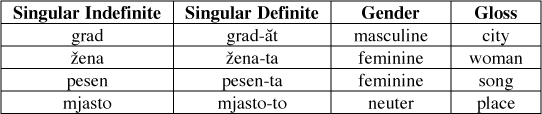
Be that as it may, other examples of inflectional marking of defi-niteness include Bulgarian (Scatton 1993:202, Stoykova 2002, 2004) and Macedonian (Friedman 1993:264, 266–267), and these provide valuable comparison. Below we consider Bulgarian. We do not offer a full ana-lysis of this complex system (see the sources just given for more detail), but we point out the salient similarities with Norwegian. In Bulgarian, if a noun stands alone, definiteness is realized as a suffix on this noun. The shape of the suffix is determined, at least in part, by the inflection class of the noun (Scatton 1993:202), as shown in table 1.
The definite suffix in Bulgarian.
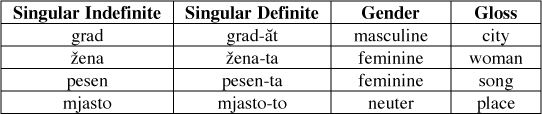
These examples demonstrate that the information provided by the phonology of the noun alone would be insufficient. Grad ‘city’ and pesen ‘song’ both end in a consonant but have different forms of the definite suffix. These two nouns belong to different inflection classes, and their inflection class allows us to predict the form of the suffix.Footnote 20
However, based on the data in table 1 alone, there could be another interpretation. One might suggest that the different shapes of the suffix is a matter of gender, since the examples with -ta are both feminine. The examples in table 2 show that gender is not a reliable predictor, while inflection class is (examples from Scatton 1993:199, 201 and Nicolova 2008:83–84).
The definite suffix in Bulgarian: Examples with gender/inflection mismatches.
The data in table 2 show that the noun form without the suffix, which indicates the inflection class, is needed to predict the form of the suffix for some nouns. The examples in table 2 do not have the same definite-ness suffix as other nouns of the same gender. These are typical “mis-match” nouns, whose inflection class and gender do not line up. The suffix that marks definiteness is clearly sensitive to the form and not to the gender of the noun, as tables 1 and 2 demonstrate. Nevertheless, the forms that realize definiteness look similar to exponents of gender. In this respect the Bulgarian examples are comparable with the Norwegian ones.
If an adjective is added, the Bulgarian definite suffix appears on the first adjective, and its form is now determined by gender in a fully regular way. Consider the examples in 36.
(36)
Thus, while the Bulgarian definite suffix presents challenges in its own way (see Popova 2000, Dost & Gribanova 2006, and references there), it does not induce the type of split found in Norwegian. When definiteness is expressed as a nominal affix, its form depends, in part, on the inflection class of the noun (not its gender). When definiteness is ex-pressed by an independent morpheme external to the noun, its form is determined regularly by gender and number agreement.
Norwegian, then, is somewhat unusual because of the inflectional marking of definiteness, though this is something shared with a minority of languages around the world, and because the shape of the definiteness suffix is so closely connected to gender. Second, the noun mother appears to be assigned to the masculine gender in a number of dialects, which is highly unusual.Footnote 21 Moreover, this noun is not simply masculine; rather, it is a hybrid, whose gender depends on the particular target. The data from the Oslo dialect have shown that the distribution of the masculine and feminine agreement is straightforwardly constrained by the Agreement Hierarchy. Masculine agreement occurs within the noun phrase, while feminine agreement occurs outside it.
The third unusual property of the noun mamma ‘mother’ surfaces in the Nordreisa dialect, where this noun is split—its gender varies according to definiteness. This is unusual, as gender alternation within the same noun is normally associated with number (Carstairs-McCarthy 1994). Given this split, the noun mamma ‘mother’ in the Nordreisa dialect is masculine only when it is definite and its agreement target is the possessive within the noun phrase. Hence, the agreement pattern is also constrained by the Agreement Hierarchy. These observations sug-gest strongly that one should maintain the definition of gender that takes into account agreement with associated words (see section 1.1). If one examines the different associated words, an interesting gender split emerges, and the phenomenon conforms to a typologically recognizable pattern.
Under the associated morpheme approach (see section 1.1), the form mamma-en ‘mother-def.sg.{m}’ in the Nordreisa dialect indicates that the noun is masculine. Then there is no obvious way to account for the different masculine and feminine forms that also occur. One needs to be able to say that its definite and indefinite forms trigger different agree-ments.
Given the intriguing data from Norwegian dialects, there are two possible ways to proceed. Either the Agreement Hierarchy needs to be elaborated, or the notion of lexical splits needs to be developed. Let us consider each of these two options.
Hypothesis 1: The Agreement Hierarchy needs to be elaborated.
The idea is to divide the attributive position within the noun phrase into definite and indefinite. This does not seem promising, since in Norwegian, this type of definite versus indefinite contrast only exists with respect to a few nouns.Footnote 22 There is evidence, however, that the at-tributive possessive has a particular status within the noun phrase (see Wald 1975 on urban Swahili, reported in Corbett 1991:252, 254; Lødrup 2011a, 2011b on “more modern” Oslo Norwegian).
Hypothesis 2: The notion of lexical splits needs to be developed.
Under this approach, lexemes may be split, with only a part of the lexeme being hybrid. Specifically, Nordreisa mamma ‘mother’ is split, and only in the definite is it a hybrid. This appears to be the more promising route. The comparison with Bosnian/Croatian/Serbian gazda ‘landlord, boss’ is helpful here, since that noun is split, and agreement options are available for it only in the plural. However, there is certainly more to be understood about lexical splits. Carstairs-McCarthy's (1994:771) claim that gender mixture can only be based on number (and not on case, for instance) has been generally accepted, as far as we are aware. Yet the gender mixture in Norwegian is based on definiteness.
Nevertheless, one may wonder why these exceptions are found with definiteness as opposed to some other category. It is well known that there is a special relationship between gender and number (Corbett 1991: 132, 2000:27). Carstairs-McCarthy (1994:771) suggests, tentatively, that the reason why gender mixture is based on number only is that number has relatively high relevance—in Bybee's (1985) terms—for nouns. According to Bybee's (1985:15) definition of relevance, “[a] category is relevant to the verb to the extent that the meaning of the category directly affects the lexical content of the stem” (emphasis removed). Though Bybee discusses the notion of relevance with respect to verbs, the con-cept can be used more widely (Bybee 1985:13, 85; see also other researchers who apply the concept to nouns, such as Lie 1986, Bauer 2003, Nübling 2005).
Should this argument be extended to definiteness? At first glance, the major consideration would be that the definite form of the noun in question is odd: mamma-en has the shape appropriate for the definite form of a masculine noun. This observation is discussed in more detail by Rice (1997), who suggests that mamma-en is chosen over mamma-a because phonology outranks morphology. Rice works within Optimality Theory, and the idea is that /mama.a/ (where . signifies syllable boun-dary) is not an acceptable phonological form, and that the account of the interfaces in Optimality Theory will ensure that the morphologically unacceptable form is chosen rather than the phonologically unacceptable one. While this explanation would work for the example from the Oslo dialect, since to have one /a/ immediately followed by another one in that dialect seems to be excluded, there are Norwegian dialects in which there is nothing phonologically wrong with /mama.a/. Trondheim is a case in point, as it has /mama.an/ in the definite plural, but it still has /maman min/ in the definite singular, just like Oslo. To us, this indicates that a form-based account, though appealing, may not be the entire story. Also, the form-based approach is not helpful with such mixtures as gong ‘time, occasion’ (see section 4.1) or with the Web examples venn ‘friend’, lærer ‘teacher’, katte ‘cat’, seter ‘summer farm’ (see section 4.2).
Note, however, that there are a number of dialects where the normal plural suffix for masculine nouns is -ar, and yet nouns that end in a in the indefinite singular can have the plural suffix -er.Footnote 23 This supports Rice's account, and more generally, the importance of form. The very reason that in the Oslo dialect the noun mamma /mama/ takes a masculine deter-miner is its formal similarity to masculine nouns such as /ha:na/ ‘rooster’ and /ste:ga/ ‘ladder’ (these nouns have a different shape in, for instance, Sunnhordland, and, therefore, cannot affect the gender of mamma there.)
As for the relevance (in Bybee's sense) of definiteness, we do find particular lexical items for which definiteness appears to have high relevance. For Swedish (which is structurally very close to Norwegian), Svanlund (2001:289ff) notes that the definite form of the noun balans ‘balance’ is used almost exclusively with reference to physical balance, while for spiritual or psychological balance the indefinite form is used. Similarly, if Swedish värld ‘world’ or its Norwegian Nynorsk cognate verd are used in the definite form (as they usually are, in normal discourse), they almost always refer to our world, and hardly ever to any other world. Thus, these polysemous nouns have slightly different senses in the definite and the indefinite, which indicates that the category defi-niteness can have high relevance for nouns. Kürschner (2008:24–25) and Lie (1986) also argue that definiteness, though less relevant than number, is more relevant than, for example, case.
Consider again the word mamma ‘mother’. This noun has an unusual distribution (also associated with some other inalienables). One normally refers to one's own mother or the person who is the mother in a family under discussion, and so explicit marking of definiteness is not strictly necessary. In its indefinite form this noun can function as though it were definite:
(37)
An indefinite article can be added for typical indefinite uses, as in A mother is expected to be caring. The definite article would appear if there is also a possessive. This noun, therefore, differs from regular nouns denoting humans, for which the syntax of 37 would not be acceptable. This special status may also be contributing to the remarkable behavior of mamma ‘mother’ in the Nordreisa dialect, in addition to the formal and semantic factors.
6. Conclusion
We have looked at surprising facts from some Norwegian dialects, where the noun mamma ‘mother’ appears to act like a masculine noun (sections 2 and 3). This is not what one would expect, given the semantics of this noun. In one particular dialect, that of Nordreisa, the word even looks like a masculine noun, but only in its definite form. This is an unusual type of split, as gender mixture is typically found on the basis of number, while in this case it is based on definiteness (although we have shown in section 4 that there are some corroborative examples in other varieties, even if the phenomenon is clearly marginal).
The Nordreisa example of mamma is unusual also because it affects its agreement targets differently, and clearly triggers masculine agree-ment within the noun phrase, but not outside it (preferably). Thus, on close inspection, and given strict adherence to the classical agreement-based definition of gender, the Nordreisa example turns out to be in accord with the Agreement Hierarchy. To conclude, this noun exhibits three unusual properties. However, each unusual property individually has analogous counterparts in other languages, and in this sense the whole phenomenon conforms to established typological generalizations.