INTRODUCTION
Team performance, which may be defined as the outcome of dynamic processes reflected in the coordination and communication processes that teams develop over time (Hackman, Reference Hackman1983), is a central object of study in the field of organizational literature. Because team composition is an important factor in determining both team processes and outcomes (Gladstein, Reference Gibson1984; Campion, Medsker, & Higgs, Reference Campion, Medsker and Higgs1993), researchers have frequently explored the effects of team composition in various group settings, particularly with respect to the team’s composition in terms of personality types (Barry & Stewart, Reference Barry and Stewart1997; Barrick, Stewart, Neubert, & Mount, Reference Barrick, Stewart, Neubert and Mount1998; Bell, Reference Bell and Kozlowski2007). Most studies on this subject have employed the ‘Big Five’ model of personality traits and cognitive abilities (Barrick et al., Reference Barrick, Stewart, Neubert and Mount1998; Humphrey, Hollenbeck, Meyer, & Ilgen, Reference Humphrey, Hollenbeck, Meyer and Ilgen2007; Olson, Parayitam, & Bao, Reference Olson, Parayitam and Bao2007). Recently, however, a number of researchers have focused on the motivational aspects of team composition, and have started to investigate the role of goal orientation (GO) composition in teams (Porter, Reference Porter2005; Mehta, Field, Armenakis, & Mehta, Reference Mehta, Field, Armenakis and Mehta2009; Porter, Webb, & Gogus, Reference Porter, Webb and Gogus2010).
‘GO’ is a personal characteristic that describes an individual’s preferred form of achievement when pursuing defined goals (Dweck, Reference Dweck1986). An individual’s goal preference influences the way in which they create frameworks for their interpretation of and reaction to events or outcomes (Dweck & Leggett, Reference Dweck1988; Dweck, Reference Dweck1989). The literature identifies two different GOs with respect to developing and demonstrating abilities, namely, orientation toward learning (learning goal orientation [LGO]) and orientation toward performance (performance goal orientation [PGO]) (Dweck, Reference Dweck1986; Dweck & Leggett, Reference Dweck1988). These two GOs foster different response patterns in the settings in which achievement is measured.
Since GO was introduced into organizational literature, considerable research has been devoted to examining how individuals who exhibit LGO and PGO interpret and respond to achievement scenarios. In the past, researchers have generally compared and contrasted these two GOs with respect to their main effects on various organizational issues, such as goal setting (Sujan, Weitz, & Kumar, Reference Sujan, Weitz and Kumar1994; Phillips & Gully, Reference Pieterse, van Knippenberg and van Ginke1997), feedback seeking (VandeWalle & Cummings, Reference VandeWalle, Brown, Cron and Slocum1997; VandeWalle, Ganesan, Challagalla, & Brown, Reference VandeWalle, Ganesan, Challagalla and Brown2000; Tuckey, Brewer, & Williamson, Reference Tuckey, Brewer and Williamson2002), job satisfaction (Janssen & Van Yperen, Reference Janssen and Van Yperen2004), and performance (VandeWalle, Brown, Cron, & Slocum, Reference VandeWalle and Cummings1999; VandeWalle et al., Reference VandeWalle, Ganesan, Challagalla and Brown2000; Kozlowski, Gully, Brown, Salas, Smith, & Nason, Reference Kozlowski and Hults2001; Seijts, Latham, Tasa, & Latham, Reference Seijts, Latham, Tasa and Latham2004; Porath & Bateman, Reference Porath and Bateman2006; Payne, Youngcourt, & Beaubien, Reference Payne, Youngcourt and Beaubien2007; Chen & Mathieu, Reference Chen and Mathieu2008). Recent research has also extended the theoretical framework of GO in order to identify mediating factors in the relationship between GO and outcomes, such as self-regulation tactics (Porath & Bateman, Reference Porath and Bateman2006), ‘backing up’ behavior (Porter, Reference Porter2005), self-efficacy (Potosky & Ramakrishna, Reference Potosky and Ramakrishna2002; Seijts et al., Reference Seijts, Latham, Tasa and Latham2004; Payne, Youngcourt, & Beaubien, Reference Payne, Youngcourt and Beaubien2007), and leader–member exchanges (Janssen & Van Yperen, Reference Janssen and Van Yperen2004). However, most studies have focused on GO at the individual level (Payne, Youngcourt, & Beaubien, Reference Payne, Youngcourt and Beaubien2007), with minimal attention having been paid to GO at the team level.
A small number of studies have investigated the relationship between team composition and GO at the team level, particularly in terms of the impact of a team’s collective GO on team functionality. These studies have begun to explore the effects that a team’s GO has on behaviors and outcomes, such as team efficacy (DeShon, Kozlowski, Schmidt, Milner, & Wiechmann, Reference DeShon, Kozlowski, Schmidt, Milner and Wiechmann2004; Porter, Reference Porter2005; Dierdorff & Ellington, Reference Dierdorff and Ellington2012), ‘backing up’ behavior (Porter, Reference Porter2005), team goal commitment (DeShon et al., Reference DeShon, Kozlowski, Schmidt, Milner and Wiechmann2004; Porter, Reference Porter2005), team adaptability (LePine, Reference LePine2005; Porter, Webb, & Gogus, Reference Porter, Webb and Gogus2010), team self-regulation tactics in team planning activities (Mehta et al., Reference Mehta, Field, Armenakis and Mehta2009), team performance (Porter, Reference Porter2005; Mehta et al., Reference Mehta, Field, Armenakis and Mehta2009; Dierdorff & Ellington, Reference Dierdorff and Ellington2012), and team creativity (Gong, Kim, Lee, & Zhu, Reference Gong, Kim, Lee and Zhu2013). Despite all of this accumulated knowledge, however, each of these studies considered the observations of teams of undifferentiated individuals who cooperated to complete a task, and involved the calculation of an average GO score for the team as a whole (LePine, Reference LePine2005; Porter, Reference Porter2005; Mehta et al., Reference Mehta, Field, Armenakis and Mehta2009; Porter, Webb, & Gogus, Reference Porter, Webb and Gogus2010; Dierdorff & Ellington, Reference Dierdorff and Ellington2012). Little consideration has been given to status differences that may exist within teams. However, team leaders and team members are typically treated as having differing effects on a team’s functionality (Yukl, Reference Yukl1994). Only a few studies have incorporated this insight in their empirical studies (Hendricks & Payne, Reference Hendricks and Payne2007; Gong, Huang, & Farh, Reference Gong, Huang and Farh2009). Accordingly, this study is designed to analyze teams’ GO composition in a manner that differentiates between team leaders and the other team members (sometimes referred to as followers or staff) in order to account for their separate roles in team processes and performance.
In particular, we address two key issues in order to test the relationship between teams’ collective GOs and team performance, using permanent teams in a field setting. Our first research question concerns the mechanism, or mediating factor, through which a team’s GO affects team performance. Payne, Youngcourt, and Beaubien (Reference Payne, Youngcourt and Beaubien2007) propose a GO model in which self-efficacy is one of the critical mediating variables in the relationship between individual GO and outcomes. In extending and applying this stream of research at the team level, we propose that team efficacy (i.e., self-efficacy aggregated at the team level) may play a mediating role in the relationship between team GO and team performance. In addition, we examine the interaction patterns obtained from analyzing the separate roles of a leader’s GO and team members’ GO in order to determine the effects of these interactions on team efficacy and team performance. The findings of this study therefore contribute to the existing theoretical literature by proposing new ways of enhancing team performance through understanding the relationship between team GOs and achievement outcomes.
Team GO
GO theory was originally developed in educational psychology literature to explain differences in student learning behavior (Dweck & Reppucci, Reference Dweck and Leggett1973; Dweck, Reference Durham, Knight and Locke1975). Over the last two decades, GO theory has become an important tool in the field of achievement motivation in organizational literature. GO is a characteristic that reflects an individual’s preferred approach to achieving defined goals. These preferences can affect individuals’ actions and reactions (Dweck, Reference Dweck1986). The literature identifies two different GO patterns: ‘LGO’ and ‘PGO’ (Dweck, Reference Dweck1986; Dweck & Leggett, Reference Dweck1988). LGO is associated with a belief that ability is malleable and can be developed with effort. Individuals with high LGO focus on learning, developing skills, and mastering knowledge in order to develop their competencies (Dweck, Reference Dweck1986; Dweck & Leggett, Reference Dweck1988; Janssen & Van Yperen, Reference Janssen and Van Yperen2004). They are likely to seek challenging tasks and to exert a greater amount of effort in order to accomplish their goals. For these individuals, errors and negative feedback are regarded as useful opportunities to improve their task-completion processes; this information can be used to facilitate learning (Elliott & Dweck, Reference Elliott and Dweck1988). Such individuals show persistence in the face of obstacles and failures, and continue to master their skills in order to accomplish future tasks (Button, Mathieu, & Zajac, Reference Button, Mathieu and Zajac1996).
By contrast, PGO is associated with a belief that ability is fixed and unchangeable. Individuals with high PGO scores focus on avoiding failure and attempting to create an impression of high ability (Dweck, Reference Dweck1986; Dweck & Leggett, Reference Dweck1988; Janssen & Van Yperen, Reference Janssen and Van Yperen2004). They are likely to avoid challenges, and to exert less effort when completing tasks in which they perceive themselves to have low levels of ability (Dweck & Leggett, Reference Dweck1988). In the face of obstacles and failures, they experience a deterioration of performance and other negative effects; as a result, they avoid novel situations and challenges, readily withdraw in the face of obstacles, and emphasize the demonstration of their abilities in comparison with others (Janssen & Van Yperen, Reference Janssen and Van Yperen2004). Since teams consist of individuals, and the traits of the individual team members form the characteristics of the team (Morgeson & Hofmann, Reference Morgeson and Hofmann1999; Stewart, Reference Stewart2003), GO can be observed at the team level (Gully & Phillips, Reference Gully and Phillips2005; Porter, Reference Porter2005). A team’s GO may be defined as a ‘shared understanding of the extent to which a team emphasizes LGO or PGO, and, consequently, helps to facilitate group process and outcomes that maintain the group’s emphasis on learning or performance goals’ (Bunderson & Sutcliffe, Reference Bunderson2003: 553). Porter (Reference Porter2005) suggests that teams can be characterized according to the average goal orientation level of all team members. This study uses team members’ mean LGO and PGO scores as a measure of a team’s LGO and PGO (Deshon et al., Reference DeShon, Kozlowski, Schmidt, Milner and Wiechmann2004; Porter, Reference Porter2005; Porter, Webb, & Gogus, Reference Porter, Webb and Gogus2010; Dierdorff & Ellington, Reference Dierdorff and Ellington2012). This method assumes that an individual’s exhibition of a given characteristic serves to increase the collective prevalence of that characteristic within a team (Barrick et al., Reference Barrick, Stewart, Neubert and Mount1998).
Team GO and team performance: the mediating role of team efficacy
Previous empirical studies have shown that a team’s LGO is positively associated with team performance (Bunderson & Sutcliffe, Reference Bunderson2003; DeShon et al., Reference DeShon, Kozlowski, Schmidt, Milner and Wiechmann2004; Porter, Reference Porter2005; Mehta et al., Reference Mehta, Field, Armenakis and Mehta2009; Dierdorff & Ellington, Reference Dierdorff and Ellington2012); however, the mediating mechanisms behind this effect remain unclear. Despite some evidence suggesting that self-efficacy plays a mediating role in accounting for the performance of individuals who exhibit LGO (Seijts et al., Reference Seijts, Latham, Tasa and Latham2004), this finding cannot be generalized to the team level. It is therefore necessary to explore the mediating process in order to fully understand how GO relates to team performance.
Team efficacy, or collective efficacy, refers to a team’s belief that it can successfully perform its tasks (Gully, Incalcaterra, Joshi, & Beaubien, Reference Gully, Incalcaterra, Joshi and Beaubien2002). Bandura (Reference Bandura1997: 447) argues that team efficacy is a shared belief in a collective’s capabilities, and that this belief influences the actions that team members choose, how much effort they exert, and what strategies are best suited to attaining their goals. A high degree of confidence within the team means that team members demonstrate a high level of commitment to their tasks, which helps teams to persevere in the face of adversity, and results in positive performance outcomes. Team efficacy has recently become an important object of study in group research. Several prior studies have identified a strong positive relationship between team efficacy and group performance in various work group settings (see e.g., Gibson, Reference Gibson and Earley1999; Gully et al., Reference Gully, Incalcaterra, Joshi and Beaubien2002; Jung & Sosik, Reference Jung and Sosik2002; Gibson & Earley, Reference Gladstein2007).
As noted above, previous studies have shown that self-efficacy is an important mediating mechanism between GO and performance outcomes at the individual level (Potosky & Ramakrishna, Reference Potosky and Ramakrishna2002; Seijts et al., Reference Seijts, Latham, Tasa and Latham2004). This result is robust according to a meta-analysis conducted by Payne, Youngcourt, and Beaubien (Reference Payne, Youngcourt and Beaubien2007). Although these results have been found to apply at the individual level, a smaller number of studies have also argued that team efficacy is an important factor in describing the relationship between a team’s GO and its outcomes (Deshon et al., Reference DeShon, Kozlowski, Schmidt, Milner and Wiechmann2004; Porter, Reference Porter2005). We therefore believe that team efficacy plays a mediating role with respect to GO and performance at the team level.
Teams with high LGO (i.e., teams composed of individuals who take their ability to be malleable) believe that performance can be improved through effort (Dweck, Reference Dweck1989). As a result, they generally react positively to work events and achievement situations, even when their performance outcomes indicate that they have performed poorly. For this reason, high LGO teams are easily motivated to adopt positive regulatory processes at the team level. These processes include maintaining confidence, adopting aggressive strategies, persisting in overcoming obstacles in the face of learning difficulties (VandeWalle et al., Reference VandeWalle and Cummings1999), and engaging in knowledge creation and solution-oriented activities when performing tasks (Payne, Youngcourt, & Beaubien, Reference Payne, Youngcourt and Beaubien2007). Such characteristics are sources of team efficacy. Teams with high efficacy are willing to expend more effort, and exhibit more persistence in overcoming setbacks and obstacles to the attainment of their task goals, than teams with low team efficacy (Bandura, Reference Bandura1986). Consequently, a high sense of team efficacy is beneficial for the purposes of team performance.
By contrast, previous studies have shown that the effects of PGO on behaviors and outcomes such as self-efficacy and performance are inconsistent at the individual level (Bell & Kozlowski, Reference Bell2002; Seijts et al., Reference Seijts, Latham, Tasa and Latham2004; Kaplan & Maehr, Reference Kaplan and Maehr2007; Dierdorff & Ellington, Reference Dierdorff and Ellington2012). Some studies have also shown conflicting results with respect to the relationship between a team’s PGO and team efficacy (DeShon et al., Reference DeShon, Kozlowski, Schmidt, Milner and Wiechmann2004; Porter, Reference Porter2005). Because individuals with PGO tend to define accomplishment primarily in terms of the external evaluations of their performance in completing tasks, their actions can be best understood by taking contextual cues into account. Accordingly, this study does not incorporate a prediction of the direct relationship between team members’ PGO, team efficacy, and performance. Hence, we propose the following as our first hypothesis:
Hypothesis 1: Team efficacy mediates the positive relationship between team members’ LGO and team performance.
Leader GO and team performance: the mediating role of team efficacy
GO is mostly seen as a relatively stable individual difference that may be influenced by situational variables (Button, Mathieu, & Zajac, Reference Button, Mathieu and Zajac1996). In particular, leadership is a situational variable that has the potential to influence team members. It is widely acknowledged that leaders have significantly more impact on internal dynamics and outcomes than team members do (Scott & Bruce, Reference Scott and Bruce1994; Yukl, Reference Yukl1994; Hendricks & Payne, Reference Hendricks and Payne2007). Hollenbeck, Ilgen, LePine, Colquitt, and Hedlund (Reference Hollenbeck, Ilgen, LePine, Colquitt and Hedlund1998) argue that teams in real-world organizations are typically hierarchical in the sense that individuals occupy distinct status levels that differ in terms of positional power. In terms of formal role designation within organizations, team leaders with higher status levels exercise a greater degree of influence over team processes (LePine, Hollenbeck, Ilgen, & Hedlund, Reference LePine, Hollenbeck, Ilgen and Hedlund1997). A team leader’s role and the team members’ roles are dissimilar, and hence should be viewed as separate (LePine et al., Reference LePine, Hollenbeck, Ilgen and Hedlund1997). Few empirical studies on leader–follower teams have been conducted in order to examine the effects of these two different roles on team processes and outcomes (Durham, Knight, & Locke, Reference Dweck and Reppucci1997; LePine et al., Reference LePine, Hollenbeck, Ilgen and Hedlund1997; Hollenbeck et al., Reference Hollenbeck, Ilgen, LePine, Colquitt and Hedlund1998; Hendricks & Payne, Reference Hendricks and Payne2007; Gong, Huang, & Farh, Reference Gong, Huang and Farh2009). According to status characteristic theory (Berger, Cohen, & Zelditch, Reference Berger, Cohen and Zelditch1972), team leaders with high status have higher expectations in terms of performance, and exert more influence over group interactions and outcomes (Bunderson, Reference Bunderson and Sutcliffe2003). Given the premise that team leaders exert a strong situational influence over team members, we speculate that a leader’s motivation and/or behaviors will carry more weight in terms of relative influence on team members. The role of a team leader involves setting task goals, adopting strategies, prioritizing working processes, and establishing performance directives for their team members. These activities will be influenced by the team leader’s GO. In fact, the leader’s GO toward learning or performance encourages the team members to stay on track, to persist, and to put effort into the process of working toward the team’s ultimate goals.
Leaders with high LGO are likely to create a climate that promotes the development of learning-oriented characteristics among members. Such characteristics include positive and proactive attitudes, as well as the tendency to seek out challenges, and to treat obstacles as opportunities to acquire new knowledge and mastery of different subject matter (Dweck, Reference Dweck1986; Button, Mathieu, & Zajac, Reference Button, Mathieu and Zajac1996; LePine, Reference LePine2005). Team leaders communicate their priorities with respect to achievement by engaging in behaviors and practices that support and reinforce their favored GO; in turn, these decisions send signals to group members about what behaviors and practices are expected and valued (Dragoni, Reference Dragoni2005; Gong, Huang, & Farh, Reference Gong, Huang and Farh2009). Such leaders create advantageous situational LGO cues for team members. These cues are adopted through processes such as behavioral modeling, in which team members frequently encounter the same situational cues and consult each other for interpretation of these cues. In such cases, their perceptions will often converge (Bunderson & Sutcliffe, Reference Bunderson2003; Gong et al., Reference Gong, Kim, Lee and Zhu2013). Accordingly, a leader with a high LGO influences team members to emphasize learning, which helps them to develop a common perception of high team efficacy. Members of teams with high team efficacy are more confident in executing aggressive approaches to task completion, such as encouraging information searches and sharing, and applying alternative problem-solving strategies. These strategies eventually lead to improved team performance.
By contrast, team leaders who exhibit PGO possess the characteristics associated with PGO, including feelings of helplessness, a tendency to experience negative emotions in the face of obstacles, a habit of seeking to avoid or withdraw from achievement-based situations and a lack of effort when it comes to completing tasks. Such team leaders are likely to have a negative reaction to challenging tasks and related environments, and to create a passive climate for team members. Through their interactions in the course of team processes, team leaders may potentially instill a common attitude of avoidance in team members, which is characteristic of low team efficacy. This could result in low confidence when it comes to task fulfillment, and may limit overall team performance. Accordingly, we propose the following as Hypothesis 2:
Hypothesis 2a: Team efficacy mediates the positive relationship between a team leader’s LGO and team performance.
Hypothesis 2b: Team efficacy mediates the negative relationship between a team leader’s PGO and team performance.
Effects of interaction between team members’ GOs and leader’s GO
Situational variables can play a powerful role in determining behavior (Jackall, Reference Jackall1988). According to Lewin’s interactionist theory, behavior is the product of both personality and situation (Weiss & Adler, Reference Weiss and Adler1984; Endler & Parker, Reference Endler and Parker1992). According to various personality researchers, personality is an important variable that can influence various behavioral patterns, but the impact of personality on behaviors is muted when situational variables are emphasized (Cooper & Withey, Reference Cooper and Withey2009). Similarly, Mischel (Reference Mischel1977) claims that situational variables are likely to dominate in terms of explanatory power when the situation is strong, while personality is likely to dominate in terms of explanatory power when the situation is weak. For example, strong situation constrain options and provide clear signals about what is expected in organization. Uniform expectancies restrict the degree of behavioral variability across individuals, which in turn limit observed personality–behavior relations. On the contrary, behaviors are more likely to reflect relevant personality traits when organizational signals and constraints are weak (Cooper & Withey, Reference Cooper and Withey2009). In our study, the team leader’s GO is considered to be a situational stimulus that affects team members’ behavior, and influences the explanatory power of the relationship between team members’ GOs, team efficacy, and team performance.
As noted above in our discussion of status characteristic theory, team leaders with high levels of influence strongly affect team processes, and team members are more willing to be influenced by such leaders (Bunderson, Reference Bunderson and Sutcliffe2003). A leader with a high level of influence and LGO acts as a strong situational influence on team members, and can motivate team members to exhibit high team efficacy and team performance (Kristof-Brown & Stevens, Reference Kristof-Brown and Stevens2001; Bunderson & Sutcliffe, Reference Bunderson2003; DeShon et al., Reference DeShon, Kozlowski, Schmidt, Milner and Wiechmann2004; LePine, Reference LePine2005; Porter, Reference Porter2005). Under this strong situational influence, the explanatory power of team members’ LGO with respect to team efficacy and team performance would be mitigated from a personality–situation perspective (Mischel, Reference Mischel1977; Cooper & Withey, Reference Cooper and Withey2009). In other words, the positive relationships between team members’ LGO and team efficacy or team performance would be weaker under the leadership of someone with a high LGO.
In comparison with LGO, past evidence about the effect of PGO on team efficacy and team performance has revealed inconsistent results (DeShon et al., Reference DeShon, Kozlowski, Schmidt, Milner and Wiechmann2004; Porter, Reference Porter2005; Dierdorff & Ellington, Reference Dierdorff and Ellington2012). In this study, we speculate that the team leader may be a factor that can help to explain the conflicting results regarding the relationship between teams’ PGO, team efficacy, and performance. A leader with high PGO and a strong influence on the team process may induce team members to exhibit low team efficacy and team performance, in keeping with the properties of PGO (LePine, Reference LePine2005; Porter, Reference Porter2005). We argue that the negative relationship between team members’ PGO and team efficacy or performance would be amplified under the strong situational influence of a leader with a high PGO. Hence, we propose Hypotheses 3 and 4:
Hypothesis 3a: A team leader’s LGO moderates the relationship between team members’ LGO and team efficacy, such that the positive relationship will be mitigated under a leader with a high LGO.
Hypothesis 3b: A team leader’s PGO moderates the relationship between team members’ PGO and team efficacy, such that the negative relationship will be increased under a leader with a high PGO.
Hypothesis 4a: A team leader’s LGO moderates the relationship between team members’ LGO and team performance, such that the positive relationship will be mitigated under a leader with a high LGO.
Hypothesis 4b: A team leader’s PGO moderates the relationship between team members’ PGO and team performance, such that the negative relationship will be increased under a leader with a high PGO.
METHOD
Participants and procedure
Our data samples were collected from work teams in various Taiwanese corporations. Data collection proceeded in two stages. First, we used convenience sampling to seek approval for the survey via telephone or mail. Second, based on the reply letters received, we contacted the human resource managers of the responding corporations to seek their approval to include their teams in the survey.
The participating human resource managers identified the number of teams in their company, and informed team supervisors about the survey. Then, the study-based survey was parceled out into questionnaire packages and mailed to team supervisors directly. Because we were unable to identify the number of team members within each company in advance, each team questionnaire package consisted of a fixed parcel of survey guidelines in pink, a blue leader questionnaire, eight white member questionnaires, and gifts (in order to improve response rates, gift incentives with values equivalent to 50 new Taiwan dollars were given to each participant). All team supervisors were asked to complete the survey themselves, as well as to randomly distribute the survey to their team members. A written statement assured subjects of the voluntary nature of the survey and the confidentiality of their individual responses. Completed materials were mailed directly to the researchers. This design was intended to reduce team members’ concerns about the exposure of their responses to supervisors.
Using convenient sampling, we surveyed 498 team members and 90 team leaders from 90 teams within 59 companies. Response data were obtained from 353 team members belonging to 78 teams. After excluding 49 invalid questionnaires with insufficient data, and deleting 13 teams consisting of 28 team members and 13 team leaders due to a response rate of less than two-thirds of the team members, the remaining valid participants comprised 268 team members and 64 leaders of 64 teams from 53 companies. The valid response rate was 53.8% for team members and 71% for team leaders.
Among the team leaders, 66.2% were male, and the average age was 35 years (SD=6.1). In terms of educational attainment, 37% held a graduate degree, and 32.3% held a 4-year university degree, while the remainder had no college degree (30.7%). Average tenure as a team leader was 41.26 months (SD=50.4). Among the team members, 41.9% were male, and the average age was 29 years (SD=4.25). In terms of educational attainment, 18.8% held a graduate degree and 53.4% held a 4-year university degree, while the remainder had no college degree (27.8%). Average team size was 4.1(SD=1.9); average tenure with the organization was 30.23 months (SD=30.3); and average tenure with the team was 20.5 months (SD=18.3).
Measurement
The following measures were administered in our survey questionnaire:
GO
The items in our GO scale were taken from Janssen and Van Yperen (Reference Janssen and Van Yperen2004). We used a back-translation procedure to ensure the accuracy of the translation (Brislin, Reference Brislin1980). The scale was designed to directly capture the team members’ assessment of chronic LGO and PGO. It contained 11 items for LGO and eight items for PGO for a total of 19 items, scored on a 7-point Likert-type scale ranging from 1=‘strongly disagree,’ to 7=‘strongly agree.’ The scale was completed by both team members and leaders. Similar to prior research on team GO composition (Porter, Reference Porter2005), the scores of team members’ LGO and team members’ PGO were both measured by averaging all team member’s scores (i.e., Chan, Reference Chan1998) for their respective GO, while the leader’s LGO and PGO was the score of his or her measurement. For team members, the Cronbach’s α of LGO and PGO was 0.93 and 0.94, respectively. For team leaders, the Cronbach’s α of LGO and PGO was 0.88 and 0.89, respectively.
We calculated interrater agreement by computing r wg(j) (James, Demaree, & Wolf, Reference James, Demaree and Wolf1984; Kozlowski & Hults, Reference Kozlowski, Gully, Brown, Salas, Smith and Nason1987), obtaining a mean value of 0.92 for teams’ LGO and 0.89 for teams’ PGO. The intraclass correlation (ICC1) and reliability of group mean (ICC2) values were also calculated: teams’ LGO was 0.31 and 0.63, while teams’ PGO was 0.17 and 0.43, respectively. These results were comparable with the median and recommended ICC values reported in the literature (Schneider, White, & Paul, Reference Schneider, White and Paul1998). Thus, the aggregation of these variables was justified.
Team efficacy
The items in our scale were adopted from Jung and Sosik (Reference Jung and Sosik1999). A total of five items used the team as referent (i.e., referent-shift composition; Chan, Reference Chan1998) and were rated using a 7-point scale ranging from 1=‘strongly disagree,’ to 7=‘strongly agree.’ The Cronbach’s α for the sample was 0.93. Team self-efficacy was measured by team member’s self-report and aggregation of every team member’s scores to represent team level efficacy. The interrater agreement by r wg(j) is 0.95, while the ICC1 and ICC2 values were 0.70 and 0.89, respectively.
Team performance
The items to measure team performance scale were from the scale developed by Edmondson (Reference Edmondson1999). It contained five items scored on a 7-point Likert scale ranging from 1=‘strongly disagree,’ to 7=‘strongly agree.’ Sample items included ‘this team meets or exceeds its customers’ expectations’ and ‘this team does superb work.’ The scale was measured by team leader evaluation, and the mean score was calculated to represent the team performance. Past research about team performance evaluation was predominantly evaluated by team leaders in order to avoid inflation measurement if using team members’ self-report (Gong, Huang, & Farh, Reference Gong, Huang and Farh2009; Hirst, van Knippenberg, & Zhou, Reference Hirst, van Knippenberg and Zhou2009), and to avoid the common method variance (CMV) bias if all data came from the same sources (Hofmann & Gavin, Reference Hofmann and Gavin1998). The scale Cronbach’s α for the sample was 0.86.
Control variables
Consistent with the work group literature, team size (Jackson, Brett, Sessa, Cooper, Jukin, & Peyronnin, Reference Jackson, Brett, Sessa, Cooper, Jukin and Peyronnin1991), team longevity (Bantel & Jackson, Reference Bantel and Jackson1989), and team members’ GO heterogeneity (Jackson et al., Reference Jackson, Brett, Sessa, Cooper, Jukin and Peyronnin1991; Jung & Sosik, Reference Jung and Sosik1999) were controlled, as there was evidence to suggest that they could potentially affect team process and team performance. Furthermore, we also controlled for leader’s tenure with the team. Team longevity is the average tenure of team members with the team. We calculated the average score of the coefficient of variation of the LGO and PGO of team members as the team members’ GO heterogeneity.
Confirmatory factor analysis
Confirmatory factor analysis was conducted using Lisrel 8.51 (Jöreskog & Sörbom, Reference Jöreskog and Sörbom1996) with maximum likelihood estimates derived from the sample covariance matrix. We examined the root mean square error of approximation (RMSEA), the standardized root mean square residual (SRMR), and comparative fit index (CFI) to evaluate the goodness of fit of the measurement model in the analysis. In the present study, the measurement model indicated better fit. χ2 (249)=585.95 (p<.01), RMSEA is 0.07, SRMR is 0.05, and CFI is 0.93. The data revealed acceptable outcomes according to the suggestion from Hu and Bentler (Reference Hu and Bentler1999).
RESULTS
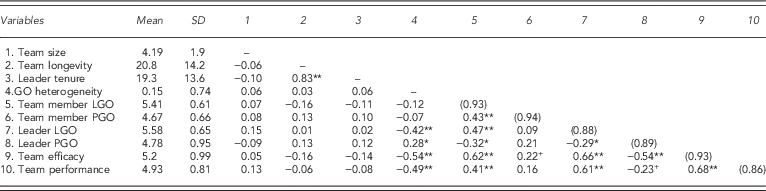
Table 1 shows the descriptive statistics and zero-order correlation among the study variables. It can be seen that team members’ LGO is positively related to team efficacy (r=0.62, p<.01) and team members’ PGO has a weak positive correlation to team efficacy (r=0.22, p<.10). Further, the team leader’s LGO is significantly and positively related to team efficacy (r=0.66, p<.01), whereas team leader’s PGO is significantly and negatively related to team efficacy (r=−0.54, p<.01). In addition, team efficacy is positively related to team performance (r=0.68, p<.01). It is observed that the mediation relationship between team leader’s GO, team efficacy, and team performance reveals different patterns according to whether a team leader has an LGO or a PGO.
Descriptive statistics, reliability coefficients, and correlation coefficients

Note. Internal consistency reliabilities appear in parentheses along the diagonal.
N=64.
Goal orientation heterogeneity was calculated by the mean score of the coefficient of variation of learning and performance goal orientation.
GO=goal orientation; LGO=learning goal orientation; PGO=performance goal orientation.
+ p<.10, *p<.05, **p<.01.
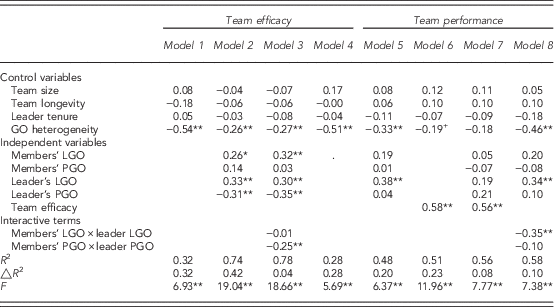
We performed hierarchical regression analyses to test our hypotheses (shown in Table 2). To facilitate interpretation of parameters and to minimize nonessential multicollinearity, all predictor variables were mean centered (Aiken & West, Reference Aiken and West1991).
Results of regression analyses for team goal orientation, team self-efficacy, and team performance

Note. Entries represent standardized regression coefficients.
N=64.
The scores of members’ learning orientation, members’ performance orientation, and team efficacy were mean centered before they were entered into the regression equation.
GO=goal orientation; LGO=learning goal orientation; PGO=performance goal orientation.
+ p<.10, *p<.05, **p<.01.
First of all, Hypotheses 1 and 2 examine team efficacy in a mediating role. In testing such mediation hypotheses, researchers are often guided by the multistep approach proposed by Baron and Kenny (Reference Baron and Kenny1986). Recently, however, research methodologists have identified potential shortcomings in this approach (MacKinnon, Lockwood, Hoffman, West, & Sheets, Reference MacKinnon, Lockwood, Hoffman, West and Sheets2002). The Sobel (Reference Sobel1982) test is another method for examining mediational analyses based on formal significance tests of the indirect effect. It is more powerful than the stepwise procedure proposed by Baron and Kenny (Reference Baron and Kenny1986), because it more directly addresses mediation (Preacher & Hays, Reference Preacher and Hays2004).
In accordance, in the present study, we examined mediation hypotheses (Hypotheses 1 and 2) by following these procedures: First, we examined the relationship between team GO and team efficacy, and the relationship between team efficacy and team performance. Second, we examined the relationship between team efficacy and team performance after controlling for team GO. These procedures exclude step 1 of the relationship between team GO and team performance as discussed earlier. Finally, we used the Sobel (Reference Sobel1982) test to further demonstrate the mediating effect.
As Model 2 of Table 2 shows, after controlling for team size, team longevity, leader tenure, and GO heterogeneity, team members’ LGO is positively related to team efficacy (β=0.26, p<.05). Model 6 also shows that team efficacy is positively related to team performance (β=0.58, p<.01). When including all GOs (team members’ LGO and PGO, leader’s LGO and PGO) and team efficacy (Model 7) in the regression equation, the effect of team members’ LGO on team performance completely disappears (β=0.05, n.s.) and team efficacy is still significantly and positively related to team performance (β=0.56, p<.05). Further, the Sobel test was computed for the indirect effects of team members’ LGO on team efficacy (β=0.42, SD=0.16) and for team efficacy on team performance (β=0.48, SD=0.09). The Sobel statistic was significant (z=2.35, p<.05), indicating that team efficacy mediated the positive relationship between team members’ LGO and team performance. Therefore, Hypothesis 1 was supported.
In addition, we further tested whether team efficacy has a mediating role in the relationship between leader’s GO and team performance. Similar to the procedure discussed earlier, Model 2 of Table 2 shows that leader’s LGO is positively related to team efficacy (β=0.33, p<.01), whereas leader’s PGO is significantly and negatively related to team efficacy (β=−0.31, p<.01). When including all GOs (team members’ LGO and PGO, leader’s LGO and PGO) and team efficacy (Model 7) in the regression equation, the effect of leader’s LGO and leader’s PGO on team performance disappears (β=0.19 and 0.21, respectively, n.s.), and team efficacy is still significantly and positively related to team performance (β=0.56, p<.05). Further, the Sobel test was computed for the indirect effects of leader’s LGO on team efficacy (β=0.50, SD=0.14) and team efficacy on team performance (β=0.48, SD=0.09). The Sobel statistic was significant (z=2.96, p<.01), indicating that team efficacy mediated the positive relationship between leader’s LGO and team performance. Therefore, Hypothesis 2a was supported. Furthermore, for the indirect effects of leader’s PGO on team efficacy (β=−0.32, SD=0.08) and team efficacy on team performance (β=0.48, SD=0.09), the Sobel statistic was significant (z=−3.2, p<.01), indicating that team efficacy mediated the negative relationship between leader’s PGO and team performance. Thus, Hypothesis 2b was supported.
Next, we examined whether a leader’s GO plays a moderating role in the relationship between team members’ GO and team efficacy. The Model 3 of Table 2 shows the results of the moderation effect. We found that the interaction term between team members’ LGO and leader’s LGO is not significant (β=−0.01, n.s.). Hypothesis 3a was not supported. Further, the interaction term between team members’ PGO and leader’s PGO is significantly negative (β=−0.25, p<.01). The interaction effect was shown in Figure 1, where the relationship between team members’ PGO and team efficacy is plotted for high and low leader’s PGO (defined as +1 and −1 SD from the mean, respectively) (Aiken & West, Reference Aiken and West1991). It shows that team members’ PGO is positively related to team efficacy when leader’s PGO is low, whereas team members’ PGO is negatively related to team efficacy when a leader’s PGO is high. Hence, Hypothesis 3b was supported.
Interaction effect of team members’ performance goal orientation (PGO) and leader’s PGO on team

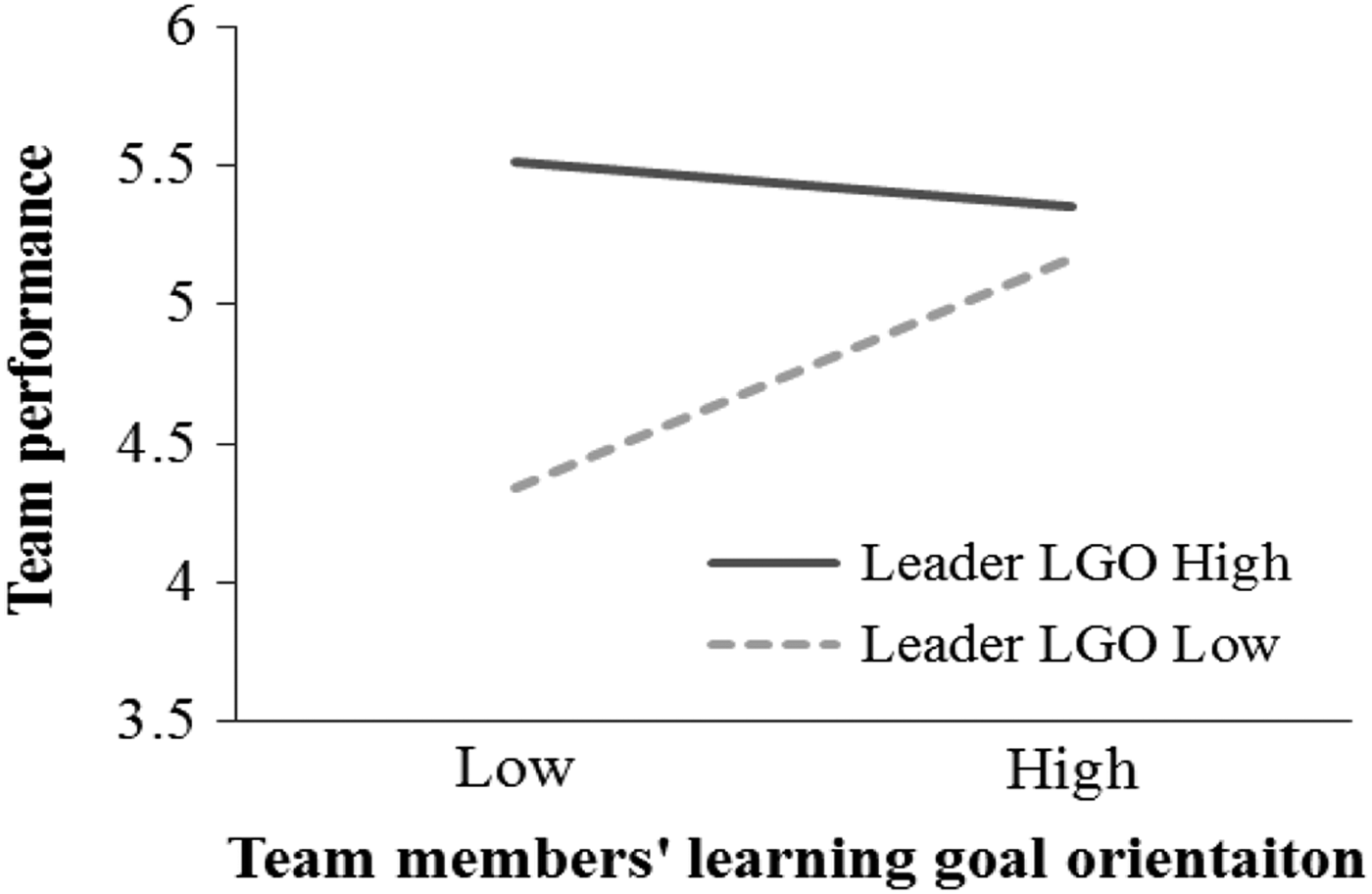
In addition, we examined whether leader’s GO played a moderating role in the relationship between team members’ GO and team performance. The Model 7 of Table 2 shows the results of the moderation effect. We found that the interaction term between team members’ LGO and leader’s LGO is significantly negative (β=−0.35, p<.05). The interaction effect is shown in Figure 2. It shows that the slope that demonstrates the relationship between team members’ LGO and team performance is nearly horizontal when leader’s LGO is high, whereas the slope is positive when leader’s LGO is low. Hypothesis 4a was supported. Furthermore, the interaction term between team members’ PGO and leader’s PGO is not significant (β=−0.07, n.s.). Hypothesis 4b was not supported.
Interaction effect of team members’ learning goal orientation (LGO) and leader’s LGO on team

DISCUSSION
The study offers several theoretical contributions to the literature on GO and on teams in the workplace. First, past empirical studies have predominantly explored GO at the individual level. There is a growing amount of interest in team GO, but the number of studies in this area remains limited. This study examines the relationship between a team’s GO composition and performance in order to supplement the existing literature regarding the impact of GO on a team. Second, the results of this study also contribute to the field of team composition literature, specifically with respect to GO as a personality trait. Although team composition is a popular subject in organizational literature, the majority of research in this area has applied the ‘Big Five’ personality and cognitive ability model (Barry & Stewart, Reference Barry and Stewart1997; Barrick et al., Reference Barrick, Stewart, Neubert and Mount1998; Bell, Reference Bell and Kozlowski2007; Olson, Parayitam, & Bao, Reference Olson, Parayitam and Bao2007). By considering GO as our motivational variable, we hope to add to the possible applications of the team composition framework. Third, the effect of team composition on team processes and outcomes has typically ignored the role of the team leader. This study also facilitates a deeper understanding of the different ways in which the GOs of team leaders and team members may affect team processes and outcomes.
In this study, we found that team efficacy significantly mediates the relationship between team members’ LGO and team performance. These results demonstrate the importance of studying the effect of team members’ LGO on performance at the team level, as well as how team efficacy plays a key role in mediating between the two. This conclusion is similar to the findings of previous research, which indicate that self-efficacy is one of the most important mediating mechanisms between individual LGO and performance (Potosky & Ramakrishna, Reference Potosky and Ramakrishna2002; Martocchio & Hertenstein, Reference Martocchio and Hertenstein2003; Seijts et al., Reference Seijts, Latham, Tasa and Latham2004). Empirical research regarding the importance of this mechanism at the team level remains limited; however, a small number of studies have suggested that team-level efficacy may also be an important ‘driver’ mechanism (DeShon et al., Reference DeShon, Kozlowski, Schmidt, Milner and Wiechmann2004; Porter, Reference Porter2005). For the purpose of those studies, team efficacy was defined as a team’s belief that it can successfully perform its tasks. Our study adopts this approach, and conceptualizes team GO as the average of each individual team member’s GO score. Other recent studies on team GOs have also used this measurement (see e.g., Mehta et al., Reference Mehta, Field, Armenakis and Mehta2009; Porter, Webb, & Gogus, Reference Porter, Webb and Gogus2010; Dierdorff & Ellington, Reference Dierdorff and Ellington2012). Our study also demonstrates that team efficacy can be an important mechanism for mediating the relationship between team members’ LGO and team performance.
In addition, our study examines the effect of a team leader’s GO on team performance and the mediating role of team efficacy. Our findings support the claim that team efficacy significantly mediates the relationship between a leader’s LGO and team performance, as well as the relationship between a leader’s PGO and team performance. Past studies regarding team composition have generally not distinguished between team leaders and other team members. By contrast, our study considers the possibility that team leaders may have a powerful influence on the perceptions and motivation of team members (LePine et al., Reference LePine, Hollenbeck, Ilgen and Hedlund1997). Recently, some researchers have started to evaluate the separate roles of team leaders and team members (Hendricks & Payne, Reference Hendricks and Payne2007; Gong, Huang, & Farh, Reference Gong, Huang and Farh2009); however, these studies have not tested the significance of these different roles as they relate to GO at the team level. For example, Hendricks and Payne’s (Reference Hendricks and Payne2007) findings suggest that a leader’s self-efficacy may partially mediate the relationship between their LGO and their affective-identity motive to lead. Our study fills this gap by generalizing the team GO framework to account for the different roles of team leaders and team members.
In addition, our study’s findings verify the claim that the PGO of a leader is negatively correlated with team efficacy, which in turn negatively influences team performance. This finding is notable in that the leader’s PGO is shown to exhibit a much stronger relationship to team performance than the PGO of other team members, as a result of the leader’s effect on the mediating factor of team efficacy. Past studies have shown inconsistent results regarding the relationship between teams’ PGO and team efficacy (DeShon et al., Reference DeShon, Kozlowski, Schmidt, Milner and Wiechmann2004; Porter, Reference Porter2005); however, these results may not be generalized with respect to the role of the team leader. Our study argues that the leader has a more powerful influence on the perceptions of team members than the team members do themselves (LePine et al., Reference LePine, Hollenbeck, Ilgen and Hedlund1997). Given the significant influence of team leaders’ PGO in our results, our study confirms that there exists a negative relationship between PGO, team efficacy, and team performance.
Our study also tests the hypothesis that a leader’s GO may play a moderating role in the relationship between team members’ collective GO and team efficacy. We found that a leader’s PGO does in fact moderate this relationship. Team members’ PGO is negatively correlated with team efficacy when their leader’s PGO is high, whereas team members’ PGO is positively correlated with team efficacy when their leader’s PGO is low. Past empirical studies have shown inconsistent patterns in the relationship between PGO and self-efficacy (Button, Mathieu, & Zajac, Reference Button, Mathieu and Zajac1996; Kaplan & Maehr, Reference Kaplan and Maehr2007). Our study shows that a leader’s GO is a moderating variable that can potentially explain these inconsistent patterns. In particular, if both team members and leaders exhibit high PGO, this may strengthen the negative relationship between PGO and team efficacy. However, our results indicate that when a leader’s PGO score is low, the negative relationship between team members’ PGO and team efficacy may be mitigated instead of changing to a positive relationship. Further research is required to untangle this knot. Apart from this observation, the moderating effect of a leader’s LGO score on the relationship between team members’ LGO and team efficacy is not significant. It may be that members with high LGO have heavily weighted positive beliefs and high confidence in their ability to achieve tasks successfully. These positive beliefs may not be easily influenced by the leader’s LGO.
We also found that the leader’s LGO moderates the relationship between team members’ LGO and team performance. The effect of team members’ collective LGO on team performance declines slightly when the leader’s LGO is high, whereas the LGO of team members is positively correlated with team performance when the leader’s LGO is low. Previous studies have found that LGO is positively associated with various behaviors and outcomes, such as performance, self-efficacy, and feedback seeking (Phillips & Gully, Reference Pieterse, van Knippenberg and van Ginke1997; VandeWalle et al., Reference VandeWalle, Ganesan, Challagalla and Brown2000; Kozlowski et al., Reference Kozlowski and Hults2001; Seijts et al., Reference Seijts, Latham, Tasa and Latham2004; Porath & Bateman, Reference Porath and Bateman2006; Payne, Youngcourt, & Beaubien, Reference Payne, Youngcourt and Beaubien2007). In this study, we took into account the role of the team leader’s GO in examining the relationship between team members’ LGO and team performance. In others words, our analysis takes team performance to be a function of both the leader’s LGO and team members’ LGO. When a team leader’s LGO is high, as a strong situational variable, it can mitigate the positive relationship between team members’ LGO and team performance by dominating the effects of the team leaders’ LGO as strong situation (Mischel, Reference Mischel1977). However, the moderating effect of a leader’s PGO on the relationship between team members’ PGO and team performance is not statistically significant. This issue also requires further research.
Implications for practice
Our study applied GO theory in combination with team composition theory to explore the effect of GO on team efficacy and team performance. The results of this study suggest three practical implications. First, teams with high LGO have positive behavioral patterns, such as high team efficacy, adaptive and ‘backing up’ behaviors, and task persistence. This finding can benefit organizational managers by increasing their understanding of their team members’ characteristics in terms of GO, which will allow them to develop and apply appropriate team management strategies.
Second, the choice of team leader is another important factor to be considered when organizing a team. Our study shows that leaders with high LGO scores lead team members with high team efficacy, while leaders with high PGO scores lead team members with low team efficacy. As a result, team performance is affected through the mediating effects of team efficacy. From a team management perspective, organizational managers may benefit from obtaining a better understanding of the consequences of choosing leaders with LGO or leaders with PGO, in terms of their effects on team processes and performance. Although it may not be feasible to appoint a team leader with a high LGO in all cases, relevant input from organizational managers may enable human resource departments to adapt and improve their recruitment strategies in advance of hiring.
Third, according to our findings, team leaders and team members may complement one another. For this reason, we recommend that managers adopt more flexibility with respect to team arrangements. Our results indicate that a team consisting of a leader with low PGO and members with high PGO will have the highest team efficacy. Further, teams consisting of a leader with a high LGO and members with low LGO are shown to exhibit the highest levels of team performance. Training courses in team building can be offered to address the issue of teams’ GO composition in order to facilitate better team performance.
Limitations and suggestions for future research
Although our study contributes to the existing literature regarding team GO as it relates to subsequent team behavioral outcomes, our results are subject to certain limitations. First, we used a cross-sectional design with self-reported data to assess our hypothesis. This design element limits our ability to make causal assertions about potential links between GO and outcomes. Future research on this subject may wish to employ a temporally lagged design, and to collect independent and dependent variables at different times, in order to clarify the nature and direction of causality.
Second, some of the variables under study were obtained from the same survey instrument; as such, ‘CMV’ (Hofmann & Gavin, Reference Hofmann and Gavin1998) is a potential problem. However, our study calculated teams’ GO scores as the mean value of all individual GO scores, and the study was conducted at the team level. This may alleviate concerns relating to CMV in the case of team members. We also measured the effect of the team leader’s attributes on team performance. In order to address the issue of CMV for these measurements, we applied Harman’s one-factor test (Posakoff & Organ, Reference Posakoff and Organ1986), and analyzed all of the variables (i.e., LGO, PGO, and team efficacy) simultaneously by means of a factor analysis. The result of the unrotated factor analysis indicated the presence of three distinct factors, and the variance explained by the factor was 39.8%. This suggests that CMV may not be a serious problem for these measurements.
Third, we conceptualized the teams’ GO as the average level of team members’ individual GOs. This is consistent with the ‘additive model’ discussed by Chan (Reference Chan1998). Using other models to conceptualize team GO, such as the ‘referent-shift consensus model,’ may also be appropriate. To conceptualize teams’ collective GO using the referent-shift consensus model, future research should redefine the construction of teams’ GO, and develop a new measurement for this construct. We believe this research direction to be potentially fruitful.
Fourth, although our study used a mean score to evaluate the teams’ composition with respect to GO, other aspects of team composition, such as the diversity of GO scores among team members, should be considered in future research (Pieterse, van Knippenberg, & van Ginke, Reference Phillips and Gully2011; Russo, Reference Russo2012).
Fifth, our study found that team leaders provide situational cues for team members; however, other situational cues may affect the relationship between the teams’ collective GO and team performance, and should be considered in future studies. For example, recent research has focused on contextual conditions such as ‘feedback referents’ and goal framing (Chen & Mathieu, Reference Chen and Mathieu2008), and a team’s bureaucratic context (i.e., centralization and formalization) (Hirst, van Knippenberg, Chen, & Sacramento, Reference Hirst, van Knippenberg, Chen and Sacramento2011).
Finally, other processes may serve as mediating factors in the relationship between teams’ GO and team performance, such as team commitment (Porter, Reference Porter2005) and teams’ self-regulation tactics during team planning (Mehta et al., Reference Mehta, Field, Armenakis and Mehta2009). Further exploration is required in order to elaborate on this theory framework.
CONCLUSION
In summary, this study contributes to the existing literature regarding the ways in which the two dimensions of GO can affect team efficacy and team performance by differentiating between the GO levels of team leaders and other team members. We have shown that team efficacy mediates the relationship between team members’ collective LGO and team performance, as well as the relationship between a leader’s LGO or PGO and team performance. The study also considers the team leader as a situational variable with respect to the behavior of other team members; our results suggest that the interaction between a leader’s PGO and team members’ collective PGO is negatively correlated with team efficacy. Furthermore, the interaction between a leader’s LGO and team members’ collective LGO is negatively correlated with team performance. By separately considering the different roles of team leaders and team members, and applying GO theory at the team level in conjunction with team composition theory, our findings have the potential to improve the existing theoretical understanding of the role of motivational factors in determining team performance.
Acknowledgement
This research is sponsored by Ministry of Science and Technology, Taiwan, R.O.C. under Grant no. NSC99-2410-H-004-010.
The authors appreciate the helpful comments from the editor and two anonymous reviewers. Their opinions have greatly improved the quality of this article.