Introduction
During the initial stages of the coronavirus disease 2019 (Covid-19) pandemic, our ENT department minimised the risk of healthcare professionals’ exposure to potential infection by reducing the number of aerosol-generating procedures performed. Overall, this has inevitably led to a change in our clinical practice regarding the management of foreign bodies in the ear, in particular allowing foreign bodies to be left in situ for longer.
According to literature, our case series is the first to specifically investigate the relationship between foreign body duration for up to three months from presentation and the risk of complications.
Aim
ENT UK has published a clinical guide on surgical prioritisation during the pandemic.1 Table 1 summarises this guidance.
Summary of ENT UK surgical prioritisation guidance

CSF = cerebrospinal fluid
Our ENT department has since transitioned away from the practice of seeing patients presenting with a foreign body in the ear urgently, to seeing patients up to 78 days after their initial presentation.
This case series aimed to answer the following questions: (1) does leaving a foreign body in the ear for a prolonged period of time (up to three months) increase the risk of complications?; (2) does leaving a foreign body in the ear for a prolonged period of time increase the success rate of removal in subsequent attempts?; (3) does a foreign body clear itself after a prolonged period of time?; and (4) does the grade or specialty of clinician affect the chances of foreign body removal?
Materials and methods
Study design
This case–control study was designed and conducted in adherence with the Strengthening the Reporting of Observational Studies in Epidemiology (‘STROBE’) checklist.
Participants
This study included patients of all ages who presented with a foreign body within the external auditory canal. Patients with foreign bodies in the remainder of the external ear, including the lobule, helix and pinna, were excluded.
Data collection
A retrospective study was conducted of all aural foreign body referrals to our ENT emergency clinic between 1 April 2020 and 31 October 2020.
Results
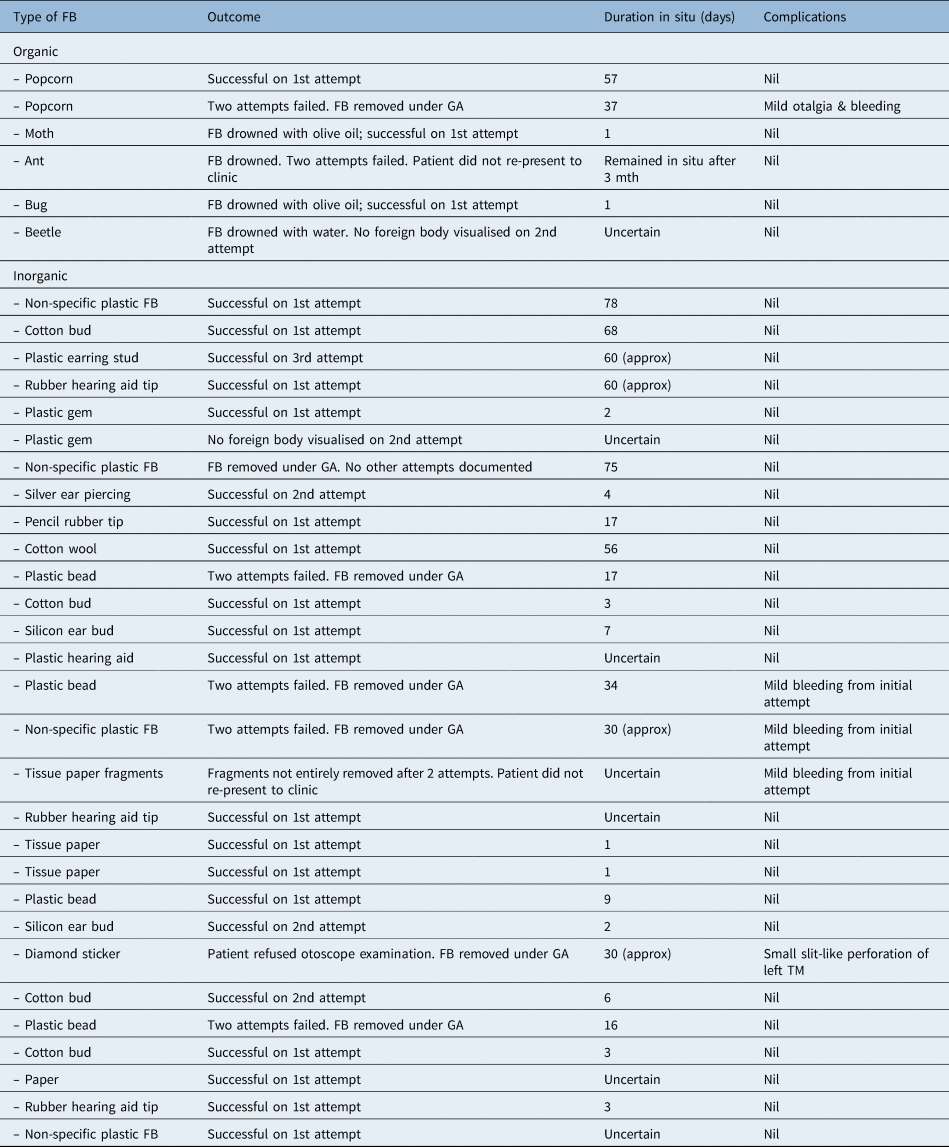
Our search yielded 35 foreign bodies in 34 patients, including 1 patient with bilateral aural foreign bodies. Patients’ ages ranged from 2 to 81 years, with 14 female patients and 20 male patients. The total duration of a foreign body in the ear ranged from 1 to 78 days in total. Seven patients required examination and removal of the aural foreign body under general anaesthesia (GA) (20.6 per cent). The type and duration of all foreign bodies, and outcomes and complications, are summarised in Table 2.
Summary of type and duration of all foreign bodies, and outcome and complications

FB = foreign body; GA = general anaesthesia; mth = months; TM = tympanic membrane
First removal attempt
Successful removal
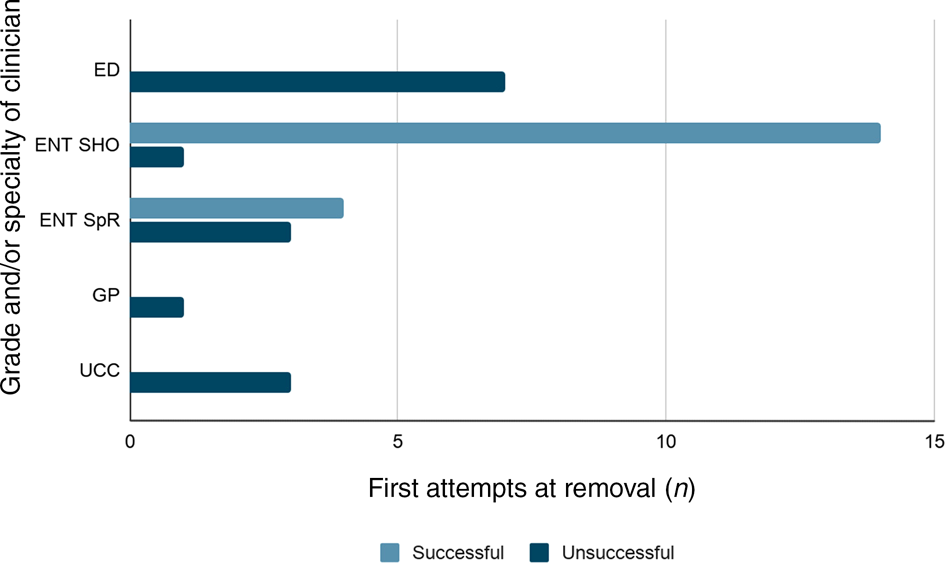
The foreign body was visualised for all 34 patients at the first removal attempt. Eighteen patients (52.9 per cent) had their foreign body successfully removed on the first attempt. Of these 18 patients, 14 foreign bodies were removed by ENT senior house officers (SHOs) (77.8 per cent) and 4 by ENT registrars (22.2 per cent) (Figure 1).
Summary of first attempts at removal by grade and/or specialty of clinician. ED = emergency department; SHO = senior house officer; SpR = specialist registrar; GP = general practitioner; UCC = urgent care centre

Unsuccessful removal
First attempts at removal failed in 16 patients (47.1 per cent). Among them, seven were attempted by emergency department doctors (43.8 per cent), three by urgent care centre doctors (18.8 per cent), three by ENT registrars (18.8 per cent), one by an ENT SHO (6.3 per cent), one by a general practitioner (6.3 per cent) and one case was undocumented (6.3 per cent) (Figure 1).
Second removal attempt
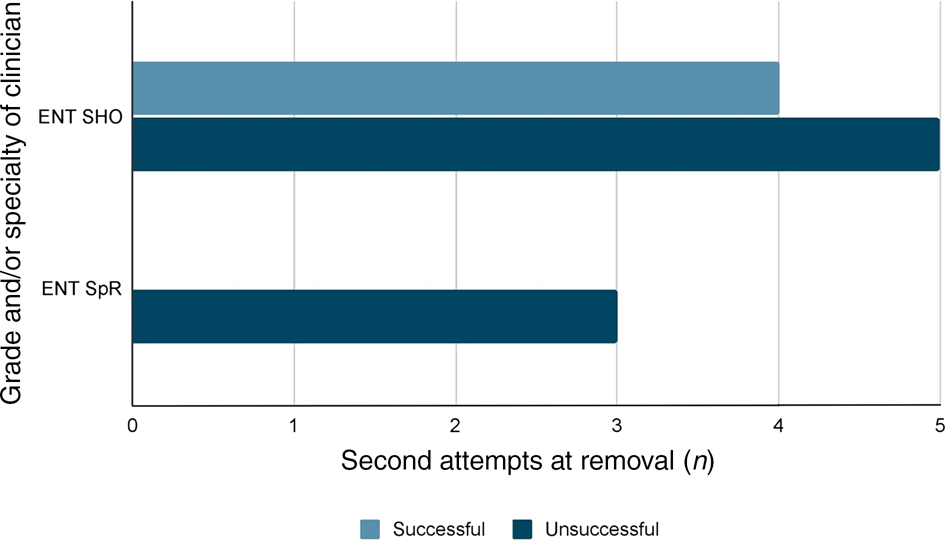
Two patients were consented for examination and removal under GA after their first attempt. Fourteen patients attended for a second attempt at removal. Four attempts were successful (28.6 per cent) and were all conducted by ENT SHOs (Figure 2). Two patients had no foreign body visualised on their second attempt (14.3 per cent), indicating the foreign bodies had spontaneously cleared on their own.
Summary of second attempts at removal by grade and/or specialty of clinician. SHO = senior house officer; SpR = specialist registrar

Among the eight patients for whom a second attempt failed (57.1 per cent), five of those attempts were made by ENT SHOs and three by ENT registrars (Figure 2). Subsequently, five patients were scheduled to have the foreign body removed under GA, one patient attended for a third attempt at removal which was successful (by ENT registrars), and two patients did not attend follow up despite multiple attempts to contact them.
Of the two patients who did not attend, one patient had a small segment of tissue paper in the external auditory canal on examination, and the other patient had a drowned ant in the external auditory canal. Both patients were unable to tolerate microsuctioning. As there were no re-presentations to the department for over four months, we assumed there were no further complications (Figure 2).
Duration of foreign body in situ
The duration of foreign bodies left in situ ranged from 1 to 78 days, with a mean duration of 25.3 days. For the seven patients who underwent removal under GA, the foreign body had been in situ for between 16 and 75 days (mean of 34.1 days). Among the non-GA group, the foreign body was left in situ for a mean of 19.25 days.
Complications
Four patients (11.7 per cent) suffered from traumatic removal of the foreign body upon the initial attempt at removal, resulting in otalgia and mild bleeding from the external auditory canal. The removal attempts in these patients were all made by non-ENT doctors (three by emergency department doctors and one by an urgent care centre doctor). One patient was discovered to have suffered a small slit-like perforation of the tympanic membrane after removal of a diamond-shaped sticker under GA, where the foreign body had been in situ for 28 days.
Organic versus inorganic foreign bodies
Among the 35 foreign bodies, 6 (17.1 per cent) were organic and 29 (82.9 per cent) were inorganic. Three organic (50 per cent) and 16 inorganic (55.2 per cent) foreign bodies were successfully removed on first attempt. Upon the second attempt, none of the organic foreign bodies were removed, and four inorganic foreign bodies were removed. Among all removals under GA, six foreign bodies (85.7 per cent) were inorganic and one (14.3 per cent) was organic. Of the six organic foreign bodies, one (16.7 per cent) resulted in a complication. In contrast, of the 29 inorganic foreign bodies, 4 (13.8 per cent) were associated with complications.
The initial success rates of removal for the organic and inorganic foreign bodies were similar. There was also no significant difference in complication rates between the two groups (Table 2).
Discussion
Foreign body duration and complication risk
Two large retrospective studies on all ENT foreign bodies have previously been conducted, both of which showed a correlation and a statistically significant relationship between non-iatrogenic complications and the permanence of foreign bodies.Reference Figueiredo, de Azevedo, de Ávila Kós and Tomita2,Reference Ibekwe, Folorunsho and Oreh3 One study included foreign bodies in situ for ‘more than 72 hours’ and the other included those in situ for up to 30 days.
Given the unique circumstances of the Covid-19 pandemic, this is the first case series to look specifically at the relationship between the duration of aural foreign bodies left in situ for over 30 days from presentation and the risk of complications. Contrary to the two retrospective studies mentioned above, our data suggest that prolonged duration does not increase the number of complications, despite our study having a smaller sample size. There were no evident major complications associated with a foreign body remaining in situ for up to 78 days.
• There was no correlation between prolonged duration of a foreign body in ear (up to three months) and risk of complications
• Most complications (80 per cent) were from traumatic first attempts conducted by non-ENT specialists
• Prolonged duration of a foreign body does not improve the chances of successful removal
• First attempts made by non-ENT specialists had a high rate of failure (68.8 per cent), with a high risk of trauma (36.4 per cent)
• There is scope for change in clinical practice to allow some aural foreign bodies to be safely removed at a later date
Foreign body duration and removal likelihood
The results showed that the chances of successful removal on the second attempt (28.6 per cent) decreased dramatically when compared to the first attempt (52.9 per cent).
From our results, we concluded that the duration of a foreign body left in the ear does not affect the chances of removal. There are other many factors involved, including: the size, shape and position of the foreign body; how co-operative the patient is at the time of removal; the ability to visualise the foreign body; any prior trauma to the ear from previous attempts at removal; the equipment and tools available; and the skill and experience of the doctor attempting removal.Reference Schulze, Kerschner and Beste4
Clinician grade and specialty
Our results revealed that first attempts at removal made by non-ENT specialists had a low success rate, with a high risk of trauma (36.4 per cent).
Although primary care and emergency department doctors have the advantage of being able to remove foreign bodies at first presentation, ENT specialists have the benefit of accessing more advanced equipment and tools, as well as experience in managing such cases. Previous studies have highlighted the benefit of referring for ENT specialist review with microscopy techniques when a foreign body is more medial or approaching the tympanic membrane, as this would be far less likely to be removed under direct visualisation.Reference Schulze, Kerschner and Beste4,Reference Grigg and Grigg5,Reference Heim and Maughan6
Limitations
We are unable to comment on the influence of foreign body position in the external auditory canal, and whether this affected the likelihood of removal, given the lack of documentation.
Conclusion
This case series aimed to investigate the relationship between the duration of foreign bodies in the ear for over 30 days from presentation and the risk of complications. We found no correlation; our data suggested that prolonged duration did not increase the number of complications.
It can be concluded that the prolonged duration of a foreign body in situ does not increase the likelihood of removal. Our results also demonstrate that attempts made by ENT clinicians were far more likely to be successful and that the specialty of clinician directly affects the chances of successful foreign body removal.
The implication of these results may be significant in the post-Covid-19 world where resources are strained. It may be possible for practice to change to allow asymptomatic patients with low-risk foreign bodies to be safely discharged with appropriate safety-netting advice, with a plan to present at a later date for removal by an experienced ENT professional under more optimal circumstances, using adequate equipment.
Competing interests
None declared