Implications
This paper shows that there is potential to reduce emissions from livestock systems by selection on correlated traits. Selecting on traits that improve the efficiency of the system (e.g. residual feed intake, longevity) will have a favourable effect on the overall emissions from the system. Improvements in system efficiency are also likely to have a favourable impact on the future sustainability of the system. The development of breeding goals and schemes that incorporate environmental concerns is both desirable and possible. However, new measurement techniques for direct and indirect emissions will improve the potential to reduce emissions by harnessing these measurements in genetic selection.
Introduction
Half of the land in the European Union (EU) is farmed. Farmland plays an important role in food production (and by-products such as fibre and fuel), as well as in the provision of public goods including, biodiversity and landscape value, which are jointly produced with conventional outputs. However, agriculture also generates negative public good including greenhouse gas (GHG) emissions. Mitigating these can play a vital role in providing solutions to the UK’s and EU’s overall climate change obligations (Gill et al., Reference Gill, Smith and Wilkinson2009). Under the 1997 UN Kyoto Protocol, the EU is committed to reduce GHG emissions by 8% by 2012 (European Union, 2000) and further targets of 80% reduction of 1990 levels by 2050 have been set by the UK government as part of the Climate Change Act 2008.
The majority of the UK land area (18.6 million hectares) is classed as agricultural land (including woodlands) of which 11.3 million hectares are under grass. This grass supports a ruminant animal population of 11.4 million cattle and 44.7 million sheep (Defra, 2008). Livestock systems are an important source of GHG emissions, particularly methane (CH4) and nitrous oxide (N2O). Livestock account for up to 40% of the world CH4 production, a large proportion (80%; de Haan et al., Reference De Haan, Steinfeld and Blackburn1996) of which comes from enteric fermentation and a smaller proportion (20%; Safley et al., Reference Safley, Casada, Woodbury and Roos1992) from anaerobic digestion in liquid manure. Sixty-four per cent of global nitrous oxide emissions are due to agriculture, chiefly due to fertiliser use (organic and inorganic). Both ruminant and monogastric species produce N2O from manure management. Ruminant production (cattle and sheep) needs to consider both CH4 and N2O, whereas monogastric production (pigs and poultry) species are mainly concerned with N2O (and ammonia, NH3). Overall, N2O accounts for 7.9% of global anthropogenic GHG emissions and CH4 14.3% (International Panel for Climate Change (IPCC), 2007a).
There are many possible technical mitigation options for livestock systems. These could be delivered through improved livestock efficiency, converting more energy into weight gain and/or milk production, thereby reducing GHG emissions per unit product. Options include selection among or within breeds, selecting larger but faster growing breeds, or through manipulation of dietary regimes (Mosier et al., Reference Mosier, Duxbury, Freney, Heinemeyer, Minami and Johnson1998; Schils et al., Reference Schils, Verhagen, Aarts and Sebek2005; Hensen et al., Reference Hensen, Olesen, Petersen, Sneath, Weiske and Yamulki2006; Monteny et al., Reference Monteny, Bannink and Chadwick2006; Jouany and Morgavi, Reference Jouany and Morgavi2007; Martin et al., Reference Martin, Morgavi and Doreau2009). The latter option could include adoption of zero grazing and higher concentrate feed usage, resulting in a greater reliance on housed systems. Dietary supplements could be used to improve the digestibility of feed. More careful management of waste products, for example, through improved (covered) slurry storage facilities, also offers potential emission savings (Amon et al., Reference Amon, Kryvoruchko, Amon and Zechmeister-Boltenstern2006).
Genetic improvement of livestock is a particularly cost-effective technology, producing permanent and cumulative changes in performance. This paper highlights some of the options for including mitigation in livestock breeding schemes, focusing on ruminant species, and details three routes through which genetic improvement can help to reduce emissions per kg product:
1. Improved productivity and efficiency in the animal;
2. Reducing wastage (e.g. involuntary culling, empty reproductive cycles) at the herd or flock level; and
3. Direct response to selection on emissions, if or when these are measurable.
The paper also outlines methods for incorporating the environmental value of emissions mitigation into breeding schemes.
Mitigation as a result of breeding for improved productivity and efficiency
Typically, selective breeding can achieve annual rates of response of between 1% and 3% of the mean in the trait (or index) under selection (see Simm et al. (Reference Simm, Bünger, Villanueva and Hill2004) for a review). Selection for productivity and efficiency helps mitigate GHG production in two ways:
• Firstly, higher productivity generally leads to higher gross efficiency (converting feed into product) as a result of diluting the maintenance cost of the productive (and non-productive) animals.
• Secondly, a given level of production (e.g. a national milk quota) can be achieved with fewer higher yielding animals and their followers.
An experimental example of the first phenomenon can be seen in the Langhill select and control lines of dairy cows. This herd has been selected for maximum production of kg milk fat plus protein (select group) or to remain at the UK national average for production (control group) and has been fed two diets of different energy density (high or low forage). In these data, the select group have been shown to have 17% higher yield per lactation, and a 14% higher gross efficiency (Veerkamp et al., Reference Veerkamp, Simm and Oldham1995). Further studies of the data showed significant differences in how cows lost and regained body energy throughout lactation to support production resulting in the higher gross efficiency, with select group cows on the high forage diet losing the greatest amount of body lipid over three lactations (Coffey et al., Reference Coffey, Simm, Oldham, Hill and Brotherstone2004).
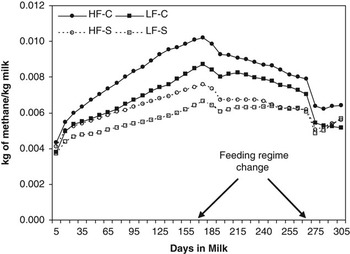
The data and analysis of Coffey et al. (Reference Coffey, Simm, Oldham, Hill and Brotherstone2004) were used to estimate methane emissions of the groups of Langhill cows over the first lactation per unit of milk produced. Based on dry matter intake and energy of the diet, the amount of methane (kg) produced per cow per day of first lactation was calculated using the formula of Yan et al. (Reference Yan, Agnew, Gordon and Porter2000), which was then expressed as per kg of milk produced. Figure 1 shows that the control group on the high forage diet was estimated to produce the most methane per kg of milk while the select cows on the low forage diet was estimated to produce the least methane per kg of milk. Overall, the select group produced 21% less methane per kg of milk than control cows over the first lactation. This demonstrates that the high gross efficiency of the select group has a knock-on effect on reducing methane output per unit of product. However, it must be noted that the select group of cows achieve this higher efficiency by utilising body energy reserves to support lactation. Although utilising body reserves to support lactation has a favourable effect on methane emissions within the first lactation, it is likely that the longer term reliance on body energy reserves to support lactation will have a longer term unfavourable biological effect and impact on health, fertility and other ‘fitness’ traits in the dairy cow (Friggens and Newbold, Reference Friggens and Newbold2007; Garnsworthy et al., Reference Garnsworthy, Sinclair and Webb2008). Poorer health and fitness in the dairy herd will affect overall systems emissions of GHG, as more followers will be required to maintain the herd size as more dairy cows may be culled involuntarily and need to be replaced. It should also be noted that predicting methane produced per animal does not take account of other GHGs produced by the dairy system (e.g. N2O, CO2) or other processes out with the farm gate (e.g. CO2 produced in the production of cereals and concentrates for the dairy diet) that may be considered in a broader life cycle analysis (Halberg et al., Reference Halberg, Kristensen and Dalgaard2000).
Effect of genotype X feed on methane production in first lactation Langhill lines of dairy cows. HF/LF = high/low forage diet; C/S = control/select genetic groups.

The second phenomenon can be demonstrated by the overall reduction of methane emissions from agriculture sector of 20% in the EU-27 (approximately 10% in the EU-15) from 1990 to 2005 (EEA, 2007a). This reduction has primarily come about due to a reduction in cattle numbers, particularly dairy cows (EEA, 2007b). Overall production improvements in dairy cows, genetic and otherwise, means that fewer dairy cows are required to meet quota levels. Similarly, the dairy sector in Canada has reduced its methane emissions by 10% since 1990 by reducing the number of animals (Désilets, Reference Désilets2006).
Increasing the efficiency of production of meat animals reduces emissions per unit output. The studies of Mrode et al. (Reference Mrode, Smith and Thompson1990a and Reference Mrode, Smith and Thompson1990b) compared two strategies of selection on lean growth rate and food conversion ratio (FCR = daily food intake/growth rate). The increase in carcass lean and reduction in FCR with selection for lean growth were similar to the responses with selection for FCR (Mrode et al., Reference Mrode, Smith and Thompson1990b) resulting in an overall improvement in FCR of 7% compared to a control line. However, growth rate was increased with selection for lean growth, but not with selection for improved FCR (Mrode et al., Reference Mrode, Smith and Thompson1990b). Therefore, in terms of genetic improvement for feed efficiency and growth rate of the slaughter generation, selection for lean growth rate is preferable to selection for FCR, such that it is not necessary to measure food intake. However, their conclusions may not hold for maternal lines where selection for lean growth rate is likely to lead to a correlated increase in mature, feed maintenance/requirements and hence emissions. Hyslop (Reference Hyslop2008) demonstrated that efficiency of the beef production system was paramount in reducing GHG emissions per unit output showing that intensive concentrate-based systems produce the lowest emissions per kg meat. Further analyses of the data showed that there was a significant breed difference suggesting that bigger continental breeds of cattle produced fewer emissions per unit output than the smaller British breeds (Hyslop, Reference Hyslop2008).
Feed utilisation has been considered directly in selection programmes for pig and poultry species, reducing the time and the amount of feed required to reach market weight. In industry breeding programmes, annual genetic change in FCR for layer and broiler chickens of about 1% and 1.2% respectively have been reported (Preisinger and Flock, Reference Preisinger and Flock2000; McKay et al., Reference McKay, Barton, Koerhuis and McAdam2000). For example, the time for a broiler to reach 2 kg has reduced from 63 days in 1976 to 36 days in 1999 (McKay et al., Reference McKay, Barton, Koerhuis and McAdam2000). Similar trends can be seen in pigs with Dutch Landrace improving feed efficiency from 3.5 (kg/kg) in 1930 to 2.8 in 1990 (Merks, Reference Merks2000). This improvement in efficiency of growing animals has a favourable effect on the emissions from these livestock industries per unit of product as shown in the study of Jones et al. (Reference Jones, Warkup, Williams and Audsley2008).
Due to the nature of many ruminant production systems, where there is less opportunity for individual feed intake recording, the use of feed intake traits in selection has been limited although there have been some examples. Hegarty et al. (Reference Hegarty, Goopy, Herd and McCorkell2007) showed that there is a decreased enteric methane production per day in beef animals selected for lower residual feed intake. Reduced residual feed intake is akin to selection for high feed efficiency as an animal is eating less but maintaining a similar growth rate (high net feed efficiency) and, therefore, less feed is required to produce a unit of output. Lines were divergently selected for high and low residual feed intake and showed no significant differences for most production traits. This shows the possibilities for selection of reduced GHG emissions through the selection of animals, which use less feed and produce less methane than average, to achieve a given level of performance.
Direct selection for efficiency of utilisation of the different components of the diet is difficult to achieve as many animal and feed records need to be collected. Work on these types of traits has mainly been at an experimental level. Ferris et al. (Reference Ferris, Gordon, Patterson, Porter and Yan1999) showed that medium genetic merit (for production) Holstein–Friesian cows have higher nitrogen and methane emissions per unit of N and gross energy intake, respectively, than high genetic merit cows. This suggests that high genetic merit cows convert the energy and protein components of the feed more effectively than medium genetic merit cows. Crocker and Robison (Reference Crocker and Robison2002) showed a genetic line effect on swine excreta with maternal line animals producing significantly less P, Ca, Cu, Zn and Fe than boar line or F1 cross animals and numerically lower N, NH3N and K. Hegarty (Reference Hegarty2004) reviewed the evidence for a genetic difference in gut function in ruminants covering genetic components of diet selection, eating rate, digestive kinetics and methane production. There were data to suggest that there are genetic differences in the amount of methane produced per unit feed intake. Further examination of the metabolic turnover of nutrients in animals may be required to understand the underlying biological differences between high-producing animals and lower genetic merit animals in their feed utilisation. Other metabolic traits that require further examination due to their impact on emissions include water dynamics (manure consistency), gut function (nutrient and mineral absorption) and litter/manure quality.
Jones et al. (Reference Jones, Warkup, Williams and Audsley2008) showed that historic selection on production traits (e.g. milk yield, fertility, growth efficiency) in UK livestock species has resulted in an average 1% per year reduction in GHG production per unit food produced. The reduction was shown to be greatest in those species with more widespread use of genetic improvement such as layer hens, broiler chickens, pigs and dairy cattle. However, the reductions were a great deal smaller in beef cattle and sheep. This was due to poorer rates of genetic improvement across the population in these sectors and poor dissemination of information from elite breeders to the commercial populations. Jones et al. (Reference Jones, Warkup, Williams and Audsley2008) speculated that current and future selection goals in many livestock species will continue to result in similar rates of genetic improvement in target traits with a continued benefit in reducing GHG emissions per unit of food produced.
Mitigation as a result of breeding for reduced wastage at the herd or flock level
Many ‘fitness’ traits have been shown to have a genetic component demonstrating there is scope to improve them via genetic selection. Broader breeding goals that seek to select animals on an optimal combination of production and fitness traits can help to mitigate GHGs from many livestock systems, as some examples below demonstrate.
Selection for improved fitness traits (lifespan, health, fertility) will help to reduce emissions by reducing wastage of animals. Improving lifespan in dairy cows and breeding beef cows and ewes will reduce GHG emissions of the system by reducing the number of followers required to maintain the herd at a given size. The study of Weiske et al. (Reference Weiske, Vabitsch, Olesen, Schelde, Michel, Friedrich and Kaltschmitt2006) showed that optimising the lifetime efficiency of dairy cows, by reducing the replacement rate and exporting surplus heifers from the system as newborns, would reduce GHG emissions by up to 13%.
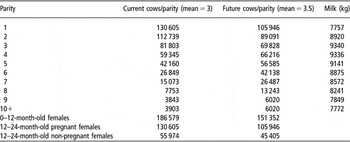
Data on parity (average parity = 3) and milk yield (average milk yield = 8580 kg) for UK-registered Holstein–Friesian cows were taken from the Centre for Dairy Information Breed Performance Statistics 2007 (CDI, 2008) and are summarised in Table 1. A model of a future scenario for registered Holstein–Friesian cows was developed, which allowed the calculation of the age distribution of cows, given current total yield but a different mean parity, equivalent to increasing the longevity of the national herd. An increase in the national average number of parities of 0.5 (new mean parity = 3.5) was modelled with cows re-distributed across parities but maintaining overall milk output (constant milk quota output). This model used the Solver function in Microsoft Excel© to define a new herd age profile resulting in the new average age, holding milk yield constant. This resulted in an increase in the numbers of animals in later lactations where yields are higher compared to first lactation animals. This could be achieved if the rates of involuntary culling in early life were improved and, therefore, animals culled for production reasons. UK national GHG inventory reporting methods were used to estimate CH4 from enteric fermentation and manure management and N2O from manure management for all milking and follower cows that have not yet entered the dairy herd (Choudrie et al., Reference Choudrie, Jackson, Watterson, Murrells, Passant, Thomson, Cardenas, Leech, Mobbs and Thistlethwaite2008). The numbers of follower cows were estimated assuming a 70% maiden heifer pregnancy rate and that all surplus heifers and males were sold as newborns and, therefore, did not contribute to the GHG of the dairy system. It should be noted that national inventory reporting methodologies do not account for varying milk yields and rather used a fixed emissions factor multiplied by animal category numbers and do not consider differences in milk yields or diet types.
Current distribution of UK-registered Holstein–Friesian cows over parities with mean parity = 3 (CDI, 2008) and a simulated future distribution of Holstein–Friesian cows over parities with a mean parity 3.5

The effect of increasing the average number of lactations in the national herd is to reduce the number of cows and followers required to maintain national milk quota output levels (Table 1). Table 2 shows that overall CH4 is estimated to fall by 4.42% and N2O is estimated to fall by 3.65%. The main reduction in CH4 and N2O emissions comes from this reduction in numbers of followers with approximately 19% reduction in GHG emissions in followers compared to 0.5% reduction from lactating cows. This example assumes that cow milk yield stays constant. The small reduction in emissions from the milking herd is due to a redistribution of animals across lactation numbers, with first lactation animals having lower yields than later lactation animals. When lifespan increases, there are more animals in later lactations than first lactation. However, it is likely that milk yield will continue to increase over time as a result of genetic improvement and, therefore, fewer cows will be required to maintain a constant milk output.
Prediction of methane and nitrous oxide emissions (t/year) from UK-registered Holstein–Friesian cows under the current national scenario (mean parity = 3) and a future national scenario with a mean parity of 3.5

t = tonnes; kt = kilo tonnes.
The time required to increase the average parity via genetic selection of the national herd depends on selection intensity and genetic variation. At current values for the heritability and relative economic value of lifespan (and correlated traits) used in that UK national dairy selection index, profitable lifetime index (£PLI), the expected annual response is approximately 0.045 lactations per year (Wall et al., Reference Wall, Brotherstone and Coffey2006). Therefore, it would take 11 years to increase lifespan by 0.5 lactations using currently available selection tools and index weights.
Improving health and fertility will reduce involuntary culling rates and thereby reduce emissions from dairy systems and beef and sheep systems (increased maternal survival) by reducing the numbers of followers required to maintain the herd at a given size. Improving fertility will reduce calving/lambing intervals and inseminations resulting in shorter dry/unproductive periods. This reduces management costs as well as emissions. Garnsworthy (Reference Garnsworthy2004) estimated, via modelling, that if cow fertility was restored to 1995 levels from 2003 levels, methane emissions from the dairy industry would reduce by 10% to 15%. Selection for health should reduce treatment costs (and lower antibiotic use), reduce inefficiencies from product withdrawal during treatment and reducing emissions by maintaining the productivity level of the animal (which is reduced during periods of poor health), all of which contribute to reduced emissions, as well as count to improving animal welfare.
Improving calving and maternal traits will reduce emissions by improving survival of offspring during the peri-, neo- and post-natal periods. This will reduce wastage in a farming system, thereby decreasing overall emissions as well as improving calf and dam welfare and survival.
Direct selection to reduce emissions
Direct selection for reduced GHG emissions would ideally be based on direct measurement of methane emissions. It is important to note that direct measurement of all sources of methane emissions from individual animals (exhaled by the animal due to enteric fermentation, flatulence and to a lesser extent from manure) may prove difficult. However, expired air samples may be taken from individual animals or groups of animals. Air samples can be analysed for their methane concentrations using infrared spectroscopy, gas chromatography, mass spectroscopy or a tuneable laser diode. Several techniques have been used to take air samples, such as respiration chambers, head boxes, hoods, masks and polytunnels (Makkar and Vercoe, Reference Makkar and Vercoe2007). Variation has been reported between animals, between breeds and across time (Herd et al., Reference Herd, Arthur, Hegarty and Archer2002) providing potential for improvement through genetic selection. However, measuring methane production directly from animals is currently difficult and direct selection on reduced methane emissions may prove difficult in practice. Development of new direct and/or indirect measurement techniques will help to enhance the capability for reducing emissions through genetic selection. In the meantime, we can make improvements through selection on traits that have a correlated effect on emissions as described earlier. This is particularly effective because it also improves profitability for the farmer.
Developing new indices to include mitigation options
Broader breeding goals, including production and non-production traits, have become the norm in many livestock species. In other words, selection is usually on a combination of production and ‘fitness’ (health, fertility, longevity) traits. Breeding goals can be built in a number of ways including the popular method of weighting traits by their relative economic value (REV). These REVs tend to be calculated by estimating the marginal economic cost or benefit to the system of a unit change in the traits being examined. A lot of the example traits given earlier have been incorporated into indices for particular livestock sectors. However, livestock industries have more recently been accounting for societal views of aspects of farming systems, including issues such as welfare, biodiversity, food safety, health properties and environment.
Taking account of societal views in an economic framework of a selection index can be difficult, as they are a combination of market and non-market attributes (Olesen et al., Reference Olesen, Gjerde and Groen1999). Non-market goods are those that typically cannot be transacted in conventional markets but whose provision increases social welfare. Many non-market goods have public good characteristics, meaning that the public sector (i.e. government) often has to intervene to address the so-called market failure in their adequate provision. That is, while some attributes provide public good, there is by definition no corresponding monetary return from their provision. Nielsen et al. (Reference Nielsen, Amer and Olesen2008) reviewed methods that could be used to include environmental and welfare considerations in breeding goals. Restricted or desired gains approaches derive index weights that restrict unwanted changes or achieve the desired response in traits of interest. For example, Wall et al. (Reference Wall, Coffey and Brotherstone2007) showed how restricted index methodology could be used to halt the expected genetic decline in fitness traits in dairy cattle if selection were to continue on the current UK economic index. The difficulty in restricted/desired gains index methodology is developing a robust way of deciding on the desired outcomes of selection. The studies of Nielsen et al. (Reference Nielsen, Christensen and Groen2005 and Reference Nielsen, Christensen and Ødegård2006) showed that non-market values could be added to economic values for traits in a dairy breeding goal. The non-market values were derived based on the amount of genetic response in milk production the dairy industry was willing to lose in order to improve functional traits. This method is also dependent on defining the desired response in functional traits and trade-offs between production and functional traits.
Another approach would be to use the economic index framework but utilise new methodology to calculate economic weights for traits that have no clear direct market value. Amer (Reference Amer2006) advocated methods of calculating economic values using market research approaches such as conjoint analysis, in which consumers are asked to assign preferences for the differing components of the product. Nielsen and Amer (Reference Nielsen and Amer2007) described a methodology by which consumer choice is taken into account in the breeding objective. This method allows public perception to be used to derive economic weights for goals without an explicit economic cost/benefit. These studies highlight the importance of number of respondents and questions/options presented in determining consumer preferences.
Many traits described earlier, including those routinely included in current selection indices, have an indirect environmental impact and therefore the effect of a change in these traits can be expressed in an environmental impact unit such as global warming potential or carbon equivalents (e.g. lifespan example given earlier). Farm models could be used to model the emissions from a livestock system and the effect that a change in a trait (e.g. fertility) would have on overall emissions. This is similar to the framework used to estimate REVs, and the weightings derived (‘relative environmental values’) could be used to create an environmental selection index. However, as with all indices using weightings other than those based on expected market values, such indices may produce suboptimal profitability for producers.
An example of integrating environmental economics and dairy selection tools
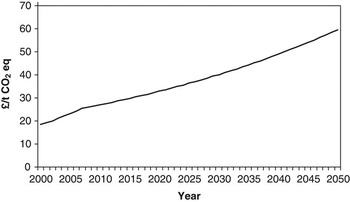
From a public perspective (e.g. government) the economic appraisal of GHG emissions is complex, and mitigation options must compare the costs associated with that option with the benefits in terms of emissions damage-avoided. The latter is approximated by the shadow price of carbon (SPC), which is derived from the best estimate of the present value of damages associated with a tonne of GHG emission in carbon dioxide equivalents (CO2 eq.; Defra, 2007). The value of the SPC is the focal point of much research in the economics of climate change around the world. Figure 2 shows the value of SPC as estimated by the UK Department of the Environment, Food and Rural Affairs (Defra, 2007). The SPC is being used across UK government departments to help appraise suggested public mitigation policies. It could also conceivably become the basis of a publicly backed breeding initiative aimed at GHG mitigation from livestock. Figure 2 shows that the value of SPC is rising through time, reflecting the increasing marginal damage of a tonne of GHG, when added to a growing stock of atmospheric GHGs. This SPC is useful because it provides a benchmark against which to judge the cost efficiency of mitigation options as well as providing a monetary value for GHG emissions.
Shadow price of carbon in £GBP (Great British Pound) per tonne of CO2 equivalents (£/t CO2 eq.) to 2050 based on 2007 prices and a 2% per annum increase (Defra, 2007).

However, the SPC is not the only prevailing carbon ‘price’. Since 2005, the EU Emissions Trading Scheme (ETS) has been in existence for the transaction of carbon allowances in a restricted or capped market between holders of credits and those that need to pay for them as a cheaper alternative than mitigating their emissions through some technological add-on or production alteration. In theory, the SPC and the ETS prices should converge (Stern, Reference Stern2007). This is not proved here, but the basic point is that either of them provides a shadow value that could ultimately be built into a breeding index. By way of motivating this development, suppose, not inconceivably as in New Zealand, that agriculture is forced into an emissions trading scheme and that farmers must hold valuable permits either through initial allocation or by purchasing in the ETS. Such a policy move will immediately move GHG mitigation traits from a public to a private breeding objective. By extension, the prevailing emissions price becomes the relevant economic weight that should be incorporated in any breeding index that includes mitigation potential.
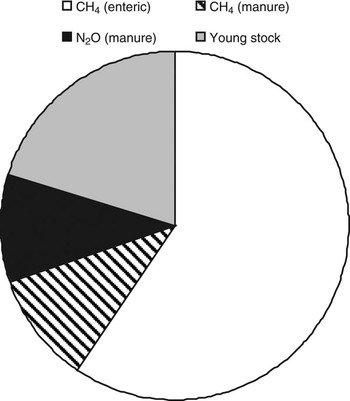
The study of Stott et al. (Reference Stott, Coffey and Brotherstone2005) described how REVs are calculated for traits included in the UK dairy profit index (£PLI) using dynamic programming tools to model a whole farm system. The REV for each trait is calculated by examining the consequence of a unit change in a trait of interest on net farm revenue, while keeping all other traits in the index fixed. The model parameters used by Stott et al. (Reference Stott, Coffey and Brotherstone2005) and IPCC Tier II methodologies (IPCC, 2006) were used to model the CH4 (enteric fermentation and manure management) and N2O (manure management) emissions from the whole farm system (young stock and milking herd) used to calculate REVs for £PLI. Under IPCC framework, N2O emissions due to nitrogen excretion when cows are grazing should be reported in the agricultural soils of the inventory framework. This study, however, will include these emissions as it accounts for over 45% of the total nitrogen excreted by the dairy system. Emissions due to managed spreading of organic or inorganic fertiliser on land or due to other processes in the farming system were not considered. Figure 3 shows that the largest proportion of GHG emissions from the defined dairy system is due to enteric fermentation in the milking herd, with over 59% of the total GHG emissions. The young stock contributed over 20% of the total GHG emissions, which included CH4 from enteric fermentation and CH4 and N2O from manure storage. Overall, the dairy system produced approximately 791 t (tonnes) CO2 eq. per annum.
Proportion of methane (CH4) emissions due to enteric fermentation and manure management and nitrous oxide (N2O) emissions from the milking herd and young stock, expressed in tonnes of CO2 equivalents for the dairy system defined by Stott et al. (Reference Stott, Coffey and Brotherstone2005).

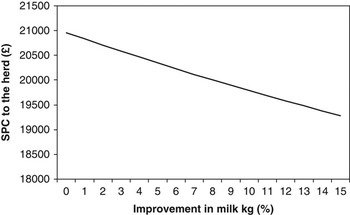
The SPC provides a useful mechanism of considering the cost of GHG emissions in an economic index framework, such as £PLI. The shadow cost to the dairy herd of GHG emissions was calculated by multiplying the current value of the SPC (2008 value = £26.50/t CO2 eq., Figure 2) by the total GHG emissions from the system described in Figure 3. This equated to annual shadow cost to the dairy herd of £20 957 per annum or 1.95 pence/kg milk produced. The REV considering the SPC for milk yield was then calculated by increasing milk yield in percentage units while holding all other traits fixed (Figure 4). The impact of improving milk yield on GHG emissions and therefore the overall shadow cost of emissions to the farm is that fewer cows and followers are required to maintain a fixed herd output. Improving milk yield by 1% decreased the GHG emissions from the dairy system by 4.8 t CO2 eq. This resulted in a new annual shadow cost to the dairy herd of approximately £20 830 per annum (or 1.94 p/kg milk), a reduction of £127 per annum. The SPC REV for milk yield was calculated to be £0.012/kg of milk per cow per annum, or £3.64 per genetic standard deviation unit. For cows born in 2005, the mean predicted transmitting ability for milk was 148 kg with a standard deviation of 303 kg (DairyCo breeding+, 2008). Adding this to the current £PLI would result in a relative weight in the index of 6% compared to the other production and functional traits already incorporated in £PLI.
Shadow price of carbon (SPC) to the herd in £GBP per annum when milk yield is improved.

This example shows a method by which a non-market or shadow environmental value can be incorporated into selection indices using increased milk yield to reduce the herd size required to maintain herd output as the goal trait. This example is dependent on the existence of the SPC, which is now an accepted policy currency in the UK for GHG policy appraisal. While this shadow price is relevant to public policy appraisal, its use is likely to move into private decisions as government seeks ways to implement the ‘polluter pays’ principle for negative externalities. A similar framework could be applied to other traits under selection to estimate a new suite of REVs that consider combinations of market and non-market traits (positive and negative). As it happens however, progress on the derivation of non-market values for other public good traits is lagging behind the climate change example. While there is evidence on the public’s willingness to pay for welfare, much less information is available for example on livestock-related biodiversity benefits. Also, once an economic framework has been established to value non-market goods mechanisms (e.g. taxation, policy, legislation) must be put in place to ensure that these externalities can be internalised to the system and the farmer responds to the non-market signal. Amer (Reference Amer1994) discusses how supply-side triggers can be incorporated into breeding schemes, helping government subsidise farmers for achieving desired goals by changing the breeding objective.
Note also that many of the other traits included in £PLI, such as lifespan and health and fertility traits, will have an additional favourable impact on GHG emissions by improving overall system efficiency as discussed elsewhere in this paper.
Interaction between genetics and systems
Production in many livestock species has been improved via genetic selection, as shown earlier. However, overall improvements in productivity are not solely as a result of genetics but also, in part, as a result of management changes such as increased grain content in the diet. For example, in 2002, one-third of the world grain production was fed to livestock – mainly pigs, poultry and dairy cows (Steinfeld et al., Reference Steinfeld, Gerber, Wassenaar, Castel, Rosales and de Haan2006). These genetic and management improvements have led to improved productivity parameters for livestock across all world regions, with improvements more marked in industrialised countries. For example, the world kg meat output/kg biomass of chicken meat has increased from 1.83 in 1980 to 2.47 in 2005 and for pig meat has increased from 0.31 to 0.45 (FAO, 2006a). Improving the efficiency with which animals convert feed into saleable product reduces overall emissions by producing the same amount of that livestock commodity with reduced inputs.
Although this paper has focused on the potential role that genetics may play in mitigating emissions from livestock systems, there is undoubtedly a large nutritional component with much ongoing research on the differences between diets in methane emissions and the use of additives in diets to reduce emissions (Moss et al. (Reference Moss, Jouany and Newbold2000) for review). However, little work has been done on the potential role of genetics on emissions, particularly considering the role of genetics in the whole farming system and its interaction with feeding strategy and management policies (e.g. energy balance, housing periods, fertilisation and manure management). Robertson and Waghorn (Reference Robertson and Waghorn2002) showed a genotype X environment (diet) interaction on the methane emissions from dairy systems with US genotypes producing 8% to 11% less methane, as a percentage of gross energy intake, compared to New Zealand genotypes, on both pasture and total mixed rations diets.
Selection indices have tended to be expressed in terms of a generalised system representative of the ‘average’ dairy farm. However, as shown by Hyslop (Reference Hyslop2008) there are differences in the emissions and economics (not shown) depending on the production system and the animals used within that system (i.e. an animal of a particular genotype will perform differently on a high input system than on a low input system). The system parameters and relative economics will also differ from production type to production type. For example, recent work has shown that the economics of body tissue mobilisation differs depending on the calving system employed (spring v. autumn) due to the different costs of feed at grazing opposed to winter feeding (Wall et al., Reference Wall, Coffey and Amer2008). There are also likely to be environmental impact differences in traits related to tissue utilisation and wastage depending on system types. In developing environmental indices, it will be important to consider the different systems to help farmers account for the long-term environmental impact in their choice of breeding animals, specific to their system of production. For example, in dairy cows is it better, in environmental terms, to gather and preserve feed for winter feeding or for cows to store some of that energy as body lipid and then use it during the winter? Is it more efficient for the cow to produce milk of low solids content ready for direct consumption, increasing the volume of milk to be transported, or for factories to alter high solids content low volume milk to suit intended use? The answer to these and other similar questions may dictate the type of dairy cow for the future. Similar questions arise in other livestock sectors.
Climate change, to some degree, is inevitable. This means that the environment in which livestock are managed will change (e.g. changes in mean temperature, grass growth seasons, drought and flood prevalence, duration of housing periods). Genetic improvement can be used as a tool to help livestock species adapt to the new environment as well as help to mitigate emissions. Examples include selection for heat tolerance (e.g. Ravagnolo and Misztal, Reference Ravagnolo and Misztal2000), selection for hardiness traits (could be introduced for other breeds through crossing or by breed substitution) and selection for efficiency/sustainability of production levels in future systems (change in dietary regimes). Genotype by environment interaction may also become important in adaptation to climate change, especially if changes are extreme or for breeds already being used at the limit of their adaptation ‘envelope’, so that animals are suitable for the new production systems needed to adapt to climate change (e.g. new disease challenges, shorter/longer housing periods, changes in feed quality).
Discussion
Selection for efficient production has a clear benefit in mitigating emissions, as illustrated here in. This may be achieved by selecting high-productivity animals and feeding higher concentrate diets. However, this leads to conflicts with other societal priorities, such as maximising the availability of cereal crops for direct human consumption, and hence affect the sustainability of livestock production. Selection solely for higher-producing animals has known knock-on effects on essential ‘fitness’ traits, which also affects sustainability. Therefore, it is important to consider a broader range of traits in selection indices and fit with other system characteristics to ensure longer-term sustainability.
Abberton et al. (Reference Abberton, Marshall, Humphreys and Macduff2008) described a variety of forage breeding options to help mitigate GHG emissions. There is increased merit in organising and optimising forage breeding and animal breeding strategies such that the interaction is optimal for both productivity and environmental impact. A recent study (Moran et al., Reference Moran, Barnes and McVittie2007) has shown the very high value of animal and plant genetics research and development in helping to deliver on likely future policy priorities, including responding to global climate change. This research showed that plant and animal genetic improvement is expected to deliver public good rates of return ranging between 11% and 61% for the case studies examined, many times higher than 3.5%, the recommended UK Government Treasury rate of return for public investment.
This paper has focused primarily on methods to increase the efficiency of production by using genetic selection to improve the efficiency of the animal, individually or as part of a wider farming system. However, the definition of a system boundary may impact on the final evaluation of genetic improvement as a mitigation option. As shown with life cycle analysis, there are many parts of the production chain that have an environmental impact (production of feed, housing and maintenance of systems, digestion of feed by animals, slaughtering and processing, transport and storage, domestic consumption and waste disposal) (e.g. Halberg et al., Reference Halberg, Kristensen and Dalgaard2000). In general, the objective of genetic improvement is to alter animals through breeding choices to improve the efficiency of the farming system. When the boundary to the system lies outside the farm gate (e.g. incorporating food transport and processing) it becomes more difficult for the farmer to influence these processes and their efficiency and the breeding choice that the farmer makes will have less of an impact, unless considered in an integrated chain of production. In an integrated meat production chain, where benefits, up/downstream of the farm system, are distributed across the chain, it may become economically beneficial for farmers to select for optimal carcass characteristics, thereby, minimising the wastage in factory processing of carcasses. However, in the UK, there are few examples where such integrated chains exist and the current payment system pays little extra in terms of differential carcass production, thereby, limiting the incentives to farmers to select for traits that will benefit the processor.
The methods by which environment policies/legislations are enforced will determine how producers will respond. Current UK inventory methods (Choudrie et al., Reference Choudrie, Jackson, Watterson, Murrells, Passant, Thomson, Cardenas, Leech, Mobbs and Thistlethwaite2008) focus on animal numbers and, therefore, the easiest mitigation option for reducing GHG emissions from UK agriculture is to reduce the animal numbers. However, reducing animal numbers will reduce product output and unless demand for UK livestock product drops, the GHG emissions associated with livestock production will simply be exported elsewhere in the world, potentially to a region where the system of production is less efficient and has wider environmental impacts (e.g. deforestation). In the era of ‘One Planet Living’, it makes little sense to export the problem of emissions from livestock in the UK to another part of the world, by buying in product from abroad when the impact of doing that could have a much larger impact in a global sense. If the ‘emissions’ from a farming system were calculated based solely on animal numbers, farmers will drive efficiency optimising animal numbers and product output, particularly in a production quota system. If system type is also considered (e.g. forage v. concentrate diets), producers will drive efficiency within their own system circumstances, including carbon sequestration (e.g. Soussana et al., Reference Soussana, Tallec and Blanfort2009). In these cases, breeding goals could consider GXE and, potentially, customisation of selection indices allowing farmers to select for the optimum set of traits to suit their system. In the future, we may move to a scenario whereby farm audits include environmental impact. In this scenario, producers will have to examine entire system efficiencies and balance the environmental budget of their system. In this latter situation, selecting animals with metabolic differences in the efficiency with which they absorb and use nutrients (e.g. low v. high methane producers) will become important.
Technological advances will occur, which we can harness in livestock production to mitigate climate change, and animal breeding could change to utilise these advances and management changes. For example, breeding goals may be developed, which could select animals with suitable excreta for the use in biodigestors. Breeding programmes could be developed that breed animals specifically to utilise by-product from processes such as biofuel production, which may reduce overall impact of biofuel and animal production chain.
External forces, above mitigation of GHG emissions, will also impact on livestock selection objectives into the future. World meat consumption is expected to double by 2050 from its 2001 level of 228 million tonnes (FAO, 2006b). This will be coupled with a change in the ability of different regions in the world being able to produce agricultural products, with crop productivity expected to increase in mid- to high latitude regions and decrease in lower latitude regions (IPCC, 2007b). We are fast approaching an era in food production, when the demand for animal products outweighs the global ability to produce the product in the perceived environmentally friendly and/or socially acceptable way. Perceptions of what is socially acceptable, considering environment, welfare, animal and human health to name but a few factors, is likely to vary from region to region as well as across time (Tilman et al., Reference Tilman, Cassman, Matson, Naylor and Polasky2002). Integrating these complex factors into local selection policies needs to be considered and measured with an understanding of the wider implications. However, livestock breeding schemes will provide some of the tools to allow agriculture to address the challenges that climate change, and other global changes, will bring.
Conclusions
There is significant potential for GHG mitigation in agriculture. Nutrient leakage from farming systems, in terms of greenhouse gases and other environmental pollutants, will attract costs and so, breeding strategies will need to be tailored to optimise production within nutrient use constraints. This study has shown that there is potential to reduce emissions from livestock systems by selection on correlated traits. For example, selecting on traits that improve the efficiency of the system (e.g. residual feed intake, longevity) has a favourable effect on system emissions as well as improving future sustainability of the system. The development of breeding goals that incorporate environmental concerns is both desirable and possible. However, new measurement techniques for direct and indirect emissions will improve the potential to reduce emissions by harnessing these measurements in genetic selection.
Acknowledgements
The Rural and Environmental Research and Analysis Directorate is gratefully acknowledged for supporting this work. Thanks to many colleagues that have contributed to discussion of this work, particularly Matt Bell, Mike Coffey and Colin Morgan.