An Indian Ocean sphere of Anglo-Dutch connections was forged by the British invasion of Dutch colonies at the Cape of Good Hope and in Java during the French Revolutionary and Napoleonic Wars (1792–1815). The British occupied the Cape Colony in 1795 after France's defeat of the Dutch Republic and the latter's transformation into a French dependency, the Batavian Republic. Although the Cape was returned to the Dutch in the Treaty of Amiens (1802), the British recaptured it, permanently, in January 1806. Java fell in September 1811 and remained under British control for five years. Once entrepôts ruled by the Dutch East India Company (Vereenigde Oost-Indische Compagnie, VOC), both colonies became despotisms in the Second British Empire, a matrix of colonial garrison states run locally by autocratic governors who, rather incongruously, adopted liberal reforms extending to antislavery and education.Footnote 1 Across the Cape and Java, British and Dutch networks of movement and sociability were entangled by colonists who worked, socialized, and moved over lines of imperial distinction. British and Dutch men patronized Java's Literary Society, Dutch colonists used British ships to move between Java and the Cape, and Britons employed Dutch officials in government.Footnote 2 In Java, Anglo-Dutch engagements in the British colonial government are seen to have laid the groundwork for the postwar consolidation of the Dutch colonial state, as they drove exchanges of knowledge that inspired invasive reforms of taxation and landownership.Footnote 3 Yet the significance of Anglo-Dutch connectivity for government and politics in the Second British Empire itself remains largely unexplored.Footnote 4
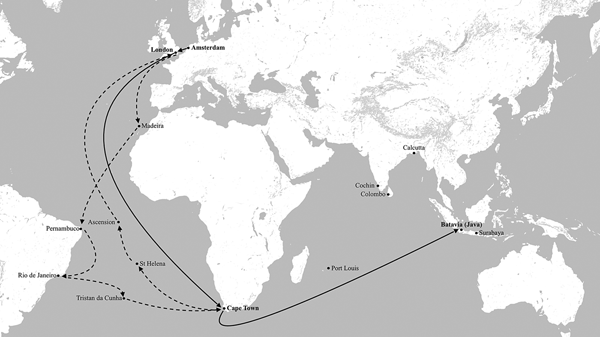
To interrogate the mutual relationship between reform and despotism in the Second Empire, this article uses the life histories of two people who moved between the Dutch and British empires in the Indian Ocean (figure 1). Using sources from diaries to printed works, autograph books, and newspapers, it reconstructs the lives of two interstitial figures connected to political debates around colonial society and administration at the Cape and in Java under the British. One of those figures is Frederik Turr, a Dutch teacher who became rector of the Cape's Latin School and, with the colony's School Commission, advanced reforms widening access to education. These reforms, inspired by practices in the Batavian Republic, were cloaked by Turr and his colleagues in the rhetoric of loyalism, a symbolic language denoting support for Britain. This loyalism gave the governor cause to annex the commission and appropriate its reforms. Turr moved to Java in 1814, joining an imperialistic antislavery society, the Java Benevolent Institution, created by Governor Thomas Raffles. Turr promoted a Dutch model of antislavery that compelled the institution to become inclusive, but, in so doing, he legitimized a society used for Raffles's information-gathering efforts. The second figure is Dorothea Ross, a Cape-born, Dutch-speaking, illegitimate daughter of a slave and a German soldier.Footnote 5 In 1813, she traveled with her husband to London via the Atlantic and recorded passages of political reportage, merging an advocacy for Batavian reforms with an attachment to British authority. Her writing displays a critical connection between reform and cross-colonial support for local British autocrats.Footnote 6
The journeys of Frederik Turr (solid line) and Dorothea Ross (dotted) and the destinations of some of their contemporaries (map data © 2018 Google, INEGI).

These two life histories link the reciprocal spread of despotism and reform in the Cape Colony and Java to Anglo-Dutch connectivity. First, they demonstrate that Dutch reformers used the rhetoric of British loyalism to advance liberal thinking. Prosopography reveals such links because it allows us to examine lives that shifted “athwart state-archived paper trails.”Footnote 7 As Achim von Oppen and Silke Strickrodt argue, it reveals experiences of “boundary-crossing,” showing how people linked “spaces, jurisdictions, milieus, identities, and … temporalities,” and thereby united seemingly distant languages and political ideas in ostensibly well-ordered colonial worlds.Footnote 8 Second, these life histories establish that the activities of Dutch reformers converged with the interests of British colonial states to facilitate the growth of institutions and controls linked to autocracy. Connections were made in uneven contexts, forcing Dutch colonists to navigate unequal relations with the British; governors were able to manipulate liberal reforms while Britons used loyalism to supplant extant currencies of social capital.Footnote 9 By fusing loyalism with reform, Dutch colonists underscored processes of territorialization whereby subjects and spaces became organized under forms and figures of British authority. This article's focus on two individuals develops a microhistorical approach that considers this contoured terrain, linking Turr's and Ross's intellectual experiences to the limited worlds of which they were a part and revealing the role of their reforms in the creation of colonial order.Footnote 10 Highlighting the restrictions as well as the innovations of these two individuals, it explores the ability of connectivity to both entrench and undermine the Second Empire's despotisms.
These life histories force us to reconceptualize British colonial history across empires. Scholars align the Second Empire's rise with Britain's shift east to the Indian Ocean after the decline of its first empire in the Atlantic in the 1780s. They see its autocracies and reforms as drawn from chauvinism and metropolitan and colonial responses to revolution, imperial liberalism, and antislavery.Footnote 11 C. A. Bayly emphasizes that a dialectic between despotism and liberalism, as a school of thought linked to ideas of political and social liberty, also extended across the empire: proconsular autocrats, he observes, used “softer protestations” of liberal theory to entrench their authority, until they were challenged by leading British liberals in the 1830s.Footnote 12 More recently, Kirsten McKenzie and Zoë Laidlaw have pointed to a global, “gradual, and often haphazard” movement between despotism and liberalism in the early nineteenth century.Footnote 13 McKenzie describes governors as relatively weak figures threatened by the liberal voices of transnational figures like the ex-convict William Edwards, who drew the language of abolition into a personal conflict with the Cape's government and prompted debate about the limits of sovereignty and liberty in the colonies.Footnote 14 Through Ross's and Turr's histories, however, we can uncover the joint spread of reform and despotism across a shared imperial geography and unearth the significance of the Dutch Empire's decline and Anglo-Dutch engagement for the making of British colonial politics across the Indian Ocean.
The Dutch and the British World
Writing biographies across an Indian Ocean world, one's eyes are inexorably drawn toward interconnected figures. Dorothea Ross and Frederik Turr were part of a pan-European middle class that was concentrated in the port cities of the former Dutch Empire. This class linked the British to the Dutch in Batavia and Cape Town and was a principal source of both loyalist rhetoric and reformist agitation in these cities. Here, the term “middle class” describes a set of people with entwined aspirations, relationships, and attachments.Footnote 15 These were people of moderate socioeconomic stature, who lacked the wealth, power, and influence of the elite but aspired to join their ranks through the accumulation of those things. They built connections across non-subaltern spaces and secured these through shifting practices of marriage and patronage.Footnote 16 Ross and Turr joined the middle class in different ways. Originally from Breda, Turr made his way to London in 1812, where he was appointed to the Cape rectorship by the British colonial secretary, Earl Bathurst.Footnote 17 Dorothea Ross (née Steyn) elevated her social status by marrying a Briton, George Ross, a junior official who became the head of the Cape's government press.Footnote 18
Lives like Ross's and Turr's have drawn greater attention as scholars have cast imperial histories across empires.Footnote 19 Caroline Drieënhuizen describes European colonialism as a phenomenon productive of a single “European imperial space” constituted by the movement of “people, artefacts, and ideas.”Footnote 20 Drieënhuizen's analytical unit is the elite “empire family,” whose cross-cultural marriages and ability to adopt different symbolic attachments allowed Anglo-Dutch colonists to create “multi-empire identities” following Britain's invasions of Java and Ceylon (the latter taken from the Dutch in 1796).Footnote 21 A comparable spirit once also animated the study of the “British world,” a space imagined by scholars as drawing together places shaped by the British Empire.Footnote 22 When the original studies of the “British world” were criticized for privileging imperial narratives, historians recast it as an “interconnected zone of mutual interaction” linked to British institutions and symbols but including “people who would not have called themselves British in any sense of direct connection.”Footnote 23 In describing the Cape, Saul Dubow refers to a “hyphenated sense of … British and Cape colonial identity” that permeated the elite.Footnote 24 This sense was the product of a “two-way process” in which Britons were absorbed into hybrid “Dutch” families.Footnote 25 These histories cast Dutchness and Britishness as broad, elective categories of belonging to which one subscribed according to one's loyalties to institutions and symbols rather than one's place within an imperial space.Footnote 26
Using the Dutch to think about the Second Empire as capacious is an instructive way of framing the interplay between its political elements. The empire's growth was linked to Dutch history. The pretext for the invasion of the Cape was provided by the stadtholder, the Dutch monarch, who fled to Kew in 1795 and issued a series of letters calling on his colonies to submit to Britain. His actions were presaged by a history of connection between the British and Dutch rulers, enshrined in the Act of Guarantee (1788), in which Britain pledged to uphold the stadtholderate to stem the revolutionary tide.Footnote 27 Accordingly, when Britain took the Cape, Dutch officials were retained in most offices, including the courts.Footnote 28 Continuities of personnel informed policy, and, before 1803, the British maintained the status quo.Footnote 29 While policies introduced after Britain's return, such as the prohibition of the slave trade, seemed to break with the past, these policies are said to have disguised a story of elite cooperation that maintained the subordination of slaves and servants.Footnote 30 Likewise in Java, Thomas Raffles pursued reforms that were contiguous with those of his predecessor, Herman Willem Daendels, and enacted with the aid of Dutch Freemasons through a “Masonic experiment in supranational governance.”Footnote 31 Ruling after the VOC's collapse, Daendels had been an autocratic republican who abolished ritual symbols of deference and sold government land. Raffles introduced a land tenure system that degraded the supposedly “tyrannical” powers of local headmen.Footnote 32
Britain's invasions of the Dutch Empire's colonies are sometimes seen as part of a process through which a modern autocratic system replaced an early modern empire.Footnote 33 Yet the Second Empire's Dutch provenance suggests that this process might be reimagined as the meeting of “interconnections within a specific global field” or an engagement through which Anglo-Dutch institutions, politics, networks, and cultures were conflated and recycled.Footnote 34 This view better reflects the “modular” character of the VOC's empire, which has been described as a sovereign totality formed by the intersection of imperial networks.Footnote 35 Settlements functioned as extensions of sovereignty and were coupled with identities imposed on people moving through migratory networks.Footnote 36 Britain removed the VOC and, in Java, its successor state, but retained their networks, legal structures, and officials, imposing over them layers of British authority and settlement. As Alicia Schrikker has shown of Ceylon, Britons’ efforts to distance themselves from their predecessors through shifts in policy were consequently impractical.Footnote 37 British administrations were forced in their earliest years to take a more cooperative path; Anglo-Dutch legal pluralism thus persisted at the Cape into the 1820s.Footnote 38
Imagining the Second Empire in this way forces us to reconsider the importance of Dutch reformers vis-à-vis imperial liberalism in British territories. Bayly notes that Ceylon had an early exposure to reform in the figure of the chief justice, Alexander Johnston, who arrived in the colony in 1806.Footnote 39 Johnston, Bayly argues, was influenced by the practices of the island's Kandyan kingdom and the Buddhist sangha (priesthood), and these, together with Johnston's own reformist leanings, inspired his campaigns to end slavery and introduce representative juries.Footnote 40 Yet Johnston was reliant on Ceylon's Dutch population, who, dissatisfied with his original reforms of the jury system, presented a more representative vision and supported his campaign against slavery.Footnote 41 Similarly, examining Frederik Turr's engagement with the Java Institution reveals how the Dutch forced an otherwise belligerent organization to adopt a capacious model of campaigning linked to Dutch campaigners like Betje Wolff. Contrary to its chauvinist historical image, the institution was an early colonial example of what Maartje Janse calls “inverse transfer”—the process through which British antislavery campaigns were rejected by Europeans as imperialist and replaced with local organizations.Footnote 42 Tracking Ross and Turr at the Cape shows how education reforms that are often cast as hegemonizing were intended to improve the accessibility of schools and were driven by the circulation of revolutionary ideas across Europe and the Indian Ocean.Footnote 43
While Dutch histories of Britain's empire might thus be used to challenge despotism's centrality, they also give us pause for thought. Questions of power and rivalry have long been at the heart of Anglo-Dutch studies.Footnote 44 P. J. Marshall showed how the Second Empire was a “formidable military machine” through which Britons articulated support for free trade and antislavery.Footnote 45 They deployed a chauvinistic narrative that dehumanized the Dutch as “selfish, unrelenting and oppressive” while elevating themselves as “liberal, comprehensive, and enlightened.”Footnote 46 This language was drawn from a rivalry dating to the seventeenth century's Anglo-Dutch Wars, fought to establish mastery over the seas; here, it justified despotism.Footnote 47 From Batavia, Raffles forced the Javanese courts to submit to him “at the point of a bayonet” and pursued forms of cultural chauvinism that limited dress and sociability.Footnote 48 Nicole Ulrich emphasizes that the British occupation of the Cape in 1806 brought with it a form of “state-led” imperialism driven by a centralized colonial state under London's direct control.Footnote 49
Where do these narratives fit relative to those stressing the capacity and connectivity of the Second Empire, the “British world,” and Britishness? Considering recent critiques of global history, this question merits attention. Global historians’ imagination of the world in terms of connections has been criticized as imperialist, as it elevates a language deployed by colonists to describe forms of globalization and cultural assimilation pioneered by empires.Footnote 50 Global historians are said to have become enchanted by the metaphor of the network, thus mystifying the relationships that “lead to differentiation and polarization” by emphasizing “multiple and unprioritised flows” of people.Footnote 51 Relatedly, historians have recently critiqued “British world” scholarship for its emphasis on endogenous connections that obfuscate inequality.Footnote 52 Tamson Pietsch, who suggests recreating the “British world” as “British worlds,” sees it as a set of spaces outlined by the uneven spread of ideas, networks, and territories through which one uncovers the “limited and unequal landscapes of the globalizing world.”Footnote 53
Britain's colonies certainly joined connectivity to inequality. Robert Ross and Vivian Bickford-Smith have highlighted the centrality of connectivity to the success of chauvinistic policies like Anglicization, whereby, after 1814, English became the official language of the Cape and institutions were assimilated to those in Britain.Footnote 54 Anglicization's (partial) triumph was about neither the rise of British hegemony nor Dutch “acceptance” of such a policy; instead, its success relied on performances of support made by Dutch elites because they saw this support as a way of advancing their political rights.Footnote 55 Charting life histories is another way of reading the Second Empire and its “British worlds” as a set of capacious spaces in which connections between colonists were multidirectional yet also joined to chauvinism. Such histories reveal interfacing between individuals and the contingencies of colonial power in complex imperial spaces, as well as the power of the state to create order through and via complex connections.Footnote 56 As we will see, the eschewal of “ethnic mobilization” for loyalism by Dutch middle-class reformers at the Cape and in Java spread liberal ideas while compounding autocracy and establishing in Britain's Indian Ocean empire an incongruous legacy of despotism and reform with which the denizens of many “British worlds” would have to grapple.Footnote 57
Two Colonial Lives
Frederik Turr's move to the Cape was an auspicious promotion for him. In the years following the French invasion of the Dutch Republic, he worked as a teacher at the Latin School in Breda. With the creation of the Batavian Republic, however, all officials were required to swear an oath declaring themselves advocates of the “Rights of Men and Burghers” and enemies of the stadtholder.Footnote 58 Turr declined to take the oath and was cast out of the school in 1797.Footnote 59 He later revised his beliefs, perhaps expediently, and joined the Batavian civil service as an exciseman in the Ministry of War.Footnote 60 There, he was eventually appointed to the Ministry of Justice and Police following the dissolution of the Batavian Republic in June 1806 and its transformation into the Kingdom of Holland, ruled by Napoleon's brother, Louis Bonaparte. Yet Turr remained unfocused; he renewed his interest in scholarship, publishing a partial translation of Homer's Iliad in 1810, and left his post to study for a doctorate of laws at the University of Harderwijk.Footnote 61 Misfortune joined him there: in 1810, Napoleon annexed the Kingdom of Holland and closed the university. These events likely drove Turr's move to Britain in 1812.
While still in Europe, Turr had befriended republicans, despite his earlier disavowal of the Batavians. Homerus, his translation of the Iliad, was issued by the Amsterdam bookseller Johannes Immerzeel, with whom he became acquainted through the revolutionary Masonic lodge Les Vrais Bataves.Footnote 62 The list of subscribers to Homerus illustrates the breadth of Turr's social network; their number includes officials, academics at Harderwijk and Leiden, members of the Society of Fine Arts and Sciences, doctors, and lawyers.Footnote 63 Geographically, they stretch beyond the Kingdom of Holland to Paris and to Bergen, in Norway.Footnote 64 Homerus itself suggests that Turr was cross-cultural in his loyalties and politically liberal. It opens with the words of the poet, Alexander Pope, a key figure in British neoclassicism.Footnote 65 Turr juxtaposed Pope's rational admiration for Homer with praise for Louis Bonaparte, to whom he dedicated his work.Footnote 66 While citing Pope next to Louis seems odd, Turr likely admired the former's satirical work, linking him to the promotion of liberal thinking in Louis's kingdom; writing later, in 1816, Turr would tie Pope's fellow satirist, John Gay, to Britain's capacity for “liberal ideas” and a “free press.”Footnote 67 Louis, meanwhile, was a key “focus for patriotic loyalties” across Holland.Footnote 68
Arriving at the Cape late in 1812, Turr cultivated the friendship of Gerrit Buyskes, a Dutch notary and one-time head of the Masonic lodge De Goede Trouw.Footnote 69 In 1814, Turr inscribed a heartfelt message in an autograph book belonging to Buyskes, claiming that he would “never forget” his memory of him.Footnote 70 Turr's name was one of hundreds in autograph books owned by the Buyskes, suggesting that he was a component in their global network. One book contains messages from people from the German states, a lock of hair, and images of Switzerland.Footnote 71 Another includes notes from an American trader, A. H. van Bokkelen, and someone who signed the name “Indo-Ceilonensis.”Footnote 72 These entries were interspersed with those of Mauritian Freemasons, and even Britons, one of whom, a supercargo returning from Batavia, described Buyskes's home as a “peaceful haven.”Footnote 73
Buyskes and his entourage were part of the Cape's reforming middle class. Historians have cast their number—mostly (if male) traders, notaries, and junior officials—as elite, but it is critical to distinguish them from the British administrators, “Cape gentry,” and former senior servants of the VOC who wielded the most power in the colony.Footnote 74 The middle classes were neither magnates nor key officials. While the experience of empire allowed them to assume positions of mastery next to their non-European counterparts, they were typically cut off from the elite groups encircling, say, Raffles, or Anne Barnard, the wife of the Cape's government secretary.Footnote 75 The contrast between the two classes is illustrated by McKenzie's exploration of the lives of Barnard and her servant, Samuel Hudson, who later left Barnard's service to “enter into (and later desperately cling to) the ranks of the middle class.”Footnote 76 Unlike Barnard, Hudson built his wealth in the Cape Colony, assuming the place of landowner only after years of graft.Footnote 77 The ambiguities of the middle-class position encouraged some to ape elite sociability while embracing the opportunities offered by the marginal networks and reformist politics that found an audience among the elite only in an anodyne guise.Footnote 78
As McKenzie shows, patronage and personal attachments were key to creating status in the Second Empire.Footnote 79 Men like Buyskes therefore forged links through clubs, hotels, and coffee houses and advertised themselves in the Cape Town Gazette. In 1800, the Gazette promoted a meeting of “merchants and inhabitants” about the opening of a coffee house by two British hoteliers on the Keizersgracht.Footnote 80 In 1806, Clemenz Wehdemann, a German soldier, publicized his library in Cape Town, designed for “LOVERS of READING,” with “a Number of Publications in the English, French, German, and Dutch languages.”Footnote 81 Women built social networks that transformed domestic spaces into connective zones. In 1801, Anna Dick issued a notice in Dutch and English informing “the ladies … that she has just arrived from London” and inviting them into her home to see her designs of millinery.Footnote 82 These spaces overlapped with those used by the colony's burghers. Burghership was historically conferred upon merchants who operated separately from the VOC but was kept as a respectable status under the British as a marker of certain town privileges. Burghers maintained transoceanic social networks that drew people together from across the globe.Footnote 83
The middle class was tied to the Indian Ocean through shipping but also moved to Europe via the Atlantic. The Dutch were focused on the port cities of what had once been their empire, but they also traveled to India with the British.Footnote 84 While the blockade of Java prevented travel between Cape Town and Batavia between 1803 and 1811, much of the Cape's middle class moved between the two localities in the years after Java's British invasion. In 1814, the year that Turr sailed to Batavia, Gerrit Buyskes sent his son to be educated in the city and soon afterward traveled there himself.Footnote 85 Aboard the ship with Turr were Maria Fichat, a Capetonian joining her British husband in Java, and Jan Keizer, who had traveled to Europe for his education and was returning home with a Capetonian wife.Footnote 86 Once in Java, Turr rebuilt his social life, joining Batavia's Harmony Society and moving from the Malay kampung (village) to Weltevreden, a suburb popular with the Dutch.Footnote 87 Batavia hosted many societies like the Harmony, including the Literary Society and Benevolent Institution, which allowed the middle classes and elites to converse. Alongside Turr in the Harmony Society were the senior official Jan van Sevenhoven and Raffles's archaeologist, Nicolaus Engelhard.Footnote 88
Anglo-Dutch connections within the middle class were secured through marriage. Six hundred such unions took place at the Cape between 1803 and 1838.Footnote 89 These unions could be beneficial to both parties; Dorothea Ross's marriage demonstrates that a shrewd negotiation of sociability could secure one's rising status. Born illegitimately in 1783, Dorothea would have been exposed to denunciations of her status during the first decades of her life, as the mothers of illegitimate children were censured by the Dutch Reformed Church.Footnote 90 Her baptismal certificate indeed carries the term onegt, suggesting that her status was public knowledge.Footnote 91 George Ross, meanwhile, arrived at the Cape as an employee of the trading company Walker & Robertson, which ran the colony's printing press until it was taken over by the government in 1801. After the return of the Cape to the Dutch in 1803, he traveled to Madras, taking with him African produce to sell on the Indian market and returning with Indian goods.Footnote 92 He later bought a small rural estate in the Cape Colony, where he kept slaves from India, Mozambique, and the Malay Archipelago.Footnote 93 As a Mason, he was linked to Buyskes's lodge, De Goede Trouw.Footnote 94 Dorothea used George Ross's social web to cultivate one of her own: during her trip to Britain with her husband, she befriended their ship's captain and fellow travelers, including one Miss Horistoun, whose company she swore she would never forget.Footnote 95 At Rio de Janeiro, the Rosses met with a settler, Mr. March, who gave Dorothea “the friendliest greeting” at his plantation and allowed her to stay with his family.Footnote 96 She befriended George's family in Deptford, joining them on excursions to the Royal Navy's dockyards.Footnote 97
As they agitated for status, many of the middle classes shared Turr's reformism. Gerrit Buyskes was a republican who arrived at the Cape under the Batavian regime (1803–06) to become a secretary to the Court of Justice.Footnote 98 Turr's fellow signatory, “Indo-Ceilonensis,” was the leading Dutch republican Pieter Ondaatje, who adopted the moniker to reflect his birthplace, Colombo, and traveled to Batavia after the restoration of the Dutch monarchy.Footnote 99 The Cape's Freemasons had also mixed with the Batavian regime.Footnote 100 The then-commissioner-general, Jacob de Mist, appointed Johannes Truter to the Council of Policy after being impressed by his work as the head of the lodge De Goede Hoop, and was greeted on arrival in the colony by another Freemason, the Reverend von Manger, whom he appointed to the School Commission.Footnote 101 Although the Cape's Batavians have been cast as less radical than their European counterparts, they issued a comparable set of reforms.Footnote 102 Inspired by notions of liberty, the Declaration of the Rights of Man, and Christian egalitarianism, the Batavians in Europe revoked the privileges granted to the Reformed Church, as well as restrictions targeting Catholics and Dissenters.Footnote 103 Their 1796 constitution vowed that “instruction” would “be given to all those needy children not already provided for from a poor fund.”Footnote 104 The Cape Batavians legislated for denominational equality and secularized marriage, while de Mist began to reform the education system by proposing a rise in the number of schools and an expansion of the curriculum so that it advanced morality and vernacular teaching.Footnote 105 Middle-class spaces could therefore be sites of liberal thinking. As we will see, Turr and the School Commission rearticulated the Batavian proposals for education. Dorothea Ross advocated for Batavian ideals like popular education, morality, and denominational equality. She wrote admiringly of London's churches and public schools, noting that men there went “to any church that they wish” and claiming that Londoners were “so religious” under their desire to “eat” and “play.”Footnote 106 The middle classes thus revived a legacy of reform linked to the Cape's burghers, who, in the 1780s, had called for new rights by adopting the language of Dutch republicanism.Footnote 107
Barring the years of Batavian rule at the Cape, however, this class operated in a context of British control. The tribulations of war meant that the Dutch were reliant on Britons for transport as well as permission to travel.Footnote 108 Marriages and patronage agreements allowed Britons to infiltrate Dutch networks and articulate claims to their spaces and peoples.Footnote 109 When the merchant James McTaggart arrived in Cape Town in 1813, he was invited to a reception, after which he was “fixed in a Dutch Family.”Footnote 110 Even Batavia's social clubs extended British control, as many were presided over by Raffles.Footnote 111 Britons articulated clichés across these connections, inhabiting a “doubled space” in which they considered themselves parts of both a colonial milieu and a superior metropolitan culture.Footnote 112 One official noted that a friend had married a woman “not of the first chop—born in the colony, and never was in Europe, which makes a great distinction among them.”Footnote 113 Writing from Weltevreden, Major James Bayley described Dutch stories of the “acts of tyranny” committed by Daendels, claiming that all women “on the Island” had been at his “command” and that there was “more than one instance of his sending a guard for her who did not answer his call.”Footnote 114
The Dutch middle classes therefore appropriated loyalist rhetoric as a way of securing social and political capital, especially after the liberation of the Netherlands by Britain and its allies at the end of 1813. On the departure of Governor John Cradock (ruled 1811–1814) from the Cape, Buyskes and other Freemasons publicly thanked him for his service; while Buyskes had retreated from officialdom, his fellow Freemason Johannes Truter (styling himself John) was the chief justice and had relied on Cradock's support.Footnote 115 Many Dutchmen found themselves in a similar position; 84 percent of government posts in Cape Town were occupied by non-British Europeans in 1807.Footnote 116 In Java, the European middle classes professed loyalty to Raffles, securing posts on enough official bodies so that, by 1815, 131 of 198 bureaucrats based in Batavia were of Dutch origin.Footnote 117 Often elites created opportunities for the middle classes to partake in loyalism: in 1814, Willem Cranssen, who sat on the Council of Java, celebrated his birthday at a party during which he toasted “the heroes who rescued Java from the Tyrant's grasp!”Footnote 118 Freemasons in Java likewise worked with the British, although, as Roy Jordaan suggests, this may have been a way of reasserting VOC-era corruption.Footnote 119
Even the more liberal colonists could therefore be sources of loyalist rhetoric. George Ross was a purveyor of such beliefs; after the couple's return to the Cape in January 1814, he published a poem in the Cape Town Gazette hailing George III as a “venerable KING” and “Lord of Freedom” who “Upheld LIBERTY,” bringing “destruction” to the “Tyrant Band.”Footnote 120 These notions echoed ideas espoused by Dorothea Ross, who imagined herself within a British world. At St. Helena, she contrasted the harshness of the terrain with the houses that were “neatly built by Englishmen.”Footnote 121 At Ascension, she was drawn to “a huge flag planted on top of the highest mountain by an English captain.”Footnote 122 In London, she publicly displayed her Britishness, visiting “Westminster [Abbey] … where all the kings and great people will be buried, there are also a thousand statues, among which are Lord Nelson and Mr. Pitt.”Footnote 123 Visiting the Tower of London, she examined the crown jewels, “so full of diamonds … more gold and diamonds than I would ever have thought to have seen.”Footnote 124 Critically, she contrasted her loyalism with the behavior of non-Britons: Madeira was “full of Roman priests and beggars” and home to “brazen” dancing of a sort that “would not be permitted in England.”Footnote 125 Her trip also reminded her of the Cape's place in the British Empire: among the animals of the Royal Menagerie, a monarchical zoo, were those “from the Cape,” including an elephant that opened doors and picked up a half-pence with its trunk.Footnote 126
Educating the Cape Colony
After arriving at the Cape to take up his rectorship appointment in 1812, Frederik Turr was instructed by Governor Cradock to pursue “the cultivation of the English language to the greatest extent” among his pupils, “as the foundation upon which they will in their future life best make their way, not only within this Territory, but beyond its limits.”Footnote 127 Cultivating English would “promote the prosperity” of the colony and secure the Cape's place as an “inseparable” part of the Second Empire.Footnote 128 In December 1812, Turr published a notice in the Gazette announcing that he would reopen the Latin School “with a Public Speech in the Reformed Church.”Footnote 129 Yet his syllabus was considerably broader than what Cradock had envisaged. He proposed teaching “the Grammar, Syntax, and Prosody of the Latin Tongue,” as well as “Reading, and Writing in the Native Language, either English or Dutch … which Languages will be taught regularly and grammatically.”Footnote 130 Pupils were to be instructed in history, antiquities, rhetoric, and geography, as well as “the Principles of the Christian Religion … to promote among them a … genuine piety.”Footnote 131
Turr's syllabus reflected the influence of the School Commission, which had been set up by de Mist in 1805 to oversee his reforms and then administered schools under the British.Footnote 132 The commissioners were drawn from the Cape's elite and middle classes: in 1809, they included the pastors Christiaan Fleck, Christian Hesse, and Johan Heinrich von Manger, as well as the burgher Jan Vermaak.Footnote 133 The commission persevered with de Mist's reforms into Cradock's tenure.Footnote 134 In one letter to the governor, they argued that the colony needed a regular “distribution of the common schools” to promote “the civilization and moral improvement” of “the future members of society.”Footnote 135 Most schools were in Cape Town, and only the Latin School taught at a higher standard.Footnote 136 Those that existed were unfit for the purpose, teaching “only … reading, writing, common arithmetic,” and “the principles of the Christian religion.”Footnote 137 The Cape needed a “total reformation in the common schools,” the posting of “respectable” teachers as “public masters,” and increased education funding.Footnote 138
De Mist and the School Commission were inspired by the Batavian Republic. The reform of the education system had been pioneered there by two officials in the Agency for National Education, Johannes Hendrik van der Palm and Adriaan van den Ende, as well as the Maatschappij Tot Nut van ’t Algemeen (“Society for the General Good”).Footnote 139 Tot Nut was established in the Dutch Republic in 1784 as a “social church,” promoting education in the vernacular, high standards of schooling, and the use of the Bible as a moral compass.Footnote 140 With the establishment of the Agency for National Education in 1798, the state took on Tot Nut's goals, buoyed by the number of officials that the society could supply. Van der Palm introduced school districts, inspectorates for public schools, and the training and examination of teachers.Footnote 141 In 1806, Van den Ende expanded the inspectorates so that they covered private and church schools, and required teachers to secure certificates before teaching. These reforms were intended to improve education for children, shaping them as a democratic citizenry. The Batavians’ schools therefore taught a range of subjects, like geography, the Dutch language, and history, “shot through with … moral earnestness.”Footnote 142 This system differed from those in the French Empire, which stressed higher education as training for new bureaucrats.Footnote 143
These ideas were rearticulated by the middle classes between the Cape and Java. A branch of Tot Nut and an associated private school were established at the Cape by Vermaak in 1802.Footnote 144 By 1805, the commission had begun to reform the Cape's schools according to Tot Nut's creed; while funding for more primary schools was not forthcoming, it established an institution in Cape Town “for young ladies … desirous of a more distinguished education.”Footnote 145 This school taught “the principles of Christianity, the Dutch and French languages, geography, and history” under the direction of a headmistress from the Batavian Republic.Footnote 146 Java's Literary Society (originally known as the Batavian Society of Arts and Sciences) also adopted the phrase “Tot ’nut van het Algemeen” as its motto.Footnote 147 In 1814, a member of the Literary Society, Arnold van der Tuuk, invoked this motto while he was trying to secure approval from Cape officials to return to Java, suggesting that it held prestigious connotations.Footnote 148
Dorothea Ross, who left the Cape on her trip to London in January 1813, set these ideas in a British context. London, she claimed, was a “wonderful city,” home to a “great abundance” of “public schools, orphan houses, and hospitals for the poor.”Footnote 149 She admired a house for soldiers’ wives, where twenty women were staying with their children, all of whom were clean, well-clothed, and given instruction in a sermon.Footnote 150 The link between education and religion was also strong: on a “great day,” she recalled seeing one thousand children marched into St. Paul's Cathedral, where she and George went to hear a “great speech.”Footnote 151 It is likely that she was writing about the Annual Meeting of the Charity Schools, an event organized at St. Paul's to which children from London's charity schools were invited. By 1813, the event was steeped in anti-Catholic and anti-Dissenting fervor; two years previously, Bishop Marsh had used the sermon to argue against the system of education proposed by Joseph Lancaster, who backed denominational equality.Footnote 152 Ross, however, imagined the meeting as a sign of religious morality. Her remarks point to the conflation of Batavian and British ideals at the Cape; by 1812, Cradock had adopted the School Commission's proposals and established regulated primary schools across the colony, including in rural districts such as Uitenhage and Graaff Reinet.Footnote 153
Back at the Latin School, Turr's syllabus displayed the extension of these influences over higher education, a sector neglected by the Batavians in Europe.Footnote 154 Formerly, the school had served those hoping to study in Europe; established in 1794, it taught Greek and Latin.Footnote 155 Turr's curriculum was comparable to a Batavian syllabus. De Mist had mandated the instruction of the Latin School's pupils in geography, history, and Christian principles and required the teaching of Greco-Roman history to inform pupils of the “great and famous deeds of their … statesmen” so they might become a “class of citizens.”Footnote 156 Turr reframed these proposals in loyalist rhetoric, describing his debt to the governor in the Gazette.Footnote 157
In part, Cradock allowed these reforms because they were a means of spreading the English language and Protestantism, both goals of the government.Footnote 158 Cradock's order that primary schools be built across the colony came with the conditions that the posts of church clerk and teacher be combined and instruction be rendered in English where possible; teachers who taught in English were to be paid a higher salary.Footnote 159 But the government's anglicizing impulses were tempered by a reliance on the school commissioners; it was to them that Turr was told to “pay the utmost attention,” and they regulated teaching.Footnote 160 Before Cradock, they had stalled the introduction of English, refusing to buy a schoolhouse for Cape Town's only English school and paying its master less than those at the Latin and girls’ schools.Footnote 161 They now bargained for the adoption of their ideas as a corollary to British demands: while “prepared” to promote “the English language,” they could not do so without “extraordinary assistance” for the expansion of primary education and for the hiring of “respectable” schoolmasters.Footnote 162 If empowered to enact these changes, they would “enter with alacrity into the execution” of the governor's “beneficial designs,” the more so as they would have been empowered to carry out reforms “conducive to the improvement of the rising generation.”Footnote 163 By 1812, the commission was looking ahead to the creation of a college and the teaching of slaves.Footnote 164
Yet changes were afoot that would plunge the commission into crisis. In a society that saw expressions of loyalism as tied to influence and status, the commission had recast itself as a British institution. The commissioners embraced the “support” that the British had given and contrasted this with Batavian sparsity. The Batavians had never delivered the funds, they claimed, but now their endeavors would be “more successful.”Footnote 165 Against their loyalism, Turr was suspect. Cradock had wished to procure “an English gentleman” for the Latin School but had been overruled by the Colonial Office.Footnote 166 Turr was soon denounced as a republican by a Dutch refugee, Charles d'Escury, in London. The Colonial Office argued that “the very strong representations” they had received in Turr's favor invalidated any concerns about his beliefs, but the news elicited a fierce reaction when it reached Cape Town in January 1813.Footnote 167 Cradock spoke of his “great embarrassment and apprehension,” as Turr's “republican character” was “known here and a matter of conversation.”Footnote 168 This information, coupled with the “unfavourable circumstance of his being a foreigner,” rendered Turr unsuited to the Latin School's rectorship and he was pressured to resign within the year.Footnote 169 Cradock supposed that Turr would take up the law and moved to stop him from doing so, feeling that he would “disturb the tranquility of the settlement.”Footnote 170
Already Cradock had begun a gradual takeover of the School Commission, adding the Cape's colonial secretary, Henry Alexander, and a British chaplain, Robert Jones, to its board in October 1812.Footnote 171 Now, however, he annexed it, turning it into the “Bible and School Commission” and styling himself as its patron.Footnote 172 On 1 July 1813, the commission was relaunched, and, in a minute authored by Alexander, was reoriented to support the spread of Christianity in “that portion of the civilized world … not actually engaged in war.”Footnote 173 While the original commissioners had advocated Christian morality amid a broad curriculum, Cradock reimagined the commission as a proselytizing Protestant body, pursuing the “extensive circulation of the Holy Scriptures” and complementing a system of education that would enable people to “behold the Divine light contained in those sacred writings.”Footnote 174 Faced with the embarrassment of a link to Turr, the original commissioners publicly supported their board's transformation, attaching their names to a proclamation issued on 8 July. Written by Jones, it argued that “the Bible ought to be in the hands of, every christian” [sic], praised Britain as the place where endeavors to educate “less enlightened fellow-christians” [sic] had taken place, and spoke of the need to diffuse Christianity into “benighted Africa.”Footnote 175
In practical terms, the commission pledged to introduce “the system of education, established in England by Dr. Bell and Mr. Lancaster,” creating a free school in Cape Town based on Bell's principles.Footnote 176 Andrew Bell, an Episcopalian priest, and Joseph Lancaster, A Quaker proponent of mass education, had each created systems in which pupils taught each other, with an emphasis on “discipline.”Footnote 177 Through these systems, far removed from the Batavian model, one master could teach a thousand pupils, using methods that included writing on sand.Footnote 178 Yet the president of the Cape's Tot Nut, Gerard Beelaerts van Blokland, also called for the introduction of the systems and, in the Dutch edition of the Gazette wrote a poem praising “Great Britain … who works hard for freedom.”Footnote 179
The Cape Colony's schools, it seemed, were now in the hands of its autocratic governors. Under their watch, the Latin School declined. Cradock's successor, Charles Somerset, refused to appoint a Dutchman to the rectorship, and in 1821 the school was turned into an English grammar school.Footnote 180 These events presaged the Anglicization of education, whereby teaching in English became compulsory.Footnote 181 Still, a Batavian legacy endured. The commission equated Lancaster's system with Bell's, failing to mention the former's emphasis on denominational equality and the latter's attachment to Anglicanism.Footnote 182 While Alexander's vision for the Cape's schools was theocratic, the 8 July proclamation drew attention only to their modes of teaching.Footnote 183 Perhaps the commissioners had found a way for their ideas to survive after all.
Raising the Fallen
Frederik Turr left the Cape for Java, arriving in August 1814.Footnote 184 His Harmony Society membership allowed him to climb the social ladder there, its meetings featuring many “loyal and patriotic toasts.”Footnote 185 By 1816, he had moved onto both the society's board and Batavia's bench of magistrates, charged with implementing law in the city.Footnote 186 While the Harmony Society was central to Turr's remaking, such societies also shaped Governor Raffles's authority, providing him with information about Java. Masonic collaboration in the Literary Society, for instance, drove Raffles's investigations into the island's natural history.Footnote 187
Just before Turr's arrival in the colony, Raffles's authority had been challenged by a series of controversies over his efforts to abate the slave trade. Raffles had initially given the impression that he would bring an end to the trade, banned by Parliament in 1807. In 1812, he opined that the period was “not very far distant” when slavery would, “with safety to the British character, cease.”Footnote 188 Accordingly, his administration introduced a tax on slaves, mandated their registration, and, in February 1813, banned their import to Java.Footnote 189 Yet slave trading around the Malay Archipelago, in which Java fell between Sumatra and Bali, was a thorny issue and one over which Raffles compromised. In 1812, a Chinese vessel called the Guanting sailing from Bali to Batavia was captured by William Owen, a vociferous antislavery trader.Footnote 190 Owen sold the ship in Madras and apprenticed its 116 slaves.Footnote 191 He was challenged by the Guanting’s owner, Kam Hianko, who petitioned Raffles, arguing that he had obtained a license to trade “for the purchase of slaves” and requesting an indemnity to “prevent him from total ruin.”Footnote 192 Raffles devolved the case to a commission, which censured Owen and ordered the Guanting’s return.Footnote 193 Faced with Owen's protestations, Raffles argued that the prohibition of the trade across the seas would necessitate a total blockade, subjecting “every trading prow to search and transmission to India” with “alarming consequences,” turning the “Eastern Seas” into “a scene of rapine.”Footnote 194 This farce recurred a year later after Owen seized another ship.Footnote 195
If Raffles's control of the seas was poor, his authority over Java's littoral regions and neighboring islands was little better. While British officials were present in these areas, they operated beyond his control and against his wishes. In March 1812, HMS Leda captured a prow sailing from Bali to Banyuwangi on Java's eastern coast, carrying fourteen slaves for Banyuwangi's British commandant.Footnote 196 This was not an isolated event: the prow's master pleaded ignorance of the law and claimed to have delivered slaves for the commandant one month earlier.Footnote 197 In November 1815, two Balinese slaves were found in Batavia, having been imported through Surabaya.Footnote 198 Abductions were also common: “pirates” would enter ports as “traders” before seizing people.Footnote 199 In 1815, five hundred Javanese were abducted from Banten, a district on Java's western coast, and seventy were taken in the first months of 1816.Footnote 200 Slavers would sail up the Sumatran coast to Riau to sell their captives.Footnote 201
Raffles moved to strengthen his control of these regions by reinforcing the connection between locality and government. In November 1815, the law banning the import of slaves was renewed in a proclamation calling on “all the public authorities acting under this government, to be vigilant and careful.”Footnote 202 The next month, Batavia's magistrates, and Java and Madura's British Residents (district administrators), were ordered to send to the government lists “of all slaves within their jurisdiction,” with their names, ages, heights, and countries of birth.Footnote 203 Raffles also sought institutional support to buttress his legal efforts and founded the Java Benevolent Institution. A notice issued in the Java Government Gazette proclaimed that the institution would be associated “in plan and principle with the ‘African Institution,’” which had been set up following Parliament's prohibition of the slave trade to improve local economies and literacy as a way of bringing an end to slave trading and slavery itself.Footnote 204 The Benevolent Institution would extend “the philanthropic views of that admirable body throughout the Eastern Islands,” seeking the “restoration of peace and order, the promotion of agriculture and commerce, the acquirement and diffusion of knowledge, and the detection of Slave Traders.”Footnote 205 Subscribers were told to present themselves to the printer of the Gazette, who would publish their names “for the information of the community.” This publication was, in effect, a public display of loyalism.Footnote 206
The institution was thus imagined as an extension of the state's information-gathering arm, laying claim to spaces along Java's coast and beyond while streamlining the passage of information between Raffles and these places. It also empowered Raffles by challenging the influence of Dutch slaveholders in Java. Writing to the Gazette, a British member calling himself “Anglicus” claimed that the institution's “primary object” was to direct islanders in “desolated Countries” like “the Moluccas,” “the Celebes,” and Java, which had “faded under the commercial spirit of Holland” to the pursuit of “agriculture and useful commerce.”Footnote 207 The Java Benevolent Institution would gather “knowledge of … languages and customs, and of … the soil,” seeking to bring them into the imperial fold.Footnote 208 It would also ameliorate “domestic slavery,” which it would regulate as “a society of liberal persons, watching over the interests of humanity.”Footnote 209
Such activities would require Dutch support, but the institution's initial incarnation was inflammatory. No mention of the Dutch was made in its founding statement, and its members were antagonistic. “Anglicus” felt that “Englishman [sic], aided by a few worthy individuals,” would have to “prosecute the work of benevolence” as the Dutch had lost the “liberal feelings of a free people” through their “selfish” interest in mercantilism.Footnote 210 The Dutch were hostile to the institution's establishment; some worried that it would abolish slavery immediately, forcing them to surrender their property.Footnote 211 Others retorted that while slavery would find “few advocates” among them, casting them as “illiberal, narrow-minded … unfeeling wretches” was unlikely to endear them to the institution's cause.Footnote 212 Indeed, when it first met, on the premises of the Harmony Society, few Dutch attended.Footnote 213
The institution then disclaimed “all intention whatever of interfering with the right of property in Slaves.”Footnote 214 This statement angered the Dutch who had signed up. Among their number were Turr and Jan van Sevenhoven, who both served on the institution's committee.Footnote 215 Turr wrote to the Gazette in January, under the pseudonym “A Liberal Colonist,” to vilify the institution's activities.Footnote 216 He objected to the stereotyping of the Dutch as illiberal and viewed as offensive the institution's “declaration intended to calm the prejudices” of his “countrymen, and satisfy their feeble minds that no intention existed of violating their property.”Footnote 217 The Dutch, he claimed, were no different to the British; it was simply the case that the Dutch had not secured “that great engine, a free press,” that would have rendered “liberal ideas more familiar to the people.”Footnote 218 They should not, therefore, “be stigmatized as the victims of unconquerable prejudice”; the institution, as an “association of Dutch and English Philanthropists,” should instead properly adopt the ideals of the African Institution.Footnote 219 He called on Dutch colonists to dismiss the idea that “our weak faculties should not be so dazzled with the full splendour of liberal ideas” and to state “that the prosecution of rational, just and attainable views, the foundation of our future prosperity … will be much more likely to attract us, than a narrow scheme projected on a mortifying principle of adaptation to our inferior … capacities.”Footnote 220
While Turr's language was dramatic, he tried to appeal to Britons’ loyalism, packing his letter with references to the poet John Gay and casting Britain as a country whose free press had driven “earlier advances in knowledge and wisdom than the rest of Europe.”Footnote 221 His intervention worked: the institution adopted an antislavery model that was both capacious and reflective of the African Institution's goals. Writing to that society in 1816, the institution's committee anticipated that the “liberal sentiments which actuate the public mind in England and Holland will be … effective in relieving the sufferings of their fellow creatures” in Java.Footnote 222 Their new charter also advocated for education as a counterpart to prohibition, noting that laws must reform “the habits and dispositions of the inhabitants.”Footnote 223 The committee adapted the African Institution's goals, appending to the articles of its charter new objectives calling for “native” improvement and the promotion of the “peace and happiness” of their “more civilized neighbours.”Footnote 224 Another of the Java committee's objectives advocated for “a correspondence with England and Holland,” while relating the need to attract “public attention both in Great Britain and the United Netherlands” to “the Slave-traffic … in the Eastern Archipelago.”Footnote 225
By this time, the Dutch monarchy had been reestablished in Europe, and in 1814, under British pressure, the Dutch government had banned the slave trade.Footnote 226 Turr's ideas inevitably reflected this context but also channeled arguments popular in Dutch enlightened circles across the Indian Ocean. Among the most influential of the Dutch abolitionists was the author Betje Wolff, who in 1790 had translated into Dutch the works of the French campaigner Benjamin Frossard.Footnote 227 Like Turr, Froussard argued that slavery could be ended through the amelioration of living conditions.Footnote 228 Yet Turr's approach toward slaveholders reflected that of his erstwhile Capetonian companion, Gerrit Buyskes. In an 1812 case in Cape Town, while defending a slaveholder accused of violence toward his slaves, Buyskes had argued that it was important to support the “humane intentions of our Government to assuage … the lot of our unfortunate fellow-creatures in slavery.”Footnote 229 Nonetheless, he argued, it was also necessary to understand and empathize with slaveholders and “never lose sight of the local and other circumstances under which the accused party laboured.”Footnote 230
Turr's public behavior reshaped the popular narrative concerning the organization. In April 1816, “Philo Colonius” wrote to the Gazette, noting that the “horrors attendant on the traffic … had been pathetically depicted to the [Dutch] Colonists” and opining that they would have openly supported the institution from the start had they not been disparaged by British chauvinists.Footnote 231 “No public proof was … extant of their being insensible” to the institution's “philanthropic principles,” he argued, “or deaf to the arguments breathed forth in almost every work published in their own Country during the last twenty years.”Footnote 232 Yet Turr's pronouncements also assisted Raffles's information-gathering efforts and his work to establish control over Java and the Archipelago. The public involvement of the Dutch in the institution allowed the British to cast it as a society that brought colonists together to “raise the fallen and succour the oppressed.”Footnote 233 However, the institution itself continued to act as a network through which Raffles gained information from slaves, Residents, and Dutch officials, and as a legal entity that extended the government's jurisdiction. William Colebrooke, later a prominent reformer, was empowered as its secretary to gather sworn depositions documenting the experiences of slaves and those involved with slaving. The state's antagonists in these documents were always described as Chinese traders or Malay rajas; as such, these statements could have facilitated the expansion of the British state over kingdoms and trade routes by legitimizing the government's management of slaves’ bodies in these places.Footnote 234 Among the accounts gathered was that of Thomas de Rozario, a “gun-room steward,” who was captured by a Malay raja at Pulo Aura before being sold into slavery.Footnote 235 De Rozario's position was unlawful, and “he suffered much for nine months.”Footnote 236 It was only when he was delivered to the British that he was relieved of his suffering and apprenticed.Footnote 237
Conclusion
For all their efforts to liberalize colonial politics, Frederik Turr, Dorothea Ross, and their ilk entrenched autocratic states across the Second Empire. In the Cape Colony, the ending of the School Commission's independence, coupled with the spread of regulated primary schools, allowed Cradock, his successors, and the Colonial Office to implement their vision of an English education system, promoting “the ultimate employment of the English language in all official and judicial Business.”Footnote 238 Where the Cape's governors had jostled with the School Commission, they now functioned increasingly as despots, regurgitating policies devised between London and Cape Town.Footnote 239 Cradock's successor, Charles Somerset, employed English schoolmasters and Anglican clergymen, who were richly paid and rewarded with property.Footnote 240 In 1826, Somerset's replacement, Richard Bourke, codified in law requirements for teaching in English and the use of the Bell and Lancaster systems.Footnote 241 As the colonial government began to exert greater control over education, so governors elevated their efforts to anglicize other aspects of the colony. They introduced aggressive land reforms in rural areas and displaced Boer farmers in favor of laborers and settlers from Britain.Footnote 242
Similarly, while the expansion of Raffles's centralized state in Java was cut short by the return of the colony to the Dutch in 1816, the significance of the Benevolent Institution there should not be understated. Throughout his tenure as governor, Raffles had explored disruptive, often violent ways of extending colonial control, and the institution was a progression of these ideas. The sack of the Yogyakarta court, which was led by Raffles in 1812 in response to Yogyakarta's perceived disaffection, was a watershed moment in European intervention in Java, and Raffles had followed this up with his invasive land reforms, devised by a commission that gathered information from across Java through Residents, local officials, and headmen.Footnote 243 The institution's discourse of “piracy,” and Raffles's access to information, would have facilitated the introduction of interventionist policies across the Archipelago. The organization's 1816 proceedings already contained a document describing the beneficial effects of the introduction of British law in Makassar and the need to disrupt “pirate settlements” in Sulawesi and Borneo.Footnote 244 As it was, the institution served largely to improve Raffles's personal cachet and encourage British chauvinism. An 1819 edition of Bryan Edwards's history of the West Indies used the institution as a stick with which to beat the Dutch.Footnote 245 Raffles himself invoked the memory of the institution while attempting to build a “native” training college during his tenure as governor of Bencoolen between 1817 and 1824.Footnote 246 While the consolidation of the Dutch state in Java after the British departure is a well-established narrative, it is worth noting that the institution also shaped part of its legacy.Footnote 247 In 1824, Governor van der Capellen established a commission to investigate Chinese-run tollgates across the island; it advised their abolition and suggested that the state annex the provinces of Bagelen and Banyumas. One of the commissioners was a former board member of the Java Benevolent Institution, Jan van Sevenhoven.Footnote 248
While the legacies of this period for the Second British Empire were in many ways despotic, its liberal effects also endured. The Bible and School Commission continued its work in the Cape Colony until 1841. By 1823, it was overseeing the education of 1,115 slaves and slave children.Footnote 249 In 1827, it provided a survey of Cape education for the liberalizing commissioners of the Eastern Inquiry—who included the Benevolent Institution's secretary, William Colebrooke—indicating that in the colony's rural districts it ran twenty-six free schools. In most of them, Dutch continued to be taught alongside English.Footnote 250 The Eastern Inquiry introduced reforms of the Cape's judicial system and the government's administration but saw surprisingly little that needed to change in the colony's education system.Footnote 251 Similarly, statements of the Java Benevolent Institution's mission were later published in a range of reformist and missionary periodicals, including the Literary Panorama and the Missionary Register.Footnote 252 Its proceedings were reissued by the directors of the African Institution, for whom it informed a report on the successes of antislavery campaigners across the Indian Ocean, next to Alexander Johnston's efforts in Ceylon.Footnote 253 In Java, the institution continued to work after 1816, helping to introduce a regulation in December 1818 that declared free all slaves not registered within a fixed time. In 1825, it aided the passage of a bill that declared free all children born of slaves, although this bill did not gain royal assent.Footnote 254
These histories suggest that reform and despotism in the Second Empire cannot be viewed in isolation but must be considered together as part of a reciprocal history. Both were products of a complex, global process of entanglement that incorporated Dutch and British colonists within and beyond the “British worlds” of the Indian Ocean. This period is perhaps an unusual focus for Anglo-Dutch history, as most historians have drawn attention to an early modern connection encircling 1688's Glorious Revolution, the rivalries that drove the seventeenth and eighteenth century's Anglo-Dutch Wars, and the period of Anglicization and the Great Trek before the decline of British autocracy later in the nineteenth century.Footnote 255 Nevertheless, its study reveals the early nineteenth century to be a transformative period of connection and competition. Although an entrenched autocracy stirred Anglo-Dutch tensions, Britain's invasions were kept incomplete. A legacy of the Kew Letters and the adaptability of Dutch networks, this situation ensured that autocrats’ powers were contingent upon chauvinistic forms of sociability. When colonists challenged central authority and British superiority more widely, as in the mid-nineteenth century, the autocrats fell from grace.Footnote 256
The fates of our two subjects reveal the power of life histories to disrupt conventional narratives and remind us of the importance of opening up the British Empire at its interstices. Dorothea Ross has been remembered for her husband's imperial careering;Footnote 257 a brief article published by George Ross's descendants in a 1987 family history journal details his travels to Tasmania and England, where he latterly settled with Dorothea and some souvenirs of their time abroad, including an assegai (spear), a “coolie hat,” and a boomerang.Footnote 258 His journal stayed with his family in England, while Dorothea's remained in South Africa. Frederik Turr stayed in Java until at least 1820.Footnote 259 He has been anglicized by history, appearing in Edward J. Morse Jones's Roll of the British Settlers in South Africa as a British settler.Footnote 260 In Peter Randall's Little England on the Veld, he features as the rector of the Latin School but with the anglicized name “Fred Turr.”Footnote 261 Both of these legacies draw attention to the Anglicization (and gendering) of the Second Empire's history and suggest that we have, in some ways, eroded the fractious stories of non-Britons who disrupted, remade, and entrenched British colonialism across the Indian Ocean. By moving away from colonial paradigms through life history, however, we can reemphasize the centrality of non-Britons to British history. While the Anglo-Dutch story is often unique—nowhere else do we find a similar concentration of transoceanic networks and confluent territories combined with a shared monarchical and imperial history—it invites the suggestion that the study of other lives, cutting across other empires, might deliver new insights into Britain's empire. By using life histories to draw links between spaces and peoples, we can conceptualize “British worlds” as unequal spaces formed amid spheres of Indian Ocean connections shaped by the denizens of earlier empires.