1. Introduction
Merapi volcano is a stratovolcano situated on the island of Java, in the Sunda Arc, Indonesia (Fig. 1). The volcano first became active in the late Pleistocene, and is the youngest and most southerly of a NNW-trending chain of four volcanoes: Merapi, Merbabu, Telomoyo and Ungaran (van Bemmelen, Reference van Bemmelen1949). With a volume estimated to be between 100 and 150 km3, and an elevation of approximately 3000 m above sea level at its summit crater, Merapi is currently one of the most active and dangerous volcanoes in the world (Newhall et al. Reference Newhall, Bronto, Alloway, Banks, Bahar, del Marmol, Hadisantono, Holcomb, McGeehin, Miksic, Rubin, Sayudi, Sukhyar, Andreastuti, Tilling, Torley, Trimble and Wirakusumah2000; Gertisser & Keller, Reference Gertisser and Keller2003a, Reference Gertisser and Kellerb; Schmincke, Reference Schmincke2005; Schwarzkopf, Schmincke & Cronin, Reference Schwarzkopf, Schmincke and Cronin2005).
Map of Java, Indonesia, showing the location of Merapi volcano (inset top right) in central Java. Map modified after Gertisser & Keller (Reference Gertisser and Keller2003a).

The recent activity of Merapi volcano has been characterized by the extrusion of viscous, basaltic-andesite lavas forming lava domes in the summit area (Camus et al. Reference Camus, Gourgaud, Mossand-Berthommier and Vincent2000; Newhall et al. Reference Newhall, Bronto, Alloway, Banks, Bahar, del Marmol, Hadisantono, Holcomb, McGeehin, Miksic, Rubin, Sayudi, Sukhyar, Andreastuti, Tilling, Torley, Trimble and Wirakusumah2000; Voight et al. Reference Voight, Constantine, Siswowidjoyo and Torley2000; Gertisser & Keller, Reference Gertisser and Keller2003a). Long periods of lava dome growth are often accompanied by dome collapse, causing small-volume pyroclastic flows, or so-called block-and-ash flows. These flows are hot, gaseous, particulate density currents consisting of fast-moving, gravity-driven basal avalanches and overriding ash clouds (Cas & Wright, Reference Cas and Wright1987; Freundt, Wilson & Carey, Reference Freundt, Wilson, Carey and Sigurdsson2000; Schwarzkopf, Schmincke & Cronin, Reference Schwarzkopf, Schmincke and Cronin2005). They typically follow topographic depressions and have the capacity to destroy virtually anything in their path by collision and/or burning. The resulting pyroclastic deposits often contain partially charred tree trunks and other organic remains, testifying to the violent and hot nature of these flows (cf. Cas & Wright, Reference Cas and Wright1987; Sparks et al. Reference Sparks, Barclay, Calder, Herd, Komorowski, Luckett, Norton, Ritchie, Voight, Woods, Druitt and Kokelaar2001; Scott & Glasspool, Reference Scott and Glasspool2005).
Block-and-ash flow deposits at Merapi volcano also contain individual andesite lava blocks that are partially coated by dark material with a metallic lustre. We hypothesize that these block coatings form as a result of charcoalification of plant material during and after the emplacement of hot block-and-ash flows. In this study, we (a) provide the first detailed report on the occurrence and distribution of these coated blocks in the field, (b) discuss the likely origin and composition of the coatings with reference to isotopic and microscopic analyses, and (c) propose two possible mechanisms for the generation of such block coatings at Merapi volcano, based on our field and laboratory observations.
2. Field observations
2.a. The 1954, 1994 and 1998 block-and-ash flow deposits
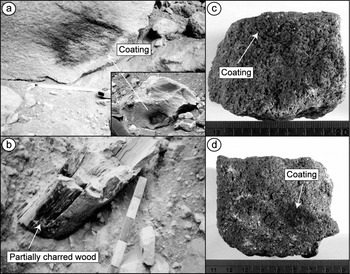
The 1954, 1994 and 1998 block-and-ash flow deposits at Merapi volcano consist of sub-angular to sub-rounded andesite blocks up to 20 m in size, set in a matrix of lapilli and ash (Schwarzkopf, Schmincke & Troll, Reference Schwarzkopf, Schmincke and Troll2001; Schwarzkopf, Schmincke & Cronin, Reference Schwarzkopf, Schmincke and Cronin2005). Metre-sized blocks from all three of these deposits display localized, dark surface coatings (Fig. 2a, c, d). These coatings form randomly orientated patches up to tens of centimetres in diameter on block surfaces, and show a gradual, irregular contact with their uncoated host rocks. The coatings are readily distinguished by their dark grey to silver colour, soft texture and characteristic metallic lustre. The coated blocks often occur in clusters within 5–30 m wide block-and-ash flow channels approximately 2–6 km from the volcano summit, in Kali (meaning ‘valley’) Apu (1954 deposits), Kali Boyong (1994 deposits), Kali Putih and Kali Lamat (1998 deposits). Isolated block coatings on individual blocks also occur but are less common.
(a–d) Deposits from the 1998 block-and-ash flow at Merapi volcano. (a) An andesite block displaying a dark surface coating with a metallic lustre. Measuring tape approximately 30 cm in length. (b) A partially charred tree trunk engulfed by the block-and-ash flow, Kali Puti valley. Ruler approximately 40 cm long. Photo taken in 2002. (c, d) Hand-samples of andesite displaying patchy, dark surface coatings. Figures also available in colour (supplementary material, available online at http://journals.cambridge.org/geo).

In addition to the coated blocks, the 1954, 1994 and 1998 basal avalanche deposits at Merapi typically contain denuded organic remains, including scorched tree trunks and twigs (Fig. 2b). These organic remains are commonly embedded within a matrix of poorly sorted andesite blocks and ash, and have been heated sufficiently for partial charcoalification to take place. Charcoalification involves incomplete combustion of organic material under oxygen-poor conditions, resulting in the formation of a solid residue of carbonaceous char (charcoal). This is a common process in pyroclastic environments and it has been well documented previously (cf. Scott & Jones, Reference Scott and Jones1991; Scott & Glasspool, Reference Scott and Glasspool2005, Reference Scott and Glasspool2007). Interestingly, foliage remains are rare or completely absent in the 1998 block-and-ash flow deposits, indicating that foliage is perhaps more susceptible to charring than lignin-rich, woody material, the former having most likely been completely destroyed by the block-and-ash flow.
2.b. The 2006 block-and-ash flow deposits
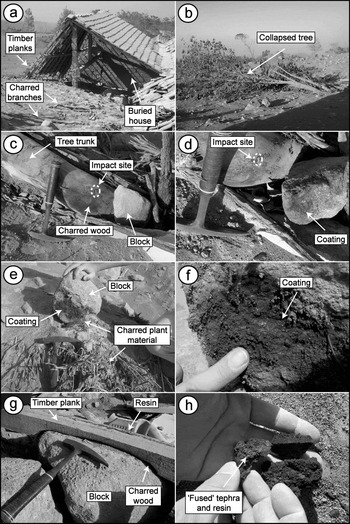
The village of Kaliadem, on the banks of Kali Gendol, about 5 km from the summit of Merapi, suffered partial burial by the block-and-ash flows of summer 2006 (Fig. 3a). The deposits at Kaliadem form part of the valley overflow facies of the 2006 block-and-ash flow, and contain numerous examples of metre-sized andesite blocks in close proximity to, or in direct contact with, timber remnants from partially collapsed dwellings (Fig. 3c–h). Emplacement temperatures of the initial surge deposit, and the tephra matrix of the subsequent overflow deposits, are constrained by the presence of partially melted plastic bottles, indicating temperatures exceeded ~165°C (R. Gertisser, pers. comm.). Block temperatures are thought to have been considerably higher (~350–400°C minimum), based on estimates made during the extraction of block deposits from a buried geological observatory bunker one day after the emplacement of the flow (R. Gertisser, pers. comm.). These most recent block-and-ash flow deposits provided ample opportunity to test our working hypothesis that block coatings originate from charred organic remains, and also offered insight into the potential mechanisms of charcoalification and coating formation. In the study area, the charcoalified wood occurs predominantly as partially charred timber remnants of houses engulfed by the advancing flow and, to a lesser extent, as scorched tree stumps and twigs. Figure 3c–h shows a number of examples where andesite blocks were found resting in direct contact with charcoalified wood. In each case, the andesite block displays a dark coating with a metallic lustre on the surface that had been adjacent to the wood (e.g. Fig. 3d). The wood, in turn, typically shows partial to severe charring over the area of contact with the block (e.g. Fig. 3c, e, g). As in older block-and-ash flow deposits, the coated blocks in the 2006 deposits typically occur in clusters in areas where charred wood is most abundant. In addition, dark-coloured, brittle material, with a characteristic globular surface texture and pungent smoky smell resembling that of charred organic remains, often occurs where wood has become entrained in, or is resting on top of, ash-rich tephra deposits (Fig. 3h).
(a–h) Deposits from the 2006 block-and-ash flow at Merapi volcano. (a) House in the village of Kaliadem engulfed by the 2006 block-and-ash flow at Merapi volcano. Note the abundance of timber planks, which provide an ample source of organic material for charcoalification by the hot andesite blocks of the pyroclastic flow. (b) A collapsed tree on the lower slopes of Merapi volcano, which has been engulfed by the relatively thin overbank facies of the 2006 block-and-ash flow deposits at Kaliadem village. (c) Splintered and partially charred trunk of tree in (b), partly embedded in the block-and-ash flow deposits, with an andesite block resting on top (turned over to the right from original position). (d) When overturned, a narrow charred domain was identified on the trunk, and a dark coating with a metallic lustre was visible on the angular edge of the block. The white circle denotes the point of impact. (e) An andesite block resting on top of remnants of a partially charred tree root. (f) When overturned, a dark coating with a metallic lustre was revealed on the block's bottom surface. (g) A timber plank wedged against an andesite block. The timber is intensely charred where it is in contact with the block, indicating block temperatures greater than ~280°C. The heat of the andesite block has caused resin to ooze out onto the surface of the wood, where it has subsequently cooled. (h) Fragments of agglutinated tephra and wood resin, found within, and resting on top of, the 2006 tephra deposits. See text for details. Figures also available in colour (supplementary material, available online at http://journals.cambridge.org/geo).

3. Analytical methods
To test the plausibility of an organic origin for the block coatings, we determined the carbon isotope compositions of coated and uncoated whole-rock material, and of a range of charred and uncharred Javanese wood samples. Scanning electron microscopy (SEM) and reflected light microscopy were employed to yield further insight into the morphology of the coatings and the internal structure of the charred wood specimens.
3.a. Carbon isotope analysis
Carbon isotope analysis was carried out on coated and uncoated bulk-rock samples by Continuous Flow Isotope Ratio Mass Spectrometry (CF-IRMS) at Geochemische Analysen, Sehnde, Germany, in 2002 and 2003 (see http://www.gca-isolab.de for a detailed analytical procedure). Coated areas were cut from blocks as thinly as possible (5–10 mm) in order to sample as much coating material as possible, thereby minimizing the effect of the host rock's composition. A number of partially charred wood specimens (twigs and branches) from the 1998 block-and-ash flow deposits at Merapi volcano, as well as a range of uncharred Javanese wood samples, were also analysed. All wood specimens were rinsed using deionized water and left to dry at room temperature for 1 to 2 days prior to analysis. Wood shavings approximately 1 mm3 in size were taken from the exterior, middle and interior of the charred specimens using a sterile scalpel. Samples of the same size were taken from the outside of the uncharred wood specimens. Carbon isotope analyses of the charred and uncharred wood samples were performed on the Thermo Deltaplus CF-IRMS in the Geochemistry Laboratory at Trinity College Dublin in 2004 and 2005 (http://www.tcd.ie/Geology/MAIN-PAGE/research.php - geochem). The mass spectrometer was coupled to a CE Instruments 1112 Flash Elemental Analyser by a Conflo III Interface, and was operated using ISODAT software. All carbon isotope ratios were measured relative to the universal standard Peedee Belemnite (PDB), and the working standard L-Alanine (δ13C = −27.00‰) was used to calibrate the data to the PDB scale. All data are reported using the delta (δ) notation where δ = 1000* ((Rsample – Rstandard)/Rstandard) and R = 13C/12C.
3.b. Scanning electron microscopy (SEM)
SEM investigations of coated bulk-rock samples CB-2 and CB-5, recovered from the 1998 block-and-ash flow deposits at Merapi, were performed on the high resolution Hitachi S-4300 SEM in the Centre for Microscopy and Analysis at Trinity College Dublin in 2004 (see http://www.tcd.ie/CMA/s4300.htm for a detailed description of the equipment and analytical procedure).
3.c. Reflected light microscopy
A charred wood sample (CMW-1) from the 1998 block-and-ash flow deposits at Merapi volcano was examined by means of reflected light microscopy at Trinity College Dublin in 2004. This method was used to determine the internal structure and composition of the wood sample. The sample was mounted in resin and polished prior to analysis. The sample was then viewed in reflected light under oil using a Leitz MPV-1 reflectance microscope connected to a Leica Image Analysis and Archiving system.
4. Results
4.a. Carbon isotope analysis
The results of carbon isotope analysis are summarized in Table 1. The δ13C values of the uncoated rock samples range from −21.1‰ to −27.5‰ (±0.25, n = 6). In contrast, the coated rock samples are relatively depleted in 13C, and have δ13C values between −26.5‰ and −32.0‰ (±0.6, n = 6). The charred wood samples have δ13C values ranging from −26.6‰ to −33.3‰ (±0.9, n = 22), whereas uncharred Javanese wood samples have δ13C values ranging from −24.9‰ to −26.7‰ (±0.7, n = 6).
Carbon isotope compositions (δ13C ‰) of uncoated and coated bulk rocks, and the charred and uncharred wood samples

o – exterior of specimen, m – middle of specimen, i – interior of specimen
Figure 4 shows a clear overlap between the δ13C compositions of the coated rocks and the charred woods. The δ13C values for the coated rocks also overlap significantly with the typical δ13C ranges of biomass (−22‰ to −38‰) and sedimentary organic carbon (−30‰ to −40‰; cf. Rollinson, Reference Rollinson1993, pp. 294–6; Hoefs, Reference Hoefs2004). The uncoated rocks are characterized by significantly heavier δ13C signatures (−21.1‰ to −27.5‰), and show a rather different range to their coated counterparts (−26.5‰ to −32.0‰).
Graph showing the range of δ13C values obtained for the coated and uncoated andesite samples, and the charred and uncharred wood samples. Also shown for comparison are the typical δ13C ranges for biomass, sedimentary organic carbon (SOC), and the mantle (Rollinson Reference Rollinson1993, pp. 294–6; Hoefs, Reference Hoefs2004).

4.b. SEM
In all SEM images of coated areas, a smooth dark surface can be identified (Fig. 5a, b). This smooth surface is most pronounced in the pore spaces of the coated rock, where it appears to partially or completely cover the crystals and matrix, producing a distinctive ‘blanket-like’ morphology.
(a, b) Secondary electron SEM images taken within the pore spaces of coated andesite samples. (a) Pore-space of CB-2 displaying a smooth, undulating surface coating, punctuated by sharp, angular crystals, creating a distinctive ‘blanket-like’ morphology. (b) Pore-space of CB-5 showing a smooth surface coating partially covering more angular rock crystals. Dust-sized particles visible on top of the coating are most likely a post-depositional feature, such as debris material arising from hammering/sample transport. Scale (in μm), accelerating voltage (in kV), working distance (WD), magnification (k) and the date of imaging are given at the bottom of each image.

4.c. Reflected light microscopy
The charred wood sample CMW-1 consists predominantly of inertinite group macerals, with characteristically high reflectance under oil (cf. Taylor et al. Reference Taylor, Teichmuller, Davis, Diessel, Littke and Robert1998, pp. 176–8). Macerals of the inertinite group are generally derived from the degradation of cellulose and lignin in plant cell walls, and form the major constituents of charcoal (cf. Taylor et al. Reference Taylor, Teichmuller, Davis, Diessel, Littke and Robert1998, pp. 176–8). The cell walls are homogenized over much of the wood sample (Fig. 6a), indicating charring temperatures of approximately 280°C or higher (Scott, Reference Scott1989; Scott et al. Reference Scott, Cripps, Collinson and Nichols2000). However, distinct areas are identified, particularly around the rim of the sample, where the cell walls have become cracked, or fragmented (Fig. 6b), giving rise to abundant loose particles at the outer margin of the charred wood.
(a, b) Reflected light images of the charcoalified Merapi wood sample, CMW-1 (magnification ×50). (a) Much of the sample displays homogenized plant cell walls (that is, the middle lamella of the cell-walls are no longer visible; cf. Scott & Jones, Reference Scott and Jones1991). However, note the presence of fragmented cell walls at the margins of the sample (b), the most probable source of particulate organic carbon for the andesite block coatings.

5. Discussion
5.a. Composition of the block coatings
Coated andesite samples from recent block-and-ash flows at Merapi volcano are characterized by isotopically light δ13C signatures relative to uncoated andesite samples from the same deposits. Uncoated bulk-rock samples have δ13C compositions ranging from −21‰ to −27.5‰, consistent with previously reported whole-rock values between −15‰ and −27‰ for ‘pure’ degassed andesites (Allard, Reference Allard, Tazieff and Sabroux1983; Holloway & Blank, Reference Holloway, Blank, Carroll and Halloway1994). The coated andesite rock samples, however, have δ13C compositions that are substantially lighter, ranging from approximately −26‰ down to −32‰. Pure andesites are not known to produce negative δ13C values of a similar magnitude at Merapi or elsewhere (cf. Holloway & Blank, Reference Holloway, Blank, Carroll and Halloway1994). In fact, the only known natural carbon reservoirs that are characterized by such isotopically light δ13C signatures are sedimentary organic carbon and biomass (cf. Rollinson, Reference Rollinson1993, pp. 294–6; Hoefs, Reference Hoefs2004; see Fig. 4). Anomalously light δ13C compositions are not observed for uncoated bulk-rock samples, strongly suggesting that such negative δ13C values reflect the presence of coatings rich in organic carbon. These carbonaceous organic coatings appear to have an overriding influence on the δ13C of the coated bulk-rock samples, despite their relatively small volume.
5.b. Formation of the block coatings
The SEM images highlight a smooth, ‘blanket-like’ cover within the pore-spaces of the coated andesite blocks, which leaves only the most angular parts of the crystals visible above the covered surface (Fig. 5a, b). We interpret this ‘blanket’ to have been deposited by a fluid phase (in either a gaseous or liquid state) rich in organic carbon, arising as a result of load and temperature effects on wood incorporated within a resting (but still hot) pyroclastic flow, and/or by mechanical grinding of wood entrained in a moving pyroclastic flow. The reflected light images of CMW-1 highlight severe fragmentation of the wood cell-walls, particularly along the margins of the specimen (Fig. 6b). In a pyroclastic environment, such disarticulated wood is the most likely source for heated carbon particles that could potentially be released onto, and penetrate into, adjacent rocks. These hypotheses are supported by field evidence from the 2006 block-and-ash flow deposits (Fig. 3b–h), in which andesite blocks in direct contact with charred and disarticulated timber consistently show dark coatings over the area of contact, identical to those found in the 1998, 1994 and 1954 block-and-ash flow deposits.
In the 1954, 1994 and 1998 block-and-ash flow deposits, coated blocks often occur in clusters, which requires the presence of a relatively large source of biomass nearby. The most likely source for these clusters is the frequent occurrence of ‘vegetation islands’ in erosional gullies that originate from processes such as slumping of the gully walls into the rapidly deepening gully floor. Large, foliage-bearing trees (e.g. Fig. 3b), and areas with abundant vegetation, would also provide highly concentrated sources of biomass. An overriding block-and-ash flow would either erode such vegetation entirely or, in a lower energy environment, engulf or completely cover it. In either situation, a substantial quantity of biomass would become available for interaction with the hot (350–400°C) and oxygen-poor pyroclastic flow material. In the 2006 block-and-ash flow deposits, large numbers of coated andesite blocks in direct contact with charred wood (e.g. Fig. 3e, f) indicate that simple covering and gradual charcoalification of organic material (perhaps over a period of several days to weeks), with limited or no transport (in situ), is the most likely mechanism that could form clusters of coated blocks.
Despite their typical occurrence in clusters, isolated coated blocks can also be found in the 1954, 1994 and 1998 block-and-ash flow deposits. These isolated blocks could simply be recycled from the older deposits that locally form the substrate to younger deposits, or they may represent the dispersed, en route collisional remnants of a block-and-ash flow, within which wood/plant material became entrained. Assuming minimum block temperatures of 350–400°C (based on estimates from the 2006 deposits at Kaliadem; see Section 2.b), and an up to 1000°C increase in temperature at the point of block–block impact (cf. Grunewald et al. Reference Grunewald, Sparks, Kearns and Komorowski2000; Schwarzkopf, Schmincke & Troll, Reference Schwarzkopf, Schmincke and Troll2001, Reference Schwarzkopf, Schmincke and Troll2002), it is highly likely that some fragments of wood would have been crushed and rapidly charred (perhaps in a matter of seconds) as a result of entrainment within a hot and fast-moving density current, giving rise to the formation of organic block coatings via block collision. This mechanism of coating formation is particularly well illustrated in Figure 3c, where an angular block has impacted an overturned tree trunk. When turned over (Fig. 3d), a dark coating with a metallic lustre was revealed on the angular tip of the andesite block, and the tree trunk had been partially charred over the area of contact with the block. Continued transport of such impacting blocks (either in the same density current or as part of a later, overriding block-and-ash flow or lahar; cf. Schwarzkopf, Schmincke & Cronin, Reference Schwarzkopf, Schmincke and Cronin2005) would result in dispersal and an apparently random distribution of individual coated blocks within block-and-ash flow deposits, explaining the occurrence of some isolated blocks.
In addition to the block coatings, fragments of dark, brittle material are found within and on top of the tephra deposits of the 2006 block-and-ash flow. This material most likely formed when wood fragments became entrained in the advancing block-and-ash flow, and the high temperatures and pressures resulted in rapid charring and the expulsion of resin from the wood into the surrounding tephra. The wood resin and tephra would have become ‘fused’ together within the still-hot block-and-ash flow, and subsequently cooled and coagulated to produce a tarry, dark-coloured hybrid mass with a globular texture and dark organic matrix. A similar process has been described by Sparks et al. (Reference Sparks, Barclay, Calder, Herd, Komorowski, Luckett, Norton, Ritchie, Voight, Woods, Druitt and Kokelaar2001) at Soufrière Hills volcano, Montserrat, where a black tar layer, generated by the rapid heating of vegetation by a fast-moving pyroclastic density current, is found filling in grooved and scoured surfaces on the flanks of the volcano.
Similar occurrences of dark block coatings were reported to us from andesitic block-and-ash flow deposits at Arenal volcano, Costa Rica (H.-U. Schmincke, pers. comm.) and from basaltic-andesite pyroclastic deposits at Kelut volcano, east Java (O. Spieler, pers. comm.). This suggests that the phenomenon of organic block coatings may in fact be more widely distributed in pyroclastic flow-type deposits than previously thought, perhaps reflecting a higher preservation potential on large solid blocks as opposed to pure ash deposits.
6. Summary and conclusions
(1) We report dark coatings with a metallic lustre on andesite blocks in the 1954, 1994, 1998 and 2006 block-and-ash flow deposits from Merapi volcano, central Java.
(2) Carbon isotope analysis indicates that the coatings contain carbon of organic origin.
(3) Charred wood fragments with intensely deformed cell walls are common in the deposits and are the most likely source of the coatings.
(4) Coatings form in situ, when ‘islands’ of organic material are overridden by block-and-ash flows, and/or when individual wood fragments are entrained and transported within block-and-ash flows.
(5) The phenomenon may be common in volcanic settings similar to that at Merapi, with lush vegetation and frequent pyroclastic flow activity.
Acknowledgements
We thank M. Schmitt from GeoChemische Analysen (GCA) for carbon isotope analysis of the rock samples, and C. Duggan for help during preparation of the wood samples. N. Leddy is thanked for technical support during SEM analysis. We are grateful for fruitful discussions with R. Gertisser, O. Spieler, H.-U. Schmincke, J. Chadwick, S. Self, I. Sanders and J. Graham. VRT acknowledges financial support from the Mineralogy Society of Great Britain and Ireland, and the Provost's Academic Development Fund at TCD, to visit Java in 2002 and 2006. We are also grateful for the support of the Volcanological Survey of Indonesia (VSI), and especially the staff of Direktorat Vulkanologi, Yogyakarta.