1 Introduction
Fluid flow descriptions at high Knudsen numbers (
 $Kn$
) require a hydrodynamic model different from the conventional Navier–Stokes equations.
 $Kn$
is defined as
 $\unicode[STIX]{x1D706}/L$
, where
 $\unicode[STIX]{x1D706}$
is the mean free path of the gas and
 $L$
is the characteristic length in the flow. When the Knudsen number is very small (
 $Kn\leqslant 10^{-3}$
) then the regime is known as the continuum regime, while for relatively high values of Knudsen number (
 $10^{-1}\leqslant Kn\leqslant 10$
) the regime is called the transition regime. For intermediate values of Knudsen number (
 $10^{-3}\leqslant Kn\leqslant 10^{-1}$
) the flow regime is referred to as the slip regime. In numerous applications, for example, hypersonic flows (Singh & Schwartzentruber Reference Singh and Schwartzentruber2016; Singh, Jadhav & Agrawal Reference Singh, Jadhav and Agrawal2017), micro-scale gas flows in micro-electromechanical systems (MEMS) devices (Ho & Tai Reference Ho and Tai1998), the gas flow is in the transition regime, therefore characterization of the flow physics in this regime is necessary.
The study of slip flow in a microchannel has been a subject of great interest over the past few decades. Pong et al. (Reference Pong, Ho, Liu and Tai1994) provided an experimental investigation of the pressure distribution for gas flow in a microchannel, and found that compressibility affects the flow substantially. Karniadakis, Beskok & Gad-el-Hak (Reference Karniadakis, Beskok and Gad-el-Hak2002) presented numerical solutions of the Navier–Stokes equations in the slip flow regime. Arkilic, Schmidt & Breuer (Reference Arkilic, Schmidt and Breuer1997) provided an analytical solution based on perturbation methods in conjunction with a first-order slip model and found good agreement with experimental mass flow rate data capturing the Knudsen minimum. Zohar et al. (Reference Zohar, Lee, Lee, Jiang and Tong2002) also provided a perturbation-based solution of the Navier–Stokes equations under the assumption that
 $Kn$
is of order 0.1 and the tangential momentum accommodation coefficient (which determines the amount of slip at the wall) is unity. Dongari, Agrawal & Agrawal (Reference Dongari, Agrawal and Agrawal2007) provided an analytical solution of the Navier–Stokes equations for isothermal gaseous flow in microchannels with a second-order slip model, using an integral approach. Interestingly, they argued that the Navier–Stokes equations with a second-order slip boundary condition can be applied over a wide range of Knudsen numbers. Recently, Huang & Li (Reference Huang and Li2017) investigated the rarefaction effects in microchannel gas flows by measuring the pressure profiles. Although the extensions of the Navier–Stokes equations solutions to the slip regime in the above-mentioned cases using slip boundary conditions at the wall have been successful, capturing the transition regime requires different constitutive relationships.
The Navier–Stokes equations have constitutive relations which are linear in terms of the thermodynamic forces (such as velocity and temperature gradients), therefore these equations are accurate for the hydrodynamic description when the deviations from equilibrium are small. The Chapman–Enskog expansion (Chapman & Cowling Reference Chapman and Cowling1970; Truesdell & Muncaster Reference Truesdell and Muncaster1980) to derive the Navier–Stokes equations from the Boltzmann equation is extended to include higher-order equations to better understand the flow physics in the slip and transition regimes. Therefore, for computing the flows in the transition regime, a set of extended hydrodynamic equations (Burnett equations) have been derived in the past by retaining the second-order terms in the Chapman–Enskog expansion. Numerous variants of the Burnett equations have been derived, for instance the original Burnett equations (Burnett Reference Burnett1935), conventional Burnett equations (Chapman & Cowling Reference Chapman and Cowling1970), augmented Burnett equations (Zhong, MacCormack & Chapman Reference Zhong, MacCormack and Chapman1993), Bhatnagar–Gross–Krook (BGK)–Burnett equations (Agarwal, Yun & Balakrishnan Reference Agarwal, Yun and Balakrishnan2001), simplified Burnett equations for hypersonic flows (Zhao, Chen & Agarwal Reference Zhao, Chen and Agarwal2014) and the Onsager-reciprocity principle consistent Burnett equations (Singh et al. Reference Singh, Jadhav and Agrawal2017). The limitations of the Burnett (conventional) equations were first reported in terms of an instability called the Bobylev instability (Bobylev Reference Bobylev1982) and later on, studied and rectified in the context of hypersonic problems (Fiscko & Chapman Reference Fiscko, Chapman and Muntz1989; Zhong et al. Reference Zhong, MacCormack and Chapman1993). García-Colín, Velasco & Uribe (Reference García-Colín, Velasco and Uribe2008) have given a detailed summary of the origin of the Burnett equations, and the validity of the Burnett equations. Although to analyse transition flow regime, there are numerical solutions of these equations, for instance Burnett equations in microchannels (Xu & Li Reference Xu and Li2004; Bao & Lin Reference Bao and Lin2008), the Boltzmann equation with the BGK model (Cercignani & Daneri Reference Cercignani and Daneri1963) with an external body force (Aoki, Takata & Nakanishi Reference Aoki, Takata and Nakanishi2002) and the direct simulation Monte Carlo (DMSC) technique-based (Bird Reference Bird1994; Piekos & Breuer Reference Piekos and Breuer1996; Cheng & Liao Reference Cheng and Liao2000) investigations, analytical solutions of these equations are limited to Singh & Agrawal (Reference Singh and Agrawal2014) and Singh, Dongari & Agrawal (Reference Singh, Dongari and Agrawal2014a ).
In the present work, we solve the conventional Burnett equations using the perturbation technique. We investigate the gaseous flow for low Mach and Reynolds numbers in a long microchannel with no external body force by using the conventional Burnett equations. Governing equations involve second-order stress terms in the momentum equations. The pressure distribution and the streamwise velocity distribution along the wall-normal direction have been derived. Analytical (closed-form) expressions for the pressure distribution have been derived for gaseous flow in a microchannel starting from the Burnett equations and shown to be in good agreement with numerical results in the literature. The numerical solution of the streamwise velocity are also compared and shown to be in good agreement with the DSMC simulation results.
2 Governing equations
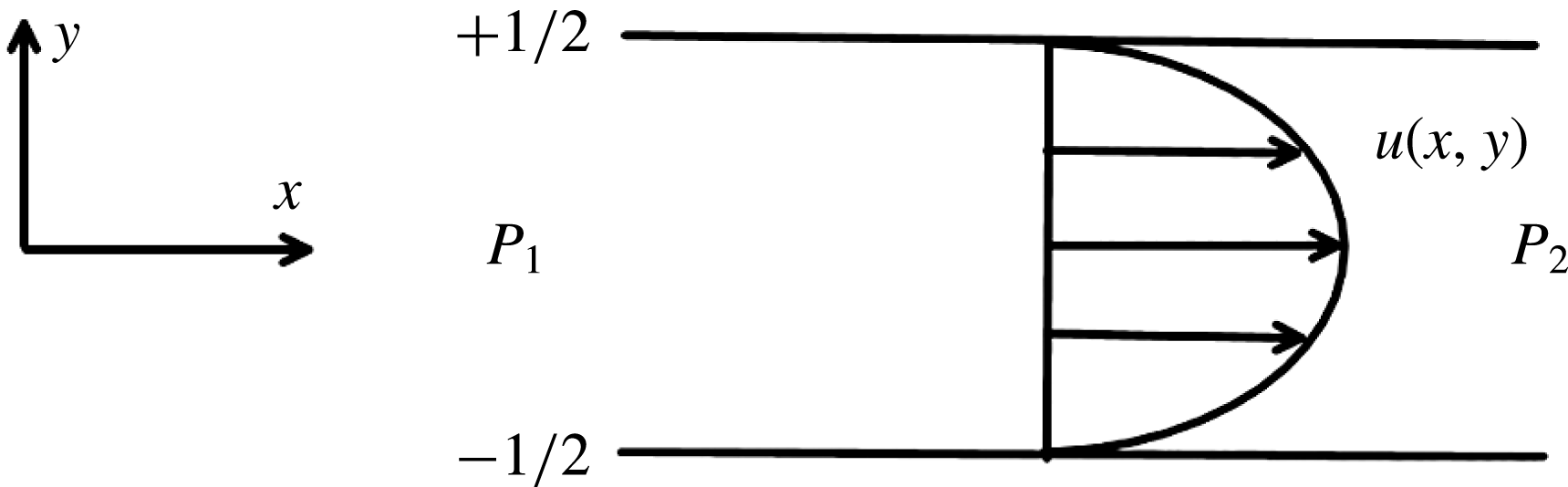
The two-dimensional form of the continuity and momentum equations (governing equations for the present problem: see figure 1) can be expressed as
 $$\begin{eqnarray}\displaystyle & & \displaystyle \left[\begin{array}{@{}ccc@{}}1 & 0 & 0\\ 0 & \unicode[STIX]{x1D70C}u & 0\\ 0 & 0 & \unicode[STIX]{x1D70C}v\end{array}\right]\left[\begin{array}{@{}c@{}}\displaystyle \frac{\unicode[STIX]{x2202}(\unicode[STIX]{x1D70C}u)}{\unicode[STIX]{x2202}x}\\ \displaystyle \frac{\unicode[STIX]{x2202}u}{\unicode[STIX]{x2202}x}\\ \displaystyle \frac{\unicode[STIX]{x2202}v}{\unicode[STIX]{x2202}x}\end{array}\right]+\left[\begin{array}{@{}ccc@{}}1 & 0 & 0\\ 0 & \unicode[STIX]{x1D70C}u & 0\\ 0 & 0 & \unicode[STIX]{x1D70C}v\\ \end{array}\right]\left[\begin{array}{@{}c@{}}\displaystyle \frac{\unicode[STIX]{x2202}\unicode[STIX]{x1D70C}v}{\unicode[STIX]{x2202}y}\\ \displaystyle \frac{\unicode[STIX]{x2202}u}{\unicode[STIX]{x2202}y}\\ \displaystyle \frac{\unicode[STIX]{x2202}v}{\unicode[STIX]{x2202}y}\end{array}\right]\nonumber\\ \displaystyle & & \displaystyle \quad +\,\left[\begin{array}{@{}c@{}}0\\ \displaystyle \frac{\unicode[STIX]{x2202}}{\unicode[STIX]{x2202}x}(p+{\unicode[STIX]{x1D70E}_{x}}_{x})\\ \displaystyle \frac{\unicode[STIX]{x2202}}{\unicode[STIX]{x2202}x}{\unicode[STIX]{x1D70E}_{x}}_{y}\end{array}\right]+\left[\begin{array}{@{}c@{}}0\\ \displaystyle \frac{\unicode[STIX]{x2202}}{\unicode[STIX]{x2202}y}{\unicode[STIX]{x1D70E}_{x}}_{y}\\ \displaystyle \frac{\unicode[STIX]{x2202}}{\unicode[STIX]{x2202}y}(p+{\unicode[STIX]{x1D70E}_{y}}_{y})\\ \end{array}\right]=0,\end{eqnarray}$$
where
 $u$
,
 $v$
are the streamwise and wall-normal components of the velocity, respectively,
 $p$
is pressure,
 $\unicode[STIX]{x1D70C}$
is density,
 $x$
and
 $y$
are the directions as given in figure 1 and
 $\unicode[STIX]{x1D70E}_{ij}$
is the viscous stress tensor. The pressure obeys the ideal gas law:
 $p=\unicode[STIX]{x1D70C}RT$
, where
 $R$
is the ideal gas constant, and
 $T$
is absolute temperature.
Geometry for the channel analysis, with a velocity profile at a given position.

2.1 Stress and heat flux terms of the conventional Burnett equations
The conventional Burnett equations were derived from the original Burnett equations (Burnett Reference Burnett1935) by replacing the material derivative terms using the Euler equations by Chapman & Cowling (Reference Chapman and Cowling1970). Stress and heat flux terms are divided into Navier–Stokes- and Burnett-order terms as
 $$\begin{eqnarray}\displaystyle & \displaystyle \unicode[STIX]{x1D70E}_{ij}=\unicode[STIX]{x1D70E}_{ij}^{(NS)}+\unicode[STIX]{x1D70E}_{ij}^{(B)}, & \displaystyle\end{eqnarray}$$
 $$\begin{eqnarray}\displaystyle & \displaystyle q_{i}=q_{i}^{(NS)}+q_{i}^{(B)}. & \displaystyle\end{eqnarray}$$
The Navier–Stokes terms are given through Newton’s law and Fourier’s law as
 $$\begin{eqnarray}\displaystyle & \displaystyle \unicode[STIX]{x1D70E}_{ij}^{(NS)}=2\unicode[STIX]{x1D707}\left(\frac{1}{2}\left(\frac{\unicode[STIX]{x2202}u_{i}}{\unicode[STIX]{x2202}x_{j}}+\frac{\unicode[STIX]{x2202}u_{j}}{\unicode[STIX]{x2202}x_{i}}\right)-\frac{1}{3}\unicode[STIX]{x1D6FF}_{ij}\frac{\unicode[STIX]{x2202}u_{k}}{\unicode[STIX]{x2202}x_{k}}\right), & \displaystyle\end{eqnarray}$$
 $$\begin{eqnarray}\displaystyle & \displaystyle {q_{i}}^{(NS)}=-\unicode[STIX]{x1D705}\frac{\unicode[STIX]{x2202}T}{\unicode[STIX]{x2202}x_{i}}. & \displaystyle\end{eqnarray}$$
The Burnett-order terms for the stress tensor and heat flux terms for hard sphere gas molecules for the conventional Burnett equations are
 $$\begin{eqnarray}\displaystyle {\unicode[STIX]{x1D70E}_{ij}}^{(B)} & = & \displaystyle k_{1}\frac{\unicode[STIX]{x1D707}^{2}}{P}\frac{\unicode[STIX]{x2202}u_{k}}{\unicode[STIX]{x2202}x_{k}}\overline{\frac{\unicode[STIX]{x2202}u_{i}}{\unicode[STIX]{x2202}x_{j}}}+k_{2}\frac{\unicode[STIX]{x1D707}^{2}}{P}\left(\left(-\overline{\frac{\unicode[STIX]{x2202}}{\unicode[STIX]{x2202}x_{i}}\frac{1}{\unicode[STIX]{x1D70C}}\frac{\unicode[STIX]{x2202}P}{\unicode[STIX]{x2202}x_{j}}}\right)+\left(\overline{-\frac{\unicode[STIX]{x2202}u_{k}}{\unicode[STIX]{x2202}x_{i}}\frac{\unicode[STIX]{x2202}u_{j}}{\unicode[STIX]{x2202}x_{k}}}\right)+\left(-2\overline{\overline{\frac{\unicode[STIX]{x2202}u_{i}}{\unicode[STIX]{x2202}x_{k}}}\frac{\unicode[STIX]{x2202}u_{k}}{\unicode[STIX]{x2202}x_{j}}}\right)\right)\nonumber\\ \displaystyle & & \displaystyle +\,k_{3}\frac{\unicode[STIX]{x1D707}^{2}}{\unicode[STIX]{x1D70C}\text{T}}\left(\overline{\frac{\unicode[STIX]{x2202}^{2}\text{T}}{\unicode[STIX]{x2202}x_{i}\unicode[STIX]{x2202}x_{j}}}\right)+k_{4}\frac{\unicode[STIX]{x1D707}^{2}}{\unicode[STIX]{x1D70C}^{2}R\text{T}^{2}}\left(\overline{\frac{\unicode[STIX]{x2202}P}{\unicode[STIX]{x2202}x_{i}}\frac{\unicode[STIX]{x2202}\text{T}}{\unicode[STIX]{x2202}x_{j}}}\right)+k_{5}\frac{\unicode[STIX]{x1D707}^{2}}{\unicode[STIX]{x1D70C}\text{T}^{2}}\left(\overline{\frac{\unicode[STIX]{x2202}T}{\unicode[STIX]{x2202}x_{i}}\frac{\unicode[STIX]{x2202}\text{T}}{\unicode[STIX]{x2202}x_{j}}}\right)\nonumber\\ \displaystyle & & \displaystyle +\,k_{6}\frac{\unicode[STIX]{x1D707}^{2}}{P}\left(\frac{\unicode[STIX]{x2202}u_{i}}{\unicode[STIX]{x2202}x_{k}}\frac{\unicode[STIX]{x2202}u_{k}}{\unicode[STIX]{x2202}x_{j}}\right),\end{eqnarray}$$
 $$\begin{eqnarray}\displaystyle {q_{i}}^{(B)} & = & \displaystyle \unicode[STIX]{x1D703}_{1}\frac{\unicode[STIX]{x1D707}^{2}}{\unicode[STIX]{x1D70C}T}\frac{\unicode[STIX]{x2202}u_{k}}{\unicode[STIX]{x2202}x_{k}}\frac{\unicode[STIX]{x2202}T}{\unicode[STIX]{x2202}x_{i}}+\unicode[STIX]{x1D703}_{2}\frac{\unicode[STIX]{x1D707}^{2}}{\unicode[STIX]{x1D70C}T}\left(\frac{2}{3}\frac{\unicode[STIX]{x2202}}{\unicode[STIX]{x2202}x_{i}}\left(T\frac{\unicode[STIX]{x2202}u_{k}}{\unicode[STIX]{x2202}x_{k}}\right)\right)+\unicode[STIX]{x1D703}_{2}\frac{\unicode[STIX]{x1D707}^{2}}{\unicode[STIX]{x1D70C}T}\left(2\frac{\unicode[STIX]{x2202}u_{k}}{\unicode[STIX]{x2202}x_{i}}\frac{\unicode[STIX]{x2202}T}{\unicode[STIX]{x2202}x_{k}}\right)\nonumber\\ \displaystyle & & \displaystyle +\,\unicode[STIX]{x1D703}_{3}\frac{\unicode[STIX]{x1D707}^{2}}{\unicode[STIX]{x1D70C}P}\left(\frac{\unicode[STIX]{x2202}p}{\unicode[STIX]{x2202}x_{k}}\overline{\frac{\unicode[STIX]{x2202}u_{k}}{\unicode[STIX]{x2202}x_{i}}}\right)+\unicode[STIX]{x1D703}_{4}\frac{\unicode[STIX]{x1D707}^{2}}{\unicode[STIX]{x1D70C}}\left(\frac{\unicode[STIX]{x2202}}{\unicode[STIX]{x2202}x_{k}}\overline{\frac{\unicode[STIX]{x2202}u_{k}}{\unicode[STIX]{x2202}x_{i}}}\right)+\unicode[STIX]{x1D703}_{5}\frac{\unicode[STIX]{x1D707}^{2}}{\unicode[STIX]{x1D70C}T}\left(\frac{\unicode[STIX]{x2202}T}{\unicode[STIX]{x2202}x_{k}}\overline{\frac{\unicode[STIX]{x2202}u_{k}}{\unicode[STIX]{x2202}x_{i}}}\right),\end{eqnarray}$$
where the overbar indicates the non-divergent symmetrical tensor represented as
 $$\begin{eqnarray}\overline{\unicode[STIX]{x1D627}_{ij}}={\textstyle \frac{1}{2}}(\unicode[STIX]{x1D627}_{ij}+\unicode[STIX]{x1D627}_{ji})-{\textstyle \frac{1}{3}}\unicode[STIX]{x1D6FF}_{ij}\unicode[STIX]{x1D627}_{kk},\end{eqnarray}$$
with
 $\unicode[STIX]{x1D6FF}_{ij}$
being the Kronecker delta.
2.2 Simplification of the governing equations
The variables have been non-dimensionalized as
 $$\begin{eqnarray}x^{\prime }=\frac{x}{L},\quad y^{\prime }=\frac{y}{H},\quad u^{\prime }=\frac{u}{U_{out}},\quad v^{\prime }=\frac{v}{U_{out}},\quad p^{\prime }=\frac{p}{p_{out}},\quad \unicode[STIX]{x1D70C}^{\prime }=\frac{\unicode[STIX]{x1D70C}}{\unicode[STIX]{x1D70C}_{out}},\end{eqnarray}$$
where subscript ‘out’ indicates values at the reference location (taken at the microchannel exit in the present case),
 $U_{out}$
is the area-averaged velocity at the reference location, and
 $p_{out}$
is the reference pressure used to normalize the pressure.
The long microchannel approximation has been employed by using the smallness parameter
 $\unicode[STIX]{x1D700}$
defined as
 $$\begin{eqnarray}\unicode[STIX]{x1D700}=\frac{H}{L}.\end{eqnarray}$$
We assume the flow to be isothermal (therefore properties are constant), two-dimensional (thus neglecting any variation in the
 $z$
-direction) with no external body force. After using the above parameters and assumptions, the non-dimensional form of the
 $x$
-momentum and
 $y$
-momentum equations for a long microchannel can be obtained. These equations are given by (A 1) and (A 2) in the appendix.
2.3 Flow in the low Reynolds number and low Mach number regime
We consider gaseous flow with low Reynolds number and low Mach number conditions, while maintaining the Knudsen number to be of order unity. This assumption has been included by substituting
 $Ma\sim \unicode[STIX]{x1D700}$
and
 $Re\sim \unicode[STIX]{x1D700}$
into the continuity and momentum equations and neglecting all higher-order terms of
 $\unicode[STIX]{x1D700}$
in (A 1) and (A 2). This approach is similar to that adopted by Arkilic et al. (Reference Arkilic, Schmidt and Breuer1997) in their analysis of the Navier–Stokes equations. For the sake of simplicity, we write the non-dimensionalized governing equations omitting (
 $^{\prime }$
) on the variables. Under the above-mentioned assumptions, the non-dimensional form of continuity equation can be written as
 $$\begin{eqnarray}\unicode[STIX]{x1D700}\frac{\unicode[STIX]{x2202}(\unicode[STIX]{x1D70C}u)}{\unicode[STIX]{x2202}x}+\frac{\unicode[STIX]{x2202}(\unicode[STIX]{x1D70C}v)}{\unicode[STIX]{x2202}y}=0.\end{eqnarray}$$
Similarly, the non-dimensional
 $x$
- and
 $y$
-momentum equations reduce to
 $$\begin{eqnarray}\displaystyle & & \displaystyle \frac{7}{3}\frac{k_{2}}{(p)^{3}}\frac{\unicode[STIX]{x1D700}}{Re}\frac{\unicode[STIX]{x2202}p}{\unicode[STIX]{x2202}y}\frac{\unicode[STIX]{x2202}^{2}p}{\unicode[STIX]{x2202}x\unicode[STIX]{x2202}y}+\frac{1}{3}\frac{k_{2}}{(p)^{3}}\frac{\unicode[STIX]{x1D700}}{Re}\frac{\unicode[STIX]{x2202}^{2}p}{\unicode[STIX]{x2202}y\unicode[STIX]{x2202}x}\frac{\unicode[STIX]{x2202}^{2}p}{\unicode[STIX]{x2202}y^{2}}-\frac{2k_{2}}{(p)^{4}}\frac{\unicode[STIX]{x1D700}}{Re}\left(\frac{\unicode[STIX]{x2202}p}{\unicode[STIX]{x2202}y}\right)^{2}\frac{\unicode[STIX]{x2202}p}{\unicode[STIX]{x2202}x}\nonumber\\ \displaystyle & & \displaystyle \quad +\,\frac{Re\unicode[STIX]{x1D700}}{Ma^{2}}\frac{1}{\unicode[STIX]{x1D6FE}}\frac{\unicode[STIX]{x2202}p}{\unicode[STIX]{x2202}x}-\frac{2k_{2}}{3}\frac{\unicode[STIX]{x1D700}}{Re}\frac{1}{(p)^{2}}\frac{\unicode[STIX]{x2202}^{3}p}{\unicode[STIX]{x2202}y^{2}\unicode[STIX]{x2202}x}=\frac{\unicode[STIX]{x2202}^{2}u}{\unicode[STIX]{x2202}y^{2}},\end{eqnarray}$$
 $$\begin{eqnarray}\frac{8}{3}\frac{k_{2}}{Re}\frac{1}{(p)^{3}}\frac{\unicode[STIX]{x2202}p}{\unicode[STIX]{x2202}y}\frac{\unicode[STIX]{x2202}^{2}p}{\unicode[STIX]{x2202}y^{2}}-\frac{2}{3}\frac{k_{2}}{Re}\frac{1}{(p)^{2}}\frac{\unicode[STIX]{x2202}^{3}p}{\unicode[STIX]{x2202}y^{3}}-\frac{k_{2}}{Re}\frac{2}{(p)^{4}}\left(\frac{\unicode[STIX]{x2202}p}{\unicode[STIX]{x2202}y}\right)^{3}+\frac{Re}{Ma^{2}}\frac{1}{\unicode[STIX]{x1D6FE}}\frac{\unicode[STIX]{x2202}p}{\unicode[STIX]{x2202}y}=0.\end{eqnarray}$$
In (2.12), the term with
 $\unicode[STIX]{x1D6FE}$
(specific heat capacity) and the second-order derivative of the velocity term are the Navier–Stokes terms; the rest of the terms are Burnett-order terms. Similarly in (2.13), the term with
 $\unicode[STIX]{x1D6FE}$
is the Navier–Stokes term while the rest of the terms are Burnett-order terms.
The above two equations involve two variables
 $u$
and
 $p$
. The equations are however uncoupled and therefore, in principle,
 $p$
can be obtained from equation (2.13) and subsequently
 $u$
from (2.12). However these two equations are nonlinear, therefore an analytical solution of the equations is not straightforward. We employ a perturbation-based approach to solve these equations and arrive at a closed-form solution for the pressure and velocity field.
3 Perturbation analysis around Navier–Stokes solution
In this section, the cross-stream momentum equation (2.13) is first solved for pressure. This solution is subsequently substituted into the streamwise momentum equation (2.12) to obtain the solution for streamwise velocity.
3.1 Solution for pressure
In order to obtain an analytical expression for
 $p$
, we rearrange (2.13) to obtain
 $$\begin{eqnarray}\frac{8\hat{k}_{2}p}{3}\frac{\unicode[STIX]{x2202}p}{\unicode[STIX]{x2202}y}\frac{\unicode[STIX]{x2202}^{2}p}{\unicode[STIX]{x2202}y^{2}}-\frac{2\hat{k}_{2}p^{2}}{3}\frac{\unicode[STIX]{x2202}^{3}p}{\unicode[STIX]{x2202}y^{3}}-2\hat{k}_{2}\left(\frac{\unicode[STIX]{x2202}p}{\unicode[STIX]{x2202}y}\right)^{3}+\frac{p^{4}}{\unicode[STIX]{x1D6FE}}\frac{\unicode[STIX]{x2202}p}{\unicode[STIX]{x2202}y}=0,\end{eqnarray}$$
where
 $\hat{k}_{2}=k_{2}Ma^{2}/Re^{2}$
.
To obtain the solution of (3.1), we perturb around the Navier–Stokes equations solution. This approach appears reasonable as pressure is expected to vary with only a small magnitude around the Navier–Stokes solution where higher-order stress terms have been neglected. The
 $y$
-momentum equation using the first-order terms of stress of the Navier–Stokes equations is simply
 $$\begin{eqnarray}\frac{\unicode[STIX]{x2202}p}{\unicode[STIX]{x2202}y}=0.\end{eqnarray}$$
This suggests that pressure is a function of
 $x$
only, i.e. within the Navier–Stokes framework, we have
 $$\begin{eqnarray}p=p_{0}(x).\end{eqnarray}$$
If the solution is perturbed around
 $p_{0}(x)$
with perturbation term
 $p_{1}(x,y)$
then the solution of (3.1) can be written as
 $$\begin{eqnarray}p=p_{0}(x)+p_{1}(x,y).\end{eqnarray}$$
Note that both
 $p$
and
 $p_{1}$
are functions of
 $x$
and
 $y$
. Upon substituting (3.4) into (3.1) we obtain the following equation for
 $p_{1}(x,y)$
:
 $$\begin{eqnarray}\displaystyle & & \displaystyle \frac{p_{0}^{4}}{\unicode[STIX]{x1D6FE}}\frac{\unicode[STIX]{x2202}p_{1}}{\unicode[STIX]{x2202}y}+\frac{(p_{1})^{4}}{\unicode[STIX]{x1D6FE}}\frac{\unicode[STIX]{x2202}p_{0}}{\unicode[STIX]{x2202}y}+\frac{{p_{1}}^{4}}{\unicode[STIX]{x1D6FE}}\frac{\unicode[STIX]{x2202}p_{1}}{\unicode[STIX]{x2202}y}+\frac{8}{3}\hat{k}_{2}p_{0}\left(\frac{\unicode[STIX]{x2202}p_{0}}{\unicode[STIX]{x2202}y}\right)\frac{\unicode[STIX]{x2202}^{2}p_{0}}{\unicode[STIX]{x2202}y^{2}}-6\hat{k}_{2}\left(\frac{\unicode[STIX]{x2202}p_{0}}{\unicode[STIX]{x2202}y}\right)^{2}\frac{\unicode[STIX]{x2202}p_{1}}{\unicode[STIX]{x2202}y}\nonumber\\ \displaystyle & & \displaystyle \quad -\,6\hat{k}_{2}\left(\frac{\unicode[STIX]{x2202}p_{0}}{\unicode[STIX]{x2202}y}\right)\left(\frac{\unicode[STIX]{x2202}p_{1}}{\unicode[STIX]{x2202}y}\right)^{2}+4\frac{p_{0}{p_{1}}^{3}}{\unicode[STIX]{x1D6FE}}\frac{\unicode[STIX]{x2202}p_{1}}{\unicode[STIX]{x2202}y}-\frac{2}{3}\hat{k}_{2}(p_{0})^{2}\frac{\unicode[STIX]{x2202}^{3}p_{1}}{\unicode[STIX]{x2202}y^{3}}-\frac{2}{3}\hat{k}_{2}{p_{1}}^{2}\frac{\unicode[STIX]{x2202}^{3}p_{0}}{\unicode[STIX]{x2202}y^{3}}\nonumber\\ \displaystyle & & \displaystyle \quad -\,\frac{2}{3}\hat{k}_{2}{p_{1}}^{2}\frac{\unicode[STIX]{x2202}^{3}p_{1}}{\unicode[STIX]{x2202}y^{3}}-2\hat{k}_{2}\left(\frac{\unicode[STIX]{x2202}p_{0}}{\unicode[STIX]{x2202}y}\right)^{3}-\frac{2}{3}\hat{k}_{2}(p_{0})^{2}\frac{\unicode[STIX]{x2202}^{3}p_{0}}{\unicode[STIX]{x2202}y^{3}}+\frac{p_{0}^{4}}{\unicode[STIX]{x1D6FE}}\frac{\unicode[STIX]{x2202}p_{0}}{\unicode[STIX]{x2202}y}-2\hat{k}_{2}\left(\frac{\unicode[STIX]{x2202}p_{1}}{\unicode[STIX]{x2202}y}\right)^{3}\nonumber\\ \displaystyle & & \displaystyle \quad +\,4\frac{(p_{0})^{3}p_{1}}{\unicode[STIX]{x1D6FE}}\frac{\unicode[STIX]{x2202}p_{0}}{\unicode[STIX]{x2202}y}+4\frac{p_{0}^{3}p_{1}}{\unicode[STIX]{x1D6FE}}\frac{\unicode[STIX]{x2202}p_{1}}{\unicode[STIX]{x2202}y}+6\frac{p_{0}^{2}{p_{1}}^{2}}{\unicode[STIX]{x1D6FE}}\frac{\unicode[STIX]{x2202}p_{0}}{\unicode[STIX]{x2202}y}+6\frac{p_{0}^{2}{p_{1}}^{2}}{\unicode[STIX]{x1D6FE}}\frac{\unicode[STIX]{x2202}p_{1}}{\unicode[STIX]{x2202}y}+4\frac{p_{0}{p_{1}}^{3}}{\unicode[STIX]{x1D6FE}}\frac{\unicode[STIX]{x2202}p_{0}}{\unicode[STIX]{x2202}y}\nonumber\\ \displaystyle & & \displaystyle \quad +\,\frac{8}{3}\hat{k}_{2}p_{0}\left(\frac{\unicode[STIX]{x2202}p_{0}}{\unicode[STIX]{x2202}y}\right)\frac{\unicode[STIX]{x2202}^{2}p_{1}}{\unicode[STIX]{x2202}y^{2}}+\frac{8}{3}\hat{k}_{2}p_{0}\left(\frac{\unicode[STIX]{x2202}p_{1}}{\unicode[STIX]{x2202}y}\right)\frac{\unicode[STIX]{x2202}^{2}p_{0}}{\unicode[STIX]{x2202}y^{2}}+\frac{8}{3}\hat{k}_{2}p_{0}\left(\frac{\unicode[STIX]{x2202}p_{1}}{\unicode[STIX]{x2202}y}\right)\frac{\unicode[STIX]{x2202}^{2}p_{1}}{\unicode[STIX]{x2202}y^{2}}\nonumber\\ \displaystyle & & \displaystyle \quad +\,\frac{8}{3}\hat{k}_{2}p_{1}\left(\frac{\unicode[STIX]{x2202}p_{0}}{\unicode[STIX]{x2202}y}\right)\frac{\unicode[STIX]{x2202}^{2}p_{0}}{\unicode[STIX]{x2202}y^{2}}+\frac{8}{3}\hat{k}_{2}p_{1}\left(\frac{\unicode[STIX]{x2202}p_{1}}{\unicode[STIX]{x2202}y}\right)\frac{\unicode[STIX]{x2202}^{2}p_{1}}{\unicode[STIX]{x2202}y^{2}}-\frac{4}{3}\hat{k}_{2}p_{0}p_{1}\frac{\unicode[STIX]{x2202}^{3}p_{0}}{\unicode[STIX]{x2202}y^{3}}\nonumber\\ \displaystyle & & \displaystyle \quad -\,\frac{4}{3}\hat{k}_{2}p_{0}p_{1}\frac{\unicode[STIX]{x2202}^{3}p_{1}}{\unicode[STIX]{x2202}y^{3}}+\frac{8}{3}\hat{k}_{2}p_{1}\left(\frac{\unicode[STIX]{x2202}p_{0}}{\unicode[STIX]{x2202}y}\right)\frac{\unicode[STIX]{x2202}^{2}p_{1}}{\unicode[STIX]{x2202}y^{2}}+\frac{8}{3}\hat{k}_{2}p_{1}\left(\frac{\unicode[STIX]{x2202}p_{1}}{\unicode[STIX]{x2202}y}\right)\frac{\unicode[STIX]{x2202}^{2}p_{0}}{\unicode[STIX]{x2202}y^{2}}=0.\end{eqnarray}$$
The above equation can be simplified by setting
 $\unicode[STIX]{x2202}p_{0}/\unicode[STIX]{x2202}y=0$
from (3.3) and collecting only the first-order terms of
 $p_{1}(x,y)$
(i.e. after discarding all the higher-order terms of
 $p_{1}$
) as
 $$\begin{eqnarray}\frac{(p_{0})^{4}}{\unicode[STIX]{x1D6FE}}\frac{\unicode[STIX]{x2202}p_{1}}{\unicode[STIX]{x2202}y}-\frac{2\hat{k}_{2}(p_{0})^{2}}{3}\frac{\unicode[STIX]{x2202}^{3}p_{1}}{\unicode[STIX]{x2202}y^{3}}=0.\end{eqnarray}$$
Note that in arriving at the above equation, as
 $y\sim O(1)$
due to non-dimensionalization, the fact that
 $\unicode[STIX]{x2202}p_{1}(x,y)/\unicode[STIX]{x2202}y\sim O(p_{1})$
is used to discard higher-order terms. The solution to (3.6) can now be easily obtained as
 $$\begin{eqnarray}p_{1}(x,y)=c_{1}(x)+c_{2}(x)\cosh \left(p_{0}\sqrt{\frac{3}{2\hat{k}_{2}\unicode[STIX]{x1D6FE}}}y\right)+c_{3}(x)\sinh \left(p_{0}\sqrt{\frac{3}{2\hat{k}_{2}\unicode[STIX]{x1D6FE}}}y\right),\end{eqnarray}$$
where the constants of integration
 $c_{1}$
,
 $c_{2}$
and
 $c_{3}$
are in general functions of
 $x$
. Thus, the complete solution to (3.1) can be written as
 $$\begin{eqnarray}p(x,y)=p_{0}(x)+c_{1}(x)+c_{2}(x)\cosh \left(p_{0}\sqrt{\frac{3}{2\hat{k}_{2}\unicode[STIX]{x1D6FE}}}y\right)+c_{3}(x)\sinh \left(p_{0}\sqrt{\frac{3}{2\hat{k}_{2}\unicode[STIX]{x1D6FE}}}y\right).\end{eqnarray}$$
Proceeding further in order to obtain the constants of integration in (3.8) we require three boundary conditions for pressure along the
 $y$
-direction. Due to the symmetry of the flow, the normal pressure gradient at the centreline is zero (
 $\unicode[STIX]{x2202}p/\unicode[STIX]{x2202}y|_{y=0}=0$
). The remaining two required conditions, the pressure at the centre (
 $p|_{y=0}=p_{c}$
) and the second-order curvature of pressure (
 $\text{d}^{2}p/\text{d}y^{2}|_{y=0}=a$
), are obtained from the DSMC data of Zheng, Garcia & Alder (Reference Zheng, Garcia and Alder2002) and Xu (Reference Xu2003). Note that all of the boundary conditions have been imposed at the centreline. This treatment of the problem as an initial value problem is deemed to be superior to treating it as a boundary value problem, as argued previously by Singh, Gavasane & Agrawal (Reference Singh, Gavasane and Agrawal2014b
).
Applying the above-mentioned boundary conditions in (3.8) gives the value of all three coefficients. From the boundary condition that pressure gradient vanishes at the centreline we get
 $c_{3}(x)=0$
, which makes the solution symmetric about
 $y$
. By using the other two boundary conditions, i.e. pressure and its curvature at the centreline, we get the following values for
 $c_{1}(x)$
,
 $c_{2}(x)$
and
 $c_{3}(x)$
:
 $$\begin{eqnarray}c_{1}(x)=p_{c}(x)-p_{0}(x)-a/A^{2},\quad c_{2}(x)=a/A^{2},\quad c_{3}(x)=0.\end{eqnarray}$$
Substituting all of the three coefficients into (3.8), the solution finally becomes
 $$\begin{eqnarray}p(x,y)=p_{c}+\frac{a}{(p_{0}A)^{2}}(\cosh (p_{0}Ay)-1),\end{eqnarray}$$
where
 $A=\sqrt{3/2\hat{k}_{2}\unicode[STIX]{x1D6FE}}$
and
 $\hat{k}_{2}=k_{2}(2/\unicode[STIX]{x1D6FE}\unicode[STIX]{x03C0})Kn^{2}$
. It is clear that the distribution of pressure in the
 $y$
-direction is a function of the Knudsen number.
3.2 Solution of streamwise velocity distribution
After deriving the expression for
 $p(x,y)$
, we proceed to find the solution of
 $u(x,y)$
. To this end, we substitute
 $p(x,y)$
into (2.12) and integrate twice with respect to
 $y$
. That is,
 $$\begin{eqnarray}\displaystyle & & \displaystyle \frac{\unicode[STIX]{x2202}^{2}u}{\unicode[STIX]{x2202}y^{2}}=-\frac{2}{3}\frac{k_{2}\unicode[STIX]{x1D700}a\displaystyle \frac{\unicode[STIX]{x2202}p_{0}}{\unicode[STIX]{x2202}x}yA\sinh (p_{0}Ay)}{Re}\left(p_{0}+\frac{a(\cosh (p_{0}Ay)-1)}{p_{0}^{2}A^{2}}\right)^{-2}\nonumber\\ \displaystyle & & \displaystyle \quad +\,\frac{Re\,\unicode[STIX]{x1D700}}{Ma^{2}\unicode[STIX]{x1D6FE}}\left(\frac{\unicode[STIX]{x2202}p_{c}}{\unicode[STIX]{x2202}x}-\frac{2a(\cosh (p_{0}Ay)-1)\displaystyle \frac{\unicode[STIX]{x2202}p_{0}}{\unicode[STIX]{x2202}x}}{p_{0}^{3}A^{2}}+\frac{a\displaystyle \frac{\unicode[STIX]{x2202}p_{0}}{\unicode[STIX]{x2202}x}y\sinh (p_{0}Ay)}{p_{0}^{2}A}\right)\nonumber\\ \displaystyle & & \displaystyle \quad -\,\frac{2k_{2}\unicode[STIX]{x1D700}a^{2}(\sinh (p_{0}Ay))^{2}}{Re\,p_{0}^{2}A^{2}}\nonumber\\ \displaystyle & & \displaystyle \times \,\left(\displaystyle \frac{\unicode[STIX]{x2202}p_{0}}{\unicode[STIX]{x2202}x}-\frac{2a(\cosh (p_{0}Ay)-1)\displaystyle \frac{\unicode[STIX]{x2202}p_{0}}{\unicode[STIX]{x2202}x}}{p_{0}^{3}A^{2}}+\frac{2a\displaystyle \frac{\unicode[STIX]{x2202}p_{0}}{\unicode[STIX]{x2202}x}y\sinh (p_{0}Ay)}{p_{0}^{2}A}\right)\nonumber\\ \displaystyle \quad & & \displaystyle \quad \times \,\left(p_{0}+\frac{a(\cosh (p_{0}Ay)-1)}{p_{0}^{2}A^{2}}\right)^{-4}+\frac{1}{3}\frac{k_{2}\unicode[STIX]{x1D700}a\cosh (p_{0}Ay)}{Re}\nonumber\\ \displaystyle & & \displaystyle \quad \times \,\left(-\frac{a\sinh (p_{0}Ay)\displaystyle \frac{\unicode[STIX]{x2202}p_{0}}{\unicode[STIX]{x2202}x}}{p_{0}^{2}A}+\frac{a\displaystyle \frac{\unicode[STIX]{x2202}p_{0}}{\unicode[STIX]{x2202}x}y\cosh (p_{0}Ay)}{p_{0}}\right)\left(p_{0}+\frac{a(\cosh (p_{0}Ay)-1)}{p_{0}^{2}A^{2}}\right)^{-3}\nonumber\\ \displaystyle & & \displaystyle \quad +\,\frac{7}{3}\frac{k_{2}\unicode[STIX]{x1D700}a\sinh (p_{0}Ay)}{Re\,p_{0}A}\left(-\frac{a\sinh (p_{0}Ay)\displaystyle \frac{\unicode[STIX]{x2202}p_{0}}{\unicode[STIX]{x2202}x}}{p_{0}^{2}A}+\frac{a\displaystyle \frac{\unicode[STIX]{x2202}p_{0}}{\unicode[STIX]{x2202}x}y\cosh (p_{0}Ay)}{p_{0}}\right)\nonumber\\ \displaystyle & & \displaystyle \quad \times \,\left(p_{0}+\,\frac{a(\cosh (p_{0}Ay)-1)}{p_{0}^{2}A^{2}}\right)^{-3}.\end{eqnarray}$$
In order to completely solve for
 $u(x,y)$
, we need two additional conditions: similar to the pressure, we impose symmetry at the centreline (
 $\unicode[STIX]{x2202}u/\unicode[STIX]{x2202}y=0$
) and apply the Maxwell slip boundary condition (
 $u|_{wall}=((2-\unicode[STIX]{x1D70E})/\unicode[STIX]{x1D70E})Kn(\unicode[STIX]{x2202}u/\unicode[STIX]{x2202}y)|_{wall}$
) (Maxwell Reference Maxwell1878) at the wall. Here
 $\unicode[STIX]{x1D70E}$
is the tangential momentum accommodation coefficient (equal to unity in the present case).
An explicit expression for
 $u(x,y)$
cannot be determined for the above equation because of the complexity of the resulting integrals. Nonetheless, we have solved the
 $x$
-momentum equation (3.11) numerically.
4 Results and discussion
For the zeroth-order solution, i.e. the solution of the Navier–Stokes equations, the following expression for the pressure distribution derived by Arkilic et al. (Reference Arkilic, Schmidt and Breuer1997) is used:
 $$\begin{eqnarray}p_{0}(x)=-6\unicode[STIX]{x1D70E}Kn+\sqrt{(6\unicode[STIX]{x1D70E}Kn)^{2}+(p_{2}^{2}+12\unicode[STIX]{x1D70E}Knp_{2})x-(p_{1}^{2}+12\unicode[STIX]{x1D70E}Knp_{1})(1-x)}.\end{eqnarray}$$
The boundary conditions employed to derive the above expression are:
∙
 $p$
at (
$x=0$
)
$=p_{1}$
(inlet pressure),
∙
$p$
at (
$x=1$
)
$=p_{2}$
(outlet pressure).


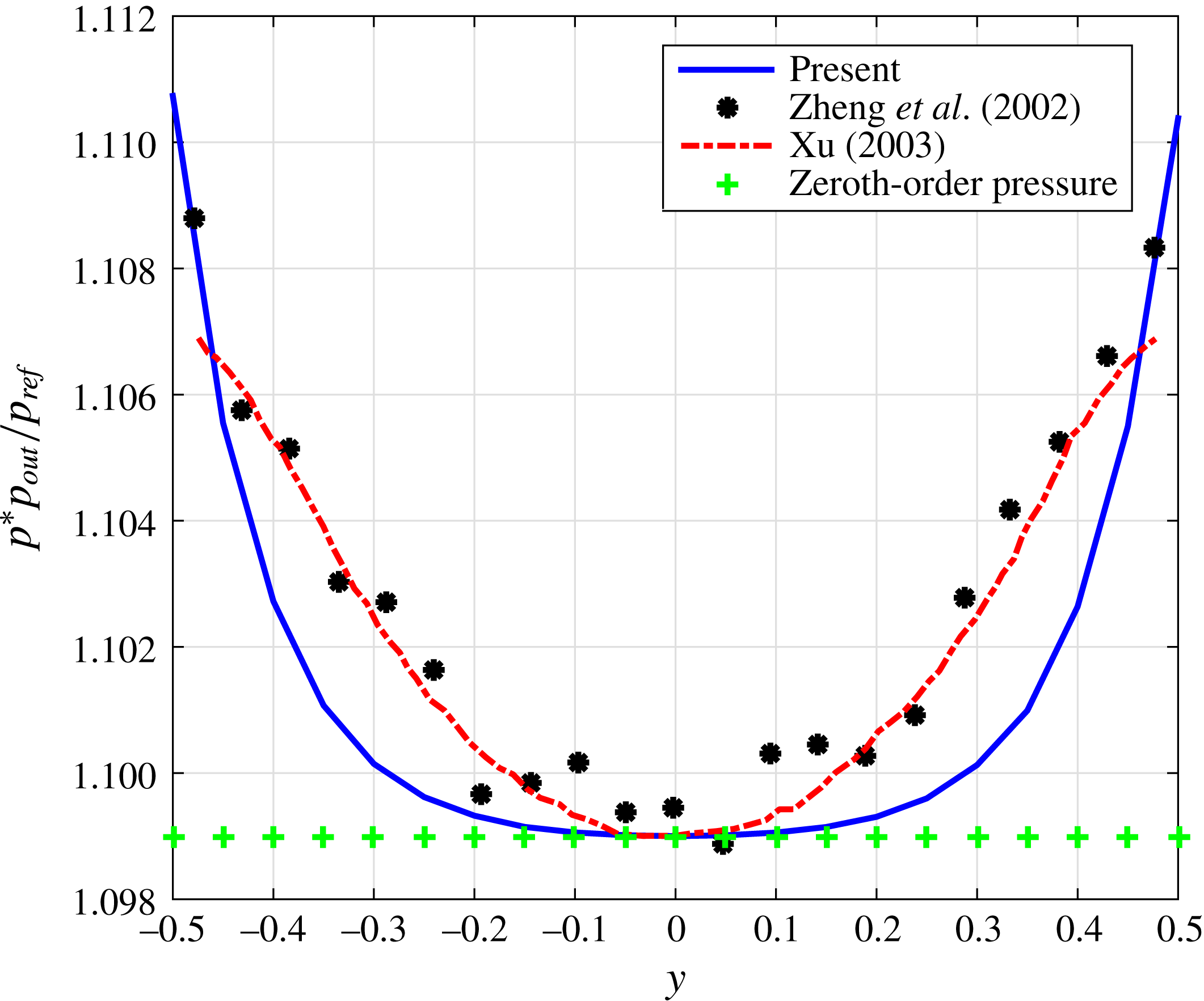
Figure 2 represents the pressure distribution with respect to the wall-normal position at Knudsen number 0.1, where
 $p_{out}=6.05\times 10^{-4}$
, as taken by Zheng et al. (Reference Zheng, Garcia and Alder2002) in order to match the solutions. Zheng et al. (Reference Zheng, Garcia and Alder2002) and Xu (Reference Xu2003) have performed DSMC numerical simulations in long microchannels and compared the DSMC solution against the solution of super-Burnett equations and the BGK–Burnett equations. The present calculations have been performed using the values of the parameters as defined in Xu (Reference Xu2003) and Xu & Li (Reference Xu and Li2004). The curvature of the pressure field has been extracted from the pressure versus
 $y$
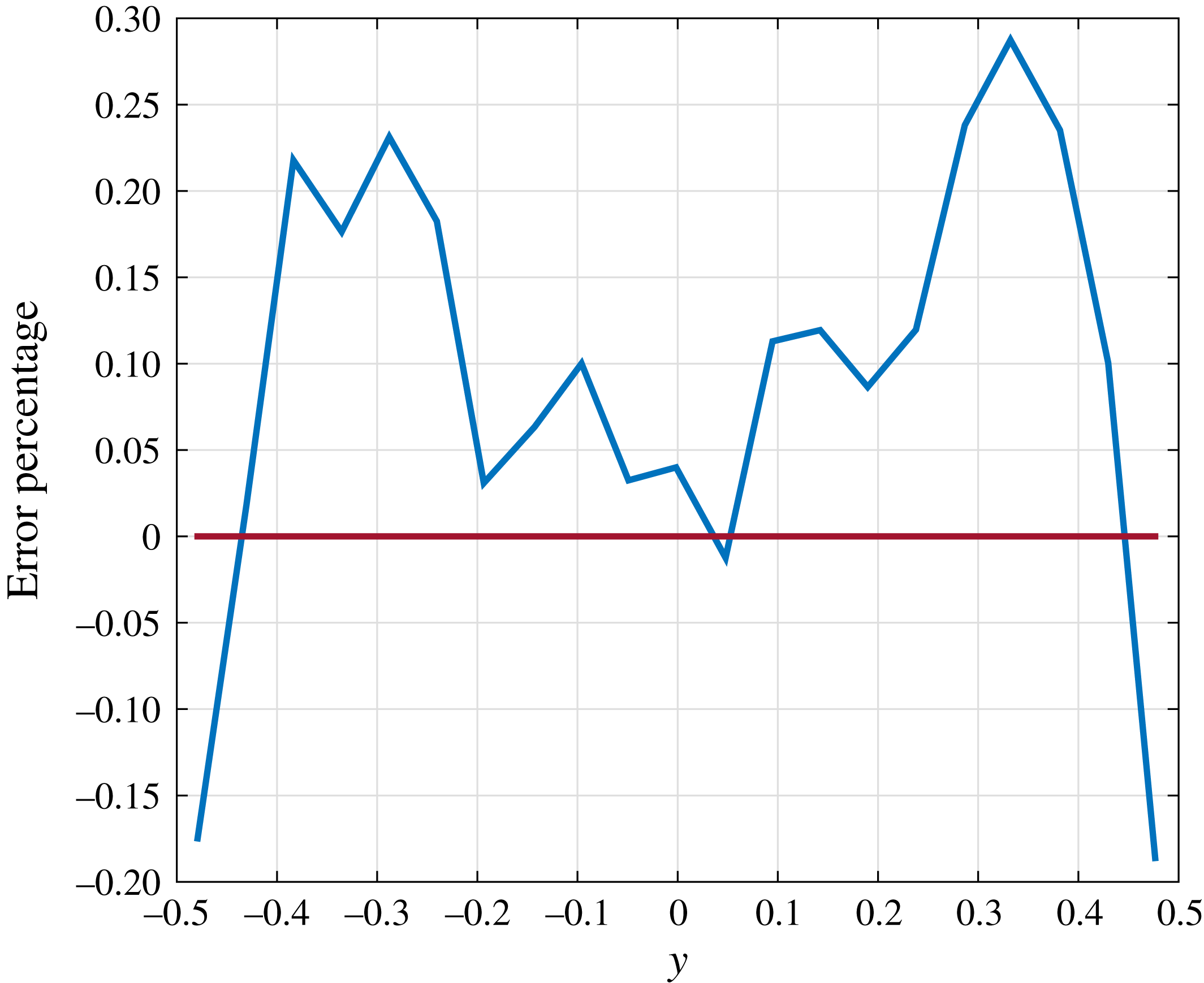
graph obtained in Xu (Reference Xu2003). Figure 2 delineates the comparison with the previous numerical results, showing good agreement. In order to quantify the difference, the deviation is calculated as
 $(p^{pred}-p^{DSMC})/p^{DSMC}\times 100$
where
 $p^{pred}$
is the value obtained from the present approach and
 $p^{DSMC}$
is the value obtained from DSMC. Figure 3 shows the error plot for pressure. The error is found to be less than 0.29 %.
Pressure distribution in a long microchannel with respect to the wall-normal position. The Knudsen number is taken to be 0.1.

Error in the pressure distribution between the DSMC and the obtained pressure with respect to the wall-normal position.

The present analytical solution is valid for flows with very low Mach number (of the order of
 $\unicode[STIX]{x1D700}$
) and very low Reynolds number. Previous reported results by Xu (Reference Xu2003) and Xu & Li (Reference Xu and Li2004) use values of
 $Ma=1.0989$
and
 $Re=17.7$
in their simulations. The discrepancy of the present results with respect to the results of Xu (Reference Xu2003) could be due to the presence of higher values of Reynolds number and Mach number employed in the DSMC calculation.
The other reason for the discrepancy observed could be the result of our choice of boundary conditions in the transverse direction. A simple analytical model with second-order slip boundary conditions for a normalized Poiseuille number has been used to model microchannel flow by Singh et al. (Reference Singh, Dongari and Agrawal2014a ). This model can be used to predict the mass flow rate and pressure distribution of a gaseous flow. The development of this model is simpler when compared to molecular simulations or solutions of the Boltzmann equation. The appropriate second-order slip coefficients include the contribution of the Knudsen layer in order to obtain the complete solution of the Boltzmann equation for a given Poiseuille number, mass flow rate and pressure distribution. It has been shown analytically that the Knudsen minimum can be predicted with the second-order model and the value of the Knudsen minimum depends on the inlet and outlet pressure ratio. However our solution involves the Burnett equations which include the second-order stress tensor terms which require appropriate boundary conditions of the form mentioned in this paper.
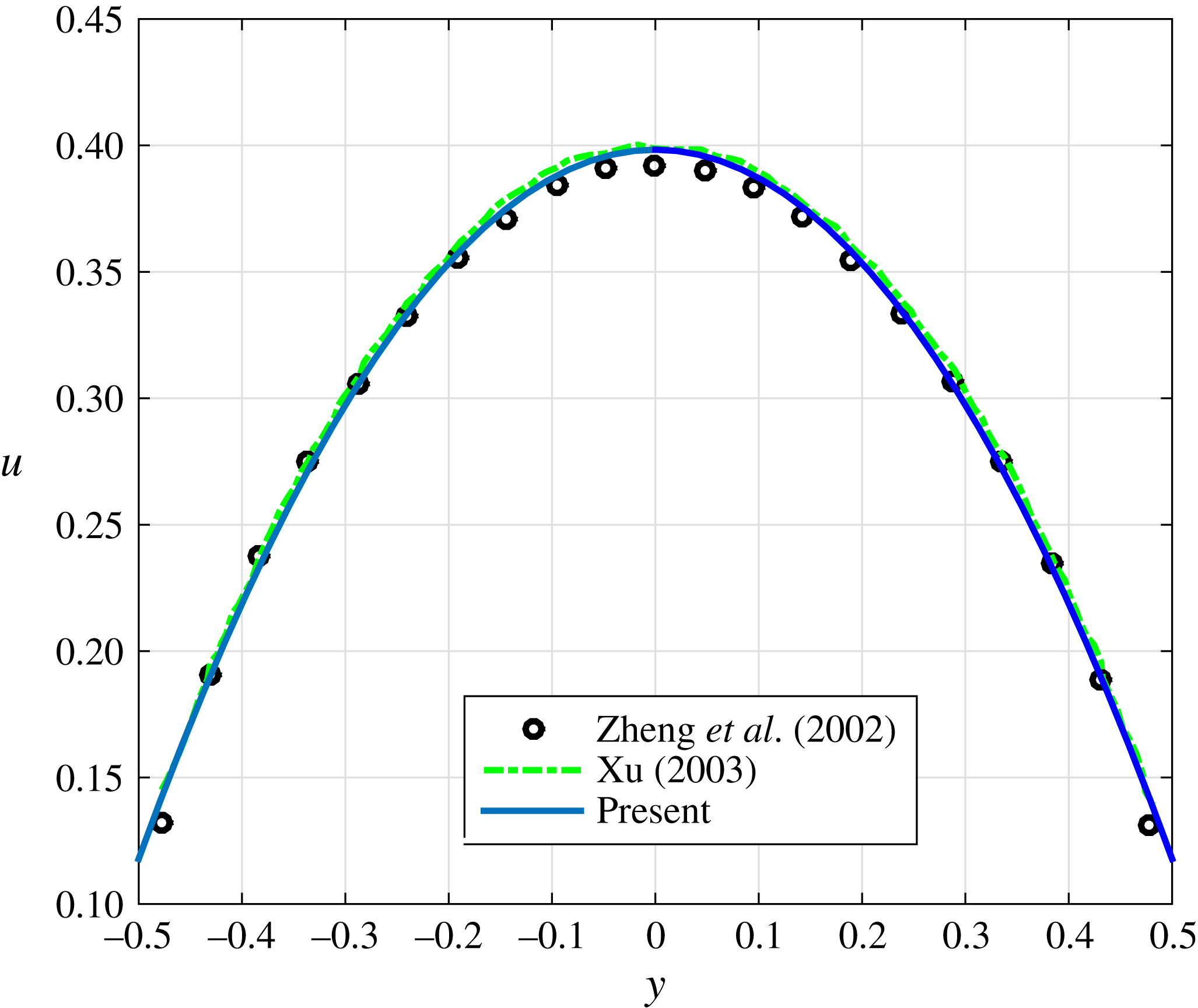
Flow distribution in the cross-stream direction;
 $u$
is the streamwise velocity and
 $y$
is the wall thickness direction, all non-dimensionalized. The Knudsen number is taken to be 0.1.

Figure 4 compares the lateral variation of streamwise velocity in the microchannel as obtained from the present approach against that of Arkilic et al. (Reference Arkilic, Schmidt and Breuer1997) and Xu (Reference Xu2003). The velocity appears to be parabolic, that is, the effect of the correction on the profile is minimal. Thus, we obtain a satisfactory solution for the streamwise velocity.
5 Conclusion
In this work, we have solved the momentum equations for a long microchannel with higher-order stress terms of the conventional Burnett equations. The momentum equation in the cross-stream direction is solved using perturbation analysis around the classical Navier–Stokes equations solution obtained previously in Arkilic et al. (Reference Arkilic, Schmidt and Breuer1997). The complete pressure field is obtained by applying appropriate boundary conditions from DSMC data. It is found that the pressure distribution depends upon both the streamwise position and the wall-normal position. The velocity field has also been obtained by substituting the pressure into the
 $x$
-momentum equation. It is found that the velocity distribution also matches the DSMC results obtained previously. A validation has been done with the results obtained in Zheng et al. (Reference Zheng, Garcia and Alder2002) and Xu (Reference Xu2003).
There are not too many examples where an analytical solution of the Burnett equations has been obtained. In fact, the first analytical solution of the Burnett equations for any configuration was derived recently by Singh et al. (Reference Singh, Dongari and Agrawal2014a ). This work presents the first perturbation-based solution of the Burnett equations. The work shows the possibility of applying perturbation analysis to other problems as well.
Acknowledgement
This work was done as a part of Department of Atomic Energy (DAE-SRC) outstanding Investigator Award project.
Appendix
The expression for momentum balance in the
 $x$
-direction after non-dimensionalization can be written as
 $$\begin{eqnarray}\displaystyle & & \displaystyle -Re\,p^{\prime }\left(v^{\prime }\frac{\unicode[STIX]{x2202}u^{\prime }}{\unicode[STIX]{x2202}y^{\prime }}+u^{\prime }\unicode[STIX]{x1D700}\frac{\unicode[STIX]{x2202}u^{\prime }}{\unicode[STIX]{x2202}x^{\prime }}\right)=\frac{Re\,\unicode[STIX]{x1D700}}{Ma^{2}\unicode[STIX]{x1D6FE}}\frac{\unicode[STIX]{x2202}p^{\prime }}{\unicode[STIX]{x2202}x^{\prime }}-\unicode[STIX]{x1D700}^{2}\frac{\unicode[STIX]{x2202}^{2}u^{\prime }}{\unicode[STIX]{x2202}x^{\prime 2}}-\frac{\unicode[STIX]{x2202}^{2}u^{\prime }}{\unicode[STIX]{x2202}y^{\prime 2}}-\frac{1}{3}\left(\unicode[STIX]{x1D700}\frac{\unicode[STIX]{x2202}^{2}v^{\prime }}{\unicode[STIX]{x2202}y^{\prime }\unicode[STIX]{x2202}x^{\prime }}+\unicode[STIX]{x1D700}^{2}\frac{\unicode[STIX]{x2202}^{2}u^{\prime }}{\unicode[STIX]{x2202}x^{\prime 2}}\right)\nonumber\\ \displaystyle & & \displaystyle \quad -\,\frac{1}{3}\frac{Ma^{2}\unicode[STIX]{x1D6FE}k_{2}\unicode[STIX]{x1D700}}{Re(p^{\prime })^{2}}\frac{\unicode[STIX]{x2202}p^{\prime }}{\unicode[STIX]{x2202}x^{\prime }}\left(\frac{\unicode[STIX]{x2202}u^{\prime }}{\unicode[STIX]{x2202}y^{\prime }}\right)^{2}-\frac{1}{6}\frac{Ma^{2}\unicode[STIX]{x1D6FE}k_{1}\unicode[STIX]{x1D700}}{Re\,p^{\prime }}\frac{\unicode[STIX]{x2202}v^{\prime }}{\unicode[STIX]{x2202}y^{\prime }}\frac{\unicode[STIX]{x2202}^{2}v^{\prime }}{\unicode[STIX]{x2202}y^{\prime }\unicode[STIX]{x2202}x^{\prime }}+\frac{1}{2}\frac{Ma^{2}\unicode[STIX]{x1D6FE}k_{1}}{Re\,p^{\prime }}\frac{\unicode[STIX]{x2202}^{2}v^{\prime }}{\unicode[STIX]{x2202}y^{\prime 2}}\frac{\unicode[STIX]{x2202}u^{\prime }}{\unicode[STIX]{x2202}y^{\prime }}\nonumber\\ \displaystyle & & \displaystyle \quad +\,\frac{1}{2}\frac{Ma^{2}\unicode[STIX]{x1D6FE}k_{1}}{Re\,p^{\prime }}\frac{\unicode[STIX]{x2202}v^{\prime }}{\unicode[STIX]{x2202}y^{\prime }}\frac{\unicode[STIX]{x2202}^{2}u^{\prime }}{\unicode[STIX]{x2202}y^{\prime 2}}-\frac{2}{3}\frac{\unicode[STIX]{x1D700}^{3}k_{2}}{Re\,p^{\prime 2}}\frac{\unicode[STIX]{x2202}^{3}p^{\prime }}{\unicode[STIX]{x2202}x^{\prime 3}}-\frac{2}{3}\frac{Ma^{2}\unicode[STIX]{x1D6FE}k_{2}}{Re\,p^{\prime }}\frac{\unicode[STIX]{x2202}^{2}v^{\prime }}{\unicode[STIX]{x2202}y^{\prime 2}}\frac{\unicode[STIX]{x2202}u^{\prime }}{\unicode[STIX]{x2202}y^{\prime }}-\frac{2}{3}\frac{Ma^{2}\unicode[STIX]{x1D6FE}k_{2}}{Re\,p^{\prime }}\frac{\unicode[STIX]{x2202}v^{\prime }}{\unicode[STIX]{x2202}y^{\prime }}\frac{\unicode[STIX]{x2202}^{2}u^{\prime }}{\unicode[STIX]{x2202}y^{\prime 2}}\nonumber\\ \displaystyle & & \displaystyle \quad +\,\frac{1}{2}\frac{Ma^{2}\unicode[STIX]{x1D6FE}k_{6}}{Re\,p^{\prime }}\frac{\unicode[STIX]{x2202}^{2}v^{\prime }}{\unicode[STIX]{x2202}y^{\prime 2}}\frac{\unicode[STIX]{x2202}u^{\prime }}{\unicode[STIX]{x2202}y^{\prime }}+\frac{1}{2}\frac{Ma^{2}\unicode[STIX]{x1D6FE}k_{6}\unicode[STIX]{x1D700}}{Re\,p^{\prime }}\frac{\unicode[STIX]{x2202}u^{\prime }}{\unicode[STIX]{x2202}x^{\prime }}\frac{\unicode[STIX]{x2202}^{2}u^{\prime }}{\unicode[STIX]{x2202}y^{\prime 2}}-\frac{2\unicode[STIX]{x1D700}^{3}k_{2}}{Re\,{p^{\prime }}^{4}}\left(\frac{\unicode[STIX]{x2202}p^{\prime }}{\unicode[STIX]{x2202}x^{\prime }}\right)^{3}\nonumber\\ \displaystyle & & \displaystyle \quad +\,\frac{1}{2}\frac{Ma^{2}\unicode[STIX]{x1D6FE}\unicode[STIX]{x1D700}^{2}k_{6}}{Re\,p^{\prime }}\frac{\unicode[STIX]{x2202}u^{\prime }}{\unicode[STIX]{x2202}x^{\prime }}\frac{\unicode[STIX]{x2202}^{2}v^{\prime }}{\unicode[STIX]{x2202}y^{\prime }\unicode[STIX]{x2202}x^{\prime }}+\frac{1}{2}\frac{Ma^{2}\unicode[STIX]{x1D6FE}\unicode[STIX]{x1D700}^{2}k_{1}}{Re\,p^{\prime }}\frac{\unicode[STIX]{x2202}v^{\prime }}{\unicode[STIX]{x2202}x^{\prime }}\frac{\unicode[STIX]{x2202}^{2}u^{\prime }}{\unicode[STIX]{x2202}y^{\prime }\unicode[STIX]{x2202}x^{\prime }}+\frac{1}{3}\frac{Ma^{2}\unicode[STIX]{x1D6FE}\unicode[STIX]{x1D700}^{2}k_{1}}{Re\,p^{\prime }}\frac{\unicode[STIX]{x2202}^{2}u^{\prime }}{\unicode[STIX]{x2202}x^{\prime 2}}\frac{\unicode[STIX]{x2202}v^{\prime }}{\unicode[STIX]{x2202}y^{\prime }}\nonumber\\ \displaystyle & & \displaystyle \quad -\,\frac{2}{3}\frac{Ma^{2}\unicode[STIX]{x1D6FE}\unicode[STIX]{x1D700}^{2}k_{2}}{Re\,p^{\prime }}\frac{\unicode[STIX]{x2202}^{2}v^{\prime }}{\unicode[STIX]{x2202}x^{\prime 2}}\frac{\unicode[STIX]{x2202}u^{\prime }}{\unicode[STIX]{x2202}y^{\prime }}-\frac{4}{3}\frac{Ma^{2}\unicode[STIX]{x1D6FE}\unicode[STIX]{x1D700}^{2}k_{2}}{Re\,p^{\prime }}\frac{\unicode[STIX]{x2202}v^{\prime }}{\unicode[STIX]{x2202}x^{\prime }}\frac{\unicode[STIX]{x2202}^{2}u^{\prime }}{\unicode[STIX]{x2202}y^{\prime }\unicode[STIX]{x2202}x^{\prime }}+\frac{2}{9}\frac{Ma^{2}\unicode[STIX]{x1D6FE}\unicode[STIX]{x1D700}^{2}k_{2}}{Re\,p^{\prime }}\frac{\unicode[STIX]{x2202}^{2}u^{\prime }}{\unicode[STIX]{x2202}x^{\prime 2}}\frac{\unicode[STIX]{x2202}v^{\prime }}{\unicode[STIX]{x2202}y^{\prime }}\nonumber\\ \displaystyle & & \displaystyle \quad +\,\frac{10}{9}\frac{Ma^{2}\unicode[STIX]{x1D6FE}\unicode[STIX]{x1D700}^{3}k_{6}}{Re\,p^{\prime }}\frac{\unicode[STIX]{x2202}u^{\prime }}{\unicode[STIX]{x2202}x^{\prime }}\frac{\unicode[STIX]{x2202}^{2}u^{\prime }}{\unicode[STIX]{x2202}x^{\prime 2}}-\frac{8}{3}\frac{Ma^{2}\unicode[STIX]{x1D6FE}\unicode[STIX]{x1D700}^{3}k_{2}}{Re\,p^{\prime }}\frac{\unicode[STIX]{x2202}u^{\prime }}{\unicode[STIX]{x2202}x^{\prime }}\frac{\unicode[STIX]{x2202}^{2}v^{\prime }}{\unicode[STIX]{x2202}x^{\prime 2}}-\frac{2}{3}\frac{Ma^{2}\unicode[STIX]{x1D6FE}\unicode[STIX]{x1D700}^{3}k_{1}}{Re(p^{\prime })^{2}}\frac{\unicode[STIX]{x2202}p^{\prime }}{\unicode[STIX]{x2202}x^{\prime }}\frac{\unicode[STIX]{x2202}u^{\prime }}{\unicode[STIX]{x2202}x^{\prime }}^{2}\nonumber\\ \displaystyle & & \displaystyle \quad +\,\frac{14}{9}\frac{Ma^{2}\unicode[STIX]{x1D6FE}\unicode[STIX]{x1D700}^{3}k_{2}}{Re(p^{\prime })^{2}}\frac{\unicode[STIX]{x2202}p^{\prime }}{\unicode[STIX]{x2202}x^{\prime }}\frac{\unicode[STIX]{x2202}u^{\prime }}{\unicode[STIX]{x2202}x^{\prime }}^{2}-\frac{5}{9}\frac{Ma^{2}\unicode[STIX]{x1D6FE}\unicode[STIX]{x1D700}^{3}k_{6}}{Re(p^{\prime })^{2}}\frac{\unicode[STIX]{x2202}p^{\prime }}{\unicode[STIX]{x2202}x^{\prime }}\frac{\unicode[STIX]{x2202}u^{\prime }}{\unicode[STIX]{x2202}x^{\prime }}^{2}+\frac{4}{3}\frac{Ma^{2}\unicode[STIX]{x1D6FE}\unicode[STIX]{x1D700}^{3}k_{2}}{Re(p^{\prime })^{2}}\frac{\unicode[STIX]{x2202}p^{\prime }}{\unicode[STIX]{x2202}x^{\prime }}\left(\frac{\unicode[STIX]{x2202}v^{\prime }}{\unicode[STIX]{x2202}x^{\prime }}\right)^{2}\nonumber\\ \displaystyle & & \displaystyle \quad +\,\frac{2}{3}\frac{Ma^{2}\unicode[STIX]{x1D6FE}k_{2}}{Re(p^{\prime })^{2}}\frac{\unicode[STIX]{x2202}p^{\prime }}{\unicode[STIX]{x2202}y^{\prime }}\frac{\unicode[STIX]{x2202}v^{\prime }}{\unicode[STIX]{x2202}y^{\prime }}\frac{\unicode[STIX]{x2202}u^{\prime }}{\unicode[STIX]{x2202}y^{\prime }}-\frac{7}{9}\frac{Ma^{2}\unicode[STIX]{x1D6FE}k_{2}\unicode[STIX]{x1D700}}{Re(p^{\prime })^{2}}\frac{\unicode[STIX]{x2202}p^{\prime }}{\unicode[STIX]{x2202}x^{\prime }}\left(\frac{\unicode[STIX]{x2202}v^{\prime }}{\unicode[STIX]{x2202}y^{\prime }}\right)^{2}+\frac{1}{2}\frac{Ma^{2}\unicode[STIX]{x1D6FE}k_{6}\unicode[STIX]{x1D700}}{Re\,p^{\prime }}\frac{\unicode[STIX]{x2202}u^{\prime }}{\unicode[STIX]{x2202}y^{\prime }}\frac{\unicode[STIX]{x2202}^{2}u^{\prime }}{\unicode[STIX]{x2202}y^{\prime }\unicode[STIX]{x2202}x^{\prime }}\nonumber\\ \displaystyle & & \displaystyle \quad -\,\frac{1}{2}\frac{Ma^{2}\unicode[STIX]{x1D6FE}k_{1}}{Re(p^{\prime })^{2}}\frac{\unicode[STIX]{x2202}p^{\prime }}{\unicode[STIX]{x2202}y^{\prime }}\frac{\unicode[STIX]{x2202}v^{\prime }}{\unicode[STIX]{x2202}y^{\prime }}\frac{\unicode[STIX]{x2202}u^{\prime }}{\unicode[STIX]{x2202}y^{\prime }}-\frac{5}{3}\frac{Ma^{2}\unicode[STIX]{x1D6FE}k_{2}\unicode[STIX]{x1D700}}{Re(p^{\prime })}\frac{\unicode[STIX]{x2202}^{2}v^{\prime }}{\unicode[STIX]{x2202}y^{\prime 2}}\frac{\unicode[STIX]{x2202}v^{\prime }}{\unicode[STIX]{x2202}x^{\prime }}+\frac{1}{2}\frac{Ma^{2}\unicode[STIX]{x1D6FE}k_{1}\unicode[STIX]{x1D700}}{Re(p^{\prime })}\frac{\unicode[STIX]{x2202}^{2}v^{\prime }}{\unicode[STIX]{x2202}y^{\prime 2}}\frac{\unicode[STIX]{x2202}v^{\prime }}{\unicode[STIX]{x2202}x^{\prime }}\nonumber\\ \displaystyle & & \displaystyle \quad +\,\frac{1}{3}\frac{Ma^{2}\unicode[STIX]{x1D6FE}k_{1}\unicode[STIX]{x1D700}}{Re(p^{\prime })^{2}}\frac{\unicode[STIX]{x2202}p^{\prime }}{\unicode[STIX]{x2202}x^{\prime }}\frac{\unicode[STIX]{x2202}v^{\prime }}{\unicode[STIX]{x2202}y^{\prime }}^{2}+\frac{1}{2}\frac{Ma^{2}\unicode[STIX]{x1D6FE}k_{6}\unicode[STIX]{x1D700}}{Re(p^{\prime })}\frac{\unicode[STIX]{x2202}^{2}v^{\prime }}{\unicode[STIX]{x2202}y^{\prime 2}}\frac{\unicode[STIX]{x2202}v^{\prime }}{\unicode[STIX]{x2202}x^{\prime }}-\frac{Ma^{2}\unicode[STIX]{x1D6FE}k_{2}\unicode[STIX]{x1D700}}{Re(p^{\prime })}\frac{\unicode[STIX]{x2202}u^{\prime }}{\unicode[STIX]{x2202}y^{\prime }}\frac{\unicode[STIX]{x2202}^{2}u^{\prime }}{\unicode[STIX]{x2202}y^{\prime }\unicode[STIX]{x2202}x^{\prime }}\nonumber\\ \displaystyle & & \displaystyle \quad -\,\frac{5}{3}\frac{Ma^{2}\unicode[STIX]{x1D6FE}k_{2}\unicode[STIX]{x1D700}}{Re(p^{\prime })}\frac{\unicode[STIX]{x2202}u^{\prime }}{\unicode[STIX]{x2202}x^{\prime }}\frac{\unicode[STIX]{x2202}^{2}u^{\prime }}{\unicode[STIX]{x2202}y^{\prime 2}}-\frac{2}{3}\frac{k_{2}\unicode[STIX]{x1D700}}{Re(p^{\prime })^{2}}\frac{\unicode[STIX]{x2202}^{3}p^{\prime }}{\unicode[STIX]{x2202}y^{\prime 2}\unicode[STIX]{x2202}x^{\prime }}+\frac{1}{2}\frac{Ma^{2}\unicode[STIX]{x1D6FE}k_{1}\unicode[STIX]{x1D700}}{Re\,p^{\prime }}\frac{\unicode[STIX]{x2202}u^{\prime }}{\unicode[STIX]{x2202}y^{\prime }}\frac{\unicode[STIX]{x2202}^{2}u^{\prime }}{\unicode[STIX]{x2202}y^{\prime }\unicode[STIX]{x2202}x^{\prime }}\nonumber\\ \displaystyle & & \displaystyle \quad -\,\frac{1}{9}\frac{Ma^{2}\unicode[STIX]{x1D6FE}k_{2}\unicode[STIX]{x1D700}}{Re\,p^{\prime }}\frac{\unicode[STIX]{x2202}v^{\prime }}{\unicode[STIX]{x2202}y^{\prime }}\frac{\unicode[STIX]{x2202}^{2}v^{\prime }}{\unicode[STIX]{x2202}y^{\prime }\unicode[STIX]{x2202}x^{\prime }}-\frac{7}{18}\frac{Ma^{2}\unicode[STIX]{x1D6FE}k_{6}\unicode[STIX]{x1D700}}{Re\,p^{\prime }}\frac{\unicode[STIX]{x2202}v^{\prime }}{\unicode[STIX]{x2202}y^{\prime }}\frac{\unicode[STIX]{x2202}^{2}v^{\prime }}{\unicode[STIX]{x2202}y^{\prime }\unicode[STIX]{x2202}x^{\prime }}+\frac{4}{9}\frac{Ma^{2}\unicode[STIX]{x1D6FE}k_{6}\unicode[STIX]{x1D700}}{Re(p^{\prime })^{2}}\frac{\unicode[STIX]{x2202}p^{\prime }}{\unicode[STIX]{x2202}x^{\prime }}\left(\frac{\unicode[STIX]{x2202}v^{\prime }}{\unicode[STIX]{x2202}y^{\prime }}\right)^{2}\nonumber\\ \displaystyle & & \displaystyle \quad +\,\frac{1}{2}\frac{Ma^{2}\unicode[STIX]{x1D6FE}k_{1}\unicode[STIX]{x1D700}}{Re(p^{\prime })}\frac{\unicode[STIX]{x2202}u^{\prime }}{\unicode[STIX]{x2202}x^{\prime }}\frac{\unicode[STIX]{x2202}^{2}u^{\prime }}{\unicode[STIX]{x2202}y^{\prime 2}}-\frac{1}{2}\frac{Ma^{2}\unicode[STIX]{x1D6FE}k_{6}}{Re(p^{\prime })^{2}}\frac{\unicode[STIX]{x2202}p^{\prime }}{\unicode[STIX]{x2202}y^{\prime }}\frac{\unicode[STIX]{x2202}v^{\prime }}{\unicode[STIX]{x2202}y^{\prime }}\frac{\unicode[STIX]{x2202}u^{\prime }}{\unicode[STIX]{x2202}y^{\prime }}-2\frac{k_{2}\unicode[STIX]{x1D700}}{Re(p^{\prime })^{4}}\left(\frac{\unicode[STIX]{x2202}p^{\prime }}{\unicode[STIX]{x2202}y^{\prime }}\right)^{2}\frac{\unicode[STIX]{x2202}p^{\prime }}{\unicode[STIX]{x2202}x^{\prime }}\nonumber\\ \displaystyle & & \displaystyle \quad +\,\frac{7}{3}\frac{k_{2}\unicode[STIX]{x1D700}}{Re(p^{\prime })^{3}}\frac{\unicode[STIX]{x2202}p^{\prime }}{\unicode[STIX]{x2202}y^{\prime }}\frac{\unicode[STIX]{x2202}^{2}p^{\prime }}{\unicode[STIX]{x2202}y^{\prime }\unicode[STIX]{x2202}x^{\prime }}+\frac{1}{3}\frac{k_{2}\unicode[STIX]{x1D700}}{Re(p^{\prime })^{3}}\frac{\unicode[STIX]{x2202}^{2}p^{\prime }}{\unicode[STIX]{x2202}y^{\prime }\unicode[STIX]{x2202}x^{\prime }}\frac{\unicode[STIX]{x2202}^{2}p^{\prime }}{\unicode[STIX]{x2202}y^{\prime 2}}+\frac{8}{3}\frac{\unicode[STIX]{x1D700}^{3}k_{2}}{Re(p^{\prime })^{3}}\frac{\unicode[STIX]{x2202}p^{\prime }}{\unicode[STIX]{x2202}x^{\prime }}\frac{\unicode[STIX]{x2202}^{2}p^{\prime }}{\unicode[STIX]{x2202}x^{\prime 2}}\nonumber\\ \displaystyle & & \displaystyle \quad -\,\frac{1}{2}\frac{Ma^{2}\unicode[STIX]{x1D6FE}k_{1}\unicode[STIX]{x1D700}}{Re(p^{\prime })^{2}}\frac{\unicode[STIX]{x2202}p^{\prime }}{\unicode[STIX]{x2202}y^{\prime }}\frac{\unicode[STIX]{x2202}v^{\prime }}{\unicode[STIX]{x2202}y^{\prime }}\frac{\unicode[STIX]{x2202}v^{\prime }}{\unicode[STIX]{x2202}x^{\prime }}-\frac{1}{2}\frac{Ma^{2}\unicode[STIX]{x1D6FE}k_{1}\unicode[STIX]{x1D700}}{Re(p^{\prime })^{2}}\frac{\unicode[STIX]{x2202}p^{\prime }}{\unicode[STIX]{x2202}y^{\prime }}\frac{\unicode[STIX]{x2202}u^{\prime }}{\unicode[STIX]{x2202}x^{\prime }}\frac{\unicode[STIX]{x2202}u^{\prime }}{\unicode[STIX]{x2202}y^{\prime }}+\frac{5}{3}\frac{Ma^{2}\unicode[STIX]{x1D6FE}k_{2}\unicode[STIX]{x1D700}}{Re(p^{\prime })^{2}}\frac{\unicode[STIX]{x2202}p^{\prime }}{\unicode[STIX]{x2202}y^{\prime }}\frac{\unicode[STIX]{x2202}u^{\prime }}{\unicode[STIX]{x2202}x^{\prime }}\frac{\unicode[STIX]{x2202}u^{\prime }}{\unicode[STIX]{x2202}y^{\prime }}\nonumber\\ \displaystyle & & \displaystyle \quad +\,\frac{5}{3}\frac{Ma^{2}\unicode[STIX]{x1D6FE}k_{2}\unicode[STIX]{x1D700}}{Re(p^{\prime })^{2}}\frac{\unicode[STIX]{x2202}p^{\prime }}{\unicode[STIX]{x2202}y^{\prime }}\frac{\unicode[STIX]{x2202}v^{\prime }}{\unicode[STIX]{x2202}y^{\prime }}\frac{\unicode[STIX]{x2202}v^{\prime }}{\unicode[STIX]{x2202}x^{\prime }}-\frac{1}{2}\frac{Ma^{2}\unicode[STIX]{x1D6FE}k_{6}\unicode[STIX]{x1D700}}{Re(p^{\prime })^{2}}\frac{\unicode[STIX]{x2202}p^{\prime }}{\unicode[STIX]{x2202}y^{\prime }}\frac{\unicode[STIX]{x2202}u^{\prime }}{\unicode[STIX]{x2202}x^{\prime }}\frac{\unicode[STIX]{x2202}u^{\prime }}{\unicode[STIX]{x2202}y^{\prime }}-\frac{1}{2}\frac{Ma^{2}\unicode[STIX]{x1D6FE}k_{6}\unicode[STIX]{x1D700}}{Re(p^{\prime })^{2}}\frac{\unicode[STIX]{x2202}p^{\prime }}{\unicode[STIX]{x2202}y^{\prime }}\frac{\unicode[STIX]{x2202}v^{\prime }}{\unicode[STIX]{x2202}y^{\prime }}\frac{\unicode[STIX]{x2202}v^{\prime }}{\unicode[STIX]{x2202}x^{\prime }}\nonumber\\ \displaystyle & & \displaystyle \quad +\,\frac{2}{3}\frac{Ma^{2}\unicode[STIX]{x1D6FE}\unicode[STIX]{x1D700}^{2}k_{2}}{Re(p^{\prime })^{2}}\frac{\unicode[STIX]{x2202}p^{\prime }}{\unicode[STIX]{x2202}y^{\prime }}\frac{\unicode[STIX]{x2202}u^{\prime }}{\unicode[STIX]{x2202}x^{\prime }}\frac{\unicode[STIX]{x2202}v^{\prime }}{\unicode[STIX]{x2202}x^{\prime }}-\frac{1}{2}\frac{Ma^{2}\unicode[STIX]{x1D6FE}\unicode[STIX]{x1D700}^{2}k_{6}}{Re(p^{\prime })^{2}}\frac{\unicode[STIX]{x2202}p^{\prime }}{\unicode[STIX]{x2202}y^{\prime }}\frac{\unicode[STIX]{x2202}v^{\prime }}{\unicode[STIX]{x2202}x^{\prime }}+\frac{2}{3}\frac{Ma^{2}\unicode[STIX]{x1D6FE}\unicode[STIX]{x1D700}^{2}k_{2}}{Re(p^{\prime })^{2}}\frac{\unicode[STIX]{x2202}p^{\prime }}{\unicode[STIX]{x2202}x^{\prime }}\frac{\unicode[STIX]{x2202}v^{\prime }}{\unicode[STIX]{x2202}x^{\prime }}\frac{\unicode[STIX]{x2202}u^{\prime }}{\unicode[STIX]{x2202}y^{\prime }}\nonumber\\ \displaystyle & & \displaystyle \quad -\,\frac{2}{9}\frac{Ma^{2}\unicode[STIX]{x1D6FE}\unicode[STIX]{x1D700}^{2}k_{2}}{Re(p^{\prime })^{2}}\frac{\unicode[STIX]{x2202}p^{\prime }}{\unicode[STIX]{x2202}x^{\prime }}\frac{\unicode[STIX]{x2202}u^{\prime }}{\unicode[STIX]{x2202}x^{\prime }}\frac{\unicode[STIX]{x2202}v^{\prime }}{\unicode[STIX]{x2202}y^{\prime }}-\frac{1}{9}\frac{Ma^{2}\unicode[STIX]{x1D6FE}\unicode[STIX]{x1D700}^{2}k_{6}}{Re(p^{\prime })^{2}}\frac{\unicode[STIX]{x2202}p^{\prime }}{\unicode[STIX]{x2202}x^{\prime }}\frac{\unicode[STIX]{x2202}v^{\prime }}{\unicode[STIX]{x2202}x^{\prime }}\frac{\unicode[STIX]{x2202}u^{\prime }}{\unicode[STIX]{x2202}y^{\prime }}-\frac{1}{2}\frac{Ma^{2}\unicode[STIX]{x1D6FE}\unicode[STIX]{x1D700}^{2}k_{1}}{Re(p^{\prime })^{2}}\frac{\unicode[STIX]{x2202}p^{\prime }}{\unicode[STIX]{x2202}y^{\prime }}\frac{\unicode[STIX]{x2202}u^{\prime }}{\unicode[STIX]{x2202}x^{\prime }}\frac{\unicode[STIX]{x2202}v^{\prime }}{\unicode[STIX]{x2202}x^{\prime }}\nonumber\\ \displaystyle & & \displaystyle \quad -\,\frac{1}{3}\frac{Ma^{2}\unicode[STIX]{x1D6FE}\unicode[STIX]{x1D700}^{2}k_{1}}{Re(p^{\prime })^{2}}\frac{\unicode[STIX]{x2202}p^{\prime }}{\unicode[STIX]{x2202}x^{\prime }}\frac{\unicode[STIX]{x2202}u^{\prime }}{\unicode[STIX]{x2202}x^{\prime }}\frac{\unicode[STIX]{x2202}v^{\prime }}{\unicode[STIX]{x2202}y^{\prime }}+\frac{1}{2}\frac{Ma^{2}\unicode[STIX]{x1D6FE}k_{6}}{Re\,p^{\prime }}\frac{\unicode[STIX]{x2202}v^{\prime }}{\unicode[STIX]{x2202}y^{\prime }}\frac{\unicode[STIX]{x2202}^{2}u^{\prime }}{\unicode[STIX]{x2202}y^{\prime 2}}.\end{eqnarray}$$
Similarly, the momentum balance in the
 $y$
-direction after non-dimensionalization can be written as
 $$\begin{eqnarray}\displaystyle & & \displaystyle -Re\,p^{\prime }\left(u^{\prime }\unicode[STIX]{x1D700}\frac{\unicode[STIX]{x2202}v^{\prime }}{\unicode[STIX]{x2202}x^{\prime }}+v^{\prime }\frac{\unicode[STIX]{x2202}v^{\prime }}{\unicode[STIX]{x2202}y^{\prime }}\right)=-\unicode[STIX]{x1D700}^{2}\frac{\unicode[STIX]{x2202}^{2}v^{\prime }}{\unicode[STIX]{x2202}x^{\prime 2}}-\frac{4}{3}\frac{\unicode[STIX]{x2202}^{2}v^{\prime }}{\unicode[STIX]{x2202}y^{\prime 2}}-\frac{1}{3}\unicode[STIX]{x1D700}\frac{\unicode[STIX]{x2202}^{2}u^{\prime }}{\unicode[STIX]{x2202}y^{\prime }\unicode[STIX]{x2202}x^{\prime }}+\frac{Re}{Ma^{2}\unicode[STIX]{x1D6FE}}\frac{\unicode[STIX]{x2202}p^{\prime }}{\unicode[STIX]{x2202}y^{\prime }}\nonumber\\ \displaystyle & & \displaystyle \quad -\,\frac{7Ma^{2}\unicode[STIX]{x1D6FE}\unicode[STIX]{x1D700}^{2}k_{6}}{18Re\,p^{\prime }}\frac{\unicode[STIX]{x2202}u^{\prime }}{\unicode[STIX]{x2202}x^{\prime }}\frac{\unicode[STIX]{x2202}^{2}u^{\prime }}{\unicode[STIX]{x2202}y^{\prime }\unicode[STIX]{x2202}x^{\prime }}+\frac{1}{2}\frac{Ma^{2}\unicode[STIX]{x1D6FE}\unicode[STIX]{x1D700}^{3}k_{1}}{Re\,p^{\prime }}\frac{\unicode[STIX]{x2202}^{2}u^{\prime }}{\unicode[STIX]{x2202}x^{\prime 2}}\frac{\unicode[STIX]{x2202}v^{\prime }}{\unicode[STIX]{x2202}x^{\prime }}-\frac{2}{3}\frac{Ma^{2}\unicode[STIX]{x1D6FE}\unicode[STIX]{x1D700}^{3}k_{2}}{Re\,p^{\prime }}\frac{\unicode[STIX]{x2202}^{2}u^{\prime }}{\unicode[STIX]{x2202}x^{\prime 2}}\frac{\unicode[STIX]{x2202}v^{\prime }}{\unicode[STIX]{x2202}x^{\prime }}\nonumber\\ \displaystyle & & \displaystyle \quad +\,\frac{1}{2}\frac{Ma^{2}\unicode[STIX]{x1D6FE}\unicode[STIX]{x1D700}^{3}k_{6}}{Re\,p^{\prime }}\frac{\unicode[STIX]{x2202}^{2}u^{\prime }}{\unicode[STIX]{x2202}x^{\prime 2}}\frac{\unicode[STIX]{x2202}v^{\prime }}{\unicode[STIX]{x2202}x^{\prime }}+\frac{1}{2}\frac{Ma^{2}\unicode[STIX]{x1D6FE}\unicode[STIX]{x1D700}^{3}k_{1}}{Re\,p^{\prime }}\frac{\unicode[STIX]{x2202}^{2}v^{\prime }}{\unicode[STIX]{x2202}x^{\prime 2}}\frac{\unicode[STIX]{x2202}u^{\prime }}{\unicode[STIX]{x2202}x^{\prime }}-\frac{2}{3}\frac{Ma^{2}\unicode[STIX]{x1D6FE}\unicode[STIX]{x1D700}^{3}k_{2}}{Re\,p^{\prime }}\frac{\unicode[STIX]{x2202}^{2}v^{\prime }}{\unicode[STIX]{x2202}x^{\prime 2}}\frac{\unicode[STIX]{x2202}u^{\prime }}{\unicode[STIX]{x2202}x^{\prime }}\nonumber\\ \displaystyle & & \displaystyle \quad +\,\frac{1}{2}\frac{Ma^{2}\unicode[STIX]{x1D6FE}\unicode[STIX]{x1D700}^{3}k_{6}}{Re\,p^{\prime }}\frac{\unicode[STIX]{x2202}^{2}v^{\prime }}{\unicode[STIX]{x2202}x^{\prime 2}}\frac{\unicode[STIX]{x2202}u^{\prime }}{\unicode[STIX]{x2202}x^{\prime }}+\frac{1}{2}\frac{Ma^{2}\unicode[STIX]{x1D6FE}k_{6}\unicode[STIX]{x1D700}}{Re\,p^{\prime }}\frac{\unicode[STIX]{x2202}v^{\prime }}{\unicode[STIX]{x2202}y^{\prime }}\frac{\unicode[STIX]{x2202}^{2}u^{\prime }}{\unicode[STIX]{x2202}y^{\prime }\unicode[STIX]{x2202}x^{\prime }}-\frac{4}{9}\frac{Ma^{2}\unicode[STIX]{x1D6FE}k_{2}\unicode[STIX]{x1D700}}{Re\,p^{\prime }}\frac{\unicode[STIX]{x2202}v^{\prime }}{\unicode[STIX]{x2202}y^{\prime }}\frac{\unicode[STIX]{x2202}^{2}u^{\prime }}{\unicode[STIX]{x2202}y^{\prime }\unicode[STIX]{x2202}x^{\prime }}\nonumber\\ \displaystyle & & \displaystyle \quad +\,\frac{1}{9}\frac{Ma^{2}\unicode[STIX]{x1D6FE}k_{6}\unicode[STIX]{x1D700}}{Re\,p^{\prime }}\frac{\unicode[STIX]{x2202}^{2}u^{\prime }}{\unicode[STIX]{x2202}y^{\prime 2}}\frac{\unicode[STIX]{x2202}v^{\prime }}{\unicode[STIX]{x2202}x^{\prime }}+\frac{5}{6}\frac{Ma^{2}\unicode[STIX]{x1D6FE}k_{1}\unicode[STIX]{x1D700}}{Re\,p^{\prime }}\frac{\unicode[STIX]{x2202}v^{\prime }}{\unicode[STIX]{x2202}y^{\prime }}\frac{\unicode[STIX]{x2202}^{2}u^{\prime }}{\unicode[STIX]{x2202}y^{\prime }\unicode[STIX]{x2202}x^{\prime }}-\frac{2}{3}\frac{Ma^{2}\unicode[STIX]{x1D6FE}k_{2}\unicode[STIX]{x1D700}}{Re\,p^{\prime }}\frac{\unicode[STIX]{x2202}^{2}u^{\prime }}{\unicode[STIX]{x2202}y^{\prime 2}}\frac{\unicode[STIX]{x2202}v^{\prime }}{\unicode[STIX]{x2202}x^{\prime }}\nonumber\\ \displaystyle & & \displaystyle \quad +\,\frac{1}{2}\frac{Ma^{2}\unicode[STIX]{x1D6FE}\unicode[STIX]{x1D700}^{2}k_{6}}{Re\,p^{\prime }}\frac{\unicode[STIX]{x2202}v^{\prime }}{\unicode[STIX]{x2202}x^{\prime }}\frac{\unicode[STIX]{x2202}^{2}v^{\prime }}{\unicode[STIX]{x2202}y^{\prime }\unicode[STIX]{x2202}x^{\prime }}+\frac{1}{3}\frac{\unicode[STIX]{x1D700}^{2}k_{2}}{Re\,p^{\prime 3}}\frac{\unicode[STIX]{x2202}p^{\prime }}{\unicode[STIX]{x2202}y^{\prime }}\frac{\unicode[STIX]{x2202}^{2}p^{\prime }}{\unicode[STIX]{x2202}x^{\prime 2}}+\frac{7}{3}\frac{\unicode[STIX]{x1D700}^{2}k_{2}}{Re\,p^{\prime 3}}\frac{\unicode[STIX]{x2202}p^{\prime }}{\unicode[STIX]{x2202}x^{\prime }}\frac{\unicode[STIX]{x2202}^{2}p^{\prime }}{\unicode[STIX]{x2202}y^{\prime }\unicode[STIX]{x2202}x^{\prime }}\nonumber\\ \displaystyle & & \displaystyle \quad -\,2\frac{\unicode[STIX]{x1D700}^{2}k_{2}}{Re\,{p^{\prime }}^{4}}\frac{\unicode[STIX]{x2202}p^{\prime }}{\unicode[STIX]{x2202}y^{\prime }}\left(\frac{\unicode[STIX]{x2202}p^{\prime }}{\unicode[STIX]{x2202}y^{\prime }}\right)^{2}-\frac{1}{3}\frac{Ma^{2}\unicode[STIX]{x1D6FE}k_{1}\unicode[STIX]{x1D700}}{Re\,p^{\prime 2}}\frac{\unicode[STIX]{x2202}p^{\prime }}{\unicode[STIX]{x2202}y^{\prime }}\frac{\unicode[STIX]{x2202}v^{\prime }}{\unicode[STIX]{x2202}y^{\prime }}\frac{\unicode[STIX]{x2202}u^{\prime }}{\unicode[STIX]{x2202}x^{\prime }}-\frac{1}{2}\frac{Ma^{2}\unicode[STIX]{x1D6FE}\unicode[STIX]{x1D700}^{2}k_{1}}{Re\,p^{\prime 2}}\frac{\unicode[STIX]{x2202}p^{\prime }}{\unicode[STIX]{x2202}x^{\prime }}\frac{\unicode[STIX]{x2202}v^{\prime }}{\unicode[STIX]{x2202}y^{\prime }}\frac{\unicode[STIX]{x2202}v^{\prime }}{\unicode[STIX]{x2202}x^{\prime }}\nonumber\\ \displaystyle & & \displaystyle \quad -\,\frac{1}{2}\frac{Ma^{2}\unicode[STIX]{x1D6FE}\unicode[STIX]{x1D700}^{3}k_{1}}{Re\,p^{\prime 2}}\frac{\unicode[STIX]{x2202}p^{\prime }}{\unicode[STIX]{x2202}x^{\prime }}\frac{\unicode[STIX]{x2202}u^{\prime }}{\unicode[STIX]{x2202}x^{\prime }}\frac{\unicode[STIX]{x2202}v^{\prime }}{\unicode[STIX]{x2202}x^{\prime }}+\frac{2}{3}\frac{Ma^{2}\unicode[STIX]{x1D6FE}\unicode[STIX]{x1D700}^{3}k_{2}}{Re\,p^{\prime 2}}\frac{\unicode[STIX]{x2202}p^{\prime }}{\unicode[STIX]{x2202}x^{\prime }}\frac{\unicode[STIX]{x2202}u^{\prime }}{\unicode[STIX]{x2202}x^{\prime }}\frac{\unicode[STIX]{x2202}v^{\prime }}{\unicode[STIX]{x2202}x^{\prime }}-2\frac{k_{2}}{Re\,{p^{\prime }}^{4}}\left(\frac{\unicode[STIX]{x2202}p^{\prime }}{\unicode[STIX]{x2202}y^{\prime }}\right)^{3}\nonumber\\ \displaystyle & & \displaystyle \quad +\,\frac{2}{3}\frac{Ma^{2}\unicode[STIX]{x1D6FE}k_{2}\unicode[STIX]{x1D700}}{Re\,p^{\prime 2}}\frac{\unicode[STIX]{x2202}p^{\prime }}{\unicode[STIX]{x2202}x^{\prime }}\frac{\unicode[STIX]{x2202}v^{\prime }}{\unicode[STIX]{x2202}y^{\prime }}\frac{\unicode[STIX]{x2202}u^{\prime }}{\unicode[STIX]{x2202}y^{\prime }}-\frac{1}{2}\frac{Ma^{2}\unicode[STIX]{x1D6FE}k_{6}\unicode[STIX]{x1D700}}{Re\,p^{\prime 2}}\frac{\unicode[STIX]{x2202}p^{\prime }}{\unicode[STIX]{x2202}x^{\prime }}\frac{\unicode[STIX]{x2202}v^{\prime }}{\unicode[STIX]{x2202}y^{\prime }}\frac{\unicode[STIX]{x2202}u^{\prime }}{\unicode[STIX]{x2202}y^{\prime }}-\frac{1}{2}\frac{Ma^{2}\unicode[STIX]{x1D6FE}k_{1}\unicode[STIX]{x1D700}}{Re\,p^{\prime 2}}\frac{\unicode[STIX]{x2202}p^{\prime }}{\unicode[STIX]{x2202}x^{\prime }}\frac{\unicode[STIX]{x2202}v^{\prime }}{\unicode[STIX]{x2202}y^{\prime }}\frac{\unicode[STIX]{x2202}u^{\prime }}{\unicode[STIX]{x2202}y^{\prime }}\nonumber\\ \displaystyle & & \displaystyle \quad +\,\frac{1}{2}\frac{Ma^{2}\unicode[STIX]{x1D6FE}\unicode[STIX]{x1D700}^{2}k_{6}}{Re\,p^{\prime }}\frac{\unicode[STIX]{x2202}v^{\prime }}{\unicode[STIX]{x2202}y^{\prime }}\frac{\unicode[STIX]{x2202}^{2}v^{\prime }}{\unicode[STIX]{x2202}x^{\prime 2}}+\frac{2}{3}\frac{Ma^{2}\unicode[STIX]{x1D6FE}k_{2}\unicode[STIX]{x1D700}}{Re\,p^{\prime 2}}\frac{\unicode[STIX]{x2202}p^{\prime }}{\unicode[STIX]{x2202}y^{\prime }}\frac{\unicode[STIX]{x2202}v^{\prime }}{\unicode[STIX]{x2202}x^{\prime }}\frac{\unicode[STIX]{x2202}u^{\prime }}{\unicode[STIX]{x2202}y^{\prime }}-\frac{2}{9}\frac{Ma^{2}\unicode[STIX]{x1D6FE}k_{2}\unicode[STIX]{x1D700}}{Re\,p^{\prime 2}}\frac{\unicode[STIX]{x2202}p^{\prime }}{\unicode[STIX]{x2202}y^{\prime }}\frac{\unicode[STIX]{x2202}v^{\prime }}{\unicode[STIX]{x2202}y^{\prime }}\frac{\unicode[STIX]{x2202}u^{\prime }}{\unicode[STIX]{x2202}x^{\prime }}\nonumber\\ \displaystyle & & \displaystyle \quad -\,\frac{1}{9}\frac{Ma^{2}\unicode[STIX]{x1D6FE}k_{6}\unicode[STIX]{x1D700}}{Re\,p^{\prime 2}}\frac{\unicode[STIX]{x2202}p^{\prime }}{\unicode[STIX]{x2202}y^{\prime }}\frac{\unicode[STIX]{x2202}u^{\prime }}{\unicode[STIX]{x2202}y^{\prime }}\frac{\unicode[STIX]{x2202}v^{\prime }}{\unicode[STIX]{x2202}x^{\prime }}-\frac{2}{3}\frac{\unicode[STIX]{x1D700}^{2}k_{2}}{Re\,p^{\prime 2}}\frac{\unicode[STIX]{x2202}^{3}p^{\prime }}{\unicode[STIX]{x2202}y^{\prime }\unicode[STIX]{x2202}x^{\prime 2}}+\frac{5}{3}\frac{Ma^{2}\unicode[STIX]{x1D6FE}\unicode[STIX]{x1D700}^{2}k_{2}}{Re\,p^{\prime 2}}\frac{\unicode[STIX]{x2202}p^{\prime }}{\unicode[STIX]{x2202}x^{\prime }}\frac{\unicode[STIX]{x2202}u^{\prime }}{\unicode[STIX]{x2202}x^{\prime }}\frac{\unicode[STIX]{x2202}u^{\prime }}{\unicode[STIX]{x2202}y^{\prime }}\nonumber\\ \displaystyle & & \displaystyle \quad +\,\frac{5}{3}\frac{Ma^{2}\unicode[STIX]{x1D6FE}\unicode[STIX]{x1D700}^{2}k_{2}}{Re\,p^{\prime 2}}\frac{\unicode[STIX]{x2202}p^{\prime }}{\unicode[STIX]{x2202}x^{\prime }}\frac{\unicode[STIX]{x2202}v^{\prime }}{\unicode[STIX]{x2202}x^{\prime }}\frac{\unicode[STIX]{x2202}v^{\prime }}{\unicode[STIX]{x2202}y^{\prime }}-\frac{1}{2}\frac{Ma^{2}\unicode[STIX]{x1D6FE}\unicode[STIX]{x1D700}^{2}k_{6}}{Re\,p^{\prime 2}}\frac{\unicode[STIX]{x2202}p^{\prime }}{\unicode[STIX]{x2202}x^{\prime }}\frac{\unicode[STIX]{x2202}u^{\prime }}{\unicode[STIX]{x2202}x^{\prime }}\frac{\unicode[STIX]{x2202}u^{\prime }}{\unicode[STIX]{x2202}y^{\prime }}+\frac{8}{3}\frac{k_{2}}{Re\,p^{\prime 3}}\frac{\unicode[STIX]{x2202}^{2}p^{\prime }}{\unicode[STIX]{x2202}y^{\prime 2}}\frac{\unicode[STIX]{x2202}p^{\prime }}{\unicode[STIX]{x2202}y^{\prime }}\nonumber\\ \displaystyle & & \displaystyle \quad -\,\frac{2}{3}\frac{Ma^{2}\unicode[STIX]{x1D6FE}k_{1}}{Re\,p^{\prime 2}}\frac{\unicode[STIX]{x2202}p^{\prime }}{\unicode[STIX]{x2202}y^{\prime }}\left(\frac{\unicode[STIX]{x2202}v^{\prime }}{\unicode[STIX]{x2202}y^{\prime }}\right)^{2}+\frac{14Ma^{2}\unicode[STIX]{x1D6FE}k_{2}}{9Re\,p^{\prime 2}}\frac{\unicode[STIX]{x2202}p^{\prime }}{\unicode[STIX]{x2202}y^{\prime }}\left(\frac{\unicode[STIX]{x2202}v^{\prime }}{\unicode[STIX]{x2202}y^{\prime }}\right)^{2}+\frac{2}{3}\frac{Ma^{2}\unicode[STIX]{x1D6FE}k_{2}}{Re\,p^{\prime 2}}\frac{\unicode[STIX]{x2202}p^{\prime }}{\unicode[STIX]{x2202}y^{\prime }}\left(\frac{\unicode[STIX]{x2202}u^{\prime }}{\unicode[STIX]{x2202}y^{\prime }}\right)^{2}\nonumber\\ \displaystyle & & \displaystyle \quad -\,\frac{5}{9}\frac{Ma^{2}\unicode[STIX]{x1D6FE}k_{6}}{Re\,p^{\prime 2}}\frac{\unicode[STIX]{x2202}p^{\prime }}{\unicode[STIX]{x2202}y^{\prime }}\left(\frac{\unicode[STIX]{x2202}v^{\prime }}{\unicode[STIX]{x2202}y^{\prime }}\right)^{2}+\frac{4}{3}\frac{Ma^{2}\unicode[STIX]{x1D6FE}k_{1}}{Re\,p^{\prime }}\frac{\unicode[STIX]{x2202}v^{\prime }}{\unicode[STIX]{x2202}y^{\prime }}\frac{\unicode[STIX]{x2202}^{2}v^{\prime }}{\unicode[STIX]{x2202}y^{\prime 2}}-\frac{28Ma^{2}\unicode[STIX]{x1D6FE}k_{2}}{9Re\,p^{\prime }}\frac{\unicode[STIX]{x2202}v^{\prime }}{\unicode[STIX]{x2202}y^{\prime }}\frac{\unicode[STIX]{x2202}^{2}}{\unicode[STIX]{x2202}^{2}}\nonumber\\ \displaystyle & & \displaystyle \quad +\,\frac{1}{2}\frac{Ma^{2}\unicode[STIX]{x1D6FE}\unicode[STIX]{x1D700}^{2}k_{1}}{Re\,p^{\prime }}\frac{\unicode[STIX]{x2202}u^{\prime }}{\unicode[STIX]{x2202}y^{\prime }}\frac{\unicode[STIX]{x2202}^{2}u^{\prime }}{\unicode[STIX]{x2202}x^{\prime 2}}+\frac{1}{2}\frac{Ma^{2}\unicode[STIX]{x1D6FE}\unicode[STIX]{x1D700}^{2}k_{1}}{Re\,p^{\prime }}\frac{\unicode[STIX]{x2202}v^{\prime }}{\unicode[STIX]{x2202}y^{\prime }}\frac{\unicode[STIX]{x2202}^{2}v^{\prime }}{\unicode[STIX]{x2202}x^{\prime 2}}-\frac{7Ma^{2}\unicode[STIX]{x1D6FE}\unicode[STIX]{x1D700}^{2}k_{2}}{9Re\,p^{\prime 2}}\frac{\unicode[STIX]{x2202}p^{\prime }}{\unicode[STIX]{x2202}y^{\prime }}\left(\frac{\unicode[STIX]{x2202}u^{\prime }}{\unicode[STIX]{x2202}x^{\prime }}\right)^{2}\nonumber\\ \displaystyle & & \displaystyle \quad +\,\frac{1}{2}\frac{Ma^{2}\unicode[STIX]{x1D6FE}k_{1}\unicode[STIX]{x1D700}}{Re\,p^{\prime }}\frac{\unicode[STIX]{x2202}u^{\prime }}{\unicode[STIX]{x2202}y^{\prime }}\frac{\unicode[STIX]{x2202}^{2}v^{\prime }}{\unicode[STIX]{x2202}y^{\prime }\unicode[STIX]{x2202}x^{\prime }}+\frac{1}{3}\frac{Ma^{2}\unicode[STIX]{x1D6FE}k_{1}\unicode[STIX]{x1D700}}{Re\,p^{\prime }}\frac{\unicode[STIX]{x2202}u^{\prime }}{\unicode[STIX]{x2202}x^{\prime }}\frac{\unicode[STIX]{x2202}^{2}v^{\prime }}{\unicode[STIX]{x2202}y^{\prime 2}}-\frac{4}{3}\frac{Ma^{2}\unicode[STIX]{x1D6FE}k_{2}\unicode[STIX]{x1D700}}{Re\,p^{\prime }}\frac{\unicode[STIX]{x2202}u^{\prime }}{\unicode[STIX]{x2202}y^{\prime }}\frac{\unicode[STIX]{x2202}^{2}v^{\prime }}{\unicode[STIX]{x2202}y^{\prime }\unicode[STIX]{x2202}x^{\prime }}\nonumber\\ \displaystyle & & \displaystyle \quad +\,\frac{11Ma^{2}\unicode[STIX]{x1D6FE}k_{6}\unicode[STIX]{x1D700}}{18Re\,p^{\prime }}\frac{\unicode[STIX]{x2202}u^{\prime }}{\unicode[STIX]{x2202}y^{\prime }}\frac{\unicode[STIX]{x2202}^{2}v^{\prime }}{\unicode[STIX]{x2202}y^{\prime }\unicode[STIX]{x2202}x^{\prime }}+\frac{2}{9}\frac{Ma^{2}\unicode[STIX]{x1D6FE}k_{2}\unicode[STIX]{x1D700}}{Re\,p^{\prime }}\frac{\unicode[STIX]{x2202}u^{\prime }}{\unicode[STIX]{x2202}x^{\prime }}\frac{\unicode[STIX]{x2202}^{2}v^{\prime }}{\unicode[STIX]{x2202}y^{\prime 2}}-\frac{1}{3}\frac{Ma^{2}\unicode[STIX]{x1D6FE}\unicode[STIX]{x1D700}^{2}k_{2}}{Re\,p^{\prime 2}}\frac{\unicode[STIX]{x2202}p^{\prime }}{\unicode[STIX]{x2202}y^{\prime }}\left(\frac{\unicode[STIX]{x2202}v^{\prime }}{\unicode[STIX]{x2202}x^{\prime }}\right)^{2}\nonumber\\ \displaystyle & & \displaystyle \quad +\,\frac{4}{9}\frac{Ma^{2}\unicode[STIX]{x1D6FE}\unicode[STIX]{x1D700}^{2}k_{6}}{Re\,p^{\prime 2}}\frac{\unicode[STIX]{x2202}p^{\prime }}{\unicode[STIX]{x2202}y^{\prime }}\left(\frac{\unicode[STIX]{x2202}u^{\prime }}{\unicode[STIX]{x2202}x^{\prime }}\right)^{2}-\frac{1}{6}\frac{Ma^{2}\unicode[STIX]{x1D6FE}\unicode[STIX]{x1D700}^{2}k_{1}}{Re\,p^{\prime }}\frac{\unicode[STIX]{x2202}u^{\prime }}{\unicode[STIX]{x2202}x^{\prime }}\frac{\unicode[STIX]{x2202}^{2}u^{\prime }}{\unicode[STIX]{x2202}y^{\prime }\unicode[STIX]{x2202}x^{\prime }}-\frac{1}{9}\frac{Ma^{2}\unicode[STIX]{x1D6FE}\unicode[STIX]{x1D700}^{2}k_{2}}{Re\,p^{\prime }}\frac{\unicode[STIX]{x2202}u^{\prime }}{\unicode[STIX]{x2202}x^{\prime }}\frac{\unicode[STIX]{x2202}^{2}u^{\prime }}{\unicode[STIX]{x2202}y^{\prime }\unicode[STIX]{x2202}x^{\prime }}\nonumber\\ \displaystyle & & \displaystyle \quad -\,\frac{Ma^{2}\unicode[STIX]{x1D6FE}\unicode[STIX]{x1D700}^{2}k_{2}}{Re\,p^{\prime }}\frac{\unicode[STIX]{x2202}v^{\prime }}{\unicode[STIX]{x2202}x^{\prime }}\frac{\unicode[STIX]{x2202}^{2}v^{\prime }}{\unicode[STIX]{x2202}y^{\prime }\unicode[STIX]{x2202}x^{\prime }}-\frac{2}{3}\frac{k_{2}}{Re\,p^{\prime 2}}\frac{\unicode[STIX]{x2202}^{3}p^{\prime }}{\unicode[STIX]{x2202}y^{\prime 3}}-\frac{5}{3}\frac{Ma^{2}\unicode[STIX]{x1D6FE}\unicode[STIX]{x1D700}^{2}k_{2}}{Re\,p^{\prime }}\frac{\unicode[STIX]{x2202}u^{\prime }}{\unicode[STIX]{x2202}y^{\prime }}\frac{\unicode[STIX]{x2202}^{2}u^{\prime }}{\unicode[STIX]{x2202}x^{\prime 2}}\nonumber\\ \displaystyle & & \displaystyle \quad -\,\frac{5}{3}\frac{Ma^{2}\unicode[STIX]{x1D6FE}\unicode[STIX]{x1D700}^{2}k_{2}}{Re\,p^{\prime }}\frac{\unicode[STIX]{x2202}v^{\prime }}{\unicode[STIX]{x2202}y^{\prime }}\frac{\unicode[STIX]{x2202}^{2}v^{\prime }}{\unicode[STIX]{x2202}x^{\prime 2}}+\frac{1}{3}\frac{Ma^{2}\unicode[STIX]{x1D6FE}\unicode[STIX]{x1D700}^{2}k_{1}}{Re\,p^{\prime 2}}\frac{\unicode[STIX]{x2202}p^{\prime }}{\unicode[STIX]{x2202}y^{\prime }}\left(\frac{\unicode[STIX]{x2202}u^{\prime }}{\unicode[STIX]{x2202}x^{\prime }}\right)^{2}+\frac{1}{2}\frac{Ma^{2}\unicode[STIX]{x1D6FE}\unicode[STIX]{x1D700}^{2}k_{6}}{Re\,p^{\prime }}\frac{\unicode[STIX]{x2202}u^{\prime }}{\unicode[STIX]{x2202}y^{\prime }}\frac{\unicode[STIX]{x2202}^{2}u^{\prime }}{\unicode[STIX]{x2202}x^{\prime 2}}\nonumber\\ \displaystyle & & \displaystyle \quad -\,\frac{1}{2}\frac{Ma^{2}\unicode[STIX]{x1D6FE}\unicode[STIX]{x1D700}^{3}k_{6}}{Re\,p^{\prime 2}}\frac{\unicode[STIX]{x2202}p^{\prime }}{\unicode[STIX]{x2202}x^{\prime }}\frac{\unicode[STIX]{x2202}u^{\prime }}{\unicode[STIX]{x2202}x^{\prime }}\frac{\unicode[STIX]{x2202}v^{\prime }}{\unicode[STIX]{x2202}x^{\prime }}-\frac{1}{2}\frac{Ma^{2}\unicode[STIX]{x1D6FE}\unicode[STIX]{x1D700}^{2}k_{1}}{Re\,p^{\prime 2}}\frac{\unicode[STIX]{x2202}p^{\prime }}{\unicode[STIX]{x2202}x^{\prime }}\frac{\unicode[STIX]{x2202}u^{\prime }}{\unicode[STIX]{x2202}x^{\prime }}\frac{\unicode[STIX]{x2202}u^{\prime }}{\unicode[STIX]{x2202}y^{\prime }}-\frac{1}{2}\frac{Ma^{2}\unicode[STIX]{x1D6FE}\unicode[STIX]{x1D700}^{2}k_{6}}{Re\,p^{\prime 2}}\frac{\unicode[STIX]{x2202}p^{\prime }}{\unicode[STIX]{x2202}x^{\prime }}\frac{\unicode[STIX]{x2202}v^{\prime }}{\unicode[STIX]{x2202}x^{\prime }}\frac{\unicode[STIX]{x2202}v^{\prime }}{\unicode[STIX]{x2202}y^{\prime }}.\nonumber\\ \displaystyle & & \displaystyle\end{eqnarray}$$