Implications
The supplementation of N,N-dimethylglycine (DMG) in parturition feed of sows has an emulsifying effect. This resulted in improvements in not only fat digestibility, but also the digestibility of the protein and the nitrogen-free dietary fraction. However, measures of reproductive performance were not affected by DMG supplementation. The addition of this supplement to gestation and lactation feed should be investigated. Supplementation of DMG over a longer period of time can possibly be beneficial in terms of sow body condition and reproductive performance of sows.
Introduction
The peripartal period is a critical period in commercial sow herds. During the last third of gestation, the sow’s metabolic and hormonal state dramatically changes (Weldon et al., Reference Weldon, Lewis, Louis, Kovar, Giesemann and Miller1994a; Pere et al., Reference Pere, Etienne and Dourmad2000). Sows can become catabolic during the last month of gestation (Close et al., Reference Close, Noblet and Heavens1985), which was evidenced by increased concentrations of non-esterified fatty acids (NEFA) and glycerol in plasma (Revell et al., Reference Revell, Williams, Mullan, Ranford and Smits1998). This is due to increased fetal demand and can lead to reduced appetite (Weldon et al., Reference Weldon, Lewis, Louis, Kovar, Giesemann and Miller1994a) and, in very rare cases, even to porcine ketosis (Alsop et al., Reference Alsop, Hurnik and Bildfell1994). After day 85 of gestation, insulin sensitivity decreases (Pere et al., Reference Pere, Etienne and Dourmad2000). Poor glucose tolerance during late gestation has also been reported (Weldon et al., Reference Weldon, Lewis, Louis, Kovar and Miller1994b) and related to an increased number of stillborn piglets (Kemp et al., Reference Kemp, Soede, Vesseur, Helmond, Spoorenberg and Frankena1996), post-partum hypophagia (Weldon et al., Reference Weldon, Lewis, Louis, Kovar, Giesemann and Miller1994a), hypogalactia and subsequently to increased pre-weaning piglet mortality (Ayoade, Reference Ayoade2003).
Several studies indicate that both feed composition and the amount of feed offered during late gestation are of major importance in preventing reproductive problems in the peripartal period and the first few days of lactation. Overfeeding sows during late gestation and high back fat thickness at parturition predispose to several problems in the first few days post partum: low voluntary feed intake (Revell et al., Reference Revell, Williams, Mullan, Ranford and Smits1998), higher catabolic rate (Hulten et al., Reference Hulten, Neil, Einarsson and Hakansson1993), increased NEFA mobilization and decreased insulin secretion (Weldon et al., Reference Weldon, Lewis, Louis, Kovar, Giesemann and Miller1994a). In this regard, it is important to consider not only the amount of energy but also the source from which the energy is derived. For instance, van der Peet-Schwering et al. (Reference van der Peet-Schwering, Kemp, Binnendijk, den Hartog, Vereijken and Verstegen2004) reported a decreased glucose tolerance and an increased number of stillborn piglets when sows were fed extra energy from fat during late gestation. But none of these problems were recorded when energy was supplied as starch, indicating the importance of feed components (van der Peet-Schwering et al., Reference van der Peet-Schwering, Kemp, Binnendijk, den Hartog, Vereijken and Verstegen2004).
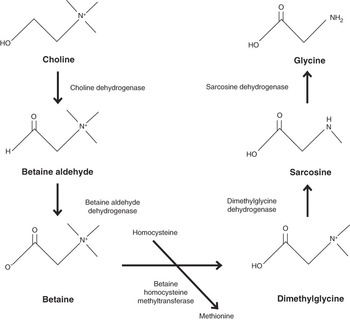
General feed composition not only influences the reproductive performance of sows, but also feed additives can have an influence on production results. Choline is one of those supplements. It has been commonly used for many decades as an additive in sow feed and its beneficial effect on sow and piglet performance has been reported in several studies (Kornegay and Meacham, Reference Kornegay and Meacham1973). More recently, a study on supplementation of betaine, a metabolite of choline, reported significantly improved total tract digestibility of crude fat (CFAT), crude ash (CA) and fiber (CF) in weaned piglets without affecting digestibility of crude protein (CP) and nitrogen-free extract (NFE) (Eklund et al., Reference Eklund, Mosenthin and Piepho2006). A less known substance is N,N-dimethylglycine (DMG), which – similar to choline and betaine – is related to glycine metabolism (Figure 1). DMG can act as a methyl donor (Friesen et al., Reference Friesen, Novak, Hasman and Innis2007) similar to betaine and, additionally, has anti-oxidative properties (Hariganesh and Prathiba, Reference Hariganesh and Prathiba2000). As methyl donation capacity (Jin et al., Reference Jin, Park, Cho, Pak, Lee, Kim, Friso, Choi, Park and Lee2007) and anti-oxidative action (Lai, Reference Lai2008) are both associated with increased insulin sensitivity, DMG can possibly influence insulin sensitivity. Other studies report that DMG, used as a dietary supplement, reduces blood lactate level and improves athletic performance in men (Tonda and Hart, Reference Tonda and Hart1992), horses (Greene et al., Reference Greene, Wickler, Bray, Burrill and London1996) and dogs (Gannon and Kendall, Reference Gannon and Kendall1982). Only one study investigated the effect of DMG as a feed additive in livestock production, namely on broiler performance (Kalmar et al., Reference Kalmar, Cools, Buyse, Roose and Janssens2010). In that study, an improved feed conversion rate of DMG-supplemented broilers was reported. Besides the application of DMG as a supplement for both humans and animals, DMG-derived molecules are also used as surfactants in industrial applications (Guan and Tung, Reference Guan and Tung1998), which indicates that DMG can possibly function as an emulsifying agent when added to the feed.
Overview of the choline pathway in which dimethylglycine (DMG) is an intermediate metabolite.

The current pilot study assessed the influence of DMG on insulin sensitivity, glucose and fat metabolism, nutrient digestibility and reproductive performance of sows in the peripartal period.
Material and methods
The experiment was approved by the Ethics Committee of the Faculty of Veterinary Medicine, Ghent University Belgium (EC 2008/070) and by the Federal Public Service Health Food Chain Safety and Environment, Belgium.
Animals, experimental design and dietary treatment
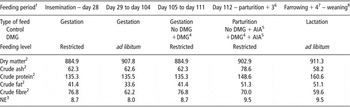
The experiment was performed at the experimental farm of a feeding company (AVEVE N.V., Leuven, Belgium) during the months June, July and August 2008. In the herd, a 3-week batch production system for sows was practiced. One group of the batch system, comprising 25 sows (Rattlerow Seghers hybrid) of different parities, was included in the study. The sows were housed individually in mechanically ventilated stables with a 12-h light period from weaning until day 28 of gestation and were fed a standard gestation diet (Table 1). Thereafter, the sows were moved to a group housing system with ad libitum access to a gestation feed, rich in soluble fiber, for creating a feeling of satiety (Table 1). At day 105, the beginning of the experiment (day 1), the sows were removed from the gestation unit, body weight (BW) of each individual sow was recorded and they were transferred to the farrowing unit. They were housed individually in farrowing crates until weaning. Sows were randomly allocated into two treatment groups: a control group (n = 13, parity 3.8 ± 3.0) and a DMG group (n = 12, parity 3.8 ± 2.4).
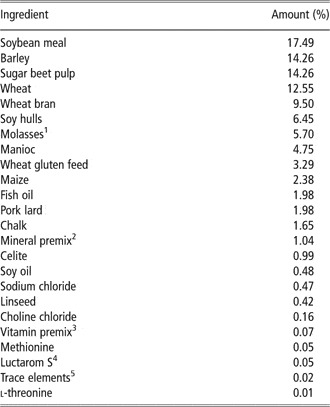
All sows were daily fed 3.5 kg of a standard gestation feed starting from day 105 of gestation until day 109 of gestation (day 5). On days 110 and 111 of gestation (days 6 and 7), all sows received 3.0 and 2.5 kg of the same standard gestation feed, respectively (Table 1). From day 112 of gestation (day 8) until 3 days after the calculated farrowing date (day 14), all sows received the same parturition feed containing 1% celite® (source of acid insoluble ash (AIA)) as an external marker to measure apparent fecal digestibility (AFD; Sales and Janssens, Reference Sales and Janssens2003; Tables 1 and 2). The amount of parturition feed provided to each sow at days 112, 113 and 114 of gestation was 2.0, 1.5 and 1.0 kg, respectively. One kg was given daily until parturition, and from parturition onward the daily amount was increased again with 0.5 kg a day. On day 15 of the trial, all sows were switched to a standard lactation diet (Table 1) that was provided ad libitum. Feed samples of each diet were taken and analyzed according to the Association of Official Analytical Chemists (AOAC) methods (Thiex, Reference Thiex2002; Table 1). For the parturition feed also, the amount of AIA was determined as described by (Sales and Janssens, Reference Sales and Janssens2003).
Feeding scheme and nutrient content of the different diets provided to the sows before, during and after the trial

DMG = N,N-dimethylglycine.
1Period of reproduction cycle during which the particular feed was given to the sows.
2Diet analyses (g/kg feed).
3Net energy (MJ/kg feed), calculated value using feed formulation software (Bestmix® Feed, Adifo N.V., Maldegem, Belgium).
4N,N-dimethylglycine, supplemented on top of feed at a ratio of 1 g/kg feed.
5Acid insoluble ash 1% added to the parturition feed.
6Three days post partum.
7Four days post partum.
8Weaning at day 26 ± 2 of lactation.
Composition of the parturition diet

1Sugar beet molasses.
2Mineral premix: 4.8% mono iron sulphate, 0.5% copper sulphate, 85.3% magnesium phosphate, 6.8% monocalcium phosphate and 2.6% zinc sulphate.
3Vitamin premix: 6.33 g/kg vitamin A, 272.15 g/kg vitamin E, 0.063 g/kg vitamin D3, 5.02 g/kg vitamin K, 75.30 g/kg vitamin PP, 5.02 g/kg vitamin B1, 25.10 g/kg vitamin B2, 37.65 g/kg vitamin B3, 15.06 g/kg vitamin B6, 7.53 g/kg vitamin B9, 0.08 g/kg vitamin B12 and 0.75 g/kg vitamin H.
4Luctarom S is an industrial flavor, added to the feed to improve feed intake. The product has no nutritional value.
5Trace elements premix: 485.07 g manganese/kg premix, 1.02 g cobalt/kg premix, 12.03 g iodine/kg premix, 2.00 g selenium/kg premix.
From day 1 (day 105 of gestation) until day 14 of the trial, all sows in the DMG group received 1 g DMG (Taminizer-D, supplied by Taminco N.V., Ghent, Belgium) per kg feed supplemented on top of their daily feed portion. The dose of 1000 ppm was based on the supplementation levels recommended for choline nutrient requirements of swine (NRC, 1998).
During the entire experiment, all sows had free access to fresh drinking water (drinking nipple – flow 1.5 to 2 l/min).
Blood sampling and oral glucose tolerance test (OGTT)
One day after parturition, a blood sample was taken and an OGTT performed after an overnight fasting period of 12 h, as described by Kemp et al. (Reference Kemp, Soede, Vesseur, Helmond, Spoorenberg and Frankena1996) and van der Peet-Schwering et al. (Reference van der Peet-Schwering, Kemp, Binnendijk, den Hartog, Vereijken and Verstegen2004). For sows that started farrowing after 2100 h, blood sampling and OGTT were performed 2 days after the actual farrowing date, also after an overnight fasting period of 12 h.
At 0700 h, a 30-ml blood sample was taken from the vena jugularis. Blood samples were divided into four subsamples: 9 ml on serum cloth activator (fructosamine and insulin analyses), 9 ml on lithium heparin (leptin, triglycerides (TG), thiobarbituric acid reactive substances (TBARS) and ferric reducing ability of plasma (FRAP) analyses), 9 ml on K3EDTA (NEFA analyses) and 3 ml on sodium fluoride/potassium oxalate (glucose analyses). The blood subsamples were stored on iced water (4°C) for about 5 h. Subsequently, tubes were centrifuged at 3000 × g for 10 min and plasma and serum samples were stored frozen at −20°C until analysis. After this blood sampling, the tail of each sow was washed with disinfectant soap. At 0750 h, a blood sample from a small incision in the tail was taken and the glucose concentration in this blood sample was measured using a glucose meter (Precision Xceed™, Abbott Diabetes Care, Louvain-la-Neuve, Belgium). This device has a coefficient of variation of 6.7% and the accuracy is according to ISO 15197 standards for glucose meters (Scandinavian evaluation of laboratory equipment for primary health care (SKUP, 2006)). Ten minutes later (0800 h), sows were fed 3 g glucose/kg BW0.75 and blood samples were taken at 11 time points (10, 20, 30, 40, 50, 60, 70, 80, 90, 105 and 120 min after glucose feeding) followed by glucose analysis as described above. Area under the curve (AUC) for glucose was calculated according to the trapezoidal method.
Colostrum and feces sampling
After the OGTT was completed, sows were fed their morning feed portion. Subsequently, a colostrum sample was taken from each sow after an intramuscular injection of 1 ml oxytocine. Finally, a fresh rectal feces sample of each sow was taken. Both the colostrum and feces samples were stored frozen at −20°C until analysis.
Analyses of blood samples
Insulin was analyzed using an immunoradiometric assay kit (BioSource INS-IRMA Kit, BioSource Europe S.A., Nivelles, Belgium). Glucose and fructosamine were both determined spectrophotometrically (Roche/Hitachi Modular P Analyzer, Roche Diagnostics, Mannheim, Germany) by adding hexokinase and glucose-6-phosphate dehydrogenase (Gluco-quant, Roche Diagnostics, Mannheim, Germany) for glucose analysis and nitrotetrazolium-blue (Fructosamine, Roche Diagnostics, Mannheim, Germany) for fructosamine analyses. TG were also measured spectrophotometrically (Monarch Chemistry System, Instrumentation Laboratories, Zaventem, Belgium) using a commercial colorimetric diagnostic kit (IL Test kit No. 181610-60, Instrumentation Laboratories, Zaventen, Belgium). Leptin in plasma samples was measured using a multispecies immunoradiometric assay kit (Multi-Species Leptin RIA Kit, Linco Research Inc., St Charles, Missouri, USA). Plasma NEFA concentrations were determined using a WAKO NEFA-HR(2) test (Wako Chemicals GmbH, Neuss, Germany), modified for use on the Monarch Chemistry System. Plasma lipid peroxidation, expressed as TBARS, was measured spectrophotometrically (Monarch Chemistry System, Instrumentation Laboratories) as described in detail by Lin et al. (Reference Lin, Decuypere and Buyse2004). Results are reported as the concentration of malondialdehyde (MDA) measured per milliliter of plasma after reaction. Similarly, the total plasma anti-oxidative capacity of plasma, expressed as FRAP, was measured spectrophotometrically (Monarch Chemistry System, Instrumentation Laboratories) as described by Benzie and Strain (Reference Benzie and Strain1996). Results are reported as the concentration of Fe2+ measured per liter of plasma after reaction.
Colostrum analyses
First, the colostrum samples were extracted with hexane to remove the fat fraction. The aqueous layer that contained the DMG was then separated from the hexane layer. Subsequently, diethylglycine sodium salt was added to the aqueous extract as an internal standard. After evaporation of the aqueous solution under a nitrogen stream, N,O-bis(trimethylsilyl)trifluoroacetamide and dimethylformamide were added to derivatize both the DMG and the internal standard. Finally, the sample was injected in a gas chromatograph equipped with a split injector and flame ionization detector. The results were calculated based on the internal standard.
Feces analyses
Feces samples of each sow were analyzed for AIA, dry matter, CP, CA, CFAT and CF according to Thiex (Reference Thiex2002). Using these results and the analyses of the parturition feed, the AFD of these nutrients was calculated using the external marker method with AIA as the external marker, according to the following formula:

with F = % nutrient in the feed, D = % nutrient in the feces, F AIA = % AIA in the feed and D AIA = % AIA in the feces (Goddard and McLean, Reference Goddard and McLean2001).
Reproductive performance parameters
The following reproductive parameters of the sows were investigated: gestation length, number of total born, live born and stillborn piglets and the number of weaned piglets. The litter weight at birth and at weaning and the mortality rate of piglets before weaning were also recorded.
Statistical analyses
The effect of DMG supplementation on glucose tolerance, blood parameters, AFD and reproduction parameters were analyzed using Student’s t-test for independent samples after performing a Kolmogorov–Smirnov test to verify normality and Levene’s test to determine equality of variance. The DMG content in the colostrum and the number of stillborn piglets were not normally distributed and therefore these data were analyzed using the non-parametric Mann–Whitney test. All statistical analyses were performed using SPSS 17.0 (SPSS, 2008), considering statistical significance when P < 0.05. All data are reported as mean ± s.d.
Results
Oral glucose tolerance test
The OGTT was successfully performed in 11 sows of the control group and 10 sows of the DMG group. Four sows (two from the control and two from the DMG group) were excluded from the OGTT because their tail was too short to perform the protocol correctly. Basal glucose levels, measured 10 min before the sows were offered their individual glucose load, were similar for both treatments (4.2 ± 1.1 mmol/l and 4.1 ± 1.7 mmol/l for control and DMG group, respectively, P > 0.05). Glucose tolerance, represented as the AUC after the OGTT, was not significantly influenced by supplementation of DMG. The average AUC values were 612 ± 105 mmol × min/l for the control group and 650 ± 151 mmol × min/l for the DMG group. A maximal increase in blood glucose level of 2.4 ± 1.4 mmol/l above basal level was recorded for sows of the control group after 57 ± 35 min, which was not significantly different from the maximal increase observed in sows of the DMG group (2.7 ± 1.5 mmol/l after 54 ± 29 min). After 120 min, blood glucose levels had decreased again to 4.7 ± 0.8 mmol/l in the control group and to 5.2 ± 0.7 mmol/l in the DMG group (P > 0.05).
Blood parameters
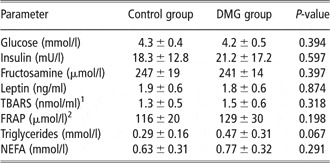
The results of the blood parameters are given in Table 3. Supplementation of DMG had no significant influence on glucose, insulin or fructosamine (P > 0.05). Similarly, leptin concentration in blood samples was not significantly affected by dietary treatment (P > 0.05). Although no significant difference could be seen for NEFA (P > 0.05), TG tended to be lower (P = 0.067) for the control group (0.29 ± 0.16 ng/ml) compared to the DMG group (0.47 ± 0.31 ng/ml). Neither TBARS nor FRAP were significantly affected by supplementation of DMG (P > 0.05).
Results (mean ± s.d.) of the blood parameters of sows in the control group (n = 13) and the DMG group (n = 12)

DMG = N,N-dimethylglycine; TBARS = thiobarbituric acid reactive substances; MDA = malondialdehyde; FRAP = ferric reducing ability of plasma; NEFA = non-esterified fatty acids.
Blood samples were taken at day one post partum. Sows of the DMG group were supplemented with 1 g DMG/kg feed during 14 days.
1TBARS expressed as the amount of MDA measured in plasma.
2FRAP expressed as the concentration of Fe2+ measured in plasma.
AFD of nutrients
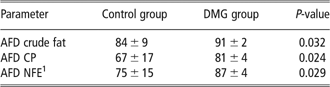
Feces samples of 11 sows of the control group and nine sows of the DMG group were analyzed. No rectal feces samples could be taken from two sows of the control group and three sows of the DMG group because these five sows were constipated. The AFD results are given in Table 4. AFD of CFAT, CP and of NFE were significantly improved in the DMG group compared to the control group (P < 0.05).
Results (mean % ± s.d.) of the AFD of nutrients of sows of the control group (n = 11) and the DMG group (n = 9)

AFD = apparent fecal digestibility; DMG = N,N-dimethylglycine; NFE = Nitrogen-free extract.
Feces samples were taken at day 1 post partum. The DMG group was supplemented with 1 g DMG/kg feed during 14 days.
1NFE calculated based on the complete proximate analyses of feed and feces samples (NFE = dry matter – crude fiber – crude fat – CP – crude ash).
Colostrum analyses
Colostrum samples of 13 sows of the control group and 11 sows of the DMG group were analyzed. From one sow of the DMG group, the amount of colostrum sampled was insufficient for analysis. The concentration of DMG in the colostrum of both groups was low and not significantly different from each other (7 ± 7 μg/g and 11 ± 16 μg/g for the control and DMG groups, respectively, P > 0.05).
Reproductive performance parameters
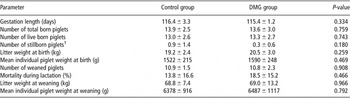
The reproductive performance parameters, shown in Table 5, were not significantly influenced by DMG supplementation (P > 0.05). However, the number of stillborn piglets was numerically lower in the DMG group (0.3 ± 0.6) than in the control group (0.9 ± 1.4, P > 0.05). In general, after a lactation period of 26 ± 2 days, an average number of 10.9 ± 1.9 piglets/litter were weaned with a total litter weight of 69 ± 10 kg.
Results (mean ± s.d.) of reproductive performance parameters of sows of the control group (n = 13) and the DMG group (n = 12)

DMG = N,N-dimethylglycine.
The DMG group was supplemented with 1 g DMG/kg feed during 14 days.
1In contrast to all the other parameters, the number of stillborn piglets was tested using a non-parametric test instead of a parametric test because data were not normally distributed.
Discussion
The results of this study observed at day 1 post partum indicated that the preprandial blood glucose levels were almost two-fold those recorded in studies testing glucose tolerance in a similar way at days 104 and 108 of gestation (Kemp et al., Reference Kemp, Soede, Vesseur, Helmond, Spoorenberg and Frankena1996; van der Peet-Schwering et al., Reference van der Peet-Schwering, Kemp, Binnendijk, den Hartog, Vereijken and Verstegen2004). Similarly, maximal increase in blood glucose level during the OGTT in this study performed post partum was higher and occurred later in time than in OGTT performed in late gestation (Kemp et al., Reference Kemp, Soede, Vesseur, Helmond, Spoorenberg and Frankena1996; van der Peet-Schwering et al., Reference van der Peet-Schwering, Kemp, Binnendijk, den Hartog, Vereijken and Verstegen2004). In line with this study and the previously mentioned studies of Kemp et al. (Reference Kemp, Soede, Vesseur, Helmond, Spoorenberg and Frankena1996) and van der Peet-Schwering et al. (Reference van der Peet-Schwering, Kemp, Binnendijk, den Hartog, Vereijken and Verstegen2004), the results of intravenous glucose tolerance tests performed on sows at day 109 of gestation and at day 4 of lactation confirm that glucose half-life is shorter in late gestation than in early lactation (Quesnel et al., Reference Quesnel, Meunier-Salaun, Hamard, Guillemet, Etienne, Farmer, Dourmad and Pere2009). Different explanations can be given for the basal hyperglycemia and decreased glucose clearance rate observed in early lactation. Oliviero et al. (Reference Oliviero, Heinonen, Valros, Halli and Peltoniemi2008) reported elevated plasma cortisol levels for more than 1 day after parturition for sows housed in farrowing crates. These increased cortisol levels could explain the lowered insulin sensitivity of tissue at the beginning of lactation (Kronfeld et al., Reference Kronfeld, Treiber and Geor2005). Although cortisol was not measured in this study, it could be a possible explanation for the observed lower glucose clearance in early lactation. Hence, interference of cortisol with glucose metabolism could mask a possible effect of DMG on the glucose metabolism in early lactation in sows. This could also explain the lack of influence of DMG supplementation on the preprandial glucose, insulin and fructosamine levels, all these parameters being related to the glucose metabolism.
Despite the anti-oxidative properties of DMG reported in rats (Hariganesh and Prathiba, Reference Hariganesh and Prathiba2000), no influence on the oxidative parameters TBARS and FRAP were reported in this study. However, the doses used by Hariganesh and Prathiba (Reference Hariganesh and Prathiba2000) were much higher than the dose used in the present trial (25 or 35 mg/kg BW in rats, in contrast to at the highest approximately 15 mg/kg BW for sows consuming the maximum of 3.5 kg feed/day in the present trial). In addition, the rats in this study suffered gastric ulceration resulting in a physiologically different status than sows on day one post partum.
Research on leptin in many different species, including humans, has revealed that this hormone is related to energy metabolism (Barb et al., Reference Barb, Hausman and Houseknecht2001; Budak et al., Reference Budak, Fernández Sánchez, Bellver, Cerveró, Simón and Pellicer2006). Moreover, levels of leptin in sows can vary in relation to the feeding level (Quesnel et al., Reference Quesnel, Meunier-Salaun, Hamard, Guillemet, Etienne, Farmer, Dourmad and Pere2009), feed composition, time after transition from one feed to another (Papadopoulos et al., Reference Papadopoulos, Maes, Van, van Kempen, Buyse and Janssens2009) and body condition, mostly measured as back fat thickness (Prunier et al., Reference Prunier, Guadarrama, Mourot and Quesnel2001). In this study, both feeding scheme and body condition of all sows were similar, resulting in similar fasting leptin levels at the first day of lactation for both treatment groups. Given the inducing role of leptin in insulin resistance, as reviewed by Barb et al. (Reference Barb, Hausman and Houseknecht2001), these similar leptin levels likely reduced the chance of finding differences in glucose tolerance induced by different dietary treatments. Fasting NEFA levels were also similar between treatments, indicating a similar amount of energy mobilized from fat reserves in both treatment groups. The absence of an influence of DMG supplementation on leptin combined with lack of effect on fasting NEFA concentration, the equal feed intake and similar body condition of all sows indicates that the present DMG supplementation over a period of 10 days did not affect the lipid metabolism of sows in the peripartal period. Although no influence on lipid metabolism could be recorded, the slight increase in TG blood levels and the significant improvement in AFD of CFAT indicate that DMG supplementation over a longer period of time or at a higher dose might have a beneficial influence on lipid metabolism. Indeed, the results of AFD in this study indicate that DMG may act as an external emulsifier in pig feed (Wieland et al., Reference Wieland, Lin and Odle1993; Dierick and Decuypere, Reference Dierick and Decuypere2004). The emulsifying effect of DMG incorporation in the sow’s diet not only resulted in improvement of CFAT digestibility, but also improved digestibility of CP and NFE. These findings corroborate with the results of a previously published study on the addition of emulsifying agents to pig feed (Dierick and Decuypere, Reference Dierick and Decuypere2004). Studies on the effects of emulsification of fat sources in piglet feed indicate that the addition of emulsifiers to piglet feed improve nutrient digestibility, resulting in a reduction of feed costs (Jones et al., Reference Jones, Hancock, Harmon and Walker1992; Odle et al., Reference Odle, Lin, Wieland and van Kempen1994). Seeing the limited number of studies published on the effects of addition of emulsifiers to the diets for sows, it would be worthwhile to do further research on the effect of DMG on nutrient digestibility.
Results of colostrum analyses in this study indicate that the technique used is not sensitive enough to measure small amounts of DMG in the colostrum samples. The low DMG levels detected in both groups indicate that little DMG is transferred into the colostrum. This finding is in line with previous studies reporting that most DMG is eliminated from the organism by demethylation rather than by excretion (Lever et al., Reference Lever, George, Dellow, Scott and Chambers2005) or in this case by secretion in the colostrum.
No direct effect of DMG supplementation on reproductive performance parameters was noted, except for a numerical decrease in the number of stillborn piglets in litters of sows fed diets supplemented with DMG. The incidence of piglet mortality at or shortly after farrowing may be linked to an increased glucose intolerance of sows during late gestation (Kemp et al., Reference Kemp, Soede, Vesseur, Helmond, Spoorenberg and Frankena1996).
In conclusion, this study showed that short-term supplementation of DMG had an emulsifying effect that resulted in an improved nutrient digestibility. However, neither a significant influence on glucose clearance one day after parturition nor improved reproductive performance parameters could be substantiated in the present trial. Further research, in which DMG is supplemented for a longer period and/or at a higher dose, is warranted to investigate the possible beneficial effects of DMG on energy and lipid metabolism, health and performance of the sow and the piglets.
Acknowledgments
The authors thank Taminco N.V. (Ghent, Belgium) for financial support and providing the DMG, AVEVE N.V. (Leuven, Belgium) for providing the feed and the use of their experimental study farm, Koen Van Criekingen for the animal care and his help during blood sampling, Steven Galle for making feed mixtures and Herman De Rycke, Inge Vaesen and Annelies Callewaert for the analyses.