Introduction
Suicide is a major public health problem, accounting for a significant portion of potential years of life lost and an annual estimated mortality of 800, 000 (WHO, 2020). Suicide risk assessment relies on a combination of non-specific risk factors and the individual's self-reported suicidal ideation and intent. As such, suicide risk assessment is often imprecise and malleable. More importantly, in the absence of an objective measure, determining suicide risk relies on accurate and complete disclosure of internal processes and intent. This is important because some individuals are unaware of their own thoughts of death and suicide, or conversely, there are circumstances in which a high degree of intent may be dissimulated (Busch, Fawcett, & Jacobs, Reference Busch, Fawcett and Jacobs2003; Wilson, Reference Wilson2009). Indeed, suicide can occur despite individuals denying suicidal thoughts or intent to health care professionals (Busch et al., Reference Busch, Fawcett and Jacobs2003).
These limitations highlight the need for objective means of assessing suicide risk and internal state to complement existing suicide risk assessment tools (Roos, Sareen, & Bolton, Reference Roos, Sareen and Bolton2013). One approach that has gained increasing research attention utilizes the principle of implicit association to identify bias using abstract mental representations (Greenwald, McGhee, & Schwartz, Reference Greenwald, McGhee and Schwartz1998). The psychometric principles of implicit association tests (IAT) rely on reaction times, with stronger implicit associations showing shorter latencies (Greenwald et al., Reference Greenwald, McGhee and Schwartz1998). Though controversial (Jost, Reference Jost2019), IATs have been extensively utilized in social psychology to reveal socially unacceptable and disavowed forms of bias (for a review see: Oswald, Mitchell, Blanton, Jaccard, & Tetlock, Reference Oswald, Mitchell, Blanton, Jaccard and & Tetlock2013).
Nock et al. (Reference Nock, Park, Finn, Deliberto, Dour and Banaji2010) developed an IAT that assesses individual differences in associating the self with concepts of life and death. The Death-IAT (D-IAT) measures differences in reaction times between target-concepts (Life/Death) and attribute dimensions (Self/Other) to provide a composite implicit association with death versus life, known as the difference or D-score (D-IAT score) (Greenwald, Nosek, & Banaji, Reference Greenwald, Nosek and Banaji2003; Nock et al., Reference Nock, Park, Finn, Deliberto, Dour and Banaji2010). Several studies have used the D-IAT to determine its ability to detect past and future suicidal behaviour; however, the literature is mixed. Specifically, while the majority of individuals have stronger implicit associations with life (Harrison et al., Reference Harrison, Stritzke, Leong, Ellison, Fay and Hudaib2020), differences have been found in the strength of this association between suicide attempters and non-attempters, with non-attempters showing stronger associations with life (Glenn et al., Reference Glenn, Werntz, Slama, Steinman, Teachman and Nock2017b; Harrison, Stritzke, Fay, Ellison, & Hudaib, Reference Harrison, Stritzke, Fay, Ellison and Hudaib2014; Millner, Coppersmith, Teachman, & Nock, Reference Millner, Coppersmith, Teachman and Nock2018; Podlogar, Gutierrez, & Joiner, Reference Podlogar, Gutierrez and Joiner2020; Wang et al., Reference Wang, Lei, Kezhi, Liang, Wang, Huang and Chen2020). However, others have failed to find a difference between D-IAT scores in suicide attempters and non-attempters (Barnes et al., Reference Barnes, Bahraini, Forster, Stearns-Yoder, Hostetter, Smith and Nock2017; Dickstein et al., Reference Dickstein, Puzia, Cushman, Weissman, Wegbreit, Kim and Spirito2015; Millner et al., Reference Millner, Augenstein, Visser, Gallagher, Vergara, D'Angelo and Nock2019; Rath et al., Reference Rath, Teismann, Schmitz, Glaesmer, Hallensleben, Paashaus and Forkmann2021; Tello, Harika-Germaneau, Serra, Jaafari, & Chatard, Reference Tello, Harika-Germaneau, Serra, Jaafari and Chatard2020). Here, we report a systematic review of the literature examining the D-IAT and suicidal behaviour, both past and future, as well as a quantitative synthesis of this data.
Methods
This protocol was registered in the international register of prospective systematic reviews (PROSPERO; CRD42020194394 – updated 18 November 2020) and was conducted according to the Preferred Reporting Items for Systematic Meta-Analyses (PRISMA; Moher, Liberati, Tetzlaff, and Altman, Reference Moher, Liberati, Tetzlaff and Altman2009) guidelines.
Search strategy
We searched the PsychINFO, Medline, EMBASE, and Cochrane Central Register of Controlled Trials (CENTRAL) databases from inception until 9 February 2021 (Figs. S1–S4). The search strategy included the use of the keywords ‘suicide AND implicit association’. We also reviewed the reference lists of included studies to identify studies that were not captured by our search.
Selection criteria
Inclusion
(1) All sexes
(2) Any age
(3) Included the D-IAT
(4) Reported data on suicide attempts
(5) Peer reviewed
(6) English language
(7) Minimum sample of n = 5 per group
Exclusion
(1) Studies that did not present primary data or we were unable to obtain the data after correspondence with the author
Risk of bias
The Risk of Bias In Non-randomized Studies of Interventions (ROBINS-I; Sterne et al., Reference Sterne, Hernán, Reeves, Savović, Berkman, Viswanathan and Higgins2016) grading scale was used to assess bias in cross-sectional and prospective studies. Bias due to missing data was assessed separately for baseline and follow-up measures.
Data collection
Data were extracted from eligible studies by two independent reviewers (AM and MS). Discrepancies were resolved by consensus or a third reviewer (CM). We systematically extracted the following data items:
(1) Study design
(2) Participant characteristics (e.g. age, sex)
(3) Sample size
(4) Study definition of suicide attempts
(5) Study setting (i.e. community/acute care)
(6) Prospective studies: duration of follow-up period
(7) Outcome measures:
(a) D-IAT scores (means and standard deviations) for individuals with and without a history of suicide attempt
(b) Number of participants with D-IAT scores ⩾ 0 with and without a history of suicide attempt
(c) Number of participants with D-IAT scores ⩾ 0 who attempted or did not attempt suicide over a follow-up period of six-months
(1) Percentage of population with a depressive disorder at the study level
(2) Interventions
Data analysis
Meta-analyses were performed using Comprehensive Meta-Analysis 2.0 (Biostat, USA). Analyses were conducted using random-effects models since it can be expected that the true effect of each study differs due to methodological differences such as study setting, primary diagnosis, and age of the population (Deeks, Higgins, & Altman, Reference Deeks, Higgins and Altman2020). These models were used to pool standard mean differences (SMD) with a 95% confidence interval (95% CI) of D-IAT scores from participants with and without a history of a suicide attempt. An SMD is an effect size equivalent to Cohen's D (Faraone, Reference Faraone2008), where the mean difference between suicide attempters and non-attempters in each study and the pooled standard deviation are used to calculate the individual study SMD for inclusion in the random-effects model. For most studies, D-IAT < 0 represented a stronger association with life; however, in two studies the composite score was calculated differently such that D-IAT < 0 represented a stronger association with death (Harrison et al., Reference Harrison, Stritzke, Fay, Ellison and Hudaib2014, Reference Harrison, Stritzke, Fay and Hudaib2018). These effect sizes were reverse coded so that here, all D-IAT scores < 0 represent a stronger association with life. A random-effects model was also used to pool categorical outcomes (D-IAT ⩾ 0 representing a greater association with death or < 0 representing a greater association with life, and the converse for reverse coded studies) and compute odds ratios (ORs and 95% CI) for suicide attempters both retrospectively and prospectively. A priori subgroup analyses examining acute care versus community settings and paediatric verusus adult samples were performed using the Q-statistic. Meta-regression analyses were conducted to assess the effect of the sex distribution and the proportion of the sample with a depressive diagnosis. The heterogeneity of studies included in these meta-analyses was assessed using Q (significance level: 0.1) and I2 (homogenous: < 40%, heterogenous: ⩾ 40%) statistics (Higgins & Thompson, Reference Higgins and Thompson2002). Publication bias was assessed qualitatively using Funnel plots and quantitatively using Egger's linear regression intercept (Egger, Smith, Schneider, & Minder, Reference Egger, Smith, Schneider and Minder1997).
Results
Literature search
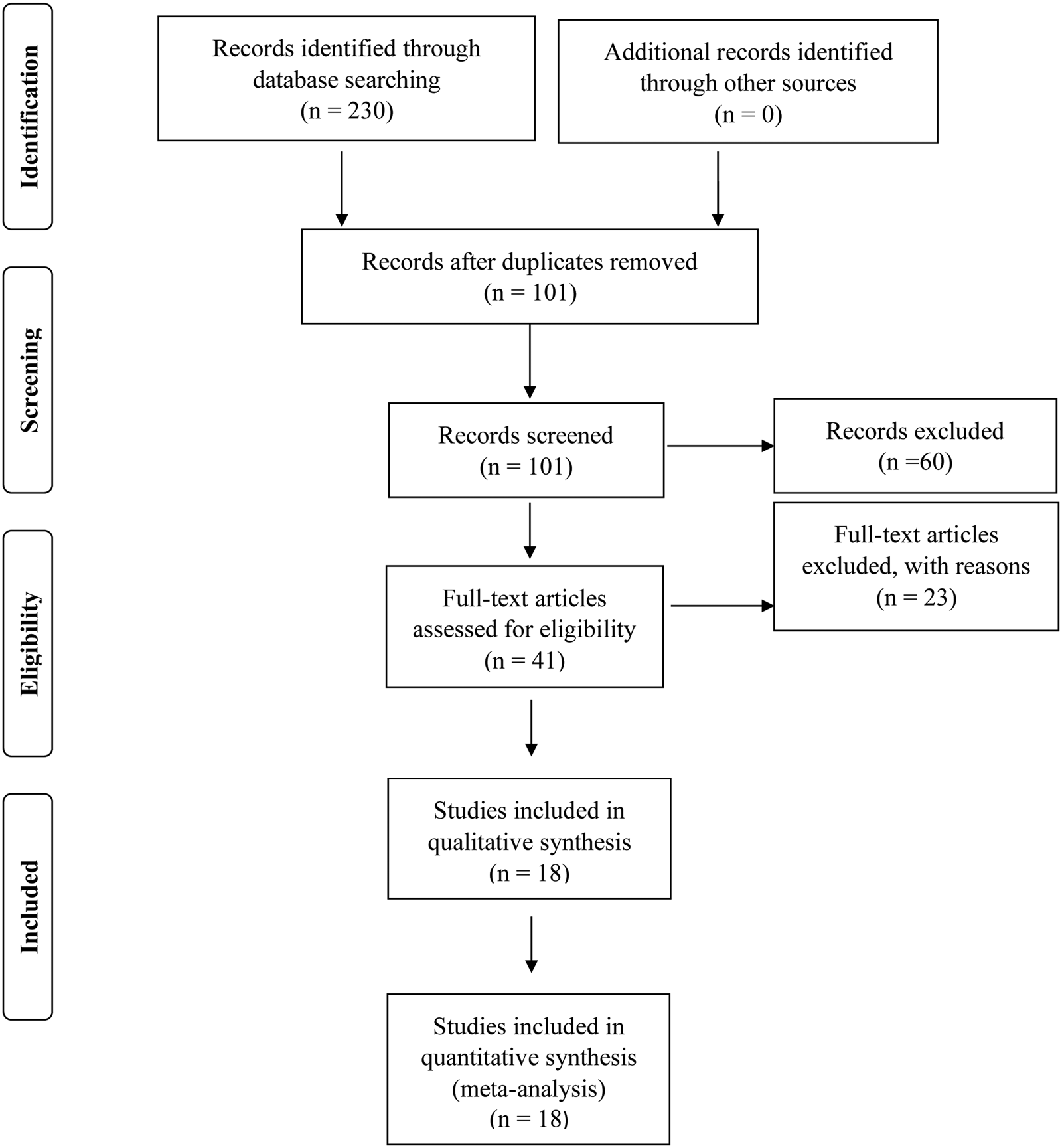
The results of our literature search are detailed in online Supplementary Figs S1–S4 and summarized in Fig. 1. Reasons for full-text exclusions are presented in online Supplementary Table S1. We identified 18 studies that measured D-IAT scores and reported a history of suicide attempt cross-sectionally. Of these, seven studies also assessed the association between D-IAT scores and future suicidal behaviour and suicide attempts at three- (two studies, n = 195) and six-months (six studies, n = 781). One study only followed up at three-months (Millner et al., Reference Millner, Augenstein, Visser, Gallagher, Vergara, D'Angelo and Nock2019) whereas the other followed up at both three- and six-months (Harrison, Stritzke, Fay, & Hudaib, Reference Harrison, Stritzke, Fay and Hudaib2018). We selected the six-month time point for meta-analysis as this represented the time point with the largest dataset for quantitative synthesis.
PRISMA study selection chart.

Characteristics of included studies
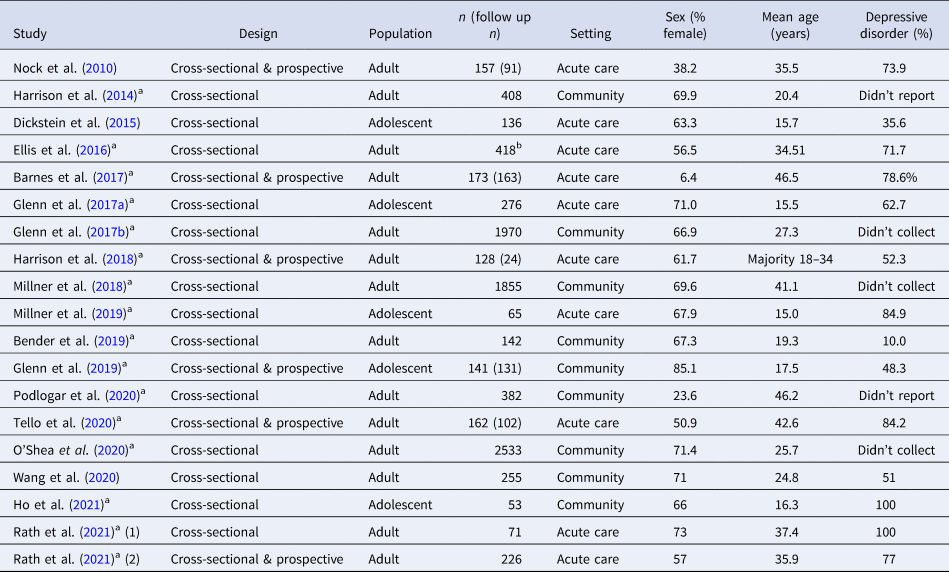
The characteristics of the 18 studies (n = 9551) that met our inclusion criteria are detailed in Table 1. Assessment of study quality according to ROBINS-I is presented in online Supplementary Table S2. These comprise 13 adult and 5 adolescent studies that took place in either acute care or community settings. Included studies defined a suicide attempt using the Self-Injurious Thoughts and Behaviours Interview (SITBI or SITBI-German; Barnes et al., Reference Barnes, Bahraini, Forster, Stearns-Yoder, Hostetter, Smith and Nock2017; Bender et al., Reference Bender, Fitzpatrick, Hartmann, Hames, Bodell, Selby and Joiner2019; Dickstein et al., Reference Dickstein, Puzia, Cushman, Weissman, Wegbreit, Kim and Spirito2015; Fischer et al., Reference Fischer, Ameis, Parzer, Plener, Groschwitz, Vonderlin and Kaess2014; Glenn et al., Reference Glenn, Kleiman, Coppersmith, Santee, Esposito, Cha and Auerbach2017a, Reference Glenn, Werntz, Slama, Steinman, Teachman and Nock2017b; Harrison et al., Reference Harrison, Stritzke, Fay, Ellison and Hudaib2014, Reference Harrison, Stritzke, Fay and Hudaib2018; Millner et al., Reference Millner, Coppersmith, Teachman and Nock2018, Reference Millner, Augenstein, Visser, Gallagher, Vergara, D'Angelo and Nock2019; Nock et al., Reference Nock, Park, Finn, Deliberto, Dour and Banaji2010; Nock, Holmberg, Photos, & Michel, Reference Nock, Holmberg, Photos and Michel2007; O'Shea, Glenn, Millner, Teachman, & Nock, Reference O'Shea, Glenn, Millner, Teachman and Nock2020; Rath et al., Reference Rath, Teismann, Schmitz, Glaesmer, Hallensleben, Paashaus and Forkmann2021), the Columbia Suicide Severity Rating Scale (CSSRS; Ellis, Rufino, & Green, Reference Ellis, Rufino and Green2016; Posner et al., Reference Posner, Brown, Stanley, Brent, Yershova, Oquendo and Mann2011), or a combination of the Beck Scale for Suicidal Ideation (BSI; Beck, Brown, and Steer, Reference Beck, Brown and Steer1997) and the suicidal thoughts and behaviours questionnaire-revised (SBQ-R or SBQ-R German; Glaesmer et al., Reference Glaesmer, Kapusta, Teismann, Wagner, Hallensleben, Spangenberg and Forkmann2018; Osman et al., Reference Osman, Bagge, Gutierrez, Konick, Kopper and Barrios2001; Podlogar et al., Reference Podlogar, Gutierrez and Joiner2020; Rath et al., Reference Rath, Teismann, Schmitz, Glaesmer, Hallensleben, Paashaus and Forkmann2021). Other studies defined suicide attempt based on self-report corroborated through medical records (Wang et al., Reference Wang, Lei, Kezhi, Liang, Wang, Huang and Chen2020) or endorsement of an actual attempt on the Kiddie-Scale for Affective Disorders and Schizophrenia-Present and Lifetime (Ho et al., Reference Ho, Teresi, Ojha, Walker, Kirshenbaum, Singh and Gotlib2021; Kaufman et al., Reference Kaufman, Birmaher, Brent, Rao, Flynn, Moreci and Ryan1997).
Characteristics of included studies (n = 18)

Note. Prospective studies had a follow-up period of six-months. Sample sizes are those used in meta-analysis (i.e. attempters and non-attempters) if that number differed from the full sample.
a Indicates data was obtained through contact with the authors. Rath (1) and (2) were published in the same manuscript.
b Ellis et al. (Reference Ellis, Rufino and Green2016) presented n = 124 in their manuscript, the extra n was obtained through contact with the authors. Demographics are those presented in their manuscript since this information was unavailable for the larger sample.
All studies performed cross-sectional assessments. Six studies also explored the relation between the D-IAT and prospective suicide attempts six-months later (Barnes et al., Reference Barnes, Bahraini, Forster, Stearns-Yoder, Hostetter, Smith and Nock2017; Glenn et al., Reference Glenn, Kleiman, Coppersmith, Santee, Esposito, Cha and Auerbach2017a; Harrison et al., Reference Harrison, Stritzke, Fay and Hudaib2018; Nock et al., Reference Nock, Park, Finn, Deliberto, Dour and Banaji2010; Rath et al., Reference Rath, Teismann, Schmitz, Glaesmer, Hallensleben, Paashaus and Forkmann2021; Tello et al., Reference Tello, Harika-Germaneau, Serra, Jaafari and Chatard2020). At follow-up, the SITBI was re-administered over the phone (Glenn et al., 2019a; Nock et al., Reference Nock, Park, Finn, Deliberto, Dour and Banaji2010; Tello et al., Reference Tello, Harika-Germaneau, Serra, Jaafari and Chatard2020) and medical records were assessed (Nock et al., Reference Nock, Park, Finn, Deliberto, Dour and Banaji2010; Tello et al., Reference Tello, Harika-Germaneau, Serra, Jaafari and Chatard2020). The method of follow-up was not reported in Rath et al. (Reference Rath, Teismann, Schmitz, Glaesmer, Hallensleben, Paashaus and Forkmann2021). In two studies, follow-up characterization was limited to individuals who initially presented with suicide attempts (Nock et al., Reference Nock, Park, Finn, Deliberto, Dour and Banaji2010; Tello et al., Reference Tello, Harika-Germaneau, Serra, Jaafari and Chatard2020). A total of 100 suicide attempts (12.80%; n = 781) were reported over the follow-up period. Online Supplemental Table S3 reports the mean D-IAT scores of suicide attempter and non-attempter groups. Across groups, only 19.44% (n = 1767/9091) of individuals had stronger associations with death compared to life (D-IAT ⩾ 0).
D-IAT scores and previous history of suicide attempts
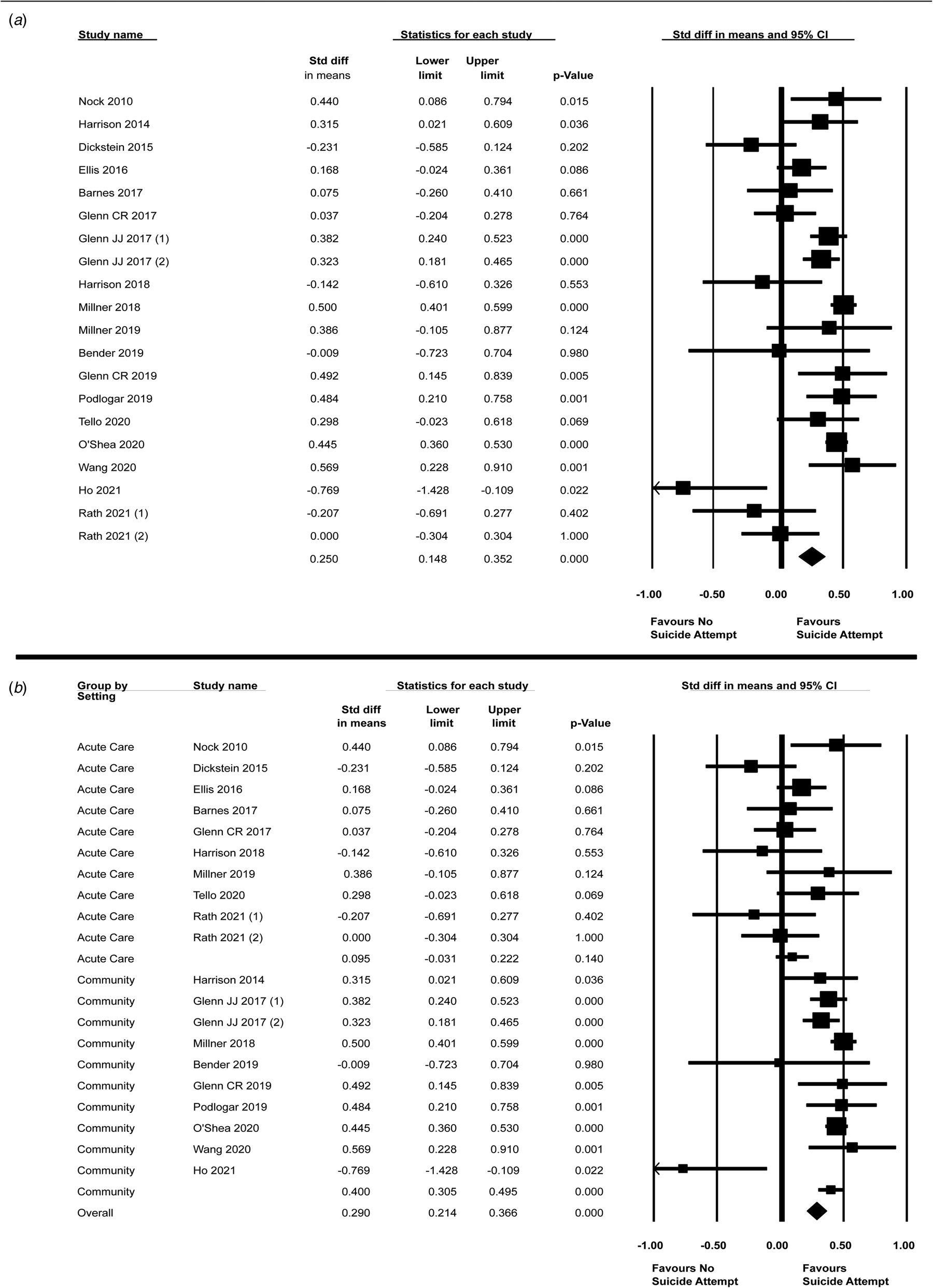
The pooled SMD (n = 18 studies, n = 9551) revealed higher D-IAT scores in those who had attempted suicide compared to non-attempters, representing a stronger association with death (SMD = 0.25, 95% CI 0.15 to 0.35, p < 0.001; Fig. 2a). The majority of studies measured a history of suicide attempts, while one study defined suicide attempters as those who were currently presenting to the emergency department with a suicide attempt (Nock et al., Reference Nock, Park, Finn, Deliberto, Dour and Banaji2010). Sensitivity analyses revealed a similar effect size estimate when this study is excluded (SMD = 0.24, 95% CI 0.14 to 0.35, p < 0.001).
Mixed-effects meta-analysis of (a) the standard mean difference (SMD) between lifetime suicide attempter and non-attempter D-IAT scores on the death implicit association test (SMD = 0.25, 95% CI 0.15 to0.35, p < 0.001) (b) subgroup analysis of SMD in acute care (SMD = 0.095, 95% CI −0.3 to 0.22, p = 0.14) v. community (SMD = 0.40, 95% CI 0.31 to0.50, p < 0.001) settings (Q = 14.24, p = 0.001). *Glenn JJ 2017 (1) and (2) represent the main and replication samples from Glenn et al. (Reference Glenn, Werntz, Slama, Steinman, Teachman and Nock2017b). Rath Reference Rath, Teismann, Schmitz, Glaesmer, Hallensleben, Paashaus and Forkmann2021 (1) and (2) represent the two samples presented in the manuscript Rath et al. (Reference Rath, Teismann, Schmitz, Glaesmer, Hallensleben, Paashaus and Forkmann2021). D-IAT scores from Harrison et al. (Reference Harrison, Stritzke, Fay, Ellison and Hudaib2014, Reference Harrison, Stritzke, Fay and Hudaib2018) were reverse coded such that D-IAT < 0 represents a stronger association with life.

There is evidence of significant heterogeneity between studies (Q = 66.73, p < 0.001, I 2 = 71.53). Subgroup analyses using the Q-statistic do not find significant heterogeneity between paediatric and adult samples (Q = 2.41, p = 0.12) but do find heterogeneity based on study setting (Q = 14.24, p = 0.001). Indeed, community settings show significant differences between suicide attempters and non-attempters (SMD = 0.40, 95% CI 0.31 to 0.50, p < 0.001), however, there is no evidence of the statistical separation between suicide attempters and non-attempters in acute care settings (SMD = 0.095, 95% CI −0.03 to 0.22, p = 0.14) (Fig. 2b). Meta-regression reveals a small but significant effect of sex distribution (Q = 3.81, p = 0.05), where studies with more female participants reported larger, positive SMDs. Too few studies reported psychiatric diagnoses to conduct this pre-planned comparison. Study estimate versus study precision is illustrated with a funnel plot (Fig. S5) revealing an asymmetric distribution. This is confirmed by Egger's regression intercept (Intercept = −2.16, 95% CI −3.40 to −0.93, p = 0.002), suggesting the presence of publication bias.
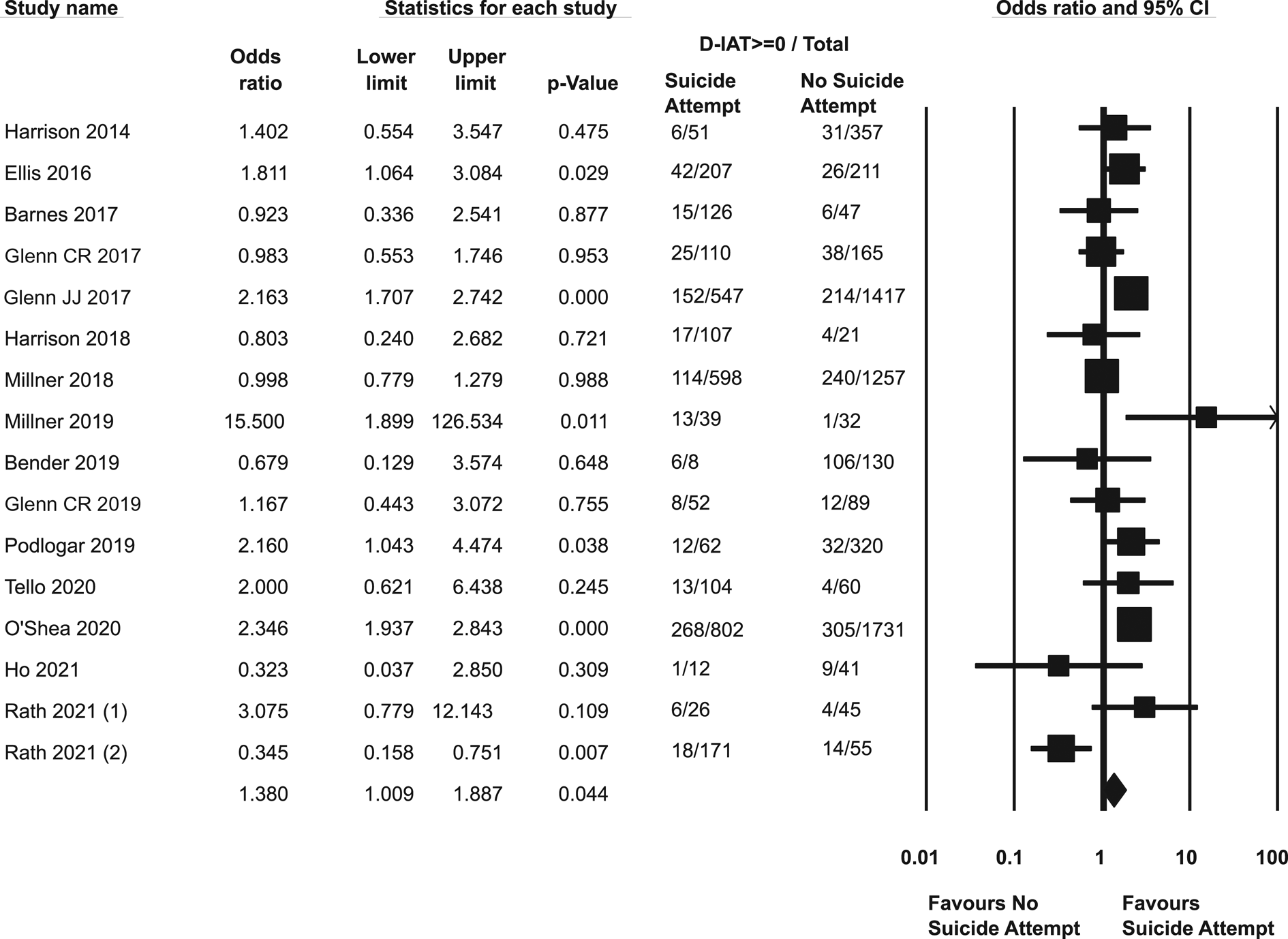
We computed ORs for previous suicidal behaviour according to the cutoff of zero, representing equipoise between life and death, for the 15 studies (n = 9000) for which this data was either published or obtained through contact with the authors (Table 1). Dichotomized data were unavailable for three studies (Dickstein et al., Reference Dickstein, Puzia, Cushman, Weissman, Wegbreit, Kim and Spirito2015; Nock et al., Reference Nock, Park, Finn, Deliberto, Dour and Banaji2010; or Wang et al., Reference Wang, Lei, Kezhi, Liang, Wang, Huang and Chen2020). Dichotomously defined D-IAT scores weakly discriminated individuals with (n = 3022, 33.58%) and without (n = 5978, 66.42%) a history of suicide attempts (OR 1.38, 95% CI 1.01 to 1.89, p = 0.04; Fig. 3). There was evidence of heterogeneity across studies (Q = 64.70, p < 0.001, I 2 = 76.82), however, subgroup analyses do not identify heterogeneity based on sample age (Q = 0.01, p = 0.91) or setting (Q = 0.29, p = 0.59). Meta-regression does not reveal significant effects of sex distribution (Q = 0.86, p = 0.35). Study estimate versus study precision for dichotomized D-IAT scores is illustrated with a funnel plot (Fig. S6) revealing an asymmetric distribution. Egger's regression intercept, however, did not reveal a significant bias (Intercept = −0.95, 95% CI −2.65 to 0.74, p = 0.25).
A mixed-effects meta-analysis assessing the retrospective odds ratio (OR) of a lifetime suicide attempt (OR 1.38, 95% CI 1.01 to 1.89, p = 0.04) when D-IAT scores fall above or equal to zero. *Data for Rath Reference Rath, Teismann, Schmitz, Glaesmer, Hallensleben, Paashaus and Forkmann2021 (1) and (2) were presented in the same manuscript. Data from Harrison et al. (Reference Harrison, Stritzke, Fay, Ellison and Hudaib2014, Reference Harrison, Stritzke, Fay and Hudaib2018) was reverse coded such that D-IAT < 0 represents a stronger association with life.

D-IAT and future suicide attempts
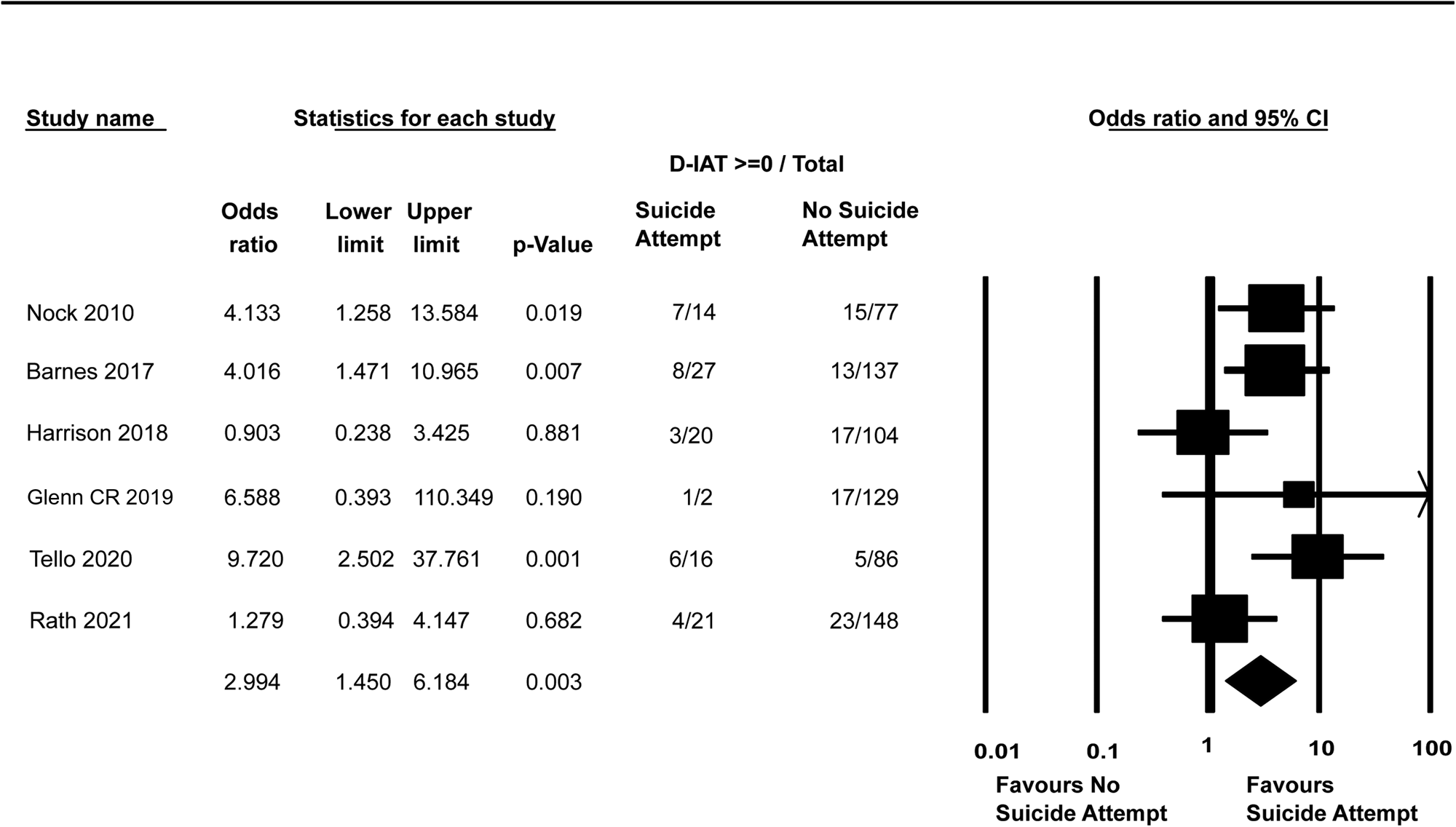
Data were synthesized from six studies (n = 781) that included a prospective examination of the D-IAT and suicide attempts (n = 100, 12.80%) at a six-month follow-up point (Barnes et al., Reference Barnes, Bahraini, Forster, Stearns-Yoder, Hostetter, Smith and Nock2017; Glenn, Millner, Esposito, Porter, & Nock, Reference Glenn, Millner, Esposito, Porter and Nock2019; Harrison et al., Reference Harrison, Stritzke, Fay and Hudaib2018; Nock et al., Reference Nock, Park, Finn, Deliberto, Dour and Banaji2010; Rath et al., Reference Rath, Teismann, Schmitz, Glaesmer, Hallensleben, Paashaus and Forkmann2021; Tello et al., Reference Tello, Harika-Germaneau, Serra, Jaafari and Chatard2020). These analyses revealed that D-IAT scores ⩾ 0 are associated with a suicide attempt over a follow-up period of six-months (OR 2.99, 95% CI 1.45 to 6.18, p = 0.003; Fig. 4). There is evidence for heterogeneity between studies (Q = 8.92, p = 0.11, I 2 = 43.93). A sensitivity analysis excluding the two studies that only followed up with suicide attempters (Nock et al., Reference Nock, Park, Finn, Deliberto, Dour and Banaji2010; Tello et al., Reference Tello, Harika-Germaneau, Serra, Jaafari and Chatard2020) revealed a smaller effect size (OR 2.01, 95% CI 0.88 to4.60, p = 0.10) and no significant heterogeneity (Q = 4.45, p = 0.22, I 2 = 32.62). Study estimate versus study precision is illustrated with a funnel plot (Fig. S7) revealing an asymmetric distribution, though Egger's regression intercept does not indicate significant publication bias (intercept = 0.65, 95% CI −5.96 to 7.26, p = 0.80).
A mixed-effects meta-analysis assessing the predictive odds ratio (OR) of a suicide attempt occurring within six-months when D-IAT scores fall above or equal to zero (OR 2.99, 95% CI 1.45 to 6.18, p = 0.003). Data from Harrison Reference Harrison, Stritzke, Fay and Hudaib2018 was reverse coded such that D-IAT < 0 represents a stronger association with life.

Discussion
To our knowledge, this is the first systematic review and meta-analysis of suicide attempts and the D-IAT, a test designed to measure implicit associations of the self with life and death. Our analyses indicate that individuals with a lifetime history of suicide attempt score higher on the D-IAT than those without a history of suicide attempt, representing a stronger implicit association with death relative to life. We did, however, observe a larger difference between attempters and non-attempters when the task was completed in the community as opposed to acute care settings, where the effect size was substantially lower. When D-IAT scores were dichotomized according to the point of equipoise between life and death, we found evidence for an association with previous suicide attempts. Moreover, prospective evidence from six studies highlighted that this dichotomy was associated with increased odds of a suicide attempt within the next six-months.
Our analyses suggest that the D-IAT may be a useful tool for assessing suicide risk; however, the small effect size we observed, and no difference seen in acute care settings indicate that clinical decisions should not be based solely on the D-IAT in its current form. Indeed, our analyses suggest that the effect size in acute care settings is neither statistically nor clinically significant. Despite this, many of the samples followed in prospective studies in which a D-IAT score ⩾ 0 was associated with an increased risk of future suicide attempts were drawn from acute care settings. This apparent contradiction suggests that associating oneself with death relative to life may be a stable predictor of suicide risk, meanwhile, this reaction time-based tool may be less sensitive during a psychiatric crisis and not suitable as a dimensional indicator of suicide risk (Buyukdura, McClintock, & Croarkin, Reference Buyukdura, McClintock and Croarkin2011; Erickson et al., Reference Erickson, Drevets, Clark, Cannon, Bain, Zarate and Sahakian2005; Greenwald et al., Reference Greenwald, McGhee and Schwartz1998; Keller, Leikauf, Holt-Gosselin, Staveland, & Williams, Reference Keller, Leikauf, Holt-Gosselin, Staveland and Williams2019; Zhu et al., Reference Zhu, Womer, Leng, Chang, Yin, Wei and Wang2019). An alternative interpretation is that there is a selection bias and that the composition of acute care participants without a history of attempt nevertheless represent a population at higher risk for suicide, whereas community ‘control’ samples have a higher representation of individuals at low risk for suicide. In support of this, acute care control samples were predominantly composed of individuals with suicidal ideation or at high risk for suicide (Table S3). Similarly, the mental state of individuals in both attempter and non-attempter groups may differ by setting, influencing D-IAT scores. Notably, the impact of mood states on D-IAT scores has been experimentally demonstrated, with transient increases in D-IAT scores following a negative mood induction protocol (Cha et al., Reference Cha, O'Connor, Kirtley, Cleare, Wetherall, Eschle and Nock2018). Accordingly, the D-IAT may be most useful to screen for suicide risk in community settings in order to identify those at risk for targeted treatment and suicide prevention.
If the D-IAT is a stable predictor of suicide risk, it may be a useful outcome for intervention studies. However, several studies suggest limited or no effect of existing treatments on D-IAT scores (Millner et al., Reference Millner, Augenstein, Visser, Gallagher, Vergara, D'Angelo and Nock2019; Price, Nock, Charney, & Mathew, Reference Price, Nock, Charney and Mathew2009, Reference Price, Iosifescu, Murrough, Chang, Al Jurdi, Iqbal and Mathew2014). Though there is uncontrolled data suggesting that D-IAT scores decrease over the course of psychiatric hospitalization (Ellis et al., Reference Ellis, Rufino and Green2016; Glenn et al., Reference Glenn, Kleiman, Coppersmith, Santee, Esposito, Cha and Auerbach2017a), it is unclear whether this represents a treatment effect or practice effects. The strongest treatment data to date comes from a pair of ketamine infusion studies that suggest the D-IAT remains stable despite improvements in depressive symptoms and decreases in self-reported suicidal ideation. In an initial uncontrolled study, there was no change in D-IAT scores despite patient-reported improvements in depression and suicidal ideation after a single subanaesthetic ketamine administration (Price et al., Reference Price, Nock, Charney and Mathew2009). This was followed by a randomized midazolam-controlled trial of intravenous ketamine treatment where again, D-IAT scores remained stable while explicit ratings of depressive symptoms and suicidal ideation decreased (Price et al., Reference Price, Iosifescu, Murrough, Chang, Al Jurdi, Iqbal and Mathew2014).
As a marker of vulnerability for subsequent suicidal behaviour, future research should determine the neural basis of the D-IAT. This would inform the design of biological interventions that strengthen associations between the self and life and determine whether this is associated with lower rates of future suicidal behaviour. A limited number of studies have identified potential biomarkers of D-IAT scores (Ballard et al., Reference Ballard, Reed, Szczepanik, Evans, Yarrington, Dickstein and Zarate2019, Reference Ballard, Gilbert, Fields, Nugent and Zarate2020; Ho et al., Reference Ho, Cichocki, Gifuni, Catalina Camacho, Ordaz, Singh and Gotlib2018, Reference Ho, Teresi, Ojha, Walker, Kirshenbaum, Singh and Gotlib2021). For example, when completing the D-IAT during a functional MRI, healthy participants have higher blood-oxygen-dependent signal, during the death-me as compared to life-me blocks of the task (Ballard et al., Reference Ballard, Reed, Szczepanik, Evans, Yarrington, Dickstein and Zarate2019). This difference is largest in the bilateral anterior insula and inferior frontal gyri. Similarly, magnetic encephalography has shown differences in functional connectivity between individuals in suicidal crisis and healthy controls when associating the self with life compared to death (Ballard, Gilbert, Fields, Nugent, & Zarate, Reference Ballard, Gilbert, Fields, Nugent and Zarate2020). Another pair of studies demonstrated that smaller striatal grey matter volume is both negatively associated with current D-IAT scores and predicts higher D-IAT scores 2-years later (Ho et al., Reference Ho, Cichocki, Gifuni, Catalina Camacho, Ordaz, Singh and Gotlib2018, Reference Ho, Teresi, Ojha, Walker, Kirshenbaum, Singh and Gotlib2021). This literature is nascent, and future studies should consider investigating biological markers with the D-IAT to elucidate the neurobiological basis of suicide and test the malleability of D-IAT scores and subsequent suicidal behaviour.
Limitations
A significant limitation of this systematic review and quantitative synthesis is the preponderance of small studies and potential evidence of publication bias. Significant publication bias was only found for continuous reporting of the D-IAT, where smaller published studies were more likely to report small or null associations with suicide attempts (Fig. S5). Methodological and statistical heterogeneity is also observed in the included studies, in part accounted for by setting and sex distribution. By including pooled data from samples with different primary diagnoses, our pooled estimates lack specificity to one clinical population and generalizability remains to be determined. An important consideration for future individual patient data meta-analyses is to control for depressive symptoms (Ellis et al., Reference Ellis, Rufino and Green2016; Glenn et al., Reference Glenn, Kleiman, Coppersmith, Santee, Esposito, Cha and Auerbach2017a). Finally, the D-IAT provides a relative measure of association with life and death, which has certain psychometric limitations such that self-identifying with life or identifying others with death is represented similarly in the final D-IAT score. Alternative means of scoring the D-IAT to decompose ‘Me’ and ‘Not Me’ associations (O'Shea et al., Reference O'Shea, Glenn, Millner, Teachman and Nock2020), and novel methods of decomposing implicit processes (Conrey, Sherman, Gawronski, Hugenberg, & Groom, Reference Conrey, Sherman, Gawronski, Hugenberg and Groom2005), should be considered as this literature grows.
Conclusions
The D-IAT may have a role in supplementing suicide risk assessment, particularly in community settings where it may identify individuals to help inform suicide intervention and prevention efforts. In its current form, however, determination of acute suicide risk and related clinical decisions should not be based on the D-IAT. Additional research is required to determine whether D-IAT scores are modifiable by psychological, pharmacological, and somatic treatments, and whether this is associated with a change in suicidal behaviour.
Supplementary material
The supplementary material for this article can be found at https://doi.org/10.1017/S0033291721002117.
Acknowledgements
Maya N. Sohn is supported by the Canadian Institute of Health Research (CIHR) Canada Graduate Scholarship-Masters. Previously unpublished data were generously provided by study authors.
Author contributions
MS was involved in the conception of the study, performed the literature search, extracted data, contacted authors, performed meta-analyses, wrote the manuscript, and created figures. CM was involved in the conception of this study, resolved any discrepancies in studies to be included, and edited the manuscript. SB was involved in the conception of the study and edited the manuscript. AM is the guarantor, he was involved in the conception of the study, performed an independent review and extraction of the data, contacted authors, edited the manuscript, and created figures. All authors have read and approved the final manuscript.
Financial support
This study was supported by the Campus Alberta Innovation Program Chair in Neurostimulation (AM).
Funding
Campus Alberta Innovation Program Chair in Neurostimulation (AM).
Conflicts of interest
None.