Clostridioides difficile infection (CDI) is one of the most common causes of healthcare-associated infection, and it is associated with high morbidity and mortality. Diarrhea, the principle symptom of CDI, is common in hospitalized patients, and it is often attributable to various noninfectious etiologies such as laxative use, enteral feeding, cancer chemotherapy, and inflammatory bowel disease.Reference McDonald, Gerding and Johnson1 Currently available diagnostic tests cannot reliably distinguish CDI from asymptomatic carriage of C. difficile,Reference McDonald, Gerding and Johnson1 and the prevalence of C. difficile colonization is generally reported in the range of 3% to 21% among hospitalized patients.Reference Crobach, Vernon and Loo2 This situation is problematic because testing patients with a low pretest probability of C. difficile can lead to unnecessary treatment of asymptomatic patients. This, in turn, perturbs host intestinal microbiotaReference Cannon, Byrne and Happe3 and predisposes the patient to vancomycin-resistant Enterococcus (VRE).Reference Al-Nassir, Sethi, Li, Pultz, Riggs and Donskey4 Furthermore, hospital-onset CDI (HO-CDI) is a publicly reported complication of hospitalization and is part of the Centers for Medicare & Medicaid Services (CMS) Hospital Value-Based Purchasing Program, which impacts CMS payment to hospitals.5 Therefore, consensus guidelines recommend that C. difficile testing be performed only in symptomatic patients without alternative causes of diarrhea.Reference McDonald, Gerding and Johnson1
At Michigan Medicine, internal infection prevention data demonstrated that 44% of C. difficile testing is performed in patients with alternative causes of diarrhea. In July 2017, an electronic health record (May 2019 version; Epic Systems, Verona, WI) best-practice alert (BPA) was instituted alerting providers ordering C. difficile testing if their patient had received any of the following in the prior 48 hours: laxatives, oral contrast, or initiation of enteral feeds. Re-evaluation of diarrhea was recommended 48 hours after receipt of oral contrast, initiation of tube feeds, or stopping laxatives in clinically stable patients. Providers could override the BPA by documenting a reason. An analysis conducted 6 months after the implementation of this change showed that only 416 of 1,284 (32.4%) orders in patients with alternative causes of diarrhea were cancelled.Reference Mills, Chang and Rao6 Thus, we explored whether adding a mandatory prior authorization by ASP pharmacists would improve testing appropriateness.
Methods
Setting and testing
In this single-center, quasi-experimental study, we assessed the impact of adding prior approval to the pre-existing BPA on C. difficile testing rates. The study took place at Michigan Medicine, a 1,000-bed tertiary-care academic medical center in Ann Arbor, including the 250-bed C.S. Mott Children’s Hospital.
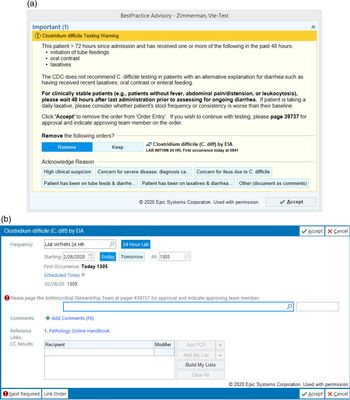
During the 3-month preintervention period from June 12, 2019, to September 10, 2019, providers were able to override activated BPAs. During the intervention period of September 11, 2019, to December 10, 2019, the wording in the BPA was revised to include the antimicrobial stewardship prior authorization requirement if overriding the alert. Additionally, a hard-stop was integrated into C. difficile orders using a required field for entry by the approver (Fig. 1a and 1b). The approver field was programmed to conditionally become visible between 7:00 am and 11:00 pm for C. difficile enzyme immunoassay (EIA) orders placed on patients who had been hospitalized for at least 72 hours. Outside this time frame, providers were able to override the BPA without needing approval similar to the preintervention period. This programming was applied to provide balance between workload concerns and the desire to achieve intervention on as many HO-CDI cases as possible. To complete and sign the order in these scenarios, providers were required to page a dedicated “C difficile Testing Approval” pager to discuss the appropriateness of testing. This pager was staffed by antimicrobial stewardship program (ASP) pharmacists. If approval was granted, the provider would select the approver’s name from a drop-down list and the order could proceed. If approval was not granted, the provider could not proceed with the order. If the provider disagreed with decision of the pharmacist, the case was escalated to the on-call antimicrobial stewardship physician. During the approval process, ordering clinicians were educated by the pharmacists about appropriate use of C. difficile testing.
a and 1b. Best-practice alert (BPA) for enzyme immunoassay (EIA) testing. Upon test order entry, provider will encounter an onscreen warning that patient has alternative cause(s) for diarrhea. If provider wishes to proceed with testing, by clicking “Keep,” a required field becomes visible on the order between 7:00 am and 11:00 pm, asking them to obtain approval and to select the approver’s name from a drop-down list once approval is granted.

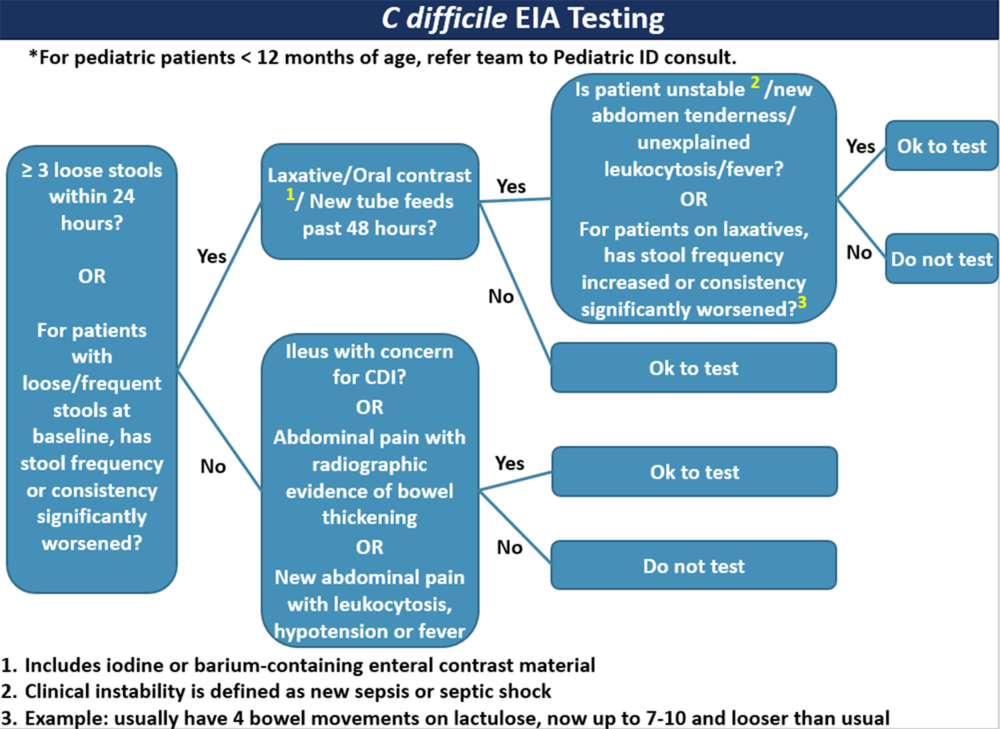
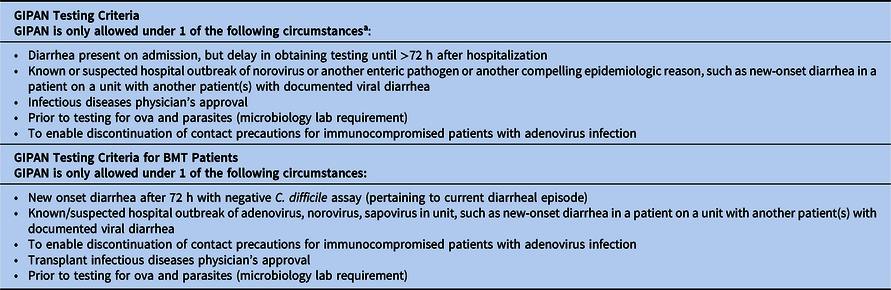
Michigan Medicine laboratories also offered a molecular multiplex gastrointestinal pathogen panel (GIPAN), which includes a C. difficile PCR (BioFire FilmArray gastrointestinal panel, BioFire Diagnostics, Salt Lake City, UT). Institutional guidance provided in the order recommended using the GIPAN primarily to diagnose community-onset diarrhea (diarrhea occurring ≤72 hours after admission) of suspected infectious etiology. To prevent substitution of GIPAN for EIA in patients requiring EIA prior authorization, prior authorization was also implemented for GIPAN orders. Approval through the same process was required for all GIPAN orders >72 hours after admission or for repeat testing during the same admission. To standardize the approval criteria amongst approvers, criteria for approval of EIA and GIPAN testing were developed by ASP and infection prevention physicians. These criteria were approved by the Divisions of Infectious Diseases and Pediatric Infectious Diseases (Fig. 2 and Table 1). Pharmacists documented all calls on a secure web-based platform.
Clinical decision support algorithm with criteria for approval of enzyme immunoassay (EIA) testing. Note. ID, infectious diseases; CDI, Clostridioides difficile infection.

Criteria for GIPAN Testing Approval

Note. GIPAN, gastrointestinal panel; BMT, bone marrow transplant.
a Refer to BMT criteria for profoundly immunosuppressed patient guidance; that guidance is generally applicable to such patients (ie, hematology/oncology patient who is profoundly neutropenic with flourid new-onset diarrhea and negative for C. difficile by enzyme immunoassay [EIA]).
No other intervention targeting C. difficile prevention or diagnostic stewardship was initiated during the study periods. However, the following efforts were implemented prior to the study and remained in place throughout the study period. A separate BPA advised against EIA testing in patients ≤1 year of age and recommended a pediatric infectious diseases consultation prior to testing. The microbiology laboratory examined stool samples submitted for C. difficile testing and rejected formed stools. C. difficile testing was performed using a multistep algorithm,Reference Solomon and Milner7 using a combined glutamate dehydrogenase (GDH) antigen EIA and toxin A/B EIA (C. Diff QuikChek Complete, Alere, Kansas City, MO). If both tests were positive, the assay was reported as positive. If both tests were negative, the assay was reported as negative. If the results were discordant (ie, GDH +/toxin−), polymerase chain reaction (PCR) for presence of toxin B gene (tcdB) was performed using the Simplexa assay (Focus Diagnostics, Cypress, CA) to determine the final interpretation. Both C. difficile testing and GIPAN testing were performed on demand. There were no changes in hospital room cleaning protocols or equipment disinfection during the study periods.
Data collection and analysis
The primary outcome was the change in the rate of EIA testing per 1,000 patient days. Secondary outcomes included the change in rate of HO-CDI per 10,000 patient days and change in rate of GIPAN orders per 1,000 patient days. Orders placed >72 hours after admission were evaluated, as these were the target of our intervention. A safety analysis was performed for all denied requests to ascertain whether denial resulted in a delayed diagnosis, whereby the patient chart was queried for subsequent positive EIA results. Testing and HO-CDI data were generated from Department of Pathology and Infection Prevention databases, respectively. Since all calls were documented, we also sought to describe call volume, timing, and result. The study was granted exempt status by the University of Michigan Institutional Review Board.
Statistical analysis
Descriptive statistics were used to summarize the data. Since the variables were not substantially skewed, means and standard deviations were used for continuous variables. Counts and percentages were used for categorical data. The weekly outcome rates were modeled with interrupted time series (ITS) models from 91 days prior to implementation of the intervention to 90 days thereafter. The regressions included a quasi-Poisson distribution and a log offset of patient days to model the rates. Heteroskedasticity and autocorrelation consistent (HAC) covariance structures were used to adjust for autocorrelation (R package “sandwich”).Reference Zeileis8,Reference Zeileis9 The treatment variables in the regressions were main effects, modeling level changes at the point of implementation of the intervention. Time variables were included to account for trends over time. Treatment and time variable interaction models were attempted, but no interactions were statistically significant, so we limited our analysis to main effects. Statistical operations were performed using R version 3.6.1 software.10
Results
During the intervention period, 228 approval requests were received: 139 for EIA, 70 for GIPAN, and 19 for both tests. To adjudicate appropriateness, 2 calls required the involvement of the ASP physician on call; both requests were approved. In addition, 31 (13.6%) requests were fielded for testing on patients on pediatric service lines. An average of 2.5 requests per day were received over the 3-month intervention period, and 83% of the requests occurred between 7:00 am and 5:00 pm. Overall, 83% of EIA test requests were approved and 90% of requests for GIPAN orders were approved. No patient who was denied EIA testing had a subsequent positive result during their admission.
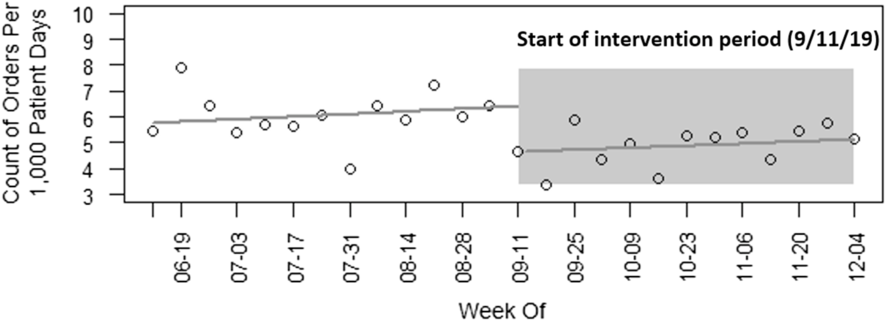
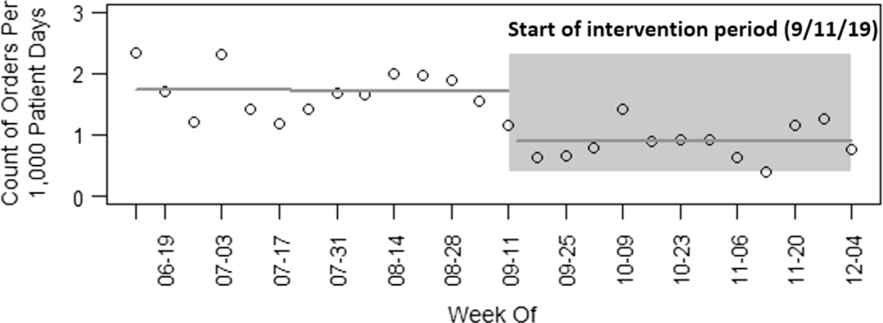
In total, 598 EIA orders were placed during the preintervention period and 486 orders were placed during the intervention period. The weekly rate (mean ± SD) of EIA orders per 1,000 patient days decreased significantly from 6.05 ± 0.94 before the intervention to 4.87 ± 0.78 after the intervention (IRR, 0.72; 95% CI, 0.56–0.93; P = .010) (Fig. 3). Overall, 170 GIPAN orders were placed during the preintervention period and 89 orders were placed during the intervention period, resulting in a significant reduction in weekly rates of GIPAN orders per 1,000 patient days from 1.72 ± 0.37 to 0.89 ± 0.29 (IRR, 0.53; 95% CI, 0.37–0.77; P = .001) (Fig. 4).
Weekly enzyme immunoassay (EIA) ordering rate per 1,000 patient days.

Weekly GIPAN (gastrointestinal panel) ordering rate per 1,000 patient days.

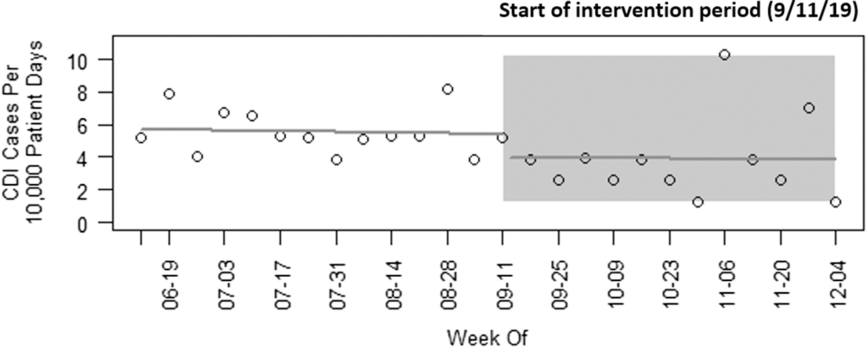
Moreover, 57 HO-CDI cases (including 3 cases in pediatric patients) occurred during the preintervention period and 39 (no pediatric cases) occurred during the intervention period, representing a 32% absolute reduction. Overall, the weekly rate per 10,000 patient days was 5.57 ± 1.39 in the preintervention group and 3.92 ± 2.46 in the intervention group (IRR, 0.74; 95% CI, 0.49–1.11; P = .148) (Fig. 5).
Weekly hospital-onset C. difficile infection (HO-CDI) rate per 10,000 patient days.

Discussion
We investigated the impact of requiring prior authorization for EIA and GIPAN testing by ASP pharmacists on testing rates at an adult and pediatric academic medical center. Our goal was to reduce test utilization in stable patients who likely had an alternative etiology for their diarrhea. Overall, we demonstrated 47% and 28% decreases in GIPAN and EIA testing, respectively, and a 26% (not statistically significant) reduction in the HO-CDI rate.
Our study is not novel in its outcomes; other centers have also demonstrated reductions in C. difficile testing and HO-CDI rates with diagnostic stewardship processes.Reference Quan, Yim and Merrill11-Reference Jakharia, Ilaiwy and Moose14 However, we developed a novel model that was similarly effective and easily integrated into existing resources and infrastructure. Existing models described in the literature were not felt to be an appropriate fit for our institution for several reasons. First, 2 centers utilized a model whereby once or twice daily review of batched orders was performed.Reference Christensen, Varr and Martin13,Reference Jakharia, Ilaiwy and Moose14 Recommendations were made to the primary team to discontinue the order if testing was deemed inappropriate. This model was not considered tenable at our institution because testing was not batched; also, concerns were expressed regarding the condensed workload at the point of review. Another study utilized a process by which preauthorization was required by the microbiology laboratory, which was instructed to approve all requests.Reference Mizusawa, Small and Hsu12 We were concerned about both the increased workload for the microbiology laboratory and the long-term retention of efficacy once clinicians knew that approval was automatic. A final model required prior authorization from infectious diseases or gastroenterology physicians.Reference Quan, Yim and Merrill11 Given the patient load that such services carry at our institution, adding an additional responsibility was not considered feasible.
Given all these factors, we developed a unique model in which antimicrobial stewardship pharmacists received real-time pages for approval. Antimicrobial stewardship pharmacists are uniquely positioned to readily integrate such a process in their workflow because of their responsibility for optimizing care of infectious diseases throughout the institution, their familiarity with prior authorization processes, and their expertise in efficiently and effectively communicating with providers on various infectious diseases initiatives. In addition, since our ASP is active 7 days per week, we were able to provide robust coverage for these services. Importantly, our process was also targeted. We utilized the existing BPA to identify those patients at highest risk of inappropriate testing, and we only required approval for orders >72 hours after admission. As such, we offer an alternative model for institutions implementing C. difficile diagnostic stewardship.
Our study is also unique in that we were able to quantify the workload required to implement our process. When including requests for GIPAN testing, a reduction in overall testing was achieved with only 2.5 calls per day. Remarkably, while we denied just 28 requests for EIA tests, we saw a decrease of 112 orders between the 2 study periods. As such, our study suggests, but does not prove, that the burden of requiring approval may have resulted in providers critically analyzing the appropriateness and necessity of testing. In the process, it apparently led to the preemptive cancellation of a sizeable number of orders. This cancellation could be considered an outsized impact relative to the effort. As such, we argue that pharmacist-driven preauthorization is an efficient means to effective diagnostic stewardship in CDI.
Our study is also the first to combine GIPAN and CDI diagnostic stewardship. The University of Nebraska previously reported a similar intervention for GIPAN testing, which resulted in a 30% reduction in GIPAN ordering rates and a yearly cost savings of $168,000.Reference Marcelin, Brewer and Beachy15 Despite our center having a large population of highly immunosuppressed patients which mandated several exceptions to our approval criteria (Table 1), we found even more substantial reductions in GIPAN use.
Most approval calls were brief in duration (estimated <5 minutes). However, a preponderance of call time was dedicated to education concerning appropriate indications for C. difficile testing. Many clinicians expressed confusion regarding performance characteristics of the different tests (GIPAN and dedicated C. difficile testing), interpretation of the 2-step EIA/PCR assay, and the fact that a positive result may represent colonization rather than clinical infection.Reference Solomon and Milner7 Knowledge about our institutional guidelines for appropriate C. difficile testing was poor, and this intervention facilitated targeted and individualized education for front-line providers. This is likely to have a higher impact than a broad-based educational campaign aimed at all inpatient providers.
The 26% decrease in HO-CDI that we observed was not statistically significant. The short period (3 months) of our study limited the statistical power of this end point. Out of concern for workload, when designing the intervention, we purposefully selected a short pilot period. However, the results illustrated in Figure 5 are striking. First, 10 of the 12 intervention weeks had rates at or below the lowest preintervention weekly rate. In our analysis of the 2 outlier weeks in November 2019, we concluded this finding to be the result of normal variation in C. difficile epidemiology. We could not discern inappropriate approvals when scrutinizing our call logs, and informal infection prevention data showed that the vast majority of overall testing in November was appropriate. As such, we believe that continued intervention would have eventually generated statistically significant results.
Our study has several limitations. Our data reflect practices and outcomes at a single institution that may not be generalizable to other institutions. Some institutions may not have the stewardship or information technology resources available to duplicate our model. Such institutions may adapt components from our model as well as from the alternative models discussed above to develop an optimal, individualized model. For example, daily review of batched tests or approvers other than pharmacists, while not feasible at our center, may be appropriate at other institutions. In addition, our study design was subject to limitations inherent to quasi-experimental studies. We did not account for patient-level variables, and thus cannot attest to whether or not changes in such variables occurred over time. However, we were able to ensure that no other interventions targeting C difficile or GIPAN testing frequency or appropriateness were enacted. Another limitation of our study is that our 3-month intervention period did not allow us to assess the long-term durability of our model. Notably, examination of infection prevention data did not identify any clear association of season with HO-CDI rates (data not presented).
In summary, we developed an efficient C. difficile diagnostic stewardship prior authorization process that targeted both dedicated EIA and GIPAN testing. This intervention was associated with both a significant decrease in testing and a commensurate trend toward lower HO-CDI rates. Such interventions are a promising tool for hospitals seeking to improve C. difficile testing. Additional studies comparing their results with these existing interventions would be useful to better identify best practices.
Acknowledgements
The authors would like to acknowledge Lukas Hager for his assistance in data collection.
Financial support
No financial support for the present study was received.
Conflicts of interest
Krishna Rao is consultant for Bio-K+ International, and for Roche Molecular Systems and is a PI for an investigator-initiated study on the treatment of C. difficile infection sponsored by Merck & Co.