

1. INTRODUCTION
This article reports on a study of the acquisition of argument placement by L2/Ln learners of Norwegian, more specifically subject shift and object shift. These constructions refer to the phenomenon where a pronominal subject or object moves across adverbials/negation, while full DP subjects (typically) and full DP objects (consistently) remain in an unshifted position as illustrated in (1)–(2).
(1)

(2)


Both subject shift and object shift involve considerable micro-variation with respect to the kind of element that may undergo this shift.Footnote 1 Thus, it is to be expected that these fine distinctions may pose a challenge to learners of Norwegian, both L1 children and adults learning it as an L2 (or as a third or fourth language, hence the term Ln, which will be used for the current study henceforth). Several studies have investigated these two constructions in Norwegian child language, based on spontaneous production as well as experimental data (e.g. Westergaard Reference Westergaard, Guijarro-Fuentes, Larranaga and Clibbens2008, Reference Westergaard2011; Anderssen et al. Reference Anderssen, Bentzen, Rodina, Westergaard, Anderssen, Bentzen and Westergaard2010; Anderssen & Westergaard Reference Anderssen and Westergaard2010; Anderssen, Bentzen & Rodina Reference Anderssen, Bentzen and Rodina2012). The general finding is that children initially prefer the unshifted position for both subjects and objects, which is non-target like for pronominal subjects and pronominal objects. Moreover, the target-like constructions are acquired at very different ages for the two phenomena; subject shift before the age of 3 and object shift considerably later (around age 6–7). Importantly, children are shown to be conservative learners in that they never shift an element that does not shift in the adult language (e.g. typically full DPs for subject shift, full DPs and certain pronouns for object shift). In this paper we use an acceptability judgement test to investigate subject shift and object shift in Ln learners of Norwegian and compare them to adult native controls with respect to the micro-variation found in the target language. We also make comparisons with previous data from child language. Our findings show that the adult learners generally prefer all subjects in a shifted position and all objects in an unshifted position, a distribution that corresponds to frequencies found in spoken corpora.Footnote 2 With increasing proficiency, they also become sensitive to some important distinctions, and to some extent exhibit different preferences for pronouns and full DPs. Nevertheless, there are a number of distinctions that they do not make, viz. between subject shift in main and subordinate clauses and between object pronouns with nominal and non-nominal antecedents. Importantly, however, they are not conservative learners, in that they are found to over-accept shifted arguments, in both subject shift and object shift constructions.
2. BACKGROUND
2.1 Subject shift and object shift in Norwegian
Both subject shift and object shift involve movement of nominal elements across adverbials/negation. In this subsection we outline the two phenomena, starting with subject shift. Norwegian is a V2 (Verb Second) language, which means that there is subject–verb inversion in non–subject-initial clauses, resulting in the subject appearing adjacent to adverbials/negation, as in (3)–(5).
(3)
(4)
(5)


Whether the subject precedes or follows these elements is relatively straightforwardly determined by pragmatic/discourse factors: New information and stressed/contrastive subjects follow adverbials/negation, while given and non-contrastive subjects precede adverbials/negation. Pronominal subjects are typically given information and thus precede all adverbials/negation unless they are contrastively stressed,Footnote 3 as shown in (3)–(4). Full DP subjects may appear in either position, as shown in (5).
Numerous syntactic analyses have been proposed to account for this variation in subject placement, and one area of contention is the location of the two subject positions, in the IP (e.g. Cardinaletti Reference Cardinaletti and Rizzi2004, Westergaard & Vangsnes Reference Westergaard and Vangsnes2005, Westergaard Reference Westergaard2011), in the CP (e.g. Wiklund et al. Reference Wiklund, Hrafnbjargarson, Bentzen and Hróarsdóttir2007, Bentzen Reference Bentzen2009) or in between the two (e.g. Nilsen Reference Nilsen1997, Mohr Reference Mohr2005). As this issue is not relevant to our study, we leave this question aside here, and proceed with the general assumption that we are dealing with two subject positions.
The distribution of different subject types in adult Norwegian has been studied in various spoken corpora. For example, reporting on data from the NoTa corpus (Oslo dialect, N = 166), Westergaard (Reference Westergaard2011) shows that in main clauses, 84.7% (1839/2170) of pronominal subjects appear in the shifted position, while only 3.4% (1/29) of full DP subjects shift.Footnote 4 Anderssen & Westergaard (Reference Anderssen and Westergaard2010) find a very similar distribution in Child Directed Speech (CDS), where 87.9% of pronominal subjects shift.Footnote 5 For subject shift, the results from these spoken corpora further reveal that the distribution of nominal types (pronouns versus full DPs) in subject position is very uneven, with subjects overwhelmingly expressed as pronouns (98.7% in NoTa, 94% in CDS). Hence, subjects in general occur much more frequently in the shifted position than in the unshifted position in Norwegian main clauses.
The two subject positions are also found in embedded clauses. However, Norwegian does not display verb movement/V2 in embedded contexts. Thus, the subject appears either immediately following the complementizer, preceding adverbials/negation, or following these elements, as shown in (6). In embedded clauses, both full DPs and pronouns are clearly preferred in the shifted position in the adult language (Westergaard Reference Westergaard2011).
(6)

Anderssen & Westergaard (Reference Anderssen and Westergaard2010) investigate the acquisition of subject shift by L1 learners, using production data from a longitudinal corpus of three children between the ages of 1;9 and 3;3 (years;months). The results show that the children start out with a preference for all subjects in an unshifted position, in both main and embedded clauses, despite the high frequency of shifted subjects in the input. The distribution of subject types in main clauses reaches adult-like levels around age 3, as also confirmed by an experimental study of slightly older children (Anderssen et al. Reference Anderssen, Bentzen, Rodina, Westergaard, Anderssen, Bentzen and Westergaard2010). In embedded clauses, target-consistent (shifted) word order falls into place somewhat later (Westergaard Reference Westergaard2011). This means that while young children (target-consistently) do not make a distinction between pronominal and full DP subjects in embedded clauses, they do make a distinction between the two clause types in the sense that subject shift is not acquired simultaneously in the two. The higher preference for the unshifted position early on is argued to be caused by economy principles in acquisition and a general dispreference for syntactic movement at an early stage of development, which is found in numerous other studies of L1 acquisition (see e.g. Westergaard Reference Westergaard2014 for an overview of Norwegian phenomena). Importantly, children can be shown to be conservative learners (see e.g. Snyder Reference Snyder2007), never shifting an element that does not shift in the adult language.
We now turn to object shift. In object shift constructions, unstressed pronominal objects typically appear preceding all adverbials/negation, while full DP objects never shift across such elements, as seen in (7).
(7)

Not shifting is the only grammatical word order if the pronoun is contrastively stressed, seen in (8).
(8)

Another restriction on object shift depends on whether the object has a nominal antecedent or not (see e.g. Andréasson Reference Andréasson, Butt and Holloway King2008, Reference Andréasson, Butt and King2010; Anderssen & Bentzen Reference Anderssen and Bentzen2012). Objects with nominal antecedents typically shift, as shown in (9), where the pronominal object det ‘it’ refers to the skirt. In this and the next a-example, the antecedents of the pronouns are in bold.
(9)

However, when the pronominal object refers to a non-nominal element, such as a clause, there is generally no object shift. In (10), the antecedent of the pronominal object det ‘it’ is the embedded clause ‘that they shall move’.
(10)

Object shift has been argued to be a defocusing operation (see Holmberg Reference Holmberg1999, Mikkelsen Reference Mikkelsen2011). Thus, objects that are not focused have to leave the focus domain (the VP) and shift to a position preceding adverbials/negation. An object that remains in the VP (and consequently follows adverbials/negation) will receive a focus interpretation (in line with the pragmatic principle of end focus, see e.g. Firbas Reference Firbas1992, Halliday Reference Halliday1967, Gundel Reference Gundel1985). Anderssen & Bentzen (Reference Anderssen and Bentzen2012), on the other hand, suggest that object shift has to do with topicalization rather than focus, and they argue that a topical object obligatorily has to move to a topic position higher in the structure.
Compared to subject shift, object shift is relatively infrequent in spoken language. In a 13-hour sample of child-directed speech investigated in Anderssen et al. (Reference Anderssen, Bentzen, Rodina, Westergaard, Anderssen, Bentzen and Westergaard2010), there were 157 examples of subject shift and only three examples of object shift. According to Westergaard (Reference Westergaard, Ferraresi and Lühr2010), the main reason for this is that, while subjects are realized as pronouns much more often than as full DPs (see previous section), the opposite is true for objects. Based on a sample of spontaneous speech from the NoTA corpus (multiple conversations between two speakers), Westergaard reports that objects constitute full DPs or clauses 66.4% (142/214) of the time, while pronouns (personal, reflexive as well as det ‘it/that’) make up only 32.7% (70/214) of all objects (leaving 0.9% for miscellaneous). Moreover, the corpus study in Bentzen, Anderssen & Waldmann (Reference Bentzen, Anderssen and Waldmann2013) show that 83.5% (237/284) of pronominal objects have a non-nominal antecedent. While pronominal objects with nominal antecedents overwhelmingly undergo object shift in their study (87%), pronominal objects with non-nominal antecedents almost consistently remain in situ (95%).Footnote 6
Previous research on language acquisition has found that children start out with all objects unshifted, and has argued that this is a result of conservative learning (Anderssen et al. Reference Anderssen, Bentzen, Rodina, Westergaard, Anderssen, Bentzen and Westergaard2010). Furthermore, children begin to show a preference for shifted objects considerably later than for subject shift (subject shift: before age 3), as object shift is still not completely acquired at the age of 6–7 (Anderssen et al. Reference Anderssen, Bentzen and Rodina2012). In Anderssen et al. (Reference Anderssen, Bentzen, Rodina, Westergaard, Anderssen, Bentzen and Westergaard2010) it is argued that this delay is due to the considerable discrepancy in input frequency between the two constructions. Anderssen et al. (Reference Anderssen, Bentzen and Rodina2012) argue that this may also be attributed to object shift being more complex than subject shift, in that there are more restrictions to be acquired.
2.2 Acquisition of movement: L1 and L2
As mentioned in the introduction, the acquisition of subject shift and of object shift follow similar paths, in that children initially tend to place all subjects and objects in the unshifted position. When children start applying the shifting operation, they do so conservatively, in the sense that they only move elements that may appear in shifted position in the adult language, and never move elements that do not shift.
For a number of other syntactic movement phenomena, it has been shown that there are differences between L1 and (adult) L2 acquisition, in that L2 learners are not conservative, but may instead be found to overgeneralize movement. A well-known example is V2 word order, i.e. verb movement to the second position of the clause (normally argued to be the C position). In L1 acquisition, development of verb movement and finiteness morphology typically go hand in hand, attested for e.g. German, Dutch, Danish, Swedish and Norwegian (see Poeppel & Wexler Reference Poeppel and Wexler1993, Haegeman Reference Haegeman1995, Hamann & Plunkett Reference Hamann and Plunkett1998, Platzack Reference Platzack and Clahsen1998, Blom Reference Blom2003, Westergaard Reference Westergaard2009). At an early stage, children produce utterances where the uninflected verb remains in the VP, i.e. there is no verb movement, while the verbs that do move to second position are always finite (Wexler Reference Wexler, Boeckx and Grohmann2013). Thus, L1 learners never move the infinitival verb to the V2 position. Adult L2 learners differ from L1 learners in this domain in that they fail to distinguish between finite and non-finite verbs. There is vast evidence of non-target movement of non-finite verbs to the V2 position, and there is evidence of failure to move the finite verb to the V2 position (e.g. Clahsen, Meisel & Pienemann Reference Clahsen, Meisel and Pienemann1983, Meisel Reference Meisel and Meisel1994, Prévost & White Reference Prévost and White2000, Eide Reference Eide and Eide2015). These findings suggest that with regard to verb movement, children are conservative, while L2 learners may overgeneralize movement, also where their input lacks evidence for such movement.
Another movement phenomenon where differences between L1 and L2 learners are documented is scrambling, which is often described as movement of the object across an adverbial. Unsworth (Reference Unsworth2005) found that both child and adult L2 learners of Dutch go through a stage not attested among L1 learners, where they fail to scramble. She argues that the lack of scrambling is due to transfer from the L2 learner's L1 English. Thus, in addition to L2 learners being different from L1 children in that they are not conservative learners, influence from the L1 may also play a role.
To sum up, there are detected differences between L1 and L2 learners for different phenomena involving syntactic movement. For verb movement, L1 learners are found to be conservative, while L2 learners both allow non-target movement and show lack of target-like movement. For scrambling, L2 learners go through a stage not found in child L1 acquisition, in which they fail to scramble.
3. RESEARCH QUESTIONS
The main purpose of this paper is to investigate to what extent Ln learners of Norwegian are sensitive to the micro-variation found in subject shift and object shift constructions. Given that we already know quite a lot about L1 acquisition, we would also like to compare this to the L1 acquisition of these phenomena in order to identify similarities and differences, both in terms of extent to which the learners are sensitive to the relevant micro-variation and with regard to the developmental paths exhibited by the learners. Making this comparison is not straight forward. The child language data that we reported on in the previous section come either from corpora, which involve naturalistic production, or from experimental studies, which also involve production data. In the current study we compare these to judgement data. This is not unproblematic, but there is good reason to believe that the structures that are judged as grammatical (receive a high acceptability score) are the ones that would be used in a production study by the same informant. Equivalently, we expect participants to be unlikely to produce structures that they consider ungrammatical.
Similarly, while the child language studies can consider developmental paths because they are longitudinal (corpora) or cross-sectional (experimental studies involving different age groups), this is not so easy to ensure with adult second (or third, fourth etc.) language learners. In order to be able to consider language development, we included three groups of speakers assumed to be at different proficiency levels. To measure proficiency, we assumed that the level of the Norwegian course that they were attending (levels 1–3) would reflect this, and further included a cloze test in the study in order to ensure that these levels reflected their actual language competence, and as we will see in the next section, they do. In this sense, we are expecting to see a developmental path towards a more target-like Norwegian in these Ln learners. Naturally, the expectation is that the higher proficiency the Ln learners have in Norwegian, the more target-like their behaviour will be with subject shift and object shift.
This further means that we are abstracting away from the influence of the L1, even though we obviously acknowledge that any previously acquired language will influence the acquisition process (see e.g. Odlin Reference Odlin and Chapelle2013). However, the current study was not designed with this in mind, and as a result, the L1 of the participants (and other previously acquired languages) was not sufficiently controlled for to include this as a factor.Footnote 7 Thus, the focus of the current study is the extent to which the Ln learners are sensitive to the micro-variation in Norwegian with regard to subject and object placement the way adult native speakers are, and to what extent their behaviour is compatible with the same kinds of factors as those observed in child L1 acquisition. For example, can the Ln learners be shown to avoid syntactic movement, how sensitive are they to the frequency of the different structures and do they make big, sweeping generalizations regarding the behaviour of categories such as subject and object or do they take different subcategories (e.g. pronominal vs full DPs) into account? We included a group of adult L1 Norwegian speakers in order to have a target baseline to compare the Ln learners to when it comes to the preferences for the different word orders with the different realizations of the subjects and the objects.
Given these considerations, our research questions are formulated as follows:
1. Sensitivity to micro-variation
a. Are Ln learners sensitive to the distinction between pronominal and full DP subjects and objects in a similar way to L1 speakers?
b. Concerning subject shift, do Ln learners distinguish between main and subordinate clauses, in a similar way to L1 speakers?
c. Concerning object shift, do Ln learners distinguish between pronominal objects with a nominal and a non-nominal antecedent, in a similar way to L1 speakers?
If the learners are sensitive to the micro-variation in the input, we would expect the Ln learners to exhibit similar preferences to the control group (the L1 adults). On the assumption that our results will match previous studies, this means that we expect the following: (i) the learners should give a high acceptability score to shifted pronominal subjects and objects (the latter only when it has a nominal antecedent) and a low score to shifted full DPs; (ii) they should provide a higher acceptability score to shifted full DP subjects in subordinate clauses than in main clauses; and (iii) they should distinguish between pronominal objects with nominal and non-nominal antecedents, and give the former a high score in the shifted position and the latter a high score in the unshifted position.
1. Mastery of the patterns
a. Do Ln learners, like L1 children, have a preference for unshifted subjects and objects? Is this related to general proficiency?
b. Do Ln learners master subject shift before object shift, like L1 children; i.e. what is the correlation between mastery of subject/object shift and general proficiency?
If Ln learners can be shown to give both subjects and objects (of all nominal types) a high score when they occur in the unshifted position, this would be similar to the production preferences of L1 children, which is to leave all subjects and objects in situ. On the assumption that the conclusions drawn in previous studies are correct, this would further suggest that Ln learners also are guided by economy principles (avoid movement). If this is related to proficiency, we would expect less proficient learners to have a stronger preference for unshifted subjects and objects than more proficient ones. Finally, if there is a stage at the lower proficiency level during which Ln learners can be shown to give pronominal and full DP subjects a high acceptability score and pronominal and full DP objects a low score, this would be equivalent to what has been observed in production studies with children, as they go through a stage when they shift subjects but not objects in production. Naturally, we expect more proficient Ln learners to provide acceptability scores that are more similar to the native controls.
4. METHODOLOGY AND PARTICIPANTS
4.1 Participants
In total 59 learners of Norwegian and a number of native controls completed two tests: one targeting object shift and one targeting subject shift. The L1 speakers were recruited through Facebook, where speakers of the local dialects from two regions, the counties of Troms and Trøndelag, were asked to take part in a survey. A total of 51 Norwegian speakers (aged 27–62 years, mean 40.8 years) completed the object shift task. Forty-three Norwegian speakers (aged 24–72 years, mean 41.1 years) completed the subject shift task. Thirty-four of these were also among the 51 who did the object shift task. The Ln learners were students enrolled in a ‘Norwegian as a foreign language’ course at two Norwegian universities located in the counties that the L1 participants were recruited from. The students came from different parts of the world and were enrolled in three different levels of Norwegian courses. According to the official course descriptions, upon completion of the first of these courses, students are expected to have a proficiency at A2/B1 level according to the Common European Framework of Reference for Languages (CEFR). After the second course, proficiency is expected to be at level B1/B2, and after the third course, a proficiency at level B2/C1 is expected. The number of participants enrolled in each of the three courses is given in Table 1.
Number of participants enrolled in each course (or course completed in previous semester for those not currently enrolled).

The participants reported to have been learning Norwegian for a period of time ranging between three months and five years, which means that some of the students presumably attended other Norwegian courses or had lived in Norway for some time prior to enrolling in these university courses. Most adult learners of Norwegian are likely to already know two or more languages, including English, and our participants can thus be classified as Ln learners (only a few were true L2 learners – generally those with English as their L1, hence we use the term Ln rather than L2).
The participants provided information about their first language(s) and potential further language knowledge. All of the Ln learners had some proficiency in English, but otherwise they had a variety of language backgrounds. As many as 27 languages were listed as L1s, the most common ones being English (14), German (7), Spanish (7), Russian (6), and Dutch (5). As is well known, a large body of research over many decades has shown that crosslinguistic influence may have major effects in Ln acquisition (see e.g. Odlin Reference Odlin and Chapelle2013 and references therein), and as we have seen, the relevant information about the learners’ L1s was collected for this study, and thus, it would be possible to check whether this had any effect on the participants’ performance. However, as the participants were not recruited with this in mind, this factor was not controlled for sufficiently and has not been included in the analysis. Indeed, we did run statistical analyses including this factor; we did not get any significant results, but the analyses did reveal some tendencies which suggest that if the factor had been included from the outset, it would probably have had an effect.
In addition to the questions about language background and length of exposure to Norwegian, we also checked the participants’ general Norwegian proficiency by including a cloze test consisting of 20 items, targeting the participants’ general lexical and morphosyntactic knowledge of Norwegian. According to the cloze test, proficiency did not turn out to vary greatly between the L1 groups, the overall proficiency mean being 14.1 (out of a maximum score of 20; SD = 4.25). As expected, proficiency scores increased with higher course levels.
4.2 Materials and procedure
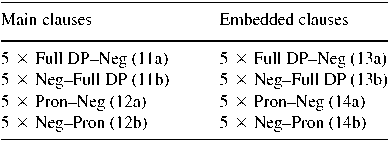
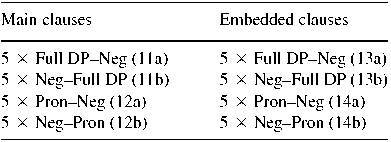
The L1 Norwegian data were collected through an electronic survey distributed on the Survey Gizmo platform. The object shift survey was sent out first and the subject shift survey followed approximately a week later. The reason for this interval between tests was to avoid test fatigue and to avoid priming effects between the two structure types. The Ln data were collected in conjunction with Norwegian as a foreign language classes through the Survey Gizmo platform. In Tromsø, the object shift survey was distributed to the students in class, while the subject shift survey was distributed via email a week later. In Trondheim, both the object shift and the subject shift survey were distributed via email, the object shift survey first and the subject shift survey a week later. In total, 76 participants completed the object shift survey and 59 of these also completed the subject shift survey. The subject shift survey contained 80 sentences, 40 of them involving subject shift. The 40 test sentences included 20 main clauses and 20 embedded clauses, all containing structures where full DPs or pronominal subjects (Pron) either preceded or followed negation, as illustrated in Table 2. All full DPs were proper nouns. In our discussion, we refer to the distinction between pronominal and full DPs as one of ‘nominal type’. The remaining 40 sentences were either fillers or targeted other grammatical phenomena such as verb placement in embedded clauses. Examples (11)–(14) illustrate the type of test sentences included in the subject shift survey.
(11)
(12)
(13)
(14)


Types of sentences in the subject shift survey.
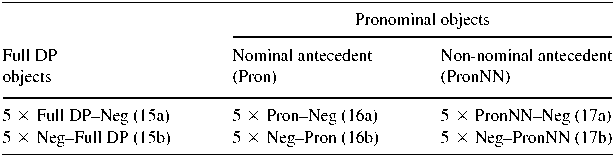
The object shift survey consisted of a total of 50 sentences, of which 30 directly targeted object shift and the remaining 20 were fillers. The test sentences were all main clauses and included structures where (definite or indefinite) full DP objects or pronominal objects with nominal or non-nominal antecedents (Pron and PronNN) either preceded or followed negation, as shown in Table 3. Examples (15)–(17) illustrate the type of test sentences included in the object shift survey.
Types of sentences in the object shift survey.

Each item consisted of two sentences: one sentence providing some background, followed by a target sentence with a shifted or unshifted argument. The test set included a shifted and an unshifted version of each item. In the target sentences with object pronouns, the antecedent of the pronoun was always introduced in the preceding sentence, see examples (16) and (17).
(15)
(16)
(17)


The sentences were shown in a pseudo-randomized order, such that the shifted and unshifted version of each item appeared with at least 10 sentences between them. The participants were asked to rate each sentence on a Likert scale from one to six, where 1 = completely unacceptable and 6 = completely acceptable. The use of a scale gives the participants the option to give more nuanced answers, while still capturing the tendencies of acceptance for the different types of examples.
4.3 Method of analysis
In presenting the results, we plot the mean acceptability score for each of the conditions for the L1 and Ln groups with error bars representing a 95% confidence interval. In addition, we analyze the data using mixed effects modelling. For the first three research questions (sensitivity to micro-variation), we investigate how the factors nominal type (full DP, pronoun with nominal and with non-nominal antecedents), syntactic function (subject and object), and Clause Type (Main and Embedded) affect preference for shifting an argument across negation. The dependent variable is what we call the shift preference, which we calculate by subtracting the acceptability score for the unshifted sentence from the acceptability score for the shifted sentence (for each participant and shifted-unshifted item pair). We thus get an 11-point scale, ranging from –5 (lowest possible score (1) for shifted sentence, and highest possible score (6) for the unshifted sentence) to 5. A score of 0 indicates that the shifted and unshifted sentence were assignied the same acceptability score. We estimate the effect of each factor by comparing an intercept-only model to a model containing the relevant predictor. In addition, we consider the interaction of the different predictors. We repeat this procedure for each of the research questions, for both the L1 and the Ln groups. For the two final research questions (mastery of patterns), we correlate the participants’ shift preference in the relevant conditions with their proficiency score. We again use mixed effects modelling with the shift preference as the dependent variable, and we investigate a possible interaction between proficiency score and the relevant condition. In Appendices A–C we include the model coefficients, standard errors and t-values from the full models of the Ln speakers, including procifiency score and linguistic predictors.
5. RESULTS
5.1 Sensitivity to micro-variation
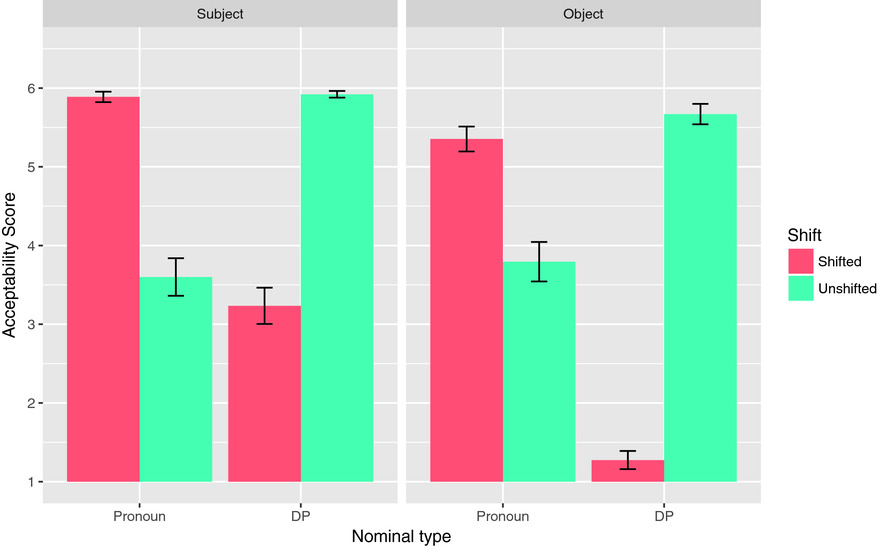
We start by considering the core cases of subject and object shift: full DPs and pronouns (for object shift, with nominal antecedents) in main clauses involving verb movement (research question 1a). For L1 speakers (N = 43/51) there is a strong preference for shifted pronouns and unshifted full DPs, for both subjects and objects, as shown in Figure 1.
L1 speakers’ mean judgement of pronominal and full DP subjects (N = 43) and objects (N = 51).
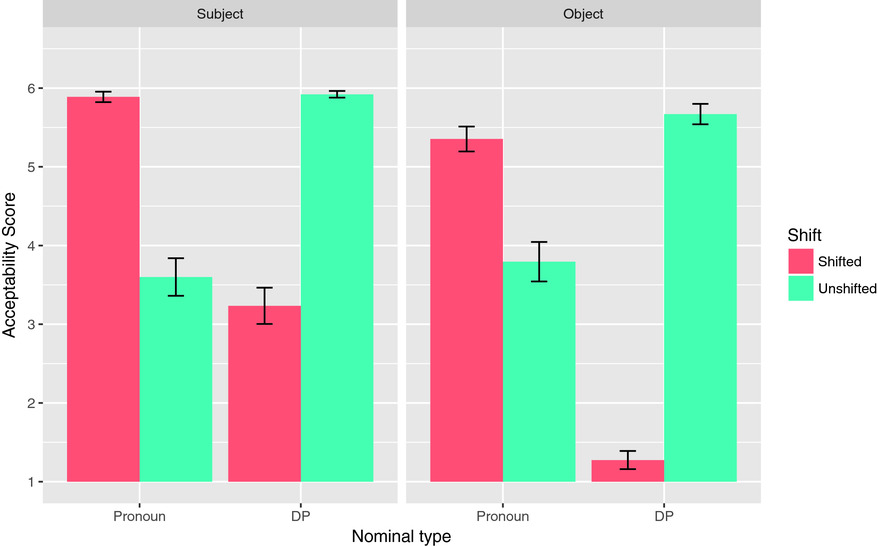
The analysis of the shift preference reveals a main effect of nominal type (χ 2 (1) = 46.024, p < .001), no main effect of syntactic function (χ 2 (1) = 0.92, ns), but an interaction between nominal type and syntactic function (χ 2 (2) = 14.74, p < .001). As we see in Figure 1, both pronominal subjects and pronominal objects are preferred in the shifted position, while DP subjects and DP objects are preferred in unshifted position. The shift preference is slightly smaller for pronominal objects compared to pronominal subjects, and the preference for the unshifted position is higher for full DP objects than for full DP subjects. The results are in accordance with the standard description of argument shift in Norwegian: subject and object pronouns shift, full DP subjects preferably do not shift and full DP objects cannot shift.
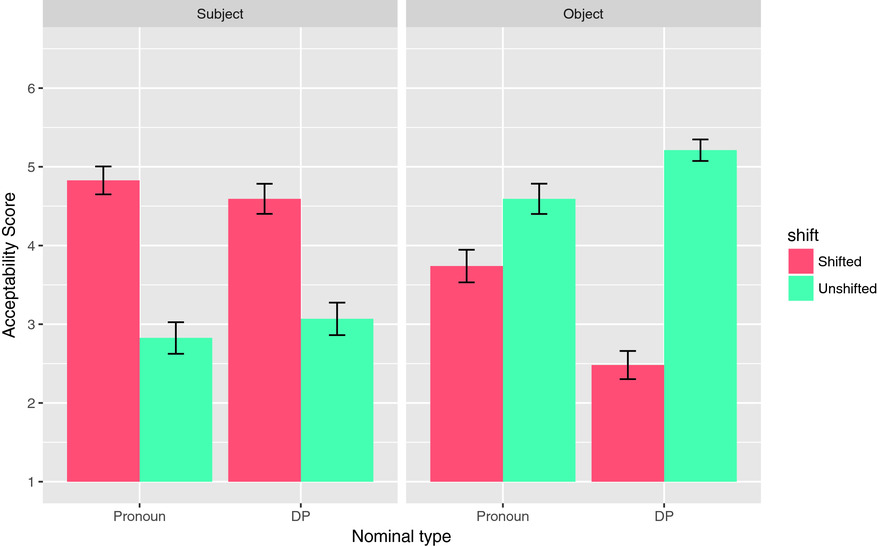
As shown in Figure 2, the results from the Ln speakers look quite the opposite of those from the L1 speakers. We see a general preference for shifted subjects and for unshifted objects. The mixed effects models reveal a main effect of syntactic function (χ 2 (1) = 37.4, p < .001), but not for nominal type (χ 2 (1) = 1.94, ns). Again, we find an interaction between syntactic function and nominal type (χ 2 (1) = 70.2, p < .001). The factor nominal type plays a minor role for objects, but not for subjects.
Ln learners’ mean judgement of pronominal and full DP subjects and objects (N = 59).
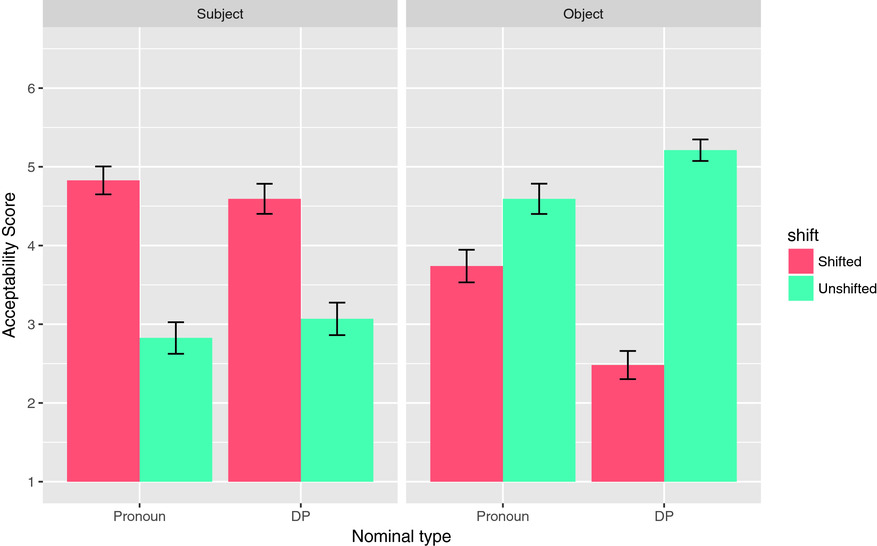
In short, whereas L1 speakers mainly make their choice of argument placement on the basis of the nominal type (pronominal vs. full DP), the Ln speakers make their choice on the basis of syntactic function (subject vs. object). However, both groups show an interaction between the two predictors in the same direction: the effect of nominal type is larger for objects than for subjects. This suggests that the Ln group may be developing towards the preferences of the L1 group.
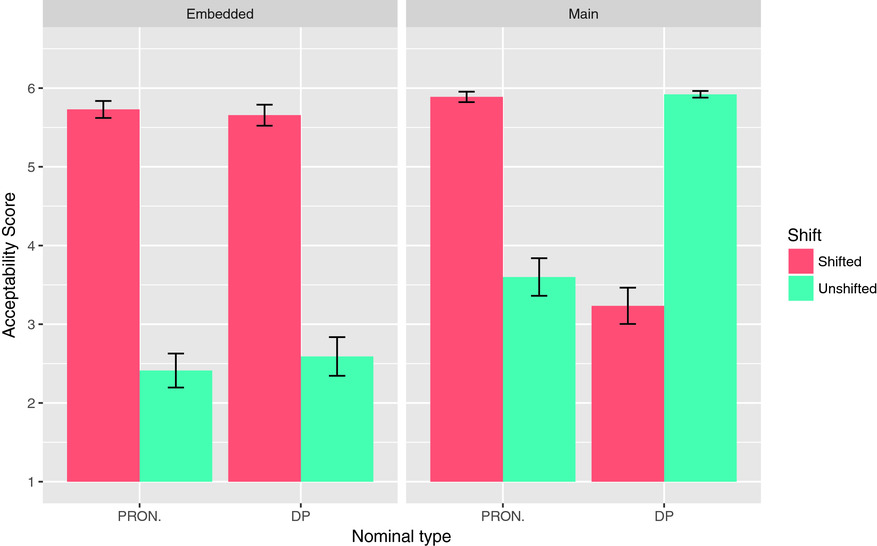
We now move on to research question 1b: Concerning subject shift, do Ln learners distinguish between main and subordinate clauses, in a similar way to L1 speakers? The results for subject placement in embedded clauses for the L1 speakers are shown in Figure 3. We repeat the main clause results here, for a simple comparison.
L1 speakers’ mean judgement of pronominal and full DP subjects in embedded and main clauses (N = 43).
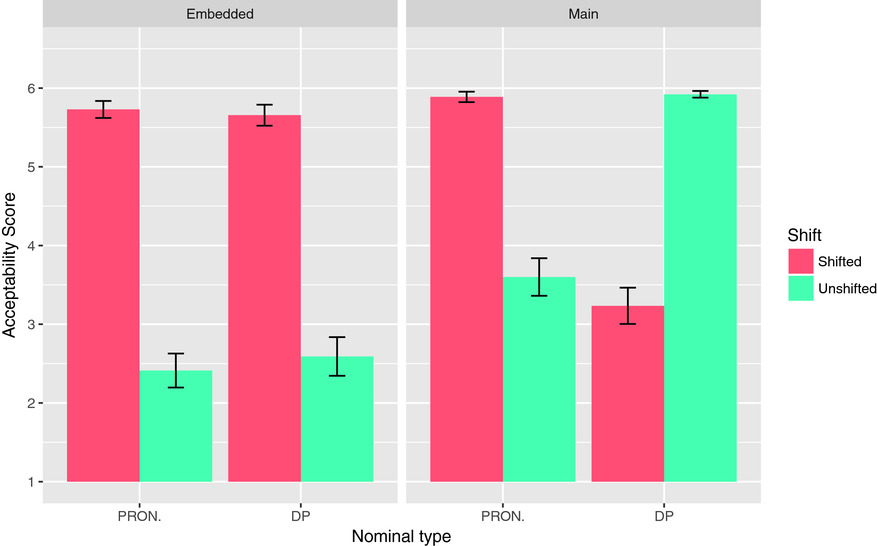
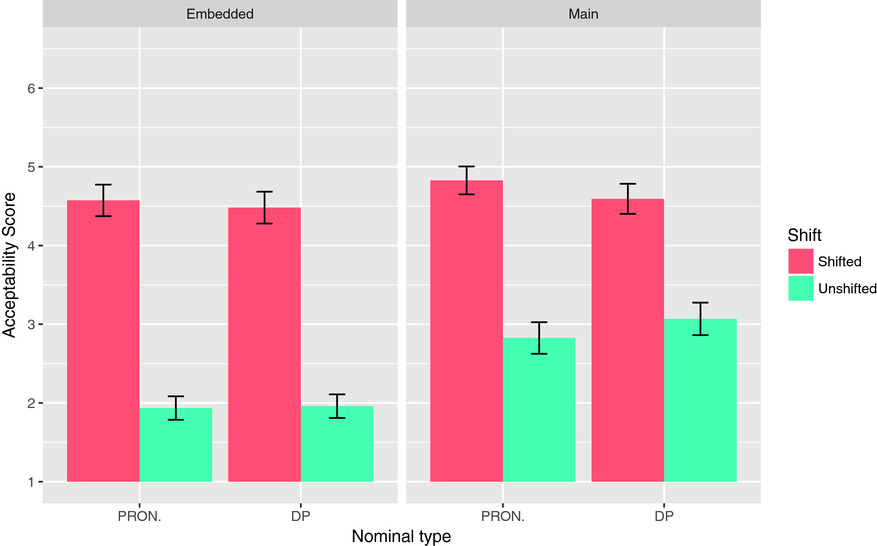
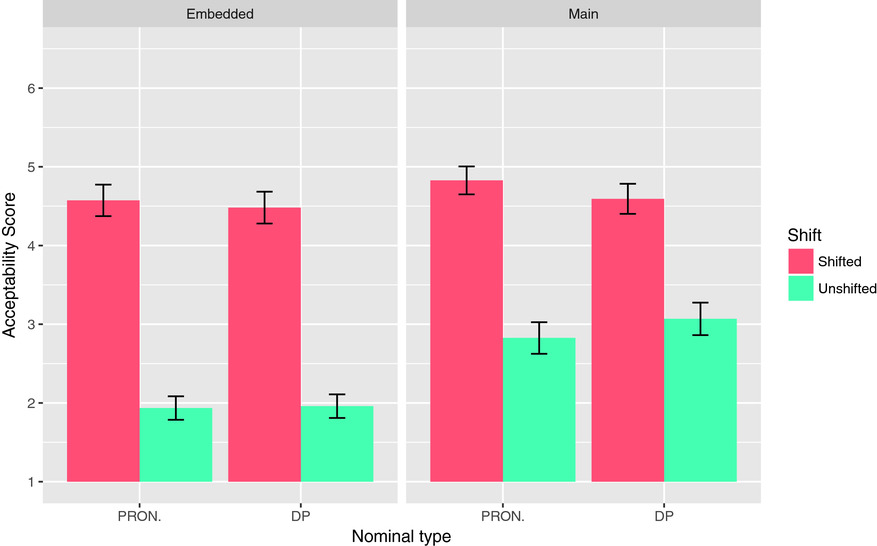
We see a high shift preference for both full DPs and pronouns in embedded clauses, which contrasts with the results for the main clauses, where only pronouns shift. There is no significant effect of nominal type for the embedded subjects. On this point Ln speakers show similar preferences to L1 speakers, as shown in Figure 4. The Ln speakers overall have a significantly higher preference for shifted subjects in embedded clauses compared to main clauses (χ 2 (1) = 19.4, p < .001), and the shift preference is equally strong for pronouns and full DPs.
Ln learners’ mean judgement of pronominal and full DP subjects in embedded and main clauses (N = 59).
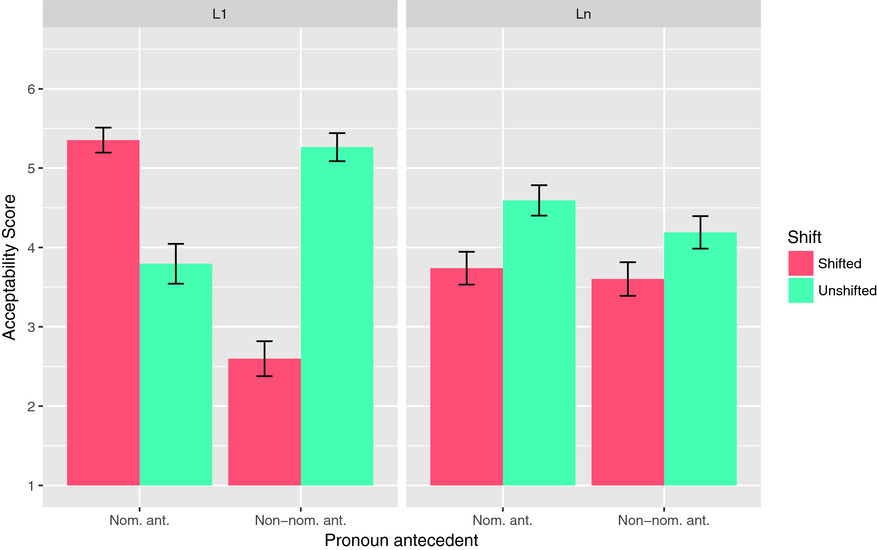
The final research question addressing micro-variation, 1c, concerns the difference between object pronouns with nominal and non-nominal antecedents. The results are shown in Figure 5. The graph contains data from both L1 and Ln speakers and shows that L1 speakers are indeed sensitive to whether pronominal objects have a nominal or a non-nominal antecedent (χ 2 (1) = 23.7, p < .001). Pronominal objects with a nominal antecedent are preferred in shifted position, while pronominal objects with a non-nominal antecedent are preferred in unshifted position. In contrast, the Ln speakers are not sensitive to this distinction (χ 2 (1) = 1.6393, df = 1, ns); both types of pronominal objects are preferred in situ, even though the shifted position also received quite a high rating.
L1 speakers (N = 51) and Ln learners’ (N = 59) mean judgement of pronominal objects with nominal and non-nominal antecedents.
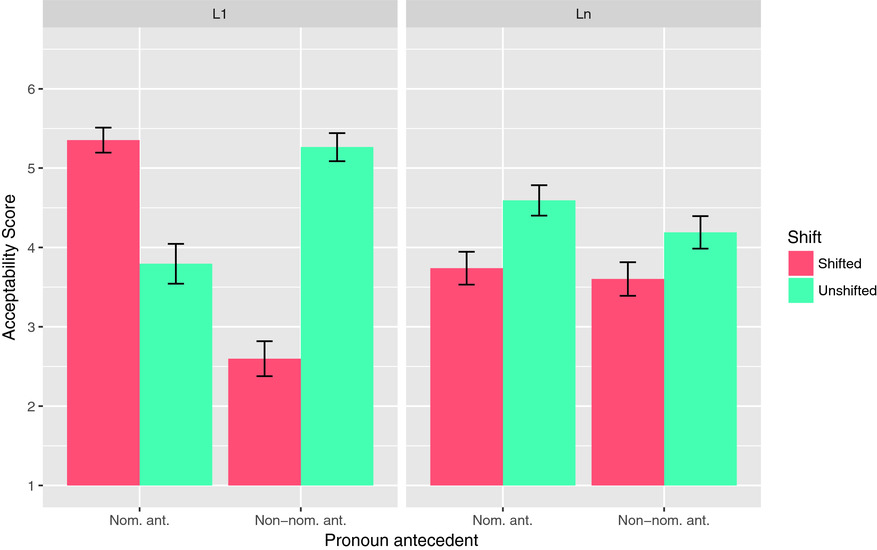
To summarize the results concerning the first three research questions, we see that Ln speakers make their choice of argument placement based on syntactic function: subjects are placed before negation and objects are placed after negation. This leads to two non-target like structures: full DP subjects are preferred before negation, and pronominal objects are preferred in situ. However, there are indications that Ln learners also take nominal type into consideration, at least for objects with nominal antecedents. Shifted pronominal objects receive higher scores compared to shifted full DP objects. The general shift preference for subjects is stronger in embedded clauses compared to main clauses, which suggests an awareness of the effect of clause type on argument placement.
5.2 Mastery of patterns
Above, we saw that Ln speakers were not very sensitive to the full DP-pronoun distinction. Whether the antecedents of object pronouns were nominal or non-nominal also did not appear to have any effect on argument placement. In the second set of research questions (2a, b), we investigate whether Ln speakers develop a more target-like grammar as their general proficiency increases. We ask whether Ln learners initially prefer the unshifted position for both subjects and objects (2a), and whether subject shift is acquired prior to object shift (2b). In order to investigate this, we add the factor proficiency score to our models, to see whether increased proficiency leads to more target-like shift preferences.
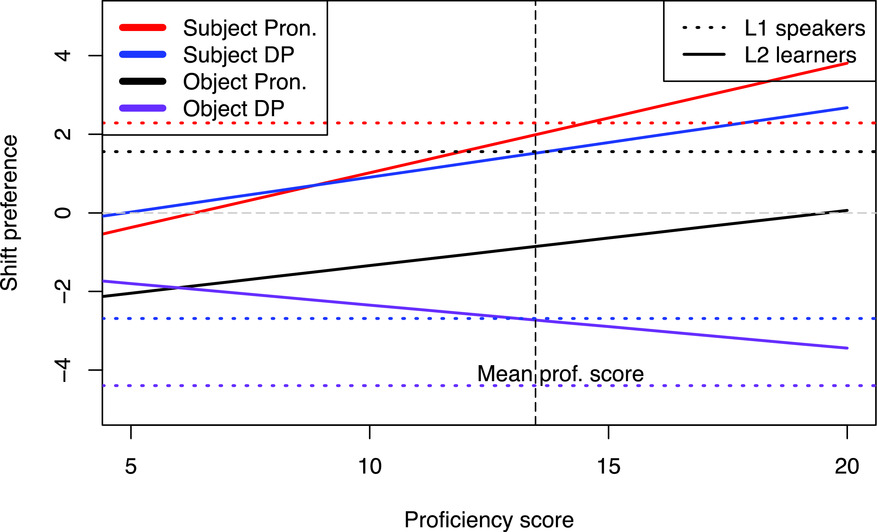
In Figure 6, we plot the correlation between proficiency score and the shift preference for main clause pronominal and full DP subjects and objects. We include the L1 shift preference in the graph (dotted lines) as reference points. A value above 0 indicates that shifted word order is preferred over unshifted, and a value below 0 indicates a preference for unshifted word order. We expect the Ln preferences to approach the L1 value as proficiency increases. This turns out to be true for pronominal subjects, pronominal objects and full DP objects (red, black and purple lines), but not for full DP subjects (blue line). Contrary to expectations, Ln speakers increase their preference for shifting full DP subjects, thus moving further away from the target L1 grammar with increased proficiency.
Ln speakers’ shift preferences relative to proficiency score and L1 speakers.
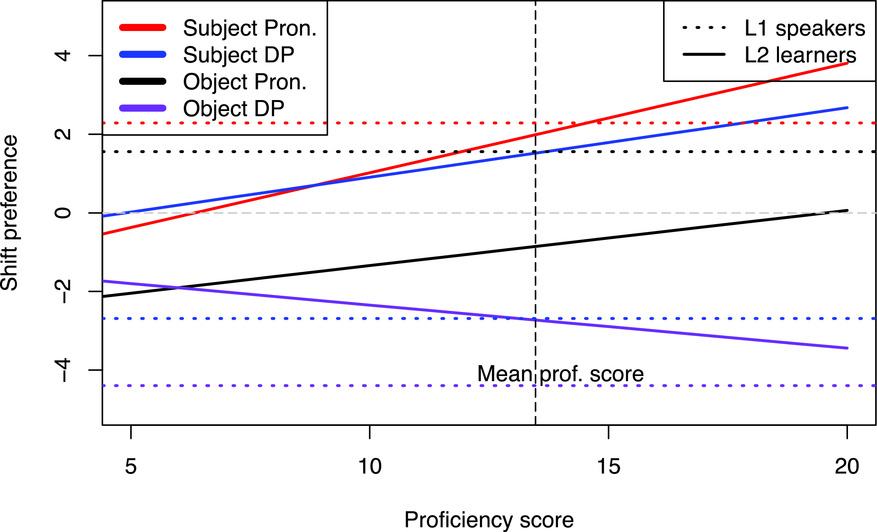
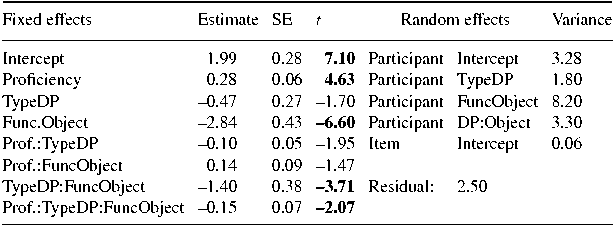
The coefficients and standard errors from the mixed effects model for the interaction between proficiency score, nominal type and function can be found in Appendix A. We find a main effect of proficiency score (β = 0.28, SE = 0.06, p < .001), but no interaction between proficiency score and argument, or proficiency score and function. This means that the preference for shifted pronominal subjects, full DP subjects, and pronominal objects increases with increasing proficiency scores. However, there is a three-way interaction between proficiency score, argument and function (β = –0.15, SE = 0.07, t > 2) – in fact, we see a small increase in the dispreference for shifted full DP objects with increased proficiency. From the model we can also conclude that Ln speakers with the lowest proficiency have a strong preference for unshifted objects, both pronouns and full DPs. The low proficient Ln learners however seem to have no clear preferences for subject placement, as both pronominal and full DP subjects are scored around zero; the preference for shifted subjects increases with increased proficiency, but this is only the target for pronouns.
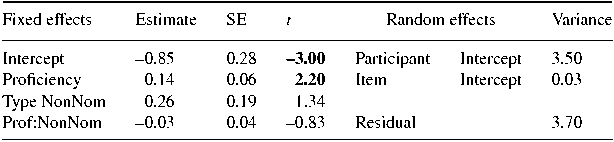
The Ln speakers thus seem to be in the process of acquiring object placement. The shift preference is increasing for the pronouns and decreasing for the full DPs. However, even the most proficient learners still have not reached a point where they prefer pronominal objects in shifted position. We can now investigate whether the Ln speakers are sensitive to the fine distinctions with respect to the type of antecedent of pronominal objects, in that they adjust their preferences for the placement of objects with non-nominal antecedents. Given L1 preferences, we would expect these objects to pattern with full DP objects rather than pronominal objects with nominal antecedents. However, it turns out that the slope for objects with non-nominal antecedents is not significantly different from the slope for other objects (χ 2 (2) = 1.23, ns): With increased proficiency, the Ln speakers increase their acceptance of shifted pronominal objects with both nominal and non-nominal antecedents. The model coefficients for both types of pronominal objects are given in Appendix B.
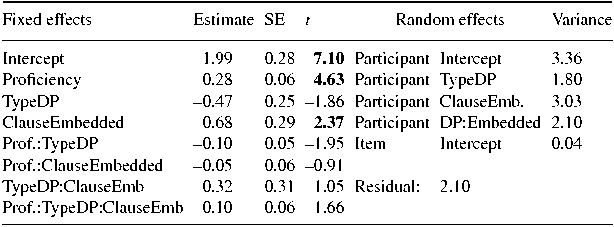
For embedded subjects, we see the same development as for main clause subjects: the shift preference for both full DPs and pronouns correlate positively with proficiency score. The effect of proficiency score is not significantly larger for embedded clauses compared to main clauses (χ 2 (1) = 0.017, ns), or for embedded pronouns compared to embedded full DPs (χ 2 (1) = 0, ns). The model coefficients for embedded and main clause subjects are given in Appendix C.
6. DISCUSSION
Our first research question (1a) concerned the Ln learners’ sensitivity to the variation in subject shift and object shift constructions, with sub-questions addressing finer distinctions between pronouns and full DPs, main and embedded clauses, and pronouns with nominal and non-nominal antecedents. As we saw in the previous section, the general picture is that Ln learners prefer all subjects shifted and all objects unshifted, whether they are realized as pronouns or full DPs. However, for objects, we see that the Ln learners soon start to treat pronouns and DPs differently. We see that the preference for unshifted over shifted full DPs objects is stronger than for pronouns, indicating that although the Ln learners do not display target-like preferences for shifting pronouns, they are more willing to accept (target-like) shifted pronouns than (non–target-like) shifted full DPs. Importantly, there is development towards distinguishing more clearly between pronominal and full DP objects with increased proficiency, as we see a significant correlation between proficiency and a preference for unshifted full DPs (Figure 6 above). This means that with increasing proficiency the learners get better at rejecting a word order that is completely ungrammatical in the target language, i.e. shifted full DP objects, while they in fact get worse at rejecting a word order that is clearly dispreferred by L1 Norwegians but not ungrammatical, i.e. shifted full DP subjects. Thus, our results indicate that the Ln learners to some extent distinguish between pronouns and full DPs. However, recall that even the most proficient learners have only just reached a point where they have no shift preference with object pronouns, but the developmental trend is in the direction of the target, as less proficient learners prefer them unshifted. Furthermore, the target-consistent micro-variation is not yet in place.
We then move to the sub-question regarding the distinction between main and embedded clauses (research question 1b). The Ln learners’ general preference for shifted subjects leads to target-like preferences for embedded clauses, where all subjects are preferred in shifted position also by the native controls. This is presumably due to a general tendency –for both L1 and Ln speakers – for clause-initial subjects. Given that this is different from L1 children's initial production (a preference for unshifted subjects), it further indicates that Ln learners may have an early preference for shifted subjects (research question 2a). Furthermore, the stronger rejection of unshifted word order in embedded clauses indicates that Ln learners make a distinction between main and embedded clauses. The Ln learners thus exhibit a similar preference to L1 children, who also have been shown to distinguish between the two clause types.
We also addressed whether Ln learners of Norwegian make a distinction between pronouns with nominal and non-nominal antecedents in the case of object shift (research question 1c). Not surprisingly, L1 speakers clearly prefer the former in shifted position and the latter in situ. However, there is no significant difference in preferences among the Ln learners; both types of pronominal objects are preferred in unshifted position. There is also no indication of development of such a distinction with increased proficiency. In fact, there is a slight increase in acceptance of shifted pronouns of both types with increased proficiency.
Our second main research question asked whether Ln learners’ would exhibit a preference for the unshifted position (2a) and whether they would acquire subject shift before object shift (2b) in a manner similar to L1 learners. The first sub-question, whether Ln learners show a preference for unshifted subjects and objects at an early stage of development, was based on previous research showing that Norwegian L1 children initially produce both subjects and objects in unshifted position. While adult Ln learners of Norwegian do show a preference for unshifted objects, just like L1 children, they seem to prefer both pronominal and full DP subjects in shifted position, in main and as well as embedded clauses. Thus, whereas L1 children acquire the two subject positions early on, the Ln learners seem to have a strong preference for the shifted position. Moreover, with increasing proficiency they even develop a stronger, non-target-like preference for shifted full DP subjects, showing no signs of connecting information structure, and hence also nominal type, to syntactic position (i.e. whether the subject conveys given or new information, recall Section 2.1 above). For objects, we see that the Ln learners disprefer shifting pronominal objects, like L1 children. However, as shown in Figure 2, they make a distinction between pronominal and full DP objects in a target-like direction, and the difference between the two argument types increases with increased proficiency (see Figure 6). Nevertheless, as also illustrated by Figure 6, even the most proficient learners only reach a point at which they exhibit no shifting preference. However, object pronouns with non-nominal antecedents, which behave like full DPs in the target grammar, are not distinguished from other pronouns in the Ln speakers’ judgements. Thus, the Ln learners over-accept shifted arguments, especially in subject shift constructions (preferring DP subjects in the high position), but also to some extent in object shift constructions (in that pronouns with non-nominal antecedents are treated like pronouns with nominal antecedents). In the L2 literature, the initial state of L2 acquisition is one of the most debated issues (see White Reference White2003 for an overview). Assuming full transfer (Schwartz & Sprouse Reference Schwartz and Sprouse1996), the initial state should be the end-state of the learners’ L1. Since there is a high number of L1s involved in this learner group, it is to be expected that there would be a variety of initial states. Furthermore, we have not investigated the Ln learners at a very early stage of acquisition and do not have any access to their earliest preferences. Nevertheless, we see a general increase of shifting with increased proficiency (Figure 6), which could indicate an early preference for lack of shifting. However, from their preferences, one could also argue that they start out with shifted subjects and unshifted objects, which would directly correspond to the frequency of shifting in the input (recall Section 2).
The final sub-question concerned whether there is a difference between subject shift and object shift in how target-like the Ln performance is (2b). Recall that subject shift falls into place several years before object shift in child L1 acquisition. As already pointed out, we find a different pattern in the current study. Like L1 children, the Ln learners seem to show an early preference for all objects in situ, but unlike the children, all subjects are preferred in shifted position. This means that becoming more target-like would require the opposite development for the two phenomena: The acceptability score of shifted full DP subjects should decrease, while that of shifted object pronouns (with nominal antecedents) should increase. For both subject shift and object shift, we see a development towards a stronger preference for target-like placement, in that with increased proficiency, the Ln learners are more likely to accept target-like shifted pronominal subjects and unshifted full DP objects. For pronominal objects, the trend is also going in a target-like direction (higher acceptability), while the opposite is true for full DP subjects.
In previous studies on L1 acquisition of subject shift and object shift (Anderssen et al. Reference Anderssen, Bentzen, Rodina, Westergaard, Anderssen, Bentzen and Westergaard2010, Anderssen & Westergaard Reference Anderssen and Westergaard2010, Anderssen et al. Reference Anderssen, Bentzen and Rodina2012), the developmental path was explained by considerations of economy, i.e. assuming that children initially prefer not to move elements and that they will only do so upon encountering clear evidence in the input. The earlier development of subject shift than object shift was explained by frequency factors, since subjects are in themselves much more frequent than objects, and since, for reasons to do with information structure, most subjects are pronominal and shift, while most objects are full DPs (or have non–nominal antecedents) and do not shift. Furthermore, Anderssen et al. (Reference Anderssen, Bentzen and Rodina2012) argue that object shift is more complex than subject shift and that this may be another explanation for the acquisition delay.
These findings may indicate that adult Ln learners are more sensitive to frequency than to economy in the early stages of acquisition. Potentially, the comparatively high proportion of shifted subjects that they encounter in the Norwegian input causes them to prefer all subjects in shifted position. Recall that previous studies based on both CDS and adult-to-adult conversations reveal that subjects overall overwhelmingly occur in the shifted position. We cannot guarantee that this is representative of the kind of input the Ln learners have been exposed to, but we have no reason to assume that the distribution in the society at large or in a Norwegian class for foreigners should be significantly different. Related to this is the possible explanation that the Ln learners are not really analyzing the sentences in the acceptability judgement test syntactically, but rather relying on some kind of shallow processing based on lexical and semantic information (see Clahsen & Felser Reference Clahsen and Felser2006). Thus, they may not be perceiving the placement of the argument as movement at all. In this context, it is relevant to note that in embedded clauses, native speakers prefer all subjects in shifted position, adding to the overall frequency of shifted subjects. Interestingly, the preference for shifted subjects is even stronger in subordinate clauses than in main clauses also for the Ln learners in our study. The lack of a positive correlation between proficiency and preference for full DP subjects in situ in main clauses indicates that this non–target-like preference is persistent, at least throughout the proficiency levels represented in our sample.
7. CONCLUDING NOTES
In this paper, we have compared judgement data from Ln learners with similar data from native controls for two word order phenomena in Norwegian where there is considerable micro-variation, subject shift and object shift. We have also compared our findings to previous (production) data from L1 children. The aim of the study was to investigate to what extent Ln learners of Norwegian are sensitive to the micro-variation found in the placement of subjects and objects relative to the negation (and adverbials). Using native controls as a point of reference, we found that the learners give a high acceptability score to all shifted subjects and a low score to all shifted objects. Thus, they fail to make the target-like distinction between pronouns and full DPs. A similar result has been found in production data from L1 learners. However, while the L1 learners generally disprefer the shifted position, the Ln learners seem to make a distinction based on function (subject versus objects). Furthermore, unlike Ln learners, the L1 learners never shift elements that should not shift. When the Ln learners’ preferences are considered in relation to their proficiency, it becomes appearent that as they get more proficient, their preference for all shifted subjects increases, making their scores less like the native controls’ for DP subjects and more target-like for pronouns. For objects, the preference for shifted DPs decreases, while it increases for pronouns, suggesting that the development is going in a target-like direction. However, this development has only progressed far enough that the most proficient learners can be shown to not have a shift preference for pronominal objects.
The comparison that is made in this study between the judgement data of Ln learners and production data in L1 acquisition is admittedly not optimal, and a production study of Ln learners may be required in future investigations. Nevertheless, there is reason to believe that the two types of data are compatible in the sense that it is likely that structures that receive a high acceptability score are the structures that the learners would produce in a production experiment. Ultimately, these results suggest that the Ln learners are different from L1 children, in that they are not conservative learners, but to some extent both over-accept syntactic movement operations (for example with subject DPs) and under-accept them (with pronominal objects).
ACKNOWLEDGEMENTS
We would like to thank Jelena Didriksen for helping develop, collect and analyze the data. We also gratefully acknowledge the audiences at BUCLD 2016, GALANA 2016, ICLA 2016, NOA 2016 and GASLA 2017 for valuable feedback on this paper at an earlier stage. Finally, we wish to thank three anonymous reviewers for many useful comments.
APPENDICES
Appendix A. Ln speakers, model coefficients for shift preference for the core subject shift and object shift conditions
The fixed effects are proficiency score (centred), type (DP, pron.) and function (subject, object). Total number of observation: 1173, N = 59, Items = 20 (7 missing values). The intercept is the estimated shift preference for pronominal subjects. The model includes random intercepts for participants and item, and by-participant random slopes for type and function. The lme$ package in R (Bates et al. Reference Bates, Maechler, Bolker and Walker2015) was used to fit the model. All t-values bigger than 2 or smaller than –2 in boldface.
Shift preference for the core subject shift and object shift conditions in Ln speakers.

Appendix B. Ln speakers, model coefficients for shift preference for object pronouns with nominal and non-nominal antecedents
The fixed effects are proficiency score (centred) and nominal type. Total number of observation: 589, N = 59, Items = 10 (1 missing value). The intercept is the estimated shift preference for object pronouns with nominal antecedents. The model includes random intercepts for participants and item. The lme4 package in R (Bates et al. Reference Bates, Maechler, Bolker and Walker2015) was used to fit the model. All t-values bigger than 2 or smaller than –2 in boldface.
Shift preference for referential and non-referential object pronouns in Ln speakers.

Appendix C. Ln speakers, model coefficients for shift preference for subjects in main and embedded clauses
The fixed effects are proficiency score (centred), type (DP, pron.) and clause type (main, embedded). Total number of observation: 1166, N = 59, Items = 20 (14 missing values). The intercept is the estimated shift preference for pronominal subjects. The model includes random intercepts for participants and item, and by-participant random slopes for type and function. The lme4 package in R (Bates et al. Reference Bates, Maechler, Bolker and Walker2015) was used to fit the model. All t-values bigger than 2 or smaller than –2 in boldface.
Shift preference for subjects in main and embedded clauses in Ln speakers.