1. Introduction
According to DSU Article 3.7, an amicable settlement is the outcome ‘clearly to be preferred’ by the WTO dispute settlement mechanism. Of about 450 cases formally brought before the WTO, over 200 were settled or are presumed to have been settled amicably by the disputing parties in one way or another.Footnote 1 Among the settled disputes are some of the most contentious and well-known WTO cases. In November 2012, a mutually agreed solution (MAS) brought the EC–Bananas dispute between the EU and ten Latin American countries over the former's discriminatory import regime for bananas from non-ACP countries to an end.Footnote 2 The ‘banana war’ had preoccupied the GATT and WTO for almost 20 years. Furthermore, already in 2009, the two high-profile SPS cases, EC–Biotech, concerning the EU's market access restrictions on genetically modified agricultural products, and EC–Hormones, relating to the EU's import ban on hormone-treated beef, had, in part, been settled.Footnote 3 These recently resolved disputes highlight the importance of amicable settlements for the WTO, especially as a solution for hard cases where litigation risks becoming endless and compliance is politically impossible.
Yet in spite of their significance, amicable settlements have not attracted much academic attention. Scholars have either focused on particular settlements or limited their analysis to specific legal aspects of MAS, such as their possible enforcement through the WTO dispute settlement mechanism.Footnote 4 A narrow focus on single disputes or MAS enforcement, however, falls short of addressing the many intricate questions amicable settlements of WTO disputes give rise to in law and in practice.
Indeed, amicable settlements are more than private deals struck between disputing parties. Instead, as bilateral solutions in a multilateral system, they point to two potentially competing aspects of justice in WTO dispute resolution. On the one hand, amicable settlements help the disputing parties to find a swift and tailored solution to their dispute. On the other hand, bilateral solutions may be reached at the expense of third parties or may undermine collective interests. ‘Out-of-court’ settlements risk to ‘work in favor of “private peace” and in opposition to “public justice”’.Footnote 5 This tension was aptly captured in a statement made by John Jackson some 15 years ago. He asked ‘what should be the fundamental objective of the [multilateral trading] system – to solve the instant dispute (by conciliation, obfuscation, power-threats, or otherwise), or to promote certain longer term systemic goals such as predictability and stability of interpretations of treaty text?’Footnote 6 Nowhere in the WTO's dispute settlement system is the balancing of these potentially competing objectives more acute than with respect to negotiated settlements. Multilateral considerations and ‘longer term systemic goals’ may generally be absent when it comes to deals struck between two disputing states where bilateral interests and the goal of solving ‘the instant dispute’ are paramount. As a result, one must ask whether the WTO regulates amicable settlements in a way that preserves their benefits for complainants while advancing and protecting the multilateral stakes of the WTO system.
This analysis needs to take place against the backdrop of the actual settlement practice of WTO members where two trends have emerged. First, similar to the better-known practice of concluding preferential trade agreements (PTAs) in deviation of WTO disciplines,Footnote 7 WTO members have used MAS to contract out of WTO law (‘WTO–’ MAS) or to add to WTO obligations (‘WTO+’ MAS). In the Softwood Lumber MAS between Canada and the United States, for instance, both parties waived their right to initiate WTO proceedings (‘WTO–’) and agreed on specific disciplines and institutional mechanisms (‘WTO+’) to govern their bilateral softwood lumber trade.Footnote 8 Although this practice demonstrates that MAS confer much needed flexibility on disputants when dealing with hard or multijurisdictional cases, such contracting-out may conflict with larger WTO systemic goals. So where does the WTO draw the line between legal and illegal MAS?
Second, in recent years, WTO members have added a further layer of complexity. Instead of signing MAS as the category of amicable settlements that the DSU explicitly recognizes, encourages, and regulates in paragraphs 5 to 7 of Article 3, WTO members have concluded interim-settlements not foreseen in the DSU. These agreements typically outline compliance steps towards a final solution of the dispute, and pledge notification as a MAS at a later stage. In 2010, for example, a ‘Framework for a Mutually Agreed Solution’ was negotiated in the US–Upland Cotton dispute.Footnote 9 Similarly, in early 2012, a Memorandum of Understanding (MoU) was reached to end the US–Zeroing cases.Footnote 10 The rise of these interim-settlements is accompanied by an overall decrease in the number of WTO disputes settled through MAS in recent years (see section 2 below).
In light of these trends and the competing interests involved in settlements, this article provides an in-depth discussion of the procedural and substantive regulation of amicable settlements in the WTO. It finds that the DSU and Appellate Body jurisprudence have so far succeeded fairly well in preserving the contractual flexibility of disputants while also safeguarding the interests of other WTO stakeholders. There is room for improvement though. While calls for an automatic MAS enforcement made in the context of DSU reform debates are unwarranted, other DSU amendments should be made to increase clarity and promptness in MAS notification. Furthermore, the system needs urgent improvement when it comes to integrating the new practice of interim-settlement into DSU structures as part of a newly proposed two stage settlement procedure.
After this introduction, section 2 provides an overview of the law and practice of amicable settlements in the WTO, exposing recent settlement trends. Section 3 identifies the competing judicial policy considerations raised in settlements and develops a framework for subsequent analysis. Building on these benchmarks, the remainder of the article evaluates how well the DSU preserves the advantages of settlements and mitigates their drawbacks. Section 4 traces the historical evolution of amicable settlements of trade disputes from a purely diplomatic tool to a more circumscribed and regulated element of the multilateral trading system. Section 5 discusses the conceptual and practical challenges of defining and managing settlements in a hybrid system such as the DSU that combines consensual and adjudicatory elements. Section 6 forms the centrepiece of the study providing an analysis of the regulation of MAS in DSU Articles 3.5–7 and jurisprudence. Building on these findings, section 7 concludes on an evaluation of current DSU reform efforts with respect to settlements.
2. MAS – an overview of law and practice
2.1 MAS and the DSU
Since the inception of the GATT, two competing views on how to solve trade disputes have occupied diplomats and academics alike. Some argue that disputes are best settled through negotiation and compromise; not legal principles and lawyers, but economic policy and diplomats should be the driving forces in the dispute settlement procedure. Others have advanced the opposite view, arguing for a more judicial and legalistic settlement of disputes involving a neutral third-party adjudicator.Footnote 11
Today's DSU, as John Jackson observed, contains elements of both views.Footnote 12 It provides a right to adjudication to complainants, quasi automaticity in the adoption of panel reports, and the possibility of appeal on matters of law. On the other hand, the DSU mandates consultations, preserves a preference for mutually agreed settlements of disputes, and requires panels to facilitate settlements between the parties. Hence, the resolution of disputes occurs today through a hybrid system combining diplomatic and adjudicatory elements.
In this hybrid system, amicable solutions of WTO disputes are explicitly regulated. DSU Article 1.1 states that the Agreement also applies to ‘consultations and the settlement of disputes between Members’. The aim of the DSU is to ‘secure a positive solution to a dispute’ pursuant to Article 3.7. That same Article envisages four different remedies. Mutually agreed solutions by the parties to a dispute that are consistent with the WTO agreements are the preferred remedy. Only if no such solution can be reached, the primary goal becomes the withdrawal of the inconsistent measures. In case of non-compliance, members may have access to the two remedies of last resort: temporary compensation and the suspension of concessions. Hence, the DSU establishes a clear hierarchy of remedies in which consensual dispute resolution trumps adjudication.
The preference for MAS is reflected throughout the stages of the DSU. Article 4.3 clarifies that the aim of consultations – the first step of the WTO dispute settlement procedure – is to reach a mutually satisfactory solution to a dispute. When consultations fail and a panel is established, the panel should give the parties ‘adequate opportunity to develop a mutually satisfactory solution’ in accordance with DSU Article 11. Only if parties do not arrive at a MAS, a panel shall submit its legal findings to the Dispute Settlement Body (DSB) for adoption pursuant to Article 12.7. Taken together with DSU Article 15, which allows parties to review and comment on a panel report before it is circulated among members, these provisions enable members to forego a DSB ruling, by reaching a MAS, until the very last minute of the panel process.Footnote 13 Finally, also during the compliance phase, a solution agreed upon by the parties to the dispute can either prevent retaliation altogether as per Article 22.2 or end the suspension of concessions in accordance with Article 22.8. In sum, MAS are available to disputing parties throughout the stages of the WTO dispute settlement procedure.
To align the preference for bilateral settlements with the overall multilateral nature of the WTO system, MAS are conditioned by two obligations, which the Panel in EC–Bananas III (Article 21.5 – Ecuador) called MAS' ‘multilateral elements’.Footnote 14 First, DSU Article 3.5Footnote 15 mandates that settlements between the disputing parties, like any other solution to disputes raised under the DSU, have to be consistent with the WTO covered agreements and shall neither nullify or impair benefits, nor frustrate any objective arising from these agreements. Second, MAS have to be notified in compliance with DSU Article 3.6Footnote 16 to all relevant WTO bodies where other members can raise any point of concern.
2.2 MAS in practice
About every third WTO dispute that is not withdrawn early ends with a formally notified MAS.Footnote 17 Until December 2012, WTO members formally notified 80 MAS.Footnote 18 Of these settlements, 49% had been reached at the consultation stage, 22% during panel proceedings, and 29% in the course of the compliance phase.
MAS occur across the entire range of WTO disputes. They resolve cases over trade in goods, services, and intellectual property rights. Furthermore, both developing and developed countries engage in MAS. Some MAS, such as the Softwood Lumber Agreement, take the form of binding international agreements.Footnote 19 Other settlements are limited to a simple letter exchange indicating a compromise.Footnote 20 Often, the notification of a MAS includes references to a piece of domestic legislation that brought an allegedly inconsistent measure into WTO conformity, e.g. by amending a discriminatory tariff schedule.Footnote 21 In other instances, parties agree on transition periods and gradual implementation measures.Footnote 22 Certain MAS, as in the Softwood Lumber litigation, end multiple WTO cases over a similar matter involving the same disputants.Footnote 23 Other settlements, as in the India–Quantitative Restrictions disputes, comprise one MAS relating to complaints by different members over the same measure.Footnote 24 Interestingly, such multi-party MAS, usually signed simultaneously and having the same content, constitute roughly half of all disputes resolved through MAS. In addition, certain MAS involve settlements between only some but not all of the claimants.Footnote 25 Finally, MAS sometimes link different levels of trade governance. The 2006 settlement of the Softwood Lumber dispute involving Canada and the US included a Termination of Litigation Agreement that settled 20 national, NAFTA, and WTO proceedings.Footnote 26
2.3 Recent settlement trends: the rise of interim-settlements
When looking at the settlement practice of WTO members over time, two trends become visible. First, the number of notified MAS has decreased in recent years. While in 1998 the number of MAS peaked with 15 settlements notified, this number dropped to zero in 2011. The sudden surge in 2012 is due to the EC–Bananas MAS, which settled six WTO disputes. It remains to be seen whether this points to a reversal of the downward trend.(figure 1)
MAS and interim-settlements based on their year of notification to the WTO

Second, members are instead concluding new forms of (interim-)settlements not foreseen in the DSU. These include Memoranda of Understanding, which envisage steps towards a final settlement that is then to be notified as MAS pursuant to DSU Article 3.6. In addition, other forms of sui-generis settlements have emerged which also typically contain a pledge of future Article 3.6 notification. They involve high-profile cases such as the ‘Framework for a Mutually Agreed Solution’ in the US–Upland Cotton disputeFootnote 27 and the 2009 ‘Geneva Agreement on Bananas’Footnote 28 preceding the 2012 Bananas MAS. Over the last five years, ten MoUs and three other sui-generis settlements have been concluded (see table 1). In other words, recently WTO members have de facto introduced the new category of interim-settlements into the WTO dispute settlement process.
Interim-settlements

3. Regulating settlements: a balancing exercise
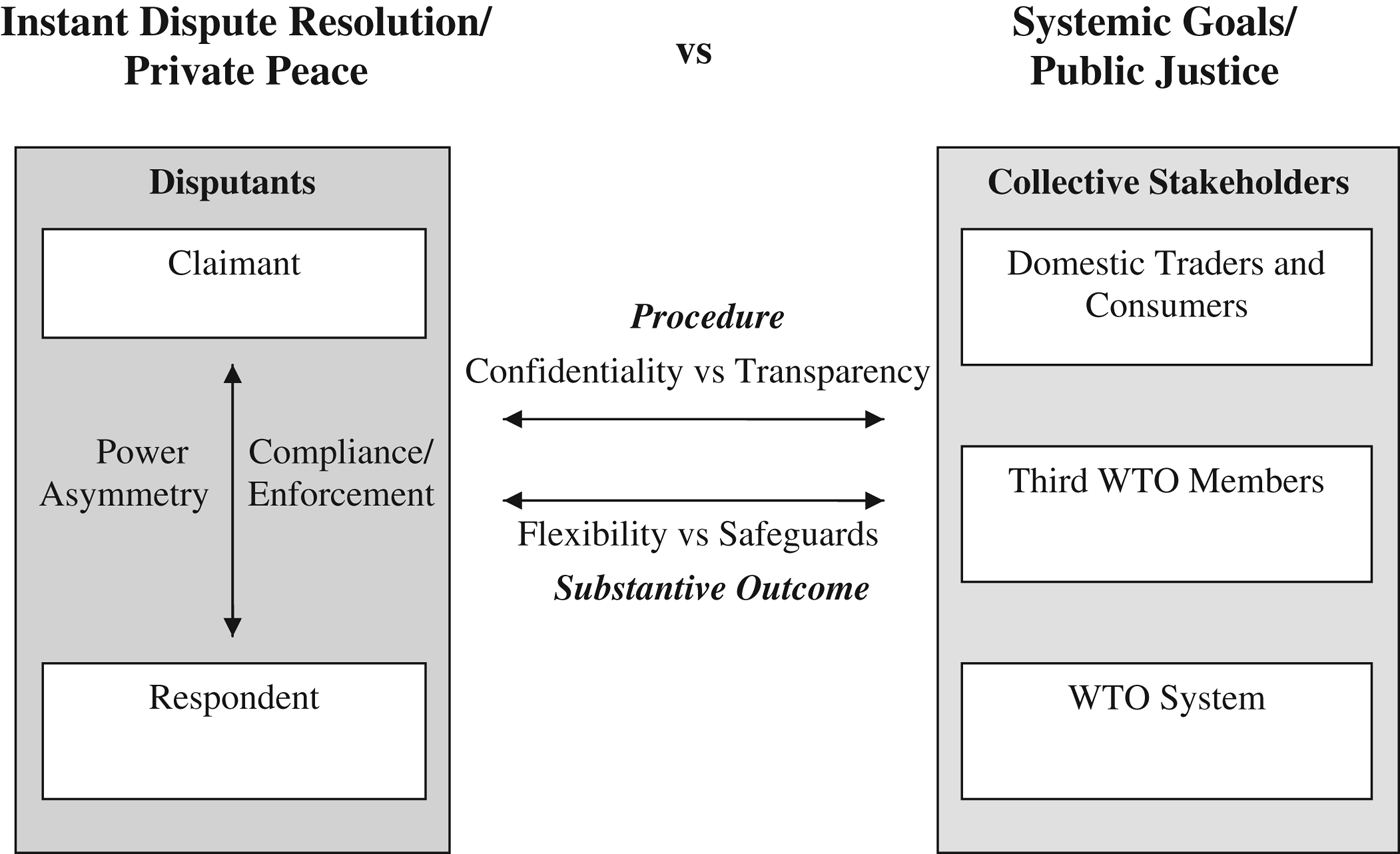
Bilateral settlements in a multilateral context raise intricate judicial policy considerations that require balancing. On the one hand, amicable settlements can restore ‘peace’ between the disputing parties. On the other hand, collective values should not be upset or third parties' rights impaired by the dispute's resolution. To fully appreciate how the DSU does or does not achieve this balance, it is useful to divide the trade-offs associated with amicable settlements of WTO disputes into three categories, which will be briefly discussed in turn. The first category comprises the risks and opportunities of settlements for the disputing parties. The second and third categories refer to settlements' procedural and substantive trade-offs between the disputants and collective stakeholders affected by the WTO dispute settlement process, namely domestic traders and consumers, third WTO members, and the WTO system at large.
3.1 MAS and the disputing parties
MASFootnote 29 promise several benefits to disputing parties. First, settlements help the disputants to avoid unnecessary costs and delays in litigation. This is particularly important in the WTO which only provides for prospective remedies but not damages for past harm.Footnote 30 Second, they allow WTO members to retain control over the dispute settlement process and its outcome. Settlement negotiations can broaden the issues under consideration opening the door for horse-trading and side-payments, impossible under normal panel proceedings.
MAS also involve risks for the disputants. Settlement negotiations may become subject to power asymmetries with powerful members bullying smaller countries into signing a MAS.Footnote 31 The DSU's adjudicatory elements alleviate some of these inequalities, casting a ‘shadow of the law’ over settlement negotiations.Footnote 32 However, powerful countries still possess means outside of the WTO to buy off or deter their smaller negotiating partner. In a case study, Shanker concluded that ‘Argentina appears to have been coerced into agreeing to amend its use of anti-competition provisions in its patent acts’Footnote 33 in a 2002 US–Argentina MAS.Footnote 34 The United States supposedly asserted pressure bilaterally and through the IMF, taking advantage of the Argentinean economic crisis in the early 2000s in order to ‘dictate a series of changes in Argentina's Patent Acts through “Mutually Agreed Solution”’.Footnote 35 A second concern for the disputants relates to compliance with and enforcement of MAS. Baroncini's review of early MAS practice finds multiple instances of parties to MAS complaining about divergent interpretations and unsatisfactory implementation.Footnote 36 Moreover, alleged non-compliance with the terms of a MAS was raised in two complaints brought to WTO panels (see section 6). Hence, power asymmetries and enforcement problems are the main pre-occupation of disputants in MAS.
3.2 Procedural balancing: transparency versus confidentiality
Aside from balancing competing interests of the disputants, MAS also raise important trade-offs between the interests of collective stakeholders and those of the disputants. Procedurally, disputants may find it necessary to keep their negotiations confidential in order to resolve delicate and politically controversial disputes. DSU Article 4.6 recognizes the need for negotiations behind closed doors, mandating consultations to remain confidential.
The requirement of confidentiality, however, may conflict with the interests of other stakeholders in transparency of bilateral settlements. First, domestic stakeholders may bear the costs of settlements that escape their democratic control. According to Petersmann, the WTO serves an important constitutional function by protecting economic liberties and individual consumer rights from protectionist tendencies in their government.Footnote 37 For democratic checks and balances to work, domestic stakeholders require access to information, including those relating to bilateral settlements. Second, other WTO members equally want MAS to be transparent. By not disclosing the terms of a settlement, disputants may prevent other WTO members from claiming most-favoured-nation (MFN) advantages arising out of a settlement. Moreover, other WTO members have an interest in scrutinizing MAS to ensure that such settlements are not struck at their expense more generally. Third, MAS also affect the multilateral trading system as a whole. Panel and Appellate Body reports provide an important public good function safeguarding security and predictability of trade rules and reinforcing trade expectations. Settlements, when kept private and confidential, fail to further other members' understanding of states' trade-related behaviour. If they are made public, however, they can generate positive externalities not unlike findings by adjudicators, providing guidance on how hard cases can be solved amicably. Therefore, transparency of settlements is a stake common to domestic consumers and traders, third parties, as well as the system at large.
3.3 Substantive balancing: flexibility versus WTO consistency
Substantively, MAS offer additional flexibility to disputants which may potentially be detrimental to other stakeholders, particularly if compared to an outcome reached through adjudication. WTO panels and the Appellate Body aim to preserve the overall balance of trade concessions with a view to safeguarding not only the interests of the disputants but of the WTO membership as a whole. Accordingly, recommendations by the DSB ‘cannot add to or diminish the rights and obligations in the covered agreements’ pursuant to DSU Article 3.2. While some settlements produce an outcome effectively identical to what would have been reached through adjudications, other MAS do what WTO adjudicators cannot do: adding to or diminishing rights and obligations.
Disputants may reach ‘WTO–’ settlements that are more limited in scope than a potential panel report leaving possible violations unaddressed or waiving rights conferred by the covered agreements. In ‘WTO–’ MAS, disputants effectively contract out of WTO law. In some MAS, for instance, disputants waived their right to initiate further DSU proceedings.Footnote 38 Disputants may also agree on ‘WTO+’ settlements that could be more comprehensive than panel reports. This may take the form of additional rights, commitments, and side-payments. For instance in the EC–Biotech case, the EU concluded a Memorandum of Understanding with Argentina and Canada respectively, setting up a bilateral dialog on biotechnology in agriculture.Footnote 39 Another example is the ‘Trade in Cement Agreement’ between Mexico and the US which aside from solving a WTO dispute over US anti-dumping measures on cement from Mexico also settled NAFTA panel proceedings and comprehensively addressed the trade in cement between the two countries.Footnote 40
These ‘WTO–/WTO+’ MAS may be problematic when it comes to the interests of other stakeholders. In settlements, disputants have an incentive to internalize the benefits of settlements, but to externalize their costs.Footnote 41 Disputants may thus strike private deals at the expense of other stakeholders. For instance, in a dispute over Japan's import quota on laver (seaweed), which, among other things, is used to prepare sushi, South Korea agreed to a MAS in which Japan promised to allocate its annual import quota exclusively to Korean laver products.Footnote 42 The WTO consistency of the settlement has been called ‘dubious’.Footnote 43 The DSU thus needs to protect the interests of domestic stakeholders, third parties, and the WTO membership at large by limiting the contractual freedom of disputants in MAS. Additionally, other WTO members may need to be able to react if their rights are indeed threatened. This raises the question of whether MAS can be challenged, e.g. before a panel, if they do conflict with third party rights.
3.4 Conclusion: a framework for analysis
In sum, MAS raise balancing considerations in at least two ways. First, between the disputants – the benefits and drawbacks of settlements need to be balanced out. While they hope for a prompt, cost-saving, and need-based settlement, claimant and respondent are concerned with power asymmetries and enforcement questions in settlements. Second, the interests between disputants and collective stakeholders require balancing, since MAS work primarily towards ‘instant dispute resolution’ and not ‘systemic goals’. Procedurally, disputants may favour confidential settlements, whereas other stakeholders ask for transparency. Substantively, disputants value flexibility in settlement outcomes. In contrast, third parties and the system at large have an interest in constraining this flexibility to harmonize MAS with collective stakes (figure 2). In the remainder of this article, we will use this framework to determine how successful the WTO balances competing interests in settlements looking at the system's evolution (section 4), the definition of MAS (section 5), and the procedural and substantive regulation of MAS in DSU Articles 3.5–7 (section 6).
Stakes, stakeholders and balancing considerations in WTO settlements
4. The history of regulating MAS
How a dispute settlement system balances the competing interests involved in amicable settlements depends on that system's overarching design and objectives. In the context of international trade, amicable settlements have been subject to increasing regulation and multilateral controls as a result of the trading system's evolution. From GATT's inception in 1947 to the creation of the WTO in 1994, the international trading system underwent a gradual ‘legalization’.Footnote 44 It developed from a ‘power-oriented’ to a ‘rule-oriented’ diplomacy.Footnote 45 In the course of this transformation, the dispute settlement mechanism became increasingly adjudicatory without, however, altogether losing its diplomatic elements. The increasing regulation of MAS through multilateral safeguards is an epitome of this broader evolution.
The early GATT 1947 dispute settlement procedure was based on GATT Articles XXII and XXIII. Article XXII foresees consultations aiming to ‘find a satisfactory solution’ to the dispute. If the parties failed to reach a bilateral solution, the matter was referred to the GATT contracting parties for collective deliberation.Footnote 46 Hence, in contrast to today's adjudicatory elements, ‘GATT's enforcement mechanism (Article XXIII) was a diplomatic procedure’.Footnote 47 In other words, if bilateral negotiation failed, multilateral settlement talks took over with a view to maintaining a balance of concessions.
In the years following GATT's inception, the dispute resolution process underwent a gradual legalization. The procedure ‘transformed from a purely diplomatic exercise to a modified form of third-party adjudication’.Footnote 48 It was in this context during the Tokyo Negotiation Round, that the contracting parties adopted the Understanding Regarding Notification, Consultation, Dispute Settlement and Surveillance in 1979.Footnote 49 The document claims to codify GATT's ‘customary practice’ of dispute settlement and adds new elements and clarifications. References to MAS appear in the document multiple times.Footnote 50 In many parts, the 1979 Understanding forms the basis on which the DSU was later negotiated. For instance, Annex Article 4 relating to the codified practice contains the familiar passage: ‘The aim of the Contracting Parties has always been to secure a positive solution to a dispute. A solution mutually acceptable to the parties to a dispute is clearly to be preferred.’Footnote 51 Compared to today's almost identical DSU Article 3.7, it should be noted that the qualification ‘consistent with the covered agreements’ is still absent. This insertion was only made in the later stages of the Uruguay Negotiations.Footnote 52
While the document refers to the central role of MAS as GATT customary practice, the 1979 Understanding, in fact, ‘re-invents’ GATT history, making amicable settlements appear to be the primary objective throughout all stages of the dispute settlement process.Footnote 53 Hudec calls the 1979 Understanding a ‘rather artful revision of GATT history’ and adds that the ‘documents are not, however, meant to be historical essays. They are statements of current regulatory policy.’Footnote 54 In fact, the emphasis placed on reaching a MAS, including at the adjudication stage, was a response to pressing and specific concerns among GATT members about ‘wrong cases’ being brought before GATT panels. ‘Wrong cases’ referred to disputes irresolvable through adjudication, because highly sensitive domestic political or economic interests were at stake that would prevent governments from complying with a panel ruling.Footnote 55 A widespread practice of non-compliance, it was feared, would undermine the system's prestige and functionality.Footnote 56 Since, at the same time, the GATT contracting parties sought to strengthen access and efficacy of the dispute settlement system, the emphasis placed on MAS also during panel proceedings was perceived as a way to solve the ‘wrong case’ problem through more negotiation in dispute settlement without foregoing greater legalization elsewhere.Footnote 57 In short, the explicit preference for MAS throughout the dispute settlement stages was not a remnant from early GATT diplomacy-only-days or subsequent practice, but a solution to a concrete problem facing trade policy makers in the Tokyo Round and was introduced together with greater legalization.
Elements protecting the interests of third stakeholders in settlements are still largely absent in the 1979 Understanding. Only Article 19 contains a collective safeguard:
if a mutually satisfactory solution is developed by the parties to a dispute before a panel, any contracting party with an interest in the matter has a right to enquire about and be given appropriate information about that solution in so far as it relates to trade matters.
While this insertion is a first effort to put in place a transparency mechanism that allows third countries to verify that a dispute is not settled at their expense, it remains limited in scope. First, the Article refers only to a MAS developed ‘before a Panel’. Bilateral settlements concluded at the consultation stage thus remain outside of the scope of the provision. Second, the right to receive information is restricted to ‘trade matters’. It hence excludes information on non-trade side-payments.
It was only with the Uruguay Round that greater weight was given to collective interest in bilateral settlements. This occurred in the context of further legalization and the growing emphasis of the GATT/WTO as the multilateral trading system. A key document in this regard is the 1989 Improvements to the GATT Dispute Settlement Rules and Procedures. Footnote 58 Considering the dispute settlement system as a ‘benefit of all contracting parties’,Footnote 59 the membership found it necessary to harness bilateral solutions for the collective benefit. The 1989 Improvements introduced two constraints on the contractual freedom of disputants: requiring, first, MAS' conformity with the GATT and, second, their mandatory notification.Footnote 60 These two innovations regulating MAS both substantively and procedurally were later incorporated in Articles 3.5 to 7 of the DSU with minor adjustments.
Hence, the evolution of the GATT's dispute settlement process goes hand in hand with a stronger regulation of bilateral settlements. Heralded as solution to the ‘wrong case’ problem during the Tokyo Round, it took until the Uruguay Round to effectively regulate amicable settlements through multilateral procedural and substantive safeguards in an attempt to align MAS with the interests of other stakeholders in the multilateral trading system.
5. Defining MAS: practical and conceptual challenges
Before proceeding to analyse how MAS are regulated in today's DSU, we must answer one question left unaddressed by the Uruguay Round: When can we speak of a MAS in the first place? While the DSU often refers to MAS, it does not define the term. So it is unclear when the regulatory obligations contained in DSU Articles 3.5–7 are triggered. One possibility to define MAS is to simply defer to WTO members: whatever agreement they formally notify as MAS pursuant to DSU Article 3.6 could be considered a MAS.Footnote 61 Using notification as a benchmark for the existence of a MAS may, however, be both under-inclusive, not capturing negotiated settlements that were never notified, and over-inclusive, capturing notified agreements that actually did not provide a final ‘solution’ to a WTO dispute. In addition, the wording of DSU Article 3.6 stands against such an interpretation. The obligation to notify is a legal consequence arising from a MAS, but not a pre-condition for its existence. Hence, notification does not prove the existence of a MAS. Vice versa, non-notification of a MAS may result in a violation of DSU Article 3.6, but it does not invalidate the existence of a settlement in the first place. This is confirmed by the Appellate Body's findings in EC–Bananas III (Article 21.5 – Ecuador). Instead of relying on the parties' statements in the course of notification, panels should assess the legal implication of a potential MAS objectively in light of the text of the agreement itself.Footnote 62 Yet, what is then the benchmark used for such an objective test? Answering this question will help WTO bodies and members to better identify agreements that qualify as MAS, which give rise to the obligations in DSU Articles 3.5–7, and to solve MAS-related disputes. Aside from developing an objective definition of MAS, this section will also demonstrates the need for a two-step legal regime to streamline WTO settlement practice and explicitly regulate interim-settlements.
5.1 Towards a definition of MAS: ‘Mutually agreed …’
Defining MAS using an objective rather than subjective test is more challenging than it may seem at first sight given the particular design of the DSU. The most distinctive element of a MAS is its consensual nature. Disputing members negotiate and agree voluntarily on a solution to a WTO dispute. However, MAS are not the only element of amicable negotiations in the WTO dispute settlement process. In fact, the DSU's hybrid nature of negotiation and adjudication contains a number of consensual elements, leaving the disputants with considerable flexibility and control over their disputes. For instance, although WTO panels assess a challenged measure's consistency with WTO obligations, they do not, unlike judges in domestic courts, specify what a member has to do to bring a measure into compliance with WTO law. Hudec thus distinguishes between panel or Appellate Body reports as outputs of the dispute settlement process and the actual outcome of the dispute, e.g. how the respondent brings its measure into conformity.Footnote 63 Due to the difference between the two, ‘the outputs in WTO disputes almost always permit more than one possible compliance outcome’.Footnote 64 What constitutes an acceptable compliance solution to a dispute is thus a matter of negotiation.Footnote 65
The very first dispute ever brought to the WTO neatly illustrates the variety of potential consensual outcomes. It involved a complaint by Singapore over Malaysia's prohibition of imports of polyethylene and polypropylene.Footnote 66 Following consultations and before the establishment of a panel, Malaysia changed its import regulation on the two substances.Footnote 67 As a result, Singapore withdrew its complaint. In the relevant DSB meeting, ‘Malaysia appreciated the cooperative spirit and understanding of Singapore's delegation in coming to an amicable solution on this matter.’Footnote 68 The withdrawal was clearly the outcome of negotiations, but a MAS was never notified pursuant to DSU Article 3.6. So the questions arises what, if anything, differentiates MAS from other consensual outcomes of a dispute, e.g. a withdrawal.
Additional consensual elements in the DSU further blur the distinction between MAS and other forms of negotiated agreements. For instance, disputing members can agree in accordance with DSU Article 21.3(b) to determine the length of the ‘reasonable period of time’ allowed for complying with a DSB ruling. In the dispute Mexico–Telecoms, the Panel found that certain Mexican telecommunications measures were inconsistent with the country's GATS commitments.Footnote 69 Subsequently, Mexico and the US reached an Article 21.3(b) agreement. In the agreement, both countries fixed the ‘reasonable period of time’ at 13 months, but, in addition, set out specific compliance steps as part of a ‘mutually agreed solution of the dispute’.Footnote 70 Following the elapse of the ‘reasonable period of time’, the US expressed its satisfaction with Mexico's compliance measures.Footnote 71 However, no mutually agreed solution was notified under DSU Article 3.6. So how can we identify MAS looking beyond subjective labels chosen by the notifying parties, but also without unduly conflating settlements with other consensual elements of the DSU, such as mere compliance negotiations or Article 21.3(b) agreements, which are, in principle, functionally very different from MAS?
The appropriate benchmark, against which the text of a negotiated agreement must be evaluated to objectively determine the existence of a MAS, lies in the substantive and the procedural specificities of MAS. Even in a hybrid system, amicable settlements are a procedural alternative to third-party dispute resolution. They are available throughout the stages of the DSU to pre-empt a panel report or to avoid compliance proceedings, arbitration, or retaliation. This makes MAS distinct from negotiations that take place as a result of third-party adjudication on how to bring a measure into compliance. At the same time, MAS, in principle, are substantively different from Article 21.3(b) agreements. Instead of fixing delays in compliance, MAS seek to provide a ‘solution’ to a dispute. Taken together, a MAS can be defined as a voluntary agreement pre-empting an adjudicatory ruling or retaliation by providing a substantive solution to a WTO dispute. In light of this objective approach, at least some of the withdrawals like Malaysia–Polyethylene and Polypropylene and some Article 21.3(b) agreements like Mexico–Telecoms should also be considered as MAS.Footnote 72
5.2 The ‘solution’-problem: interim v. final settlements
The proposed definition, however, leads to a second problem: what is a ‘solution’ to a WTO dispute? Is it enough to agree on steps to resolve a dispute to have a MAS or can we only speak of a MAS once there is agreement that these compliance steps have been taken? In other words, does a MAS propose a ‘solution’ or does it declare a dispute resolved? The Panel and Appellate Body in EC–Bananas III (Article 21.5 – Ecuador), several years prior and unrelated to the final settlement reached in 2012, struggled with this exact question. The EC had notified a 2001 agreement known as the ‘Bananas Understanding’ as MAS in accordance with DSU Article 3.6 as a ‘solution’ to its dispute with Ecuador.Footnote 73 In contrast, Ecuador, in its own communication to the DSB, made clear that it did not consider the Understanding to be a MAS, stating that the agreement rather sets out implementation steps that ‘can contribute to an overall, definite and universally accepted solution’ once fully executed.Footnote 74 The Panel took the view that an agreement had to provide ‘a positive solution and effective settlement to the dispute’Footnote 75 in order to qualify as MAS and that the opposing notification statements weighed against the existence of such a ‘positive solution’. Although the Appellate Body disagreed with the Panel's reliance on the conflicting notifications and instead endorsed an objective approach, as outlined above, based on the agreement's text itself, it also stated that the ‘mere identification of the means will not resolve the dispute’.Footnote 76 The Bananas Understanding could thus only be ‘a precursor to the possible conclusion of a final settlement agreement’.Footnote 77 Hence, according to both the Panel and the Appellate Body, outlining negotiated implementation steps as part of an interim-settlement is not enough. To qualify as MAS, an agreement has to amount to a ‘final settlement agreement’. WTO panels thus need to determine on a case-by-case basis whether it was the parties' intention, objectively manifested in the agreement they concluded, to have their dispute considered resolved for an agreement to qualify as MAS. Elements such as conditional language, expressions of expectation, or pledges of future MAS notification point to the intention to conclude an interim-settlement instead of a final settlement agreement.Footnote 78
The distinction between final settlements qualifying as MAS and interim-settlements stands in contrast to WTO practice as WTO members have notified both types of agreements as MAS under Article 3.6. In Japan–Sound Recordings, the parties declared a solution only after an amendment was made to the Japanese copyright law.Footnote 79 In contrast, a MAS between Argentina and the US over the former's patent law was already notified before and subject to subsequent domestic implementation.Footnote 80 The Panel and the Appellate Body, however, are correct in making a distinction between interim-settlements proposing to solve a dispute and final settlements declaring a dispute resolved. An agreement in which both parties assert their understanding that a dispute is resolved should have a different legal effect and follow-up mechanism than a document which merely sets out compliance steps requiring further implementation. Unfortunately, the DSU, as it stands today, only addresses the former (through MAS) but not the latter.
It is this gap in the DSU that WTO members are reacting to by their emerging practice of concluding MoUs and sui generis settlements.Footnote 81 Before committing to a final settlement through MAS, these agreements allow members to work towards the solution of a dispute. In principle, these interim-settlements are thus meant to bridge a legal gap and to complement rather than to substitute MAS. This is evidenced by the fact that MoUs and sui generis settlements always foresee future MAS notification as final settlement. What makes their relationship problematic in practice, however, is that past MoUs or sui generis agreements have not always been followed by a final settlement and subsequent Article 3.6 MAS notification.Footnote 82 Hence, disputes risk remaining formally ‘pending’ indefinitely, while it is unknown to all but the parties involved whether the agreed compliance steps have actually been taken. As a result, due to a lack of formality and follow-up this new practice currently seems to be undermining rather than complementing the role of MAS in the WTO.
5.3 Conclusion: the need for a two-step settlement procedure
Grounded in both the wording of the DSU and Appellate Body jurisprudence, it has been shown that the existence of a MAS needs to be determined objectively as a voluntary agreement pre-empting an adjudicatory ruling or retaliation by providing a final solution to a WTO dispute. To arrive at such a final settlement, WTO members increasingly conclude informal interim-settlements not addressed by the DSU. Negotiators should close this gap in the DSU by introducing and regulating the separate category of interim-settlements explicitly. Amicable settlements of WTO disputes could thus be streamlined as a two-step procedure as was de facto done in the recent EC–Bananas settlement. First, in 2009 the ‘Geneva Agreement on Bananas’ was concluded as an interim-settlement,Footnote 83 then, in 2012, upon scrutiny by the WTO membership as well as the interested public, ratification and domestic implementation, a MAS was notified as final settlement.Footnote 84 Unfortunately, the degree of transparency and follow-up achieved by the high-profile nature of the Bananas dispute is absent in less well-publicized cases. Hence, for all disputes to benefit from an equally streamlined two-step procedure, the DSU has to be amended. First, interim-settlements should be governed by the same notification and commentating procedure as MAS in Article 3.6. In addition, they should be subject to continuous progress reporting in order to facilitate their implementation. Second, once an interim-settlement is implemented, the parties are required to notify the final settlement as MAS (see section 7 for drafting suggestion). Such a two-step procedure fully accommodates the competing bilateral and multilateral interests in settlements: it allows the disputing parties to work towards a final settlement in a structured and transparent manner, alleviates power asymmetries by placing interim-settlement negotiations into the ‘shadow of the law’, and, finally, safeguards collective interests by bringing otherwise informal negotiations into the official DSU process where it can be subject to full scrutiny.
6. The procedural and substantive law of MAS in DSU Articles 3.5–7
Having identified the agreements that are considered as MAS and that trigger the obligations of Articles 3.5–7, we can finally turn to how the DSU balances the competing bilateral and multilateral interests involved in settlements. This section sheds light on the mechanisms and the success of this balancing framework which facilitates, constrains, and regulates amicable settlements in the multilateral trading system.
6.1 The procedural law of MAS
Disputants I: legal effects of MAS
When opting for a settlement instead of adjudication, disputants have an interest in enforcing the terms of a MAS and to prevent the other party from reneging on its MAS commitments. Yet, MAS display important differences compared to the status and effect of the alternative DSU remedy of adjudication, which need to be borne in mind. Unchallenged panel reports and Appellate Body findings arguably have the status of a res judicata.Footnote 85 A member may hence not raise a claim relating to the same matter, parties, and cause of action twice. In other words, adjudication conclusively determines the (il)legality of an allegedly WTO inconsistent measure. The impact of a MAS on a dispute is less clear as the DSU is silent on the legal effect of MAS and the possibility of their enforcement.Footnote 86 Can a member hence challenge a measure after having settled a dispute over that same measure in a MAS? Guidance can be found in case law. The Panel in India–Autos was faced with that question. India argued that a MAS concluded with the EC over the prior dispute India–Quantitative Restrictions Footnote 87 precluded the EC from bringing a new challenge. Remarking that the DSU is silent on the impact of MAS on subsequent proceedings,Footnote 88 the Panel faced a dilemma between preserving members' right to a panel and giving effect to a MAS as ‘clearly to be preferred’ DSU remedy.Footnote 89 The Panel solved the problem by noting that this question has to be answered on a case-by-case basis and that, in the present dispute, the terms of the earlier MAS did not cover the specific issues raised in the newer dispute.Footnote 90 Finally, the Panel stressed that this finding is without prejudice to the general legal question ‘whether a notified mutually agreed solution can ever operate as a bar to a panel's express mandate from the DSB’.Footnote 91
A similar strategy was adopted by the later Panel EC–Bananas III (Article 21.5 – Ecuador), already discussed above, which had to decide whether a MAS, the Bananas Understanding, concluded during the implementation stage, could preclude a claimant from requesting compliance proceedings under DSU Article 21.5. While the Panel indicated that it would follow the India–Autos approach of a case-specific analysis,Footnote 92 it stated in a more general way that ‘the Bananas Understanding can legally bar Ecuador from bringing this compliance challenge only if that Understanding constitutes a positive solution and effective settlement to the dispute in question’.Footnote 93 The Panel went on to apply this ‘positive and effective solution’ test to the Bananas Understanding. It addressed the substantive obligations underlying a MAS and concluded that the ‘complainant must have the possibility of having recourse to WTO dispute settlement in order to review the conformity with the covered agreements of a measure purportedly taken by the respondent to implement a step set out in an alleged mutually agreed solution or other legally binding agreement’.Footnote 94 On appeal, the Appellate Body overturned the Panel's reasoning and stressed the flexibility and contractual freedom of the parties. Whether a MAS constitutes a ‘positive and effective solution’ to a dispute has no bearing on whether or not a complainant has access to 21.5 proceedings. The question is rather whether the terms of a MAS indicate ‘the agreement between the parties of a relinquishment of the right to have recourse to Article 21.5’.Footnote 95 The Appellate Body thus refrained from attributing to MAS the effect of precluding further proceedings per se and, instead, stressed the contractual freedom of the disputants in a MAS. In consequence, the legal effect of a MAS has to be assessed on a case-by-case basis in light of the actual terms of the agreement.
Disputants II: enforcement
Another important difference in settlements compared to WTO adjudication relates to the enforcement of MAS. A panel or Appellate Body decision, once adopted by the DSB, entails a commitment on the part of the respondent state to bring a measure, found to be inconsistent with the WTO agreements, into conformity. Once such a decision is rendered, the DSU provides for a detailed follow-up mechanism. A complainant unsatisfied with the respondent's compliance can request the establishment of a DSU Article 21.5 compliance panel. If the respondent fails to comply, the complainant can request retaliation rights pursuant to DSU Article 22.
No such follow-up mechanism exists with respect to MAS. According to the conventional view, parties cannot, in principle, enforce the provisions of a settlement through WTO panels. DSU Article 1.1 makes clear that the jurisdiction of panels is limited to the WTO covered agreements and MAS are not part thereof.Footnote 96
In an article published in 2011 in this journal, Alvarez-Jiménez presents an alternative view. Reacting to the 2006 Softwood Lumber settlement of several WTO disputes between Canada and the United States which provided for a self-standing commercial arbitration mechanism to solve MAS-related disputes, Alvarez-Jiménez argues that WTO panels should and can assume jurisdiction over MAS-related controversies. He demonstrates in a detailed legal analysis that the jurisdiction of panels over MAS can be grounded in DSU Article 3.3 read together with Article 3.7, since a MAS creates rights and obligations accruing indirectly out of the DSU – a WTO agreement.Footnote 97 He also shows that MAS are applicable law under the DSU and explores various procedural implications of having MAS litigated at the WTO.Footnote 98
There are, however, a number of legal and judicial policy considerations that militate against his argument. First, it is doubtful whether a panel or the Appellate Body would follow Alvarez-Jiménez's reading of the DSU, since Article 3.3 merely provides contextual language, whereas DSU Article 1.1, in which the word ‘indirectly’ is absent, sets out the jurisdictional scope of the WTO dispute settlement. Second, the Appellate Body as outlined above has so far stressed the contractual freedom of the parties to a MAS and declined to attribute any automatic legal effects to these agreements. Already today, WTO members can provide for an independent enforcement mechanism in their MAS, if they wish to do so. As Shoyer suggests, WTO members can even foresee WTO-based arbitration pursuant to DSU Article 25 in their MAS, which would then be subject to the DSU's follow-up mechanism in Articles 21 and 22.Footnote 99 Opting for an automatic enforcement of MAS would be a reversal of the existing approach in case law and would frustrate the intention of those parties to a MAS that purposefully refrained from including any enforcement mechanism in their agreement under the legal expectation that their contractual choices would be observed. Third, Alvarez-Jiménez points to the Softwood Lumber Agreement (SLA), as one of the examples when WTO members made use of their contractual flexibility to set-up an independent enforcement mechanism, to demonstrate the need for an automatic WTO-based MAS enforcement. In fact, the SLA points to the opposite conclusion. The SLA did not only solve a number of WTO disputes but settled 20 national, NAFTA, and WTO litigations. In such a multi-level and multi-jurisdictional context, a ‘customized interstate arbitration vehicle’ is in a much better position than a WTO panel to manage issue-specific, cross-jurisdictional disputes and to bring some order into the ‘spaghetti bowl’ of overlapping trade agreements. Forth, the rise of interim-settlements and decline of MAS shifts disputes over implementation to MoUs and sui generis settlements. As interim-settlements, these agreements would not benefit from the automatic enforceability of MAS. Integrating these agreements in a structured and transparent two-step settlement procedure as proposed above would also help address disputes over their implementation. Finally, MAS enforceability is currently one of the controversial issues discussed in the on-going DSU reform debate (see section 7). So even if there were a genuine need for automatic enforcement, the Appellate Body would be wise to leave such a controversial topic to the WTO membership rather than to pre-empt the outcome of negotiations.
Collective stakeholders I: notification as procedural safeguard
The notification requirement of MAS in DSU Article 3.6Footnote 100 serves to harmonize instant dispute resolution with collective stakes. As discussed above, confidentiality and privacy are needed to facilitate MAS, but they come at the expense of procedural transparency. The DSU resolves this dilemma by recognizing and maintaining procedural confidentiality during negotiations but introducing ex ante and ex post transparency through notification. Ex ante, WTO consultation requests are notified and hence made known to other members and the interested public pursuant to DSU Article 4.4. In addition, DSU Article 4.11 allows WTO members with a ‘substantial trade interest’ to join the consultation.Footnote 101 Busch and Reinhardt, however, find that the inclusion of third parties in the consultation phase significantly decreases the odds of a settlement.Footnote 102 If a MAS is reached, it must be notified ex post to the DSB and other relevant WTO bodies ‘where any member may raise any point relating thereto’ as stipulated in DSU Article 3.6. Hence, as Baroncini puts it:
the diplomatic nature of the conclusion of a WTO dispute by no means entails that the amicable settlement may be considered as a private business between the parties involved in the controversy but, on the contrary, is seen – in the same way as it happens for third party binding decisions – as an act of general interest with reference to which the WTO system guarantees a right of immediate knowledge and comment.Footnote 103
The DSU is silent, however, on how exactly MAS' ex post notification in DSU Article 3.6 is to be done. Particularly, it is unclear who has to notify, how detailed notification has to be, and when it has to be made. In practice, this ambiguity has created considerable problems. Although conflicting notification such as in the above mentioned case of the Bananas Understanding are rare and the majority of MAS are notified by both parties,Footnote 104 the Bananas dispute demonstrates that DSU Article 3.6 would benefit from further clarification as to whether both parties are under an obligation to notify. Similarly, the notification practice is highly divergent when it comes to detail and timing. The arguably most extreme case involves a dispute between Hungary and Croatia over the latter's SPS import measure allegedly adopted to prevent the spread of BSE. Hungary filed a consultation request in July 2003. Almost six years later, in February 2009, both countries notified the DSB that a MAS had already been reached in 2003. The communication's part relevant to the MAS is limited to the sentence: ‘On behalf of our authorities we would like to inform you that Hungary and Croatia did find a mutually satisfactory solution to this case in 2003.’Footnote 105 No further detail was provided. Baroncini concluded in her 1998 research on MAS that a notification that lacks detail and is not promptly made fails to function as means to safeguard third parties' stakes.Footnote 106 This can only be reiterated in light of such more recent practice.
Notification, if properly done, can be a procedural safeguard for the collective interests involved in MAS. First, domestic stakeholders learn about the terms of the settlement and can scrutinize their government's decision based on this information. Second, DSU Article 3.6 ‘ensure[s] that all WTO Members may review mutually agreed solutions for consistency with WTO obligations’.Footnote 107 In other words, notification allows third WTO members to monitor whether a settlement was made at their expense and potentially claim MFN benefits arising out of the settlement. In contrast to direct participation of third countries in consultations, such ex post notification of MAS does not diminish the likelihood of a MAS being reached.Footnote 108 Third, notification is also crucial for the WTO system at large as a properly notified MAS could produce valuable guidance on ways in which contentious and long-standing WTO disputes can be solved amicably.Footnote 109
Collective Stakeholders II: challenging a MAS
DSU Article 3.6 provides a second control mechanism according to which ‘any member may raise any point relating’ to MAS in the relevant WTO bodies. The term ‘any point’ may refer to further clarification requests, but also to objections against elements in a MAS that undermine third party rights.Footnote 110 While Article 3.6 provides for a purely diplomatic mechanism to check and potentially challenge the WTO consistency of MAS, a WTO member also has the possibility to lodge a formal request for consultation against one of the parties to a settlement on the grounds that a measure enacted pursuant to a MAS nullifies or impairs benefits accruing to it under the WTO agreements.Footnote 111 However, a more direct surveillance mechanism to systematically verify the consistency of MAS with WTO law is missing in the DSU.
6.2 The substantive law of MAS
While, in principle, MAS offer greater flexibility to disputants than panel adjudication, the DSU also places limits on the contractual freedom of the disputants and includes substantive requirements to harmonize a MAS with the interests of other stakeholders.
DSU Article 3.6 confines MAS to ‘matters formally raised under the consultation and dispute settlement provisions of the covered agreements’. Hence, only disputes subject to a request for consultation pursuant to DSU Article 4.4 can be settled in a MAS.Footnote 112 Furthermore, Shanker interprets this provision to limit the content of a MAS to the precise issues raised in the consultation request.Footnote 113 This would limit the ability of WTO members to conclude ‘WTO+’ MAS encompassing additional issues and side-payments. However, the object and purpose of DSU Article 3.6 is to set out the notification requirement of settlements to WTO disputes and not to limit the substantive contents of these settlements.Footnote 114 Therefore, disputants can include issues in their MAS that were not specified in the request for consultation as long as they form part of a ‘package deal’ that provides a final settlement to the ‘matters formally raised’ by the complainant.
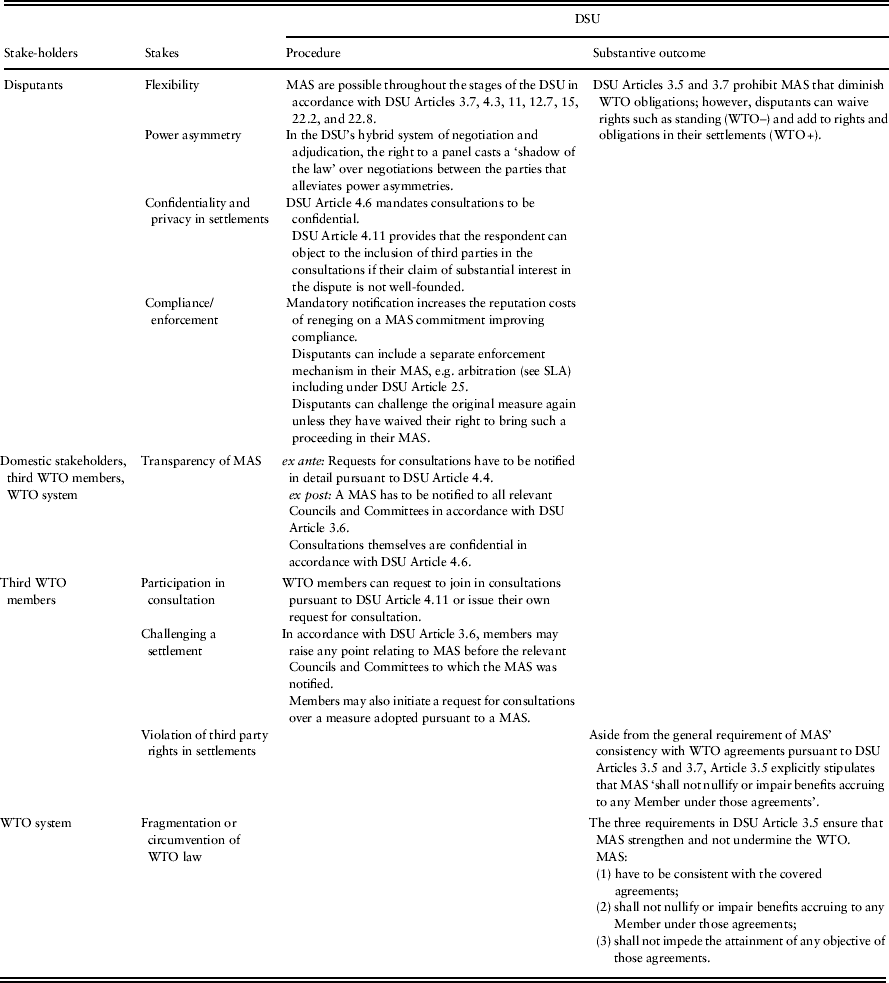
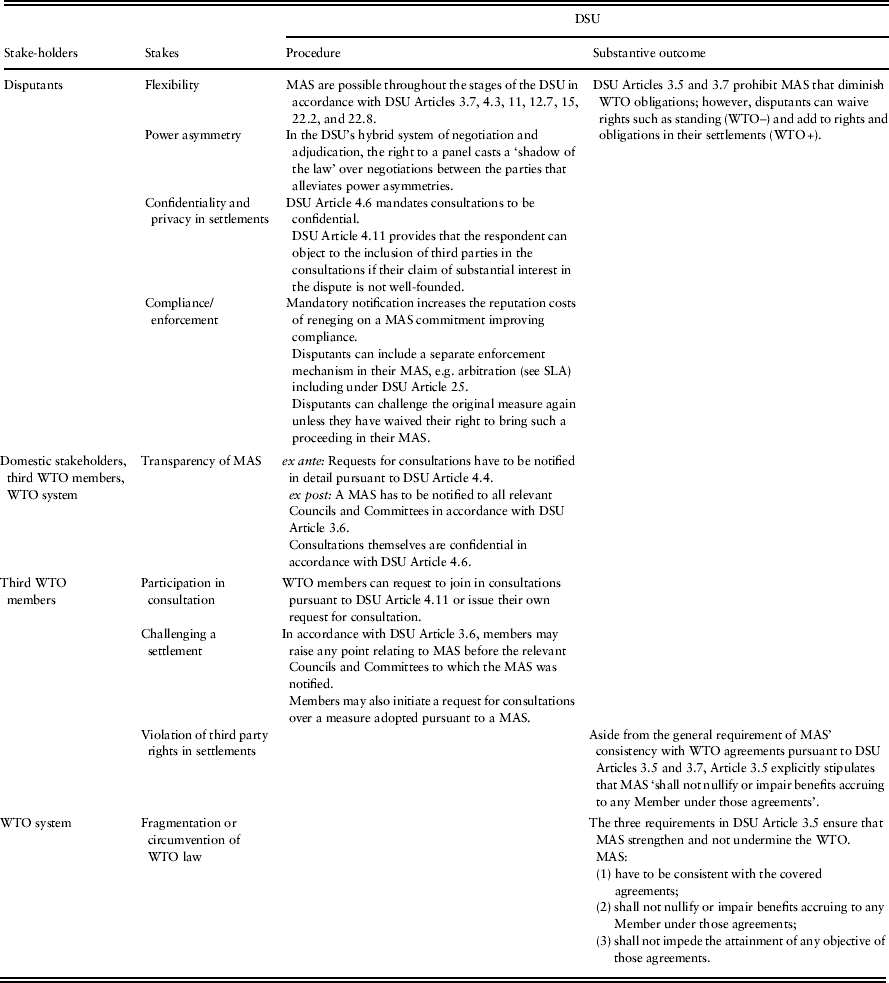
Other parts of the DSU, however, do regulate the content of MAS. DSU Article 3.5Footnote 115 is an umbrella provision that deals with ‘all solutions to matters formally raised’ before the WTO. This includes arbitration awards as specifically mentioned, but also MAS as well as outcomes reached following panel or Appellate Body reports. In order to be a valid ‘solution’, MAS have to meet three criteria: they have to ‘[1] be consistent with those agreements and [2] shall not nullify or impair benefits accruing to any Member under those agreements, [3] nor impede the attainment of any objective of those agreements’. Together with Article 3.7 that reiterates the requirement of consistency for MAS, these three criteria embody the substantive balancing considerations in the DSU limiting the contractual freedom of the disputants with respect to settlements and safeguarding the interests of other stakeholders. An agreement that fails to meet these criteria cannot amount to a ‘solution’ within the meaning of these provisions. So even though a settlement may provide a ‘final solution’ for the disputing parties, as objectively determined on the basis of the text of the agreement, and thus qualify as MAS (see section 5), non-compliance with DSU Article 3.5 and 3.7 will render such a MAS null and void in its entirety for the sake of protecting collective interests.Footnote 116 Let us now discuss these requirements from the different balancing angles beginning with the contractual freedom of disputants.
Disputants: contractual freedom to conclude ‘WTO–’/‘WTO+’ settlements?
The DSU categorically mandates MAS to be ‘consistent with’ the covered agreements. The Appellate Body clarified a similarly worded term in Article 5.1 of China's Accession Protocol ‘[w]ithout prejudice to China's right to regulate trade in a manner consistent with the WTO Agreement’ in the case China–Audiovisuals.Footnote 117 The Appellate Body stated that ‘WTO Members’ regulatory requirements may be WTO consistent in one of two ways. First, they may simply not contravene any WTO obligation. Second, even if they contravene a WTO obligation, they may be justified under an applicable exception’.Footnote 118 Applied to the MAS context, this means that to be WTO-consistent settlements must conform with all WTO obligations, but can also benefit from the flexibilities granted by the covered agreements, e.g. their exceptions. Conversely, it can also be inferred from the passage that MAS that are acting against a WTO obligation and do not benefit from an exception are ‘inconsistent with’ the covered agreements. Therefore, a MAS that contracts out of a WTO obligation without being justified by the covered agreements themselves would be inconsistent with DSU Articles 3.5 and 3.7.
MAS can thus not diminish WTO obligations. But can they diminish rights granted by the WTO agreements and still be consistent with the covered agreements? For instance, is the already mentioned MAS practice of waiving a right to further DSU recourse inconsistent with Article 3.5? Diminishing rights could conflict with the second requirement of DSU Article 3.5 mandating that MAS ‘shall not nullify or impair benefits accruing to any Member under those agreements’. The term ‘any member’ includes the disputants. As the Panel in EC–Bananas III (Article 21.5 – Ecuador) pointed out: ‘it is first and foremost the benefits accruing to the complainant in the dispute that might be affected [by a MAS]’.Footnote 119
The non-exercise or waiving of rights does not conflict with DSU Article 3.5 for a number of reasons. In public international law, it is generally accepted that states can waive rights and claims as long as the exercise of their international obligations remains unaffected.Footnote 120 WTO law mirrors general international law in this respect. The Appellate Body stated in EC–Poultry with respect to the ordinary meaning of the word ‘concession’ that ‘a Member may yield or waive some of its own rights and grant benefits to other Members, but that it cannot unilaterally diminish its own obligations’.Footnote 121 Hence, members cannot diminish their own obligations, but they can waive or choose not to exercise their own rights.
A specific outgrowth of the general principle of waiving rights is found in the ILC Articles on State Responsibility Article 45, which states that an injured state may not invoke the responsibility of another state if, previously, it has validly waived its right of standing. The freedom of states to waive a right of standing is also recognized in WTO law. This links back to the discussion in the previous section on the EC–Bananas III (Article 21.5 – Ecuador) case and the emphasis placed by the Appellate Body on the terms of a MAS when evaluating their effects. While rejecting that a MAS per se ‘necessarily implies that parties waive their rights to have recourse to the dispute settlement system’,Footnote 122 the Appellate Body acknowledged the contractual freedom of the disputants by stating that ‘a mutually agreed solution pursuant to Article 3.7 may encompass an agreement to forego the right to initiate compliance proceedings’.Footnote 123 Such agreement, however, must be clearly indicated.Footnote 124 If this is the case, the waiver of standing in a MAS could constitute a ‘legal impediment to the exercise of a panel's jurisdiction’.Footnote 125 Such a legal impediment is different from a legal effect equivalent to res judicata rejected above and relates instead to the individual member's right of standing that is waived. The respondent can thus use a MAS as a defence before a WTO panel to prevent the claimant from exercising a right that has explicitly been waived in a MAS.
Waiving of a procedural right of standing can also have a comparable effect to an explicit contracting-out of obligations. If two members agree not to challenge a measure in violation of a WTO obligation, they tacitly accept that violation. Such arrangements may be particularly likely in disputes involving de facto counter claims.Footnote 126 For instance, in a dispute over Brazil's patent law and its compulsory licensing system on antiviral drugs,Footnote 127 the US accepted a settlement establishing a bilateral dialog and leaving the challenged measure intact, once Brazil came forth with its own claimFootnote 128 against provisions of the US Patent Code.Footnote 129 In the letter exchange notified as a MAS, the US Trade Representative wrote: ‘In addition, we would expect Brazil not to proceed with further dispute settlement action regarding sections 204 and 209 of the U.S. patent law.’Footnote 130 While this understanding may not amount to a binding or formal waiver, it demonstrates how a MAS can be used to tacitly agree on a non-exercise of rights amounting de facto to the acceptance of a violation.Footnote 131
Beyond the waiving of standing, the WTO also more generally recognizes the possibility of waiving procedural rights. In Canada–Continued Suspension, for example the parties ‘waived their right to confidentiality and requested open hearings’.Footnote 132 Furthermore, members are also free to take on new trade-related obligations that limit rights and flexibilities granted under the WTO covered agreements, such as ‘TRIPS+’, ‘TRIMS+’ or generally ‘WTO+’ commitments, in a MAS.Footnote 133 This may amount to a de facto waiver of substantive rights. In conclusion, members may voluntarily waive rights or forego benefits accruing to them under the covered agreements in a MAS without violating DSU Article 3.5. It also follows that a member can use a MAS as defence before a WTO panel to prevent the exercise by another member of rights that have been validly waived in a MAS.
Collective stakeholders: substantive safeguards
DSU Article 3.5, especially in its second and third requirement, is also directed towards safeguarding the interests of other stakeholders. The second requirement stipulates that MAS may not nullify or impair benefits accruing to third WTO members. Not only does this provision make clear that MAS cannot be achieved at the expense of other states, but also that MAS cannot be used to prevent members from enjoying the benefits accruing to them under the covered agreements. Bilateral concessions granted in MAS, therefore, have to be multilateralized by virtue of the MFN obligation. Furthermore, the third requirement in DSU Article 3.5 states that MAS shall not ‘impede the attainment of any objective of those agreements’. This refers to the collective interests of the WTO membership at large in preventing MAS that go against the spirit of the WTO agreements.
Guidance on the interpretation of these two requirements may be found in general international law. Taken together, the second and third requirements in DSU Article 3.5 mirror the conditions attached to inter se modifications of multilateral treaties under the Vienna Convention on the Law of Treaties (VCLT) Article 41.Footnote 134 Underlying the conditions in the VCLT is a distinction between two kinds of multilateral treaties: those containing obligations that can be reduced to a bundle of bilateral relationships and those that are collective in nature and are owed to the treaty membership as a whole.Footnote 135 Bilateral obligations in multilateral treaties may be modified inter se without contravening the rights of other members or a treaties' objective. Collective obligations, in contrast, relate to third party rights and common values transcending individual parties' interest. They can therefore not be modified inter se without affecting the enjoyment of other members' rights and frustrating an agreement's purpose.Footnote 136
Applying the distinction to the WTO, Pauwelyn concludes that WTO obligations are essentially bilateral in nature. The object of WTO disciplines is the regulation of trade, which is an inherently bilateral activity. Since WTO obligations can be individualized, they are bilateral in nature and inter se modifications are possible.Footnote 137 Carmody, on the other hand, argues that these obligations are in fact better understood as collective. He contends that the WTO does not regulate trade, but ‘expectations concerning trade-related behavior of governments’.Footnote 138 In that case, inter se modification would be impossible as this would violate the rights of third parties and frustrate the objectives of the WTO agreements.
The divergent views expressed in that debate highlight how difficult it is to identify the ‘objective’ of an agreement. While it may be relatively easy to determine whether an inter se modification or a settlement infringes on third party rights, it is far less clear when a MAS impedes the attainment of a WTO objective. Pauwelyn argues that the two elements in VCLT Article 41 – the protection of third party rights and the impediment of an agreement's objective – are deeply intertwined.Footnote 139 Indeed, also for MAS, it is difficult to imagine a settlement that would be consistent with WTO agreements and respect third party rights, meeting the first two criteria of DSU Article 3.5, but that still impedes an objective of the covered agreements. Consequently, the third requirement of DSU Article 3.5 may only prove decisive in rare circumstances in which it can function as a safety net that prevents MAS that exceed the degree of flexibility given to the disputants and risk unduly fragmenting the multilateral trading system. Table 2 summarizes the findings of this section.
Summary table – stakes, stakeholders and the law of MAS
7. Amicable settlements and the DSU reform
Introduced during the Tokyo Round, MAS have fulfilled their primary purpose of adding stability to the multilateral trading system by providing negotiated solutions to hard or ‘wrong cases’. The challenge remains, however, to find a suitable middle ground between preserving the contractual freedom of disputants while safeguarding third party and collective interests. Although, as this article has shown, the DSU is relatively successful in balancing the different stakes and stakeholders in MAS, there is certainly room for improvement. Particularly the issues of notification and enforcement of MAS have featured prominently in recent efforts to reform the DSU. Already in 1994, the WTO Ministerial Conference called for a revision of the DSU until 1999Footnote 140 and the Doha Ministerial Conference agreed upon a re-negotiation of the DSU in 2001.Footnote 141
As for MAS notification, there is a consensus among the membership to reform DSU Article 3.6. A number of different WTO members submitted proposals that shared the desire to make notification more detailed and to set a time limit for notification of 60 days.Footnote 142 The 2003 negotiation text under chairman Péter Balás reflected these preferences in the new Article 3.6.Footnote 143 The 2011 negotiation text goes even further and limits the notification period to ten days after reaching a settlement.Footnote 144 Furthermore the new text clarifies that both parties (‘each party’) have to notify. Hence, much progress has been made on the rules governing notification.
A more contentious issue in current negotiation is the enforceability of MAS. Early on, the EC submitted a proposal to treat a failure to implement the terms of a notified MAS as a violation of the covered agreements and to amend DSU Articles 21.5 and 22 so that a party could initiate compliance proceedings to enforce a MAS.Footnote 145 According to the EC, this would make MAS more attractive and save time and resources, as a complainant would not have to restart a new procedure.Footnote 146 However, the proposed changes have not been introduced in the negotiation draft. According to the recent report by the DSB Special Session Chairman Ronald Saborío Soto, disagreement still persists over that issue.Footnote 147 While some scholars have made a compelling case for such reform,Footnote 148 the need for additional enforcement capacity may be overrated (see also section 6). First, given that only in a minority of cases non-implementation was alleged, the majority of MAS seem to be complied with. Second, members are free to include other enforcement mechanisms in their MAS such as arbitration pursuant to DSU Article 25. Third, unless they waived their right of standing, members can always bring a new case of non-compliance against the initial measure if they are unsatisfied with the compliance of a MAS. Finally, the conclusion of more and more MoUs is shifting the compliance debate to interim-settlements where more regulation and follow-up is needed. Hence, there is little added-value in including a further enforcement mechanism in the DSU for MAS.
However, if members decide to accept the EC's proposal and strengthen enforceability of MAS, they should simultaneously improve the control mechanisms of third parties to check MAS consistency. Instead of only letting members ‘raise any point relating to’ MAS before the relevant WTO bodies, a WTO Committee could be designated to monitor new MAS for WTO conformity on its own accord. Furthermore, it could also be clarified that compliance panels, as envisaged by the EC, should not only enforce but also check a MAS for consistency with DSU Articles 3.5, 3.6, and 3.7.Footnote 149
Two issues raised in this study, however, do not currently feature on the DSU reform agenda. First, the WTO would benefit from a more clearly defined objective concept of amicable settlements. This could take the form of a MAS definition in the DSU. But even more limited efforts could prove fruitful. Currently, researchers and states alike have to actively look beyond regular Article 3.6 notifications to find potential settlements ‘hidden’ in DSB minutes or Article 21.3(b) submissions. Instead the WTO Secretariat in its efforts for more transparency could, in coordination with the WTO membership, compile a publicly accessible list of all known amicable WTO settlements whether formally notified or not.
Second, the on-going DSU reform turns a blind eye to the issue of interim-settlements which are steadily growing in numbers. Legal security and transparency would be greatly enhanced, if the provisions of the DSU made a clear distinction between MAS as final settlements and interim-settlements such as MoUs introducing new disciplines on the latter. As part of a two-stage procedure, parties could be required to notify and report continuously on the progress made in implementing interim-settlements until the moment that a final MAS is reached.Footnote 150 Such a regime would strengthen and streamline the settlement practice for the disputing parties. At the same time, it would bring interim-settlements that currently escape regulation into the ordinary DSU structures allowing other members and the interested public to follow their progress towards a final settlement more closely.
In conclusion, the DSU at it stands today is already relatively well equipped to deal with many of the balancing considerations arising out of MAS, aligning disputants' flexibility needs and ‘instant dispute’ resolution with collective stakes and ‘systemic goals’. Together with the refinements already tabled and those newly proposed in this study, the DSU can further enhance legal security and predictability in the law governing MAS and foster amicable solutions that strengthen the multilateral trading system.