Introduction
Disaster reduction educationReference Codreanu, Celenza and Ngo 1 (DRE) constitutes one of the priorities of the Hyogo Framework for action 2005-2015. 2 Risk perception and risk reducing behaviors are linked intrinsically. 3 , Reference Bennett and Murphy 4 Between the time of receiving information about a potential risk and the moment of preparation, there is an intervening period in which an adult seeks further data;Reference Paton and Johnston 5 - Reference Mileti and Fitzpatrick 7 however, this behavior is observed less frequently in adolescents.Reference Paton and Johnston 5 , Reference Mileti and Fitzpatrick 8 Young people need to learn essential competencies to mitigate the effects of disasters and adapt to the post-disaster environment. Teenagers may even have additional responsibilities, including providing care for siblings. It is expected that DRE would not only result in improved knowledge, skills, and attitudes towards disasters, but it also would change a teenager’s behavior towards preventive and mitigation actions taken in preparation for such events.Reference Ronan and Johnston 9 , Reference Martin 10
Disaster education is a topic that addresses issues for which both student and teacher hope never to be asked to act upon. In school, the subject is taught largely as an appendix to a more formal discipline (geography, environmental studies, citizenship, personal development, or life-skills lessons),Reference Ronan, Crellin, Johnston, Finnis, Paton and Becker 11 and the subject matter might appear, if not alien, certainly distant. Formal assessments of learning are uncommon and difficult to design since the result is an expected change in a student’s behavior in DRE activities.
Previous researchReference Sharpe and Kelman 12 has shown that participation in school lessons about disasters and the existence of a national educational program is essential for DRE. What is less clear is which educational and delivery methods are best suited for DRE, which entities are best placed to engage with teenagers, and whether the assumption that DRE can be learned like any other subject is true. While school lessons have been associated positively with discussions about disasters, the existence of a national disaster educational program (NDEP) has shown a negative relationship.Reference Codreanu, Celenza and Jacobs 13 It might be that a behavioral change is more likely if DRE is provided by specific agencies (within the framework of school lessons and/or a disaster program) with which the respondents are more likely to engage.
This multinational study of the terminal year of high school students aims to explore the relationship between engaging in discussions about disasters, as a primary outcome, and the entities best situated to deliver DRE, in addition to a series of independent predictors identified in previous research.Reference Codreanu, Celenza and Jacobs 13
It is difficult to determine what specific actions DRE might result in; therefore, the preamble of such an action, which is to have discussions about it, has been chosen as the surrogate outcome measure for DRE success. This study’s subjects were teenagers enrolled in secondary school education and, as such, it would be reasonable to expect that this behavioral change would be associated with discussions with their families or friends, and not a unilateral action outside their family structure.
Participation in school lessons about disasters, gender, the country’s level of economic development and disaster risk, the presence of a NDEP, the ability to list pertinent examples of disasters, and the youth literacy rate have been identifiedReference Codreanu, Celenza and Jacobs 13 previously as significant predictors for teenagers engaging in discussions about disasters. However, at an individual level, there might be a different perception of the disaster risk in which one lives compared to the official country ranking. Therefore, the respondent’s perception of his/her own country’s risk of disasters, and their ability to list examples of country-specific risks, also were examined in the current study as potential predictors of engaging in discussions about disasters.
Methods
The detailed methodology has been described previously.Reference Codreanu, Celenza and Jacobs 13 In brief, 3,829 final year high school students were enrolled in an international, multi-center prospective, cross-sectional study using a 27-item, validated, written survey (Appendix 1; available online only) which enquired about knowledge, knowledge of skills, and attitudes towards disasters. Nine countries (Bahrein, Croatia, Cyprus, Egypt, Greece, Italy, Portugal, Romania, and Timor-Leste) with different disaster exposure risk and economic development were surveyed. Analysis of the data was performed using the statistical software IBM SPSS ver. 22 (2014: IBM Corporation; Armonk, New York USA).
Out of 3,829 questionnaires from the nine participating countries, 61 were incomplete and therefore excluded, resulting in 3,768 valid questionnaires retained for analysis. Ethical Committee approval was obtained from the relevant national institutions (Department of Health and Human Research Ethical Committee, West Australian Country Health Services 2010:33/22.11.2010; West Australian Government Department of Education D10/0780282/15.12.2010; and the University of Western Australia Human Research Ethics Committee RA/4/1/5715/14 November 2012). Although all questionnaires were anonymous, where the local ethical committee’s guidelines required, formal informed written consent was obtained from the participant and/or his/her parents/legal guardians. Each survey was conducted during class hours in the presence of the European Masters in Disaster Medicine-Alumnus data collector, or a local school teacher.
There were no variables with more than five percent missing values, and there were no patterns identified in the missing data; therefore, those values were considered missing at random, and pairwise exclusion was appropriate. All hypotheses were tested at a significance level of .05.
Answers related to discussions about disasters with friends and/or family, participation in school lessons about disasters, and one’s country perceived risk of disasters could record more than two values (ie, “Yes,” “No,” and “Don’t Remember/Don’t Know”). For regression analysis purposes, the answers recorded other than “Yes” were added to the “No” group resulting in dichotomous values (1=“Yes” and 0=“No”).
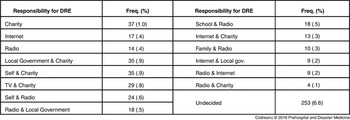
Although the respondents were asked to indicate two entities perceived as responsible for DRE, some selected just one option while others indicated more than two. These results were recoded into three categories; that is: one response, two responses, and undecided (three or more responses). The pairing possibilities without repetition of two out of eight variables resulted in 28 combinations. The respondents were not asked to rank their responses; consequently, the answers of those who indicated more than three entities could not be ordered. For this reason, regression analysis was not applied to the “undecided” category, and the combinations chosen by less than one percent of the respondents were excluded from analysis (Table 1).
Summary of Frequencies for Entities Excluded from Analysis

Abbreviation: DRE, disaster risk education.
The development of the final prediction equation required three intermediary models.
Disaster Risk, Perceived Responsibility for DRE, and Examples of Disasters as Predictors for Discussions (Model I)
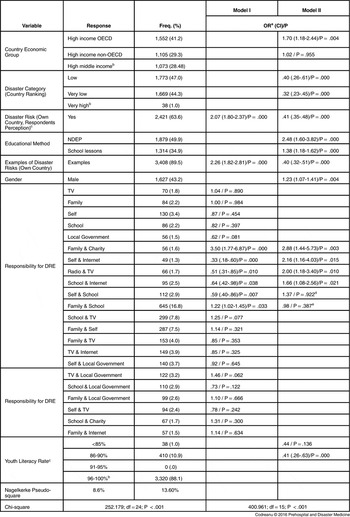
The first model used a series of independent variables (respondent’s perception of own country disaster risk, examples of disaster risk, and the entity perceived as responsible for DRE) in a univariate logistic regression analysis to predict discussions about disasters (Table 2, Model I).
Summary of Frequencies and Results from the Regression Analysis of Model I and Model II

(Note: The coefficients for the perceived entities responsible for DRE are in contrast with Family & Charity Organizations. The educational delivery methods’ coefficients are in contrast with school lessons.)
Abbreviations: DRE, disaster risk education; NDEP, national disaster educational program; OECD, Organization for Economic Co-operation and Development.
a OR value significant at P <.05.
b Denotes reference variable.
c Denotes binned category.
d Denotes variable eliminated at step 3.
e Denotes variable eliminated at step 2.
Predicting Discussions as Function of the Entities Responsible for DRE (Model II)
The respondents were required to select two out of a list of eight possible entities responsible for their DRE. In order to explore whether specific entities were significantly associated with predicting discussions, Model II was constructed by amalgamating the significant main effect predictors from Model I with the previously identifiedReference Codreanu, Celenza and Jacobs 13 significant independent variables (Table 2, Model II). After checking for assumptions, backward stepwise elimination was used to retain only significant predictors for likelihood of discussions about disasters.
Exploring Significant Interactions between the Educational Delivery Methods and the Entities Responsible for DRE (Model III)
Model III explored the independent predictors’ main effects as well as the two-way interactions between the educational delivery methods and entities responsible for DRE. The construct of the equation respected three requirements. First, all non-significant predictors identified in Model II were eliminated. Second, parsimony required selecting the interaction terms in such a way that it reflected expected real-life situations. Two model variants were created, one with single entities responsible for DRE (Model IIIa) and the second with combinations of entities (Model IIIb). For example, the interaction between Internet & Self and school lessons was realistic and was kept in the model, whereas the interaction between TV & Internet and school lessons was eliminated. The selections have been made on common-sense grounds, as no formal theory to underpin such interactions exists. Third, hierarchy was respected by adding all the terms of the interaction, whether or not they had a significant main effect, as single predictors.
Model IIIa contained eight common trunk independent variables (school lessons, NDEP, gender, country disaster risk, youth literacy rate, one’s country perceived risk of disasters, examples of such risks, and country economic group), five entities responsible for DRE (Family, Self, School, TV, and Local Government), and selected interactions between these and the two methods of educational delivery (school lessons and NDEP, respectively). Model IIIb contained the same common trunk variables, 17 combinations of entities responsible for DRE (TV & Internet, Family & School, Family & Self, Radio & TV, Self & Internet, Family & Charity Organization, Self & School, School & Internet, Self & TV, School & Charity Organization, Self & Local Government, School & TV, Family & TV, Family & Internet, TV & Local Government, Family & Local Government, and School & Local Government), as well as their respective selected interactions (Table 3).
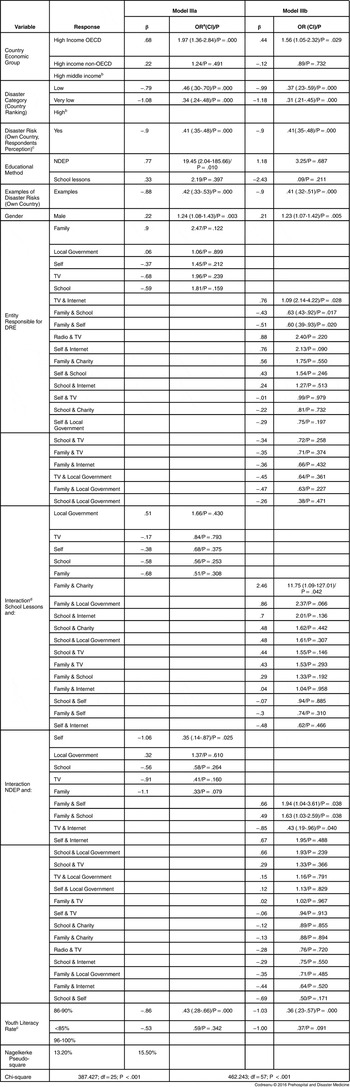
Summary of Results from the Regression Analysis of Model IIIa and IIIb

(Note: The way OR are expressed depends on the reference category. The ratio A:B can be equally expressed as B:A. To express all OR in a common direction, the comparator category can be reversed when a factor shows a negative association. Each of the β coefficients for the entities responsible for DRE represent the difference between that entity and the reference category (Family & Charity Organizations), but only for the respondents in the baseline category of School lessons. The coefficients for each interaction between the entity responsible for DRE and the educational intervention represent how much the school lessons contrasts vary for each entity, relative to the size of the school lesson effect among those respondents who chose Family & Charity Organizations. To estimate the size of the effect among other entities responsible for DRE relative to Family & Charity: β(entity) + β(interaction)=C, and then Exp(C)= OR.)
Abbreviations: β, coefficient; DRE, disaster risk education; NDEP, national disaster educational program; OECD, Organization for Economic Co-operation and Development.
a OR significant at a P value <.05.
b Denotes reference variable.
c Denotes binned category.
d The interactions between school lessons and the following entities have been excluded as unlikely: Radio & TV, Self & TV, Self & Local Government, TV & Internet, TV & Local Government.
The multivariate logistic analysis of the model used dummy variables for the entities responsible for DRE contrasted against the largest main effect predictor (Family & Charity Organizations), whereas school lessons, as the largest educational delivery method, was contrasted with NDEP.
For a better understanding of the relationship between discussions and the significant interactions, the outcome’s predicted probability was plotted as function of the educational delivery methods and the significant entities responsible for DRE.
Exploring the Relationship between Each Educational Delivery Method and Their Predictive Value
Since there were two methods of educational delivery tested by Model III (school lessons and NDEP), a further series of analyses were run to test two additional hypotheses. First, that a reduced model containing only one of the educational interventions would perform as well as the full model (Model III), and second, that a reduced model containing only school lessons would perform as well as the one containing only NDEP. The first hypothesis was tested using a linear regression and comparing the R-square change between models and the second hypothesis by a bivariate correlation analysis supplemented by a Hotelling’s t-test for non-independent correlations.
Results
Normality, general descriptive statistics for age, gender, examples of perceived disasters, discussions about disasters, participation in school disaster education, and the disaster ranking and economic group of the country have been described elsewhere.Reference Codreanu, Celenza and Jacobs 13 Those for the new variables introduced in the model, that is, the respondent’s perception of own country’s risk of disasters, pertinent examples of disaster risks, and the perceived entity responsible for DRE, are summarized in Table 2 (Freq./%).
Relationship and Correlation Analysis
Disaster Risk, Perceived Responsibility for DRE, and Examples of Disasters as Predictors for Discussions (Table 2, Model I)
The respondent’s perception of his/her own country disaster risk (OR=2.07; CI=1.80-2.37; P <.001) and the ability to list pertinent examples of such disasters (OR=2.26; CI=1.82-2.81; P <.001) were statistically significant. None of the single entities responsible for DRE made a unique, statistically significant contribution to the model. Family & Charity Organizations (OR=3.50; CI=1.77-6.87; P <.001) and Family & School (OR=1.22; CI=1.02-1.45; P=.033) both had a positive, statistically significant relationship with discussions, whereas School & Internet (OR=.64; CI=.42-.98; P=.038), Self & School (OR=.59; CI=.40-.86; P=.007), Radio & TV (OR=.51; CI=.31-.85; P=.010), and Self & Internet (OR=.33; CI=.18-.60; P <.001) were negatively related.
Predicting Discussions as Function of the Entities Responsible for DRE (Table 2, Model II)
The significant independent predictors from Model I where retained and used to construct Model II, which also included the previously identified, significant independent variables (school lessons, NDEP, country economic group, country disaster risk ranking, one’s perception of own country disaster risks, examples of such risks, gender, and youth literacy rate). A backwards stepwise regression analysis was used to predict discussions about disasters. The resulting prediction model contained 12 of the 16 initial predictors and was reached in three steps. Family & Charity Organizations retained its positive predictive value (OR=2.88; CI=1.44-5.73; P=.003). A positive change to the direction of the significant effect was noted for Self & Internet, Radio & TV, and School & Internet, whereas a negative change was noted for the literacy rate. Self & School and Family & School were eliminated from the model.
Exploring Significant Interactions between the Educational Delivery Methods and the Entities Responsible for DRE (Model III)
Model IIIa and Model IIIb included all significant, main effect predictors of Model II and the addition of the selected two-way interactions with the educational delivery methods.
Both variants were statistically significant (Model IIIa χ2 [25, N=3,768]=387.427; P<.001; and Model IIIb χ2 [57, N=3,768]=462.243; P<.001) indicating that the models were able to distinguish between respondents who reported discussions about disasters with friends and family and those who did not.
As a whole, Model IIIa explained between 9.8% (Cox and Snell R-square [CSR]) and 13.2% (Nagelkerke R-square [NR]) of the variance in discussion reporting and correctly classified 64.7% of cases. The strongest independent variable as predictor for reporting discussions was NDEP (OR=19.45; CI=2.04-185.66; P=.010), followed by a high-income Organization for Economic Co-operation and Development (OECD) country (OR=1.97; CI=1.36-2.84; P <.001). None of the single entities responsible for DRE were significant. From the 10 interactions studied, Self & NDEP was significant but was negatively associated with discussions (OR=.35; CI=.14-.87; P=.025).
Model IIIb returned a CSR=11.5% and a NR=15.5% and correctly classified 65.7% of cases. From the common trunk predictors, both school lessons and NDEP had lost their significance (P=.687 and .211, respectively). Three interactions of the 29 analyzed returned a positive relationship with the outcome variable. Family & Charity Organizations in interaction with school lessons was the strongest predictor (OR=11.75; CI=1.09-127.01; P=.042), followed by Family & Self in interaction with NDEP (OR=1.94; CI=1.04-3.61; P=.038). TV & Internet as an independent predictor was positively associated with discussions (OR=1.09; CI=2.14-4.22; P=.028), but its effect changed direction when in association with NDEP (OR=.43; CI=.19-.96; P=.040).
Graphical Interpretation of the Predictive Utility of the Educational Methods as Function of the Significant Entities Responsible for DRE
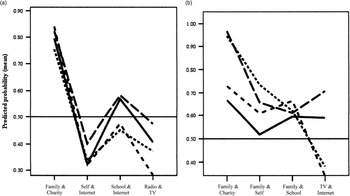
The graphical representation of the mean probability for discussions, as a function of the significant entities responsible for DRE and the educational delivery methods, is shown in Figure 1A and 1B. The graph lines represent the four possible educational interventions, that is: school lessons (long dash), NDEP (medium dash), concomitant school lessons and NDEP (short dash), and the probability in the absence of an educational intervention (no school lessons and no NDEP) is plotted (full line).
Predicted Probability (mean; P <.05) for Discussions about Disasters as Function of the Significant Entities Responsible for DRE by Educational Method (A. Model II; B. Model IIIb). (Note: The horizontal line denotes .5 probability. The graph segments under the .5 mark represent negative association, whereas the ones above .5 represent a positive association with discussions. The graph lines represent the four possible educational interventions, that is school lessons (long dash), NDEP (medium dash), concomitant school lessons and NDEP (short dash), and the absence of any educational intervention (full line).) Abbreviations: DRE: disaster reduction education; NDEP, national disaster educational program.

Figure 1A (Model II) shows that Family & Charity Organization (as single independent predictor) had the most significant, main effect on discussions in the presence of a NDEP, followed by school lessons. The combination of school lessons and NDEP showed less association with discussions than no educational intervention. Self & Internet and Radio & TV were negatively associated with discussions, irrespective of the presence or absence of an educational intervention.
The predicted probabilities for discussions when the interaction between the entity responsible for DRE and the educational intervention is significant is shown in Figure 1B. Family & Charity Organizations in interaction with school lessons had the most significant, main effect on discussions, followed by its interaction with school lessons and NDEP. The interaction between Family & Self and school lessons was stronger than that with NDEP, whereas the one between Family & School was stronger for NDEP than school lessons. TV & Internet only showed a positive effect when in interaction with NDEP.
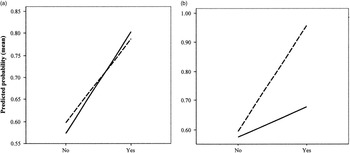
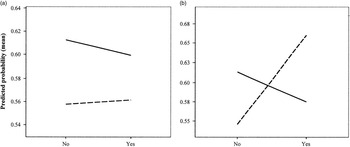
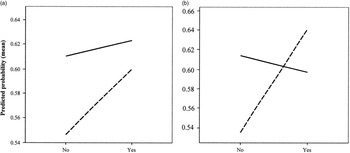
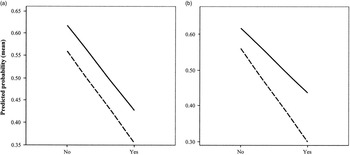
The graphical representations of the probability for discussions as a function of the significant entity acting as independent predictor or in interaction with the relevant method of educational delivery are shown in Figures 2-5. The main effect of Family & Charity Organizations was the largest among entities responsible for DRE as independent predictors (Figure 2a), whereas Radio & TV was showing its negative relationship. Among interactions, with the exception of Radio & TV, all entities showed a positive relationship. Comparison of the slopes and the scale of the probability plots showed that the largest effect on discussion occurred when Family & Charity Organizations were in interaction with school lessons.
Predicted Probability (mean; P <.05) for Discussions about Disasters for Family & Charity Organizations as: a) Independent Predictor, and b) Interaction with School Lessons.

Predicted Probability (mean; P <.05) for Discussions about Disasters for Family & Self as: a) Independent Predictor, and b) Interaction with NDEP. Abbreviation: NDEP, national disaster educational program.

Predicted Probability (mean; P <.05) for Discussions about Disasters for Family & School as: a) Independent Predictor, and b) Interaction with NDEP. Abbreviation: NDEP, national disaster educational program.

Predicted Probability (mean; P <.05) for Discussions about Disasters for Radio & TV as: a) Independent Predictor, and b) Interaction with NDEP. Abbreviation: NDEP, national disaster educational program.

Exploring the Relationship between Each Educational Delivery Method and Their Predictive Value
Reduced models were employed to analyze the individual relationship of each educational delivery method on the likelihood of discussing disasters to the full Model IIIb (R2=.100; F(25, 3,767)=16.686; P <.001).
The first hypothesis was that a model including just school lessons (Reduced Model 1 [RM1]) would perform equally as well as the full model. The reduced model had a R2=.099; F(24, 3,767)=17.222; P <.001 with school lessons maintaining its unique statistically significant contribution to the model. As hypothesized, RM1 performed as well as the full model, R2-change=−.001; F(20, 3,767)=3.465; P=.063.
The second hypothesis was that a model including just NDEP (Reduced Model 2 [RM2]) would perform as well as Model IIIb. This reduced model had a R2=.097; F(25, 3,767)=16.658; P <.001. However, this premise was not supported, as RM2 had a R2-change =−.004; F(20, 3,767)=15.696; P <.001.
Finally, the predictive utility of the two reduced models was compared. The correlation between the models, for RM1 and for RM2, was ρ1,2=.977, ρ1=.315, and ρ2=.31, respectively; P<.001. The Hotelling’s t-test for non-independent correlations returned a t(3,765, P=.05)=1.206 and a Z= 1.206.
Discussion
To the best of the authors’ knowledge, this was the first study which had analyzed the relationship between the method of educational delivery and the perceived entities responsible for disaster education and which reported discussions about disasters with family or friends as a proxy measure adopted for quantification of behavioral change.
Previous data supported the hypothesis that, controlling for other factors, school lessons or a NDEP are significant methods of educational delivery for DRE in teenagers. What is less clear is which entities are best situated to deliver the educational intervention? Which entities are most likely to be engaged with by teenagers? Would the efforts of a single provider be enough to trigger a behavioral change, or are such efforts not rewarding?
Individual disaster preparedness is a complex concept which does not enjoy an evidence-based definition, characteristics, or measurement tools. Due to the inherent difficulties in conducting research in disasters, the specifics of disaster preparedness rely significantly on expert opinion rather than first-hand proof.Reference Codreanu and Celenza 14
The respondent’s perceptions of own country disaster risk status, the ability to list pertinent examples of such risks, and Family & School and Family & Charity Organizations were the only statistically significant predictors for positive change in a model incorporating just three independent variables (Model I). A possible explanation for this observation might be that, in the absence of a structured approach to DRE through schools and/or NDEP, the behavioral change results from a common-sense approach to the identified risk, through word-of-mouth, folklore, or familial example. Family & Charity Organizations returned a greater odds ratio than that for Family & School suggesting that teenagers would be more likely to engage with the former than the latter. In the absence of an educational intervention, the significant negative association with Self & Internet, School & Internet, and Radio & TV suggests that such efforts are not conducing a behavioral change. Radio, TV, and the Internet are relatively cheap, ubiquitous, and far-reaching means of propaganda and information dissemination and their potential influence on discussions, especially in the teenage stratum, should not be overruled without further research. Significant lack of access to these technologies in today’s world is unlikely to be responsible, but rather a content or contextual issue. While this study looked at the methods and not the content of the educational delivery, it may be that, among other changes, revisions of the content and of the standard of the language used for the target audience are required in order to enhance the attractiveness of these technologies for DRE.
The modelling suggests that a unique DRE provider was not a statistically significant predictor for discussions, and it would appear that the isolated efforts of all single entity DRE providers would be equally fruitless in achieving behavioral change, controlling for all other factors in the model. The respondents’ compliance with the question instruction to select two entities, and not just one, might have introduced an element of selection bias, which might have influenced the result. It is doubtful that the magnitude of the bias was such that it would have resulted in a change of the effect direction since the respondents were able to select that preferred entity as one of the two required.
The model containing only previously identified, significant, independent predictors (Model II) showed a better overall predictive value for a behavioral change, even in the context of an effect direction change for some of the positive predictors from Model I (perception of own country disaster risk status and the ability to list pertinent examples of such risks).
The concerted efforts of two separate DRE providers seemed to result in teenagers engaging in discussions about disasters. The combination Family & Charity Organizations has retained its highest positive predictive value, whether the respondent was subjected to school lessons or NDEP, and suggests that teenagers would be almost three times more likely to engage in discussions about disasters if DRE is channeled through families and independent charities rather than any other combination of entities.
In contrast with Model I, Model II showed a negative association with the respondent’s perception of own country disaster risk status and the ability to list pertinent examples of such risks. The reason for this change is not evident, but one possible explanation might be that the DRE intervention’s content is not country specific; rather, it offers the student a global view on the subject. On the other hand, Self & Internet, Radio & TV, and School & Internet have become positively associated with discussions, suggesting that the respondents do trust and recognize these media channels as significant sources of information for DRE.
It would have been expected that the combination Family & School would predict the outcome variable conclusively, yet the data do not support this assumption. Why Family & Charity Organizations (although with less selections) have, instead, a significant predictive value would require further study. It might be that the delivery of DRE through schools needs to be associated with the student’s family in one way or another. Similarly, charity organizations are to be involved together with families in order to spark, and possibly achieve, the sought after behavioral change. It might also reflect reaching a common denominator between the family and the student, which might form the basis for collective efficacy.Reference Uscher-Pines, Chandra, Acosta and Kellermann 15 - Reference Bajayo 17 These results suggest that the educational message is better received (and/or more credible) if delivered through these two entities.
The graphical representation of the probabilities (Figure 1A and 1B) is useful in showing, on the one hand, which combinations and interactions are most likely to result in discussions, and, potentially, which models will predict a greater magnitude of change. As independent predictors (Model II), school lessons have a lower odds ratio than NDEP (1.38 and 2.48, respectively). However, the graphical representation (Figure 1A) shows a higher overall probability for discussions for the respondents who had school lessons (long dash) than NDEP (medium dash). In the cases where there is a NDEP, and the respondents have participated in school lessons as well, the main effect is very similar to the one in which only school lessons are used. It follows that such a duplication of efforts and resources is not necessary. These results are significant as they suggest that the resources available might be either underused or wasted. For example, in communities where families and charity organizations work together, the behavioral change could be anticipated equally well by using only one method of educational delivery. In the model which includes possible interactions between the method of educational delivery and selected entities responsible for DRE, both educational methods fail to retain their significant main effect as independent predictors, yet those who chose Family & Charity Organization in interaction with school lessons were almost 12 times more likely to discuss about disasters (Table 3, Model IIIb). The graphical representation of the predicted probabilities (Figure 1B) shows that the combined efforts through school lessons and NDEP will achieve almost identical results than that of school lessons alone (long dash), suggesting, once more, a duplication of resources. Another significant finding was that in the absence of a structured method for education delivery (full line), the probability for discussions about disasters decreases, and the implication being that such isolated efforts by the DRE providers are misguided at best, and out of touch at worst.
More research is needed in order to explain why a high literacy rate did not make a unique, statistically significant contribution to the model. Would it be that educated teenagers are seeing themselves in a better position to weather a disaster? The truth value of such assumption requires further research, especially in the light of this study’s results which suggest that seeing oneself as solely responsible for DRE is negatively associated with a behavioral change.
It would be difficult, however, to quantify the true influence of these factors in the absence of a prospective interventional study, but such a project is unlikely to succeed at a multinational level.
Limitations
Similar to the study described previously,Reference Codreanu, Celenza and Jacobs 13 the results are subject to the inherent limitations of a survey design. The social environment to which the teenagers belong raises the expectation that they would not act in isolation to sanction change. Hence, the primary outcome - disaster discussion - is a surrogate measure of behavior change and has been chosen arbitrarily as a logical precursor of action.
It has been impossible to ascertain the degree of separation or overlap between school lessons and a NDEP as means of delivering DRE interventions. As such, the dichotomy is artificial.
The finding that a single entity responsible for DRE has no significant influence on behavior requires further study as it may represent an inaccurate conclusion resulting from the respondent’s compliance with the questionnaire instructions.
This study only shows an association between factors and the primary outcome. The true influence of these factors would only be studied definitively using a prospective interventional design, which is unlikely to be feasible in an international study.
It is possible that the data captured and the associations identified may not reflect the respondents’ true knowledge and skills required in a disaster situation, and further research is needed to test this hypothesis.
Conclusion
The current study suggests that a behavioral change towards disaster preparedness (using discussions about disasters with friends and family as a surrogate marker) in teenagers requires a partnership between different entities acting in a synergistic way. Careful consideration should be given to the most appropriate way to deliver the educational intervention and, at the same time, how to avoid duplication of efforts and resources. Based on these results, DRE providers should engage with the entities with which the teenagers are more likely to collaborate, most and foremost, their families.
Supplementary Material
To view supplementary material in this article, please visit http://dx.doi.org/10.1017/S1049023X16000340