


Adolescence is a period of significant changes in the areas of physical, cognitive, social, and emotional development (Santrock, Reference Santrock2014). Although this period of life is a risky period in terms of psychological distress (Andersen & Teicher, Reference Andersen and Teicher2008), it can also be seen as a period of opportunity in which positive gains can occur (Lerner & Galambos, Reference Lerner and Galambos1998). Furthermore, adolescents are confronted with a variety of challenges related to developmental, educational and vocational issues, and peer and family relationships. Especially for Turkish youth, parental pressure and test anxiety are important problem areas (Sarı, Bilek, & Çelik, Reference Sarı, Bilek and Çelik2018). These are potential stress factors for adolescents and it can be said that adolescents who are more mentally tough can deal with these issues more effectively (Villasana, Alonso-Tapia, & Ruiz, Reference Villasana, Alonso-Tapia and Ruiz2016). Research results also acknowledge that positive parenting behaviours help adolescents cope effectively with these stress factors (Lerner & Galambos, Reference Lerner and Galambos1998; Steinberg & Morris, Reference Steinberg and Morris2001). Specifically, warm, close, and autonomy-supportive parenting behaviours are associated with adolescents’ higher self-esteem, life satisfaction, wellbeing, and resilience (e.g., Baumrind, Reference Baumrind1991; Lamborn, Mounts, Steinberg, & Dornbusch, Reference Lamborn, Mounts, Steinberg and Dornbusch1991; Özdemir, Vazsonyi, & Çok, Reference Özdemir, Vazsonyi and Çok2017; Soenens, Deci, & Vansteenkiste, Reference Soenens, Deci, Vansteenkiste, Wehmeyer, Shogren, Little and Lopez2017).
Despite the studies that have examined the effects of positive parenting behaviours on adolescents, to date the majority of researches have focused more on the effects of negative parenting behaviours, such as psychological control, overprotection, and hostility to child/adolescent adjustment (Barber, Reference Barber1996; Barber & Harmon, Reference Barber, Harmon and Barber2002; Bleys, Soenens, Claes, Vliegen, & Luyten, Reference Bleys, Soenens, Claes, Vliegen and Luyten2018; Williamson et al., Reference Williamson, Creswell, Fearon, Hiller, Walker and Halligan2017). However, in the last two decades, parallel to the call for integration of Seligman and Csikszentmihalyi’s (Reference Seligman and Csikszentmihalyi2000) positive psychology point of view into family studies, in comparison with deficit-based approaches, strength-based approaches have been more frequently applied to promote flourishing families and children in the empirical studies (Waters & Sun, Reference Waters and Sun2016).
For parenting researchers, the most recent construct derived from positive psychology is strength-based parenting, which involves recognising the strengths of the child and encouraging her/him to use those strengths (Waters, Reference Waters2015a, Reference Waters2015b). As a leading researcher, Waters (Reference Waters2015b) defined strength-based parenting as ‘a style of parenting that seeks to deliberately identify and cultivate positive states, positive processes, and positive qualities in one’s children’ (p. 690). Strength-based parenting focuses on recognising and nurturing the strengths of children. Recent research results showed that knowing and using strengths are associated with positive mental health outcomes across different age groups (e.g., Allan & Duffy, Reference Allan and Duffy2014; Douglass & Duffy, Reference Douglass and Duffy2015; Jach, Sun, Loton, Chin, & Waters, Reference Jach, Sun, Loton, Chin and Waters2018; Proctor, Maltby, & Linley, Reference Proctor, Maltby and Linley2011; Waters, Reference Waters2015a, Reference Waters2015b).
As noted above, research findings suggest that strength-based parenting is linked to positive psychological outcomes among children and adolescents. However, only a few studies have examined the mediators and moderators between strength-based parenting and adolescents’ outcomes. For example, Loton and Waters (Reference Loton and Waters2017) found that self-efficacy acts as a mediating mechanism in the link between strength-based parenting and mental health outcomes in adolescents. Waters, Loton, and Jach (Reference Waters, Loton and Jach2018) proposed that perseverance mediates the association between strength-based parenting and academic achievement. Jach et al. (Reference Jach, Sun, Loton, Chin and Waters2018) explored the moderating effect of mindset on the relationship between strength-based parenting and subjective wellbeing. But, more research is needed on mediating and moderating factors in the relationship between strength-based parenting and mental health outcomes in adolescents. To date, no study has specifically examined the mediator role of mental toughness underlying the effects of strength-based parenting on adolescent psychological distress and subjective happiness. Mental toughness, defined as a psychological trait that helps individual cope with pressures and demands, contributes to psychosocial adjustment processes (McGeown, St Clair-Thompson, & Putwain, Reference McGeown, St Clair-Thompson and Putwain2018). As previous studies have indicated (Loton & Waters, Reference Loton and Waters2017), strength-based parenting has been linked to psychological traits like self-efficacy. Within this context, strength-based parenting would develop attributes of mental toughness, which in turn may contribute to psychological outcomes in adolescents. Thus, the present study aims to examine the direct effects of strength-based parenting on psychological distress and subjective happiness, as well as indirect effects via mental toughness.
Strengths, strength-based parenting, and child/adolescent psychological outcomes
Strengths are one of the most important concepts in the positive psychology literature (Seligman & Csikszentmihalyi, Reference Seligman and Csikszentmihalyi2000). According to Linley and Harrington (Reference Linley and Harrington2006), ‘strengths are natural, they come from within, and we are urged to use them, develop them, and play to them by an inner, energising desire’ (p. 41). It is theoretically suggested that strengths as natural and virtuous capacities lead to optimal functioning, development, and performance in an individual’s life (Linley, Reference Linley2008). The strengths that can be expressed through thoughts, emotions, and behaviors (Govindji & Linley, Reference Govindji and Linley2007) tend to be both stable over time and changeable, depending on environmental factors (Biswas-Diener, Kashdan, & Minhas, Reference Biswas-Diener, Kashdan and Minhas2011).
Strength-based approaches focus on two dimensions, namely, identifying and using strengths (Biswas-Diener et al., Reference Biswas-Diener, Kashdan and Minhas2011). Govindji and Linley (Reference Govindji and Linley2007) conceptualise the first dimension as the strength knowledge, and this dimension emphasises the awareness of one’s own strengths. In other words, this dimension points out the accuracy of perceptions regarding the strengths that the individual has. The second dimension, expressed as the use of strengths, refers to an energising experience that enhances intrinsic motivation and drives an individual to experience positive emotional states. Self-reported strengths knowledge and use have been identified as major predictors of subjective wellbeing in both cross-sectional and longitudinal studies among different age groups (e.g., Govindji & Linley, Reference Govindji and Linley2007; Proctor et al., Reference Proctor, Maltby and Linley2011; Quinlan, Swain, Cameron, & Vella-Brodrick, Reference Quinlan, Swain, Cameron and Vella-Brodrick2015; Sheldon, Jose, Kashdan, & Jarden, Reference Sheldon, Jose, Kashdan and Jarden2015; Waters, Reference Waters2015a; Wood, Linley, Maltby, Kashdan, & Hurling, Reference Wood, Linley, Maltby, Kashdan and Hurling2011). Strength use was associated with hope and positive coping in child samples (Madden, Green, & Grant, Reference Madden, Green and Grant2011; Waters, Reference Waters2015b), life satisfaction and self-esteem in adolescents (Proctor et al., Reference Proctor, Maltby and Linley2011; Suldo, Savage, & Mercer, Reference Suldo, Savage and Mercer2014; Waters, Reference Waters2015a), subjective wellbeing, self-esteem, self-efficacy, and life satisfaction in college samples (Allan & Duffy, Reference Allan and Duffy2014; Douglass & Duffy, Reference Douglass and Duffy2015; Proctor et al., Reference Proctor, Maltby and Linley2011), and happiness in adult samples (Seligman, Steen, Park, & Peterson, Reference Seligman, Steen, Park and Peterson2005). While some studies have shown that both self-reported strength knowledge and use are associated with subjective wellbeing (Govindji & Linley, Reference Govindji and Linley2007), in some studies, self-reported strength use was found to be the strongest predictor of wellbeing (Linley, Nielsen, Gillett, & Biswas-Diener, Reference Linley, Nielsen, Gillett and Biswas-Diener2010).
Parents have an important role to recognise the strengths of their children and to reflect on them. Studies show that the feedback we get from close and knowledgeable people around us makes a significant contribution to the information about ourselves (Bollich, Johannet, & Vazire, Reference Bollich, Johannet and Vazire2011). Waters (Reference Waters2015a, Reference Waters2015b) argues that strength-based parenting requires knowing a child’s strengths, providing opportunities to the child to acknowledge her/his strengths, and encouraging the child to use those strengths. In other words, strength-based parenting involves the awareness of natural capacities of the children and the efforts of parents to develop these capacities. This style of parenting builds on parents’ and children’s unique individual characteristics and strengths instead of weaknesses. Research results suggest that strength-based parenting is associated with lower levels of depression, anxiety, and stress (Loton & Waters, Reference Loton and Waters2017; Waters, Reference Waters2015b), and higher levels of self-efficacy (Loton & Waters, Reference Loton and Waters2017) and subjective wellbeing (Jach et al., Reference Jach, Sun, Loton, Chin and Waters2018; Waters, Reference Waters2015a). Recent findings also acknowledge that strength-based parenting has an indirect effect on academic achievement through perseverance (Waters et al., Reference Waters, Loton and Jach2018). In addition to correlational research results, experimental research results also demonstrate that improving strength-based parenting is linked with positive outcomes for children. For example, Sheely-Moore and Bratton (Reference Sheely-Moore and Bratton2010) found that parents reported fewer behavioural problems in their preschool children after attending the strength-based parenting intervention program. Waters and Sun (Reference Waters and Sun2016) indicated that a strength-based parenting intervention program increases parental self-efficacy and parental positive emotions as well.
Strength-based parenting and mental toughness
It has been well established that parenting behaviours and supportive parent-child relationships have significant effects on children’s cognitive, behavioural, and social/emotional development (Fay-Stammbach, Hawes, & Meredith, Reference Fay-Stammbach, Hawes and Meredith2014). Although no studies have focused directly on the links between parenting and mental toughness, a limited number of studies have been conducted to evaluate the effects of parenting behaviors on children’s resilience, a concept closely related to mental toughness (e.g., Greeff & Van Der Merwe, Reference Greeff and Van Der Merwe2004; Kritzas & Grobler, Reference Kritzas and Grobler2005). Results of these studies indicated that parental involvement and parental supervision are positively associated with greater resilience in children. Since resilience or mental toughness can be amenable to certain parental factors (Gucciardi, Gordon, & Dimmock, Reference Gucciardi, Gordon and Dimmock2009), it is important to discover specific parenting behaviours that influence children’s mental toughness. In this sense, strength-based approaches or strength-based parenting might be one of the variables that can have an impact on mental toughness (Gucciardi & Gordon, Reference Gucciardi and Gordon2011; Waters Reference Waters2015a, Reference Waters2015b).
Mental toughness and psychological outcomes
While some people can cope more easily with stress and difficulties, others either give up quickly or experience psychological distress. The way in which one responds to stress or difficulties arises from the complex interactions between genetic, biological, social, and cultural factors (Ingram & Luxton, Reference Ingram, Luxton, Hankin and Abela2005). One of the important factors in coping with stress is individual differences. As an individual difference, the level of mental toughness is regarded as a crucial predictor of coping ability (Gerber et al., Reference Gerber, Kalak, Lemola, Clough, Perry, Pühse and Brand2013).
Initially, the concept of mental toughness has been investigated in sports research (Nicholls, Polman, Levy, & Backhouse, Reference Nicholls, Polman, Levy and Backhouse2008). In this research, mental toughness was defined as a psychological trait that enables an athlete to constantly cope with the pressures and demands of the sport (Jones, Reference Jones2002). It is proposed that mental toughness contributes to the coping, adaptation, and performance of the athletes (Gucciardi et al., Reference Gucciardi, Gordon and Dimmock2009; Gucciardi & Jones, Reference Gucciardi and Jones2012). However, it has been suggested that mental toughness may not only be limited to the sport (McGeown et al., Reference McGeown, St Clair-Thompson and Putwain2018). More recently, it has been addressed in educational settings and general mental health researches (Brand et al., Reference Brand, Kalak, Gerber, Clough, Lemola, Pühse and Holsboer-Trachsler2016; McGeown et al., Reference McGeown, St Clair-Thompson and Putwain2018). The results of initial studies suggest that mental toughness is associated with stress resistance among young people. Gerber et al. (Reference Gerber, Kalak, Lemola, Clough, Perry, Pühse and Brand2013) found that high mental toughness reduced the effects of perceived stress on depressive symptoms in high school and college students.
Although mental toughness is conceptualised in different forms (Gucciardi & Gordon, Reference Gucciardi and Gordon2011; Stamp et al., Reference Stamp, Crust, Swann, Perry, Clough and Marchant2015), the most accepted model is the 4C mental toughness model. The model includes commitment, challenge, control, and confidence dimensions. Commitment is defined as the perseverance and ability to successfully accomplish what one has to do, despite some problems or obstacles the person has. Students with high levels of commitment, even if they have some difficulty or obstacles, try to achieve their goals. Challenge refers to pursuing opportunities for self-improvement. Students who are high in challenge see new situations not as threats, but as opportunities for self-improvement. Control involves two subdimensions, namely, life control and emotional control. Life control emphasises that one has an influence on her/his own life. Individuals with a high sense of control over their life may feel that they can shape their own lives and future. Emotional control refers to ability to regulate one’s own emotions, especially in difficult conditions. Those with high emotional control would be more skilled at regulating their emotions. Confidence also involves two subdimensions, confidence in abilities and interpersonal confidence. Those who trust their own abilities will feel confident as they begin new or difficult tasks. People with a high level of interpersonal confidence will feel safe when they enter new or unfamiliar social environments (Clough, Earle, & Sewell, Reference Clough, Earle, Sewell and Cockerill2002).
Research results from the educational settings demonstrate that mental toughness is significantly related to academic success and positive school outcomes in adolescents (St Clair-Thompson et al., Reference St Clair-Thompson, Bugler, Robinson, Clough, McGeown and Perry2015) and linked with academic achievement and progression in university students (Crust et al., Reference Crust, Earle, Perry, Earle, Clough and Clough2014). In addition, mental toughness was found to be a significant predictor of successful educational transitions for students (St Clair-Thompson et al., Reference St Clair-Thompson, Giles, McGeown, Putwain, Clough and Perry2017). Furthermore, research results also show that mental toughness is associated with effective coping skills and optimistic appraisals (Nicholls et al., Reference Nicholls, Polman, Levy and Backhouse2008), and psychological wellbeing (Clough et al., Reference Clough, Earle, Sewell and Cockerill2002; Gucciardi & Jones, Reference Gucciardi and Jones2012; Nicholls et al., Reference Nicholls, Polman, Levy and Backhouse2008).
The present study
The existing literature has shown that there is a positive relationship between strength-based parenting and psychological outcomes of children and adolescents (e.g., Jach et al., Reference Jach, Sun, Loton, Chin and Waters2018; Loton & Waters, Reference Loton and Waters2017; Waters, Reference Waters2015a, Reference Waters2015b). However, the possible mechanisms accounting for the effects of strength-based parenting on adolescents’ psychological outcomes has been scarcely explored. Therefore, the present study aims to examine the direct effects of strength-based parenting on psychological outcomes, as well as the indirect effects via mental toughness. We hypothesised that (1) strength-based parenting would be directly and negatively associated with psychological distress and directly and positively associated with subjective happiness of adolescents, and (2) adolescents’ mental toughness would mediate the links between strength-based parenting and adolescents’ psychological outcomes.
Method
Participants
In the present research, using a random multistage cluster sampling technique, a total of 370 adolescents (14–18 years old) were drawn from four high schools located in city of Aydın, Turkey. The mean age of the participants was 15.86 years (SD = .50). Sex distribution of the sample was relatively equal: 51.6% of participants (n = 191) were females, 48.4% (n = 179) were males. In terms of grade distribution, 35.1% of participants were in the 9th grade, 37% were in the 10th grade, 22.7% were in the 11th grade, and 5.1% were in the 12th grade. A majority of the sample (89.2%) came from intact families, while 7.3% were from divorced families. In terms of socioeconomic background, participants were mostly (78.6%) from low- to middle-income families, representing the local population. With regard to parental educational level, a majority of parents (mothers 80%, fathers 70%) had graduated from high school and below.
Measures
Strength-based parenting
Strength-based parenting was assessed using the Strength-Based Parenting (SBP) scale (Jach et al., Reference Jach, Sun, Loton, Chin and Waters2018). The scale comprises 14 items using a 7-point, Likert-type scale rating from 1 (strongly disagree) to 7 (strongly agree). It is composed of two subscales: SBP-Knowledge (seven items; e.g., ‘My parents see the strengths [personality, abilities, talents, and skills] that I have’) and SBP-Use (seven items; e.g., ‘My parents give me opportunities to regularly do what I do best’). Higher scores represent a higher level of perceived strength-based parenting knowledge and use. The SBP Scale has been reported to possess good validity and reliability indices (Jach et al., Reference Jach, Sun, Loton, Chin and Waters2018). A Turkish validation study of the SBP Scale was carried out by Sağkal and Özdemir (Reference Sağkal and Özdemir2018a). The results from their study confirmed the original factor structure of the scale and provided high internal consistency coefficients (α = .92 for SBP-Knowledge and α = .93 for SBP-Use). In the present study, Cronbach’s alpha coefficients were .93, .95, and .96 for SBP-Knowledge, SBP-Use, and SBP-total respectively.
Mental toughness
To assess adolescents’ mental toughness, the Mental Toughness Scale for Adolescents (MTS-A; McGeown et al., Reference McGeown, St Clair-Thompson and Putwain2018) was used in this study. The MTS-A was first developed by McGeown et al. (Reference McGeown, St Clair-Thompson and Putwain2018) and later revised by Sağkal and Özdemir (Reference Sağkal and Özdemir2018b). While the original scale comprises six subscales (commitment, challenge, control life, control emotions, confidence in abilities, and interpersonal confidence) and 18 items in total, Sağkal and Özdemir (Reference Sağkal and Özdemir2018b) in their Turkish validation study with 11- to 18-year-old school children tested the validity and reliability of a short-form version of the MTS-A that included the best exemplar items of the six dimensions. An example item is ‘I am happy to try new and challenging tasks’. Research results confirmed the unidimensional structure of the six-item short version of the MTS-A and provided good reliability coefficient (Sağkal & Özdemir, Reference Sağkal and Özdemir2018b). Participants responded to a six-item scale on a 4-point Likert-type scale (1 = strongly disagree, 4 = strongly agree), with higher scores indicating higher mental toughness. In the present study, Cronbach’s alpha for MTS-A was calculated to be .65.
Psychological distress
In order to measure psychological distress, adolescents responded to the 21-item Depression, Anxiety, Stress Scale (DASS-21; Lovibond & Lovibond, Reference Lovibond and Lovibond1995). It is composed of three subscales: depression (seven items; e.g., ‘I couldn’t seem to experience any positive feeling at all’), anxiety (seven items; e.g., ‘I was aware of dryness of my mouth’), and stress (7 items; e.g., ‘I found it hard to wind down’). Participants responded to items on a 4-point scale (0 = did not apply to me at all, 3 = applied to me very much, or most of the time), such that higher scores represent higher levels of depression, anxiety, and stress. Validity and reliability of the DASS-21 have been demonstrated in adolescents (Szabó, Reference Szabó2010). Psychometric properties of the Turkish version have also been found to be satisfactory (Sarıçam, Reference Sarıçam2018). In the present study, Cronbach’s alpha coefficients were .84, .73, .81, and .91 for depression, anxiety, stress subscales, and total scale, respectively.
Subjective happiness
In order to measure the subjective happiness levels of adolescents, the Subjective Happiness Scale (SHS; Lyubomirsky & Lepper, Reference Lyubomirsky and Lepper1999) was used. It is a four-item scale that assesses the global subjective happiness (e.g., ‘Some people are generally not very happy. Although they are not depressed, they never seem as happy as they might be. To what extent does this characterisation describe you?’). Items are responded on a 7-point Likert scale, with higher scores representing greater happiness. English and Turkish validity and reliability of the SHS have been confirmed across samples (e.g., Lyubomirsky & Lepper, Reference Lyubomirsky and Lepper1999; Özdemir & Koruklu, Reference Özdemir and Koruklu2011). In the present study, Cronbach’s alpha for SHS was determined to be .61.
Procedure
The study protocol was ethically and legally approved by the Aydın Provincial Directorate of National Education. All the research procedures comply with the American Counseling Association’s ethical guidelines. Research assistants informed participants about the purpose and voluntary nature of the research and obtained their informed consent before delivering the questionnaires. The participants were asked to complete the questionnaires during course hours under the supervision of research assistants.
Data analysis
Prior to the main analyses, preliminary analyses were performed. To begin with, coding errors were checked in the dataset. Data were screened for missing values, and no missing value was detected. Cases with standardised scores ≥ |3.29| were identified as univariate outliers (n = 9) and removed from the dataset (Tabachnick & Fidell, Reference Tabachnick and Fidell2007). Mahalanobis d-squared values (n = 13), which are furthest from the centroid, were excluded (Byrne, Reference Byrne2010). Skewness and kurtosis values ranging from −1 to +1 suggested that the data had univariate normal distribution. However, since Mardia’s multivariate kurtosis critical ratio was above 5.00 (C.R. = 14.687), data had marginally multivariate non-normal distribution (Byrne, Reference Byrne2010). To address this issue, the bootstrap method, which does not impose multivariate normality, was used to estimate the model’s parameters (Preacher & Hayes, Reference Preacher and Hayes2008). A Durbin-Watson value of 1.78 indicated the absence of an autocorrelation problem in the estimated model. As the variance inflation factor values were below 5.0 (ranging from 1.17 to 2.36), tolerance indexes were above .20 (ranged from .42 to .86), and condition index was below 30 (Condition Index = 19.697), there was no evidence of multicollinearity (Tabachnick & Fidell, Reference Tabachnick and Fidell2007).
After the statistical assumptions were met, we calculated descriptive statistics (intercorrelations among study variables, means, standard deviations, and reliabilities). Then, we used the two-step procedure to analyse the hypothesised model (Anderson & Gerbing, Reference Anderson and Gerbing1988). We tested the measurement model to see whether the four latent variables (strength-based parenting, mental toughness, psychological distress, and happiness) are well represented by their indicators. Next, we tested the structural model by using the bootstrapping technique with 5,000 resamples and 95% bias-corrected confidence intervals. The model fit was assessed in terms of chi-square statistics, root mean square error of approximation (RMSEA), root mean square residual (RMR), and comparative fit index (CFI). The analyses were performed using SPSS 24.0 and AMOS 24.0 programs.
Results
Descriptive statistics
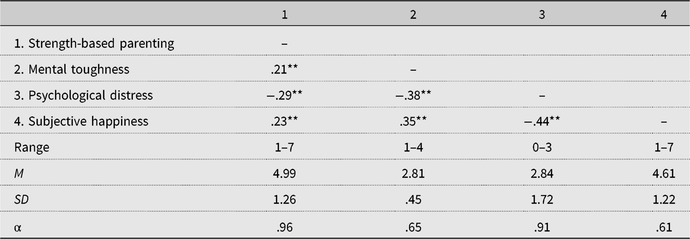
Descriptive statistics, including means, standard deviations, Cronbach’s alpha coefficients, and bivariate correlations between strength-based parenting, mental toughness, psychological distress, and subjective happiness are presented in Table 1. The correlations between strength-based parenting, mental toughness, and psychological outcomes (psychological distress, and subjective happiness) were all statistically significant. As expected, strength-based parenting was positively related to mental toughness (r = .21, p < .01) and subjective happiness (r = .23, p < .01), and negatively related to psychological distress (r = −.29, p < .01). Furthermore, adolescents relatively higher in mental toughness reported lower psychological distress (r = −.38, p < .01) and greater subjective happiness (r = .35, p < .01).
Descriptive Statistics and Bivariate Correlations (N = 348)

Note: ** p < .01.
Measurement model
The measurement model is composed of four first-order latent variables (strength-based parenting, mental toughness, psychological distress, and subjective happiness) and 15 observed variables. The strength-based parenting latent variable was represented by SBP-Knowledge and SBP-Use subscales. Mental toughness was represented by six MTS-A items. Psychological distress was represented by the depression, anxiety, and stress subscales of DASS-21. Happiness was represented by four SHS items. The results of confirmatory factor analysis showed that measurement model had adequate fit to the data: χ2(84) = 239.491, p < .001, χ2/df = 2.85, RMSEA = .07, CI [.06, .08], RMR = .08, and CFI = .90. Standardised factor loadings ranged from .80 to .93 for strength-based parenting, .32 to .62 for mental toughness, .77 to .89 for psychological distress, and .36 to .69 for subjective happiness. All standardised factor loadings and correlations among latent variables were statistically significant at the p < .001 level.
Structural model
The hypothesised model included one independent variable (strength-based parenting), one mediator (mental toughness), and two dependent variables (psychological distress and subjective happiness). Structural equation modelling indicated that the hypothesised model yielded an acceptable model fit: χ2(85) = 270.195, p < .001, χ2/df = 3.18, RMSEA = .08, CI [.07, .09], RMR = .09, and CFI = .88. All factor loadings for observed variables and structural pathways were significant at the alpha .01 level. As seen in Figure 1, strength-based parenting was positively related to mental toughness (β = .29, p < .001), which in turn, was negatively related to psychological distress (β = −.45, p < .001) and positively related to subjective happiness (β = .54, p < .001). Strength-based parenting was also negatively associated with psychological distress (β = −.22, p < .001) and positively associated with subjective happiness (β = .21, p < .01). Strength-based parenting and mental toughness explained 30% of the variance in psychological distress and 40% of the variance in subjective happiness.
Structural model (N = 348). Standardised regression weights are reported. SBP-K and SBP-U subscales are observed variables of strength-based parenting; MTS1-MTS6 items are observed variables of mental toughness; depression, anxiety, and stress subscales are observed variables of psychological distress; SHS1-SHS4 items are observed variables of subjective happiness.

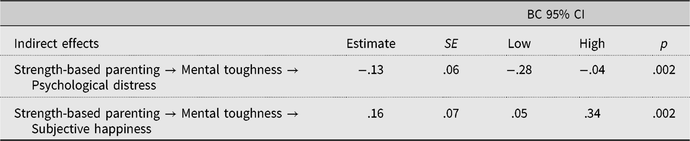
To estimate the significance of indirect effects, 5,000 bootstrapped samples with 95% bias-corrected confidence intervals were used. As presented in Table 2, the results of the bootstrap analyses indicated that the indirect effects of strength-based parenting to psychological distress (β = −.13, 95% CI [−.28, −.04]) and strength-based parenting to subjective happiness (β = .16, 95% CI [.05, .34]) via mental toughness were both significant. These findings show that increased strength-based parenting is linked to higher mental toughness, which in turn is related to lower psychological distress and higher subjective happiness. Thus, our research hypotheses are supported. The direct pathways from strength-based parenting to both psychological distress (β = −.22, p < .001) and subjective happiness (β = .21, p < .001) were significant when mental toughness was considered in the analysis. Therefore, we concluded that mental toughness partially mediated the links between strength-based parenting and psychological distress and subjective happiness.
Indirect Effects of Mental Toughness Linking Strength-Based Parenting to Adolescents’ Psychological Outcomes (N = 348)

Note: Bootstrap resamples = 5,000; BC = bias corrected; CI = confidence interval.
Discussion
In the present study, the direct effects of strength-based parenting on psychological outcomes, as well as the indirect effects via mental toughness were examined. We hypothesised that strength-based parenting would be directly and negatively associated with psychological distress and directly and positively associated with subjective happiness of adolescents. We also hypothesised that adolescents’ mental toughness would mediate the links between strength-based parenting and adolescents’ psychological outcomes. The results are generally consistent with the expectations, indicating that strength-based parenting is associated with higher mental toughness, which in turn linked to lower levels of psychological distress and higher levels of subjective happiness.
The results revealed that correlations among study variables were in the expected directions. Strength-based parenting was related to higher levels of mental toughness, lower levels of psychological distress, and higher levels of subjective happiness. These findings were consistent with the findings of Gucciardi and Gordon (Reference Gucciardi and Gordon2011), Jach et al. (Reference Jach, Sun, Loton, Chin and Waters2018), Loton and Waters (Reference Loton and Waters2017), and Waters (Reference Waters2015a, Reference Waters2015b). Also, higher level of mental toughness was related to lower levels of psychological distress and higher levels of subjective happiness. The findings were similar with Gucciardi and Jones (Reference Gucciardi and Jones2012), McGeown et al. (Reference McGeown, St Clair-Thompson and Putwain2018), and Nicholls et al. (Reference Nicholls, Polman, Levy and Backhouse2008).
First, we hypothesised that strength-based parenting would be directly and negatively associated with psychological distress and directly and positively associated with subjective happiness of adolescents. Research results indicated that higher rates of strength-based parenting predicted lower levels of psychological distress and higher levels of subjective happiness. Consistent with these results, previous findings indicated that strength-based parenting was associated with higher strength-based coping and lower stress in children (Waters, Reference Waters2015b), higher subjective wellbeing (e.g., Jach et al., Reference Jach, Sun, Loton, Chin and Waters2018; Loton & Waters, Reference Loton and Waters2017; Waters, Reference Waters2015a), self-efficacy, and lower psychological distress (Loton & Waters, Reference Loton and Waters2017) in adolescents. Waters (Reference Waters2015b, p. 690) states that ‘strength-based parenting is an approach where parents deliberately identify and cultivate positive states, processes and qualities in their children’. Theoretically, it is proposed that strength-based parenting encourages children to become aware of innate strengths and uncover their full potential (Waters, Reference Waters2015a, Reference Waters2015b; Waters et al., Reference Waters, Loton and Jach2018). Seeing, cultivating, and celebrating strengths helps children develop inner resources, boost wellbeing, and buffer psychological distress. Based on these explanations, it can be said that identifying and nurturing positive states, positive processes, and positive qualities importantly contributes to children’s and adolescents’ mental health outcomes. The other important explanation for current research findings might be that knowing and using strengths would be beneficial for individuals’ mental health since they may serve to satisfy their competency needs. Indeed, the significance of the satisfaction of competence need for mental health has been acknowledged both theoretically and empirically in previous researches (e.g., Ryan & Deci, Reference Ryan and Deci2000; Soenens et al., Reference Soenens, Deci, Vansteenkiste, Wehmeyer, Shogren, Little and Lopez2017).
Second, we hypothesised that adolescents’ mental toughness would mediate the links between strength-based parenting and adolescents’ psychological outcomes. Research results indicated that strength-based parenting was indirectly linked to both psychological distress and subjective happiness through the mechanism of mental toughness. This finding was consistent with the findings of the previous studies that show indirect effects of parenting behaviours on offspring’s mental health or adjustment through some cognitive constructs as mediators (Özdemir, Vazsonyi, & Çok, Reference Özdemir, Vazsonyi and Çok2013; Zhong et al., Reference Zhong, Wu, Nie, Xia, Li, Lei and Mahendran2016). For example, Zhong et al. (Reference Zhong, Wu, Nie, Xia, Li, Lei and Mahendran2016) indicated that parenting behaviours indirectly affect children’s mental health through resilience. However, there are very few studies that have specifically examined the mediators and moderators between strength-based parenting and adolescents’ outcomes. Self-efficacy (Loton & Waters, Reference Loton and Waters2017) and perseverance (Waters et al., Reference Waters, Loton and Jach2018) have been confirmed as mediating mechanisms underlying the effects of strength-based parenting on adolescents’ outcomes. Mindset has been proposed as a moderator in the link between strength-based parenting and adolescents’ mental health outcomes (Jach et al., Reference Jach, Sun, Loton, Chin and Waters2018). But, to the best of our knowledge, the present study is the first that has examined mental toughness as a mechanism accounting for the association between strength-based parenting and adolescent outcomes. As evident from this research, the mediating effect of mental toughness is important to discuss. Mental toughness, as an effective coping mechanism, helps the individual to deal effectively with environmental stressors and to seek out opportunities for personal development (McGeown et al., Reference McGeown, St Clair-Thompson and Putwain2018; St Clair-Thompson et al., Reference St Clair-Thompson, Bugler, Robinson, Clough, McGeown and Perry2015). Mental toughness comprised of attributes of commitment, challenge, control, and confidence is regarded as a malleable personality trait that can potentially be developed through supportive parental practices and positive youth experiences (Gordon & Gucciardi, Reference Gordon and Gucciardi2011; McGeown, St Clair-Thompson, & Clough, Reference McGeown, St Clair-Thompson and Clough2016). It is proposed that mentally tough adolescents are more likely to deal successfully with obstacles, seek out opportunities for development, control and regulate both their life and emotions, and believe in their personal and interpersonal abilities (Gucciardi & Gordon, Reference Gucciardi and Gordon2011; McGeown et al., Reference McGeown, St Clair-Thompson and Putwain2018). Consistent with theoretical explanations, empirical findings demonstrate that mental toughness attributes predict positive school and mental health outcomes in educational settings (McGeown et al., Reference McGeown, St Clair-Thompson and Putwain2018). As a result, it can be deduced that strength-based parenting would develop attributes of mental toughness, which in turn may contribute to psychological outcomes in adolescents.
This study has some limitations as well. First, the data obtained in this study was based solely on self-report of a youth sample. This may have created a limitation in terms of common source bias. In future studies, parental reports would be also collected. A second limitation was the cross-sectional nature of the study. As such, causal conclusions cannot be drawn from the research results. For example, youth who have higher levels of mental toughness might encourage their parents to use strength-based parenting strategies. Longitudinal and intervention studies are needed to show causal relationships between strength-based parenting, mental toughness, and psychological outcomes of adolescents. In addition, other parenting dimensions have not been addressed in this study in order to demonstrate the unique effect of strength-based parenting. In future studies, other positive parenting dimensions could also be included in the research design. Finally, in this research, we investigated the overall effect of strength-based parenting on adolescents’ psychological outcomes. Future studies could examine differential effects of strength-based parenting-knowledge and strength-based parenting-use dimensions on adolescents’ psychological outcomes.
Despite these limitations, the present research strongly contributes to parenting and positive psychology literatures. The findings of this research highlight that strength-based parenting is linked to increased mental toughness, which in turn is associated with lower psychological distress and greater subjective happiness among adolescents. Incorporating newly defined constructs showing structural relationships among research variables and testing the mediator role of mental toughness from sport research were unique contributions of this research. Finally, it is obvious that today’s children and adolescents, including Turkish youth, are exposed to a large number of stressors. If this is the case, discovering the protective factors of mental health from the perspective of positive psychology may be regarded as an important contribution to the existing literature.
The present study has several implications for practitioners and researchers as well. In this study, both strength-based parenting and mental toughness accounted for an important degree of variance in adolescents’ psychological outcomes. Based on this finding, psychologists and counsellors working at community health centres and in school counselling services may introduce and explain strength-based parenting in parent training programs in order to preserve and improve the mental health of children and adolescents. In particular, the effect of knowing adolescents’ strengths and encouraging them to use those strengths on adolescents’ mental toughness and mental health should be emphasised in parenting interventions. In future research, researchers should identify antecedents of strength-based parenting and other variables that might mediate and moderate the relationship between strength-based parenting and adolescents’ psychological outcomes.
In conclusion, the present study revealed the salient role of strength-based parenting and mental toughness, of which we do not have enough data yet, on the mental health of adolescents. Strength-based parenting and mental toughness are exciting areas of research in the field of positive psychology as to how parents can promote healthy development of their children. More empirical findings are needed to unpack the tremendous effects of strength-based approaches on individuals’ development and flourishing.
Author ORCIDs
Ali Serdar Sağkal, 0000-0002-2597-8115.