INTRODUCTION
Consonants and vowels produced by infants during early periods of speech acquisition have been examined in many studies over a number of years (e.g. Boysson-Bardies, Halle, Sagart & Durant, Reference Boysson-Bardies, Halle, Sagart and Durand1989; Boysson-Bardies & Vihman, Reference Boysson-Bardies and Vihman1991; Davis & MacNeilage, Reference Davis and MacNeilage1995; Kern & Davis, Reference Kern, Davis, Pellegrino, Marsico, Chitoran and Coupéin press; Locke, Reference Locke1983; Rvachew, Mattock, Polka & Menard, Reference Rvachew, Mattock, Polka and Menard2006). Characterizing these patterns in infant output provides an avenue for considering universal production patterns in the context of early perceptual learning of precise phonological characteristics of the ambient language. Currently, two perspectives have been proposed for understanding this formative period of speech acquisition: emphasis on universal production system characteristics versus focus on the role of input in infant acquisition of ambient language regularities.
Views emphasizing the production system, which are related to claims of early universal production patterns, predict that infant output will show great similarity across languages, reflecting limitations based on the structure of the vocal tract as well as immature speech motor control (e.g. Green, Moore, Higashikawa & Steeve, Reference Green, Moore, Higashikawa and Steeve2000; Kent, Vorperian, Gentry & Yandell, Reference Kent, Vorperian, Gentry and Yandell1999). Data-based studies of the canonical babbling period have indicated that spontaneously produced babbling patterns are restricted to a relatively small sound inventory. A predominance of occlusive consonants (stops and nasals) and vowels in a restricted region of the vowel space (e.g. mid and low as well as front and central vowels) has been observed in English (Davis & MacNeilage, Reference Davis and MacNeilage1995) and across diverse language environments (e.g. Kern & Davis, Reference Kern, Davis, Pellegrino, Marsico, Chitoran and Coupéin press; Locke, Reference Locke1983). These similarities have provided data supporting a production system oriented view of early acquisition.
Views emphasizing the role of input and perceptual learning suggest that production patterns are influenced by the young infant's capacities for processing regularities in the input. Relative to production–perception interfaces, Kuhl & Meltzoff (Reference Kuhl and Meltzoff1996) found that the vowel productions of infants aged 12–20 weeks were changed in accordance with the acoustic characteristics of adult modeled vowels in a controlled laboratory environment. Additionally, infants have demonstrated capacities for learning and retaining regularities in the phonetic structure of their ambient language by around age 0 ; 10, as evidenced in looking time paradigms (Aslin, Saffran & Newport, Reference Aslin, Saffran and Newport1998; Saffran, Aslin & Newport, Reference Saffran, Aslin and Newport1996). Several cross-linguistic studies of infants' spontaneous babbling vocalizations in the first year of life have proposed that infants' perceptual learning of ambient language regularities is demonstrated by early effects on consonant and vowel distributions within their babbling repertoire (Boysson-Bardies et al., Reference Boysson-Bardies, Halle, Sagart and Durand1989; Boysson-Bardies & Vihman, Reference Boysson-Bardies and Vihman1991; Rvachew et al., Reference Rvachew, Mattock, Polka and Menard2006).
The purpose of this study was to evaluate common tendencies as well as early appearance of ambient language patterns in infant output repertoires during canonical babbling. Unlike previous studies reporting infant speech data within a single observation period, twelve infants in Korean and English language environments were followed longitudinally across the canonical babbling period (0 ; 8 to 1 ; 0). The segmental distribution of phonemes in infant-directed speech (IDS) in the two ambient languages was also compared to evaluate whether differences of consonant and vowel segmental patterns between Korean- and English-learning infants were reflected by differences in their ambient language. In order to investigate segmental patterns in the ambient language, IDS was analyzed because the IDS speech style is prominent in input directed to infants during this developmental period.
Infant production patterns
In an early review, Locke (Reference Locke1983) surveyed three studies of consonant production involving a total of 131 English-learning infants at the age of 0 ; 11–1 ; 0. In terms of median percentages, high relative frequencies were observed for [h] (21%), coronal stops (22%), labial stops (18%), dorsal stops (14%), labial and coronal nasals (9%) and glides (20%). Fricatives, affricates and liquids were extremely rare. Locke (Reference Locke1983) asserted that preferences found in the English-learning infants tended to be confirmed in infants' babbling in fourteen other language environments.
Except for the frequency of [h], and somewhat higher frequencies for fricatives and liquids, similar patterns were found in a large-scale study of six English-learning infants, including analysis of a total of 15,690 consonants (Davis & MacNeilage, Reference Davis and MacNeilage1995). The median percentages of occurrence for manner of articulation were stops (48%), nasals (14%), glides (11%) and other consonants (18%), consisting primarily of liquids and fricatives. For place of articulation, the median percentages were coronals (47%), labials (26%), dorsals (9%) and other (17%). While Davis and MacNeilage used a larger sample than in previous studies, their results were mainly descriptive.
In the most comprehensive cross-language study of babbling available in terms of database size (Kern & Davis, Reference Kern, Davis, Pellegrino, Marsico, Chitoran and Coupéin press), consonant and vowel frequencies were tabulated for five sets of four children in Dutch, French, Romanian, Tunisian Arabic and Turkish language environments. A total of 57,472 consonants were tabulated. The median percentages for occurrence of manner of articulation were stops (51%), nasals (16%), glides (17%), oral fricatives (8%), glottal fricatives (5%) and others (5%). For place of articulation, the median percentages of occurrence were coronals (50%), labials (23%), dorsals (12%) and glottals (3%).
Vowel patterns in babbling have also been studied extensively. MacNeilage & Davis (Reference MacNeilage, Davis and Jeannerod1990) reviewed studies of vowels in babbling in a total of twenty-three infants in English (Kent & Bauer, Reference Kent and Bauer1985; Lieberman, Reference Lieberman, Yeni-Komshian, Kavanagh and Ferguson1980), French (Boysson-Bardies et al., Reference Boysson-Bardies, Halle, Sagart and Durand1989) and Spanish (Oller & Eilers, Reference Oller and Eilers1982) language environments. They found a tendency for mid and low as well as front and central vowels to be preferred across languages. This pattern has been designated as a preference for ‘lower left quadrant’ vowels. The lower left quadrant preference was confirmed in the analysis of a large database of 15,719 vowels produced by six English-learning infants in babbling (Davis & MacNeilage, Reference Davis and MacNeilage1995): ‘of the top three vowels for the 6 subjects, all but one vowel for one subject … were mid or low front or central vowels’ (p. 1205). In the babbling data on five languages analyzed by Kern & Davis (Reference Kern, Davis, Pellegrino, Marsico, Chitoran and Coupéin press), a total of 69,007 vowels were tabulated. About two-thirds of all vowels occurred in the lower left quadrant. In all five languages, front and central vowels exceeded back vowels, and mid and low vowels exceeded high vowels.
A summary of production patterns for consonantal and vocalic patterns in canonical babbling shows some strong central tendencies across language studied to date. Canonical babbling shows a predominance of occlusive consonants (stops and nasals) and a much less frequent occurrence of constrictive consonants (fricatives, affricates and liquids). Glides are the main non-occlusive consonantal category. Infants in this period tend to produce lower left quadrant vowels.
Although Kern & Davis (Reference Kern, Davis, Pellegrino, Marsico, Chitoran and Coupéin press) employed statistical analyses, most studies of diverse languages have employed descriptive methods to report infant consonant and vowel patterns, often based on very small corpora. In addition, vowel production has been examined largely within Indo-European languages such as English, French and Spanish. It is not certain whether the lower left quadrant vowel space is a universal characteristic in infant vowel production patterning. Moreover, infant patterns have not been compared to ambient language sound patterns consistently. No comparison with ambient language frequencies is available in the large infant databases reported by Kern & Davis (Reference Kern, Davis, Pellegrino, Marsico, Chitoran and Coupéin press) for five Indo-European languages or in the English database analyzed by Davis & MacNeilage (Reference Davis and MacNeilage1995). It is difficult to argue conclusively that infant speech patterns are based only on production limitations without comparison with adult input frequencies.
The role of input: ambient language influences in canonical babbling
Ambient language influences on babbling have been explored in varied languages. Boysson-Bardies & Vihman (Reference Boysson-Bardies and Vihman1991) compared relative frequencies of consonants in babbling and first words (from 0 ; 9 to 1 ; 5) with each infant's target language to consider ambient language influences in French, English, Japanese and Swedish. Infants in the four language groups (five infants per group) showed significant differences in consonant manner and place frequency distributions. In particular, the same ranking of frequency of labials as in the ambient language; French>English>Swedish=Japanese, was found in early infant babbling and in target words. The authors concluded that ‘a clear phonetic selection could already be discerned in babbling, leading to statistically significant differences between the groups’ (p. 297). However, Boysson-Bardies & Vihman (Reference Boysson-Bardies and Vihman1991) summed babbling vocalizations across the entire 0 ; 9–1 ; 5 period analyzed, raising the possibility that concurrently produced words were influencing the patterns reported as characterizing the babbling repertoire. It is unknown at this point whether babbling concurrent with early word use is consistent with prelinguistic babbling. Also, words attempted by children were employed to represent target language frequencies in that study. They may not provide an accurate estimate of consonant frequencies in adult input to the infant.
Levitt & Aydelott Utman (Reference Levitt and Aydelott Utman1992) compared the babbling of one infant reared in an English and one reared in a French environment in weekly 20-minute sessions at ages 0 ; 5, 0 ; 8, 0 ; 11 and 1 ; 2. Both children produced stops most frequently. This pattern was consistent with cross-language tendencies observed in Locke (Reference Locke1983). However, the absolute frequency of stop productions was different between the two children. The difference in frequency of stop consonants was interpreted as resulting from language-specific feature differences between English and French. The authors suggested that their results provided evidence of both universal and language specific characteristics in babbling. Levitt & Aydelott Utman's data were based on analysis of one infant per language. It may thus not be valid to generalize these case study results or compare them with group data.
Boysson-Bardies and colleagues (Boysson-Bardies et al., Reference Boysson-Bardies, Halle, Sagart and Durand1989) acoustically analyzed vowels in the babbling of Arabic, Chinese, English and French infants at age 0 ; 10. They measured the ratio of the second to the first formants acoustically (F2/F1). F2/F1 ratios in babbling were reported as reflecting ratios in the infants' ambient language environment. French and English infants showed more diffuse ratios than those of Arabic and Chinese infants, reflecting relatively more front vowels for English, more mid-central vowels for French and Arabic, and more low-back vowels for Cantonese Chinese. A significant overall similarity among the four infant group patterns and the patterns of their corresponding ambient language led the authors to conclude that language-specific vowel production may appear by age 0 ; 10.
Rvachew et al. (Reference Rvachew, Mattock, Polka and Menard2006) acoustically analyzed F1 and F2 values for Canadian English- and Canadian French-learning infants' vowels. They studied a larger number of infants (i.e. forty-three for both groups) and gathered data longitudinally between 0 ; 10 and 1 ; 6. The authors found that the French-learning infants and English-learning infants showed different developmental patterns. French-learning infants demonstrated a significant decline in the mean value of F1 while the English-learning group showed a significant decline in the mean of F2 values. In a subsequent study, Rvachew, Alhaidary, Mattock & Polka (Reference Rvachew, Alhaidary, Mattock and Polka2008) reported that English-learning infants produced more frequent high-back vowels than French-learning infants through the age range of 0 ; 8 to 1 ; 6, supporting the hypothesis that infant vowel production begins to reflect the ambient language in this early period of prelinguistic and early language based vocal output.
Based on available studies, there are indications that ambient language influences on sound patterns may occur during canonical babbling. Most previous studies which claim both universal production patterns and ambient language influence are not conclusive due to methodological limitations. Very small databases within a single data collection session or case studies have frequently been employed with the exception of Rvachew et al. (Reference Rvachew, Mattock, Polka and Menard2006) and Davis & MacNeilage (Reference Davis and MacNeilage1995). These methods result in a very small number of vocalizations per infant. According to Locke (Reference Locke1989), ‘it appears … that individual infants vary from day to day. So when two infants differ, how can we be sure that the variations are due to something about the infants themselves as opposed to mere fluctuations across sampling intervals?’ (p. 201). In addition, available studies have not consistently pursued statistical analysis to evaluate the strength of assertions about early appearance of ambient language regularities in infant production repertoires relative to general patterns reported widely. As a result, large-scale longitudinal studies supported by quantitative evaluation of canonical babbling are needed. These studies can support valid characterization of the relative role of production system capacities, evidenced by common output patterns across languages. Also, they can more precisely describe early appearance of ambient language patterns in output repertoires.
Segmental patterns in infant-directed speech
One issue has so far been neglected when researchers have considered whether the segmental patterns in infant speech output resemble ambient language patterning. It is the issue of what patterns the infant hears most frequently. Previous investigations have shown that when caregivers talk to their infants, they use a special register called infant-directed speech. IDS contains characteristics distinguishing it from adult-directed speech (ADS). IDS characteristics have been proposed as influencing speech and language development in diverse dimensions of language (e.g. Cooper, Abraham, Berman & Staska, Reference Cooper, Abraham, Berman and Staska1997; Fernald, Reference Fernald1991).
Recently, Lee, Davis & MacNeilage (Reference Lee, Davis and MacNeilage2008) found that the segmental distribution of IDS in Korean is significantly different from Korean ADS. For example, Korean IDS speakers produced more labial consonants, but fewer fricatives than ADS speakers. Korean IDS speakers also manifested more mid- and low-central vowels in comparison to mid-front and high-central vowels. In terms of consonant and vowel association patterns, Lee, Davis & MacNeilage (Reference Lee, Davis and MacNeilage2007) found that consonant–vowel association patterns were different between Korean IDS and ADS as well. Coronal consonants were frequently associated with front vowels (coronal–front), labials occurred with back vowels (labial–back) and dorsal consonants preferred front vowels (dorsal–front) in IDS. In ADS, dorsal–central and coronal–back associations were significantly more frequent. These studies suggest that sound patterns in IDS may be different from ADS patterns. IDS has been established as a speech style frequently spoken to infants. To consider the impact of IDS input, infant consonant and vowel patterns should be compared with IDS. This comparison will enable consideration of the role of naturally occurring input to infants during canonical babbling in the appearance of ambient language-specific patterns.
The purpose of this study
The current study investigated consonant and vowel characteristics in the babbling of six Korean-leaning infants aged between 0 ; 8 and 1 ; 0, and compared those patterns to an existing babbling database of English-learning infants during the same period (Davis & MacNeilage, Reference Davis and MacNeilage1995). To enable a statistical analysis of canonical babbling patterns, a large dataset of infant vocalizations was collected longitudinally. Small corpora are subject to daily fluctuations that may be biased based on sample size.
Consonant and vowel patterns between Korean and English IDS were also analyzed to characterize segmental patterns available to infants. Korean and English have distinctive consonant and vowel inventories. These differences can facilitate consideration of emergence of ambient language patterns
Two questions were addressed in this study:
(1) What are the similarities and differences between Korean- and English-learning infants' consonant and vowel production patterns in canonical babbling?
(2) Are the similarities and differences between Korean- and English-learning infants related to significant differences found in their ambient language?
Korean- and English-language sound systems
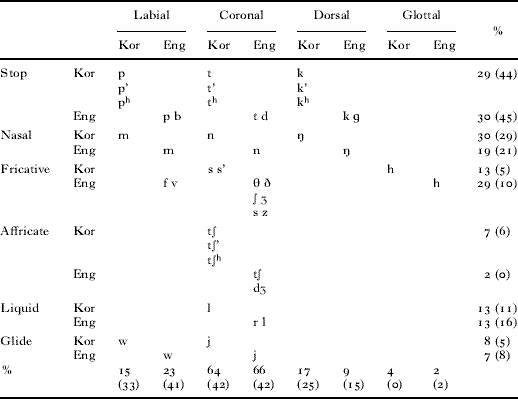
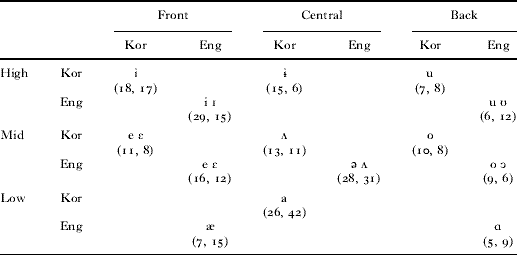
A brief summary of consonant and vowel phoneme frequencies provides background for evaluating emergence of ambient language patterns in Korean-learning and English-learning infants. Korean belongs to the Altaic family of languages, including Turkic, Mongolic and Japanese. English is a member of the Indo-European language family. Tables 1 and 2 show the percentages of frequency distribution for consonant and vowel categories in Korean and English ADS. Phoneme frequencies for ADS were based on Jin (Reference Jin1993) for Korean and on Mines, Hanson & Shoup (Reference Mines, Hanson and Shoup1978) for English. The tables also indicate the percentage of each consonant and vowel category for the target toys used in this study. Phoneme frequency distributions for the target toys will be discussed in the ‘Method’ section in more detail.
The percentage of Korean and English consonant categories in ADS and target toys

note: ADS frequencies for Korean are adopted from Jin (Reference Jin1993) and for English from Mines et al. (Reference Mines, Hanson and Shoup1978). Percentages in parentheses indicate frequencies for target toys used in the current study.
The percentage of Korean and English vowel categories in ADS and target toys

note: The first percentage in parentheses is for ADS samples adopted from Jin (Reference Jin1993) for Korean and Mines et al. (Reference Mines, Hanson and Shoup1978) for English. The second percentage in parentheses is for the target toys used in the current study.
Mines et al. (Reference Mines, Hanson and Shoup1978) obtained the frequency of occurrence of English phonemes from an adult conversational speech sample. Frequencies for consonant and vowel phonemes presented here include only phonemic consonants and vowels. For Korean, Jin (Reference Jin1993) collected narrative samples, including radio/TV scripts, to determine the frequency of occurrence of each phoneme. Frequencies of /j/ and /w/ were categorized as glides, since in Korean glides only exist with vowels to form diphthongs (e.g. /ja/).
Comparisons of consonant and vowel phoneme frequencies from Jin (Reference Jin1993) and Mines et al. (Reference Mines, Hanson and Shoup1978) reveal general patterns. The frequency of labial and fricative consonants is higher in English than in Korean. In contrast, dorsal and nasal frequencies are lower in English. Similarly, high-front and mid-central vowel frequencies are higher in English than in Korean while low-central vowel frequencies are lower in English.
METHOD
Infant speech
Korean-learning infants' canonical babbling data were gathered for the purpose of this study. An existing database (Davis & MacNeilage, Reference Davis and MacNeilage1995) was analyzed for English-learning infants' babbling samples. In order to ensure that Korean and English babbling data were comparable, data collection and analysis procedures for the Korean-learning infants' babbling followed those of Davis & MacNeilage (Reference Davis and MacNeilage1995). Thus, methods for Korean-learning infants' data are described in detail. Detailed information on participant and collection procedures for English-learning infants is available in Davis & MacNeilage (Reference Davis and MacNeilage1995).
Participants
Six Korean-learning infants (four females and two males) were selected as participants. The infants were selected by informal referral from Korean families in Austin, Texas. Two criteria were applied for participation. First, all infants were described as normally developing, without any reported physical, mental or sensory impairments. To establish typical development, parent reports on their infants' developmental milestones as well as medical records made available by parents were considered. All infants had normal hearing, based on sound field hearing testing results at the University of Texas at Austin Speech and Hearing Center. Second, the Korean-learning infants were developing within a monolingual Korean language environment. Primary caregivers spoke only Korean to their infants. While the Korean-learning infants might be exposed to English indirectly (e.g. on TV), no English speaker was interacting with them on a regular basis.
The number of English-learning infants was the same as Korean-learning infants except that there were three males and three females. All participants were typically developing according to parent report and had normal hearing responses based on sound field testing.
Data collection
The data collection procedure for the Korean babbling samples was similar to the procedure used for the English babbling samples except for the recording equipment (see Davis & MacNeilage, Reference Davis and MacNeilage1995, for more detail on audio recorder information) and the period of data collection. The English-learning infants' data were from a larger set of longitudinal data collected from reported onset of canonical babbling at age 0 ; 7–0 ; 8 until 3 ; 0. The recordings for Korean-learning infants started at 0 ; 7–0 ; 8 and ended at 2 ; 0.
Consistent with the English data collection methods, a one-hour audio-recording was made every one or two weeks until age 1 ; 0, depending on family schedule. From age 1 ; 1 to 2 ; 0, recordings were made once every three or four weeks. All recordings occurred in the home environment during natural play interactions. No structure was imposed on normal household routines for either language group. The Korean data were collected using a Sony MiniDisc Recorder MZ-N10 inside and an MM-Lapel-1 microphone. Each infant wore a vest with the recorder placed in a pocket on the back of the vest. The microphone connected to the recorder was clipped to the shoulder of each infant's vest in both studies. This arrangement made it possible to collect clear acoustic signals at a consistently close distance and prevented infants from tampering with the microphone and recorder.
Recording sessions for both Korean and English infant data occurring between ages 0 ; 8 and 1 ; 0 were selected for analysis in order to analyze the frequency of occurrence for consonants and vowels during the canonical babbling period. Babbling produced earlier than 0 ; 8 has been described as ‘marginal babbling’, as vocalizations often do not meet the rhythmic requirements for speech-like utterances (see Oller, Reference Oller2000, for canonical babbling criteria). To avoid any potential influence of words on babbling, babbling vocalizations after 1 ; 0, when some infants started to produce their first words, were not included. A total of 78 one-hour recordings were obtained for the Korean-learning infants. The same number of sessions were available for the English-learning infants.
Data selected for analysis included all utterances judged perceptually to be rhythmically speech-like canonical babbling. Canonical babbling can be characterized as phonation accompanied by an alternation of closed and open phases of the mouth (Davis & MacNeilage, Reference Davis and MacNeilage1995; Oller, Reference Oller2000). Word productions were excluded based on parent report that the infant was producing a recognizable word form. All utterance strings analyzed were comfort state vocalizations produced without conspicuous environmental noise or speech. Singleton and repeated isolated consonant and vowel segments, as well as vocalizations such as grunts, laughs, shrieks, whispers and raspberries were excluded. Utterances that were difficult to transcribe due to excessive background noise were not analyzed. Approximately, 8·5% of the total utterances were excluded. Including English-learning infants' babbling, a total of 45,606 consonant-like and vowel-like sounds were analyzed for both groups. The mean number of consonants and vowels was 1,633 (SD=427) and 1,517 (SD=624) for Korean. For English, the means for consonants and vowels were 2,299 (SD=1,434) and 2,423 (SD=1,545), respectively.
Transcription and reliability
Utterances were transcribed using the International Phonetic Alphabet's broad phonetic transcription conventions. The primary investigator transcribed all Korean data. To support more accurate transcription, the recording for each Korean-learning infant was transferred from the MiniDisc to a digital file on a computer. Thus, transcription was accomplished using a waveform editor so that each babbling utterance could be played as often as necessary without rewinding the tape. In addition, spectrograms and spectra were generated when vowels or other segments were not perceptually apparent. A native Korean speaker who had knowledge of English, and was blind to the study goals, re-transcribed 10% of the Korean-learning infants' data for reliability in terms of each consonant and vowel category. Reliability for the Korean-learning infants' consonants and vowels were 83% (ranging from 70·8% to 90·3%) for consonants and 82% (ranging from 79·2% to 86·6%) for vowels.
Transcription could be biased when native language transcribers transcribe toward the patterns in their own ambient language (Oller, Reference Oller2000). To prevent native language transcriber bias, inter-language transcription reliability between native Korean and English speakers was also conducted. Three native English speakers re-transcribed 10% of the Korean-learning infants' data in terms of each consonant and vowel category. Reliability for consonant and vowel categories was 82% (ranging from 81·3% to 91·2%) and 80% (ranging from 70·4% to 84·2%), respectively, suggesting that there was no native language transcription bias in the data analyzed.
Davis & MacNeilage (Reference Davis and MacNeilage1995) reported on reliability for the English-learning infants' data. English data were transcribed by native English speakers. A single transcriber was assigned to each English-learning infant for analysis of all sessions on each infant. Another native English speaker, blind to the study's hypotheses, re-transcribed 10% of utterances. The mean reliability for consonants and vowels in terms of consonant and vowel categories was 76·8% for consonants and 50% for vowels. Pooling results of vowel reliability across neighboring cells increased reliability for all cells except mid-central and high-back vowels. Reliability increased overall to 80% or better. According to Davis and MacNeilage, ‘this result indicated that with the exception of mid-central and high-back vowels, there is relatively good agreement that a given vowel belongs within a broadly defined region of the overall vowel space’ (p. 1206).
Data analysis
The transcribed Korean data were entered into a database, enabling computer analysis (Logical International Phonetic Program, LIPP; Oller & Delgado, Reference Oller and Delgado1990), consistent with analysis procedures for the existing English data. All infant data were analyzed using LIPP to consider consonant place and manner dimensions, and vowel categories. Consonants were grouped in terms of place of articulation as labials, coronals, dorsals and glottals. They were also categorized with respect to manner of articulation as stops, nasals, fricatives, affricates, liquids and glides. Vowels were categorized into high-front [i I], mid-front [e ɛ], low-front [æ], high-central [ɨ], mid-central [ə ʌ ɚ], low-central [a], high-back [u Ʊ], mid-back [o ɔ] and low-back [α] dimensions.
Statistical analyses
Hierarchical Linear Modeling (HLM) was employed for the analysis of infant consonant and vowel categories (Bryk & Raudenbush, Reference Bryk and Raudenbush1992). HLM is designed to analyze data in which lower-level units of analysis are nested in higher-level units of analysis. Repeated observations for each infant were nested within infant. Infants were also nested within language (i.e. Korean vs. English). While differences in each session were not the focus of this study, when comparing differences between two language groups the repeated observations potentially have an effect on the outcome. Thus, it should be accounted for in a statistical model. HLM analysis is known to be useful for different numbers of repeated observations for each participant. In HLM, differences in intercepts represent mean differences in dependent variables that can be predicted from independent variables.
Infant-directed speech
Participants
Ten monolingual English or Korean mothers living in a Midwestern city participated. Their infants were aged approximately 1 ; 0. For the existing English babbling data, mothers of English-learning infants were not available. To ensure comparable data collection and analysis, both Korean- and English-speaking mothers who were not mothers of the participating infants were recruited. All mothers had limited exposure to other cultures and languages. In particular, the Korean-speaking mothers were native Korean speakers who had lived in the United States only for two to three years. They were either graduate students or wives of graduate students of universities in the United States. None had significant language contacts outside of their own community.
Data collection
Both Korean- and English-speaking mothers' speech was recorded at either the participant's home or the Speech Acoustic Laboratory in a university setting. Mothers wore a small traveling bag on their waist, with a Sony MiniDisc Recorder MZ-N10 inside and an MM-Lapel-1 microphone connected to the recorder and clipped to their clothing. During the initial two to three minutes, the mothers were asked to play with their infants using several toys as they normally did. Then, four specific types of target toys were provided to obtain an IDS sample. The toys included a pair of stuffed animals (e.g. a dog and a pig), a pair of cars (e.g. a truck and a car), toy foods (e.g. fruits and vegetables) and a miniature house with family members (e.g. Daddy, Mommy and baby). These toys were selected because they are commonly used in mother–child interaction in various cultures (Fernald & Morikawa, Reference Fernald and Morikawa1993) and reflect daily activities at home (Lee et al., Reference Lee, Davis and MacNeilage2008). With each set of toys, mothers were asked to play with their own infants for approximately five minutes.
In order to identify whether target toys selected influenced segmental distributions, consonant and vowel frequencies for the target toy names were tabulated (see Tables 1 and 2, in parentheses). Citation transcriptions for these target words (e.g. dog) were adopted from dictionaries (for English, Merriam-Webster, 1993; for Korean, Jones, Reference Jones1999). These tabulations indicated trends similar to those in Korean and English ADS. For example, labial consonants are more frequent in English while dorsal consonants are more frequent in Korean in both ADS and in target toy distributions. Unlike the ADS samples, however, the percentage of high-front vowels was similar between Korean and English in the target toys. The similarity in frequency for the high-front vowel category in the target toy names could provide a method to examine whether English and Korean IDS provide similar input.
Data analysis
Interjections and infant names were initially excluded from analysis. If Korean mothers used English words, they were also eliminated. Only a few English words (less than five words per participant) were produced by Korean mothers. The first 250 syllables produced with each set of test materials in the IDS samples were selected for analysis. In total, 10,000 syllables of IDS were obtained for analysis in each language (i.e. 250 syllables×4 types of test materials×10 participants). Data were transcribed by native Korean and English speakers using IPA conventions. The Korean IDS samples were transcribed by the primary investigator, a native Korean speaker. The English IDS samples were transcribed by three native English speakers who had received intensive training in the use of IPA symbols. Another native speaker re-transcribed 20 percent of the utterances which were randomly selected for testing reliability using each consonant and vowel category. Average reliability for IDS consonant categories was 98·3%, with 96·7% for vowel categories in English. For Korean it was 98·5% for consonant and 96·1% for vowel categories.
All transcribed data were entered into the LIPP program and analyzed in terms of the same consonant place, manner dimensions and vowel categories used for the infant samples. English diphthongs were excluded because Lehiste & Peterson (Reference Lehiste and Peterson1961) have reported that English-speaking listeners depend on transition rather than steady state in vowels when they perceive diphthongs. Two-way mixed ANOVAs, with language group as a between-group factor (two levels: Korean IDS and English IDS) and consonant or vowel category as a within-subject factor, were completed to examine whether the difference for each category was significant between the two groups. Using Bonferroni correction, a new alpha level was set at α=0·003 by dividing 0·05 by 18 (the total number of comparisons for simple main effect).
RESULTS
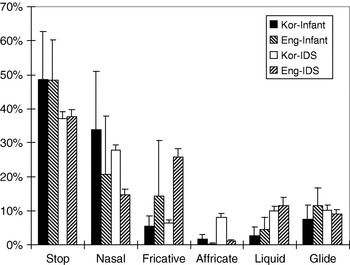
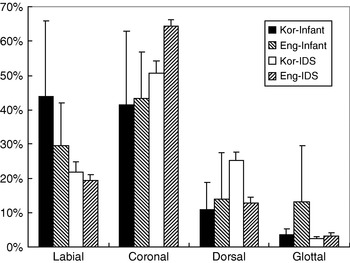
The mean frequencies in percentages for the consonant and vowel categories for infants and for languages are shown in Figures 1–3.
The percentage of each consonant manner for infant babbling and IDS.

Consonants
Infant speech
As shown in Figure 1, the two infant groups showed similar production patterns for most but not all consonants. The high relative frequencies of stops and nasals and the low frequencies of fricative, affricate and liquid manner of articulation were expected, as these relative frequencies were found in previous studies of babbling. However, the low frequencies of glides were not expected. For place of articulation (see Figure 2), labial and coronal place of articulation patterns were most frequent, as expected from previous studies.
The percentage of each consonant place for infant babbling and IDS.

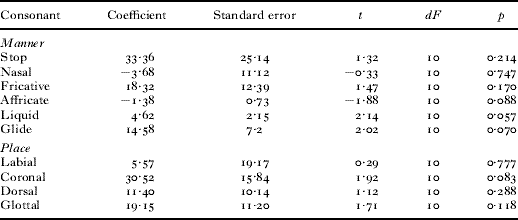
Some patterns which might be considered to reflect ambient language influences on production repertoires were observed. Korean-learning infants produced more nasal consonants while English-learning infants produced more fricatives. In addition, English-learning infants produced more frequent glottal consonants than Korean-learning infants. To examine whether there were significant differences in the frequency of occurrence of consonant manner and place categories between English- and Korean-learning infants' babbling, HLM comparisons were conducted (see Table 3). Although the mean frequencies in percentage for some categories were different between the two groups, as seen in Figures 1 and 2, no significant differences in consonant manner and place categories were found between Korean- and English-learning infants in these large longitudinal databases across the canonical babbling period.
HLM results for consonants in babbling

Infant-directed speech
Figure 1 also shows the percentages of each consonant manner in Korean and English IDS. IDS in both groups contained stop consonants as the most frequent category. In Korean IDS, nasals were the second most frequent consonant manner. In English, fricatives were produced next most frequently, followed by nasals. Glides and liquids showed similar percentages in both language groups. Affricates were produced the least frequently in English IDS. Affricates were slightly more frequent than fricatives in Korean IDS. Fricatives were the least frequent consonant manner in Korean IDS.
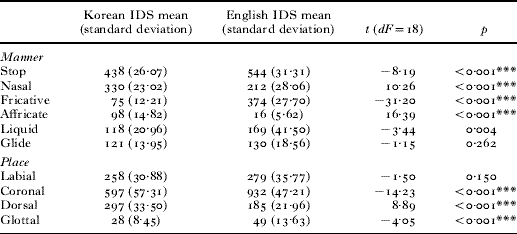
A two-way mixed ANOVA showed a significant two-way interaction (F(5, 90)=194, p<0·001, η2=0·915) as well as a significant main effect for consonant manner (F(5, 90)=811, p<0·001, η2=0·978) and for group (F(1, 18)=107, p<0·001, η2=0·856). Frequency of occurrence was significantly different between Korean and English IDS, among the six consonant manners. Since the interaction effect was significant, six independent t-tests for each consonant manner were conducted to further examine whether there were significant differences in frequency for each consonant category between English and Korean IDS. Means, standard deviations, t and p values for the simple main effect for consonant manner are shown in Table 4. There were significant differences for four consonant manners at α=0·003; stops, fricatives, affricates and nasals. However, glide and liquid categories showed no significant differences between the two IDS samples for English and Korean.
Simple main effect for consonant manner and place category in Korean and English IDS

notes: α=0·003 using Bonferroni correction; *** p<0·001.
Figure 2 also shows the percentages of the four consonant places analyzed in Korean and English IDS. Labial place was similar between Korean and English IDS although it was slightly more frequent in Korean. Coronal, which was the most frequent in both language groups, was more frequent in English, while dorsal was more frequent in Korean. Glottal place was the least frequent in both languages.
A two-way mixed ANOVA indicated significant main effects for group (F(1, 18)=105, p<0·001, η2=0·854) and for consonant place (F(3, 54)=1437, p<0·001, η2=0·988), as well as a significant interaction (F(3, 54)=135, p<0·001, η2=0·883). Similar to consonant manner, independent t-tests for a simple main effect for consonant place revealed significant differences for all places except labials between the two language groups. As can be seen in Table 4, coronal and glottal place were significantly more frequent in English while dorsal place was significantly more frequent in Korean.
Vowels
Infant speech
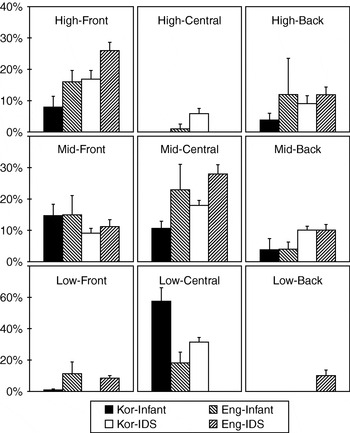
As shown in Figure 3, both infant groups showed relatively high frequencies of vowels which included those in the mid-front, mid-central and low-central dimensions of the vowel space. Relatively infrequent back and high-central vowels were observed, consistent with other studies of this period. However, there was also some evidence to indicate ambient language influence on vowel production. Korean-learning infants did not produce frequent low-front vowels. Instead, they produced an extremely high frequency of low-central vowels. In contrast, English-learning infants produced more high-front and high-back vowels than typically reported in babbling studies.
The percentage of each vowel category for infant babbling and IDS.

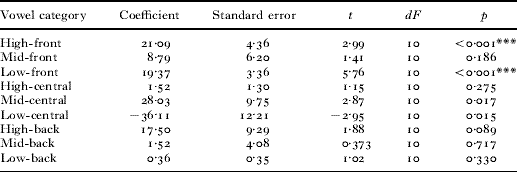
HLM analyses showed significant differences in frequency of occurrence for two of nine vowel categories (i.e. high-front and low-front) between Korean- and English-learning infants (see Table 5). English-learning infants produced significantly more high-front and low-front vowels than Korean-learning infants. Although differences were not statistically significant, mid-central vowels were produced more frequently by English-learning infants than Korean-learning infants. In contrast, Korean-learning infants produced more low-central vowels.
HLM results for vowels in babbling

notes: α=0·003 using Bonferroni correction; *** p<0·001.
Infant-directed speech
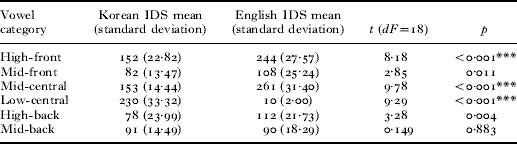
Figure 3 also shows the percentages of each vowel category in Korean and English IDS. The order of frequencies in the two languages was different. Low-central vowels were most frequent in Korean (31%) while mid-central vowels were most frequent in English (28%). In Korean IDS, mid-central and high-front vowels were the second most frequent vowels used. Mid-front, high-back and mid-back vowels were produced similarly. High-central vowels were produced least frequently among Korean phonemic vowels. In English IDS, high-front vowels were the second most frequent, followed by similar percentages of high-back, mid-front, mid-back and low-front vowels, in that order. Low-back and low-central vowels in English were rare.
A two-way mixed ANOVA was conducted to examine whether the six vowel categories in common across both languages were significantly different. ANOVA results indicated no significant main effects for group (F(1, 18)=0·296, p=593, η2=0·016). However, there were significant differences for the six vowel categories (F(5, 90)=101, p<0·001, η2=0·85) as well as a significant interaction (F(5, 90)=152, p<0·001, η2=0·895). Independent t-tests were conducted to compare whether the frequency of the six vowel categories was significantly different in English and Korean IDS. Means, standard deviations, t and p values for simple main effect for vowel category are shown in Table 6. Three of the six vowel categories were significantly different in frequency between the two languages. Korean mothers produced more low-central vowels than English-speaking mothers. In contrast, English-speaking mothers produced more high-front and mid-central vowels.
Simple main effect for vowel category in Korean and English IDS

notes: α=0·003 using Bonferroni correction; *** p<0·001.
DISCUSSION
The goal of this study was to consider the presence of common production patterns relative to the emergence of ambient language influences in canonical babbling. Cross-linguistic comparison of English and Korean infants and adult speakers was employed to evaluate this issue. Overall, sounds frequently produced by Korean- and English-learning infants were mostly similar, as documented previously for infants across a number of Indo-European languages. However, ambient language influences were also apparent relative to the vowel patterns found in English and Korean IDS input available to infants in this developmental period. Thus, common production patterns and ambient language influence can be found simultaneously in this early developmental stage of speech like vocal development. The results of this study are consistent with Levitt & Aydelott Utman (Reference Levitt and Aydelott Utman1992), Oller & Eilers (Reference Oller and Eilers1982) and Kern & Davis (Reference Kern, Davis, Pellegrino, Marsico, Chitoran and Coupéin press) in indicating both language-universal and language-specific patterns in prelinguistic babbling in studies of Indo-European languages.
Consonants
Both Korean- and English-learning infant babbling were characterized by a predominance of stop consonants (over 50% for both) and relatively frequent nasal (33% for Korean and 17% for English) manner of articulation. Both groups produced frequent labial (46% for Korean and 33% for English) and coronal (38% for Korean and 42% for English) compared to dorsal and glottal place of consonant articulation, consistent with previous studies of the babbling period (Boysson-Bardies & Vihman, Reference Boysson-Bardies and Vihman1991; Davis & MacNeilage, Reference Davis and MacNeilage1995; Kern & Davis, in press; Vihman, Ferguson & Elbers, Reference Vihman, Ferguson and Elbers1986; Vihman, Macken, Miller, Simmons & Miller, Reference Vihman, Macken, Miller, Simmons and Miller1985).
The two infant groups, on average, however, showed different frequencies of nasal, fricative and glide manner of articulation. Korean-learning infants produced more nasals and fewer glides and fricatives than English-learning infants. Compared to previous studies, the percentage of nasal consonants produced by these Korean-learning infants (33%) was consistently higher than in the English-learning infants reported by Locke (Reference Locke1983; 9%), Boysson-Bardies & Vihman (Reference Boysson-Bardies and Vihman1991; 16·8%) and Levitt & Aydelott Utman (Reference Levitt and Aydelott Utman1992; less than 10%). In contrast, the percentage of fricative consonants produced by Korean-learning infants (5%) was also consistently lower than the English-learning infants in the Boysson-Bardies & Vihman (11·8%) and Levitt & Aydelott Utman (30%) data. However, despite the large databases analyzed in this study, it was not possible to find a statistically significant difference in relative frequencies of major consonant categories between these two infant groups in Korean- and English-language environments.
While no significant differences were found between these two infant groups, qualitative differences found in nasal and fricative manner frequencies were reflected by differences in frequency of occurrence between the Korean and English IDS samples. These trends toward ambient language patterns might indicate that infants in the two language groups were beginning to manifest learning from ambient language input in their production repertoires during canonical babbling, although not yet at a statistically significant level. Future studies should follow infants into the first word period to better understand outcomes for these non-significant trends observed during babbling.
The non-significant differences in consonant manner and place between Korean- and English-learning infants may result from great variability in consonant production among infants within each group. This variability was reflected in relatively higher standard errors (see Table 3). Previous studies (Davis & MacNeilage, Reference Davis and MacNeilage1995; Locke, Reference Locke1989; Roug, Landberg & Lundberg, Reference Roug, Landberg and Lundberg1989; Vihman et al., Reference Vihman, Ferguson and Elbers1986) have also reported great individual variability in consonant and vowel segmental patterns during babbling. In particular, Locke (Reference Locke1989) raised a concern about whether between-group variability is greater than within-group variability in early infant vocal patterning. Although individual segmental patterns were not analyzed, it is possible that infants' production patterns were different from each other. Some Korean-learning infants might produce nasals dominantly, consistent with Korean ambient language patterns, while others might not. These results partially respond to Locke's (Reference Locke1989) concern about day-to-day variations in consonant and vowel frequencies in infant babbling repertoires. Longitudinal analysis enables consideration of possible fluctuations across sampling intervals. These results suggest that within-group infant variability exceeds variations between-groups so that no significant differences between groups were found, although mean frequency of occurrence of each consonant category was different between the Korean and English groups.
In sum, because of the great within-group variability in consonant frequencies, the between-group difference may not be statistically significant. This finding suggests that, during canonical babbling, some infants may not be ready to adjust their production repertoire in response to ambient language input. Other infants may show an ability to perceive the frequency patterns of the ambient sound input and implement their perception capacities in their production output. However, significant differences might also be found if longitudinal data were collected from a larger number of infants. Further studies should examine more infants to confirm the findings of this study.
Vowels
Both Korean- and English-learning infants showed some common vowel patterns. They produced similar frequencies of low-back and high-central vowels even though the frequencies of these vowels were different between English and Korean IDS. The extremely rare production of low-back and high-central vowels in infant babbling in both language environments confirmed previous findings that production of these vowels was low frequency in infant babbling (e.g. Davis & MacNeilage, Reference Davis and MacNeilage1995; Roug et al., Reference Roug, Landberg and Lundberg1989). Furthermore, English-learning infants produced more low-central than low-back vowels, although English IDS contained less frequent low-central than low-back vowels. This finding was consistent with Oller & Eilers (Reference Oller and Eilers1982) in that their English-learning infants produced more low-central [a] (8%) than low-back [α] (2·4%) vowels.
HLM analysis indicated that, unlike consonants, there were significant differences in frequency for high-front and low-front vowels due to relatively small standard errors (see Table 5). These significant differences between the two infant groups in vowel patterns can be interpreted as revealing strong ambient language effects because the differences reflect corresponding vowel patterns in English and Korean IDS. Low-front vowels are phonemic in English but not in Korean. Consequently, low-front vowels were rarely produced in Korean IDS. In babbling, Korean-learning infants produced low-front vowels, even though they were not frequently present in Korean IDS. However, the frequency in Korean-learning infants' babbling was significantly lower than in English-learning infants' babbling. Based on these results, future studies should take into account the possibility that frequently reported lower left quadrant vowel use may not be a universal production pattern. In particular, when an ambient language does not contain low-front vowels, infants may not produce them as frequently as other vowels.
The frequency difference for high-front vowels in IDS provided convincing evidence of ambient language influence. As can be seen in Table 2, English contains more frequent high-front vowels than Korean in ADS. Although the target words in English IDS showed a similar frequency of high-front vowels compared to Korean IDS, the overall frequency of high-front vowels in English IDS was significantly higher than in Korean IDS. Thus, the frequent high-front vowels in English IDS as well as in ADS may support the emergence of a higher frequency of high-front vowels in the babbling of English-learning infants. This finding of higher frequency for high-front vowels has been acoustically and perceptually confirmed in other studies of this period. Boysson-Bardies et al. (Reference Boysson-Bardies, Halle, Sagart and Durand1989) reported that the proportion of high-front vowels in English-learning infants was greater than in French-, Algerian- and Cantonese-learning infants.
In addition to high- and low-front vowel categories, frequencies of mid- and low-central vowel categories were different between the two infant groups. English-learning infants produced more mid-central vowels than Korean-learning infants. Conversely, Korean-learning infants produced more low-central vowels. However, the differences were not statistically significant. The finding of non-significant differences may be attributed to the relatively larger standard errors (9·75 for mid-central and 12·21 for low-central) compared to high-front and low-front vowels (4·36 for high-front and 3·36 for low-front). These results suggest that within-group infant variability exceeds between-group variability for categories including mid- and low-central vowels. Between-group variability is greater than within-group variability for high-front and low-front vowel categories. Such findings may indicate ambient language effects. A similar pattern was observed in mid- and low-central vowel categories between Korean and English IDS. Analysis of a larger number of infants in future studies might enable a finding of significant difference in these vowels between Korean- and English-learning infants.
Altogether, the difference in vowel patterns found in this study is similar to previous reports on canonical babbling (e.g. Boysson-Bardies et al., Reference Boysson-Bardies, Halle, Sagart and Durand1989; Oller & Eilers, Reference Oller and Eilers1982). Consistency across studies suggests that infants at around age 0 ; 10 appear to begin producing some vowel dimensions which match vowel patterns in their ambient language. As Boysson-Bardies et al. (Reference Boysson-Bardies, Halle, Sagart and Durand1989) suggested, variability among vowels seemed greater between than within language groups. This result for vowels is different from the results for consonants.
Why are vowels more likely to manifest ambient language patterns in infant production output than consonants? Importantly, vowels are produced at a uniformly higher amplitude than consonants. They are typically associated with a well-defined formant pattern which generally remains constant for a longer time. In contrast to vowels, consonants are heterogeneous in terms of both their perceptual basis and their production properties. For example, the main acoustic cue for stops and nasals is a relatively rapid second formant transition, while perceptual cues for fricatives and liquids are available for a longer duration. However, fricatives and liquids are generally considered difficult to produce, related to the precision of tongue placement required. Finally, it may also be important to note that while infants produce vowel-like sounds virtually from birth onward, many consonants are not produced consistently until the onset of marginal babbling, when the close – open mouth alternation is observed.
The role of IDS
The current study analyzed IDS samples to examine ambient language influences in babbling. Overall frequency of segmental distribution in IDS was similar to ADS, as documented in Mines et al. (Reference Mines, Hanson and Shoup1978) and Jin (Reference Jin1993). Thus, both IDS and ADS manifest segmental characteristics of the native language phonology. However, some consonant and vowel distributions in IDS were different from ADS, consistent with previous findings (Lee et al., Reference Lee, Davis and MacNeilage2008). In particular, the percentage of high-back vowels in English IDS (12%) was higher than in English ADS (6%). Also, the high-back vowels in English IDS (12%) were more frequent than Korean IDS (9%), although the difference was not statistically significant (p=0·004) following Bonferroni adjustment.
The higher frequency of high-back vowel input in English IDS may affect English-learning infants' babbling. These English-learning infants produced more high-back vowels (12%) than Korean-learning infants (4%), although the difference was not significant. The frequency of high-back vowels in the English-learning infants was consistent with Rvachew et al. (Reference Rvachew, Alhaidary, Mattock and Polka2008). Rvachew et al. recently reported that their English-learning infants produced a greater frequency of [u] vowels relative to French infants, arguing for early ambient language influences in babbling. If English-learning infants produce high-back vowels more frequently than infants in other language environments, especially Korean- and French-learning infants, the role of input frequency for [u] vowels may not be clear if ADS is considered as the only ambient input. There is a low frequency of high-back vowels in English ADS. Thus, differences between ADS and IDS can help to clarify possible reasons why infants show precise vowel frequency distributions. Further studies examining ambient language effects should take into account differences in segmental distribution between ADS and IDS. IDS should be considered as an important source of ambient input.
Although the present study made an attempt to overcome methodological limitations by collecting data longitudinally, analyzing a relatively larger number of infants and gathering a larger dataset, several methodological constraints remain. Transcription of infant babbling has been considered as extremely difficult among child language researchers. Oller (Reference Oller2000) has raised a concern that native language bias may emerge when transcribers listen to infants' speech from other languages. Since the present study employed an existing English-learning infant babbling sample, all utterances were previously transcribed by native English speakers. Korean-learning infant babbling samples were transcribed by native Korean speakers. Thus, non-native sounds might be perceived by transcribers through the lenses of their own ambient language phonology. To eliminate potential bias, acoustic analysis was implemented to complement perception-based transcription. This convention resulted in relatively high reliability between transcribers. In addition, inter-language reliability between Korean and English transcribers was analyzed. The inter-language transcription was similar to the intra-language transcription results for two Korean transcribers. In particular, among the vowels selected for re-transcription, only 2% and 2·8% of the vowels were not consistently transcribed as high-front and low-front vowel categories respectively between Korean and English transcribers. Thus, the Korean babbling data do not appear to be biased toward Korean language phonology. However, the existing English-learning infants' speech samples were transcribed without supportive acoustic analysis and inter-language reliability was not obtained. The reliability for the existing English data was relatively low, especially for vowels. Davis & MacNeilage (Reference Davis and MacNeilage1995) reported that reliability for front vowels was higher than for back vowels. Thus, the findings of this study that English-learning infants produced more frequent high- and low-front vowels than Korean-learning infants reflect a valid picture of vowel space use and is consistent with findings from other studies of this period (e.g. Boysson-Bardies et al., Reference Boysson-Bardies, Halle, Sagart and Durand1989). Future studies need to incorporate acoustic analysis of vowels produced by both Korean- and English-learning infants to confirm these findings.
Continuing cross-linguistic analysis of large databases in varied language families is needed to enable complete evaluation of perception based learning and reproduction of ambient language influences in canonical babbling in the context of common tendencies in production output. In addition, longitudinal studies extending into the first word period can allow more comprehensive understanding of the emergence of ambient language consonant and vowel patterns in young children.