Introduction
Anorexia nervosa (AN) is a predominantly female disorder. Most studies have reported a female:male ratio of approximately 10:1 (Lucas et al. Reference Lucas, Beard, O'Fallon and Kurland1991; Raevuori et al. Reference Raevuori, Hoek, Susser, Kaprio, Rissanen and Keski-Rahkonen2009) and a lifetime prevalence among males of approximately 0.2–0.3% (Crisp et al. Reference Crisp, Burns and Bhat1986; Kjelsas et al. Reference Kjelsas, Bjornstrom and Gotestam2004; Bulik et al. Reference Bulik, Sullivan, Tozzi, Furberg, Lichtenstein and Pedersen2006; Hudson et al. Reference Hudson, Hiripi, Pope and Kessler2007; Raevuori et al. Reference Raevuori, Hoek, Susser, Kaprio, Rissanen and Keski-Rahkonen2009). The incidence of male AN has been found to be less than 1 per 100 000 person-years (Currin et al. Reference Currin, Schmidt, Treasure and Jick2005).
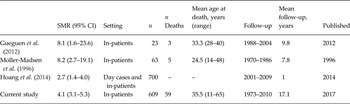
AN is a psychiatric disorder with high mortality (Arcelus et al. Reference Arcelus, Mitchell, Wales and Nielsen2011), but studies of mortality in males with AN are scarce and suffer from small samples or short follow-up times. Two studies have reported standardized mortality ratios (SMRs) for male in-patients with AN of 8.1 [95% confidence interval (CI) 1.6–23.6] (Gueguen et al. Reference Gueguen, Godart, Chambry, Brun-Eberentz, Foulon, Divac, Guelfi, Rouillon, Falissard and Huas2012) and 8.2 (95% CI 2.7–19.1) (Moller-Madsen et al. Reference Moller-Madsen, Nystrup and Nielsen1996). A third study reported an SMR of 2.7 (95% CI 1.4–4.0) for a large group of both day cases and in-patients (Hoang et al. Reference Hoang, Goldacre and James2014) (Table 1).
SMRs for male anorexia nervosa patients in the literature

SMR, Standardized mortality ratio; CI, confidence interval.
Anxiety disorders, depression, substance use disorders, schizophrenia and personality disorders (Olivardia et al. Reference Olivardia, Pope, Mangweth and Hudson1995; Carlat et al. Reference Carlat, Camargo and Herzog1997; Nielsen et al. Reference Nielsen, Moller-Madsen, Isager, Jorgensen, Pagsberg and Theander1998; Bou Khalil et al. Reference Bou Khalil, Hachem and Richa2011) have been reported to be over-represented in male patients with AN compared with the general population. Factors associated with poor outcomes include longer illness duration, greater weight loss and lower body mass index (BMI), older age at admission and the restrictive subtype of AN (Burns & Crisp, Reference Burns and Crisp1985; Gueguen et al. Reference Gueguen, Godart, Chambry, Brun-Eberentz, Foulon, Divac, Guelfi, Rouillon, Falissard and Huas2012). However, prior studies have not examined the effect of psychiatric co-morbidity on mortality in males with AN.
The aim of this study was to investigate mortality in a large sample of males with AN over an extended follow-up time. Furthermore, we aimed to investigate the prevalence of psychiatric co-morbidity and the influence that it might have on mortality in this sample.
Method
Registers
The National Patient Register, The Swedish Cause of Death Register and the Swedish Cancer Register were used to obtain information for this study and to exclude patients with cancer diagnoses.
The National Patient Register was founded in 1965 and is comprehensive from 1987 onwards; it covers all in-patients who were admitted for either psychiatric or somatic reasons. The National Patient Register contains information about admission and discharge dates, along with primary and secondary diagnoses at discharge. This register is considered to be population-based because there are very few private in-patient facilities in Sweden. From 2001, all private facilities were also included.
The Swedish Cause of Death Register contains information about the dates of death and the underlying (main) and secondary causes of death based on death certificates that are recorded according to the International Classification of Diseases (ICD). The Swedish Cause of Death Register includes all deaths of persons registered in Sweden since 1952. External causes of death, such as suicide, homicide and traffic accidents, are considered unnatural causes of death. All other causes, including AN and other mental disorders, are considered natural causes of death.
The Swedish Cancer Register was founded in 1958 and contains all cancer diagnoses among Swedish residents.
Study population
Men with main or secondary diagnoses of AN between 1 January 1973 and 31 December 2010 were identified using the ICD codes in the Swedish Hospital Discharge Register. The following ICD codes were used: 306.50 (ICD-8), 307B (ICD-9) and F50.0 or F50.1 (ICD-10). Only patients aged 10–40 years at the date of discharge were included to minimize the risk of incorrect diagnoses due to, for example, feeding problems with origins other than AN, in infants, children and elderly.
We excluded two men with cancer diagnosis before their AN diagnoses and one man with a diagnosis of malignant cancer in the first year after his AN diagnosis from the study. Patients diagnosed with non-malignant tumors were not excluded because they were not considered to be at risk of being misclassified as AN cases due to weight loss and cachexia. Valid data for 609 men were thus available for the analyses.
Psychiatric co-morbidity was defined by having received a main or secondary diagnosis of a psychiatric disorder other than AN and other eating disorders (EDs). Using the ICD codes at discharge, the patients with psychiatric co-morbidities were divided into ICD diagnostic groups. The time-frames used for the different ICD codes were 1973–1988 (ICD-8), 1987–1998 (ICD-9) and 1996 onwards (ICD-10). For full descriptions of the codes used, please see online Supplementary Table S1.
Comparison cohort
To estimate the effects of psychiatric disorders other than AN on the mortality of the AN patients, a comparison cohort of males without AN was utilized. A total of 6025 controls from the general Swedish male population matched for age, calendar year and county of residence were supplied by the administrative agency Statistics Sweden (www.scb.se). The controls were similarly linked to the other registers to obtain information about admissions for psychiatric disorders and causes of death. Since the controls were matched for age, they were all 10–40 years old at inclusion. None of them was hospitalized for AN during follow-up but 0.05% (n = 3) were hospitalized for an ED other than AN.
Statistics
Mortality was measured using the SMR, which is the ratio of the observed to the expected deaths. To calculate the number of expected deaths, the population was stratified into 5-year age groups according to calendar year, and the calculated person-time was multiplied by the calendar year- and age group-specific mortality rates from the general population for each group. These annual mortality rates were gender-specific and were obtained from the Swedish Cause of Death Register. The 95% CIs were calculated for the SMRs under the assumption that the observed numbers of deaths in each group followed Poisson distributions. The statistical analyses were performed with SAS version 9.2 (Statistical Analysis Software, SAS Institute, Inc., USA).
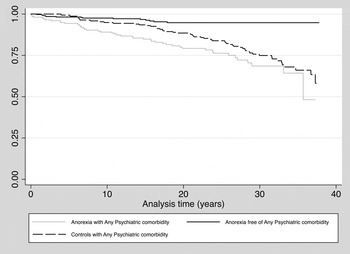
The Kaplan–Meier survival estimates for mortality by psychiatric co-morbidity and anorexia status are presented graphically. The log-rank test was used for the comparisons of the Kaplan–Meier curves. The corresponding incidence rate ratios (IRRs) were calculated and are presented along with their 95% CIs.
Cox regression analysis was applied to estimate the effects of any psychiatric co-morbidity on the hazard for mortality among the anorexia patients. The patients with no psychiatric co-morbidity were the reference category for which the hazard ratios (HRs) were calculated. The analysis was repeated with adjustments for the number of treatments for anorexia, the calendar year of the first anorexia diagnosis and patient age at the time of the first anorexia diagnosis. The proportionality assumption for the Cox models was assessed graphically. In all survival analysis procedures, the psychiatric co-morbidity was introduced as a time-varying variable; thus, in the Cox regression models, robust coefficients were estimated to allow for intragroup correlations.
Follow-up
The Swedish Cause-of-Death Register was used to follow-up the participants by linkage using each individual's national registration number.
For the patients who had psychiatric co-morbidities prior to AN, the person-times were calculated from the date of discharge after the first admission for AN. For the patients with AN prior to psychiatric co-morbidities, the person-times were calculated from the date of discharge for the first hospitalization for the psychiatric co-morbidity. In the patients with no psychiatric co-morbidities, the person-times were calculated from the date of discharge after the first admission for AN. The patients with psychiatric co-morbidities contributed person-times to the group of patients without co-morbidities until the date of the first discharge for psychiatric co-morbidity. The follow-up for all patients ended at the date of emigration, death or the end of the study (31 December 2010).
Results
Descriptive results and crude death rates
Overall, 609 males who were admitted for AN from 1973 to 2010 were included in the study.
All of the subjects were diagnosed with AN sometime during the follow-up, and AN was the main diagnosis for at least one admission in 86% of the subjects. Of the cases, 78 (13%) also received a diagnosis of an ED other than AN. Among these cases, 24 received these diagnoses before the first AN diagnosis.
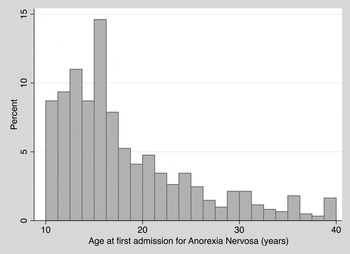
The mean age at the first hospitalization for AN was 18.2 years (s.d. = 6.9), the median age was 16 years, and the modal (most frequent) age was 13 years (Fig. 1). Of the 609 patients who were admitted for AN, 337 (55.3%) were admitted once, 122 (20.0%) were admitted twice, 59 (9.7%) were admitted three times, and 91 (15.0%) patients were admitted more than three times for AN. The mean length of the first hospital stay was 27.4 days (s.d. = 52.2), and the median was 10 days [range: 0–688, interquartile range (IQR) = 27].
Age distribution at first admission for anorexia nervosa.

Of the 609 patients, 59 (9.7%) died during follow-up. Of those, 35 died of natural causes, and 24 died of unnatural causes. The leading natural causes of death were AN and cardiovascular disease, with eight deaths each. The leading unnatural cause of death was suicide, which accounted for 15 deaths (see online Supplementary Table S2). The mean age at death was 35.5 (s.d. = 11.3) years, and the median age at death was 34 years (range: 11–65, IQR = 13).
Of the patients, 42% received a diagnosis of a psychiatric disorder other than AN/ED during the follow-up. Overall, 21.5% were diagnosed with one psychiatric disorder other than AN/ED, 9.5% were diagnosed with two psychiatric disorders other than AN/ED, and approximately 11% had three or more diagnoses other than AN/ED. One in five patients received a diagnosis of an anxiety disorder, 13.5% received a diagnosis of depression, and 11% received a diagnosis of personality disorder.
Of the patients with psychiatric co-morbidities, 17% died during the follow-up compared with 4% in the group without co-morbidities. Of the 49 patients with alcohol use disorder, 19 (39%) died during the follow-up.
SMR
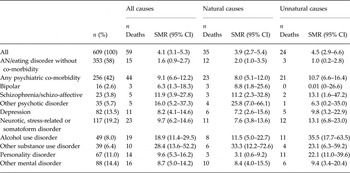
The total follow-up time was 10 433 person-years. The SMR for all causes of death was 4.1 (95% CI 3.1–5.3). The total SMR for natural causes was 3.9 (95% CI 2.7–5.4), and that for unnatural causes was 4.5 (95% CI 2.9–6.6) (Table 2).
SMRs for psychiatric co-morbidities in male AN patients

SMR, Standardized mortality ratio; AN, anorexia nervosa; CI, confidence interval.
For the patients with psychiatric co-morbidities, the SMR for all causes of death was 9.1 (95% CI 6.6–12.2), and among those without psychiatric co-morbidities, this value was 1.6 (95% CI 0.9–2.7).
Across the different diagnostic subgroups, the SMRs for natural causes of death were within the range of 7.2 and 11.5 with the exceptions of those with other substance abuse and other psychotic disorders; these groups exhibited increases in mortality in the range of 30-fold. The subgroup with personality disorders exhibited a three-fold increase in mortality compared with the general population. SMRs for subgroups of natural causes of death were also calculated, including endocrine causes of death (SMR 7.9, 95% CI 1.6–23.1) and cardiovascular causes of death (SMR 2.5, 95% CI 1.1–4.8) (see online Supplementary Table S2).
Regarding the unnatural causes of death, the SMRs of the different diagnostic groups ranged between 6.3 and 13.1, with the exceptions of the alcohol and other substance use disorder groups, which exhibited nearly 20- and 30-fold increases in mortality, respectively, and the subgroup with personality disorders, which exhibited a more than 20-fold increase in mortality compared with the general population.
One of the largest diagnostic groups was that with co-morbid depression. This group exhibited similar SMRs for natural and unnatural causes of death, i.e. 7.2 (95% CI 2.6–15.6) for natural and 9.8 (95% CI 3.2–22.9) for unnatural causes of death.
The SMRs were higher for natural causes than unnatural causes of death among the patients with no co-morbidities and among the patients with other substance abuse and other mental disorders. For the group with other mental disorders, the SMR for natural causes of death was 8.4 (95% CI 4.0–15.5), and that for unnatural causes of death was 9.4 (95% CI 3.4–20.4).
The Cox-derived HRs were calculated, and the HR for all causes of death was 5.45 (95% CI 3.0–9.9). After adjusting for age at the first AN hospitalization, the number of AN in-patient treatments and the year of the first anorexia diagnosis, the HR was 4.12 (95% CI 2.3–7.5) for all causes of death (Table 3).
Cox-derived HRs and aHRs

HR, Hazard ratio; aHR, adjusted HR; CI, confidence interval; AN, anorexia nervosa.
a Adjusted for age at the first hospitalization for AN, calendar year of the first hospitalization for AN and the number of treatments for AN. AN patients without psychiatric co-morbidity was the reference category.
For the group with later ages of onset, the adjusted HR was 1.08 (95% CI 1.05–1.12), and that for the group with earlier years of first anorexia diagnosis was 0.96 (95% CI 0.93–1.00).
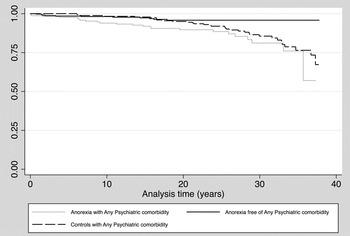
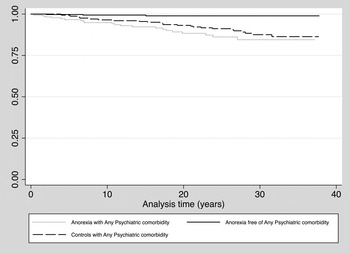
Figs 2–4 present the Kaplan–Meier survival curves. The controls consisted of 6025 men who were hospitalized for psychiatric disorders during follow-up. The prevalences of these disorders ranged from 0.3% for bipolar disorder to 2.7% for alcohol use disorder. Of the controls, 7% were hospitalized for any psychiatric disorder during follow-up.
Kaplan–Meier survival estimates for any cause of death. The incidence rate ratio between the anorexia nervosa cases with any psychiatric co-morbidity and the controls with any psychiatric co-morbidity was 1.2 (95% confidence interval 0.8–1.8, p = 0.2).

Kaplan–Meier survival estimates for natural causes of death. The incidence rate ratio between the anorexia nervosa cases with any psychiatric co-morbidity and the controls with any psychiatric co-morbidity was 1.0 (95% confidence interval 0.5–1.7, p = 0.5).

Kaplan–Meier survival estimates for unnatural causes of death. The incidence rate ratio between the anorexia nervosa cases with any psychiatric co-morbidity and the controls with any psychiatric co-morbidity was 1.4 (95% confidence interval 0.7–2.6, p = 0.16).

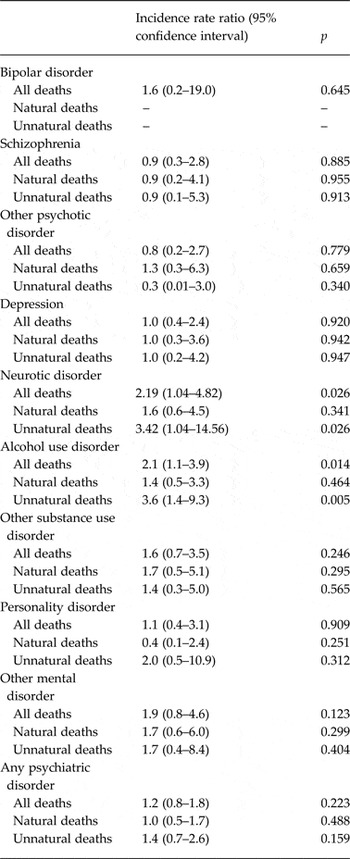
The corresponding IRRs were also calculated (Table 4), and the IRR for all causes of death among the AN males with psychiatric disorders compared with the AN males without psychiatric co-morbidities was 5.3 (95% CI 2.9–10.3, p < 0.001). The IRR for all causes of death between the AN males with any psychiatric co-morbidity and the controls with psychiatric disorders was 1.2 (95% CI 0.8–1.8, p = 0.223). Similarly, none of the IRRs for death between the AN males with specific psychiatric disorders and the controls with the same psychiatric disorders was statistically significant, with the exceptions of alcohol use disorder (IRR = 2.1, 95% CI 1.1–3.9, p = 0.014) and neurotic, stress-related and somatoform disorder (IRR = 2.2, 95% CI 1.04–4.82, p = 0.026).
Incidence rate ratios between anorexia nervosa patients with psychiatric co-morbidity and controls with psychiatric disorders

The IRR for natural causes of death between the AN patients with neurotic, stress-related and somatoform disorders and the controls with the same disorders was 1.6 (95% CI 0.6–4.5, p = 0.341), and that between the AN patients with alcohol use disorder and the controls with the same disorder was 1.4 (95% CI 0.5–3.3, p = 0.464). For unnatural causes of death, the IRR between the AN patients with neurotic, stress-related and somatoform disorders and the controls with the same disorders was 3.42 (95% CI 1.04–14.56, p = 0.026), and the IRR between the AN patients with alcohol use disorder and the controls with the same disorder was 3.6 (95% CI 1.4–9.3, p = 0.005).
Discussion
The patients in this study exhibited a four-fold increase in mortality compared with the general male population. There were no major differences in the excess mortalities due to natural and unnatural causes. The patients with AN and a psychiatric co-morbidity exhibited a profound nine-fold increase in mortality, whereas the AN patients without psychiatric co-morbidity did not differ in terms of mortality from the general population. A study made on Swedish female in-patients with AN, that had the exact same study design as the present study, found that the female AN in-patients with psychiatric co-morbidity had a similar eight-fold increase in mortality compared with the general population, whereas AN patients without psychiatric co-morbidity exhibited a three-fold increase in mortality compared with the general population (Kask et al. Reference Kask, Ekselius, Brandt, Kollia, Ekbom and Papadopoulos2016).
In our sample, psychiatric co-morbidities occurred in 41.8% of the in-patients.
Previous studies of male AN cases have found that the prevalence of psychiatric co-morbidity ranges widely from 5 to 83%. These studies had small samples and were often conducted on males with mixed EDs in various settings.
We found that 13.5 and 19.2% of our patients had received in-patient treatment for depression and anxiety disorders, respectively. Previous mixed-design studies of co-morbidity in male ED have reported various findings regarding the prevalences of these disorders in the ranges of 2–27% for major depression (Woodside et al. Reference Woodside, Garfinkel, Lin, Goering, Kaplan, Goldbloom and Kennedy2001; Weltzin et al. Reference Weltzin, Cornella-Carlson, Fitzpatrick, Kennington, Bean and Jefferies2012) and 32–43% for anxiety disorders (Feldman & Meyer, Reference Feldman and Meyer2010; Weltzin et al. Reference Weltzin, Cornella-Carlson, Fitzpatrick, Kennington, Bean and Jefferies2012).
We expected that the SMR for unnatural causes of death would be increased compared with that for natural causes, but there were no major differences in the total SMRs between the groups with or without psychiatric co-morbidities. It is possible that this finding was at least partially due to the high rates of suicide in the general male population in this age group. Specifically, we found a seven-fold increase in suicide mortality compared with the general population; although this value is high, it is below the reported SMRs for suicide among women, which range from 13.6 to 56.9 (Papadopoulos et al. Reference Papadopoulos, Ekbom, Brandt and Ekselius2009).
The SMRs for natural causes of death were high. Delays in seeking and receiving medical attention have been discussed as reasons for the greater frequency of medical complications in male AN cases (Siegel et al. Reference Siegel, Hardoff, Golden and Shenker1995). Based on a sample of 135 males with mixed EDs, Carlat et al. (Reference Carlat, Camargo and Herzog1997) reported a mean latent period of 1.2 years (s.d. = 1.4) before the initiation of treatment for AN. There are diagnostic challenges for males with AN that result not only from social stigma but also from the fact that the majority of diagnostic tools were developed for women. For example, the Eating Disorder Inventory-2 (EDI-2) has been found to be less reliable for men (Spillane et al. Reference Spillane, Boerner, Anderson and Smith2004).
The SMR for endocrine causes of death exhibited an eight-fold increase compared with the general population in this study. Earlier studies have found that the mortality in women with AN and type 1 diabetes is 14 times higher than expected (Nielsen et al. Reference Nielsen, Emborg and Molbak2002); this effect is potentially caused by the restrictive use of insulin to keep the weight down, which leads to high blood sugar levels for prolonged periods of time, which in turn causes early cardio- and neurovascular pathologies.
In our cohort, a two-fold increase in mortality due to cardiovascular causes was observed. Similar increases in cardiovascular mortality have been reported in other psychiatric disorders, such as major depression, bipolar disorder and schizophrenia (Osby et al. Reference Osby, Correia, Brandt, Ekbom and Sparen2000, Reference Osby, Brandt, Correia, Ekbom and Sparen2001). AN is thought to have a protective effect on mortality that is potentially mediated by low levels of caloric intake and high levels of physical activity (Korndorfer et al. Reference Korndorfer, Lucas, Suman, Crowson, Krahn and Melton2003). The negative effects of hypercholesterolaemia in combination with low levels of triiodothyronine, thyroxine and oestradiol (Matzkin et al. Reference Matzkin, Slobodianik, Pallaro, Bello and Geissler2007) in AN and the direct cardiovascular complications of the acute and refeeding phases, such as bradycardia and arrhythmias (Royal Colleges of Psychiatrists, 2014), might explain the increase in SMR observed in the present study. Additionally, depression and smoking, both of which are over-represented in patients with AN and other psychiatric disorders, have been found to be risk factors for coronary heart disease (Suls & Bunde, Reference Suls and Bunde2005).
In two earlier studies in which the SMRs were calculated exclusively for in-patient males with AN, the SMRs were found to be 8.1–8.2 (Moller-Madsen et al. Reference Moller-Madsen, Nystrup and Nielsen1996; Gueguen et al. Reference Gueguen, Godart, Chambry, Brun-Eberentz, Foulon, Divac, Guelfi, Rouillon, Falissard and Huas2012), although the CIs were broad. Our SMR for the whole sample with and without psychiatric co-morbidities was 4.1, which is considerably lower; however, our sample was 10–20 times larger, which probably affected the results. Our mean follow-up time of 17.1 years was also longer than the 9.8 years in the study of Gueguen et al. (Reference Gueguen, Godart, Chambry, Brun-Eberentz, Foulon, Divac, Guelfi, Rouillon, Falissard and Huas2012) which is known to reduce lower SMRs because mortality in the general population increases with age. Moreover, the mean age at the first admission for AN in our study was 18.2 years, which is considerably lower than that reported in the study of Gueguen et al. (Reference Gueguen, Godart, Chambry, Brun-Eberentz, Foulon, Divac, Guelfi, Rouillon, Falissard and Huas2012) in which the mean age at admission was 26.6 years. A later age of onset has been reported to be a feature of male AN (Braun et al. Reference Braun, Sunday, Huang and Halmi1999; Gueguen et al. Reference Gueguen, Godart, Chambry, Brun-Eberentz, Foulon, Divac, Guelfi, Rouillon, Falissard and Huas2012) and a factor that is significantly associated with worse outcomes (Gueguen et al. Reference Gueguen, Godart, Chambry, Brun-Eberentz, Foulon, Divac, Guelfi, Rouillon, Falissard and Huas2012).
A study performed by Hoang et al. (Reference Hoang, Goldacre and James2014) calculated the SMRs for AN males who received both out-patient and in-patient care in the UK and reported an SMR for all causes of death of 2.7 (95% CI 1.4–4.0). In this study, fewer than half of the discharges had records of ED as the main diagnosis upon discharge. When calculating the SMR exclusively for patients with EDs as the main diagnoses, male AN exhibited an SMR of 3.2 (95% CI 0.4–5.9); however, in the below 45-year-old age group that was more similar to our sample, the SMR was 14.4 (95% CI 0–30.6). The follow-up time was 1 year, which, compared with our 17.1 years, probably elicited higher SMRs, and as these authors concluded, was informative primarily in terms of short-term risk after discharge. Unfortunately, direct comparison with this study is not possible because of lack of statistical power after stratification, since there were no statistically significant SMRs in the subgroups.
For the male AN patients with psychiatric co-morbidities, we observed an almost 10-fold increase in mortality compared with the AN patients without psychiatric co-morbidities. Previous studies have linked psychiatric co-morbidities in women with AN to increases in mortality (Papadopoulos et al. Reference Papadopoulos, Ekbom, Brandt and Ekselius2009). Psychiatric co-morbidities have been associated with long-standing EDs (Herpertz-Dahlmann et al. Reference Herpertz-Dahlmann, Muller, Herpertz, Heussen, Hebebrand and Remschmidt2001), which in turn are associated with higher mortalities. Psychiatric co-morbidity probably particularly affects the mortality due to unnatural causes of death because it increases the risks for self-harm and suicide.
Very high excess mortalities due to both natural and unnatural causes were observed in the patients with alcohol use disorder or other substance use disorders. Alcohol use disorder is associated with high levels of impulsivity and is a known risk factor for suicide (Rivara et al. Reference Rivara, Mueller, Somes, Mendoza, Rushforth and Kellermann1997). The increase in mortality due to natural causes might have been mediated by a combination of malnutrition, liver cirrhosis, infections, arrhythmias, seizures and intoxication associated with alcohol use disorder.
Westman et al. (Reference Westman, Wahlbeck, Laursen, Gissler, Nordentoft, Hallgren, Arffman and Osby2015) observed mortality ratios of 3.5–4.0 among male patients who were hospitalized for alcohol use disorder in Sweden from 1987 to 2006. In our study, the SMR for all causes of death among the male AN patients with co-morbid alcohol use disorder was 18.9, which, coupled with the two-fold increase in the IRR for all causes of death between the AN patients with alcohol use disorder and the controls with alcohol use disorder, suggests that the combination of AN and alcohol use disorder indeed exerted a negative synergistic effect on mortality in this patient group.
The Kaplan–Meier curves and the IRRs further indicated that survival differed between the AN patients with and without psychiatric co-morbidity. However, the non-significant IRR between the AN male patients with psychiatric co-morbidities and the controls with psychiatric diagnoses indicated that the latter were the driving factor of the excess mortality among the male AN patients. As exceptions, alcohol use disorder and neurotic, stress-related and somatoform disorders exhibited increased IRRs that indicated that these disorders in combination with AN conferred greater risks of death than these disorders alone.
Moreover, our results indicate that the main driving factors behind the increased mortalities among the patients with AN combined with neurotic, stress-related and somatoform disorders or alcohol use disorder were unnatural deaths including suicide.
Although there has been controversy regarding whether anxiety disorders are risk factors for suicidal behaviour, studies on both genders have found anxiety disorders to be significantly associated with suicide attempts after adjusting for sociodemographic factors and all other mental disorders. Additionally, co-morbid anxiety disorders have been found to amplify the risk of suicide attempts among those with mood disorders (Sareen et al. Reference Sareen, Cox, Afifi, de Graaf, Asmundson, ten Have and Stein2005). In our sample, 33 patients (28.2%) with AN and anxiety disorders also experienced co-morbid depression at some point during the follow-up.
A later age of onset was found to be significantly associated with fatal outcome in our sample, and this finding confirms the results of previous studies of male AN (Gueguen et al. Reference Gueguen, Godart, Chambry, Brun-Eberentz, Foulon, Divac, Guelfi, Rouillon, Falissard and Huas2012). An earlier calendar period of AN onset was also significantly associated with fatal outcome. These effects might be attributable to the improvements in the methods of diagnosis and treatment that have occurred in recent years.
Strengths and limitations
This study was a retrospective open cohort with a uniquely large number of men with AN and an extensive follow-up time. Swedish registers are known for their quality and low frequencies of missing and invalid data. Through the age span that we included and our exclusion criteria, we attempted to include as few misclassified patients as possible. Most of the earlier studies in this field were performed with materials from a single hospital or city. Among the strengths of this study are the facts that our cohort was geographically heterogeneous and taken from a nationwide sample living in diverse sociocultural locations.
However, there are number of limitations that should be accounted for when considering our results. Our population exclusively included in-patients who were treated for AN and co-morbid psychiatric disorders. Thus, our results would mostly translate to the most severe cases and cannot be generalized to patients who are cared for in out-patient facilities or to patients who do not seek help at all. Regarding the times of the onsets of AN and the co-morbid disorders, the possibility that the onsets of the disorder are likely to have occurred prior to the first hospitalization must be considered.
The diagnoses that were used for case selection in this study were derived from the National Patient Register. There are several studies of the validity of the psychiatric diagnoses in this register. The positive predictive values for correct diagnoses of personality disorders vary from 56 to 96% (Ludvigsson et al. Reference Ludvigsson, Andersson, Ekbom, Feychting, Kim, Reuterwall, Heurgren and Olausson2011). In a study of the validity of bipolar disorder hospital discharge diagnoses (Sellgren et al. Reference Sellgren, Landen, Lichtenstein, Hultman and Langstrom2011), researchers found that two independent diagnoses were sufficient for use in epidemiological studies. In our population, 13 (81%) of the 16 patients with co-morbid diagnoses of bipolar disorder were identified as having two or more separate diagnoses.
Weight loss is a known consequence of schizophrenia, and we acknowledge that these patients are therefore at risk of being incorrectly diagnosed with AN. Furthermore, patients with severe AN are at risk of being classified as psychotic or schizophrenic due to their occasionally borderline psychotic notions of body image and lack of insight or awareness of their condition. In our cohort, 20 (87%) of the 23 cases received a co-morbid schizophrenic diagnosis on two or more separate occasions during the follow-up. However, of these 23 patients, 15 had a main diagnosis of AN at some point during the follow-up.
The Swedish National Patient Register does not carry information about BMI at admission or discharge or about the restrictive or binge/purge type of AN. These factors have both been described to influence mortality in the literature.
In conclusion, we reported that the mortality among male patients with AN was increased in the presence of a psychiatric co-morbidity and that this increase was even greater in cases of alcohol and other substance use disorders. Our results also revealed that psychiatric co-morbidity might be one of the most important factors accounting for mortality in this patient group. Close monitoring and treatment of psychiatric co-morbidity in male AN patients during follow-up may improve long-term outcomes.
Supplementary material
The supplementary material for this article can be found at http://dx.doi.org/10.1017/S0033291717000034
Acknowledgements
This project was financed in part by the Swedish Society of Medicine (grant numbers SLS-253101 and SLS-230421).
Declaration of Interest
None.