Recent approaches suggest that authoritarianism should be considered an ideological attitude expressing motivational needs for order, social control, and security (Duckitt, Reference Duckitt and Zanna2001). In line with this idea, authoritarians have a strong identification with the extant social order and a high sensibility to what threatens it (Duckitt & Sibley, Reference Duckitt and Sibley2009). Empirical research showed that authoritarianism changes as a function of individual and contextual characteristics, reinforcing the idea that it is an ideological variable liable to change more than a stable personality trait (e.g., Sibley & Duckitt, Reference Sibley and Duckitt2010). In particular, many studies reported that authoritarianism is intimately related to societal threats. Archival research showed that societal indicator measures of authoritarianism tend to be higher during times of economic crisis (e.g., Doty et al., Reference Doty, Peterson and Winter1991; Sales, Reference Sales1973; Sales & Friend, Reference Sales and Friend1973). Correlational studies looked at the relationship between contextual factors, such as crime rates, or self-reported threat perception, and authoritarian attitudes, and concluded that the endorsement of authoritarian attitudes is associated to societal threats (e.g., Dallago & Roccato, Reference Dallago and Roccato2010; Roccato et al., Reference Roccato, Vieno and Russo2014). Finally, experimental studies showed that levels of authoritarianism and/or support to authoritarian political systems increase when people are exposed to a threatening scenario, in which the society is described as going through a political and economic crisis with high criminality, unemployment, and terrorism (e.g., Altemeyer, Reference Altemeyer1988; Duckitt & Fisher, Reference Duckitt and Fisher2003; Stenner, Reference Stenner2005).
One interpretation for this relationship refers to the idea that people endorse authoritarian attitudes and support to authoritarian political systems mainly to restore the loss of perceived control caused by the exposure to societal threat (Mirisola et al., Reference Mirisola, Roccato, Russo, Spagna and Vieno2014). Through a compensatory control mechanism (Kay et al., Reference Kay, Gaucher, Napier, Callan and Laurin2008; Kay et al., Reference Kay, Whitson, Gaucher and Galinsky2009), people can try to compensate the lack of perceived control by supporting sources of external control, such as established authorities and authoritarian political systems (Kay et al., Reference Kay, Gaucher, Napier, Callan and Laurin2008). Authoritarianism is one of the main social psychological bases of such support (Altemeyer & Hunsberger, Reference Altemeyer and Hunsberger1992). Consistent with this, Kakkar and Sivanathan (Reference Kakkar and Sivanathan2017) showed that economic uncertainty results in a greater preference for dominant and authoritarian leaders, mainly because of people’s lack of perceived control. Overall, thus, archival, correlational, and experimental studies converge supporting the idea that threats undermining the social order are fertile ground for the development of authoritarian attitudes and preference for strong and dominant authorities.
In this field of study, whether using indicators of threat (real and hypothetical) or self-reported threat perceptions, scholars did not explicitly address the relationship between the threat itself and authoritarians’ perception of it. When using contextual data or hypothetical scenarios (e.g., Doty et al., Reference Doty, Peterson and Winter1991, Stenner, Reference Stenner2005), we do not know if authoritarians and non-authoritarians perceive them in the same way; similarly, when using perceived threats (e.g., Dunwoody & McFarland, Reference Dunwoody and McFarland2018; Huddy & Feldman, Reference Huddy and Feldman2011), we do not know if such reports are biased or not. This is not a trivial issue, as people constantly incur perceptual and cognitive biases. For example, the literature on the heuristic strategies used to provide estimates or make predictions (Tversky & Kahneman, Reference Tversky and Kahneman1974) shows that cognitive processes might produce inaccurate outcomes. In particular, the availability heuristic can produce over- and under-estimation of threats (Stein, Reference Stein1988). The availability heuristic (Tversky & Kahneman, Reference Tversky and Kahneman1973) describes the tendency to estimate probabilities based on the availability in memory of an information and on its emotional load, more than on the real objective probability that an event would occur. Authoritarians might be especially susceptible to this bias when it comes to threat perception, as some studies showed that they are more likely to read threatening news stories (Lavine et al., Reference Lavine, Lodge and Freitas2005) and perceive different kinds of threat differently than low authoritarians (Duckitt, Reference Duckitt and Zanna2001). Based on these studies and on the literature about the availability heuristic (Tversky & Kahneman, Reference Tversky and Kahneman1973), we suggest that authoritarians should overestimate societal threats because they perceive them as anxiety-inducing (Roccato & Russo, Reference Roccato and Russo2017). Such overestimation might explain, at least partially, the association between societal threat and authoritarianism.
In the current experimental study, we focused on the relation between objective societal threat and authoritarians’ perception of it. We suggest that authoritarians tend to overestimate societal threat and that such overestimation increases the endorsement of authoritarian attitudes and the preference for authoritarian political systems. In other words, we expect a vicious circle whereby threat estimation exacerbate already existing authoritarian attitudes. To test this idea, we investigated if such overestimation bias occur independently from the level of initial objective threat (low vs. moderate).
Method
Design and Participants
The study was conducted as a computerized experiment. The participants (N = 209, M age = 29.70, SD = 9.53, 64.1% women) were contacted by two graduating students at the Torino University among their social networks. Participants were provided with instructions and the link to the study, which was programmed with the Dynamic Process Tracing Environment (DPTE; Redlawsk & Lau, Reference Redlawsk and Lau2009) and run entirely on the computer. First, we asked participants a set of questions to assess their authoritarian attitudes and their previous experiences with crime. Second, participants were told to imagine that they had moved to an unnamed European country and read a general description about it, containing information such as the total population (67 million inhabitants), public administration, and tourism. Crucial for our study was the information related to crime rates. Participants were randomly assigned to read either a low threat scenario (n = 109), in which the number of theft victims reporting the crime to the police in the last year was 3,350,000 (corresponding to 5% of the total population), or a moderate threat scenario (n = 100), in which the number of thefts was 20 million (rate of about 30%). We have focused on theft and not on more severe crimes because actual and perceived micro-criminality showed to foster psychological reactions to crime much more than other severe crimes, such as rapes and murders (e.g., Hale, Reference Hale1996). Third, we asked participants to report the probability, as a percentage, for them to be victim of a theft during the first year spent in the country. Finally, we assessed again their authoritarian attitudes, their support to authoritarian political system, and their socio-demographic characteristics.
Measures
We measured participants’ authoritarianism using Roccato and Russo’s (Reference Roccato and Russo2015) short, parallel, balanced versions of the RWA scale. Each scale included 10 items with response options ranging from 1 (totally disagree) to 5 (totally agree). The first one was administered at the beginning of the study (RWAt1, α = 0.76), the second one (RWAt2, α = 0.72) after the presentation of the scenarios and the question about the probability of being victim of a theft during the first year spent in the new country. Specifically, when introducing the second scale, participants were asked to answer how they would do if living in the country mentioned above. We computed two mean indexes of RWA, with higher scores indicating stronger authoritarian attitudes. After the exposure to the scenario, we also asked the participants to indicate, on a scale from 1 (awful system) to 4 (excellent system), their opinion about two authoritarian political systems, namely ‘a strong leader who does not have to bother with elections or parliament’ and ‘a military government’ (Moreno & Méndez, Reference Moreno and Méndez2002). Based on r = .42, p < .001, we computed a mean index of support to authoritarian political systems.
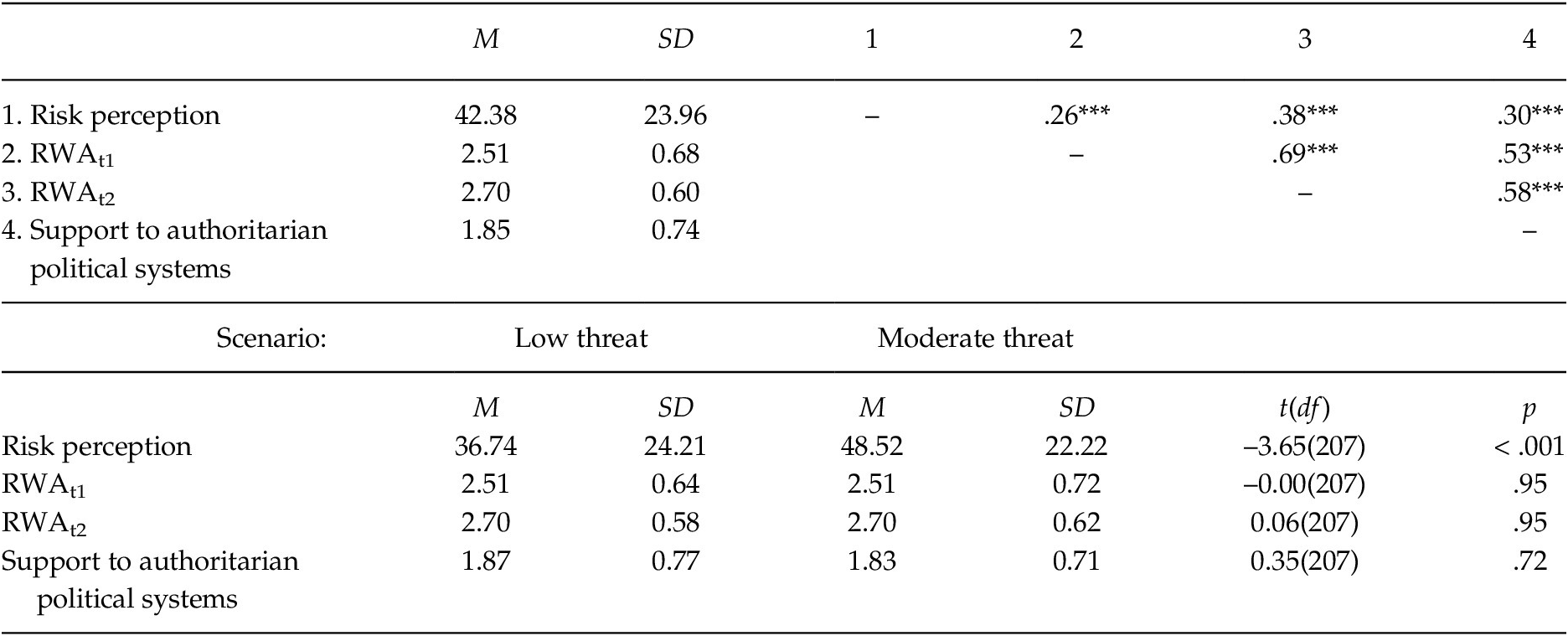
Table 1 reports, in the upper portion, descriptive statistics and correlations among the study variables, and, in the lower portion, descriptive statistics for all variables in the low vs. moderate threat conditions. A list of all items administered is reported in the Appendix.
Correlations among the Variables used in the Study, Descriptive Statistics for the Whole Sample, and for Low versus Moderate Threat Scenarios

Note. *** p < .001.
Results
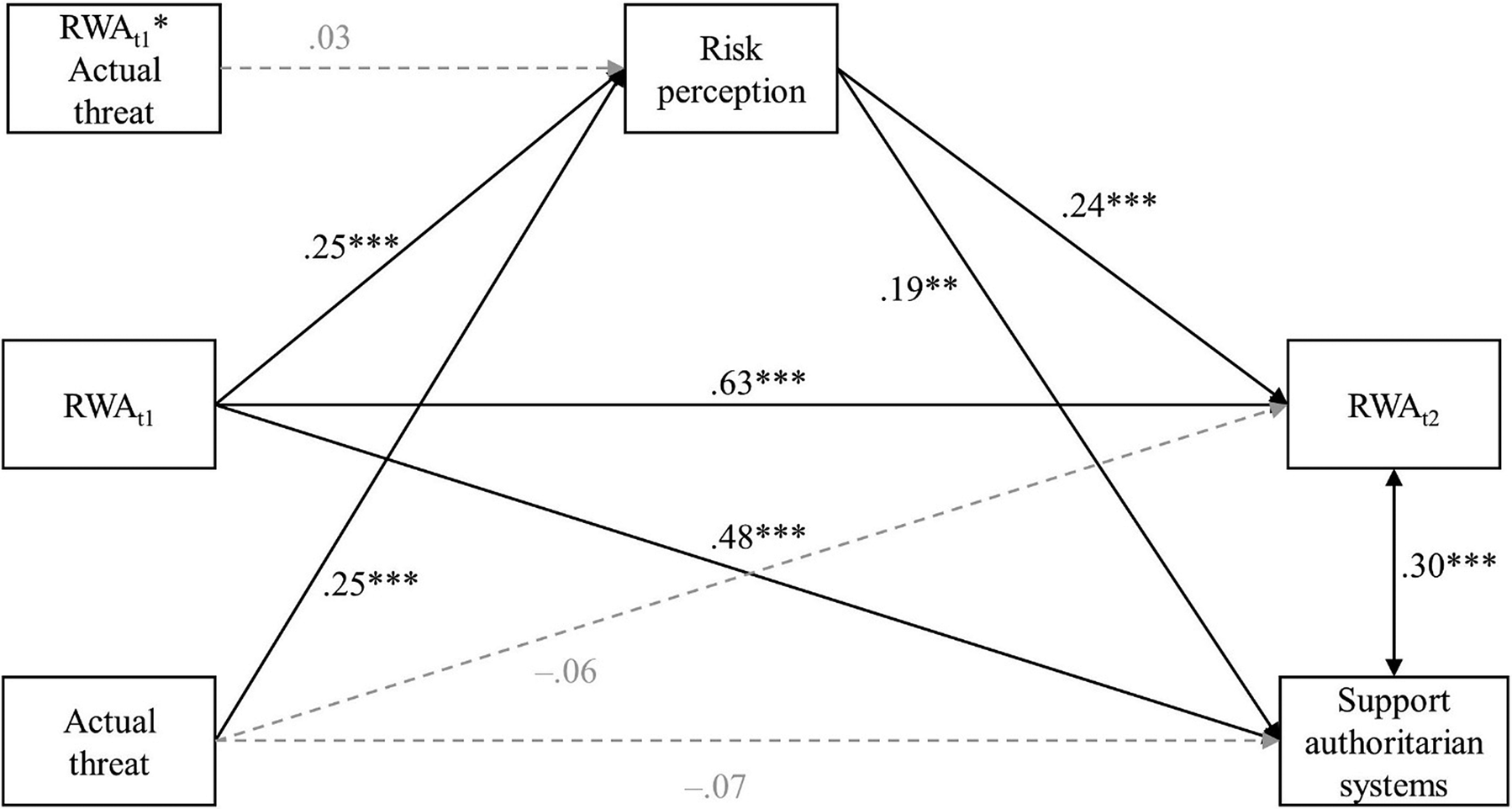
We tested a moderated-mediated regression model (using Mplus7, Muthén & Muthén, Reference Muthén and Muthén1998–2012, 5,000 bootstrap resamples) aimed at predicting authoritarianism and support to authoritarian political systems. We estimated the effect of authoritarianism (RWAt1, mean centered) on risk perception, defined as the probability reported by the participants of being victim of a theft, and the effect of this perception on authoritarianism (RWAt2) and support to authoritarian political systems. In addition, we estimated the effect of the initial objective threat—in terms of exposure to the low (–1) vs. moderate (1) crime rates scenario—and tested whether the effect of RWAt1 on risk perception was moderated by it.
The general fit of the model was good, χ2(2) = 1.03, p = .60 (CFI = 1.00, TLI = 1.02, RMSEA = .00).
Figure 1 reports the results of this analysis and shows that both RWAt1 and the objective threat significantly predicted risk perception, R2 = .13, SE = .04, p < .01, while their interaction did not. Even if it was true that risk perception was anchored to the objective threat level, it was also true that authoritarians tended to overestimate such threat. Interestingly, risk perception–but not the objective threat–predicted both RWAt2 (R2 = .53, SE = .05, p < .001) and support for authoritarian political systems (R2 = .32, SE = .06, p < .001), indicating that individual perceptions matter more than objective data. In addition, RWAt1 was related directly and indirectly, via the mediation of theft risk perception, to RWAt2, standardized indirect effect = .06, p < .01, 95% CI [0.03, 0.10], and to support for authoritarian political systems, standardized indirect effect = .05, p < .05, 95% CI [0.02, 0.09]. Objective threat, though, was only indirectly related to RWAt2, standardized indirect effect = .06, p < .01, 95% CI [0.03, 0.10], and support for authoritarian political systems, standardized indirect effect = .05, p < .05, 95% CI [0.02, 0.09]. Parallel analyses, performed adding gender, age, and previous victimization experiences as control variables in the model above, led to analogous results (cf. Appendix).
Moderated Mediated Regression Model predicting RWAt2 and Support to Authoritarian Political Systems as a Function RWAt1, theft Risk Perception, Controlling for Actual Threat.

Discussion
Since the pioneering studies by Adorno and colleagues (Adorno et al., Reference Adorno, Frenkel-Brunswick, Levinson and Sanford1950), the conceptualization of authoritarianism has changed and developed. Independently from whether it was conceived as a stable personality variable (e.g, Altemeyer, Reference Altemeyer1996) or as an ideological attitude (e.g., Duckitt, Reference Duckitt and Zanna2001), authoritarianism has consistently been linked to societal threat. In this study, we suggested that societal threat exacerbates already existing authoritarian attitudes. More specifically, we found that individual perceptions of the probability of being victims of theft mediated the effect of initial authoritarian level on subsequent authoritarian attitudes and support for authoritarian political systems. In other words, the findings point to a vicious circle whereby authoritarians tend to overestimate the societal threat they are exposed to, and this leads to a polarization of their initial attitudes and a greater endorsement of authoritarian political systems.
We also found that the objective threat level does not have the same weight in this process. It is not much surprising that what people perceive the world to be (rather than the world itself) is what matters most in shaping individual attitudes and cognitions; but it is interesting to note that the effect of the objective threat equals that of authoritarianism on risk perception. This is important because it indicates that threat perception is biased in a way that has implications for the research on societal threat and authoritarianism. At present, the main approach in the literature is to look at right-wing attitudes as reactions to societal threat (e.g., Onraet et al., Reference Onraet, van Hiel, Dhont and Pattyn2013). However, some studies suggested that authoritarians tend to perceive the world as a dangerous place (Altemeyer, Reference Altemeyer1988) and that authoritarians tend to be more sensitive to threat, both at the explicit (Lavine, Lodge, Polichak, & Taber, Reference Lavine, Lodge, Polichak and Taber2002) and at the implicit level (Cohrs & Ibler, Reference Cohrs and Ibler2009). Our findings add to the extant literature in two ways. First, authoritarians are not more responsive to threatening cues, rather they seem to be on a perceptual heightened alert as indicated by their general tendency to overestimate threats, independently from the objective threat. Second, we found that right-wing attitudes are both antecedents and consequences of threat perception, indicating that researchers should be cautious with causal interpretations of the associations between RWA and perceived threat.
Among the limitations of the study, we need to acknowledge that we focused on a single index of RWA, encompassing authoritarian submission, aggression, and conventionalism. Even though it is widely used in empirical research, Altemeyer’s scale (Reference Altemeyer1988) is not exempt of criticisms, most of them addressing the fact that it assesses unidimensionally a multidimensional construct (cf., Duckitt & Bizumic, Reference Duckitt and Bizumic2013; Funke, Reference Funke2005). According to the Authoritarianism-Conservatism-Traditionalism (ATC) model (Duckitt et al., Reference Duckitt, Bizumic, Krauss and Heled2010), RWA is a set of three different social attitudes, each expressing different motivational goals and stemming from different social threats. While authoritarianism is related to direct and physical threats to safety, conservatism is linked to threats to social order and cohesion, and traditionalism to threats to social values and morality (Duckitt et al., Reference Duckitt, Bizumic, Krauss and Heled2010). A replication of this study using the ATC scale and people’s estimates about different type of threats seems especially promising to improve our understanding of the relationship between authoritarianism and threats. Moreover, our approach did not inform us about potential long-term effects. Societal threats are psychologically more relevant, persistent and salient in everyday life than in experimental settings. Future research could benefit from a longitudinal approach aimed at comparing the strength, significance, and duration of the reciprocal relationship between authoritarianism and threat.
Notwithstanding, our study had some important strengths. First, we captured empirically the complex links between actual threat, perceived threat, and authoritarianism. To do so, we used an experimental approach that allowed us to deal with the bidirectional relationships between threat (actual and perceived) and authoritarianism, an issue that has been called for (Onraet et al., Reference Onraet, van Hiel, Dhont and Pattyn2013). In addition, our analysis was not limited to authoritarian reactions to threat; we have also considered the support to authoritarian political systems and showed that—consistent with the first theorizations on this topic (e.g., Fromm, Reference Fromm1941)—perceived threat may actually be a relevant predictor of people’s preference for anti-democratic political systems.
Supplementary Materials
To view supplementary material for this article, please visit http://dx.doi.org/10.1017/SJP.2020.7.
Appendix
Measures
RWA T1
1. Homosexual long-term relationships should be treated as equivalent to marriage.*
2. What our country really needs is a strong, determined Chancellor who will crush evil, and take us back to our true path.
3. It is wonderful that young people today have greater freedom to protest against things they don’t like, and to make their own “rules” to govern their behavior.
4. Being vitruous and law-abiding is in the long run better for us than permanently challenging the foundation of our society.
5. It is important to protect the rights of radicals and deviants in all ways.
6. The real keys to the “good life” are obedience, discipline, and sticking to the straight and narrow.
7. Gays and lesbians are just as healthy and moral as anybody else.
8. Our country will be great if we honor the ways of our forefathers, do what the authorities tell us to do, and get rid of the “rotten apples” who are ruining everything.
9. The situation in our country is getting so serious, the strongest methods would be justified if they eliminated the troublemakers and got us back to our true path.
10. There is absolutely nothing wrong with nudist camps.
RWA T2
1. People should pay less attention to the Bible and the other forms of religious guidance, and instead develop their own personal standards of what is moral and immoral.
2. What our country really need, instead of more ‘civil right’, is a good stiff dose of law and order.
3. A ‘woman’s place’ should be wherever she wants to be. The days when women are submissive to their husbands and social conventions belong strictly in the past.
4. The withdrawal from tradition will turn out to be a fatal fault one day.
5. There is no such crime to justify capital punishment.
6. Obedience and respect for authority are the most important virtues children should learn.
7. You have to admire those who challenged the law and the majority’s view by protesting for women’s abortion rights, for animal rights, or to abolish school prayer.
8. The facts on crime, sexual immorality, and the recent public disorders all show we have to crack down harder on deviant groups and troublemakers if we are going to save our moral standards and preserve law and order.
9. What our country needs most is discipline, with everyone following our leaders in unity.
10. There is no “ONE right way” to live life; everybody has to create their own way.
Support to Authoritarian Political Systems
I’m going to describe various types of political systems and ask what you think about each as a way of governing this country. For each one, would you say it is a very good, fairly good, fairly bad or very bad way of governing this country?
A strong leader who does not have to bother with elections or parliament
A military government
Risk Perception
In your opinion what is the probability, from 0% a 100%, that you would suffer a theft in the next 12 months after moving in this country?
Victimization Experiences
Thinking about the last 12 months, has it happened to you or to someone close to you, a friend or a relative, to suffer one of the following crimes?
Car theft
Burglary
Pickpocketing
Robbing
Attack
Rape