INTRODUCTION
Stable isotope analysis (SIA) has been used extensively to infer diet (Frazer, Reference Frazer1996; Kibirige et al., Reference Kibirige, Perissinotto and Nozais2002), nutrient flow in ecosystems (Rau et al., Reference Rau, Mearns, Young, Olson, Schafer and Kaplan1983; Pinnegar & Polunin, Reference Pinnegar and Polunin2000; Sherwood & Rose, Reference Sherwood and Rose2005) and trophic position (Estrada et al., Reference Estrada, Rice, Lutcavage and Skomal2003; Vander Zanden & Rasmussen, Reference Vander Zanden and Rasmussen2001), and to differentiate between organisms feeding in nearshore and offshore areas (Burton & Koch, Reference Burton and Koch1999; Perry et al., Reference Perry, Thompson, Mackas, Harrison and Yelland1999). Stable isotopes have allowed the determination of diet assimilated over a period of time ranging from days to months, whereas stomach contents analysis gives information on recently ingested items (Michener & Schell, Reference Michener, Schell, Lajtha and Michener1994; Fry, Reference Fry2006).
The use of SIA in ecological research relies on an approximately constant increase in the ‘heavier’ isotopes (13C and 15N) with progression up the food chain. δ13C values increase by 0–1.5‰ from one trophic level to the next, and δ15N values by approximately 3.4‰ (Rau et al., Reference Rau, Mearns, Young, Olson, Schafer and Kaplan1983; Vander Zanden & Rasmussen, Reference Vander Zanden and Rasmussen2001; Post, Reference Post2002; McCutchan et al., Reference McCutchan, Lewis, Kendall and McGrath2003). This enables the use of δ15N to determine the trophic level of organisms in the wild, whereas δ13C values are often used to differentiate between nearshore and offshore nutrient sources (France, Reference France1995; Perry et al., Reference Perry, Thompson, Mackas, Harrison and Yelland1999).
Seasonal variability in isotopic signals at the base of the food web (producers and primary consumers) has been observed in marine coastal ecosystems (Simenstad & Wissmar, Reference Simenstad and Wissmar1985; Vizzini & Mazzola, Reference Vizzini and Mazzola2002). This seasonality is less pronounced higher up the food web (Simenstad & Wissmar, Reference Simenstad and Wissmar1985), which has made it difficult to assign trophic positions to vertebrates high on the food chain on the basis of point sampling (O'Reilly et al., Reference O'Reilly, Hecky, Cohen and Plisnier2002).
Devil rays (Mobula spp.) are a relatively unstudied group of myliobatiform ray. Of the nine recognized species within the genus Mobula, five are present in the Gulf of California (McEachran & Notarbartolo-di-Sciara, Reference McEachran, Notarbartolo-di-Sciara, Fischer, Krupp, Schneider, Sommer, Carpenter and Niem1995), and have been the target of a directed artisanal fishery for decades. Like the majority of elasmobranchs, devil rays display life history traits such as production of few embryos at long intervals (Homma et al., Reference Homma, Maruyama, Itoh, Ishihara, Uchida, Séret and Sire1999), that make them vulnerable to over-exploitation (Stevens et al., Reference Stevens, Bonfil, Dulvy and Walker2000).
The most comprehensive study on the devil rays of the south-west Gulf of California was carried out in the early 1980s (Notarbartolo-di-Sciara, Reference Nortarbartolo-di-Sciara1988). It was determined through stomach contents analysis that the bentfin devil ray (Mobula thurstoni Lloyd) and spinetail devil ray (Mobula japanica Müller & Henle) fed almost exclusively on Nyctiphanes simplex Hansen, the most abundant euphausiid species in the area (Brinton & Townsend, Reference Brinton and Townsend1980; Notarbartolo-di-Sciara, Reference Nortarbartolo-di-Sciara1988; De Silva-Dávila & Palomares-García, Reference De Silva-Dávila, Palomares-García and Hendricks2002). Notarbartolo-di-Sciara (Reference Nortarbartolo-di-Sciara1988) reported a high percentage of empty stomachs in his study, possibly due to the high digestibility of zooplanktonic prey (Chipps & Garvey, Reference Chipps, Garvey, Brown and Guy2007).
We used SIA of carbon (δ13C) and nitrogen (δ15N) to confirm the diet of M. thurstoni and M. japanica in the south-west Gulf of California, Mexico, by comparing their isotopic signal to that of their most probable prey, N. simplex, as well as to other zooplanktonic groups representative of different trophic levels in the food web. We analysed zooplankton samples over several months in order to observe isotopic variability in the prey and relate this variability to the isotopic signal of the devil rays.
Our objectives were: (1) to confirm the diet of M. thurstoni and M. japanica through the use of stable isotopes of C and N; and (2) to determine the trophic position of these two rays in the Gulf of California food chain, within the context of a seasonally changing isotopic baseline.
MATERIALS AND METHODS
Sample collection
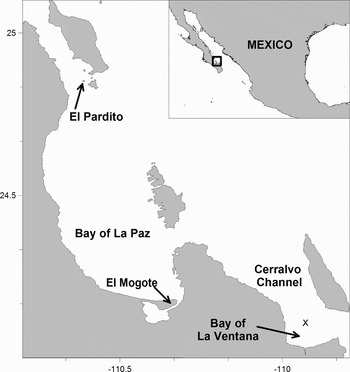
Samples of dorsal muscle of bentfin devil ray (Mobula thurstoni) and spinetail devil ray (Mobula japanica) were obtained from fishing camps on the island of El Pardito, the Bay of La Ventana and the sandbar of El Mogote (Figure 1), areas where devil rays are consistently caught (Notarbartolo-di-Sciara, Reference Nortarbartolo-di-Sciara1988). In addition, a polespear with a modified tip was used to obtain biopsies from live devil rays swimming at the surface in the bay of La Paz.
Study area, showing zooplankton sampling station (X), El Pardito Island, El Mogote sandbar and bay of La Ventana fishing camps.

The Gulf of California has a monsoonal wind pattern, with strong winds blowing from the north-west in winter (December to April) leading to strong upwelling of nutrient-rich waters primarily along the eastern shores of the gulf. During summer (May to November) weak winds blow from the south-east, resulting in weak upwelling along the western margin of the gulf and allowing warm Pacific waters to enter the gulf (Lavín & Marinone, Reference Lavín, Marinone, Velasco-Fuentes, Sheinbaum and Ochoa de la Torre2003). The bays of La Paz and La Ventana are on the south-west margin of the gulf, and the entrance of Pacific water in the summer could potentially influence local isotopic signals. There are few published studies on SIA of phytoplankton or suspended matter for the study area. For the Carmen basin, north-west of the bay of La Paz, Altabet et al. (Reference Altabet, Pilskaln, Thunnel, Pride, Sigman, Chavez and Francois1999) determined that δ15N values in the sediment ranged from 5.6‰ to 10.0‰ during the period 1990–1992.
Zooplankton samples were collected monthly from March to November 2006 at a station in the bay of La Ventana, in the middle of the Cerralvo Channel (Figure 1). Diurnal and nocturnal samples were obtained in a 505 µm conical net towed at the surface for 10 minutes. The following were separated from the sample for isotopic analysis: N. simplex individuals, as well as carnivorous chaetognaths and copepods (genera Candacia, Labidocera and Euchaeta), omnivorous decapods and herbivorous zooplankton (copepods from the genus Acrocalanus and N. simplex calyptopes) (Suh, Reference Suh1989; Ritz et al., Reference Ritz, Hosie and Kirkwood1990; Suh et al., Reference Suh, Toda and Terazaki1991; Sánchez-Ortíz & Gómez-Gutiérrez, Reference Sánchez-Ortíz and Gómez-Gutiérrez1992; Palomares et al., Reference Palomares, Suárez-Morales and Hernández-Trujillo1998). For each group, the number of individuals sorted was appropriate for the isotopic analysis (approximately 40 copepods, 10 euphausiids, 20 chaetognaths and 10 decapods). We were able to compare the isotopic signal of devil rays to that of their most probable prey as well as to those of other zooplanktonic groups present in the area that the rays could potentially consume.
All devil ray samples were kept in 96% ethanol for a maximum of 7 days then frozen. From March to May all zooplankton samples were kept frozen until processed; from June to November samples were kept in 96% ethanol for a maximum of 5 days, and then frozen. A sub-sample of devil ray and zooplankton tissues was divided in half, with one half being frozen and the other stored in ethanol. For devil ray tissue there was no significant difference between samples stored in ethanol or frozen (t-test, P > 0.05). For zooplankton, there was a significant difference between samples frozen and those kept in ethanol (t-test, P < 0.05). We therefore calculated a correction factor for the effects of ethanol on δ13C and δ15N values for each zooplankton group, which was later used to correct the isotopic values for the remaining samples.
Isotopic analysis
Muscle samples were dried for 48 hours in an oven at 58°C; lipids were extracted by placing the samples in 20 ml of 1:1 chloroform:methanol solution for 20 minutes in a microwave (MARS5 FALCON). Zooplankton samples were dried for 24 hours in an oven at 58°C. All samples were ground to a fine powder with a mortar and pestle; 0.001 g were weighed and packed in 3.3 × 5 mm tin cups. Stable isotope ratios were determined at the stable isotope facility of the University of California at Davis (USA) using a PDZ Europa Hydra 20/20 continuous flow isotope ratio mass spectrometer (PDZ Europa Ltd, Norwich, UK). Stable isotope ratios are given using the conventional δ notation where δ13C or δ15N = (Rsample/Rstandard – 1) × 1000 and R is 13C/12C or 15N/14N. The standard used for δ13C was Vienna Pee Dee Belemnite (VPDB) and for δ15N atmospheric nitrogen. Analytical precision was 0.19‰ estimated from standards analysed with the samples.
Data analysis
The size distribution and sex of sampled rays were used to infer the composition of the population sampled. Individuals of M. thurstoni measuring <150 cm disc width (DW) and individuals of M. japanica measuring <205 cm DW were considered to be immature (Notarbartolo-di-Sciara, Reference Nortarbartolo-di-Sciara1988). We determined isotopic composition at different times of the year in order to compare isotopic values to oceanographic conditions in the area.
For zooplankton isotopic data, the difference in the values obtained after freezing and after storage in ethanol was used as a correction factor. Legget et al. (1999) and Kaehler & Pakhomov (Reference Kaehler and Pakhomov2001) found that while storage in ethanol acted as a solvent and lipid extractor, resulting in more positive δ13C values, δ15N values were not significantly affected.
The Shapiro–Wilk test was used to analyse isotopic data of devil rays and zooplankton (all tests used Statistica 6 software, StatSoft Inc. 2004). Since the original data were not normal, we removed 2 outliers, thereby achieving normality. We used t-tests to compare isotopic values between devil ray species, between sexes, between juveniles and adults, and between samples frozen and samples stored in ethanol. ANOVA was used to compare isotopic variability between N. simplex and devil rays.
We calculated the trophic fractionation and trophic position of devil rays and zooplankton using published values and equations (Vander Zanden & Rasmussen, Reference Vander Zanden and Rasmussen2001; McCutchan et al., Reference McCutchan, Lewis, Kendall and McGrath2003).
RESULTS
Isotopic values
DEVIL RAYS
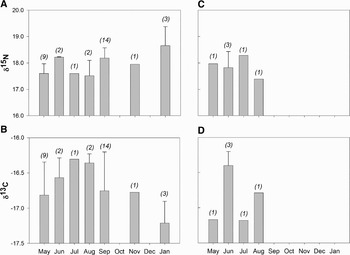
We obtained 32 Mobula thurstoni and 6 Mobula japanica muscle samples (Figure 2). The size of organisms sampled ranged from 86 to 210 cm for M. thurstoni and from 96 to 240 cm for M. japanica. Twelve M. thurstoni were immature (<150 cm DW), 19 were mature (>150 cm DW) and 1 undetermined, while five of the six M. japanica individuals were immature (<205 cm DW) (Notarbartolo-di-Sciara, Reference Nortarbartolo-di-Sciara1988; White et al., Reference White, Giles, Dharmadi and Potter2006). We found no significant differences in stable isotope (SI) values between mature and immature individuals or between males and females (t-test, P > 0.05).
δ15N and δ13C values for Mobula thurstoni (A and B) and Mobula japanica (C and D) from May 2006 to January 2007 in the south-west Gulf of California. Number of samples in parentheses. Black lines indicate 1 standard deviation.

Stable isotope values for M. thurstoni (all values given as average ± standard deviation) ranged from −17.14 ± 0.13‰ to −16.29 ± 0.31‰ for δ13C and from 17.51 ± 0.58‰ to 18.66 ± 0.72‰ for δ15N. Samples from August showed the most depleted δ15N and δ13C values, and samples from January had the most enriched values.
For M. japanica SI values ranged from −17.10 ± 0.20‰ to −16.32‰ for δ13C and from 17.39‰ to 18.29‰ for δ15N. Samples from June had the most depleted δ13C values, and samples from August had the most depleted δ15N values. The most enriched values for δ13C and δ15N were obtained in July. These monthly values, however, were not significantly different from each other for either species (t-test, P > 0.05). There were no significant differences in isotopic values between M. thurstoni and M. japanica (ANOVA, P > 0.05).
ZOOPLANKTON
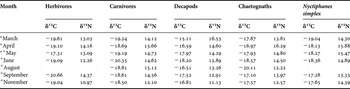
Eleven zooplankton samples were obtained for March, April, May, June, August, September and November 2006. Storage in ethanol affected zooplankton isotopic values significantly (ANOVA, P < 0.05), resulting in an increase of δ15N values of 0.72 ± 0.37‰ on average, and an increase of δ13C values of 2.00 ± 0.64‰ on average. The increase of δ13C values in these samples was probably due to an extraction of lipids, which are depleted in 13C (Post, Reference Post2002). Since ethanol acts as a solvent, removing lipids from the sample (Leggett et al., Reference Leggett, Servos, Hesslein, Johannsson, Millard and Dixon1999), the isotopic value of samples stored frozen were corrected for lipid content. This allowed us to compare all samples across trophic levels. The δ13C values ranged from –20.66‰ (for herbivores) to –15.11‰ (for decapods) and δ15N values ranged from 10.97‰ (for herbivores) to 16.53‰ (for decapods) (Table 1). There were no significant differences in isotopic values between samples that were collected during day or night (ANOVA, P > 0.05).
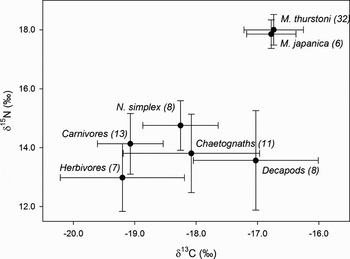
Annual isotopic values of δ13C and δ15N for mobulids and zooplankton in the south-west Gulf of California in 2006–2007. Number of samples in parentheses.

Monthly isotopic values (δ13C and δ15N, in ‰) for zooplankton groups analysed in the south-west Gulf of California during 2006.

*, samples stored frozen; +, samples stored in ethanol. Correction factor has been applied to values shown in table.
Trophic fractionation
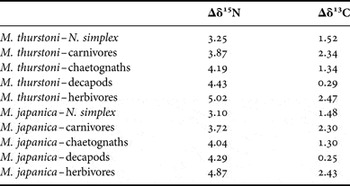
Variability in the isotope signal (indicated by the standard deviation in Figure 3) was significantly higher in zooplankton than in devil rays (ANOVA, P < 0.05). Zooplankton was depleted in 13C and 15N compared with devil rays (annual averages for total zooplankton –18.36‰ δ13C and 13.95‰ δ15N; M. thurstoni –16.74‰ δ13C and 18.00‰ δ15N; M. japanica –16.78‰ δ13C and 17.85‰ δ15N). From the annual isotopic averages we calculated the trophic fractionation between devil rays and zooplankton (Table 2). The trophic fractionation between devil rays and N. simplex was 3.17‰ for δ15N and 1.50‰ for δ13C on average.
Mean trophic fractionation between devil rays and zooplankton in 2006.
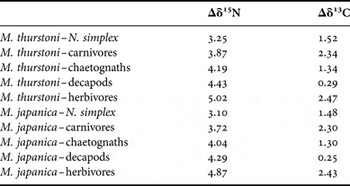
Δδ, isotopic fractionation for nitrogen and carbon respectively; M. thurstoni, Mobula thurstoni; N. simplex, Nyctiphanes simplex; M. japanica; Mobula japanica.
Several authors have provided differing values of the isotopic fractionation occurring between a consumer and its prey, ranging from 0.3 ± 0.6‰ to 0.8 ± 1.2‰ for δ13C and from 1.3‰ to 3.4 ± 1.8‰ for δ15N (Minagawa & Wada, Reference Minagawa and Wada1984; Vander Zanden & Rasmussen, Reference Vander Zanden and Rasmussen2001; Sherwood & Rose, Reference Sherwood and Rose2005). The Minagawa & Wada (Reference Minagawa and Wada1984) study included a range of animals from freshwater and saltwater environments; Vander Zanden & Rasmussen (Reference Vander Zanden and Rasmussen2001) studied freshwater lakes; and although Sherwood & Rose (Reference Sherwood and Rose2005) studied an oceanic ecosystem, their samples were not lipid-extracted. We selected the study by McCutchan et al. (Reference McCutchan, Lewis, Kendall and McGrath2003) as our benchmark for comparison, since it was carried out on muscle of marine organisms on which lipid extraction had been performed, corresponding to the circumstances of the present study.
We additionally calculated the trophic fractionation between zooplankton groups known to exhibit different feeding strategies (herbivores, omnivores and carnivores) and the devil rays. Devil rays probably did not feed on any of these groups, since the fractionation values for δ13C and/or δ15N fell outside the range of expected values between predators and prey (Table 2).
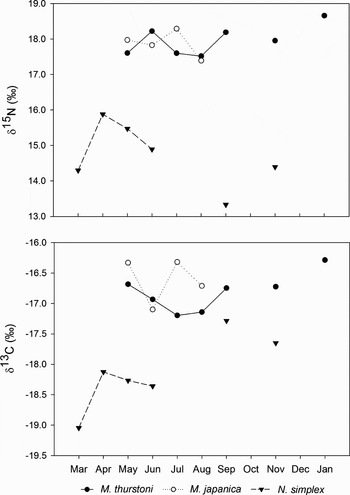
Regarding temporal variation in isotopic values, during 2006 we found that M. thurstoni reflected N. simplex SI values with a 2 month delay for δ15N and a 1 month delay for δ13C. For M. japanica the small sample size prevented determination of a SI trend that could be compared to N. simplex SI values (Figure 4).
δ13C and δ15N monthly values for Mobula thurstoni, Mobula japanica and Nyctiphanes simplex during 2006–2007 in the south-west Gulf of California.

Calculated trophic positions
Trophic position was calculated following the equation proposed by Vander Zanden & Rasmussen (Reference Vander Zanden and Rasmussen2001):

This equation takes as δ15Nbaseline a primary consumer, since there seems to be less variability in their isotopic values than lower down the food chain, at the phytoplankton trophic level (Vander Zanden & Rasmussen, Reference Vander Zanden and Rasmussen2001). In this study δ15Nbaseline was given by herbivorous zooplankton (calyptope larvae of N. simplex and copepods of the genus Acrocalanus). We obtained trophic positions of 3.48 for M. thurstoni, 3.43 for M. japanica and 2.52 for N. simplex.
DISCUSSION
Stable isotope analysis, through the comparison of bentfin and spinetail devil ray (Mobula thurstoni and Mobula japanica) SI values with those of their potential prey, allowed us to determine a predator–prey relationship between the devil rays and the euphausiid Nyctiphanes simplex in the south-west Gulf of California. This confirmed the results previously found through stomach contents analysis by Notarbartolo-di-Sciara (Reference Nortarbartolo-di-Sciara1988).
The low variability in the isotopic values of devil ray tissues was indicative of a highly specialized diet (Sweeting et al., Reference Sweeting, Jennings and Polunin2005). We obtained five whole specimens of devil ray during 2006, all of which contained only remains of euphausiids in the gut. Nyctiphanes simplex is an important component of the south-west Gulf of California food web, as it is preyed on by birds, blue whales (Balaenoptera musculus), Bryde's whales (B. edeni) and fin whales (B. physalus) (Gendron, Reference Gendron1992). It is also the most abundant euphausiid in neritic waters of the Gulf of California (Gómez-Gutiérrez et al., Reference Gómez-Gutiérrez, Tremblay, Martínez-Gómez, Robinson, Del Ángel-Rodríguez, Rodríguez-Jaramillo and Zavala-Hernández2009), and its swarming behaviour (Gendron, Reference Gendron1992) potentially makes it an easy prey for filter-feeding predators such as devil rays. Within the study area, N. simplex represents the main component of zooplankton samples, accounting for more than 98% of euphausiid larval abundance and from 27‰ to 99.7‰ of euphausiid adult abundance (De Silva-Dávila & Palomares-García, Reference De Silva-Dávila, Palomares-García and Hendricks2002).
Basking sharks are highly specialized filter-feeding elasmobranchs, feeding mostly on one species of copepod. Sims & Merrett (Reference Sims and Merrett1997) found that basking sharks spent most of their feeding time in areas where large copepods Calanus helgonlandicus were predominant. The results of the present study concur with the results of the only previous account of mobulid diet (Notarbartolo-di-Sciara, Reference Nortarbartolo-di-Sciara1988), which reported an index of relative importance for N. simplex of 97.90% in stomachs of M. thurstoni and 99.62% in M. japanica.
The fractionation values obtained in this study between devil rays and their prey fit within the values proposed by McCutchan et al. (Reference McCutchan, Lewis, Kendall and McGrath2003) (3.2 ± 0.43 ‰ for δ15N and 1.8 ± 0.29 ‰ for δ13C) for one trophic level. Fractionation factors obtained between devil rays and the other zooplanktonic groups analysed were outside the range of proposed values, confirming the fact that devil rays did not feed on those groups.
As expected, SI variability was greater in zooplankton than in devil rays; zooplankters tend to have more variable SI values, since these reflect changes in the environment over a period of days, whereas larger organisms such as rays integrate isotopic signals over a period of several months (O'Reilly et al., Reference O'Reilly, Hecky, Cohen and Plisnier2002). We detected variations in the isotopic signal of N. simplex of up to 2.55‰ for δ15N and 1.76‰ for δ13C, whereas the signal for the devil rays varied only up to 1.14‰ for δ15N and 0.91‰ for δ13C. Sampling for prey during several months provided a shifting isotopic baseline, which was compared with the isotopic values from the tissues of the devil rays. Harvey et al. (Reference Harvey, Hanson, Essington, Brown and Kitchell2002) have pointed out the importance of taking into account seasonal variations in isotopic signals. Small zooplanktonic prey reflect baseline SI changes much faster than larger animals, so sampling prey over a longer period of time gives a better estimate of the isotopic signals that the predators are reflecting (MacNeil et al., Reference MacNeil, Skomal and Fisk2005).
The values obtained for devil rays were slightly higher than the value of 3.2 calculated by Estrada et al. (Reference Estrada, Rice, Lutcavage and Skomal2003) for the filter-feeding basking shark Cetorhinus maximus, which consumes mainly copepods (Sims et al., Reference Sims, Southall, Tarling and Metcalfe2005). The organisms selected as the baseline δ15N (calyptope stage N. simplex and Acrocalanus copepods) were deemed appropriate to represent trophic level 2 of this food chain as their diets consist mostly of phytoplankton and/or detritus (Suh, Reference Suh1989; Suh et al., Reference Suh, Toda and Terazaki1991). Most zooplanktonic organisms are not purely herbivores or carnivores, but ingest a range of food items depending on availability (Kleppel, Reference Kleppel1993; Zhang et al., Reference Zhang, Li, Sun, Zhang, Sun and Ning2006). The overlapping SI values observed in all the zooplanktonic groups analysed here reflect their changing feeding strategies as well as changes in nutrient origin during the study period.
Mobula thurstoni isotopic values were most enriched in January. Notarbartolo-di-Sciara (Reference Nortarbartolo-di-Sciara1988) suggested that this species switches to a diet consisting mainly of mysids during the winter. In this study we collected only one mysid sample (14.37‰ δ15N and –17.68‰ for δ13C) and we did not collect zooplankton samples in the winter months. We therefore do not have a good estimate of mysid isotopic values and could not compare M. thurstoni values with those of mysids to determine whether the more enriched values observed in January are indicative of a mysid diet. The M. thurstoni samples collected that month were obtained at El Mogote, which is close to the city of La Paz, and the higher δ15N values obtained could be reflecting nitrogen runoff from the city (Hansson et al., Reference Hansson, Hobbie, Elmgren, Larsson, Fry and Johansson1997).
The most depleted isotopic values for M. thurstoni were obtained in August. This could be explained by the oceanographic conditions in the Gulf of California in the summer, when the entry of Pacific Ocean water could bring into the gulf different water masses with a distinctive isotopic signature (Altabet et al., Reference Altabet, Pilskaln, Thunnel, Pride, Sigman, Chavez and Francois1999).
We did not collect as many M. japanica (N = 6) as M. thurstoni samples (N = 32), making it difficult to infer the diet of the former species. Sample numbers, however, do not necessarily reflect the true abundance of these species in the area. Because of former overexploitation of devil rays in Mexico, their capture, trade, and consumption are now considered illegal according to Mexican regulations (NOM-029-PESC (2004)). As the samples were obtained from fishing camps where these species were incidentally caught, sample abundance reflects the willingness of the local fishermen to cooperate. Mobula japanica is locally known to be more abundant during the summer months (Notarbartolo-di-Sciara, Reference Nortarbartolo-di-Sciara1988). In the present study samples for this devil ray could not be obtained after August 2006.
Local fishermen report that M. japanica moves out of the south-west Gulf of California at the end of the summer, and Notarbartolo-di-Sciara (Reference Nortarbartolo-di-Sciara1988) mentioned that large individuals of this species were locally rare in winter. Studies of a variety of marine animals (sea turtles, whales, seabirds and seals) have used stable isotopes in order to investigate migration patterns by comparing tissue SI values with values of prey in certain areas, or based on tissue growth (Hobson, Reference Hobson1999). If Mobula japanica feeds outside the south-west Gulf of California in winter, the isotopic signature it presents in the spring might be reflecting the isotopic signal of a different food chain. Tissue turnover rate refers to the replacement of old tissue with new, and results in the detection of new prey items in the isotopic signature of the consumer (Sweeting et al., Reference Sweeting, Jennings and Polunin2005). Large migrating animals have slow tissue turnover rates; if they consume prey with different isotopic signals, their SI values could be reflecting the isotopic signal of food consumed at a previous location (Schmidt et al., Reference Schmidt, Atkinson, Stübing, McClelland, Montoya and Voss2003; Carmichael et al., Reference Carmichael, Rutecki, Annett, Gaines and Valiela2004). Mobula thurstoni samples were obtained from May to January, indicating that this species probably remains in the study area all year round.
Sweeting et al. (Reference Sweeting, Jennings and Polunin2005) found that after about 7 months of being fed a new diet, European sea bass (Dicentrarchus labrax) <1 year old had equilibrated with their diet. If M. japanica enters the study area in May and leaves in October, its tissues would probably not be completely in equilibrium with the local prey. If M. thurstoni fed in the study area all year, it would be reflecting the SI values of the local prey, with a time delay dependent on tissue turnover rates. The delay found in the present study was 2 months for δ15N and 1 month for δ13C.
The data obtained, however, suggest that overall M. thurstoni and M. japanica have very similar diets, as their δ13C and δ15N values as well as their standard deviation, were very similar (t-test, P > 0.05). Mobulids have a very specialized diet. As filter feeding animals they might have evolved to follow euphausiid swarms. Sims & Merrett et al. (1997) suggest that basking sharks Cetorhinus maximus feed in areas where their preferred prey are located, and do not feed indiscriminately. This supports the suggestion that mobulids would tend to favour areas where there are aggregations of N. simplex and therefore integrate the signal of this prey as opposed to other prey that might be found in the area. To our knowledge this is the first stable isotope study of devil rays, and the first time the stable isotope values of devil rays have been linked to their prey.
ACKNOWLEDGEMENTS
The authors thank Dr Don Croll and Kelly Newton from the University of Santa Cruz, California, for help during field sample collections, and Dr Ann Grant for reviewing this manuscript. The authors thank the following: Instituto Politécnico Nacional of Mexico (IPN) for funding the project ‘Biology and ecology of sharks and rays in the Southwest Gulf of California’; the Programa Institucional de Formación de Investigadores (PIFI) for support for L.S.; the Instituto Politécnico Nacional Estímulos al Desempeño de los Investigadores (EDI) and Comisión de Operación y Fomento de Actividades Académicas (COFAA) fellowships for F.G.M., R.S.D. and S.A.G.; and the Monterey Bay Aquarium for contributing funds.