INTRODUCTION
The shallow-water gorgonian fauna (<50 m) of Perú is poorly known. Fourteen species in five genera have been reported in the literature (Mobius, 1861; Verrill, Reference Verrill1868a; Stiasny, Reference Stiasny1951; Breedy & Guzman, Reference Breedy and Guzman2002, Reference Breedy and Guzman2007; Breedy et al., Reference Breedy, Guzman and Vargas2009): two Eugorgia, four Leptogorgia and two Pacifigorgia in the family Gorgoniidae, and five Muricea and one Echinogorgia in the family Plexauridae. Although samples exist in museums as a result of several foreign expeditions, the specimens have not been properly examined.
Recent field campaigns along the Peruvian coast conducted by Yuri Hooker have yielded a large collection of marine invertebrates, the octocorals being a major faunal component mostly composed of Pacifigorgia, Leptogorgia and Psammogorgia species. Psammogorgia species are considered abundant in Isla Foca while rare at Isla San Gallán in the Reserva Nacional de Paracas (Y. Hooker, personal communication).
In this paper, we describe a new species of the plexaurid genus Psammogorgia Verrill, Reference Verrill1868, contribute to the establishment of characters for the morphological review of the genus, report the occurrence of this genus for the first time off Peru, and provide a basis for taxonomic knowledge about octocorals in the region.
Museum abbreviations
CZA, Colección de Zoología Acuática, Universidad Peruana Cayetano Heredia.
UCR, Museo de Zoología, Universidad de Costa Rica.
YPM, Yale Peabody Museum of Natural History, Yale University.
MATERIALS AND METHODS
Collection of specimens and morphological examination
Specimens were collected by SCUBA diving down to 25 m deep, and acquired on land from a local fish market. The samples were preserved in 95% ethanol or air-dried. Fragments of colonies were treated with 3.5% sodium hypochlorite (household bleach) for sclerite dissociation. Sclerites were rinsed many times with distilled water then 100% ethanol, dried, and mounted on stubs for scanning electron microscopy (SEM), and coated with 60–80 nm Pt/Pd. They were observed and photographed using a Hitachi 3700 SEM operated at 15 kV. For light microscopy, clean sclerites were mounted in water or glycerine and observed and photographed using an Olympus LX 51 inverted stereoscope (for details see Breedy & Guzman, Reference Breedy and Guzman2002). The sclerites were measured and the size ranges given in Table 1 correspond to the smallest and the largest sclerites for each morphological type found in the preparations. Colours of the sclerites are given as observed under the light microscope. Colony colour patterns were obtained against standard calibration digital charts (http://encycolorpedia.com/). The holotype and a paratype are deposited in the UCR and the other paratypes are deposited in the CZA. Comparative material from YPM was examined as well. We compared the new species with the described Psammogorgia species for the eastern Pacific by Valenciennes (Reference Valenciennes and Dupetit-Thouars1846), Verrill (Reference Verrill1868), and Kükenthal (Reference Kükenthal1919, Reference Kükenthal1924). The terminology used in the taxonomic description conforms to that of Bayer et al. (Reference Bayer, Grasshoff and Verseveldt1983).
Comparative features of Psammogorgia species (according to Verrill, Reference Verrill1868, and YPM syntypes).

The samples were collected by Y. Hooker with the assistance and logistical support of personnel from the Peruvian Servicio Nacional de Áreas Naturales Protegidas (SERNANP).
SYSTEMATICS
Class AONOTHOZA Ehrenberg, 1834
Subclass OCTOCORALLIA Haeckel, 1866
Order ALCYONACEA Lamouroux, 1816
Family PLEXAURIDAE Gray, Reference Gray1859
Genus Psammogorgia Verrill, Reference Verrill1868
Psammogorgia Verrill, Reference Verrill1868a: 414; Verrill, Reference Verrill1868b: 414; Studer (& Wright), Reference Studer1887: 60; Nutting, Reference Nutting1909: 719; Nutting, Reference Nutting1910: 16; Kükenthal, Reference Kükenthal1919: 234–236, 905; Kükenthal, Reference Kükenthal1924: 106; Bayer, Reference Bayer and Moore1956: F212; Bayer, 1958: 43; Harden, Reference Harden1979: 114; Bayer, Reference Bayer1981: 925.
TYPE SPECIES
Psammogorgia arbuscula Verrill, Reference Verrill1866
DIAGNOSIS
Colonies bushy or flabellate. Branching dichotomous, irregularly dichotomous, or subpinnate. Branches round or slightly flattened. Axis horny, chambered central core filled with organic non-mineralized fibres. Coenenchyme thin to moderately thick, surface finely granulated with rough, warty sclerites. Polyps mostly close together, calyces slightly raised, or prominent. Polyp apertures slit-like or engrossed with wide lips around them. Anthocodial sclerites mostly large, elongated, warty rods or slender, spinose rods, in collaret and points arrangements at the base of the tentacles. Sclerites of the coenenchyme thick, warty spindles, radiates and crosses. Wart clubs and derivatives of them, present in calyx rim and coenenchyme. Colony colours red, orange, pink or white.
REMARKS
The genus Psammogorgia was established by Verrill (Reference Verrill1868a) for three species and two varieties basically from Pearl Islands, Panamá, Nicoya Gulf, Costa Rica and San Salvador: P. arbuscula, P. arbuscula var. pallida, P. arbuscula var. dowii, P. gracilis and P. teres. Verrill (Reference Verrill1868a) also, included in the genus a species formerly figured by Valenciennes (Reference Valenciennes and Dupetit-Thouars1846) from Mazatlán, Mexico, Gorgonia fucosa. Subsequently, other species in the genus were described from different regions and bathymetric ranges, but their taxonomic statuses need revision.
Psammogorgia hookeri, sp. nov.
(Figures 1–4)
Psammogorgia hookeri sp. nov., in situ photographs by Yuri Hooker: (A) Isla San Gallán, Paracas National Reserve, 25 m deep, collection site of the holotype; (B) same locality.
Psammogorgia hookeri sp. nov: (A) holotype colony; (B) sclerites; (C) detail of the branches.
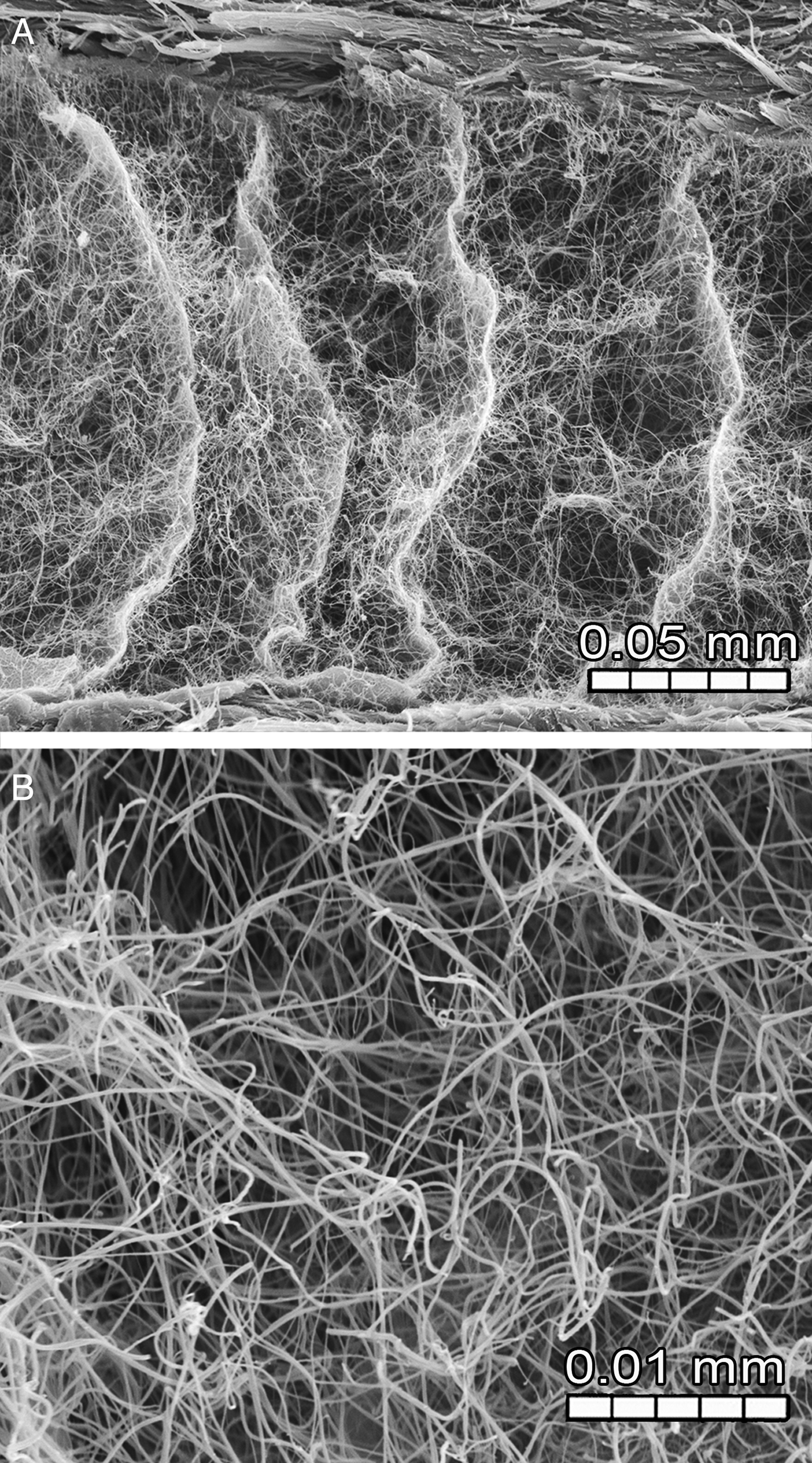
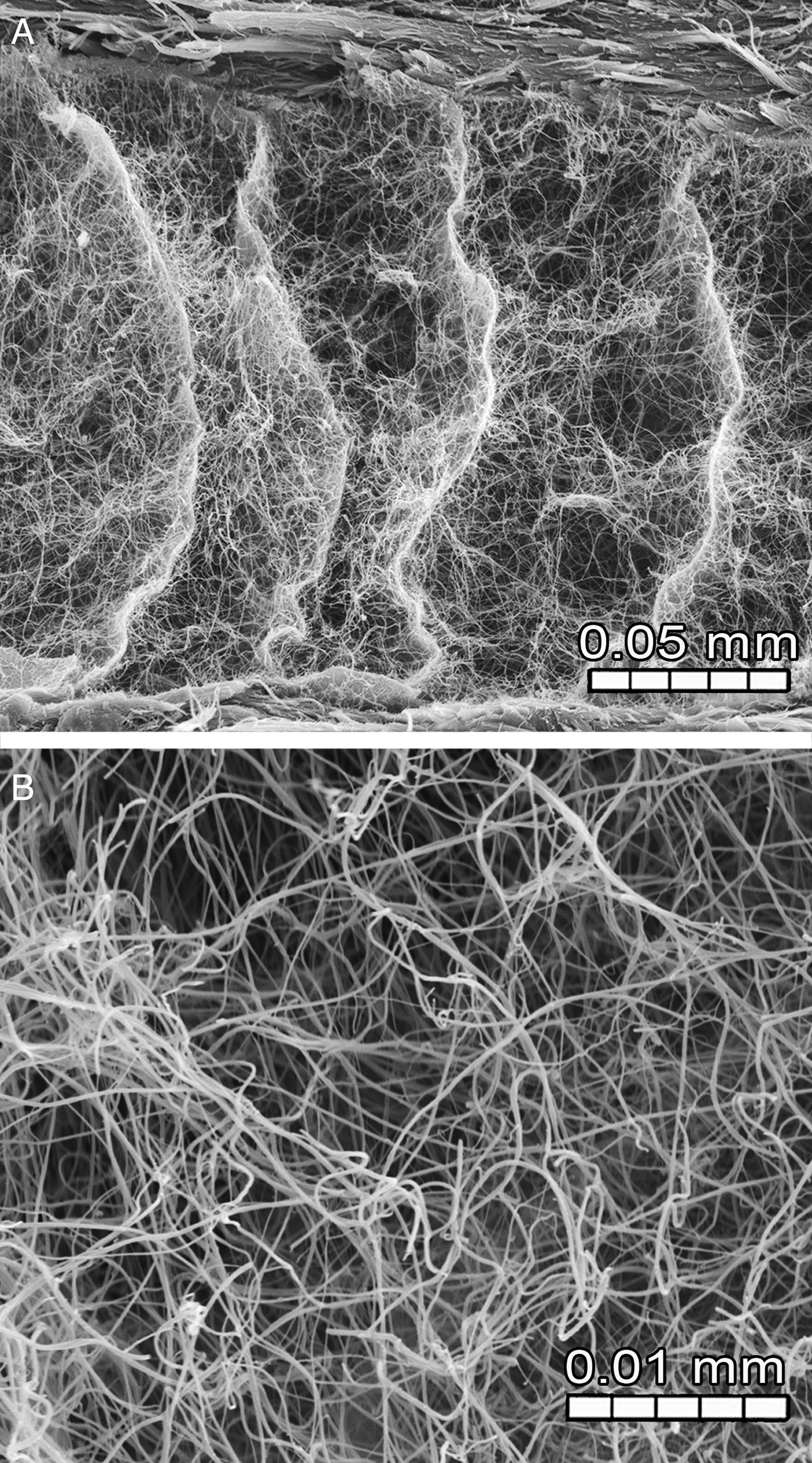
Psammogorgia hookeri sp. nov: (A) axis; (B) detail of organic fibres.
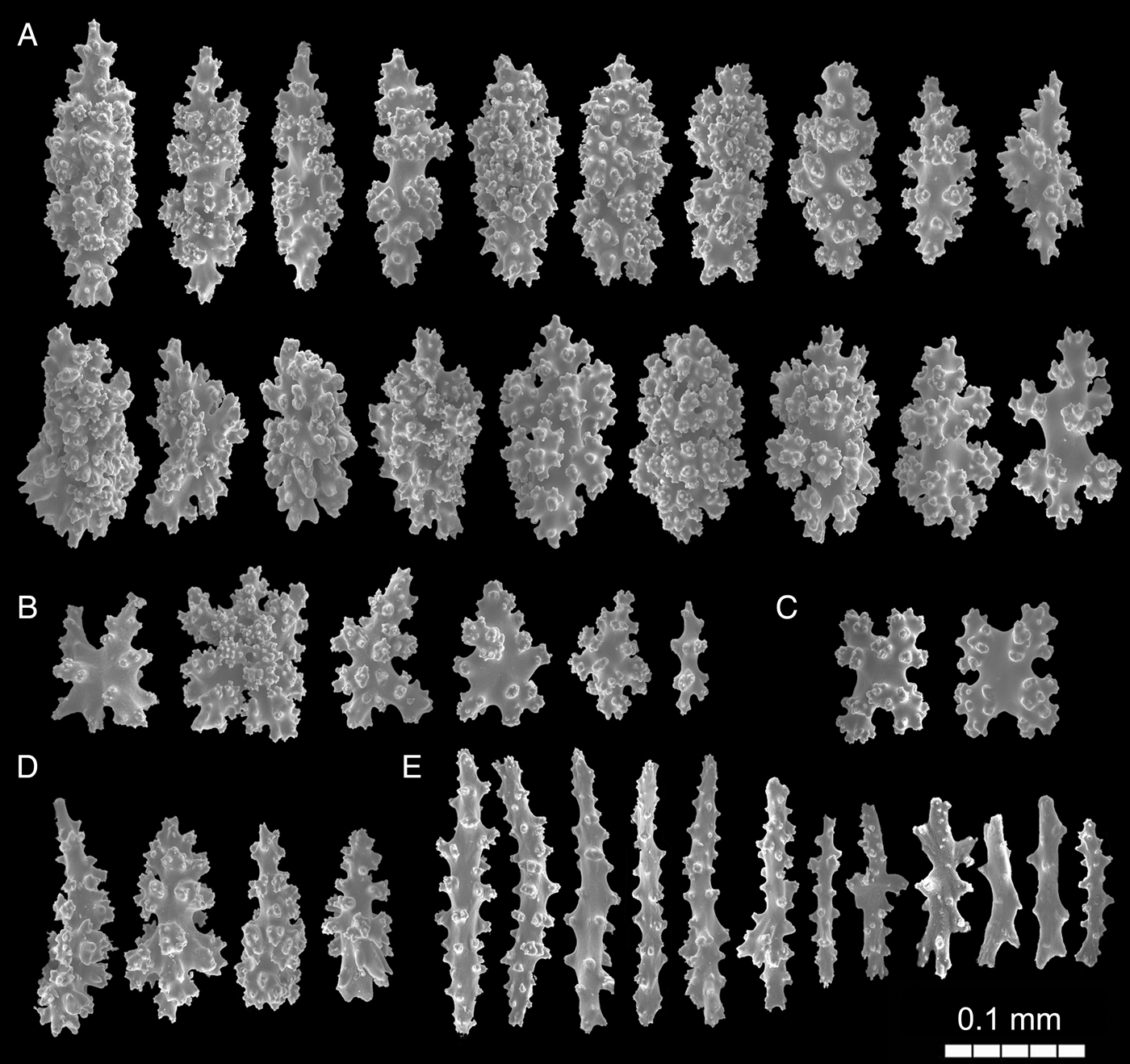
Psammogorgia hookeri sp. nov: (A) spindles; (B) star-like radiates and radiates; (C) crosses; (D) wart clubs; (E) anthocodial rods.
TYPE MATERIAL
Holotype: dry colony, Isla San Gallán (13°48′54″S 76°27′16″W), Reserva Nacional de Paracas, Perú, 25 m, CZA 269A, coll. Y. Hooker, 14 December 2008.
Paratypes: CZA 269B-I, data as the holotype; CZA 267; 268A-C, Bahía Independecia, Reserva Nacional de Paracas, Y. Hooker from fish market, 8 May 2010.
Type locality. Isla San Gallán, Paracas National Reserve, Perú.
COMPARATIVE MATERIAL EXAMINED
Psammogorgia arbuscula Verrill, Reference Verrill1868. Syntype, Panama, YPM 573 a-h, coll. F.H. Bradley, 1866–1867. Psammogorgia arbuscula var. dowii Verrill, Reference Verrill1868. Syntype, Islas Perlas, Panama, YPM 1787, coll. F.H. Bradley, 1866–1867. Psammogorgia arbuscula var. pallida Verrill, Reference Verrill1868. Syntype, Islas Perlas, Panama, YPM 1785a-b, coll. F.H. Bradley, 1866–1867. Psammogorgia gracilis Verrill, Reference Verrill1868. Syntype, Islas Perlas, Panama, YPM 813a, coll. F.H. Bradley, 1866–1867. Psammogorgia teres Verrill, Reference Verrill1868. Syntype, Islas Perlas, Panama, YPM 1556a–b, coll. F.H. Bradley, 1866–1867.
DIAGNOSIS
Colonies small, bushy, multiplanar and irregularly dichotomous. Coenenchyme moderately thick and granular. Calyces prominent, closely placed, with wide lips around polyp apertures without a special type of sclerites, but with some thorny, irregular shaped spindles, and wart-clubs around the calyx rim; these sclerites are up to 0.16 mm long. Coenenchymal sclerites: wide, irregular spindles with acute or bifurcated ends, and combinations of both; warty and irregular radiates, crosses and conspicuous star-like radiates. Anthocodial rods, thin and spiny, in crown and points arrangements. Coenenchymal sclerites reddish, coral red and lighter, anthocodials yellowish, and pale pink. Colonies coral red.
DESCRIPTION
Colonies are small, bushy, branching in several planes and irregularly dichotomous. They reach up to 12 cm long and about 8 cm wide. The holotype is part of a lot of nine specimens that shared a spreading holdfast covered with polyps when alive (Figure 1B). The holotype is 6 cm long and 5 cm wide dry colony, with a holdfast of 1 cm diameter (Figure 2A). The main stem is 9 mm tall and 2.5 mm diameter including calyces; it gives off several branches of uniform thickness, 2–2.5 mm diameter, with tapered tips. The branches emerge at angles of 45–90°, ascend parallel and slightly curve inwards, a few starting at obtuse angles and curve outwards. Some branches are engrossed, up to 4 mm, at certain points because they stick one to another, grow longitudinally, and the coenenchyme covers both. The colony branches up to eight times. Most unbranched terminal ends reach 10–15 mm long, but some bifurcate close to the tips, about 3 mm long. The axes are composed of longitudinal gorgonin layers (amber, horn-like) with a loculated central cord filled with organic fibres without mineralization (Figure 3). The coenenchyme is moderately thick, granular and brittle when dry. The colonies are coral red in ethanol or dry preserved with lighter spots around the calyces. When alive, colonies are brighter coral red and the polyps are translucent (Figures 1A, B). The calyces are densely arranged around the branches, more separated on the holdfast, and at the base of the stems. The calyces are prominent, as tall as wide up to 1.4 mm, composed of eight marginal lobes producing a wide lip around the polyp apertures, which is evident when polyps withdraw or in dry specimens (Figure 2C). Calyces do not present a special type of sclerites, but a concentration of thorny, irregular spindles and some wart-clubs often appear, around the calyx rim. The coenenchymal sclerites are composed of many different forms: irregular, wide spindles with acute or bifurcated ends, and combinations of both (Figures 2B, 4A), they reach up to 0.19 mm long and 0.07 mm wide. Some spindles are club shaped with one short, tapered end and an expanded tuberculate head; they reach up to 0.14 mm long and up to 0.09 mm wide at the head (Figure 4A), other irregular warty modifications are present. Warty radiates reach up to 0.15 mm tall and 0.09 mm wide (Figure 4B); conspicuous star-like radiates reach up to 0.12 mm long and about the same width (Figure 4B, first two sclerites); and warty crosses are up to 0.11 mm by 0.09 mm (Figure 4C), and some immature forms. The occurrence of wart clubs is concentrated at the calyx rim and the base of the anthocodiae; they measure up to 0.16 mm long and 0.05 mm wide (Figure 4D). Anthocodial armature is well developed. It is composed of thin, spiny rods arranged in crown and points, and flat rods with small tubercles and scattered warts. The rods reach up to 0.18 mm long and 0.04 mm wide (Figure 4E); the smaller rods are 0.09–0.10 mm.
Polyp sclerites are pale pink and yellowish. Coenenchymal sclerites are coral red and of some lighter hues (Figure 2B).
ETYMOLOGY
This species is named after biologist and naturalist Yuri Hooker (Universidad Peruana Cayetano Heredia, Lima), in recognition of his indefatigable and valuable contribution to the knowledge of the marine invertebrates and natural history of Perú.
HABITAT
Coral reefs and coral communities have never been described for Peru (Cortes, Reference Cortés and Cortés2003). The diversity of Peruvian shallow-water octocorals may be low, but species and ecosystems have adapted to dramatic coastal oceanographic changes, where habitats are constantly affected by the large seasonal and inter-annual variability of the Peru–Humboldt upwelling and El Niño events that induce high coastal biological productivity and dramatic changes in sea surface temperature (Nixon & Thomas, Reference Nixon and Thomas2001; Bakun & Weeks, Reference Bakun and Weeks2008). This contrasts with more benign conditions in other tropical areas of the eastern Pacific where water temperatures can exceed 25°C and can be nutrient-limited. Furthermore, it is suggested that this productivity, with sea surface temperatures as cool as 16°C, that creates a ‘turbid green-to-brown ecosystem’, is high at the expense of diversity (Chavez et al., Reference Chavez, Bertrand, Guevara-Carrasco, Soler and Csirke2008). Psammogorgia hookeri was observed in clusters at specific spots on rocky ledges and cliffs, extending along the substrate with spreading holdfasts (Figure 1B); it was not found shallower than 20 m in depth. However, it is common to find colonies attached to mussel shells in local fish markets (as paratypes CZA 267; 268A-C) and, whereas they have not been observed on shallow mussel banks between 10 and 20 m deep (Y. Hooker, personal communication), a deeper bathymetric distribution for the species is suggested. The colonies were surrounded by other organisms such as sponges, worms, sea urchins and brachiopods among other sessile creatures (Y. Hooker, personal communication).
DISTRIBUTION
Presently known from the type locality, Isla Gallán, Paracas National Reserve, Perú, at ~25 m depth, and from Bahía Independencia, 47 km from Isla Gallán at unknown depth (collected by fishermen).
DISCUSSION
The Psammogorgia species can be separated in two groups, one with prominent calyces and the other with slightly raised calyces. This character is analysed in dry specimens, thus it could vary depending on the drying history of the particular specimen. However, its reliability has been proven in other octocoral studies (e.g. Breedy et al., Reference Breedy, Guzman and Vargas2009). In this sense, P. arbuscula and P. hookeri are most similar to each other (see Table 1). They have a similar calyx structure forming a wide lip when polyps retract, sclerites around the calyx apertures are basically the same types, warty spindles and wart clubs, but smaller in P. hookeri (Table 1), and with a more complex sculpture in the new species. Psammogorgia arbuscula reaches larger sizes, 20 cm or more, than P. hookeri, and its bright red–orange colour is very different from the coral red colour of the new species. The occurrence of star-like radiates in the new species is very characteristic and is not found in any other species of the genus. The anthocodial rods in P. arbuscula are large, strong and warty, reaching up to 0.26 mm long, while in P. hookeri sp. nov. they are smaller, not more than 0.18 mm long, and are mostly, thinner spinose rods; stronger larger forms are not found (Table 1). Psammogorgia fucosa and P. gracilis have smaller anthocodials, reaching no more than 0.16 and 0.15 mm (Table 1), but other characteristics definitely separate the new species from them.
The Paracas National Reserve is the only locality along the Peruvian Zoogeographic Region where P. hookeri was found. Currently no records exist from any other eastern Pacific place and the species thus may be endemic.
ACKNOWLEDGEMENTS
We are grateful to anonymous referees for critical improvements of the manuscript. We thank Yuri Hooker from the Universidad Peruana Cayetano Heredia and Miguel Romero from the Instituto del Mar del Perú (IMARPE) for providing access to examine the Peruvian octocoral collections. We are grateful to Eric Lazo-Wasem and Lourdes Rojas (YPM) for the loan of type specimens used for comparison; and to Alex Rodríguez (CIEMIC) for the figure composition. We thank the Servicio Nacional de Áreas Naturales Protegidas, Perú (SERNANP, former INRENA) for the logistic support provided during the field research.
FINANCIAL SUPPORT
This project was partially funded by the Vicerrectoría de Investigación, Universidad de Costa Rica, and the Smithsonian Tropical Research Institute in Panama.