1. Introduction
Decapod crustaceans are a diverse arthropod group with ∼15 000 named species among more than 170 families (Crandall et al. Reference Crandall, Porter, Pérez-Losada, Hedges and Kumar2009). Fossil decapods, however, are generally rare (Pagani et al. Reference Pagani, Damborenea, Mancenido and Ferrrari2011). The first members of this group can be traced to the Devonian Period (Feldmann & Schweitzer, Reference Feldmann and Schweitzer2010; Gueriau et al. Reference Gueriau, Charbonnier and Clément2014), although molecular clock estimates indicate an early Silurian (∼430 Ma) origin for the group, with all major infraorders represented by late Carboniferous time (Crandall et al. Reference Crandall, Porter, Pérez-Losada, Hedges and Kumar2009).
Crayfish – freshwater decapod crustaceans (Astacidea Latreille, Reference Latreille1802) – are unusual in that they do not inhabit marine conditions typical of decapods (Bliss, Reference Bliss1968). Although crayfish fossils are rare (Feldmann & Pole, Reference Feldmann and Pole1994; Babcock et al. Reference Babcock, Miller, Isbell, Collinson and Hasiotis1998; Taylor et al. Reference Taylor, Schram and Shen1999; Shen et al. Reference Shen, Schram and Taylor2001; Martin et al. Reference Martin, Rich, Poore, Schultz, Austin, Kool and Vickers-Rich2008; Feldmann et al. Reference Feldmann, Schweitzer and Leahy2011), their record extends to the Pennsylvanian, suggesting an early Carboniferous origin, prior to the Pangaean break-up (Hasiotis, Reference Hasiotis2002). After the break-up, three crayfish families diverged across Laurasia and Gondwana: Cambaridae Hobbs, Reference Hobbs1942 and Astacidae Latreille, Reference Latreille1802 (Northern Hemisphere) and Parastacidae Huxley, Reference Huxley1879 (mostly Southern Hemisphere, but see Feldmann et al. Reference Feldmann, Schweitzer and Leahy2011) (Hasiotis, Reference Hasiotis2002). The majority of fossil evidence for crayfish comes from their traces, especially burrows (Hasiotis & Mitchell, Reference Hasiotis and Mitchell1993; Babcock et al. Reference Babcock, Miller, Isbell, Collinson and Hasiotis1998; Hasiotis et al. Reference Hasiotis, Kirkland and Callison1998), although body fossils are also known (e.g. Garassino, Reference Garassino1997; Taylor et al. Reference Taylor, Schram and Shen1999; Garassino & Krobicki, Reference Garassino and Krobicki2002; Martin et al. Reference Martin, Rich, Poore, Schultz, Austin, Kool and Vickers-Rich2008; Pasini & Garassino, Reference Pasini and Garassino2011). Traces (burrows) constitute the bulk of the fossil record of the Southern Hemisphere family, Parastacidae (Hasiotis, Reference Hasiotis2002; Bedatou et al. Reference Bedatou, Melchor, Bellosi and Genise2008; Martin et al. Reference Martin, Rich, Poore, Schultz, Austin, Kool and Vickers-Rich2008). As a result, the evolutionary history of Parastacidae is poorly understood (Martin et al. Reference Martin, Rich, Poore, Schultz, Austin, Kool and Vickers-Rich2008) and additional fossil evidence is vital to unravelling the distribution patterns of this group (Feldmann et al. Reference Feldmann, Schweitzer and Leahy2011).
Like all decapod crustaceans, crayfish have a rigid, calcified, cuticular exoskeleton covering the softer internal body parts (Luquet, Reference Luquet2012; Nagasawa, Reference Nagasawa2012). Despite offering protection from predators, the exoskeleton constrains growth of the organism. As such, the decapod exoskeleton is periodically moulted during ecdysis, after which the body size increases and a new exoskeleton is sclerotized (Greenaway, Reference Greenaway1985; Brandt, Reference Brandt2002; Luquet, Reference Luquet2012). Prior to ecdysis, select crustacean taxa resorb calcium-carbonate and other cuticular minerals from the old exoskeleton (Luquet, Reference Luquet2012). In lobsters and crayfish, calcium storage involves the deposition of paired hemispherical structures in the cardiac stomach between the single-layered epithelium and a cuticle lining (Greenaway, Reference Greenaway1985; Brandt, Reference Brandt2002; Luquet, Reference Luquet2012; Habraken et al. Reference Habraken, Masic, Bertinetti, Al-Sawalmih, Glazer, Bentov, Fratzl, Sagi, Aichmayer and Berman2015). Such structures have been referred to as gastroliths (Travis, Reference Travis1960, Reference Travis1963; McWhinnie, Reference McWhinnie1962) or more correctly, bio-gastroliths, which differentiates them from ingested sediment particles and pathological ‘stomach stones’ (Wings, Reference Wings2007). After moulting, the bio-gastroliths are passed to the gizzard, dissolved and resorbed to accelerate exoskeletal recovery and restart the ability to feed (Frizzell & Exline, Reference Frizzell and Exline1958; Travis, Reference Travis1960; Glazer et al. Reference Glazer, Tom, Weil, Roth, Khalaila, Mittelman and Sagi2013). Bio-gastroliths therefore act as temporary calcium-carbonate storage units (Ueno, Reference Ueno1980; Nagasawa, Reference Nagasawa2012).
Although widespread in extant decapods, fossil bio-gastroliths are exceedingly rare. The only records come from the Upper Jurassic Yixian Formation in China (Taylor et al. Reference Taylor, Schram and Shen1999) and the middle Eocene Clairborne Group in Texas (Frizzell & Exline, Reference Frizzell and Exline1958). Similar calcium storage structures (dermoliths) have also been reported in Late Cretaceous isopods from Lebanon (Feldmann, Reference Feldmann2009; Feldmann & Charbonnier, Reference Feldmann and Charbonnier2011). Here, we formally report on the first Cretaceous decapod bio-gastroliths, which come from the Cenomanian-aged Griman Creek Formation near the town of Lightning Ridge in central-northern New South Wales, Australia (Fig. 1). Although decapod bio-gastroliths from the Griman Creek Formation have been referred to on multiple occasions (Smith, Reference Smith1999; Bell et al. Reference Bell, Fanti, Hart, Milan, Craven, Brougham and Smith2019; Tucker & Tucker, Reference Tucker and Tucker2019), they have not been formally described and their affinities have not been discussed. We describe these remains and discuss their implications for palaeobiogeography and as palaeoenvironmental indicators in the Griman Creek Formation.
Locality map of (a) Australia and (b) the Lightning Ridge region. Grey area in (a) depicts the expanded area in (b). Fossilized parastacid crayfish bio-gastroliths described here come from the Cenomanian-aged Griman Creek Formation in the vicinity of Lightning Ridge (arrow).

2. Geological setting
Decapod remains described here derive from the Wallangulla Sandstone member of the Griman Creek Formation (Rolling Downs Group, Surat Basin). Near the town of Lightning Ridge (New South Wales), surface exposures of this interval are generally lacking; however, more than a century of small-scale opal mining, which is almost exclusively responsible for the extraction of fossils, permits observations of the geology underground. Subterranean exposures of the Wallangulla Sandstone member (Moore, Reference Moore2002) exceed 25 m in thickness and include laterally extensive but discontinuous claystone lenses (‘Finch Clay facies’; Scheibner & Basden, Reference Scheibner and Basden1998) that are the sole source of commercial opal and opalized fossils, including those described here. These sediments are interpreted to have been deposited in freshwater lakes and lagoons on a lowland floodplain that drained into the epeiric Eromanga Sea, which lay to the north and northwest of the study area (Bell et al. Reference Bell, Fanti, Hart, Milan, Craven, Brougham and Smith2019). Although chiefly freshwater (based on the diverse invertebrate fauna), rare marine vertebrates (aspidorhynchid teleosts, lamniform chondrichthyans, leptocleidid plesiosaurs) attest to distal connections between some of these water bodies and the Eromanga Sea (Bell et al. Reference Bell, Fanti, Hart, Milan, Craven, Brougham and Smith2019 and references therein). During Cenomanian time, Lightning Ridge would have been at a palaeolatitude of ∼60° S (Matthews et al. Reference Matthews, Maloney, Zahirovic, Williams, Seton and Müller2016) and probably had a mean annual temperature of ∼14 °C based on the diverse crocodylomorph fauna (Molnar, Reference Molnar1980; Molnar & Willis, Reference Molnar, Willis, Grigg, Seebacher and Franklin2001) and the minimum thermal tolerance of modern crocodylians (Markwick, Reference Markwick1998). The minimum depositional age of the Griman Creek Formation at Lightning Ridge has been radiometrically dated at 100.2–96.6 Ma (Cenomanian; Bell et al. Reference Bell, Fanti, Hart, Milan, Craven, Brougham and Smith2019).
3. Systematic palaeontology
Arthropoda von Siebold, Reference von Siebold, von Siebold and Stannius1848
Pancrustacea Zrzavý & Štys, Reference Zrzavý and Štys1997
Malacostraca Latreille, Reference Latreille1802
Eucarida Calman, Reference Calman1904
Decapoda Latreille, Reference Latreille1802
Astacidea Latreille, Reference Latreille1802
Parastacoidea Huxley, Reference Huxley1879
Parastacidae Huxley, Reference Huxley1879
Parastacidae gen. et sp. indet.
Material. LRF (Lightning Ridge Fossil, Australian Opal Centre, Lightning Ridge, New South Wales, Australia) 0022, 0058, 0171–0176, 0294–0305, 0381, 0419, 0433–0435, 0585–587, 0603–0665, 0720–0722, 0801, 1064, 1075–1084, 1168–1213, 1245–1285, 1326–1328, 1396, 1417, 1434, 1458, 1571, 1592, 1689–1693, 1752–1755, 1829–1831, 1844, 1871–1873, 1908, 1982, 2128–2129, 2177, 2201, 2210, 2775–2782, 2943, 3063, 3094, 3351–3357; AM F (Australian Museum, Sydney, New South Wales, Australia) 112635, 112669, 112966, 134336, 112969, 121705, 121706, 121708, 128045, 131602, 131603, 131606, 131608, 131609, 131684–131690, 131692–131700, 131701–131703, 131705, 131706, 131710, 131712–131714, 131717, 131718, 131724, 131726, 131727, 131735, 134528, 137347–137348; isolated bio-gastroliths.
Preservation. As with most fossils from the Griman Creek Formation at Lighting Ridge, the bio-gastroliths are pseudomorphs composed of precious and non-precious opal (SiO2.nH2O), which typically precludes replication of internal histology. However, concentric growth rings are often visible as surface features.
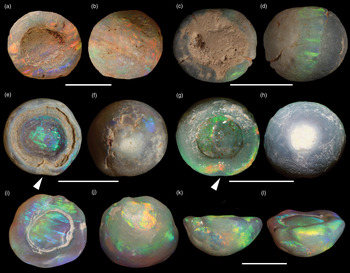
Description. Low-domed to nearly hemispherical bio-gastroliths with maximum diameters ranging from ∼4 mm up to ∼19 mm (e.g. LRF3355 and LRF3352, respectively) but most commonly 10–13 mm (Fig. 2; Table 1). They are slightly ‘wider’ than ‘long’. In life, the long-axis would presumably have been oriented at roughly 45° (anterodorsally oriented in lateral view) to the long-axis of the animal as in modern crayfish (McWhinnie, Reference McWhinnie1962, fig. 1), while the domed (external) surface contacted the epidermis, and the concave (internal) surface contacted the stomach lining (Travis, Reference Travis1960). In some specimens, the dome is comparatively low, and although predominantly smooth, many examples show random networks of shallow splits or cracks (e.g. LRF3352), and in others the texture is weakly knobbled (e.g. LRF3353). Presumably, these variations are due to incomplete development, partial resorption and/or postmortem decay.
(a, c, e, g, i) Internal and (b, d, f, h, j) external views of opalized parastacid bio-gastroliths from the Griman Creek Formation. (a, b) LRF3063; (c, d) LRF419; (e, f) LRF722; (g, h) LRF585; (i–l) LRF435; (k) lateral view; (l) lateral oblique view. Arrowheads demarcate the groove, or channel, on the outer rim. All scale bars = 5 mm. Photos: Robert A. Smith (Australian Opal Centre).

Table of measurements (in millimetres) for select crayfish bio-gastroliths from the Griman Creek Formation

Internally, the outer rim is thickened relative to the central portion of the disc. This outer rim displays concentric growth rings in well-preserved specimens (e.g. LRF722; Fig. 2e), whereas they are absent in others (e.g. LRF585, LRF1246; Fig. 2g). Growth rings appear to be accentuated where the rim has been broken or abraded, presumably soon after death. This outer rim is interrupted on one of the long edges by a shallow U-shaped groove or channel, which widens slightly towards the periphery of the element (Fig. 2e, g). The central depression (attachment scar) on the internal side may be concave (e.g. LRF722) or flat (e.g. LRF603, LRF1285) with a slightly roughened or irregular surface.
4. Discussion
Decapod bio-gastroliths are restricted to the Astacidea, a group that includes marine lobsters (Nephropoidea Dana, Reference Dana1852) and freshwater crayfish. The latter group is divided into the Northern Hemisphere clade, Astacoidea Latreille, Reference Latreille1802 (consisting of Astacidae plus Cambaridae), and its Southern Hemisphere counterpart, Parastacoidea Huxley, Reference Huxley1879 (Parastacidae). This Northern–Southern Hemisphere dichotomy has its origins in the Jurassic Period, coinciding with the separation between Laurasia and Gondwana ∼200–185 Ma (Ahyong & O’Meally, Reference Ahyong and O’Meally2004; Martin et al. Reference Martin, Rich, Poore, Schultz, Austin, Kool and Vickers-Rich2008; Crandall et al. Reference Crandall, Porter, Pérez-Losada, Hedges and Kumar2009), although more recent phylogenetic hypotheses place this divergence in late Permian time ∼261–268 Ma (Bracken-Grissom et al. Reference Bracken-Grissom, Ahyong, Wilkinson, Feldmann, Schweitzer, Breinholt, Bendall, Palero, Chan, Felder, Robles, Chu, Tsang, Kim, Martin and Crasndall2014). The oldest parastacoid occurrence in Gondwana is established on the basis of burrows from the Upper Jurassic of Argentina (Bedatou et al. Reference Bedatou, Melchor, Bellosi and Genise2008), and burrows and body fossils firmly place this group in southern Australia by the Aptian (Martin et al. Reference Martin, Rich, Poore, Schultz, Austin, Kool and Vickers-Rich2008). Morphologically, the Griman Creek Formation specimens resemble the bio-gastroliths of extant freshwater crayfish such as Procambarus Ortmann, Reference Ortmann1905 and Cherax Erichson, Reference Erichson1846 (including C. destructor Clark, Reference Clark1936, which is the species still found today around Lightning Ridge), sharing with them a smooth convex external surface and an internal surface dominated by a centrally depressed attachment scar, which is circumscribed by a thickened ‘rim’. In fact, those of C. destructor are virtually identical in all respects (including size and morphology) to those of the Griman Creek Formation specimens (Fig. 3). Thus, an argument for the referral of the latter to C. destructor could be made. Combined molecular and morphological phylogenies of extant lobsters constrained by fossil occurrences suggest the genus Cherax may have persisted since 77 Ma (Bracken-Grissom et al. Reference Bracken-Grissom, Ahyong, Wilkinson, Feldmann, Schweitzer, Breinholt, Bendall, Palero, Chan, Felder, Robles, Chu, Tsang, Kim, Martin and Crasndall2014). Other long-lived extant parastacoid taxa have estimated ranges close to 100 million years (e.g. Engaeus Erichson, Reference Erichson1846; Bracken-Grissom et al. Reference Bracken-Grissom, Ahyong, Wilkinson, Feldmann, Schweitzer, Breinholt, Bendall, Palero, Chan, Felder, Robles, Chu, Tsang, Kim, Martin and Crasndall2014). Therefore, there is arguably a precedent for referral of the Griman Creek Formation specimens to the genus Cherax. As noted above, however, bio-gastrolith morphology is virtually identical between many modern genera (e.g. Frizzell & Exline, Reference Frizzell and Exline1958), rendering any assignment of the fossil material to any of these taxa dubious.
Modern crayfish (Cherax destructor) bio-gastrolith collected from Lightning Ridge in the vicinity of the fossil representatives. (a) Internal; (b) external; and (c) posterior views.

While morphologically congruent with modern crayfish, the Griman Creek specimens are unlike the bio-gastroliths of extant marine lobsters (Nephropoidea), which tend to form loose aggregates of hundreds of small spicules that disaggregate rapidly postmortem (Herrick, Reference Herrick1911; Frizzell & Exline, Reference Frizzell and Exline1958). Other bio-gastroliths occur in gecarcinid land crabs; however, these number four or more and are irregularly shaped (Greenaway, Reference Greenaway1985; Luquet, Reference Luquet2012).
The assignment of these fossils to freshwater crayfish is further supported by the depositional environment of the fossiliferous horizons of the Griman Creek Formation at Lightning Ridge, which have been interpreted as representative of freshwater lakes (Bell et al. Reference Bell, Fanti, Hart, Milan, Craven, Brougham and Smith2019). Importantly, at 96–100 Ma, deposition of the Griman Creek Formation at Lightning Ridge is concurrent with the late Albian – early Cenomanian regression of the epicontinental Eromanga Sea (Exon & Senior, Reference Exon and Senior1976). Although some waterways may have maintained distal connections to the Eromanga Sea (Bell et al. Reference Bell, Fanti, Hart, Milan, Craven, Brougham and Smith2019), taxa that are regarded as exclusively marine (represented solely by aspidorhynchid fishes and sharks) are extremely rare in these deposits, whereas the diverse molluscan fauna (Newton, Reference Newton1915; McMichael, Reference McMichael1956; Hocknull, Reference Hocknull1997, Reference Hocknull2000; Hamilton-Bruce et al. Reference Hamilton-Bruce, Smith and Gowlett-Holmes2002, Reference Hamilton-Bruce, Kear and Smith2004; Kear & Godthelp, Reference Kear and Godthelp2008; Hamilton-Bruce & Kear, Reference Hamilton-Bruce and Kear2010) attests to strictly freshwater conditions. Thus, the marine taxa may have been infrequent visitors to freshwater ecosystems rather than palaeoenvironmental indicators of marine conditions at Lightning Ridge (Bell et al. Reference Bell, Fanti, Hart, Milan, Craven, Brougham and Smith2019). While modern marine decapods may also venture upstream into freshwater habitats (e.g. Chow & Fujio, Reference Chow and Fujio1987), this appears to be related to temporary occupation or hatching of planktonic larvae. In contrast, the ubiquity and relatively common occurrence of decapod bio-gastroliths in the Griman Creek Formation favours the assignment to a resident freshwater population. Indeed, bio-gastroliths are among the most commonly recovered fossils of any invertebrate or vertebrate from the Griman Creek Formation (P. R. Bell and E. T. Smith, pers. obs.), occurring throughout the opal fields over an area of several hundred square kilometres. Based on the above palaeoenvironmental, morphological and palaeobiogeographic arguments, we therefore assign the Griman Creek Formation bio-gastroliths to freshwater parastacid crayfish.
Fossil bio-gastroliths are extremely rare in the fossil record outside of the Griman Creek Formation, having only been identified in three taxa. Frizzell & Exline (Reference Frizzell and Exline1958) described bio-gastroliths from the middle Eocene Clairborne Group in Texas, which they named Wechesia pontis Frizzell & Exline, Reference Frizzell and Exline1958 but did not assign them below Astacidea (their ‘Nephropsidea’). These differ from the Griman Creek Formation specimens in their minute dimensions (typically ∼0.2 mm in diameter), discoid (rather than hemispherical) shape, and the presence of radial grooves and a central depression on the external surface of the bio-gastrolith. The only other fossil crayfish bio-gastroliths belong to the cambarids (Astacoidea) Palaeocambarus licenti Taylor, Schram & Shen, Reference Taylor, Schram and Shen1999 and Cricoidoscelosus aethus Taylor, Schram & Shen, Reference Taylor, Schram and Shen1999 from the Upper Jurassic Yixian Formation in China (Taylor et al. Reference Taylor, Schram and Shen1999). Unlike both Wechesia and the Griman Creek Formation specimens, the Chinese bio-gastroliths were preserved as natural moulds (up to 7 mm in diameter) of the original structures within the foregut of articulated body fossils. Those authors briefly described them in two specimens of Palaeocambarus, one of which was described as having a ‘rounded convex surface while the other possesses an outer depressed ridge with raised circular region’ (Taylor et al. Reference Taylor, Schram and Shen1999, p. 124). These descriptions presumably refer to the impressions of the external and internal surfaces of the bio-gastroliths, respectively. Those of Cricoidoscelosus were mentioned but neither described nor figured. Nevertheless, we note that they superficially resemble the bio-gastroliths of the Griman Creek Formation and other crayfish in overall morphology (see above). Thus, fossil evidence for the mode of calcium storage in crayfish as a whole indicates a deep evolutionary origin that extends at least as far back as the Jurassic Period, although the shared presence of these bio-gastroliths in Astacoidea and Parastacoidea implies their presence at the time of divergence between these two groups, which has been dated to the middle Permian (Bracken-Grissom et al. Reference Bracken-Grissom, Ahyong, Wilkinson, Feldmann, Schweitzer, Breinholt, Bendall, Palero, Chan, Felder, Robles, Chu, Tsang, Kim, Martin and Crasndall2014).
In Australia, parastacid body fossils from the Aptian–Albian Eumeralla Formation (Otway Group) in Victoria (Martin et al. Reference Martin, Rich, Poore, Schultz, Austin, Kool and Vickers-Rich2008) and parastacid burrows from both the Eumeralla Formation and equivalent beds in the upper Strzelecki Group (= Wonthaggi Formation) establish their presence in eastern Gondwana by middle Cretaceous time (Martin et al. Reference Martin, Rich, Poore, Schultz, Austin, Kool and Vickers-Rich2008). Recent reports of crayfish bio-gastroliths from the Aptian–Albian marine deposits at Coober Pedy (South Australia) (Tucker & Tucker, Reference Tucker and Tucker2019) are erroneous (E. Tucker, pers. comm. 2019), and in fact derive from the Griman Creek Formation. The remains from Victoria, estimated at 116 Ma (upper Strzelecki Group) and 106 Ma (Eumeralla Formation), also constitute the oldest parastacid body fossils from Gondwana (Martin et al. Reference Martin, Rich, Poore, Schultz, Austin, Kool and Vickers-Rich2008). A variety of fossil invertebrate burrows occur throughout the Wallangulla Sandstone member (Griman Creek Formation) at Lightning Ridge; which of these, if any, represent crayfish burrows is a matter for further investigation. In other parts of the world, such traces are typically preserved in palaeosols (e.g. Bedatou et al. Reference Bedatou, Melchor, Bellosi and Genise2008, Reference Bedatou, Melchor and Genise2009; Genise et al. Reference Genise, Bedatou, Bellosi, Sarzetti, Sánchez, Krause, Mángano and Buatois2016; Nascimento et al. Reference Nascimento, Batezelli and Ladeira2017), a facies not represented in the Griman Creek Formation (see Bell et al. Reference Bell, Fanti, Hart, Milan, Craven, Brougham and Smith2019).
The recognition of bio-gastroliths from the Griman Creek Formation augments the scant fossil record of parastacids and has the potential to fill significant gaps in our knowledge of the evolution and palaeobiogeography of crayfish. However, the taphonomy of these structures is virtually unknown, especially in the Griman Creek Formation, where the unusual mode of preservation (i.e. as pseudomorphs in opal) may have contributed to their ubiquity as components of the fossil fauna; indeed, given the abundance of opalized molluscs in the Griman Creek Formation, there is an inference that opalization favoured CaCO3 structures. But despite the abundance of bio-gastroliths, other crayfish body fossils are entirely lacking in the Griman Creek Formation. The implications are interesting. The unique suite of conditions postulated to have been responsible for opal formation in central Australia – involving regional acidic oxidative weathering following the regression of the inland sea – invoke a peak period of opal production (and, hence, fossil formation) from ∼97 Ma to 60 Ma (Rey, Reference Rey2013). Autochthonous microbes preserved within opal nodules at Lightning Ridge have even been used to suggest that opal formation was synchronous with the deposition of sediments (Watkins et al. Reference Watkins, Behr and Behr2011), a model that is consistent with evidence from vertebrate fossils that indicates of a combination of preservation modes, from specimens with defined internal features to full pseudomorphs lacking microstructure. Fossil bones preserving cancellous or spongiform histology indicate a cell-by-cell mineralization process that commenced prior to decomposition of the organic material. In the case of complete pseudomorphs, a slightly more protracted diagenetic history prior to opalization is likely (Pewkliang et al. Reference Pewkliang, Pring, Brugger and Roach2004); however, the presence at deposition of opaline silica or silica in solution is inferred.
The size, abundance and wide distribution of crayfish within the Griman Creek Formation at Lightning Ridge implies they were a substantial food source for a range of predators. Bio-gastroliths are temporary calcium storage structures that develop several weeks prior to ecdysis, after which they are rapidly resorbed (Frizzell & Exline, Reference Frizzell and Exline1958; McWhinnie, Reference McWhinnie1962). Frizzell & Exline (Reference Frizzell and Exline1958, p. 273) commented that ‘intervention of a predator, consuming the premolt animal, normally is required for deposition of the gastrolith in sediments’, a role they asserted was normally played by fish and ducks in modern settings. Thus, crayfish bio-gastroliths exist in the gut for only a short period of time, representing a limited window during which they can be potentially incorporated into the sedimentary record. Based on the ratio of body length-gastrolith diameter in modern crayfish (11:1 to 13:1; Frizzell & Exline, Reference Frizzell and Exline1958), the largest Griman Creek Formation individuals would have been up to ∼250 mm in length. Birds and large predatory fish are both known from the Griman Creek Formation (Molnar, Reference Molnar, Tomida, Rich and Vickers-Rich1999; Bell et al. Reference Bell, Fanti, Hart, Milan, Craven, Brougham and Smith2019) (although the known bird fossils represent individuals too small to have been viable crayfish predators), as are a variety of carnivorous theropod dinosaurs and marine reptiles (plesiosaurs) that might have fed on crayfish, either systematically or opportunistically.
The discovery of parastacid bio-gastroliths in the Griman Creek Formation indicates that this group was widely distributed across Australia by Cenomanian time and inhabited a variety of freshwater ecosystems, consistent with modern members of the clade. In Victoria, extensional tectonics associated with the Australian–Antarctic rift valley (represented by the Eumeralla Formation and upper Strzelecki Group) supported freshwater lakes and braided streams (Vickers-Rich et al. Reference Vickers-Rich, Rich, Wagstaff, Mason, Douthitt, Gregory and Felton1988; Constantine et al. Reference Constantine, Chinsamy, Vickers-Rich and Rich1998; Herne et al. Reference Herne, Tait, Weisbecker, Hall, Nair, Cleeland and Salisbury2018; Tosolini et al. Reference Tosolini, Korasidis, Wagstaff, Cantrill, Gallagher and Norvick2018). The high palaeolatitute (∼68° S; Matthews et al. Reference Matthews, Maloney, Zahirovic, Williams, Seton and Müller2016) and cold annual average temperatures (−6 to +5 °C) evoked for the Victorian localities imply a long history of cold-water adaptation in this group, a trait consistent with modern parastacids (Martin et al. Reference Martin, Rich, Poore, Schultz, Austin, Kool and Vickers-Rich2008 and references therein). In the Griman Creek Formation, near-coastal freshwater lakes supported crayfish at a palaeolatitude of ∼60° S (Matthews et al. Reference Matthews, Maloney, Zahirovic, Williams, Seton and Müller2016; Bell et al. Reference Bell, Fanti, Hart, Milan, Craven, Brougham and Smith2019). Palaeotemperatures at Lightning Ridge may have been significantly warmer (∼14 °C based on the diverse crocodylomorph fauna and the minimum thermal tolerance of modern crocodylians; Molnar, Reference Molnar1980; Markwick, Reference Markwick1998; Molnar & Willis, Reference Molnar, Willis, Grigg, Seebacher and Franklin2001). Crocodylomorphs, while present, are extremely rare in the Eumeralla Formation and upper Strzelecki Group (Poropat et al. Reference Poropat, Martin, Tosolini, Wagstaff, Bean, Kear, Vickers-Rich and Rich2018), and other cold-sensitive ectotherms such as turtles are neither as abundant nor as diverse in Victoria as they are at Lightning Ridge (Smith, Reference Smith2010; Smith & Kear, Reference Smith, Kear, Brinkman, Holroyd and Gardner2013), where they are the most commonly recovered vertebrate remains (Bell et al. Reference Bell, Fanti, Hart, Milan, Craven, Brougham and Smith2019).
5. Conclusions
The fossil record of Southern Hemisphere freshwater crayfish (Parastacoidea) is extremely sparse. The earliest fossil evidence of this group comes from the Upper Jurassic of Argentina and the uppermost Lower Cretaceous of Australia. Crayfish bio-gastroliths, identified here from the Griman Creek Formation in New South Wales (eastern Australia), extend this record into the earliest part of the Upper Cretaceous (Cenomanian). The new specimens indicate that Australian parastacids were relatively widespread by middle Cretaceous time and had occupied a variety of freshwater ecosystems consistent with the modern ecology of this group. Bio-gastroliths in the Griman Creek Formation are some of the most commonly recovered faunal remains from this interval, which is in stark contrast to the global fossil record of these structures, and of parastacids more generally. The presence of fossilized bio-gastroliths in both parastacoid and astacoid crayfish indicates a deep origin for these structures – perhaps extending as far back as the Permian Period, based on divergence timing estimates for these groups – and that these calcium storage modes have remained virtually unchanged to the modern day. The recognition of such structures in the fossil record has the potential to unlock aspects of the cryptic evolutionary history of Parastacoidea; however, the morphological similarity between bio-gastroliths of various crayfish potentially limits their application to high taxonomic levels.
Acknowledgements
We thank Jenni Brammall (Australian Opal Centre), Patrick Smith and Matt McCurry (Australian Museum) for collections access, advice, specimen data and logistics; Michael Cusack for inspiration; and Robert A. Smith for photographs (Fig. 2). For outright donation of fossil specimens, thanks to Jim Baxter, Costa Englezos, Ed Long, David Schoeffel and Clytie Smith. For donations through the Australian Government’s Cultural Gifts Program, thanks to Arcright Pty Ltd, Adrian Boot, Robert and Debbie Brogan, Paul Burza, Down to Earth Opals P/L, Peter and Vicki Drackett, James Fahey, Matthew Goodwin, Andrew Kemeny, Samuel Miltenberg, Otrad P/L, David Sanders, Stewart Tranter-Brown, Michael Poben, Timothy Seekamp, Graham and Christine Thomson, Mathew Triffitt and Stephen Turner. Thanks also to the Australian Geographic Society and to participants who collected specimens during the annual AOC Fossil Digs; and the opal miners of Lightning Ridge, without whom none of these fossils would have been found. We thank the editor, Bas Van de Schootbrugge, and an anonymous reviewer for their helpful comments that improved the final version of this paper. We pay grateful respects to Yuwaalaraay, Yuwaalayaay and Gamilaraay custodians of country in the Lightning Ridge district. This research was funded by an Australian Research Council Discovery Early Career Researcher Award (project ID: DE170101325) to PRB and an Australian Postgraduate Award to RDCB.