Introduction
Lifetime cumulative adversity (LCA) denotes the accumulated exposure to a wide spectrum of potentially traumatic events (Turner and Lloyd, Reference Turner and Lloyd1995). There is an increasing interest in LCA as adverse events generally tend to co-occur and their combined impact on mental health is greater than that of a single event (Kessler, Reference Kessler1997; Seery et al., Reference Seery, Holman and Silver2010). In line with the dose–response model, there is evidence, albeit not entirely consistent, that the greater the severity of adversity, the worse the ensuing mental symptoms (Keinan et al., in press).
The effect of LCA on late-life functioning has been studied to only a limited degree. A recent relevant theoretical framework, the cumulative inequality theory (Ferraro and Shippee, Reference Ferraro and Shippee2009), takes a lifespan perspective on the aging process. It proposes that social systems (stratifying society according to class, race, income etc.) and personal exposure to risk generate inequality which accumulates across the life span. One's ability to mobilize social, economic, and psychological resources, together with human agency (i.e., the ability to change one's environment), interact with cumulative inequality in shaping physical and mental functioning in old age. The theory further proposes that accumulated stress may lead to biologic changes that accelerate aging and senescence. This suggests that LCA may not only be related to a low level of physical and mental functioning at a specific point in time, but may also be related to an increasingly deteriorating, and to a chronic, functional impairment in late life.
The bulk of research on LCA and its association with late-life mental health has been measured at a single point in time (Kraaij et al., Reference Kraaij, Arensman and Spinhoven2002; Shmotkin and Litwin, Reference Shmotkin and Litwin2009; Shrira et al., Reference Shrira, Shmotkin and Litwin2012). However, pivotal detrimental effects of LCA may be reflected by deteriorating or chronic mental impairment in old age. Deterioration and chronicity refer to two distinctive yet potentially related temporal trajectories of mental health. While deterioration refers to increase in distress and/or decrease in well-being, chronicity refers to continuous high levels of distress and/or low levels of well-being. The effect of LCA on deterioration in mental health over time has been generally neglected, and relatively few studies have examined whether LCA is associated with chronic mental impairment, usually among young adults (Kessler, Reference Kessler1997; Klein, Reference Klein2010). As elaborated later, examining deteriorating and chronic mental impairment is especially important in old age, as deterioration may signal accelerated aging processes and chronic impairment increases the risk for physical and mental comorbidity.
The current study fills an evident void by addressing the association between LCA and late-life deterioration, as well as continuous impairment, in two major markers of mental health: depressive symptoms and quality of life. To this end, the study uses a large-scale sample of older adults with longitudinal data from the first three waves of the Survey of Health, Ageing and Retirement in Europe (SHARE; Börsch-Supan et al., Reference Börsch-Supan2008).
This study focuses on depressive symptoms and quality of life as they respectively account for negative and positive aspects of mental health: mental distress and well-being. Mental distress and well-being are moderately related, but still constitute two distinctive constructs (Keyes, Reference Keyes2007). Moreover, mental distress and well-being may be differently affected by LCA. The positive relationship between cumulative adversity and depressive symptoms is well-documented among young and older adults (Kessler, Reference Kessler1997; Kraaij et al., Reference Kraaij, Arensman and Spinhoven2002). In contrast, the effect of LCA on positive markers of mental health has been considered to a much lesser degree. Positive mental health markers may be less susceptible to the deleterious effects of adversity. For example, most people maintain a relatively stable level of well-being following highly such aversive events as divorce and widowhood (Mancini et al., Reference Mancini, Bonanno and Clark2011). Recent studies focusing on LCA found it unrelated to outcomes such as quality of life, life satisfaction, and optimism (Shrira et al., Reference Shrira, Shmotkin and Litwin2012; Keinan et al., in press, but see Krause, Reference Krause2004). Given the state of the literature and to better understand the differential effect of cumulative adversity, it is important to examine its respective effects on depressive symptoms and quality of life.
As mentioned earlier, there is a need to assess whether LCA is related to late-life deterioration in mental health over time. Although there is no known direct evidence for a stronger deterioration in mental health markers among older adults who were exposed to high levels of LCA, there is indirect evidence that stress and cumulative adversity can accelerate the biological aging process. Several studies found a stronger physical or cognitive decline among those exposed to adverse events (Elder et al., Reference Elder, Shanahan and Clipp1997; Wilmoth et al., Reference Wilmoth, London and Parker2010; Lapp et al., Reference Lapp, Agbokou and Ferreri2011). Moreover, negative life events, including cumulative childhood adversity, were found to be related to telomere shortening (Lin et al., Reference Lin, Epel and Blackburn2012). Telomeres are DNA–protein complexes which become shorter in older organisms, thereby decreasing genetic stability and cell function. Interestingly, childhood adverse life events were related to shorter telomere length in both clinical and non-clinical groups (Lin et al., Reference Lin, Epel and Blackburn2012), suggesting that exposure to adversity may be related to rapid late-life functional decline independent of clinical distress. In view of this evidence, it is possible that lifetime cumulative adversity would be related to late-life deterioration in mental health over time.
Moreover, as stated earlier, the effect of LCA on chronic impairment in mental health among older adults deserves a further look. Indeed, chronically impaired mental health is a pivotal risk factor. For example, people with chronic depression have higher rates of comorbid physical and mental disorders and greater suicidality (Blazer and Hybels, Reference Blazer and Hybels2005). A few works have found a relationship between adverse events and recurrent or chronic depression, and most of them examined young samples and focused on childhood adversity (Kessler, Reference Kessler1997; Klein, Reference Klein2010). Based on these previous findings, Klein (Reference Klein2010) suggested that childhood adversity is one of the strongest predictors of chronic depression. The effect of LCA on continuous impairment, as reflected in positive mental health indices such as quality of life, is even scarcer. Although there is a substantial number of older adults who maintain high quality of life in the face of significant adversity (Hildon et al., Reference Hildon2010), there is evidence that specific adversities, such as divorce, death of a spouse, unemployment, and disability, are associated with a lasting decrease, albeit not a large one in most cases, in one's sense of well-being (Lucas, Reference Lucas2007).
To conclude, the study tested three hypotheses derived from the aforementioned literature. Hypothesis 1 maintains that LCA is associated with high level of depressive symptoms and a low level of quality of life in Wave 1. Hypothesis 2 holds that LCA is associated with an increase in depressive symptoms and a decrease in quality of life from Wave 1 to Wave 2. Hypothesis 3 maintains that LCA is associated with a continuous high level of depressive symptoms and a continuous low level of quality of life across waves. As no previous study is known to directly compare the relative effects of LCA on different mental health markers, the differences in the respective effects of LCA on depressive symptoms and on quality of life were assessed without formulating a specific hypothesis.
Method
Participants
Data were drawn from the three first waves of the Survey of Health, Ageing and Retirement in Europe (SHARE; Börsch-Supan et al., Reference Börsch-Supan2008). The SHARE data include persons aged 50 years and older from a dozen countries, and their spouses of any age. Based on probability samples of households in each participating country, SHARE represents the community-dwelling older population. The data were collected by a comprehensive computer-assisted personal interview, which lasted about 90 minutes, and a supplementary paper Drop-Off questionnaire, which was generally returned later. In the computer-assisted interview, interviewers read the questions to the interviewees and typed their answers. The paper Drop-Off questionnaires were completed by the respondents. Informed consent had been obtained from all respondents prior to the interview.
In total, 31,115 respondents participated in Wave 1 (W1, 2004–2006). Of them, 18,742 and 14,052 participated at Wave 2 (W2, 2006–2008) and Wave 3 (W3, 2008–2009), respectively. As cumulative adversity was retrospectively reported at W3 (see Measures section), the current study focused on those who participated in all three waves (N = 14,052). After further omitting those who did not complete the Drop-Off questionnaire at W1 (that included the Quality of life measure; see Measures section), and respondents below the age of 50, the final sample of the current study was 9,154.
These respondents were interviewed in 11 countries (Austria, Belgium, Denmark, France, Greece, Italy, Netherlands, Germany, Spain, Sweden, and Switzerland). The mean age (at W1) was 63.84 (SD = 9.17, range = 50–96), 55.4% were women, and the mean education level (at W1; see Measures section) was 2.57 (SD = 1.53), corresponding to less than an upper secondary education.
Attrition analyses showed that those who did not complete the Drop-Off questionnaire at W1 were older, had an average lower education level, and reported more depressive symptoms than those who did. However, the size of these differences was negligible (η2 for age, education, and depressive symptoms was 0.001, 0.002, and 0.003, respectively). The groups were identical in gender composition. When comparing those who participated in W1 only, those who participated in the first two waves only, and those who participated in all three waves, the former were older than the two latter groups, and reported more depressive symptoms than those who completed all three waves. Again, the size of these differences was negligible (η2 for age and depressive symptoms was 0.006 and 0.004, respectively). Moreover, those participating in W1 only did not differ in education level compared to those completing all three waves. Also, the groups did not significantly differ in gender composition.
Measures
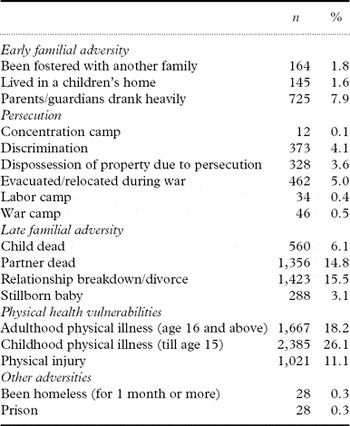
LCA was assessed from a list of difficult life events queried in W3 entitled SHARELIFE. The third wave of SHARE was devoted to retrospective examination of the respondents’ lives. Events were included in the LCA inventory of the current study if they fulfilled the criteria for a traumatic event or met the criteria for an event of an adjustment disorder where the stressor can be of any severity as described by the DSM-IV-TR (American Psychiatric Association, 2000). It was further corroborated that all of the selected events had previously appeared in major studies on cumulative adversity (Kraaij et al., Reference Kraaij, Arensman and Spinhoven2002; Krause, Reference Krause2004; Green et al., Reference Green2010). The final list consisted of 18 difficult life events that reflected early familial adversity (e.g. parents/guardians drank heavily, being fostered, living in a children's home), persecution (e.g. being incarcerated in a concentration/labor/war camp), late familial adversity (e.g. relationship breakdown/divorce, death of a partner or a child), physical health vulnerabilities (e.g. childhood and adulthood physical illness), and other adversities (e.g. being in a prison, being homeless). Table 1 presents a complete list of the events.
Occurrence of difficult life events

Note. N = 9,154. Events which were reported to occur at or after W1 interview year were omitted from the final count.
Respondents in SHARELIFE were presented with an Event History Calendar displayed on the interviewees’ computers. The calendar marked each year of the respondents’ life with their corresponding age. Important personal key events in the respondents’ lives (e.g. partners, children, accommodation, jobs) were marked in the calendar so they could be used as reference points. General country-specific events could also be used as reference points. Respondents were asked to indicate whether each of the 18 queried difficult events had ever happened to them. If confirming the experience of an event, respondents were further asked to specify the year when the event had taken place (for more details, see Schröder, Reference Schröder2011).
As respondents could cite the reoccurrence of some, but not all, of the events, each event was coded as not confirmed (0) or confirmed (1). In order to calculate overall LCA, the number of confirmed events was summed (possible range 0–18). An event count as an index of cumulative adversity has been used in many studies (Green et al., Reference Green2010; Seery et al., Reference Seery, Holman and Silver2010) as it avoids potential ambiguities and confounds that are characteristic of other methods of assessment that weight for subjective perception of severity or event duration (for a discussion, see Kessler, Reference Kessler1997). In the present inquiry, difficult events reported to have occurred at or after W1 interview year (which ranged between 2004 and 2006) were omitted from the final count, given that the outcome measures (depressive symptoms and quality of life) were tapped in W1 and subsequently in W2.
Depressive symptoms were assessed by the European Depression scale (Euro-D; Prince et al., Reference Prince1999). This scale contains 12 items that specify recent depressive symptoms (e.g. “In the last month, have you cried at all?”), scored as a sum of “no” (0) and “yes” (1, indicating presence of a symptom) encoded answers. Five items were phrased in positive terms (e.g. “do you keep up your interests?”). In the present analysis, a minimum of completion of 10 items was required for scoring a sum, with scores of 10–11 items being interpolated by dividing the sum score by the number of completed items and then multiplying that value by 12. Internal reliability measured by Kuder–Richardson's ρ was 0.69 and 0.70 at W1 and W2, respectively.
Quality of life was measured by 12 items originating from the CASP-19 (CASP-12; Hyde et al., Reference Hyde, Wiggins, Higgs and Blane2003; Sim et al., Reference Sim, Bartlam and Bernard2011). This measure conceptualizes quality of life in terms of need satisfaction in four domains: having a sense of control, autonomy, self-realization, and pleasure. Control is defined as the ability to actively intervene in one's environment. Autonomy is defined as the ability of an individual to be free from the unwanted interference of others. Self-realization and pleasure capture the active and reflexive processes of self-fulfillment. The items are rated on a scale ranging from “never” (1) to “often” (4). In the present analysis, a minimum of completion of 10 items was required for scoring a sum, with scores of 10–11 items being interpolated by dividing the sum score by the number of completed items and then multiplying that value by 12. Internal reliability for the CASP-12 measured by Cronbach's α was 0.82 and 0.81 at W1 and W2, respectively.
Background characteristics included age, gender, and country. Education was also included and was recorded by one of seven education levels according to the International Standard Classification of Educational Degrees (ISCED-97; UNESCO, 1997).
Data analyses
To diminish the effect of outliers, the number of adverse events was truncated at 3. Therefore, LCA included 0 (n = 2,938), 1 (n = 3,190), 2 (n = 1,812), and 3 or more events (n = 1,214 which is the sum for n = 794, 290, 101, 19, and 10 respondents reporting 3, 4, 5, 6, and 7 events, respectively). In order to assess the effect of LCA on the outcome variables beyond the effect of background characteristics, age at W1, gender, country (divided into ten dummy-coded variables), and education at W1, each of these variables served as covariates in the main analyses. As the SHARE sample included coupled and non-coupled respondents, another covariate was a dichotomous variable of being coupled versus non-coupled. Finally, events reported to have occurred between W1 interview year and W2 interview year (n = 8,431, 660, 60, and 3 for 0, 1, 2, and 3 events, respectively, dichotomized into 0 events vs. 1 or more events) were added as a covariate when predicting outcomes of change and chronicity.
Preliminary analyses included Pearson, point-biserial, and Spearman's rank correlations to examine the relationships between the study variables, and an analysis of covariance that examined country differences in LCA (controlling for background characteristics).
Analyses testing the study hypotheses used logistic models, as appropriate in the case of dichotomous outcome measures. Depressive symptoms were dichotomized at the optimal Euro-D cut-off point for predicting a diagnosis of depression in semistructured clinical interviews (Prince et al., Reference Prince1999), 0–3 symptoms and 4 symptoms or above. Quality of life was dichotomized to scores below the median (Md = 26 in both waves) and to scores at the median or above it. In all logistic analyses, background characteristics were entered as covariates and the predictor was LCA.
The relationship between LCA and depressive symptoms and quality of life in W1 (Hypothesis 1) was examined by models in which the dichotomized outcome scores served as the dependents. In order to test whether LCA was related to between-waves increase impairment (Hypothesis 2), two additional logistics were performed. In one logistic regression, only those who were below the Euro-D cut-off point at W1 were entered to the model. The dependent referred to remaining below the Euro-D cut-off point at W2 (coded as 1) and being above the cut-off point at W2 (coded as 2). In the other logistic regression, only those who were at the W1 quality of life median or above it were entered to the model. The dependent referred to remaining with high quality of life at W2 (coded as 1) and being below the median of quality of life at W2 (coded as 2). The relationship between LCA and continuous impairment in outcome measures (Hypotheses 3) was examined by multinomial logistic regressions. The outcome variable included three categories. For depressive symptoms, the categories were: consistent low depressive symptoms (maintaining 0–3 symptoms across both waves), episodic high depressive symptoms (reporting 4 symptoms or above in one of the waves), and continuous high depressive symptoms (reporting 4 symptoms in both waves). For quality of life, the categories were: consistent high quality of life (maintaining a median or above the median score in both waves), episodic low quality of life (reporting a score below the median in one of the waves), and continuous low quality of life (reporting a score below the median in both waves). In all logistic analyses, background characteristics were entered as covariates and the predictor was LCA. Odds ratio (OR) and 95% confidence intervals (CI) were determined. Overall, six main analyses were performed to test the study hypotheses, and therefore a Bonferroni correction was made resulting in a 0.008 threshold for significance.
For the purpose of the analyses equating the effect of LCA on depressive symptoms and on quality of life, the likelihood ratios after entering depressive symptoms to the relevant models were compared to those after entering quality of life to the relevant models.
Results
Descriptive statistics and preliminary analyses
Table 1 presents the frequencies for each of the 18 difficult life events. Early familial adverse events and events of persecution were reported by relatively few respondents. Late familial adverse events were more frequent, and physical health vulnerabilities were the most frequent.
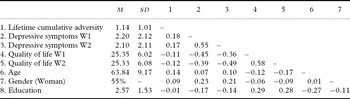
Table 2 presents the descriptive statistics for the study variables.
Means, standard deviations, and correlations for the study variables

Note. Maximal N = 9,154. Values represent Pearson coefficients except for coefficients for gender that represent point-biserial coefficients and those for education that represent Spearman's rank coefficients.
Coefficients above 0.05 are significant at the 0.0001 level.
The mean LCA score was 1.14 (SD = 1.01). LCA was moderately positively correlated with depressive symptoms in both waves, and showed negative correlations with quality of life in both waves. It also correlated positively with age and was higher among women. After controlling for age, gender, education, and coupled respondents, cumulative adversity significantly differed across countries, F(10,9086) = 30.91, p < 0.0001, η 2 p = 0.033. It was highest in Denmark (Adj. M = 1.25, SD = 1.01) and lowest in Greece (Adj. M = 0.83, SD = 0.81).
The relationship between lifetime cumulative adversity and depressive symptoms and quality of life
When referring to W1 outcome measures (Hypothesis 1), beyond the effect of background characteristics, compared to those who reported no adversity, those who reported 1 event were 1.30 times more likely (B = 0.26, 95% CI = 1.14–1.49, p < 0.0001) to report a high level of depressive symptoms. The risk for high depressive symptoms was 1.85 (B = 0.61, 95% CI = 1.59–2.14, p < 0.0001) and 2.66 (B = 0.98, 95% CI = 2.25–3.15, p < 0.0001) among those who reported 2 and 3 or more events respectively. Compared to those who reported no adversity, those who reported 1 event were 1.22 times more likely (B = 0.20, 95% CI = 1.09–1.37, p < 0.0001) to report a lower level of quality of life. The risk for low level of quality of life was 1.70 (B = 0.53, 95% CI = 1.49–1.94, p < 0.0001) and 2.26 (B = 0.81, 95% CI = 1.93–2.64, p < 0.0001) among those who reported 2 and 3 or more events, respectively.
When comparing the likelihood ratios for the model predicting depressive symptoms (−2LL = 151.34) to that predicting quality of life (−2LL = 134.74), the effect of LCA on depressive symptoms was significantly stronger than the effect of LCA on quality of life, χ 2(1) = 16.60, p < 0.0001.
The relationship between lifetime cumulative adversity and change in depressive symptoms and quality of life
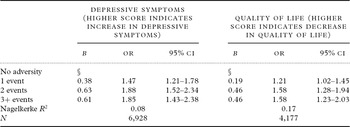
Table 3 presents the results of the logistic regressions examining whether LCA increased the risk of showing an increase in depressive symptoms and a decrease in quality of life between waves (Hypothesis 2).
Logistic regression coefficients of lifetime cumulative adversity in predicting change in depressive symptoms and quality of life

Note. Step 1 included age, gender, education, country (10 dummy variables), a dummy variable dividing respondents into coupled versus uncoupled respondents, and events reported to have occurred between W1 interview year to W2 interview year. Only additional variables are shown in the results of Step 2. OR = Odds ratio. CI = Confidence interval. § = reference category.
All B coefficients are significant above the 0.001 level.
Beyond the effect of background characteristics, LCA increased the risk of showing an increase in depressive symptoms and a decrease in quality of life between waves. Compared to those who reported no adversity, those who reported 3 events or more were 1.85 times more likely (B = 0.61, 95% CI = 1.43–2.38, p < 0.0001) to have an increase in depressive symptoms across waves, and 1.58 times more likely (B = 0.46, 95% CI = 1.23–2.03, p < 0.0001) to have a decrease in quality of life across waves.
When comparing the likelihood ratios for the model predicting change in depressive symptoms (−2LL = 40.55) to that predicting change in quality of life (−2LL = 24.22), the effect of LCA on change in depressive symptoms was significantly stronger than the effect of LCA on change in quality of life, χ 2(1) = 16.33, p < 0.0001.
The relationship between lifetime cumulative adversity and continuous high depressive symptoms and low quality of life
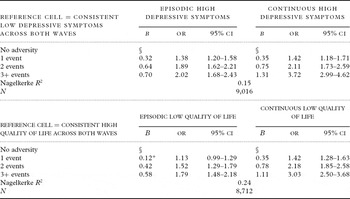
Table 4 presents the results of the multinomial regressions examining whether LCA increased the risk of having episodic as well as continuous high depressive symptoms and low quality of life (Hypothesis 3).
Multinomial logistic regression coefficients of the chronicity categories of depressive symptoms and quality of life onto lifetime cumulative adversity

Note. Covariates included age, gender, education, country (10 dummy variables), and a dummy variable dividing respondents into coupled versus uncoupled respondents. Only cumulative adversity coefficients are shown in the results. OR = Odds ratio. CI = Confidence interval. § = reference category.
All B coefficients are significant above the 0.001 level except for the coefficient marked with + which is not significant (p = 0.074).
Beyond the effect of background characteristics, LCA increased the risk of being in the continuous high depressive symptoms group. Compared to those who reported no events, those with 3 or more adverse events were 3.72 times more likely (B = 1.31, 95% CI = 2.99–4.62, p < 0.0001) to be in the continuous high depressive symptoms group. When quality of life was the dependent, LCA increased the risk of being in the continuous low quality of life group. Compared to those who reported no events, those with 3 or more adverse events were 3.03 times more likely (B = 1.11, 95% CI = 2.50–3.68, p < 0.0001) to be in the continuous low quality of life group.
An alternative multinomial logistic regression examined whether LCA increased the chances of being in the continuous groups relative to the episodic groups. When the reference cell was changed into episodic high depressive symptoms, relative to those who reported no events, those with 3 or more adverse events were 1.84 times more likely to have continuous high depressive symptoms (B = 0.61, 95% CI = 1.44–2.35, p < 0.0001). Those with 1 or 2 adverse events were not significantly more likely to be in the continuous high depressive symptoms cell (for those with 1 event: B = 0.03, OR = 1.03, 95% CI = 0.84–1.27, p = 0.75; for those with 2 events: B = 0.11, OR = 1.11, 95% CI = 0.89–1.40, p = 0.33).
When the reference cell was changed into episodic low quality of life, LCA still increased the risk of being in the continuous low quality of life group. Relative to those who reported no events, those with 1 event were 1.25 times more likely to have continuous low level of quality of life (B = 0.22, 95% CI = 1.09–1.43, p < 0.0001), those with 2 events were 1.43 times more likely to have continuous low level of quality of life (B = 0.36, 95% CI = 1.22–1.67, p < 0.0001), and those with 3 events or more were 1.68 times more likely to have continuous low level of quality of life (B = 0.52, 95% CI = 1.40–2.02, p < 0.0001).
When comparing the likelihood ratios for the model predicting chronicity in depressive symptoms (−2LL = 313.97) to that predicting chronicity in quality of life (−2LL = 161.26), the effect of LCA on chronicity in depressive symptoms was significantly stronger than the effect of LCA on chronicity in quality of life, χ 2(1) = 152.71, p < 0.0001.
Discussion
This study examined the effect of LCA on change in, and chronicity of, depressive symptoms and quality of life among older adults. All study hypotheses were confirmed. Confirming Hypothesis 1, respondents with more LCA were at greater risk of reporting high level of depressive symptoms and low level of quality of life in W1. Confirming Hypothesis 2, those with more LCA were also at greater risk of reporting an increase in depressive symptoms and a decrease in quality of life between waves. Confirming Hypothesis 3, those with more LCA were at greater risk to show continuous high level of depressive symptoms and low level of quality of life across waves. In accordance with the evidence on a dose–response relationship between cumulative adversity and mental health (for a review, see Keinan et al., in press), the current study showed that the more adverse events reported the higher the detrimental effects were on the mental health outcomes, both in terms of their between-wave change and chronicity. Therefore, this study offers an important addition to the existing literature. It suggests that the noxious effect of LCA extends beyond the episodic level of mental impairment to a greater risk of late-life deteriorating and chronic mental impairment.
The higher risk for deterioration, as manifested in a higher risk for an increase in depressive symptoms and a decrease in quality of life, among those with more accumulated adversity is commensurate with the evidence for an accelerated physical and cognitive decline among old people who were previously exposed to stress (Wilmoth et al., Reference Wilmoth, London and Parker2010; Lapp et al., Reference Lapp, Agbokou and Ferreri2011; Lin et al., Reference Lin, Epel and Blackburn2012). The increased risk for continuous high level of depressive symptoms hereby found among older adults exposed to LCA is consistent with previous evidence from younger samples (Kessler, Reference Kessler1997; Klein, Reference Klein2010). Continuous high levels of depressive symptoms may render older adults susceptible to other physical and mental disorders and suicidality (Blazer and Hybels, Reference Blazer and Hybels2005). The continuous low quality of life shown by those with high LCA further proposes that these older adults also find it hard to attain a strong sense of control, autonomy, self-realization, and pleasure. These individuals possibly have difficulties in perceiving themselves as flourishing in old age (Keyes, Reference Keyes2007).
Together, these findings correspond with the assumptions of the cumulative inequality theory (Ferraro and Shippee, Reference Ferraro and Shippee2009) that cumulative adversity shapes functioning in old age and may lead to an accelerated aging process. Still, as found elsewhere when the level of mental impairment was in focus (Kraaij et al., Reference Kraaij, Arensman and Spinhoven2002; Shmotkin and Litwin, Reference Shmotkin and Litwin2009; Shrira et al., Reference Shrira, Shmotkin and Litwin2012; Keinan et al., in press), LCA in the current study had an overall modest effect on change and chronicity in outcome measures. This complements the assumption that resilience to the accumulation of difficult life events is common (Seery et al., Reference Seery, Holman and Silver2010), and that the ability to mobilize resources and human agency mitigate long-term noxious effect of adversity (Ferraro and Shippee, Reference Ferraro and Shippee2009). There are several explanations for resilience to LCA in older adults. First, many difficult events are predictable so that old people prepare themselves to cope with such events. There is also a tendency of old people to de-emphasize negative experiences and selectively optimize positive experiences. Moreover, when old people face negative events they are geared with experience and wisdom acquired throughout life (Blazer and Hybels, Reference Blazer and Hybels2005).
In this context, the analyses also showed that the effect of LCA was stronger for depressive symptoms than for quality of life, when level, change, and chronicity were examined. Compared to mental distress, general evaluations of well-being and quality of life were previously found to be less affected by single adverse events (Mancini et al., Reference Mancini, Bonanno and Clark2011), as well as by accumulated adversity (Shrira et al., Reference Shrira, Shmotkin and Litwin2012; Keinan et al., in press). Future research should examine whether the stronger effects of LCA may be encapsulated to specific markers of mental health and should clarify what the mechanisms are that help older adults to sustain the more general and positive evaluations of life.
Although LCA may increase the risk for deterioration and lead to chronically impaired mental health, other interpretations of the current findings are also open to further investigation. For example, the relationship between adversity and mental health can be reciprocal so that impaired mental health can elicit or exacerbate certain stressful events and difficulties (Kessler, Reference Kessler1997). Moreover, associations between past adversity and current mental health may not necessarily reflect direct paths, as certain predispositions, such as early social circumstances, genetic liability, aspects of personality, or access to social support, may render people prone to be afflicted by both adverse events and impaired mental health (Ferraro and Shippee, Reference Ferraro and Shippee2009; Green et al., Reference Green2010). Still, aside from other possible causal paths, the one leading from cumulative adversity to greater mental distress has already been established (Moos et al., Reference Moos, Schutte, Brennan and Moos2005), and therefore it is relatively safe to propose that LCA produces deteriorating and continuous mental impairment.
The current findings should be assessed in light of the study limitations and strengths. One limitation of the current study is the availability of two measurement occasions of mental health. With two measurement occasions, it is hard to confirm whether change or chronicity represent a constant process. When more data points become available in SHARE, future exploration should implement growth curves analyses. Moreover, as the current sample was confined to the respondents of the Drop-Off questionnaire who completed all three waves, it lost some of the representativeness of the full sample in SHARE. This could also affect the modest effects of LCA. However, attrition analyses showed that the differences between those who completed all waves and the Drop-Off and those who did not were negligible.
Nevertheless, this study has two major strengths. First, it longitudinally examines a large heterogeneous sample drawn in a multinational survey. Second, recall bias in retrospective reports of LCA was partially mitigated in the current design. Fairly objective and major events, such as those assessed in the current study, are better remembered (Hardt and Rutter, Reference Hardt and Rutter2004). Moreover, SHARE included a significant memory aid procedure – the Event History Calendar – that was proven to reduce errors in retrospective reports of life events (Schröder, Reference Schröder2011). Finally, reports on LCA were made at a different time point than self-evaluations of the outcome measures.
In conclusion, this study adds to the current literature by showing that older adults exposed to LCA are not only at greater risk of episodic mental impairment, but also at greater risk of showing an increase in depressive symptoms and a decrease in quality of life over time. Furthermore, they are at a higher risk of suffering from continuous high levels of depressive symptoms and low levels of quality of life. Therefore, prevention and intervention programs for older adults should target older people with cumulative adversity, and refer to their deterioration in important components of mental health, and to their chronic vulnerability.
Conflict of interest
None.
Acknowledgments
This article uses data from SHARELIFE release 1, as of November 24, 2010 and SHARE release 2.5.0, as of May 24, 2011. The SHARE data collection has been primarily funded by the European Commission through the 5th framework programme (project QLK6-CT-2001- 00360 in the thematic programme Quality of Life), through the 6th framework programme (projects SHARE-I3, RII-CT- 2006-062193, COMPARE, CIT5-CT-2005-028857, and SHARELIFE, CIT4-CT-2006-028812), and through the 7th framework programme (SHARE-PREP, 211909 and SHARE-LEAP, 227822). Additional funding from the U.S. National Institute on Aging (U01 AG09740-13S2, P01 AG005842, P01 AG08291, P30 AG12815, Y1-AG-4553-01 and OGHA 04-064, IAG BSR06-11, R21 AG025169) as well as from various national sources is gratefully acknowledged (see www.share-project.org for a full list of funding institutions). I thank Howard Litwin, Yuval Palgi, and Dov Shmotkin for their helpful comments on earlier versions of this article.