1. Introduction
The English language, although a second language, plays a prominent role in Nigeria. As the official language in the media, governmental administration, education, law courts, commerce, entertainment and politics, it has assumed a hegemonic position over indigenous Nigerian languages (Oladipupo, Reference Oladipupo2021). In view of its long years of interaction with these languages, the absence of native models, and the influence of Nigerian teachers who lack Standard English pronunciation competence (Awonusi, Reference Awonusi and Akinjobi2015; Akinjobi, Reference Akinjobi2020), it has been nativised and acculturated (Adegbija, Reference Adegbija, Awonusi and Babalola2004). This has, therefore, resulted in a Nigerian English (NigE) variety that is markedly different from Standard British English, its precursor and target model, at the syntactic (e.g., Akinlotan, Reference Akinlotan2021), pragmatic (e.g., Fuchs, Gut & Soneye, Reference Fuchs, Gut and Soneye2013) and phonological (e.g., Awonusi, Reference Awonusi and Akinjobi2015; Akinola & Oladipupo, Reference Akinola and Oladipupo2021) levels.
Consequently, some scholars believe that NigE has come of age (Awonusi, Reference Awonusi1990) and so should be codified and adopted as an endonormative Standard for communication and learning in Nigeria (Awonusi, Reference Awonusi, Owolabi and Dasylva2004; Adegbite, Udofot & Ayoola, Reference Adegbite, Udofot and Ayoola2014). However, a few others are of the opinion that the exonormative Standard (RP) should be upheld in order to sustain intelligibility with other English speakers worldwide. But in the absence of native English models, an acrolectal variety that is close to RP or technology-driven, non-enculturation sources of speech practice should be adopted as a normative model (Akinjobi, Reference Akinjobi2012a; Awonusi, Reference Awonusi, Oladipupo, Akindele and Osisanwo2020).
Following the latter view, studies have been conducted to investigate the suitability of select speaker groups in Nigeria as ancillary models of Standard English pronunciation. These include teachers and teachers-in-training (Adesanya, Reference Adesanya2014; Aina, Reference Aina2014, Reference Aina2018; Toki, Reference Toki2014), postgraduate students of English (Akinjobi, Reference Akinjobi2012b); media practitioners such as newscasters, reporters, and television and radio presenters (Akinjobi & Oladipupo, Reference Akinjobi and Oladipupo2005; Melefa, Reference Melefa2019); educated Nollywood Artistes – actors and actresses in the Nigerian film industry – (Adeniyi, Reference Adeniyi2016) and Nigerian corporate advertisers (Sunday & Ayinde, Reference Sunday, Ayinde, Oladipupo, Akindele and Osisanwo2020).
For example, Adeniyi (Reference Adeniyi2016) examines the extent to which educated elite Nollywood artistes (educated actors and actresses that play elite roles in Nigerian films) approximate the RP stress patterns and concludes that their performance portrays them as appropriate pronunciation models. Therefore, in furtherance of the search for a suitable ancillary model of Standard English pronunciation in Nigeria, this study probes Adeniyi's (2016) claim further by examining the phonemic realisation of Educated Nollywood Artistes (ENA), since his study was confined to stress assignment. The specific goal of this study is to investigate ENA's realisation of the English segmental phonemes that have been established in the literature as problematic to Nigerian users of English (Adetugbo, Reference Adetugbo, Dadzi and Awonusi2009; Awonusi, Reference Awonusi, Dadzie and Awonusi2009, Reference Awonusi and Akinjobi2015) in order to determine their (ENA's) suitability as normative Standard English pronunciation models.
2. English pronunciation and modelling issues in Nigeria
A pronunciation model is an accent that serves as a normative Standard for learners of a language (Roach et al., Reference Roach, Hartman, Setter and Jones2006). Although various accents of English exist, Received Pronunciation (RP) and General American (GA) are widely recognised as pronunciation models used in the teaching of English as a second or foreign language in different parts of the world. For instance, the model accent that is adopted in Nigerian schools is RP, apparently due to the colonial affinity between Nigeria and Britain. In recent times, however, the appropriateness of these accents as target models in non-native contexts has been a subject of debate and has resulted in different recommendations. These include the options of English as an International Language (Jenkins, Reference Jenkins2002), English as a lingua franca (Ur, Reference Ur2009) and the adoption of regional and continental standards (Awonusi, Reference Awonusi, Owolabi and Dasylva2004).
In Nigeria, in particular, there have been discussions around the adoption of either an endonormative (Standard NigE variety) or exonormative (RP) model of pronunciation for Nigerian learners of English. The advocates of the endonormative model believe that RP is fast losing its prestige, acceptability and relevance, and is faced with stiff opposition both within and outside the UK (Awonusi, Reference Awonusi, Owolabi and Dasylva2004; Jowitt, Reference Jowitt, Opeibi, Schmied, Omoniyi and Adedeji2015). They further argue that, although RP is the constitutionally recognised Standard enshrined in the national curricula (Jowitt, Reference Jowitt2019), the target accent for Nigerian learners of English and the model used for teaching and tests in Nigerian schools, the absence of native models makes its retention difficult and impracticable. These scholars, therefore, suggest the development and adoption of local, regional or continental Standards as pronunciation models (Awonusi, Reference Awonusi, Owolabi and Dasylva2004; Okoro, Reference Okoro, Dadzie and Awonusi2009).
On the other hand are the proponents of an exonormative accent (e.g. Akinjobi, Reference Akinjobi2012a, Reference Akinjobi2020; Adesanya, Reference Adesanya, Oladipupo, Akindele and Osisanwo2020; Awonusi, Reference Awonusi, Oladipupo, Akindele and Osisanwo2020) who opine that retaining RP is the more viable option in view of the multiple English accents in Nigeria and the need to maintain intelligibility with other speakers of English around the world. They argue that, since RP is defined and codified, learning materials (e.g. dictionaries, texts, etc.) and tests are available to guide teachers and learners. And in the absence of native models to explicate these materials, which is the major bane of this proposition, Akinjobi (Reference Akinjobi2012a, Reference Akinjobi2020) proposes technology-driven, non-enculturation sources of speech practice, which she operationally refers to the use of electronic and social media, internet sites and audio-aided e-dictionaries for improving spoken English in non-native contexts. She believes that these resources would provide an opportunity for Nigerian learners of English to interact remotely with native speakers and be exposed to Standard native accents.
Another option suggested by the exonormative school is the adoption of the accent of professionally trained Nigerian speakers as an ancillary pronunciation model. These include media practitioners, teachers of English, Nollywood Artistes and Nigerian corporate advertisers, amongst others. It is believed that such trained human models would be able to provide normative guidance for Nigerian learners of English. Consequently, a few empirical studies have been conducted to verify the competence of some of these speaker groups. Adesanya (Reference Adesanya2014), Aina (Reference Aina2014, Reference Aina2018) and Toki (Reference Toki2014) examine the segmental and suprasegmental pronunciations of Nigerian teachers and teachers-in-training and conclude that the speaker groups lack the requisite RP pronunciation competence that Nigerian learners could imbibe. In regard to media practitioners, Akinjobi and Oladipupo (Reference Akinjobi and Oladipupo2005) and Aladeyomi and Adetunde (Reference Aladeyomi and Adetunde2007) find certain inadequacies that limit the speakers’ ability to serve as models, while Ufomata (Reference Ufomata1996) and Melefa (Reference Melefa2019) believe that they significantly approximate RP and can provide a normative Standard. Adeniyi (2016) and Sunday and Ayinde (Reference Sunday, Ayinde, Oladipupo, Akindele and Osisanwo2020) respectively examine the pronunciation of educated elite Nollywood Artistes and Nigerian corporate advertisers and conclude that both groups show evidence of remarkable approximation to RP. So, the search for suitable human pronunciation models is ongoing in Nigeria. Hence this study, which aims to examine ENA's realisation of Standard English segmental phonemes that are considered problematic for Nigerian speakers so as to determine their suitability as Standard English pronunciation models.
3. Language use in Nollywood films
‘Nollywood’, a term coined from ‘Hollywood’ (the American movie production business), is often used to refer to the Nigerian film industry. The earliest use of the term has been traced to Matt Steinglas’ and Norimitsu Onishi's separate articles in the New York Times in 2002 (Haynes, Reference Haynes2005; McCain, Reference McCain2013). Since the video-film revolution in Nigeria, which arguably began with the production of Living in Bondage in 1992 (Onuzulike, Reference Onuzulike2009), the film industry has grown by leaps and bounds, so much so that it has become a household name and global brand, ranking second in 2005 after Bollywood (its Indian counterpart) in terms of the volume of film production (UNESCO, 2009). Nollywood films have gained widespread popularity, not only amongst Nigerians of different linguistic backgrounds at home and in the diaspora, but also among the citizens of other African countries, Europe, America and the Caribbean (Adedun, Reference Adedun2010; Giwa, Reference Giwa2014).
In terms of language use, Nollywood films are produced in English and in a few indigenous languages, such as Yoruba, Hausa, Igbo, Benin, Ibibio and Efik (Adedun, Reference Adedun2010). Although available statistics from the National Film and Video Censors Board (Bala, Reference Bala2011) show that Nigerian-language films make up about 75% of film production in Nigeria, the reputation of English-based films has continued to soar and the brand is often regarded as the face of Nigerian film production on the international scene (McCain, Reference McCain2013). The possible reason for this is the hegemonic status of English, and the consequent potential of English-based films to reach a wider audience. The globalisation of English-based Nollywood films, therefore, places a huge demand, not only on film directors who must ensure professionalism and quality in terms of improved scriptwriting, cinematography and film directing (Giwa, Reference Giwa2014), but also on artistes who must strive to improve their English pronunciation through professional training in order to attract and sustain international viewership. This is against the background that films are capable of influencing the linguistic habits of many viewers.
Although the use of English in Nollywood films has attracted the attention of scholars lately, most of these studies have concentrated on the sociolinguistics and pragmatics of Nollywood films. For example, Adedun (Reference Adedun2010) has made a sociolinguistic study of languages used in the Nollywood film production, which establishes the hegemony of English over other languages. Ehinemi (Reference Ehinemi2015) conducts a pragmatic analysis of language use in three Nigerian Nollywood films – Last Fight to Abuja, Figurine and Police Woman – and shows that language use in Nollywood epitomises the sociolinguistic realities of everyday NigE usages. Akindele (Reference Akindele2017) also investigates the use of English in two Nigerian video films and attests to distinctive NigE usages traceable to the artistes’ cultural and linguistic backgrounds. However, only a few studies have analysed the English accent of Nollywood Artistes. For instance, Adeniyi's (2016) investigation of stress assignment in Nollywood English shows that the artistes approximate Standard British English stress patterns. The paucity of studies on the accent features of Nollywood artistes, therefore, creates a wide gap in NigE phonological research which this study attempts to fill.
4. The segmental features of Nigerian English Accent
Nigerian English is said to possess distinctive sound features that are considerably different from RP. This development has been traced to the influence of indigenous Nigerian languages and culture, orthography, the history of implantation and mode of acquisition of English by Nigerian learners, amongst others (Awonusi, Reference Awonusi and Akinjobi2015).
At the phonemic level, RP comprises maximally 22 or 23 vowels and 24 consonants (Jowitt, Reference Jowitt, Opeibi, Schmied, Omoniyi and Adedeji2015); whereas, Nigerian English Accent (NEA) has roughly 13 vowels, comprising seven monophthongs and six diphthongs, and minimal consonantal differences with RP (Adetugbo, Reference Adetugbo, Dadzi and Awonusi2009). Some of the consonantal features that mark out NEA from RP include the absence of the dental fricatives /θ, ծ/, the voiced palato-alveolar fricative /ʒ/, and the velar nasal /ŋ/ which tend to be substituted with different phonemes of the indigenous languages. For example, /θ/ and /ծ/ may be replaced with /t/ and /d/ or /s/ and /z/ respectively, depending on the first language of the speaker. The voiced palato-alveolar fricative /ʒ/ is often substituted with /ʃ/ (e.g., measure /mɛʃɔ), while the velar nasal /ŋ/ is most times realised as /g/ before a pause (e.g., sing /sɪng/). Other consonantal distinctions between both accents are h-dropping in h-full words (e.g., house /aus/), h-insertion in h-less words (e.g., honour /hɔnɔ/) and inconsistent yod dropping (e.g., congratulate /kɔngratulet/) (Gut, Reference Gut, Kortmann, Schneider, Burridge, Mesthrie and Upton2004; Simo Bobda, Reference Simo Bobda2007).
In regard to the vowel systems, NEA has a reduced vowel inventory compared to RP due to the absence of some RP vowels in the indigenous languages of NigE speakers. This commonly leads to the neutralisation of the long-short vowel contrast (e.g., /i:/ and /ɪ/ as /i/), substitution of the central vowels /ʌ/, /ɜ:/ and ə/ with other vowels such as /ɔ/, /e/ and /a/, monophthongisation of RP diphthongs /eɪ/ and /əʊ/ to /e/ and /o/ respectively, and absence of vowel reduction (Gut, Reference Gut, Kortmann, Schneider, Burridge, Mesthrie and Upton2004; Adetugbo, Reference Adetugbo, Dadzi and Awonusi2009; Awonusi, Reference Awonusi, Dadzie and Awonusi2009).
Ugorji (Reference Ugorji2010) further analyses the sound system of educated NigE using a lectal approach which divides speakers’ competence into basilect, mesolect and acrolect, measured in proximity to RP such that the higher the movement on the rung of the lects, the closer the speaker is to the RP norm. His basilectal vowel system is made up of seven pure vowels (/i/, /e/, /ɛ/, /a/, /ɒ/, /o/ and /ʊ/) and five complex vowels (/aɪ/, /ɒɪ/, /ɪa/, /ɪɒ/ and /aʊ/). The mesolect comprises 8 vowels with /i/ and /ɪ/ differentiated (though still variably used by some speakers) and same complex vowels as in the basilect (/ɛa/ now included as a variant of /ɪa/). The acrolectal simple vowels contain twelve sounds which include /i/ and /ɪ/ (differentiated as in the mesolect); /e/ (with /eɪ/ in free variation); /ɛ/; /ɜ/ (with variant /ɛ/); /a/ (with variant /æ/); /ɒ/; /o/ (with /əʊ/ as a variant for a few sophisticated speakers); and /u/ (with /ʊ/ as a variant). The complex vowels correspond with the mesolect, except that /eɪ/, /əʊ/, and /ʊə/ now replace /ɪɒ/ and four triphthongs: /eɪə/, /aɪə/, /aʊə/, and /ɒɪə/ are included.
Analysing this account further, Jowitt (Reference Jowitt, Opeibi, Schmied, Omoniyi and Adedeji2015: 10) avers that Ugorji's acrolectal variety demonstrates that RP is ‘already the actual, operative standard of pronunciation in Nigeria’ and thus should serve as the benchmark for endonormative standardisation of spoken NigE. Following Ugorji (2010), therefore, this paper attempts to measure the competence of ENA along the lectal continuum for the purpose of recommending them as suitable normative Standard pronunciation models for Nigerian learners of English.
5. Methodology
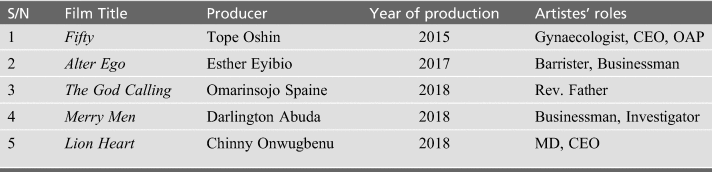
The data for this study were sourced from five English-based Nollywood films: Fifty by Tope Oshin, Merry Men by Darlington Abuda, The God Calling by Omarinsojo Spaine, Alter Ego by Esther Eyibio and Lion Heart by Chinny Onwugbenu, which were produced between 2015 and 2018 (see Table 1). The movies were purposively selected on the basis of their currency and settings (set in urban Lagos and Enugu, Nigeria). Ten educated Nollywood artistes (five males and five females) were chosen from the films based on their elitist roles within the context of the selected films (see Table 1), where they are expected to use a Standard English accent. The authors listened carefully to their utterances and transcribed how they articulated phonemes that are considered problematic in NigE. Such phonemes include short vowels /ɪ/ and /ʊ/, long vowels /ɔ:/ and /ɑ:/, central vowels /ʌ/, /з:/ and /ə/, diphthongs /əu/ and /eɪ/ and consonants /θ/, /ð/, /z/ and /h/. The vowels are represented in this paper using Wells’ (Reference Wells1982) standard lexical set keywords, such as kit /ɪ/, strut /ʌ/, nurse /з:/, etc. (see Table 7). The extracted data were analysed through auditory means, frequency counts and percentage distribution. The frequencies of the observed pronunciation variants of each phoneme were then taken and converted to percentages; the variant with the higher or highest percentage score was considered as the norm.
Information about the films

6. Analysis and discussion of findings
In this section, we analyse and discuss the findings of the extracted data. Different realisations of each phoneme produced were identified and their frequency counts were calculated and tabulated. An attempt was then made to establish the main variant of a particular phoneme vis-a-vis the other forms that are in free variation with it, based on the percentage of production. Altogether, 1,843 lexical items with problematic phonemes were extracted from the films, comprising 1,576 vowels and 267 consonants. In 6.1, we focus on problematic lexical sets and pay attention to problematic consonants in 6.2.
6.1 Analysis of problematic lexical sets
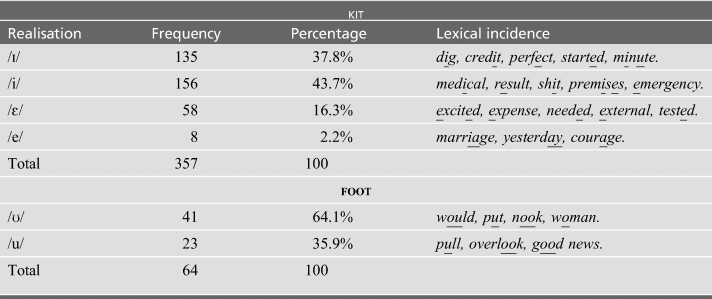
The lexical sets examined in this section include short vowels kit and foot, long vowels thought and start, central vowels strut, nurse and letter/comma, and diphthongs goat and face. Table 2 shows the performance of ENA in the lexical incidence of each vowel.
Analysis of kit and foot

The standard lexical set kit comprises lexical items whose citation form contains the stressed vowel /ɪ/ in RP. As shown in Table 3, the kit corresponds to /ɪ/, /i/, /e/ and /ɛ/ in ENA's accent. Out of 357 lexical incidence of the vowel, there were 135 (37.8%) realisations of /ɪ/, 156 (43.7%) cases of /i/, 58 (16.3%) occurrences of /ɛ/ and 8 (2.2%) instances of the monophthongised /e/. These results indicate that the vowel is identical in both accents in only 37.8% of the items extracted, while a higher number of speakers (43.7%) prefer the /i/ variant.
Analysis of thought and start

This confirms the earlier claim that NigE speakers have difficulty in producing the RP kit and tend to substitute some of its lexical incidence with other phonemes or merge it with the fleece (Simo Bobda, Reference Simo Bobda2007; Adetugbo, Reference Adetugbo, Dadzi and Awonusi2009; Awonusi, Reference Awonusi, Dadzie and Awonusi2009). This is also in tandem with Cruz-Ferreira's (Reference Cruz–Ferreira1987) observation that L2 speakers may use close substitutes of their native sounds to replace sounds in the target language that are absent in the phonemic inventory of their native language. The finding also establishes the proclivity for spelling-pronunciation amongst NigE speakers, as kit in most words with grapheme <e>, such as excited, expense, needed, decided, and tested was realised as /ɛ/ in egg and ten. The same goes for most words with the grapheme <a> which were produced with the monophthongised /e/ as in say and lay (e.g. marriage and message).
The standard lexical set foot comprises lexical items whose citation form contains the stressed vowel /ʊ/ in RP. As Table 2 shows, it was realised by ENA as /ʊ/ in 41 (64.1%) cases and as /u/ in 23 (35.9%) instances out of the 64 lexical incidence extracted. This suggests that, in a good number of cases, ENA's production of foot corresponded to RP /ʊ/, while the substitution of /ʊ/ with /u/ which is a common feature of NigE (Jowitt, Reference Jowitt2019) was minimal.
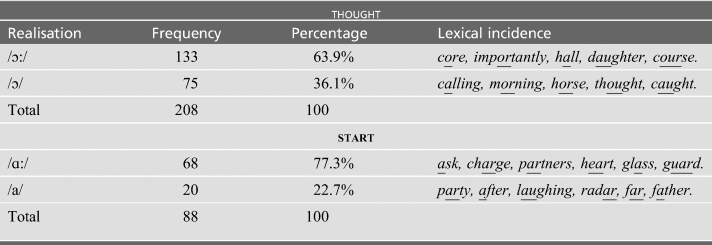
The standard lexical sets thought and start comprise lexical items whose citation forms contain the stressed vowel /ɔ:/ and /ɑ:/ respectively in RP. Table 3 shows that, out of the 208 thought-vowel words produced by ENA, 133 (63.9%) were realised as /ɔ:/ while 75 (36.1%) were pronounced as /ɔ/. Similarly, start was realised as /ɑ:/ in 68 (77.2%) instances and as /a/ in 20 (22.7%) cases, out of the 88 lexical incidence of start uttered by ENA. The results suggest that ENA's realisations of thought and start correspond considerably to the RP forms. Notwithstanding, the standard RP forms and variants /ɔ/ and /a/ respectively are both in contention, although the RP variant is dominant.
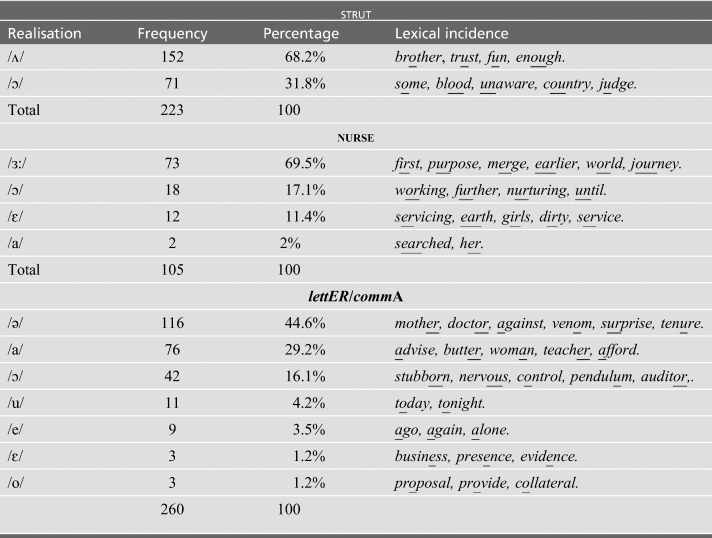
In Table 4 is the analysis of the central vowels: strut, nurse and lettER/commA, which comprise lexical items whose citation forms contain vowels /ʌ/, /з:/ and /ə/, respectively, in RP. The participants realised strut as /ʌ/ in 152 (68.2%) cases and as /ɔ/ in 71 (31.8%) instances out of a total of 223 strut-vowel words produced. nurse corresponds to /з:/, /ɔ/, /ɛ/ and /a/ in ENA's accent. Out of the 105 words extracted, 73 (69.5%) were realised as the RP /з:/, 18 (17.1%) as /ɔ/, 12 (11.4%) as /ɛ/ and two (1.9%) as /a/.
Analysis of the central vowels: strut, nurse and lettER/commA

The lettER and commA sets comprise words with a weak vowel /ə/ which occur word-finally in RP. While lettER words contain final < r > or < re >, commA words end in grapheme <a>. In this paper, they are extended to all contexts of the weak vowel /ə/ in order to verify ENA's level of competence in the pronunciation of /ə/, which is believed to be a rare vowel in NigE. The 260 lettER/commA words extracted from the films were produced with 116 (44.7%) tokens of /ə/, 76 (29.2%) cases of /a/, 42 (16.1%) instances of /ɔ/, 11 (4.2%) occurrences of /u/, nine (3.5%) incidence of /e/, three (1.2%) instances of /ɛ/ and three (1.2%) items of /o/.
The results indicate that, in most cases of the lexical incidence of strut and nurse, ENA's realisations of the vowels were identical with the RP forms. This suggests that, unlike the typical NigE accent, /ʌ/ is largely differentiated (although still in free variation with /ɔ/), and /з:/ is also substantially distinguished from variants /ɔ/, /ɛ/ and /a/. Similarly, ENA's performance demonstrate an improvement in the realisation of the schwa /ə/ (although it is commonly in free variation with other sounds), which generally has a low occurrence rate in NigE (Adetugbo, Reference Adetugbo, Dadzi and Awonusi2009). Again, the tendency to replace a difficult sound with an easier one by NigE speakers, especially as suggested by spelling, is brought to the fore as lettER/commA corresponds to seven different vowels.
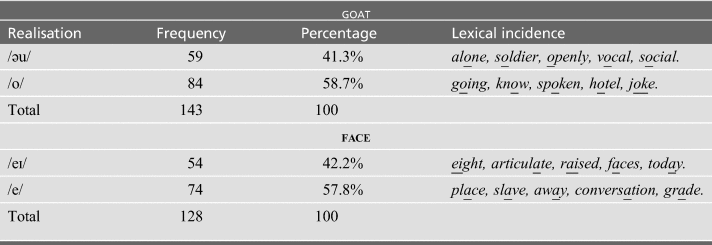
The standard lexical sets goat and face comprise lexical items whose citation forms in RP have the stressed vowel /əu/ and /eɪ/ respectively. According to Table 5, goat corresponds to two vowel variants in ENA's accent: /əu/ and /o/. Out of 143 goat-vowel words, 59 (41.2%) were pronounced with /əu/ while 84 (58.7%) were monophthongised as /o/. The face vowel was realised as /eɪ/ in 54 (42.2%) instances and monophthongised as /e/ in 74 (57.8%) cases out of 128 words. The findings show that, in both lexical sets, the monophtongised variants /o/ and /e/ were significantly articulated by ENA. This affirms the previous claim that the RP diphthongs /əu/ and /eɪ/ are commonly produced as monophthongs in NigE (Adetugbo, Reference Adetugbo, Dadzi and Awonusi2009; Dyrenko & Fuchs, Reference Dyrenko and Fuchs2018; Jowitt, Reference Jowitt2019). It is interesting to note that both variants, /o/ and /e/, are also attested in the acrolectal usage of Urgoji (2010) and that Jowitt (Reference Jowitt2019) advocates their inclusion in endonormative standard NigE pronunciation, in view of their proclivity amongst NigE speakers.
Analysis of diphthongs goat and face

6.2 Analysis of problematic consonants
In this section, we examine four problematic consonants uttered by ENA. Some of them are absent in most indigenous Nigerian languages (e.g., /θ/, /ð/, /z/), while NigE speakers are sometimes unable to distinguish others due to inconsistency in English spellings (e.g., /z/ in rise or comes) or some language-specific challenges (e.g., /h/ deletion in Yoruba English).
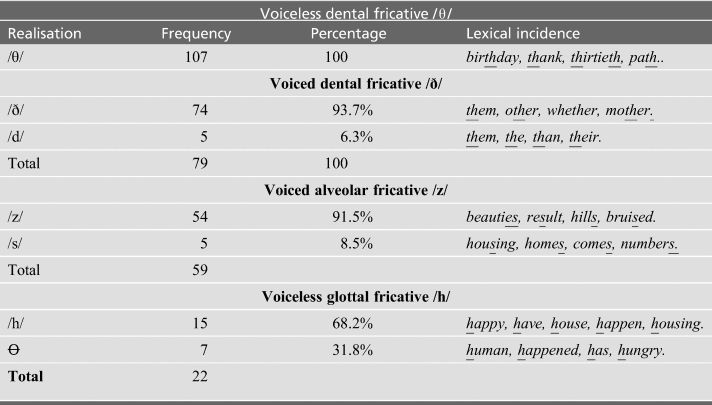
Table 6 shows that the pronunciation of the lexical incidence of voiceless dental fricative /θ/ is identical with the RP form, as all the 107 tokens were pronounced with /θ/. The voiced dental fricative also corresponds to /ð/ in 74 (93.7%) instances and to /d/ in only five (6.3%) items. Similarly, 54 (91.2) tokens of the voiced alveolar fricative /z/ were realised while only five (8.4%) cases were produced as /s/. The glottal fricative /h/ shows two pronunciation variants: /h/-full with 15 (68.2%) tokens and /h/-less (Ꝋ) with seven (31.8%) occurrences.
Analysis of consonant sounds

The results show that the realisations of these phonemes, in most cases, were identical with the RP norms. In fact, other variants of the phonemes were rarely articulated. This implies that ENA showed a profound mastery of the pronunciation of the consonants that are considered problematic for most Nigerian speakers of English. This, again, indicates a considerable departure from the typical NigE pronunciation tendencies. For instance, quite a number of speakers were able to articulate the [z] allomorph in such words as beauties, ladies and ways, and could pronounce /z/ in bruised, reason, result and hills where the spelling does not suggest the sound. Similarly, the tendency in NigE to substitute /θ/ and /ð/ with /t/ and /d/ respectively is not prevalent in the data and, at the same time, the voiceless glottal /h/ was articulated in many instances, unlike in NigE where it may be dropped or inserted by speakers (Awonusi, Reference Awonusi, Dadzie and Awonusi2009).
7. Conclusion
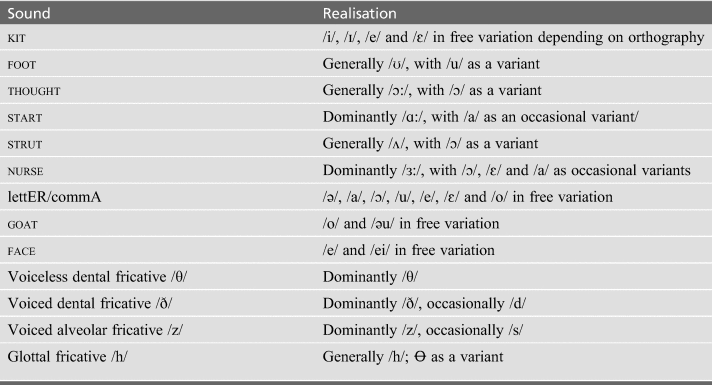
This study investigates the suitability of ENA's accent as a normative Standard of English pronunciation, in support of the proposition for an ancillary pronunciation model for Nigerian learners of English in the absence of native models. The findings show that ENA's pronunciation of ten problematic phonemes (the FOOT, THOUGHT, START, STRUT, NURSE and lettER/commA vowels, and consonants /θ/, /ð/, /z/ and /h/), out of 13 investigated, largely correspond to RP. As shown in Table 7, phonemes /ʊ/, /ɔ:/, /ɑ:/, /ʌ/, /з:/, /θ/, /ð/, /z/ and /h/ are either dominantly or generally articulated by ENA, while /u/, /ɔ/, /a/, /ɔ/, /ɛ/, /t/, /d/, /s/ and Ꝋ, respectively, occur as occasional or common free variants. Remarkably, the schwa /ə/, which is said to be very rare in NigE, is preferred by ENA, though commonly in free variation with /a/, /ɔ/, /u/, /e/, /ɛ/ and /o/, depending on the spelling. This suggests that many problematic phonemes examined in this study are substantially differentiated and in close approximation to RP, unlike in the typical NigE variety where they are commonly merged or substituted.
Patterns of realisation of problematic vowels and consonants by ENA

However, cases of non-RP pronunciations are dominant in kit, goat and face: /i/ is generally adopted in kit (with /ɪ/, /e/ and /ɛ/ as variants), /o/ is common in goat (with /əu/ in free variation) while /e/ is often heard in face (with /ei/ as a free variant). Incidentally, two of these non-RP vowels, the monophtongised /o/ and /e/, also feature in Ugorji's (Reference Ugorji2010) acrolectal variety of spoken NigE. In fact, Jowitt (Reference Jowitt, Opeibi, Schmied, Omoniyi and Adedeji2015) has argued for their official adoption as candidates for endonormative Standard of pronunciation in Nigeria because of their frequency of occurrence across all lectal levels.
Therefore, considered from the lectal framework: basilect, mesolect and acrolect (Awonusi, Reference Awonusi1987; Ugorji, Reference Ugorji2010), ENA fits into a group of acrolectal, sophisticated or advanced speakers of English as a second language who are regularly in close contact with RP due to their constant exposure and professional training. Awonusi (Reference Awonusi, Oladipupo, Akindele and Osisanwo2020) hints at the possibility of designating the accent of such acrolectal speaker groups as Near RP, the same variety that Jowitt (Reference Jowitt, Opeibi, Schmied, Omoniyi and Adedeji2015) refers to as Nigerian RP. Speakers in this category, obviously, have what is required to serve as models of Standard Nigerian English pronunciation. It is in light of this that ENA's accent is recommended as a normative Standard of English pronunciation in Nigeria. However, as this study is restricted to problematic phonemes only, it is important to investigate ENA's realisation of all the English phonemes and other accent features before validly accepting this position.
 ROTIMI OLADIPUPO teaches English at Redeemer's University, Ede, Nigeria. His research interests include (socio)phonetics/phonology, corpus linguistics, and language contact. He has published articles in English Today, Sage Open, Journal of Pragmatics, World Englishes and Cogent Arts & Humanities. Email: olarotimi2002@yahoo.com
 ELIZABETH AKINFENWA is a graduate of English from Redeemer's University, Ede, Nigeria. She is currently the Head of Arts Department at David Great Prevarsity, Abeokuta, Ogun State, Nigeria. Email: akinfenwaelizabetho@gmail.com