

Despite partners in on-again/off-again relationships reporting lower relational quality (Dailey, Hampel, & Roberts, Reference Dailey, Hampel and Roberts2010; Dailey, Pfiester, Jin, Beck, & Clark, Reference Dailey, Pfiester, Jin, Beck and Clark2009; Halpern-Meekin, Manning, Giordano, & Longmore, Reference Halpern-Meekin, Manning, Giordano and Longmore2013a, Reference Halpern-Meekin, Manning, Giordano and Longmore2013b; Vennum, Lindstrom, Monk, & Adams, Reference Vennum, Lindstrom, Monk and Adams2014), these relationships are renewed and maintained. Although research has focused on distinguishing on-again/off-again (i.e., cyclical) relationships from relationships that do not break up and renew (i.e., non-cyclical; Dailey et al., Reference Dailey, Hampel and Roberts2010; Dailey, Pfiester et al., Reference Dailey, Pfiester, Jin, Beck and Clark2009; Halpern-Meekin et al., Reference Halpern-Meekin, Manning, Giordano and Longmore2013a, Reference Halpern-Meekin, Manning, Giordano and Longmore2013b), types or trajectories of cyclical relationships (Dailey, Brody, LeFebvre, & Crook, Reference Dailey, Brody, LeFebvre and Crook2013; Dailey, McCracken, Jin, Rossetto, & Green Reference Dailey, McCracken, Jin, Rossetto and Green2013), and consequences of cycling for early marriage (Vennum & Johnson, Reference Vennum and Johnson2014), few studies have uncovered factors that explain why partners maintain these relationships. Further, although positive qualities have been assessed, research has predominantly revealed the negative qualities of cyclical relationships (e.g., Dailey et al., Reference Dailey, Hampel and Roberts2010; Halpern-Meekin et al., Reference Halpern-Meekin, Manning, Giordano and Longmore2013b; Vennum & Johnson, Reference Vennum and Johnson2014). Yet, as argued by Halpern-Meekin et al. (Reference Halpern-Meekin, Manning, Giordano and Longmore2013a), renewals might be instigated by positive qualities of these relationships. Taking Johnson's (Reference Johnson and Duck1982) conceptualisation of commitment as being comprised of forces that pull partners together (e.g., attachment, satisfaction) and forces that constrain partners from leaving (e.g., structural constraints, barriers), this study explores more positive dimensions of relationships, or those that draw partners together, to better understand why cyclical partners maintain their relationships. We focus on partners who are currently dating and explore how qualities while dating might vary for cyclical and non-cyclical partners. We also focus on young adult relationships, given that they likely experience fewer constraints, which allows us to highlight and isolate the potential positive qualities. Identifying experiences that are particularly attractive to cyclical partners while dating might guide future research in explaining their maintenance and renewals.
On-Again/Off-Again Relationships
On-again/off-again (or cyclical) relationships are prevalent; about two-thirds of young adults experience at least one cyclical relationship, each averaging about two and a half renewals (Dailey et al., Reference Dailey, Hampel and Roberts2010; Dailey, Pfiester et al., Reference Dailey, Pfiester, Jin, Beck and Clark2009). Further, 30–45% of individuals’ current or most recent relationship is cyclical in nature (Halpern-Meekin et al., Reference Halpern-Meekin, Manning, Giordano and Longmore2013a; Vennum, Reference Vennum2011; Vennum et al., Reference Vennum, Lindstrom, Monk and Adams2014). Previous research shows that cyclical partners, as compared to non-cyclical partners, are at a greater risk for relationship distress, such as greater relational uncertainty, less effective conflict, and verbal and physical aggression (Dailey et al., Reference Dailey, Hampel and Roberts2010; Dailey, Pfiester et al., Reference Dailey, Pfiester, Jin, Beck and Clark2009; Halpern-Meekin et al., Reference Halpern-Meekin, Manning, Giordano and Longmore2013b; Vennum et al., Reference Vennum, Lindstrom, Monk and Adams2014). Thus, cyclical partners consistently report less relational satisfaction and commitment overall (Dailey et al., Reference Dailey, Hampel and Roberts2010; Vennum et al., Reference Vennum, Lindstrom, Monk and Adams2014). Further, because cyclical partners are also less likely to make conscious decisions about their transitions (i.e., ‘sliding’; Stanley, Rhoades, & Markman, Reference Stanley, Rhoades and Markman2006) and are more likely to report structural constraints that might prevent dissolution (Vennum, Reference Vennum2011), the lower level of satisfaction is carried forward into marriage (Vennum & Johnson, Reference Vennum and Johnson2014).
Given that cyclical relationships are prevalent and the cycling has implications for current and long-term functioning (Vennum & Johnson, Reference Vennum and Johnson2014), understanding why partners maintain and renew these less satisfying relationships is important. In addition to the research above, other studies have explored renewals to understand the perpetuation of cyclical relationships. A study focusing on reasons for renewals (Dailey, Jin, Pfiester, & Beck, Reference Dailey, Jin, Pfiester and Beck2011) revealed that lingering feelings was perhaps the strongest predictor, but uncertainty about what breakups indicated, not dating others after breakups, and feeling the cyclical nature improved the relationship were all associated with an increased chance of renewals. Conversely, mutual initiation of breakups and uncertainty about the general nature of the relationship were associated with a decreased chance of renewals. In a qualitative analysis, reasons for renewal included dissatisfaction with alternatives, continued attachment, post-dissolution contact, and breakups sometimes improving the relationship (Dailey, Rossetto, Pfiester, & Surra, Reference Dailey, Rossetto, Pfiester and Surra2009).
Collectively, these findings, perhaps apart from lingering feelings and continued attachment, reveal few positive aspects that might facilitate the maintenance of cyclical relationships. Hence, this study explores positive dimensions of relationships — namely, love, sex, and need satisfaction. Because previous research has provided more insights on the negative qualities or the post-dissolution phase, we compare both cyclical and non-cyclical partners who are currently dating to best understand how positive qualities might contribute to the continuation of cyclical relationships.
Components of Love
Love is a difficult concept to define, in part, because using words to define love often fails to fully elucidate the feelings we experience. Further, the different components that comprise overall evaluations of love are intertwined (Fehr, Reference Fehr, Simpson and Campbell2013). Various perspectives on love exist, including biological and evolutionary (e.g., Fisher, Reference Fisher, Sternberg and Weis2006), attachment (e.g., Hazan & Shaver, Reference Hazan and Shaver1987), physiological or passionate (Berscheid & Walster, Reference Berscheid, Walster and Huston1974; Hatfield & Sprecher, Reference Hatfield and Sprecher1986), companionate (Grote & Frieze, Reference Grote and Frieze1994), and compassionate (Sprecher & Fehr, Reference Sprecher and Fehr2005). For the purposes of this study, we will employ Sternberg's (Reference Sternberg1986, Reference Sternberg1997; Sternberg & Barnes, Reference Sternberg and Barnes1988; Sternberg & Weis, Reference Sternberg and Weis2006) triangular theory to more succinctly assess these different conceptualisations of love.
Sternberg's (Reference Sternberg1986) triangular theory of love posits that love is comprised of three components: intimacy, passion, and decision/commitment. Intimacy is the emotional connection built in the relationship, reflected by warmth, trust, mutual understanding, and provision of emotional support (Sternberg, Reference Sternberg1997). Passion can be viewed as the motivational involvement in the relationships and can be generated by any form of psychophysiological arousal (Sternberg, Reference Sternberg1986, Reference Sternberg1988). It is characterised by an array of experiences and emotions such as sexual arousal, elation, pain, anxiety, and jealousy. Decision/Commitment consists of both the short-term decision to love someone and the long-term commitment to maintain the relationship (Sternberg, Reference Sternberg1986). Although nine types of love are possible based on varying levels of each component, the three dimensions are of interest in the current study. Specifically, we are interested in whether cyclical and non-cyclical partners report different levels of these three dimensions.
In the first study regarding cyclical relationships, Dailey, Pfiester et al. (Reference Dailey, Pfiester, Jin, Beck and Clark2009) assessed Sternberg's (Reference Sternberg1997) three dimensions of love. As the number of renewals increased (non-cyclical relationships were operationalised as those with zero renewals), passion and commitment decreased, but number of renewals was not associated with intimacy. This suggests cyclical partners might have no different levels of intimacy but less commitment and passion as compared to non-cyclical partners, especially if they had experienced more cycling. That study, however, did not directly compare cyclical and non-cyclical partners. If lingering feelings are one reason for renewal, passion or other types of love might be a reason to continue in the relationship. Thus, our first research question is:
-
RQ1: Do non-cyclical and cyclical partners differ in levels of intimacy, passion, and commitment?
Global satisfaction and stability are prevalent outcome measures in research on romantic relationships. Research has already established that relational concepts such as love are positively associated with global satisfaction (e.g., Hendrick & Hendrick, Reference Hendrick, Hendrick, Sternberg and Hojjat1997; Sternberg, Reference Sternberg1997) and stability (e.g., Cate, Levin, & Richmond, Reference Cate, Levin and Richmond2002; Le, Dove, Agnew, Korn, & Mutso, Reference Le, Dove, Agnew, Korn and Mutso2010). Thus, taking this a step further, assessing how these associations are possibly moderated by relationship type (i.e., non-cyclical vs. cyclical) should provide additional insights into why cyclical partners might continue these relationships. For example, commitment could be associated with satisfaction for non-cyclical but not cyclical partners; or conversely, passion might be associated with stability for cyclical but not non-cyclical partners. Because of our focus on relationships that have cycled through one or more breakups and renewal, stability cannot be measured in the tradition manner (for a discussion of this, see Karney, Bradbury, & Johnson, Reference Karney, Bradbury, Johnson, Adams and Jones1999). Stability is typically operationalised as whether relationships remain intact over a period of time (e.g., 6 months, a year). Thus, we focus on perceived stability, which encompasses partners’ beliefs about the long-term viability of the relationship (Dailey, Middleton, & Green, Reference Dailey, Middleton and Green2012). This provides a subjective (rather than objective) assessment of individuals’ evaluations of the relationship. Hence, extending on the findings of Dailey et al. (Reference Dailey, Pfiester, Jin, Beck and Clark2009) regarding the love components, we add the following research question:
-
RQ2: Are the associations between components of love and a) global satisfaction and b) perceived stability moderated by relationship type?
Relationship Need Satisfaction
Theories such as interdependence (Thibaut & Kelley, Reference Thibaut and Kelley1959) focus on rewards (vs. costs) in relationships, but rewards are self-defined and vary for each individual. Thus, there might be certain types of rewards or positive features of relationships that cyclical partners emphasise or require as compared to non-cyclical partners. Drigotas and Rusbult (Reference Drigotas and Rusbult1992) delineated five needs that relationships are expected to satisfy. Intimacy is defined as the disclosure or sharing of personal information such as thoughts, feelings, or secrets. Sexual intimacy includes physical intimacy from holding hands to sexual intercourse. Emotional involvement entails interdependence and feeling connected to the other. Companionship involves spending time together and enjoying each other's company. Finally, intellectual involvement entails the sharing of ideas and information or discussing attitudes and values. Partners whose needs were better satisfied in their current relationships as compared to anticipated need satisfaction in alternative relationships were more likely to stay in their relationships (Drigotas & Rusbult, Reference Drigotas and Rusbult1992).
Drigotas and Rusbult (Reference Drigotas and Rusbult1992) differentiated between need importance (i.e., how much a person values or desires the relational dimension) and need satisfaction (i.e., the degree to which the need is met by their partner's behaviour). Although no study of need satisfaction has been conducted with cyclical relationships, assessing how the two relationship types might differ in the importance of these various needs as well as the extent to which both types of partners are satisfied would expand our understanding of what facilitates cyclical relationships. For example, we might find that cyclical partners value companionship more than non-cyclical partners or that cyclical partners feel their needs of sexual intimacy are satisfied more than non-cyclical partners. Thus, we add the following research questions:
-
RQ3: Do non-cyclical and cyclical partners differ in levels of need importance (i.e., intimacy, sexual intimacy, emotional involvement, companionship, and intellectual involvement)?
-
RQ4: Do non-cyclical and cyclical partners differ in levels of need satisfaction (i.e., intimacy, sexual intimacy, emotional involvement, companionship, and intellectual involvement)?
We again explore how the associations between relational needs and global satisfaction as well as perceived stability might vary by relationship type. Because differences in need importance (or how much they value each dimension) might not explain satisfaction or stability, we focus only on the extent to which the specific needs are satisfied.
-
RQ5: Are the associations between need satisfaction and (a) global satisfaction and (b) perceived stability moderated by relationship type?
Sexual Satisfaction
Although sexual behaviour is an important component in romantic relationships and is related to overall relationship satisfaction (Holmberg, Blair, & Phillips, Reference Holmberg, Blair and Phillips2010; Sprecher, Reference Sprecher2002), the role of sex and sexual satisfaction in cyclical relationships has not yet been extensively explored. The satisfaction of sexual needs is incorporated in the above research questions; however, the relational need regarding sex involves all forms of physical intimacy and applies to all romantic partners even if they are not sexually active. Hence, we also focus specifically on the sexual nature of the relationship for those who are sexually active. Currently, there are no data on the overall prevalence or quality of sex in cyclical relationships as compared to non-cyclical relationships. Halpern-Meekin et al. (Reference Halpern-Meekin, Manning, Giordano and Longmore2013a), however, found that half (53%) of cyclical partners also had sex while in a post-dissolution phase as compared to only 6% of those who had never renewed previously. As such, many cyclical partners might be continuing the sexual nature of their relationship in the ‘off’ stages. Further, sexual activity or satisfaction might be a strong reason for cyclical partners to renew their relationships, even among those who do not have sex after breakups. The only other study to address sexual activity in cyclical relationships was Dailey et al. (Reference Dailey, Brody, LeFebvre and Crook2013), who found no differences in sexual satisfaction across various trajectories of cyclical relationships (i.e., those who had steady increases in commitment, fluctuated in commitment, or had stably low commitment across the course of the relationship). Thus, direct comparisons between cyclical and non-cyclical partners are needed. In addition, we again explore how the associations between sexual satisfaction and global satisfaction and perceived stability might differ for the two relationship types. As such, we add these research questions:
-
RQ6: Do non-cyclical and cyclical partners differ in levels of sexual satisfaction?
-
RQ7: Are the associations between sexual satisfaction and (a) global satisfaction and (b) perceived stability moderated by relationship type?
Current Study
The current study contributes to the extant literature regarding cyclical relationships in several ways. First, this study specifically focuses on positive qualities that might make these relationships attractive to cyclical partners. Second, we assess how these relationship features are related to more general qualities of global satisfaction and perceived stability. Third, the importance and satisfaction of the sexual nature of romantic relationships, and under-explored but potentially salient features of cyclical relationships, are examined. Collectively, exploring these facets of relationship should help explicate why cyclical partners continue these less satisfying relationships.
Method
Participants
The 558 participants who were currently in a romantic relationship were recruited from a participant pool in a communication department at a large, southwestern university in the United States. Data were collected during two separate semesters (n 1 = 280, n 2 = 278), but the two samples were largely the same and were combined for the analyses.Footnote 1 The vast majority of the sample was female (n = 479, 85.8%), and participants’ ages ranged from 18 to 25 (M = 20.49, SD = 1.21). Another nine participants who did not report age or were 26 or older were excluded from the sample. Ethnicities of the sample included: 299 (53.6%) Caucasian, 116 (20.8%) Latino or Hispanic, 63 (11.3%) Asian or Pacific Islander, 26 (4.7%) Black or African American, and 54 (9.7%) other or multiple ethnicities. Most participants reported having a heterosexual relationship (95.7%).
About half the sample reported they were in a serious dating relationship (n = 3.03, 54.3%), another 42.8% (n = 239) reported they were in a long-term, committed relationship, 10 were engaged, and six reported they were in a domestic partnership (three married individuals were excluded from the analyses and are not counted in the sample size of 558). Length of the relationship ranged from less than 1 week to 96 months (M = 18.80 months, SD = 18.50, median = 13). A little more than a quarter of the participants reported their current relationship was a cyclical relationship (n = 155, 27.8%) with an average of 2.48 renewals (SD = 2.26, range was 1 to 20 times, excluding an outlier of 79 times). Three-quarters of the sample reported being sexually active (n = 428, 76.7%).
Procedures
The Qualtrics online survey was accessed through a system that electronically manages research participation and extra credit for the participant pool. Interested participants clicked on the link provided, and the survey's first page included consent information. Because it was an online survey, participants were informed that their participation in the study indicated their consent. Students’ participation was anonymous; extra credit was provided automatically without eliciting identifying information. The survey took approximately 15 minutes to complete.
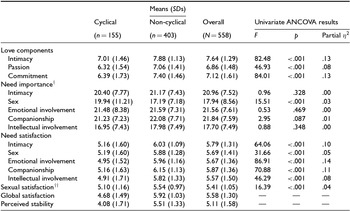
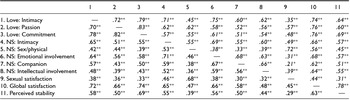
Means were computed to create overall scores with higher scores indicating higher levels of each construct. Means and standard deviations of the variables are provided in Table 1 by relationship type. Correlations among the variables by relationship type are presented in Table 2.
Means and Standard Deviations of the Variables by Relationship Type (RQs 1, 3, 4, and 6)

Note: †Means are based on the 525 participants; 33 individuals’ scores across the five needs did not total 100. ††Means for sexual satisfaction include only the 428 who were sexually active (cyclical = 121, non-cyclical = 307).
Correlations Among the Variables by Relationship Type

Note: Correlations above the diagonal in italics are for cyclical partners (n = 155); correlations below the diagonal are for non-cyclical partners (n = 403). NS = need satisfaction.
*p < .05, **p < .001.
Measures
Love components
Sternberg's (Reference Sternberg1997) scale assessing intimacy, passion, and commitment were employed. Sample items include: ‘I have a warm relationship with _____’ (intimacy), ‘Just seeing _____ excites me’ (passion), and ‘I am committed to maintaining my relationship with _____’ (commitment). The 45 items (15 for each subscale) were assessed on a 9-point Likert-type scale (1 = not at all, 9 = extremely). The reliabilities were all high: Cronbach's alpha was .97, .95, and .97 for intimacy, passion, and commitment, respectively.
Need satisfaction
Based on the procedures of Drigotas and Rusbult (Reference Drigotas and Rusbult1992), we assessed the importance and satisfaction of the five needs: intimacy, sex, emotional involvement, companionship, and intellectual involvement. The participants were first instructed to ‘please judge the importance of each area for you in your romantic relationships by giving it a percentage. The combination of all five percentages should add up to 100%.’ For example, if all five needs were of equal importance, participants would have rated each as 20%. We then asked participants to rate the satisfaction of these needs on a 7-point scale (1 = not at all satisfied, 7 = extremely satisfied). No reliabilities were calculated as the items are analysed separately.
Sexual satisfaction
This measure was presented to those who responded yes to a question asking whether they were sexually active with their partner (n = 428, 76.7%). We employed Waite's (Reference Waite2000) six-item scale on a 7-point Likert scale (1 = strongly disagree, 7 = strongly agree): ‘My partner and I have a fulfilling sexual relationship’, ‘I find the sexual contact that I have with my partner to be satisfying’, ‘My partner always makes sure that I achieve orgasm’, ‘I am content with the sexual aspect of our relationship’, ‘There are parts of our sexual relationship that need improvement’, and ‘I am generally dissatisfied with our sexual relationship’ (the last two were reverse-coded). A seventh item was added to address satisfaction with the frequency of sex (i.e., ‘How satisfied are you with the frequency of sex in your relationship?’) and was assessed on a 7-point scale (1 = not at all satisfied with how often we have sex, 7 = very satisfied with how often we have sex). The seven items had high reliability: alpha = .83.
Global satisfaction
The five items in Rusbult, Martz, and Agnew's (Reference Rusbult, Martz and Agnew1998) global satisfaction scale (e.g., ‘I feel satisfied with our relationship’) were assessed using a 7-point Likert scale (1 = strongly disagree, 7 = strongly agree) and showed high reliability (alpha = .94).
Perceived stability
Perceptions that the relationship would continue were assessed through Dailey et al.’s (Reference Dailey, Middleton and Green2012) three items on a 7-point Likert scale (1 = strongly disagree, 7 = strongly agree): ‘We've reached a point in our relationship where I'm confident we'll stay together’, ‘I feel like we're at a stable point in our relationship’, and ‘I'm not worried about us breaking up’. Reliability was also high for this measure (alpha = .90).
Results
Differences by Relationship Type
Analyses of RQs 1, 3, 4, and 6, comparing cyclical and non-cyclical relationships, entailed univariate or multivariate analyses of covariance (ANCOVAs) and are reported first. The main independent variable was relationship type. Potential control variables were sex, age, and relationship length. Based on bivariate correlations, age was not associated with any of the variables in the analyses. Females reported more intimacy, commitment, and sexual satisfaction as well as fewer sexual/physical intimacy needs (ts ranged from +/−1.98 to 3.05, ps < .05). Relationship length was positively associated with the three components of love (rs ranged from .08 to .13, ps < .05). As such, sex and relationship length were included in all the analyses for consistency. The univariate results for each are reported in Table 1 along with the means and standard deviations for each relationship type.
RQ1 pertained to potential differences by relationship type in Sternberg's components of love: intimacy, passion, and commitment. The multivariate ANCOVA showed that, after controlling for sex and relationship length, cyclical partners reported less love than did non-cyclical partners, Wilks lambda = .85, F(3, 551) = 32.10, p < .001, partial η2 = .15. The univariate results revealed cyclical partners reported lower levels of all three components (see Table 1).
RQ3 asked whether cyclical and non-cyclical partners report differences in need importance. In assessing the data, 33 participants either did not respond to these items or misunderstood the instructions (i.e., totals did not equal 100) and were thus excluded from the analyses. The multivariate ANCOVA showed that, after controlling for sex and relationship length, cyclical and non-cyclical partners differed in the importance of relational needs overall, Wilks lambda = .97, F(4, 518) = 4.23, p = .002, partial η2 = .03. The univariate results, however, showed that cyclical partners only placed more importance on sex; the other four needs did not significantly differ by relationship type.
Following the third research question, RQ4 pertained to differences in the extent to which the five needs were satisfied. This multivariate ANCOVA showed that, controlling for sex and relationship length, cyclical and non-cyclical partners differed in how much their needs were satisfied, Wilks lambda = .85, F(5, 547) = 19.73, p < .001, partial η2 = .15. In the univariate analyses, all needs satisfaction were significant; Table 1 shows that cyclical partners reported lower need satisfaction across all needs, often by around a full point (on a 7-point scale).
RQ6 more fully explored sexual satisfaction and included only those who reported being sexually active (n = 428). The ANCOVA showed cyclical partners reported less sexual satisfaction than non-cyclical partners. See Table 1 for the means of the two groups.
Moderating Role of Relationship Type in Predicting Satisfaction and Stability
We used hierarchical linear regressions to analyse RQs 2, 5, and 7, which assessed whether the associations between the relational characteristics and satisfaction and stability were moderated by relationship type. Two hierarchical linear regressions were conducted for each RQ — one for each dependent variable. The control variables of sex and relationship length were included in the first step. Relationship type (non-cyclical = 0, cyclical = 1) and the independent variables (centred) were included in the second step, and the interaction terms between relationship type and the independent variables were included in a third step.
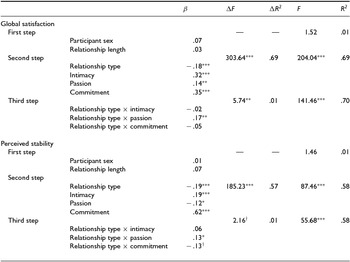
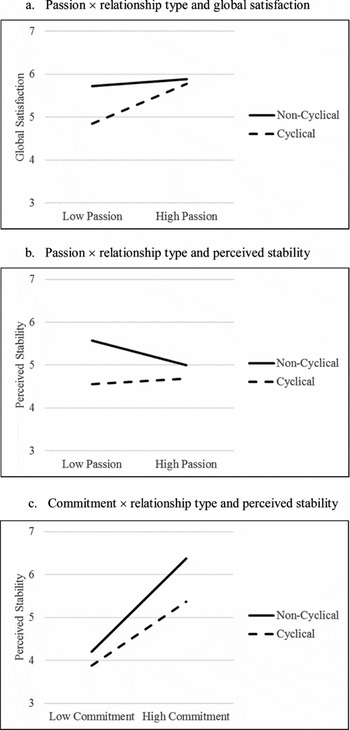
RQ2 was posed to explore whether relationship type moderated the association between the three components of love and global satisfaction as well as perceived stability. The results of these regressions are reported in Table 3. For global satisfaction, relationship type was significant; cyclical partners reported less overall satisfaction than did non-cyclical partners. All three components of love were also positively associated with global satisfaction. The addition of the interaction terms was also significant, but only the association between passion and satisfaction was moderated by relationship type. Decomposing this interaction (see Figure 1a) shows that passion was not associated with satisfaction for non-cyclical partners, b = .06, t = 1.25, p = .211, but was positively associated with satisfaction for cyclical partners, b = .31, t = 4.41, p < .001.
Hierarchical Regression Results for RQ2: Love Components

Note: † p < .10, *p < .05, ** p < .01, ***p < .001. Participant sex: females = 0, males = 1. Relationship type: non-cyclical = 0, cyclical = 1.
Love components × relationship type in predicting global satisfaction and perceived stability.

For perceived stability, relationship type was significant as were the three components of love. Interestingly, passion showed a negative association with stability when accounting for the other components of love. The third step with the interactions approached significance; the relationship type × passion interaction was significant, and the relationship type × commitment interaction approached significance (see Figures 1b and 1c). The interaction for passion shows that passion and stability were negatively associated for non-cyclical partners, b = −.19, t = −3.07, p = .002, but were not associated for cyclical partners, b = .04, t = 0.41, p = .682. The interaction for commitment shows that commitment was positively associated with stability for both non-cyclical, b = .68, t = 9.60, p < .001, and cyclical partners, b = .46, t = 4.64, p < .001, but it was stronger for non-cyclical partners.
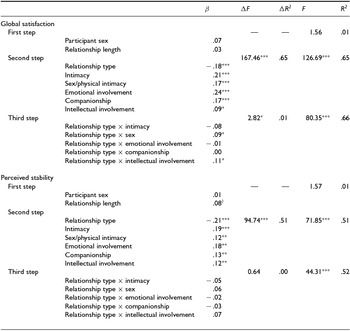
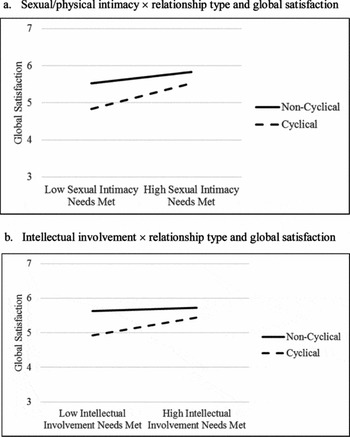
RQ5 explored whether relationship type moderated the association between need satisfaction and global satisfaction and perceived stability (see Table 4 for the results of these regressions). For satisfaction, relationship type was again significant, and as would be expected, the satisfaction of all five needs were positively associated with global satisfaction. The third step with the interaction terms was significant; two of the five interactions (relationship type × sex/physical intimacy, relationship type × intellectual involvement) were significant. Decomposing these interactions (see Figures 2a and 2b) shows that the meeting of sexual/physical needs was positively associated with global satisfaction for both non-cyclical, b = .11, t = 3.38, p < .001, and cyclical partners, b = .25, t = 5.48, p < .001, but it was stronger for cyclical partners. Intellectual involvement was positively associated with satisfaction for cyclical partners, b = .17, t = 3.18, p = .002, but the association was not significant for non-cyclical partners, b = .03, t = 0.92, p = .396. For perceived stability, relationship type was significant as were all of the satisfaction of needs. Relationship type, however, did not moderate any of these associations.
Hierarchical Regression Results for RQ5: Need Satisfaction

Note: † p < .10, *p < .05, ** p < .01, ***p < .001. Participant sex: females = 0, males = 1. Relationship type: non-cyclical = 0, cyclical = 1.
Needs satisfaction × relationship type in predicting global satisfaction.

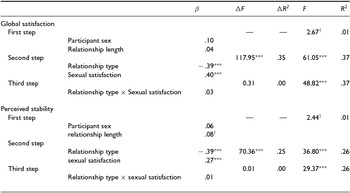
RQ7 assessed whether relationship type moderated the association between sexual satisfaction and global satisfaction and perceived stability (see Table 5). For both satisfaction and perceived stability, relationship type was a negative predictor, and sexual satisfaction was a positive predictor; their interaction, however, was not significant.
Hierarchical Regression Results for RQ7: Sexual Satisfaction

Note: † p < .10, *p < .05, ** p < .01, ***p < .001. Participant sex: females = 0, males = 1. Relationship type: non-cyclical = 0, cyclical = 1.
Discussion
The current study attempted to understand what positive relational qualities might compel cyclical partners to maintain their relationships. With a sample of young adults who were currently dating, we explored components of love, sexual satisfaction, and need satisfaction. Overall, the results supported the general trend that cyclical partners have lower relational quality (Dailey, Pfiester et al., Reference Dailey, Pfiester, Jin, Beck and Clark2009; Dailey et al., Reference Dailey, Hampel and Roberts2010; Halpern-Meekin et al., Reference Halpern-Meekin, Manning, Giordano and Longmore2013b, Vennum et al., Reference Vennum, Lindstrom, Monk and Adams2014). A less prominent pattern of findings regarding passion and sexual needs satisfaction, however, revealed a few insights on how cyclical and non-cyclical relationships differ. The findings are discussed within existing literature, and potential explanations for the findings as well as future directions are offered.
General Relational Quality
These findings overall support the consistent trend in the research that cyclical partners report less relational quality than their non-cyclical counterparts. Previous research has shown cyclical partners report less satisfaction, less relational maintenance, more relational uncertainty, and more aggression (Dailey, Pfiester et al., Reference Dailey, Pfiester, Jin, Beck and Clark2009; Dailey et al., Reference Dailey, Hampel and Roberts2010; Halpern-Meekin et al., Reference Halpern-Meekin, Manning, Giordano and Longmore2013b; Vennum et al., Reference Vennum, Lindstrom, Monk and Adams2014). Here, we find that cyclical partners also experience less love, sexual satisfaction, and the satisfaction of various relational needs (e.g., companionship, emotional involvement). These differences between cyclical and non-cyclical partners were also not typically small; the variance explained by relationship type in the multivariate analyses of both the love components and needs satisfaction was 15%. Hence, the question driving this investigation largely remains: Why do cyclical partners continue these relationships if they are significantly less satisfying than non-cyclical relationships?
One explanation explored in the current study was whether cyclical partners valued different dimensions within romantic relationships and that these particular needs were more satisfied. Need importance or satisfaction, however, did not appear to be strong explanations for why young adult cyclical partners continue their relationships. In general, cyclical partners rated the importance of the relational needs similarly as non-cyclical partners. In other words, cyclical partners reported similar intimacy, emotional involvement, companionship, and intellectual involvement needs as those who had not experienced breakups and renewals. The exception, but explaining relatively little variance, was sexual/physical intimacy; cyclical partners felt sexual and physical intimacy was more important than did non-cyclical partners. Yet, cyclical partners reported that even these needs were less satisfied as compared to non-cyclical partners. For some of these needs, cyclical partners reported approximately a point less (based on a 7-point scale) than non-cyclical partners, and the variance explained by relationship type for each need ranged from 5% to 14% (see Table 1).
Another explanation explored pertained to lingering feelings or continued attachment (Dailey et al., Reference Dailey, Jin, Pfiester and Beck2011; Dailey, Rossetto et al., Reference Dailey, Rossetto, Pfiester and Surra2009). To assess this in current relationships, we focused on dimensions of love that might capture the emotional forces drawing partners together, particularly within the passion component. However, here too, we find that cyclical partners reported lower levels of love in all three components: intimacy, passion, and commitment. Hence, young adult cyclical partners do not appear to be experiencing a more passionate or intimate connection that draws them to their partners, at least not while they are currently dating. Further, individuals in cyclical relationships did not have a stronger commitment to maintaining the relationship that might tie them to their partners. In fact, non-cyclical partners reported a stronger, positive association between commitment and perceived stability. Considering these findings, comparing levels of love when partners are currently dating to post-dissolution phases might be more revealing. Perhaps love increases after breakups when partners feel less pressure to make the relationship work or when experiencing less of the negative sides of the relationship (Dailey, Rossetto, et al., Reference Dailey, Rossetto, Pfiester and Surra2009), thereby eliciting a desire for reconciliation. Complicating this potential explanation, however, cyclical partners have also been found to report less relational maintenance in the post-dissolution phase (Dailey et al., Reference Dailey, Hampel and Roberts2010).
Because the positive qualities of relationships assessed here were not strong explanations for why cyclical partners maintain their relationships, perhaps exploring structural constraints will provide a better understanding. Johnson (Reference Johnson and Duck1982) characterised relationships as having attractions or forces that pulled partners towards each other and constraints or forces that restricted partners from dissolving their relationships. If cyclical partners have less ‘pull’ towards their partners (e.g., attraction, satisfaction), they might have more of constraint commitment, which can take the form of structural commitment (e.g., marriage), barriers, investments, social pressures, and lower quality alternatives. Certain structural constraints such as having children and lower household income have been found to be associated with cyclical relationships (Vennum et al., Reference Vennum, Lindstrom, Monk and Adams2014). Although these constraints might not apply to the current college student sample, a variety of constraints should be assessed in future research to explore forces that might keep cyclical partners tethered together.
Sex and Passionate Love
Although cyclical partners’ sexual satisfaction was not as high as non-cyclical partners, an interesting trend emerged regarding sexual intimacy and passionate love. As noted above, cyclical partners placed more importance on the sexual and physical intimacy dimension of relationships. Further, assessing the moderating role of relationship type in the association between the components of love and general satisfaction and stability revealed that passionate love was positively associated with satisfaction for cyclical partners (whereas for non-cyclical partners, it was not related to satisfaction but was negatively related to stability). Yet, interestingly, relationship type did not moderate the association between sexual satisfaction and general satisfaction and perceived stability. Nonetheless, the passionate nature of the relationship and the satisfaction of general physical intimacy needs (not merely sex) might play a larger role in cyclical relationships than in non-cyclical relationships. Given that the passion component of love entails more physiological arousal, cyclical partners might value the excitement of romantic relationships. If this is true, the fading nature of passion and physiological arousal (Ahmetoglu, Swami, & Chamorro-Premuzic, Reference Ahmetoglu, Swami and Chamorro-Premuzic2010; Baumeister & Bratslavsky, Reference Baumeister and Bratslavsky1999) might help explain why cyclical partners break up and renew their relationships. When passion wanes and sex becomes routine (Rubin & Campbell, Reference Rubin and Campbell2012), partners might be more likely to consider dissolution; and a reconciliation might present a rekindling of passion. Framing this within a dialectic perspective (e.g., Baxter, Reference Baxter and Duck1988; VanLear, Reference VanLear, Montgomery and Baxter1998), cyclical partners might break up and renew to manage the predictability versus novelty tension in relationships. The current data, however, show that time since renewing the relationship was positively associated with both passion (r = .45, p < .001) and sexual need satisfaction (r = .16, p = .009). Yet, obviously, longitudinal data tracking partners through their relational transitions, or at least also incorporating reports from post-dissolution phases, would be a better test of this supposition.
An additional factor to consider in cyclical partners’ lower relational quality as well as lower sexual satisfaction is when these partners initiated sex in the relationship. Given that those who initiate sex earlier in the relationship tend to have poorer outcomes (Willoghby, Carroll, & Busby, Reference Willoghby, Carroll and Busby2014), this might be one explanation for the lower general quality. Determining whether cyclical partners tend to engage in sexual activity before non-cyclical partners as well as whether their relationships stemmed from ‘hookup’ experiences might better elucidate how sex plays a role in these relationships, both in the development as well as maintenance of these relationships. Length of time dating prior to sexual behaviour or previous hookup experiences were not assessed in the current study but would be beneficial future directions.
Satisfying Enough?
Perhaps one overall conclusion that could be gleaned from the combined research is that, despite their lower relational quality, cyclical relationships might be satisfying enough for the partners involved in them, at least for these young adults. Given that the satisfaction scores were relatively high overall (i.e., scores were at least above the mid-point for global satisfaction as well as the individual needs satisfaction), perhaps these relationships meet individuals’ expectations for relationships. Interdependence theory (Thibaut & Kelley, Reference Thibaut and Kelley1959) provides a more complex assessment of this. Interdependence theory suggests individuals weigh their comparison levels (i.e., what people believe they deserve in relationships), their outcomes (rewards–costs in the current relationship), and the outcomes individuals believe they would experience with their best available alternative (i.e., comparison level of alternatives) to determine whether they will stay in the relationship. Thus, simultaneously testing all of these components might help explain why cyclical relationships are maintained.
This simultaneous test is not possible with the current data, but certain conclusions or comparisons can be made. For example, the data would suggest cyclical and non-cyclical partners have similar comparison levels because both types of partners rated the importance of the relational needs relatively similarly. However, an additional analysis would also suggest cyclical partners do not feel their needs are sufficiently met (i.e., importance levels are higher than their need satisfaction levels) whereas non-cyclical partners feel their needs exceed their expectations.Footnote 2 Further, a recent analysis related to this revealed that cyclical partners do not see their quality of alternatives as different from non-cyclical partners; cyclical partners were merely less satisfied with their current partners (Dailey, Nelson, Crook, & LeFebvre, Reference Dailey, Nelson, Crook and LeFebvre2016). In other words, cyclical partners are not maintaining their relationships due to lower quality alternatives. These findings combined suggest a more explicit test of all interdependence constructs is needed to make a more definitive conclusion on whether cyclical relationships are ‘satisfying enough’.
Limitations
The current findings should be contextualised within the study's limitations. First, the sample is predominantly female. Although we controlled for sex, males only comprised 14% of the sample and the findings thus speak more to the experiences of women. Given that men have more unrestricted sociosexual attitudes than women (Schmitt, Reference Schmitt2005) and have higher desires for sex (Vohs, Catanese, & Baumeister, Reference Vohs, Catanese, Baumeister, Harvey, Wenzel and Sprecher2004), stronger differences regarding sexual satisfaction might emerge with more balanced sample sizes by sex. Second, in attempting to understand why cyclical partners are returning and continuing to maintain their relationships, we only assessed partners who were currently dating. Yet, exploring love, need satisfaction, and sexual activity as well as motivations or reasons for renewals in post-dissolution relationships might better explain why partners return to these less satisfying relationships. Additionally, some of the non-cyclical partners might be in the initial stages of a cyclical relationship. Hence, longitudinal data would be helpful in not only identifying cyclical relationships but in obtaining contemporaneous assessments of the various relational transitions (i.e., breakups and renewals) in cyclical relationships. Third, the current study used a sample of college students whereas a more thorough understanding of cyclical relationships should include a sample more representative of dating relationships. For example, studies with broader populations (i.e., not merely college students) have found that partners in cyclical relationships tend to be more socioeconomically disadvantaged (Halpern-Meekin & Turney, Reference Halpern-Meekin and Turney2016; Nepomnyaschy & Teitler, Reference Nepomnyaschy and Teitler2013; Vennum et al., Reference Vennum, Lindstrom, Monk and Adams2014). Thus, in addition to age and relationship stage, characteristics such as education, socioeconomic status, cohabitation status, and presence of children need to be incorporated into analyses of cyclical relationships.
Conclusion
This study explored how positive relational qualities — love, need satisfaction, sexual satisfaction — might compel cyclical partners to maintain their relationships. The results overwhelming supported the bulk of research showing cyclical partners report lower relational quality. A pattern of findings regarding passion and need satisfaction regarding sex, however, suggested cyclical partners might value the physical component of relationships more, and further, that passion might be more strongly related to global satisfaction as compared to non-cyclical partners. Overall, the value of the current findings is not in what differences were found but in ruling out certain explanations of what perpetuates cyclical relationships. The current findings suggest the reasons individuals return to less satisfying relationships is complex and might require novel theoretical models. The results also offer directions for future research in understanding the development and continuance of cyclical relationships.