Introduction
Chronic diseases due, in part, to lifestyle choices remain societal challenges, resulting in significant reductions in population health and increased medical care spending (Sturm, Reference Sturm2002; Yach et al., Reference Yach, Hawkes, Gould and Hofman2004; Thorpe, Reference Thorpe2005; Anderson et al., Reference Anderson, Frogner and Reinhardt2007; Schroeder, Reference Schroeder2007; Finkelstein et al., Reference Finkelstein, Cohen and Dietz2009; Cawley and Meyerhoefer, Reference Cawley and Meyerhoefer2012; Lim et al., Reference Lim, Vos, Flaxman, Danaei, Shibuya and Adair-Rohani2012). However, the distribution of chronic conditions and medical expenses is spread unevenly, with both primarily concentrated among older adults (Fuchs, Reference Fuchs1999; Meara et al., Reference Meara, White and Cutler2004; Rice and Fineman, Reference Rice and Fineman2004; Breyer and Felder, Reference Breyer and Felder2006). Older adults’ propensity for high medical care needs can then translate into considerable financial risks for this demographic (Palumbo, Reference Palumbo1999; Jappelli et al., Reference Jappelli, Pistaferri and Weber2007; Paez et al., Reference Paez, Zhao and Hwang2009; De Nardi et al., Reference De Nardi, French and Jones2010).
Fortunately, improvements in health behaviors can lead to better health, even at older ages and for those with pre-existing conditions (Grembowski et al., Reference Grembowski, Patrick, Diehr, Durham, Beresford, Kay and Hecht1993; Lorig et al., Reference Lorig, Sobel, Stewart, Brown, Bandura, Ritter, Gonzalez, Laurent and Holman1999; Brawley et al., Reference Brawley, Rejeski and King2003; Demark-Wahnefried et al., Reference Demark-Wahnefried, Aziz, Rowland and Pinto2005; Falba, Reference Falba2005; Jha et al., Reference Jha, Ramasundarahettige, Landsman, Rostron, Thun, Anderson, McAfee and Peto2013). While this offers some optimism for individuals and health care systems, adopting healthier lifestyles is challenging since tobacco products are addictive and weight loss can be difficult. Moreover, a long history of an unhealthy behavior can make the costs of change markedly higher. Thus, the question is not whether older adults modify their behaviors, but instead, what could serve as sufficient impetus to do so?
One motivating factor could be an abrupt deterioration in personal health. Several studies demonstrate that new medical conditions (i.e. ‘health shocks’) can induce healthy changes in smoking and weight status among older adults (Clark and Etilé, Reference Clark and Etilé2002; Falba, Reference Falba2005; Khwaja et al., Reference Khwaja, Sloan and Chung2006a, Reference Khwaja, Sloan and Chung2006b; Keenan, Reference Keenan2009; Sundmacher, Reference Sundmacher2012). Although explanations for these findings vary, and include increased provider contact and personal desires to improve health (Falba, Reference Falba2005; Keenan, Reference Keenan2009), only a few studies offer theoretical guidance (e.g., Clark and Etilé, Reference Clark and Etilé2002). Notable exceptions are studies by Khwaja et al. (Reference Khwaja, Sloan and Chung2006a, Reference Khwaja, Sloan and Chung2006b) in which the authors develop models for learning about personal health risks. Within their work, smokers are assumed to be aware of population-level risks but lack sufficient information to rationally price their own health risks into current consumption. Experiencing a health shock provides new and credible information, which can then be used to update personal health risk beliefs.
In this paper, we extend Khwaja and colleagues’ framework by introducing the role of health insurance. We first contend that individuals’ differing levels of financial risk exposure to medical spending may be a source of heterogeneity in the smoking response to a health shock. We then describe two mechanisms that could build such a link. Below, we present our conceptual framework and use longitudinal data from 11 European countries to estimate simple models of smoking decisions after a health shock. Our results reveal previously overlooked heterogeneity and suggest that smokers with more financial risk exposure are more likely to invest in personal health after a health shock – particularly among patient groups with tighter budget constrains at baseline.
Conceptual framework
Despite general awareness of the potential health consequences from lifestyle choices, people tend to have biased perceptions of personal risks (Weinstein, Reference Weinstein1987; Viscusi, Reference Viscusi1990; Schoenbaum, Reference Schoenbaum1997). Furthermore, individual susceptibility to a distant smoking-related health shock is ultimately unknown (Clark and Etilé, Reference Clark and Etilé2002), which makes the decision to smoke a choice under uncertainty (Khwaja et al., Reference Khwaja, Sloan and Chung2006b). Individuals update their information set over their lifetimes as known smoking population risks transform into personal outcomes, which may eventually alter their tobacco consumption path (Clark and Etilé, Reference Clark and Etilé2002; Khwaja et al., Reference Khwaja, Sloan and Chung2006b).
From these starting points, we introduce the role of health insurance. Specifically, we argue that smoking decisions after a health shock may differ by the level of personal protection against health-related financial losses. While differing smoking responses by insurance coverage could be driven by many factors, we describe two potential mechanisms: differences in subjective health risk beliefs ex ante and realized personal expenditures ex post. Admittedly, we cannot fully disentangle these two mechanisms within this work, nor test other potential pathways, but our data allow a detailed examination of each proposition.
The ex ante mechanism: subjective risk beliefs
Because individual’s true health risks are latent factors determined by genetics and health endowment (Smith et al., Reference Smith, Taylor, Sloan, Johnson and Desvousges2001; Clark and Etilé, Reference Clark and Etilé2002; Khwaja et al., Reference Khwaja, Sloan and Chung2006b), individuals must form subjective beliefs about their risks in order to make health-related decisions. For example, prospective smokers may classify themselves as relatively high or low health risk and then contemplate a trade-off between the discounted life-time utility from consuming tobacco and the downstream consequences that follow (i.e., health and financial losses).Footnote 1
As described in Khwaja et al. (Reference Khwaja, Sloan and Chung2006b), weighing the costs and benefits of smoking is complicated by the uncertainty surrounding any personal consequences. A prospective smoker must re-weight the consequences of smoking according to her perceived likelihood of personally being afflicted with a smoking related illness. Those with beliefs of being relatively high-risk should be less likely to consume, which is implicitly assumed within the existing learning models for smokers.
The availability of health insurance can partly separate the smoking decision from current health risk beliefs and thereby allow a mix of risk types to use tobacco products. For example, full insurance eliminates the risks of future out-of-pocket (OOP) medical spending due to smoking. Thus, those choosing to smoke, who also presume having high intrinsic health risks, can then seek generous coverage, especially if premiums are exogenously set (e.g., community rating) and only vary with the level of financial risk protection sought. Absent liquidity constraints and perfect risk-rating by insurers, adverse selection can lead to greater coverage for high-risk smokers, who wish to simultaneously insure against their innate health risks and lifestyle choice – making market insurance and self-protection substitutes (Ehrlich and Becker, Reference Ehrlich and Becker1972). Removing the risks of financial consequences from the cost-benefit calculation also leaves only the difficult to quantify and perhaps incremental health consequences to offset the total expected utility from tobacco consumption (Koszegi and Szeidl, Reference Koszegi and Szeidl2013). Likewise, smokers confident in being lower-risk can forego purchasing generous coverage and divert the savings toward consumption of other goods.
Similar individuals, with divergent subjective risk beliefs, may be equally likely to consume tobacco but unlikely to select the same level of insurance – allowing differences in pre-shock coverage to partially reveal differences in baseline beliefs. Insofar as preferences over insurance products reflect priors about personal health risks, smokers selecting less financial risk protection ex ante could do the most updating ex post. Meanwhile, smokers who correctly presumed being high-risk (and accordingly purchased generous coverage) only have their priors reinforced after a health shock. This mechanism accordingly delivers two empirical predictions: (1) smokers with less coverage should be more likely to quit and (2) smokers with less coverage should have greater changes to their subjective beliefs following the shock.
The ex post mechanism: financial consequences
After a health shock, individuals with high financial risk exposure may experience substantive OOP medical expenditures – a common experience among older adults (Smith, Reference Smith1999; Meara et al., Reference Meara, White and Cutler2004; Paez et al., Reference Paez, Zhao and Hwang2009; De Nardi et al., Reference De Nardi, French and Jones2010; Babiarz et al., Reference Babiarz, Widdows and Yilmazer2013; Paccagnella et al., Reference Paccagnella, Rebba and Weber2013). Before the health shock, individuals are unlikely to know the type, scope and total costs of medical treatments made necessary by a given condition. Different shocks require different medical care, and the same shock can be treated differently across patients due to provider discretion and practice variance. Furthermore, the vector of prices belonging to all possible shock-and-treatment combinations cannot be known in the absence of perfect price transparency, which is likely rare (Anderson, Reference Anderson2007; Schoen et al., Reference Schoen, Osborn, Squires, Doty, Pierson and Applebaum2010). Whether cost-sharing varies by service type or is fixed across all services – as often the case (Chernew et al., Reference Chernew, Rosen and Fendrick2007) – the relevant prices and quantities of care are likely masked (and costly to know) before experiencing a specific illness. Owing to these particular features of medical care transactions, the financial consequences of poor health are learned after a shock requiring direct OOP expenditures – providing a second possible pathway between insurance coverage pre-shock and smoking behavior post-shock.
Importantly, acute health shocks, such as myocardial infraction, can happen again as well as signal higher risk for future disease burden. The individual is then faced with the prospect of a series of health shocks and/or a sharper decline in health, which may also necessitate further OOP payments. With this in mind, the realized financial burden from entering a worse health state in the present may add incentive to reduce tobacco consumption going forward, but generous coverage mutes the incentive via moral hazard. If this mechanism is in operation, we should empirically see that individuals with greater financial risk are (1) less likely to smoke after a health shock (2) bear higher OOP expenses following the shock and (3) have a stronger smoking response if financially constrained.
Data
Sample selection
We use the final release of the 2004 and 2006/2007 waves of the Survey of Health, Ageing and Retirement in Europe (SHARE), which surveys households with at least one member aged 50 or older across 11 European countries (Austria, Belgium, Denmark, France, Germany, Greece, Italy, the Netherlands, Spain, Sweden and Switzerland). The survey collects rich information on a wide range of domains, including health, health care utilization, health behaviors and wealth. Detailed information on the survey methodology can be found in Börsch-Supan and Jürges (Reference Börsch-Supan and Jürges2005). We focus our analysis on individuals aged 50 and over interviewed in both waves with complete information on smoking and who do not report any change of insurance coverage between waves (n=15,507). This last restriction is important for our analysis as it ensures that financial risk exposure did not vary following, or in anticipation, of a severe health shock.Footnote 2 We further restrict the sample to respondents with complete information on all variables included in the analysis and obtain an analytic sample of 13,017 adults (respondents with missing information are older, less educated and more likely to be female).
Outcomes
The survey collects information on current and past use of tobacco products. Our main outcome of interest is a binary variable that indicates whether or not the respondent currently smokes cigarettes. In additional analyses, we focus on smokers and use the average number of cigarettes smoked per day as an outcome to examine changes in smoking intensity. In order to explore underlying mechanisms of behavior change, we exploit two additional variables that measure OOP spending and subjective mortality risk. Specifically, we use respondents’ self-reported OOP spending for inpatient care, outpatient care and prescription drugs (expressed in Euro-PPP) and exploit a question on subjective probability of survival where respondents are asked to report the likelihood, on a 0–100 scale, that they will live to a specific age (the relevant ‘target’ age depends on respondent’s age at the time of interview).Footnote 3
Health shocks
The survey includes information on a wide range of severe health events and diagnoses and on respondent’s medical history. In this paper, we focus on acute cardiovascular (CV) conditions – myocardial infarction, severe cardiac conditions and stroke. We construct a CV health shock indicator that equals one if the respondent reports at least one of these conditions in the second wave that was not reported in the first wave as existing or having previously existed. We focus on CV shocks because of their high incidence among older adults, link to tobacco use, less anticipated arrival (i.e., making them more ‘shock-like’ than the onset of chronic disease), and likelihood of requiring immediate and intensive use of costly medical services. In addition, these acute shocks may have implications for the individuals’ planning horizons over the remaining years of life [e.g., mortality risk and subjective life expectancy (SLE)], which can then influence health-related behaviors; and as previously stated, these health shocks can reoccur that makes them different from the onset of a chronic illness and makes prevention efforts in the ex post period of value to the individual.
Financial risk exposure
The 11 countries included in our sample are typically a blend of public and private health insurance systems, which may overlap or supplement one another (Siciliani and Verzulli, Reference Siciliani and Verzulli2009). Although, Denmark, Italy, Spain and Sweden are predominantly tax-funded and publicly administered systems, which somewhat distances them from the other systems’ structures (Allin et al., Reference Allin, Bankauskaite, Dubois, Figueras, Golna, Grosse-Tebbe, Jemiai, McDaid, Riesberg, Schreyoegg and Thomson2005; Atella et al., Reference Atella, Brunetti and Maestas2012). A basic level of coverage is virtually universal within each country, and even Germany, which relatively recently mandated insurance for all its residents, had only a small portion of the population uninsured before its mandate (Docteur and Oxley, Reference Docteur and Oxley2003; Allin et al., Reference Allin, Bankauskaite, Dubois, Figueras, Golna, Grosse-Tebbe, Jemiai, McDaid, Riesberg, Schreyoegg and Thomson2005; Atella et al., Reference Atella, Brunetti and Maestas2012; Thomson et al., Reference Thomson, Osborn, Squires and Jun2013). Of note, Greece is an unusual case in that it has a publicly provided national health system, but at the same time, is characterized by considerable OOP spending burdens for its residents (Allin et al., Reference Allin, Bankauskaite, Dubois, Figueras, Golna, Grosse-Tebbe, Jemiai, McDaid, Riesberg, Schreyoegg and Thomson2005). As one explanation, a perverse custom of informal payments for care likely adds to the risks of personal medical spending in Greece and may account for the larger fraction of health care expenditures borne by individuals (Liaropoulos et al., Reference Liaropoulos, Siskou, Kaitelindou, Theodorou and Katostaras2008; Siskou et al., Reference Siskou, Kaitelindou, Papakonstantinou and Liaropoulos2008).
While not necessary in all countries, private insurance is required in Switzerland and is a key entity in Germany and the Netherlands. For the remaining SHARE countries, private insurance primarily functions to further reduce OOP expenses and/or extend the choice of providers and health care institutions for an enrollee (Docteur and Oxley, Reference Docteur and Oxley2003). Despite the rare absence of coverage within these countries, individuals generally face some level of OOP spending risk – a risk that has been ticking upward over time as many countries attempt to curb soaring health care expenditures (Atella et al., Reference Atella, Brunetti and Maestas2012). Cost-sharing often takes the form of set copayments for various services (e.g., provider visits and most commonly pharmaceuticals), but OOP expenses through coinsurance responsibilities are also possible (Allin et al., Reference Allin, Bankauskaite, Dubois, Figueras, Golna, Grosse-Tebbe, Jemiai, McDaid, Riesberg, Schreyoegg and Thomson2005; Thomson et al., Reference Thomson, Osborn, Squires and Jun2013). However, the bulk of these countries cap annual OOP payments for different components of care – providing a ceiling of sorts on personal financial risk. These system characteristics subsequently foster heterogeneity in OOP risk both across and importantly within countries due to individual differences in coverage attribute decisions and/or purchases of additional coverage. With these features in mind, we expect that SHARE respondents’ perceptions of personal financial risk exposure to medical spending are relative to their country of residence in terms of possible OOP costs and associated services.
Within the insurance portion of the SHARE survey instrument, questions ask if the respondent is ‘entirely,’ ‘mostly,’ ‘only somewhat’ or ‘not at all’ responsible for payments related to a list of medical services. We create a ‘high financial risk’ (HFR) indicator that equals ‘1’ if an individual reports being primarily (i.e., ‘entirely’ or ‘mostly’) responsible for medical spending related to at least one of these services: general practitioner visits, referred visits to specialists, public hospital care or prescription drugs, rather than a third party payer. We select this bundle of health services to reflect the medical care needs likely to follow the health shock during the acute and chronic phases as well as the varying potential OOP spending drivers facing individuals within these diverse health systems. Hence, the HFR variable is based on subjective perceptions of financial risk, as we cannot observe detailed insurance contracts, but individual perceptions can have informative value in this specific context.
Finally, we use demographic information on age, retirement status and wealth, unless otherwise indicated. The wealth measure is a sum of household income from respondent employment, employment of other household members, interest and dividend payments, public and private pension earnings, and savings. The composite wealth measure is then placed within the appropriate deciles of wealth for the respondent’s country of residence to reflect relative financial position of the household.
Empirical approach
We estimate standard linear probability models of cigarette demand to assess the impact of CV shocks on smoking status and to examine whether the effect differs by exposure to medical spending risk. We start with the following baseline specification to obtain the main effect of experiencing a new CV health shock on smoking status:
 $$s_{{it}} =\beta {\rm CV}_{{it}} {\plus}\gamma {'} X_{{it}} {\plus}\delta _{t} {\plus}\eta _{i} {\plus}{\varepsilon}_{{it}} $$
where s it is a binary variable that reflects current smoking status, CV indicates whether the respondent had a CV shock between waves, X is a vector of time-varying characteristics including age and age squared. Finally, we control for general trends in smoking rates by including a wave dummy δ t, and η i represents fixed unobserved individual characteristics. We estimate equation (1) using the fixed effects (within) estimator and are therefore able to address potential bias arising from time-invariant characteristics correlated with coverage choice, health and smoking status (e.g., risk aversion/tolerance or myopic planning).
To assess any differential effect of the health shock among the HFR subgroup, we augment equation (1) by introducing an interaction term between the CV shock and the HFR indicator. We then have:
 $$s_{{it}} =\beta {\rm CV}_{{it}} {\plus}\theta ({\rm CV}_{{it}} {x}{\rm HFR}_{i} ){\plus}\gamma {'} X_{{it}} {\plus}\delta _{t} {\plus}\eta _{i} {\plus}{\varepsilon}_{{it}} $$
Our main coefficient of interest, θ, captures the differential impact of a CV shock by financial risk exposure. We complement our analysis by estimating similar models in different income groups and by baseline retirement status. These subgroup analyses are useful in that they reflect individuals who may be more sensitive to OOP expenditures due to limited financial resources (lower income) or fixed incomes requiring careful consumption smoothing over the remaining years of life (retirees).
Our final set of analyses examines potential mechanisms. We use specifications similar to equations (1) and (2) to investigate the impact of CV shock on OOP spending and subjective mortality risk. Given the highly skewed distribution of OOP spending, we use the logarithm of spending as the outcome variable. Finally, we model the probability of survival as a continuous variable. In all models, the standard errors are clustered at the household level.
Results
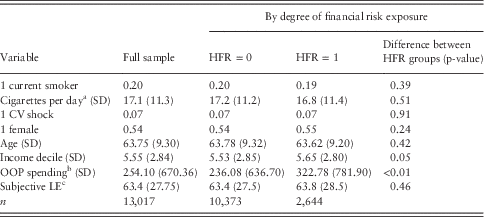
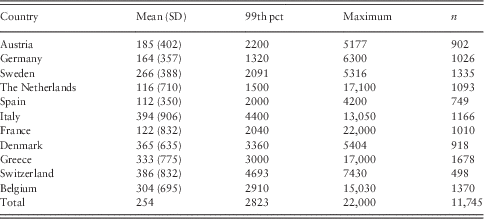
Table 1 displays summary statistics for our baseline analytic sample. Values are presented for the full sample and are also broken down by financial risk exposure group (HFR). We observe that almost 20% of our sample was smoking at baseline and that 7% of respondents experienced a CV shock between the two waves. One in five respondents is classified in the HFR exposure group. Overall, characteristics of individuals do not differ by financial risk exposure group, except for OOP spending that are significantly higher in the HFR group (p<0.01). Table 2 provides summary measures of OOP spending by country during the first data wave. Average spending is typically low or modest, but the standard deviations and maximum reported amounts indicate substantial within-country variation in spending and a long right tail in the distribution of OOP expenditures.
Summary statistics
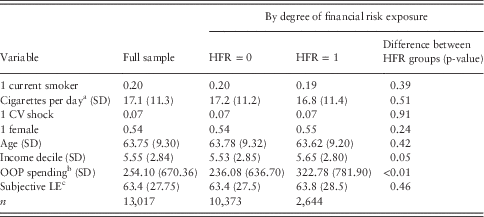
HFR=high financial risk; CV=cardiovascular; OOP=out-of-pocket.
a Based on 2331 smokers.
b In Euro-PPP. Based on 11,745 observations.
c Probability that respondent will live to target age (specific target age depends on current age).
Out-of-pocket spending (Euro-PPP)
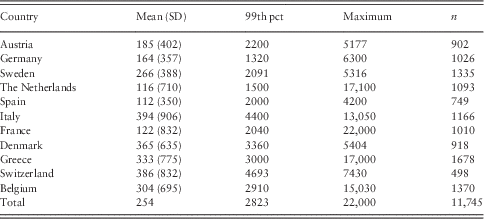
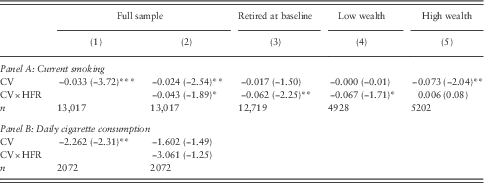
Table 3 presents results for our key outcomes. The first column of panel A shows the main impact of experiencing a CV shock on current smoking in the full sample. A new CV shock has a significant negative impact on the probability to smoke, which is consistent with previous findings (e.g., Khwaja et al.’s, Reference Khwaja, Sloan and Chung2006a, Reference Khwaja, Sloan and Chung2006b work). The second column of panel A displays our main specification results that include an interaction between the CV health shock and HFR status. We find some evidence that the negative impact of a CV shock is stronger among those with more exposure to medical spending risk (i.e., the HFR group). The remaining three columns of panel A examine heterogeneity in three population groups: those retired at baseline, low wealth (defined as belonging to the bottom two wealth deciles) and high wealth individuals (top two wealth deciles). The more financially constrained individuals (retired and low baseline wealth) are more responsive to a CV shock, so long as they are simultaneously exposed to HFR group. Conversely, individuals from the high-income group are 7 percentage points less likely to smoke after a CV shock, irrespective of their degree of financial risk exposure.
Impact of CV shock on smoking outcomes
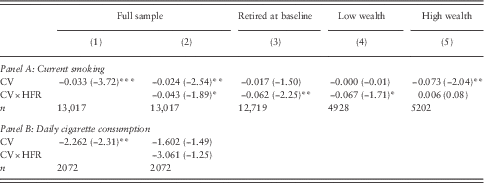
HFR=high financial risk; CV=cardiovascular.
Coefficients on age, age squared and wave dummy not reported. Standard errors are clustered at the household level. Low/high wealth includes individuals from the two bottom/top income deciles. Models in panel B are conditional on smoking in both waves. t-statistics in parentheses *p<0.1, **p<0.05, ***p<0.01.
Panel B of Table 3 shows the results for smoking intensity. We find evidence that smokers reduce their daily consumption by 2 units after a CV shock (corresponding to a 12% decrease in conditional consumption). While patterns in the model with interaction are similar to those observed for current smoking status, the estimates are noisier. We also do not report any subgroup analyses for smoking intensity due to small sample sizes.
Finally, Table 4 investigates potential mechanisms that may help explain the main results. The first two columns show the impact of a CV shock on OOP spending. The CV shock significantly increases OOP spending by 40%, on average (column 1), but the more nuanced examination in column 2 reveals that the magnitude of the change is nearly double for the HFR group. The remaining columns in Table 4 examine the impact of the CV shock on SLE, measured as the self-reported probability of living to a specific age. The estimates indicate that a CV shock reduces SLE by 5 percentage points overall; however, the interaction model suggests that individuals in the HFR group do relatively less updating for their SLE after a health shock – and perhaps none at all.
Mechanisms: impact of CV shock on OOP and subjective probability of survival

CV=cardiovascular; OOP=out-of-pocket; HFR=high financial risk.
Coefficients on age, age squared and wave dummy not reported. Standard errors are clustered at the household level. Probability of survival is defined as the self-reported probability to live to a specific age; the age for which the probability is expressed depends age at the time of the survey (e.g., 75 years old for those aged 50–65, 80 years old for those aged 66–71, etc). t-statistics in parentheses *p<0.1, **p<0.05, ***p<0.01.
Discussion
This work presents a novel contribution to the health shocks and health behaviors literature. We build on several past studies involving health risk updating (Smith et al., Reference Smith, Taylor, Sloan, Johnson and Desvousges2001; Clark and Etilé, Reference Clark and Etilé2002; Khwaja et al., Reference Khwaja, Sloan and Chung2006b) to conceptually and empirically explore the implications of medically related financial risk on smoking decisions after a health shock. Our results suggest that, overall, people are less likely to smoke after a CV health shock and that the smoking response is stronger among individuals with high OOP spending risk. Based on our conceptual framework, we explore two plausible mechanisms that are also compliant with our data availability.
The first (differences in subjective risk beliefs) does not receive support in the data: members of the HFR group fail to exhibit a change in their subjective life expectancies after a shock that is more pronounced than their non-HFR peers.
Conversely, the second posited mechanism (higher OOP expenditures) better matches the overall pattern of findings. Not only do HFR individuals smoke less after the health shock, they also experience relatively larger OOP payments – which appear most persuasive for those with less financial resources and/or less flexible budgets at baseline. Such behavior is consistent with moral hazard where greater coverage blunts the full incentive to quit smoking after a health shock. Of note, an existing literature discusses the implications of ex ante moral hazard on lifestyle choices (Ehrlich and Becker, Reference Ehrlich and Becker1972; Keeler et al., Reference Keeler, Sloss, Brook, Operskalski, Goldberg and Newhouse1987; Rashad and Markowitz, Reference Rashad and Markowitz2007; Dave and Kaestner, Reference Dave and Kaestner2009; Richards and Helmchen, Reference Richards and Helmchen2013), but the role of moral hazard after health risk types are revealed has received little attention.
Our study has several limitations that should be noted. First, we had to rely on self-reported financial risk exposure to construct our main insurance variable of interest. Relatedly, some may expect that smokers could merely purchase more coverage after a health shock. While not impossible, we observe very little of this in the full SHARE sample. In some health systems, private insurers (e.g., selling supplementary coverage) can risk-rate prospective customers, and certain OOP requirements are prohibited from being eliminated by supplemental coverage. In addition, and in light of our findings, those with less financial flexibility may be more inclined to take advantage of the ‘full savings’ from smoking cessation than bear the additional costs of more generous coverage. In addition, and because detailed information on health insurance is not available, we are not able to exploit features of the various national systems that would provide potentially exogenous variation in coverage. An immediate goal for our work is to extend the analyses to new countries and health care contexts, with alternative sources of identification.
We also lack information on health shock severity and treatment heterogeneity, which are relevant to our framework, and have sparse information on spousal health behaviors and shocks; however, existing literature suggests learning operates through personal health events rather than spousal (Khwaja et al., Reference Khwaja, Sloan and Chung2006a, Reference Khwaja, Sloan and Chung2006b). In future work, we aim to incorporate vicarious shock experiences, and ongoing work is unpacking the roles of labor supply in individual responses to health shocks.
Finally, we wish to acknowledge that there are other potential mechanisms that we cannot examine within this work. For example, changes in time preferences or self-control after a health shock that may differ between these two financial risk groups – although older adult smokers have been engaging in unhealthy habits for extended periods of time, irrespective of insurance preferences. As another alternative, there is an implicit income effect occurring for those bearing larger OOP medical expenditures that could lower all consumption – including tobacco. Given that many of these countries have various limits on OOP responsibilities and that these older adults are likely not facing their first financial shock, we suspect that pure income effects are a less likely candidate to drive the behavior changes we see. Rather, we believe that the potential for accumulated health-related financial shocks due to smoking (perhaps individually modest in size) is likely to be more persuasive to an individual. In addition, stronger effects for the intensive margin (cigarettes per day) would be more consistent with short-term income effects than complete smoking cessation, which is opposite our findings. Yet, we admit our inability to tease out the role of income effects in our data.
Conclusion
Even if predominantly descriptive, our results from 11 European health systems suggest that individuals with less coverage appear less inclined to smoke following a health shock, and the data suggest this is at least partly due to the financial burdens of worse health. From the patient’s perspective, trying to project current and future medical spending trajectories poses a significant challenge. Relatedly, patients’ imperfect knowledge of coverage details and subsequent disputes with insurers are common across many Western health care systems (Schoen et al., Reference Schoen, Osborn, Squires, Doty, Pierson and Applebaum2010). Thus, realized expenditures may represent one of the more important pieces of new information in the post-shock period, and a better understanding of personal health risks as well as the risks of future financial losses via similar or repeat health shocks may consequently tip the cost-benefit scales against continuing unhealthy behaviors.
Acknowledgements
We wish to thank Jason Fletcher, James Choi, Susan Busch, Elizabeth Bradley, Anthony Lo Sasso, Daniel Polsky, Mark Pauly, Amanda Starc, Scott Herrington, Andrew Epstein, Ashley Swanson and many participants at the University of Pennsylvania LDI seminar series for numerous helpful comments and suggestions. Richards gratefully acknowledges the Agency for Healthcare Research and Quality T32 HS017589 grant for its generous financial support. Marti is grateful to the Swiss National Science Foundation for its financial support through the Young Researcher Postdoctoral Fellowship award. We also thank the many funders and administrators of the SHARE data project for providing us with this resource. SHARE data collection has been primarily funded by the European Commission, along with additional funding from the US National Institute of Aging and the German Ministry of Education and Research as well as various national sources (see www.share-project.org for a full list of funding institutions and additional data details). The authors have no conflicts of interest to disclose and all expressed views and remaining errors are their own.