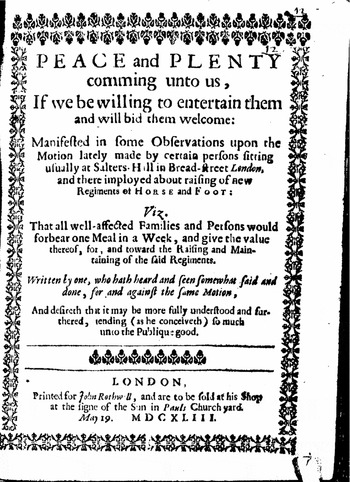
In May 1643 the pamphlet Peace and Plenty Coming unto Us outlined an intriguing proposition for its London readership. It suggested that, in order to meet some of the costs of civil war, ‘all well-affected Families and Persons would forbear one meal a week, and give the value thereof . . . unto the Publique-good’. Such costs, which included raising a new city regiment to fight the forces of ‘antichrist’ and finding supplies to meet the subsistence crisis in Ireland, reflected the origins of the proposal in the sub-committee of the London Militia Committee at the Salters’ Hall on Bread Street.Footnote 1 The responsibility of the Bread Street committee was auxiliary military mobilization, and the anonymous author explained how he ‘hath heard and seen somewhat said and done, for and against the same Motion’.Footnote 2 His job now was to persuade Londoners to adopt the policy of a weekly fast on the assumption that ‘if London begins’ then ‘England (except where the enemy's armies hinder) will follow her example’.Footnote 3
The pamphlet accordingly deployed a number of arguments judged to resonate with the ordinary citizenry. It combined Old Testament and civic-republican exemplar: the pamphlet opened by invoking 2 Kings 7 and explicitly drew on the advice of ‘a witty Florentine in time of famine’ (possibly Machiavelli's history of Florence).Footnote 4 It also presented the ‘motion’ as the logical, if somewhat surprising, extension of everyday civic and familial practice. To this end, the author suggested that ‘two men in every Parish went with two Books, the one with a White book and the other with a Black book’, recording ‘Benefactors’ in one (for ‘perpetual honour’) and ‘Malignants’ in the other (for the ‘infamy’ of ‘their Posterity’).Footnote 5 More, he argued that ‘This work seems to be most proper for women, especially, now when men have so many other employments.’ After all, ‘Have not women generally the disposing of meats and drinks in Families?’ Appropriating the procedures and language of male parochial governance, he suggested that ‘A few of the wisest of them here in London (joining but together unanimously, and appointing some of their sex fittest and most active in every Parish) might both ease the men of this Labour, and carry this good work through the City first, and Kingdom afterward.’ These she-citizens would hence ‘be honoured for it both by God and man, in all countries, and in all ages’. They would also ‘give Parliament cause (as in the like case once the Dames of Rome did that Senate) to give them publike thanks for their love and care of the Commonwealth’.Footnote 6
If this parochial citizenship is striking, then so, too, was the language by which the Bread Street proposal was presented to Londoners (see Figure 1). ‘Peace and Plenty’ was not, perhaps, an obvious epithet for weekly fasting in a time of violent conflict, nor the obvious watchword of those citizen militants who dominated the Salter's Hall committee.Footnote 7 Here, however, it was intended to describe what the proposal would help ‘procure’. The word ‘peace’ was accordingly imbued with a number of inferences beyond the simple sense of not at war (the way we instinctively define peace today). Rather, ‘this abstinence, beside the saving of our Lives (with the Lord's blessing) will also preserve unto us our Goods, Lands, Laws, Liberties and true Religion’. The motion rested, that is, on a complicated and enriched sense of peace which encapsulated material, social, political and spiritual well-being and freedom. The pamphlet suggested, moreover, that such a peace would be secured by ‘entertaining’ precisely the kind of participatory and communal action – ‘love and care of the commonwealth’ – which was itself born of, and associated with, the ‘liberties’ and ‘true religion’ of the citizen. In this way, the attributes of peace as defined in the pamphlet also served as the practical means for securing peace for the future. The money raised through ‘cheerfully abstain[ing] from one meal in a week’ would accordingly provide troops ‘for our own safety’; it would support the war-effort (‘the only way to a good and godly peace’); it would prevent the famine which was ‘otherwise so much unavoidable’; and it would ease the spiralling levels of conventional assessment, with all the discontent that extra taxation engendered.Footnote 8
Meanings of ‘peace’ on a 1643 title-page Source: Thomason/E. 102 [12], British Library.

Whatever ordinary Londoners may have thought of the Bread Street motion, it was not adopted by parliament.Footnote 9 But this is not to say it is without historical interest. On the contrary, that communal abstinence in time of war could be both publicly presented in terms of ‘peace’ and ‘plenty’ and touted as an expression of civic identity more or less consistent with normal parochial and familial governance begs questions about the political culture of the time. These certainly include the ideology of the Bread Street sub-committee and its resonance, or not, with the civic consciousness of ordinary urban householders.Footnote 10 They also include the linguistic bricks and mortar out of which a pamphlet like Peace and Plenty was constructed. Was the author of the pamphlet usual, for example, in using the word ‘peace’ at once so prominently and complicatedly? Was the word's knotted web of inferences as suggested by the pamphlet normal or controversial, commonplace or partisan? How did these inferences fit within the broader semantics of peace in seventeenth-century England? Or, to put that slightly differently (and apologies to Raymond Carver): what did early moderns talk about when they talked about peace?Footnote 11
The question is important if only because ‘peace’ has received so little explicit attention from historians of early modern England.Footnote 12 At first glance, this is hardly surprising. Just as for political historians the seventeenth century was self-evidently an era of endemic warfare and political ‘crises’, so for social historians national political strife was nothing compared to the intensified ‘micro-politics’ of family, communal and economic life.Footnote 13 In both instances, the semantics of peace have not been an obvious interpretative priority. On closer inspection, however, the picture is more complicated. Since the 1970s, political revisionism has emphasised the consensual nature of Elizabethan and early Stuart politics, arguing for the absence of a ‘radical’ political agenda, or even contrary constitutional positions, which could have precipitated civil war.Footnote 14 And if the English polity accidently slipped into war in 1642, then social historians have highlighted the widespread quest for ‘order’ across the populace at large.Footnote 15 As Ian Archer has demonstrated, even in 1590s London the potential for social conflict was matched only by the propensity for stability.Footnote 16
One question for this article, then, is whether the neglected language of peace can illuminate these somewhat paradoxical features of early modern politics and society. To focus on the term and its uses reflects, in turn, the burgeoning historiographical interest in contemporary language and concepts. The antecedents of this interest can be found in both the history of political thought and social history. Influential examples include Quentin Skinner's survey of how the term ‘state’ was adopted by political theorists and Keith Wrightson's tracing of the word ‘sort’ in more general contemporary discourse.Footnote 17 In both instances, ostensibly non-evaluative language accreted new meanings and concepts because of the discursive contexts in which they were used. Skinner shows how ‘state’, which traditionally meant ‘condition’ (in the sense of ‘the state we are in’), was appropriated as the descriptor for the kind of abstract sovereign power eventually described by Hobbes in Leviathan from 1646. Wrightson demonstrates that ‘sort’, as an alternative for ‘type’ or ‘kind’, acquired the more specific sense of distinctive social grouping – as in ‘better sort’ or ‘middling sort’ – by the 1640s.Footnote 18 Both words transformed conceptually over time, in the process reconfiguring the lexicon of how people could talk and quite possibly think about their politics, their society and their relationship to both. Both words also raise the question about the relationship between concepts and language on the one hand, and institutions and practices on the other hand. How, for example, did changes in the former relate to developments in the latter? Subsequent work has expanded both the vocabularies so contextualised and, with the help of digital technology, the range and quantity of discursive contexts considered.Footnote 19 This kind of contextualised history of the English vernacular is still nascent, especially when compared to the German tradition of ‘conceptual history’.Footnote 20 It is nevertheless clear that certain words – ‘commonwealth’ is a notable example – underwent significant changes in and contests over their meaning between the fifteenth and eighteenth centuries.Footnote 21 It is likewise clear that words which carry a particular sense today could have very different connotations 400 years earlier. An important Renaissance meaning of ‘honesty’, for example, was not simply sincerity and integrity but also discretion and prudence: the capacity to speak civilly rather than truthfully.Footnote 22
As this suggests, attention to language is a powerful tool of historicism, enabling early modern culture to be recovered on its own terms. Such an approach can also tease out the ironies and paradoxes which distinguish the past from the present. Two recent examples are Alexandra Walsham's treatment of ‘toleration’ and Ethan Shagan's discussion of ‘moderation’. Walsham notes that while in the West today ‘toleration’ is primarily an affirmative and idealised word ‘instinctively linked with equality, liberty and democracy’, in the early modern era it is best understood as a form of ‘charitable hatred’ – a ‘casuistical stance involving a deliberate suspension of righteous hostility and, consequently a considerable degree of moral discomfort’.Footnote 23 It was a word used not to proclaim religious freedom but as ‘a weapon in religious controversy’ – to ‘wound, hurt, brand, stigmatize, and slur’.Footnote 24 Shagan likewise historicises the term ‘moderate’ in order to show that ‘moderation subsumed two concepts that today are incompatible but in early modern England had not yet been differentiated’.Footnote 25 One was ‘the state of equipoise’: the achievement of ‘order and proportion’ at once internally, in terms of the self, and externally, in terms of society. The other was ‘the act of restraint that produced it’: the acts of government which made people and their community's moderate.Footnote 26 Shagan suggests that this semantic conflation helps explain one of the most striking paradoxes of early modern England: that the most vociferous proponents of ‘moderation’ tended to subscribe to the most intensive programmes of ‘coercion and control’.Footnote 27 Like toleration, moderation's genealogy emerges as altogether murkier and more ambiguous than these terms’ modern usage might suggest.
What follows suggests that ‘peace’ was a similar kind of word to toleration and moderation in important respects. As a term applicable at once to the inner life of the person, the institutions and environment constituting the wider world and the external behaviour and actions of people, peace raised important questions about the relationship between self, society, agency and governance. Could inner tranquillity always be reconciled with the rules and morality upon which social peace was based? If not, which took precedence? Likewise, just as humanists and religious writers puzzled over how to encourage people to behave moderately or tolerantly, so they wondered how to make them live in peace. In Reformation Europe the answer, more often than not, was through various kinds of force. Indeed, it was peace which legitimated the organization of political power and violence, the first systematic theory of the modern ‘state’ explaining
the common-wealth, in Latin civitas . . . One Person, of whose Acts a great Multitude, by Mutual Covenants one with another, have made themselves everyone the Author, to the end he may use the strength and means of them all, as he shall think expedient, for their Peace and Common Defence. Footnote 28
For Thomas Hobbes, the psychology of man and the endemic will to power made this ‘artificial man’ necessary. So, too, did the fact that different people had very different conceptions as to what the nature and quality of peace – whether internal or external – should be. Indeed, as the authors of Peace and Plenty vividly demonstrated, attaining the power to define and control peace was something for which ideologues could fight, die or at the very least go hungry.
The semantic complexities which this suggests are explored in four stages. The next sections trace the changing visibility of ‘peace’ in sixteenth- and seventeenth-century printed texts and survey some of what contemporaries styled its primary ‘significations’. The article concludes by outlining some of the prevailing meanings and uses of the term before, during and after the mid-century civil wars.
I
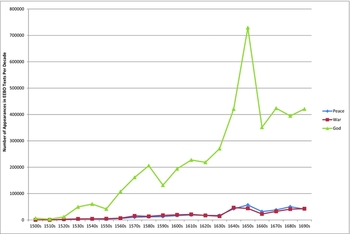
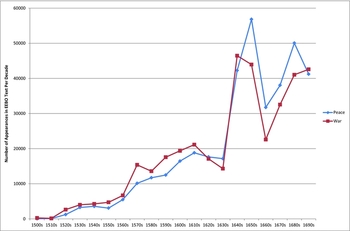
How prominent a word was ‘peace’ in early modern printed discourse? One useful indicator of linguistic usage, a corpus large enough to be statistically significant while allowing qualitative analysis, is the Shakespearean canon. This is saturated with the term. ‘Peace’ appears in Shakespeare's plays an estimated 547 times, more than double the number of times ‘war’ is used (261 times). Although neither term approaches a word like ‘God’, which Shakespeare used an estimated 796 times, ‘peace’ also compares favourably to other words which have received especial attention from historians: for example ‘state’ (312 times), ‘sort/s’ (87 times), ‘moderate’ and variants (11 times), and toleration and variants (not at all).Footnote 29 A second indicator is presented by Figures 2 and 3, which simply record the number of ‘hits’ of ‘God’, ‘peace’ and ‘war’ in all searchable texts catalogued on Early English Books Online (EEBO) between 1473 and 1699. As things stand, this is the crudest method for measuring language use: by no means all texts are digitized and searchable, the search itself is prone to various kinds of error, from misrecognition to unrecognized variants, and the size of the data makes contextualisation of usage difficult.Footnote 30 The predictable ubiquity of ‘God’ in Figure 3 is methodologically reassuring, therefore, and lends the estimated number of appearances of ‘peace’ and ‘war’ some degree of meaning. The charts suggest that, although ‘peace’ appears considerably more often than ‘war’ in Shakespeare's plays, in the EEBO corpora ‘war’ was used more frequently than ‘peace’, at least until the 1620s. Thereafter, however, this pattern flipped, with ‘peace’ appearing more frequently than ‘war’ until the end of the century. The exception was the 1640s, when both words proliferated dramatically.
Appearances of peace, war and God in texts on EEBO, 1500–1700

Appearances of peace and war in texts on EEBO, 1500–1700

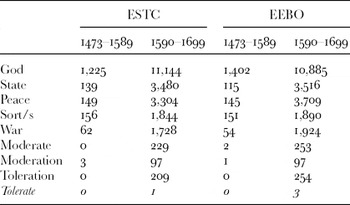
A third means of measurement focuses on surviving title-pages catalogued on EEBO and the English Short Title Catalogue (ESTC). This method rests on the assumption that the typography and wording of title-pages was an important component of the publishing process.Footnote 31 Because title-pages at once invoked textual content and appealed to potential readers and buyers, words and images were not chosen lightly or even, necessarily, by the author (see Figure 1). Indeed, when taken in aggregate title-pages are the best index of that elusive but valuable quarry: early modern print consciousness. Certainly, they are a more precise indication of usage than the aggregate number of words in all texts. Table 1, which provides a rough count of title-pages between the 1470s and 1690s, accordingly shows that while ‘God’ continues to be (as it were) up there, adorning many more title-pages than all the other selected words put together, ‘state’ and ‘peace’ are second or third depending upon which catalogue is preferred (a reminder of the crude contingency of this counting method with the technology as it is). ‘Peace’ nevertheless appears on the front of nearly twice as many printed texts as ‘war’ both before and after 1600.
Appearances of ‘peace’ on ESTC and EEBO title-pages, 1470–1690s

Source: http://estc.bl.uk; http://eebo.chadwyck.com (consulted 6 Feb. 2013).
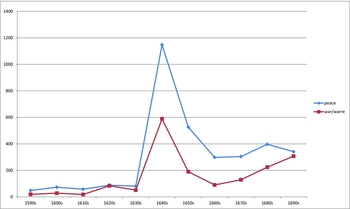
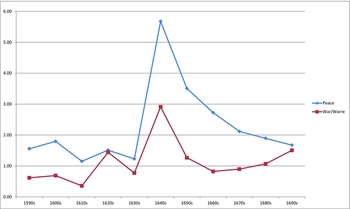
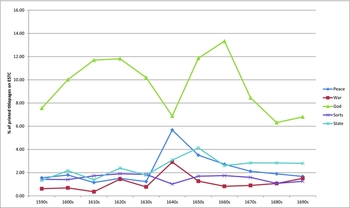
A more precise sense of chronology is given by Figure 4, which shows by decade the number of printed title-pages inscribed with peace and war. It indicates consistent usage of both terms until the 1630s; an enormous upsurge of use, especially for peace, in the 1640s; and a relative decline in use by the 1660s, although peace continues to appear considerably more often on title-pages than it did before 1641. This is, of course, a period in which the number of all printed texts increases exponentially. Figure 5, which gives the number of ‘peace’ and ‘war’ title-pages as a percentage of all printed title-pages catalogued on the ESTC, demonstrates that the rise of ‘peace’ and ‘war’ was not merely a function of this more general trend. The aggregate rise in the use of peace in the 1640s makes for a percentage increase from just over 1 per cent of all title-pages to almost 6 per cent of all title-pages, falling to just under 3 per cent by the 1660s. That the mid-century rise of ‘peace’ was not simply a function of the expansion in print is emphasised by Figure 6, which compares peace and war with some of the comparators from earlier: God, state and sort/s. Indeed, in the 1640s the presses were so busy that even God experienced a relative decline in public visibility – so much so that peace, as one of the words of the moment, was almost up there with him.
‘Peace’ and ‘war’ on printed title-pages, 1590s to 1690s

‘Peace’ and ‘war’ on printed title-pages (%), 1590s to 1690s

‘Peace’ and ‘war’ compared with some keywords (%), 1590s to 1690s

II
These measurements provide, then, a crude but illuminating index of the relative visibility of ‘peace’ in the early modern era. This was a term less ubiquitous than ‘God’ but used much more often than ‘moderation’ and ‘toleration’. More prominent than ‘war’ on title-pages and the Shakespearean stage, the seventeenth century saw ‘peace’ overtake its antonym in printed text more generally. Most striking, perhaps, is that with the outbreak of civil war ‘peace’ became especially prominent, appearing more often than ‘state’ and almost as much as ‘God’. All of which suggests that the print-reading English-speaking public of the sixteenth and seventeenth centuries talked and thought a lot about peace.
What did they mean when they did so? Three kinds of Renaissance text can be used to exemplify the rich and complicated semantic fields which peace delineated long before the interventions of Hobbes and the Bread Street committee. Such texts include vernacular translations of influential medieval treatises, ‘Englished’ for the first time in the sixteenth and seventeenth centuries; versions of the more accessible autodidactic literature which increasingly characterised the reading proclivities of early modern men and women; and performative genres which popularised and re-presented ‘learned’ language and ideas for wider audiences: for example, through the theatre. Each of these textual types – translations, self-helps, performances – was integral to making classical and medieval ideas available to new, vernacular and more socially extensive audiences. At the same time, the very development of these genres also distinguished early modern culture from what had gone before.
To take the Renaissance translations: peace was an organizing paradigm of two medieval treatises deeply implicated in the English Reformation, but which linked the concept to two contrasting discursive traditions. In the first instance, the Spanish humanist Juan Luis Vives dedicated his Latin edition of St Augustine of Hippo's The City of God to Henry VIII in 1522. In return, Henry congratulated Vives on bringing Augustine ‘from darkness to light’ and restoring him ‘to his ancient integrity, for all posterity’, and entrusted him with the tutorship of his daughter, Mary.Footnote 32 For Augustine and perhaps Henry in the 1520s, the ‘peace of all things lies in the tranquillity of order; and order is the disposition of equal and unequal things in such a way as to give to each its proper place’.Footnote 33 This imperative applied to the body and soul, whether ‘rational’ (human) or ‘irrational’ (animal), as well as relations between people – in their households, their cities and with God. In theorising peace as a ‘universal’ imperative, however, Augustine made two important distinctions: between pagan and Christian peace; and between earthly and heavenly peace.Footnote 34 Thus, while ancient philosophers like Cicero believed ultimate peace, or the ‘Supreme Good’, to exist ‘in the here and now’ and through ‘their own efforts’, for Christians ‘the earthly city’ was merely a prelude to ‘the Heavenly City’ and ‘the enjoyment of eternal peace’.Footnote 35 Christians valued ‘earthly peace’ and the political institutions which guaranteed it, especially if these institutions embraced ‘Christian precepts’ and enabled the church to do ‘her work effectively’.Footnote 36 But ultimate redemption was ‘the peace of the Heavenly City’: a ‘perfectly ordered and perfectly harmonious fellowship in the enjoyment of God, and of one another in God’.Footnote 37
This was not the moral of The Defence of Peace by Marsilius of Padua, which was ‘translated out of the Latin into English’ by William Marshall thirteen years later, in 1535, in order to justify Henrician imperial power against ‘the proud bishops of Rome’.Footnote 38 Whereas Augustine's peace was the foundation stone of ecclesiastical authority, and ‘the city is ordered to religion rather than the other way round’, Marsilius reclaimed peace as the embodiment of civil society as derived from classical exempla.Footnote 39 Peace, or what he also styled ‘tranquillity’, ‘will then be that good condition of a city or realm, in which each of its parts is enabled perfectly to perform the operations appropriate to it according to reason and the way it has been established’.Footnote 40 It followed that ‘intranquillity will be that bad condition of a city or realm (just like the sickness of an animal) in which all or some of its parts are prevented from performing the operations appropriate to them’.Footnote 41 For Marsilius, not only was law-making – by which tranquillity was established and defended – the preserve of the prevailing part of the civic community as customarily established.Footnote 42 It was ‘the avarice, desire for power and deceitfulness of the human interpreters of Christ's religion’ which was most likely to disturb the peace of the city or realm.Footnote 43 A weak response to this scenario (Marsilius was commenting on the fourteenth-century papacy) was the exclusion of priests from temporal power. A strong response, developed in the second half of his book and adopted by Marshall for Henry VIII, was that the ‘supreme civic legislator rightfully has all power over spirituals’.Footnote 44
An Augustinian conception of peace accorded with Henrician kingship before the break with Rome; its treatment by Marsilius was much more conducive to Tudor imperium thereafter. Viewed in these terms, it is unsurprising that while Defender of the Peace was available in the vernacular from 1535, City of God remained untranslated until 1610 (remarkably late for such an important text). This Reformatory hedging of peace in classical and civil discourse was replicated in two texts with much greater communicative potential than works of political theory, translated or otherwise. Sir Thomas Elyot's Latin–English dictionary, published in 1538, marked at once the beginning of the English lexicographical tradition; an early example of Renaissance autodidactism (it was designed to teach yourself Latin); and a crucial moment in the development of the printed vernacular.Footnote 45 ‘Peace’ appeared throughout the dictionary, though never with religious inferences. Instead, Elyot translated the Latin pax as ‘peace, a quiet liberty’ and used ‘peace’ to translate a host of terms associated either with diplomacy and the opposite of war, or with civil governance (both of self and society).Footnote 46 Especially significant in this respect was his gloss on ‘Irenarches, & irenarcha’ as ‘he which is in authority to see peace kept in a country or city, which among us may be called a Justice of the Peace’.
This was significant if only because, for the 100 or so years after the publication of Marsilius and Elyot, it was on handbooks explaining how to be a justice of the peace that English readers of printed texts were most likely to have encountered the word ‘peace’. Moreover, in William Lambarde's bestselling version of the genre, which explicitly invoked Eirenarcha to depict the Office of the Justices of Peace and was reprinted twelve times between 1582 and 1620, readers would also have found the single most coherent and accessible ‘signification of this word Peace’.Footnote 47 In contrast to Elyot's pithy ‘quiet liberty’, Lambarde explained that ‘Of the Latin word Pax, the Normans framed their Paix, and we (out of that) our Peace, the which hath sundry significations both in Holy Scripture of God, and in the laws of our Country.’Footnote 48 Lambarde explained that peace was both inward and outward. Echoing Augustine, he noted that ‘Good inward peace’ involved ‘Peace with God’ and ‘Peace of Conscience, for that our Consciences (by faith in Christ) at Peace, both with God and itself’. ‘Evil inward peace’ was, in contrast, a ‘mundane peace’ amounting to nothing more than ‘carnal security’: an earthly tranquillity derived not from God but other material, corporeal or philosophical sources.Footnote 49 Lambarde also explained there were two kinds of ‘outward peace’. One was ‘opposed (or set) against all manner of striving and contention, whether it be in countenance, gesture, word, or work’; ‘the other is only an abstinence from actual force, and offer of violence, and is rather contrary to arms and war’.Footnote 50
Echoing Marsilius, Lambarde accordingly observed that while ‘the Law of our Realm likewise uses the word peace diversely, but yet so, as it is altogether occupied about these outward Peaces’: ‘the law of God (which is the only true Philosophy) respects the mind and conscience, although the laws of men do look but to the body, hands, and weapons’.Footnote 51 Budding magistrates instead learned to conceptualise their peace in three ways: as ‘Protection or Defence’; as ‘Rights, Privileges, and Liberties’; and as ‘a withholding (or abstinence) from . . . injurious force and violence’.Footnote 52 They were also told that:
Justices of the Peace were not ordained (as some have thought) to the end to reduce the people to an universal amity (or agreement of minds) which is indeed a Thing rather to be wished for, then to be hoped after: Neither is it any part of their office, to forbid lawful suits and controversies.Footnote 53
Lambarde's literary successor, Michael Dalton, concurred, though with the caveat that he could ‘see not why Justices of the Peace should be restrained from preventing and repressing such other offences, misbehaviours, and deceits, as may break the amity, quiet, and good government of the people’; that the concept of peace should also incorporate the notion of ‘Good Behaviour’.Footnote 54
C. 1600, therefore, English magistrates were provided with a complicated conception of outward civil peace which ranged from active ‘defence’, to the assertion of ‘liberties’, to restraint from and punishment of ‘violence’: peace which had civic as well as simply judicial connotations. These ‘peaces’ were defined in relation to religious peace, by which was meant the social organization and provision of faith and the condition of the soul and conscience (whether ‘good’ or ‘evil’). It also segued into diplomatic peace, involving the absence of war between sovereign bodies and the diplomatic processes used to achieve it.
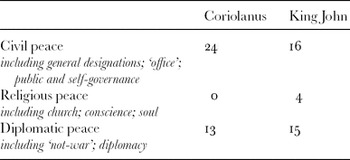
A similar set of ‘significations’ can be found in the works of Lambarde's contemporary, Shakespeare. We have already seen that Shakespeare used the term readily (547 times compared to 261 uses of war). Although ‘peace’ appears at least once in most if not all of the plays, there are four plays in which the word is used 30 times or over, acquiring, it could be argued, a degree of paradigmatic power. These ‘peace plays’ were Henry IV 2, Henry VI 1, Coriolanus and King John; plays, that is, about societies in conflict and at war. Table 2 accordingly shows that, like readers of Elyot's dictionary, audiences of the Roman Coriolanus or the Anglo-Norman King John would have been bombarded with uses of peace with civil and diplomatic inferences.
Types of ‘peace’ in Shakespeare's Coriolanus and King John

Religious connotations, in contrast, were all but absent from the stage. Putting that slightly differently, insofar as the semantics of peace were concerned, these Elizabethan and Jacobean audiences were children of Padua rather than Hippo.
III
These contemporary significations suggest that a defining feature of the word ‘peace’ was its connective power: its use, that is, to describe and idealise at once the inner self (whether earthly or spiritual), the external world (civil and religious), the quality of relationships (between individuals, households, associations or states) and the establishment and maintenance of all of the above. This connectivity is not always apparent in the historiography, with historians tending to focus on peace within a particular semantic field – and so historical sub-discipline – rather than explore its centrality to several.Footnote 55 Even as sophisticated a historian as John Bossy nevertheless corrals ‘peace’ to describe a particular ‘moral tradition’ informed by what he terms three ‘items’: ‘the notion or practical instinct that to be a Christian means to love your neighbour, and in particular your enemy’; the urgent need for such ‘peacemaking’ in periods of accentuated ‘enmity’ (such as the Reformation); and the ‘historical’ or ‘archaic’ role of the church in facilitating peace.Footnote 56 Bossy takes this Christian tradition, which he labels ‘peace’, to have been ‘rather deeply embedded in the consciousness of the populations of the time of Reformation’ and wonders ‘what happened to it thereafter’.Footnote 57 His answer is that it was eventually eroded by ‘the current of civility’ and ‘civil society’. As he puts it: ‘Invented, for our purposes, by the Renaissance, precipitated by the wars of religion, civil society must be the real terminus of the moral tradition, insofar as it has one.’Footnote 58 Yet even as cursory an analysis as the one above has shown that just as semantically ‘peace’ in the Reformation was not limited to a single ‘moral tradition’, so diachronically it was a rising rather than declining term. At the very least, ‘civil’ and ‘Christian’ connotations of ‘peace’ remained concurrent throughout the sixteenth and seventeenth centuries. Other meanings and uses of the term only complicate Bossy's story further.
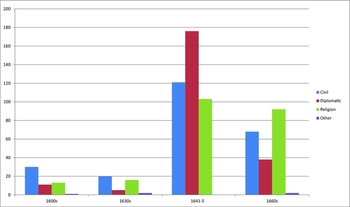
There is no space here to tell an alternative, let alone comprehensive, story of early modern peace. It is possible, however, to take the word's civil, religious and diplomatic significations as a historicised framework for tracing relative changes in meaning and usage before, during, and after the civil wars. Figure 7 accordingly compares the appearance of civil, diplomatic and religious significations on printed title-pages at four intervals during the seventeenth century. These are the 1600s, the first decade of Stuart rule in England; the 1630s, when Charles I ruled without parliament; 1641–5, coinciding with the first civil war; and the 1660s, the decade following the Restoration of the Stuart monarchy. The chart nicely illustrates the proliferation of all significations of peace in the first half of the 1640s, especially diplomatic inferences which followed from the peace negotiations which accompanied war. It also depicts a longer-term trend. At the beginning of the seventeenth century, printed significations of civil peace appeared far more often than diplomatic or religious significations. By the 1660s, the opposite was the case. This was not so much because people had stopped talking about the civil semantics of peace; far from it. Rather, it was because there was now even more printed discourse about religious peace.
Civil, diplomatic and religious uses of peace on printed title-pages, 1600s, 1630s, 1641–5, 1660s

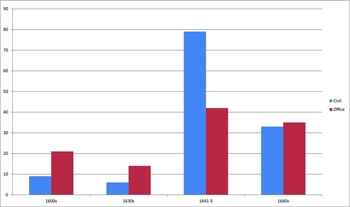
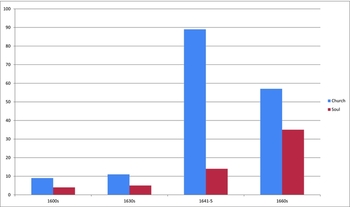
Two final charts give a more detailed picture of this change in emphasis. Figure 8 divides uses of civil peace into its two predominant types: as a general evocation of quiet liberties, in which the term was often coupled in phrases like ‘laws, liberties, and peace’, ‘public peace’, ‘peace and safety’, ‘peace and freedom’ and ‘settled peace’; and as a specific referent to institutions and offices authorised to keep and defend the peace (most obviously justices of the peace). While it was officers of the peace who dominated title-pages until the 1630s, in the early 1640s this tendency was dramatically reversed, with notions of liberties and freedoms increasingly signalled. In the 1660s, there was almost parity between the two senses of the term. Somewhat more ambiguously, Figure 9 shows the changing number of references to the ‘outward’ church on the one hand – its organisation, constitution, liturgy, form and so on – and the ‘inward’ soul and its synonyms on the other hand. (The data is ambiguous because for many commentators the one implied the other; this chart describes only explicit references to, and concern with, peace of conscience or mind). With that caveat in mind it can nevertheless be seen that while in the early 1640s religious evocations of peace most often referred to external forms, by the 1660s discourse about conscience had significantly increased.
Civil peace on printed title-pages: general and office, 1600s, 1630s, 1641–5, 1660s

Religious peace on printed title-pages: church and soul, 1600s, 1630s, 1641–5, 1660s

There are at least three striking features of this (albeit extremely schematic and exploratory) survey of the texts introduced by ‘peace’ on their title-pages. One is the multi-edged nature of civil peace. Social historians have tended to understand ‘peace’ simply as the restraint or amelioration of conflict within communities: ‘the resolution of social conflict, the keeping of the public peace’.Footnote 59 However, during the middle of the seventeenth century the more assertive and civic connotations of ‘defence’ and ‘liberties’ invoked by ‘peace’ – and recognized by magistrates – became more prominent.Footnote 60 In the political circumstances of the 1640s, that is, justices empowered to ‘keep of the peace’ were also encouraged to become (in the language of Marsilius) ‘defenders of the peace’. As a result, peace became not merely the justification for magistracy and governance but also a politicised slogan of war. The second, more obvious point is that whether or not Bossy's ‘moral tradition’ really did decline over the course of the seventeenth century, religious significations of the term in general, and notions of inner tranquillity and conscience in particular, clearly increased in prominence; might be said, indeed, to have been a consequence of the mid-century troubles. Certainly, peace as a term of religious enunciation remained very much in the discursive mix of ‘civil society’. More obvious still is that, insofar as the semantics of peace were concerned, the revolutionary era was extremely significant. This was true not so much because it saw the invention of new meanings for the term – the significations of peace were well established by 1600. Rather, it was the intensity and mutability of how peace was used which was different. As one exasperated commentator (typically) declared in 1643: Will and Law, Reason and Religion, Treasons and Rebellion, Peace and War, Payments and Punishments, People and Parliament, Are Words of Wonder to Weak and Wise Men, and by Them Malignants Deceive the Multitude.Footnote 61
IV
Telling a coherent story in an era of such semantic flux and conflict is a hazardous interpretative exercise. By way of conclusion, I would nevertheless like to suggest a narrative of peace between the 1630s and 1660s which at least begins to make sense of the patterns revealed by the data and the significations available to contemporaries. This narrative is based on a sequence of key appropriations of the word: while there were always concurrent and conflicting claims on peace, at particular moments certain claims were more emphatic, or at least visible, than others. Told in these terms the story involves a transition from ‘peace and unity’ in the 1630s to ‘peace and truth’ in the 1640s to ‘peace and conscience’ by the 1660s.
Notions of civil, religious and diplomatic peace were integral to the kingship of the early Stuarts. James I cultivated the epithet of ‘peacemaker’ at home and in Europe and both he and his son were drawn to the conflation of unity, order, hierarchy, beauty and peace promised by episcopacy. The poet Robert Aylett knew which buttons to press in his 1622 poem, Peace with her Four Guarders. The guarders of peace were ‘concord’, chastity’, ‘constancy’, courtesy’ and ‘gravity’ – virtues embodied in bishop and king. As Aylett explained to John Williams, bishop of Lincoln:
Thou great Peace-keeper, whom the greatest King / That our great God of Peace did ever bring / To rule these Western Isles, in happy Peace, / For Honour, Arts, and Piety's increase, / Thou, whom this Mighty Monarch doth intrust, / With his Great Seal, as Prudent, Faithful, Just. / God to thy outward bliss, add inward Peace, / That Goodness with the Greatness may increase.Footnote 62
After James's death in 1625, Aylett became a close ally of William Laud, a dominant figure in the Caroline regime, and he remained a loyal lieutenant of the archbishop throughout the ‘Personal Rule’. The centrality of peace to Caroline (and Laudian) ideology was nicely expressed in a royal proclamation for the ‘Establishment of the Peace and Quiet of the Church of England’ as early as 1626.Footnote 63 This announced the king's ‘utter dislike of all those, who to show the subtlty of their wits, or to please their own humours, or vent their own passions, do . . . stir up or move any new Opinions, not only contrary, but differing from the Sound and Orthodox grounds of the true Religion’. In contrast, the ‘Divine Providence put into his hands as shall be . . . for the repressing and severe punishing of the insolencies of such, as out of any sinister respects, or disaffection of Government, shall dare either in Church or State, to disturb or disquiet the Peace thereof.’ Such ‘disquiet’ which disturbed the peace included most forms of discursive activity, whether ‘writing, preaching, printing, conferences, or otherwise’. In Augustinian fashion, the king accordingly corralled all ‘his reverend Archbishops and Bishops [civil magistrates] speedily to reclaim and repress all such spirits, as shall in the least degree attempt to violate this bond of peace’. The king's offices of peace were accordingly aligned against ‘unquiet and restless spirits’ who ‘to express their rash and undutiful insolencies, shall wilfully break that Circle of Order, which without apparent danger to Church and State, may not be broken’. Faced with such a threat, ‘his Majesty shall and will proceed against all such offences . . . with that severity . . . they deserve, so that by the exemplary punishment of some few . . . all others may be warned’.Footnote 64
In Caroline ideology, then, ‘outward peace’ conflated divine power, monarchical will and civil and religious institutions into a ‘circle of order’; it precluded not only the usual acts of violence but also public discourse per se; it criminalised attempts at religious peace (both inward and outward) outwith the strictures and structures of the established church; and it also raised questions about the ‘quiet liberties’ which subjects enjoyed semi-autonomously of their monarch. This vision of peace was shattered by the so-called Bishops’ Wars of 1639 and 1640, which led directly to the Short and Long parliaments and the chance to redress grievances. Given the Caroline aversion to discursive noise, the sudden outpouring of ‘opinion’ – in declarations, speeches, petitions, news-books, sermons, pamphlets, treatises, ballads, dialogues, tracts, and the rest – must have been cacophonic.Footnote 65 Indeed, a begging speech by Charles to the corporation of Oxford in 1643, subsequently published, suggests just how closely Charles had aligned his inner peace with the outward ‘circle of order’, and the psychological damage its disintegration was causing:
We lose Our Royalty [and the] benefit of Our Exchequer revenues . . . We lose Our Strength in the loss of Our Subjects (the strength of Kings) and We lose that which is more precious to us than all things else, Our peace and quiet of mind, never free from cogitations of Our people's injuries and Our own sufferings.Footnote 66
The speech also shows how discursively marginalised the royalist conception of ‘peace’ had become; because what is most striking about the intense discourse of peace in the early 1640s was how parliamentarian polemicists successfully appropriated civil and religious significations of the term as a justification – epithet even – for war.
They did this in at least three ways. First, an active and intrinsically civic conception of peace was presented, alongside notions of liberties, laws, freedoms and estates, as a fundamental attribute of the subject. This peace was now in grave jeopardy and had to be defended, with force if necessary. From the very outset, parliamentary declarations explained that they ‘do hold themselves bound in Conscience to raise forces for the preservation of the peace of the kingdom and protection of the subjects in their Persons and Estates [for] the publique good which they will always prefer before their own lives and fortunes’.Footnote 67 It was precisely in this spirit that tracts like Peace and Plenty could be written. Second, the king's recruitment of Cavaliers and other military malcontents (as characterised by parliamentary propaganda) threatened, in a very real and tangible way, these ‘quiet liberties’. In such circumstances, militarisation became an extension of legitimate civic responsibilities and participation. The anonymous author of The Kingdom's Case, who ‘prays and studies the peace of the kingdom’, asked ‘whether the king's subjects may not by the laws of this kingdom . . . oppose quell and vanquish . . . the five or ten thousand or more persons who aggregate and assemble themselves together, in a warlike manner under the name of the king’.Footnote 68 It was a leading question. Their assembly ‘is a breach of the peace, and that in the highest degree; now every man may take up arms, to preserve the Peace, nay ought, if otherwise it cannot be preserved’. More, their assembly was ‘Rebellion’ and ‘High Treason’: ‘If the assemblers to pull down Enclosures were adjudged Traitors, much more these Rebels assembled to pull down . . . our Religion, Law and Liberties.’Footnote 69 Third, because of the political dependency of the king on Catholics and other ‘Evil Counsellors’, the Protestant church – and so outward peace with God – remained in mortal danger. This warranted forceful defence. However, the providential turn of events also meant that the church need not simply be protected but also, finally and properly, reformed. Thus Richard Bernard could write
To the Watchful Eyes in this our State, the worthy Justice, Imprisoners of Malefactors, and Preservers of Peace; that peace is wished which pass all understanding, with the zeal of God, in due execution of Justice against the enemies of Christ, and our country.Footnote 70
The semantics of this position, which was monopolised by parliamentary propagandists, were nicely outlined by John Saltmarsh, who became chaplain to Thomas Fairfax and the New Model Army and (like most parliamentary writers) was a self-confessed lover of ‘true peace and liberty’. In 1643, Saltmarsh explained: ‘That which I now conceive to be the only Interest of our Reformation, is not a Pacification but a Peace, for a Pacification is a more proper and safe notion for foreign states than our own.’Footnote 71 The usual diplomatic process, ‘the accommodating of a difference, and a meeting of several principles, and a resolving to agree with one another, without any further incorporation, but cannot be intrinsic nor natural enough for us of the same kingdom’. This was because even ‘as our new and holy fundamentals call over purest and soundest peace . . . there will break forth any fresh and mutual contending’. It followed that ‘there must needs be more security in that peace where all possibility of resistance is taken away’; this could only be achieved through war.Footnote 72 In the same year, John Norton lamented at once the prevalence and the power of these arguments. Also claiming to be a Lover of Truth and Peace, he bemoaned ‘Salamander Spirits’ who ‘will admit of nought that sounds of peace, but cry down all accommodation, unless their own prodigious fancies (conditions worse than war) may be the ingredients’.Footnote 73 He complained that ‘I cannot meet with any two of them that concur in the same particular, only this far they agree in the general, that is for the maintenance of the Protestant Religion, and the Laws of the Land.’ He wondered how this belief in law and religion could be consistent with war. And he saved his especial scorn for those who ‘seeking to varnish over their bloodthirsty desires with a pretended inclination to peace, say, they refuse it not, so it may be accompanied with truth. Tis well said, I wish it were as truly meant. He must be a man of very easy credulity that can assent to credit it.’Footnote 74
Disingenuous or not, this conception of peace made for a powerful military ideology. As early as 1642 that quintessential Cavalier, Prince Rupert, advised his uncle, ‘Consider the composition of our Enemies, they fight for Conscience, Liberty and Law, though misinterpreted, and there is none but knows what power and charm that bears over him that doth make use of it.’Footnote 75 Misinterpreted or not, it was nevertheless out of this ideology that a third conception of peace, as worrying to Presbyterians as it was to Episcopalians, emerged. It centred on the liberty of each person to find inward religious peace – peace of conscience – however and with whomsoever one pleased. The first half of the 1640s saw the publication of some of the key works which identified ‘peace and truth’ with ‘liberty of conscience’.Footnote 76 As is well known, parliamentary victory in 1645 inaugurated not so much the true reformation of the national church (for which most mainstream Puritans initially fought) as the devolution of ‘inward peace’, or quiet liberty, into separate ‘sects’ and ‘societies’. Following the abolition of monarchy in 1649, protecting this liberty became an imperative of the Commonwealth governments and was one of the main reasons why politicians like Oliver Cromwell were unable to dispense with the New Model Army. For many, however, the military enforcement of liberty of conscience contravened civil peace and liberties, and this tension between civil and religious peace and also inward and outward peace proved fatal for the revolutionary regime after the death of Cromwell in 1658. The return of the monarchy in 1660 not only robbed the dispersed churches, like the Quakers, of their military enforcers; it inaugurated a systematic reaction against liberty of conscience based on unitary and hierarchical principles reminiscent of the 1630s. Accordingly, the establishment of outward religious peace at the Restoration was based on the exclusion of so-called nonconformists and dissenters from the national church and the persecution of unauthorised congregations and churches – ‘conventicles’ – by justices of the peace. In this way, liberty of ‘inward peace’ was configured as antithetical to ‘outward peace’ (both religious and civil); and it was because Quakers relentlessly contested this configuration both in print and in practice that they emerge as by far the most voluble proponents of ‘peace’ in the 1660s (when 19 per cent of printed texts with peace in the title can be attributed to Quakers).
This radical conception of inward peace entailed, on the one hand, a personal relationship with God that was unmediated by scripture or ritual. On the other hand, it required the autonomous association or ‘society’ of likeminded souls in silent and communal worship. George Bishop explained in 1663 that ‘Every Man must come to his proper state, and know how it is with him, because Every Man must account to God; and before his Judgment all must stand.’Footnote 77 And as Humphrey Smith wrote in 1662, ‘Peace’ was integral to this state.Footnote 78 This was true externally: ‘Friends, this is a time of quietness and stillness, or a time for you so to be, and there hath been a large time of gathering; and for convincing, and now the Lord is proving and trying them that are gathered.’Footnote 79 It was also true internally:
In peace my lines are read my words are heard my mind is known my language understood my love received . . . what shall I say I am with, here or in the midst of all the innocent lambs by the virtue of the power and invisible spirit which ruleth all in all? And in silence with you could I long rest.Footnote 80
V
Early moderns talked about a lot when they talked about peace. This was as true for ‘this word's sundry significations’ as it was for the variety of ideologies into which it, or rather they, became appropriated over the course of the seventeenth century. The resulting semantics were messy and political and make for a word significantly more complex and powerful than has been allowed by those religious, political, and social historians who have concentrated on only one aspect of its meaning and usage. This points, in turn, to the connective power of the term: over the course of the sixteenth and seventeenth centuries, peace drew the self and society, church and state and human and corporate bodies into potentially pathological juxtaposition. It also enabled Laudians and parliamentarians, Presbyterians and Quakers, and indeed Hobbes and the Bread Street Committee, to use the same language to mean different and conflicting things. These semantics must have been especially confusing for justices of the peace, whose monopoly of peace charged them not only with resolving and punishing conflict within the community but also defending the community from external threats and asserting and protecting perceived rights and liberties. Many if not all of these tensions and vagaries were apparent as early as the 1530s: it is not difficult to discern the ghosts of Augustine and Marsilius in seventeenth-century discourse. Cumulatively, however, this semantics swelled, mutated, changed, politicised and was used to different intents and purposes across the social spectrum. As a consequence, peace underwent a sustained process of displacement and atomization: from the grand ‘circle’ of Caroline monarchy in the 1630s to the more intimate spaces of personal spirituality by the 1660s. While Marsilius would no doubt have appreciated the semantic confusion faced by justices of the peace, the Quaker imperative of inner and unmediated spiritual tranquillity may have proved more baffling.
The approach to the word taken here begs more questions than it answers. How did the printed uses and appropriations so traced sit alongside quotidian practices and conversations? Can the schematic dots that have been painted be joined by more systematic and contextualised analyses? What other words, and other semantic fields, were used and invoked alongside peace? What is clear is that, like toleration or moderation, there was much more to peace than meets the modern eye. As the philologist Adam Littleton noted in 1669, ‘The charming name of Peace itself is now become an Alarm, and entertained by most as unwelcome news; and they, that bring any tidings to it, looked upon as Enemies, and ill-affected.’ Littleton acknowledged that ‘The reason of this ’tis a hard matter to find out.’Footnote 81 It remains, nevertheless, a paradox worth exploring.