India offers special opportunities for the development of broadcasting. Its distances and wide spaces alone make it a promising field. In India's remote villages there are many who, after the day's work is done, find time hangs nearly enough upon their hands, and there must be many officials and others whose duties carry them into out-of-the-way places where they crave for the company of their friends and the solace of human companionship. There are of course, too, in many households, those whom social custom debars from taking part in recreation outside their own homes. To all these and many more broadcasting will be a blessing and a boon of real value. Both for entertainment and for education its possibilities are great, and yet we perhaps scarcely realise how great they are. Broadcasting in India is today in its infancy, but I have little doubt that before many years are past, the numbers of its audience will have increased tenfold, and that this new application of science will have its devotees in every part of India. Footnote 2
As the electricity crackled through the capacitors and amplifiers of the Indian Broadcasting Company's (IBC's) Bombay transmitter station on 23 July 1927 the collective achievement of almost a decade of experimental broadcasting in India was brought to a spectacular and momentous resolution. The Viceroy Lord Irwin, addressing the gathered crowds and an expectant wireless audience, heralded this “new application of science” as a blessing and a boon of real value to the far-flung populations who would be brought within earshot of the IBC's output. Whether for education or entertainment, companionship or culture, Irwin anticipated a rapidly developing ‘listenership’ and that before long – such were the ‘special’ geographical opportunities provided by the subcontinent's scale and open spaces – ‘broadcasting’ would attract devotees in every part of India.
As Irwin well understood, however, such technological innovations were not without precedent, and warnings from history. The development of the railway, the telegraph and uniform postage during the 1850s may have instituted India's “nineteenth-century communications revolution”, but it had also helped spark the touch-paper of early Indian nationalisms; the improved state of transport and communications allowing latent ideas and attitudes to travel and ferment into broader political movements.Footnote 3 Although the telegraph and the railways had proven their tactical worth in re-establishing British authority following the so-called Sepoy Uprising,Footnote 4 the legacy of such modernising initiatives did not provide the most (geo)politically compelling incentive for further technological developments, particularly on the seventieth anniversary of the 1857 uprising (in 1927), and at a moment when anti-colonial sentiment was finding new focus under the charismatic and media-aware leadership of M.K. Gandhi.Footnote 5
Perhaps then, the inauguration of the Bombay wireless station denoted a recognition and acknowledgment within the colonial administration that radio broadcasting could act as a potential salve to India's internal political divisions. After all, broadcasting experiences from Europe and the imperial metropole were already appearing to show the way in this regard, and it was surely just a matter of time before India followed suit. As Partha Sarathi Gupta has recently recognised,
Monopolistic control of information strengthens the authority of those in power, and one would expect a colonial state [i.e. British India] to make the most of this device. In the 1920s the Indian scene was characterised by social unrest and political agitation. Europe showed that the broadcasting medium could be used by Fascist Italy to manufacture an illusion of political consensus and by the Soviet Union to broadcast revolutionary messages through the length and breadth of the former Tsarist Empire. In Britain itself radio came to the aid of the ruling circles during the nine-day General Strike in May 1926.Footnote 6
In colonial India the political opportunities for this new wireless medium were unquestionably considerable, if not always immediately obvious (or politically/economically expedient) to the key decision makers in London and New Delhi. As a result, the early adventure of Indian broadcasting was, in reality, rather less straightforward than any such international lessons might suggest. Even the vision of wireless's future put forward in the Viceroy's speech would prove somewhat wide of the eventual mark. Indeed, looking back to the advent of the wireless broadcasting medium in India (and its reception by the public and the Imperial authorities) we are confronted with a distinctly turbulent early history; filled with moments of great technological promise and geopolitical opportunity followed by long periods of political and financial neglect, widespread mistrust (and misunderstanding), and an undercurrent of ‘official’ scepticism. This was in marked distinction to many of those early broadcasting experiences being played out elsewhere around the emerging wireless world; India's radio story ultimately deferring from British, European and colonial ‘models’ of broadcasting development during the 1920s/1930s as a very particular set of geographic, political, social and economic conditions began to deflect radio's growth in the subcontinent away from its earlier, much-anticipated, course.
This article, then, examines the period of early radio development in India between the wars and sets the emergence of an Indian wireless broadcasting system not only within the context of 1920s/1930s British India and anti-colonial agitation, but also within the burgeoning – and hotly contested – ‘international broadcasting’ environment. It also seeks to explore the series of relationships that emerged between the Government of India (New Delhi/Simla), the India Office (London) and the BBC during this pre-Independence era in an effort to elucidate and better understand the ‘real’ (direct, political, personal and institutional interactions) and, what we might call, ‘ethereal’ connections (more indirect, broadcaster-listener exchanges) that, together, shaped BBC-Indian relations prior to 1947. Thus, it is not assumed that radio broadcasting and listening were simply tools of imperial domination, but rather that this intervention highlights the contingent nature of radio development. The information presented here has been drawn from unpublished primary materials held within the archives of the BBC and the India Office in London, and from the Government of India papers within the National Archive of India (New Delhi). Secondary material, including published diaries and government reports, from the period have also been used, as has more recent historical research on the cultural and political history of British rule in India, with particular reference to the role of communications.
Broadcast Pioneers: radio enthusiasm and the emergence of the IBC
The IBC's ceremonial inauguration is generally considered to mark the naissance of organised broadcasting in India, and came only a matter of months after the British Broadcasting Corporation (BBC) was awarded its first charter to provide public service programming across the UK by the British government.Footnote 7 As Gupta has noted (despite somewhat divergent future paths), “the beginnings of broadcasting in India and Britain were almost contemporaneous”.Footnote 8 Gupta's point here does not simply relate though to the formal institutional arrangements that were being realised in early-mid 1927, but reflects the fact that indigenous Indian radio enthusiasts had been energetically testing wireless technologies since the early 1920s – at a time when dedicated radio engineers in the UK (the Marconi Co., in particular) were themselves still grappling with designing and building the most rudimentary of transmission systems.Footnote 9
In India this early interest in radio was being driven largely by the ‘Radio Clubs’ that had formed in the large urban centres of Bombay, Calcutta and Madras, through which educated and enthusiastic amateurs – backed by the financial instincts of both indigenous Indian and European (British) entrepreneurs – sought a rather more ‘collective’ approach to the design and application of broadcasting technologies.Footnote 10 The Bombay Presidency Radio Club was an early leader in this field thanks in large part to the efforts of Giachand Motwane, one of the Club's founding members, who is widely credited with having made the first recorded (i.e. ‘noted’) radio transmission in India, during 1920.Footnote 11 This was soon followed by commercially funded broadcasting experiments by the Times of India newspaper and Bombay's Post & Telegraph (P&T) Office during the summer of 1921.Footnote 12 In West Bengal, meanwhile, Britain's Marconi Company, Ltd. had started transmitter trials and experimental broadcasts from sites across Calcutta. They reported incremental successes:
The first concert programme was heard at a distance of 3 miles, and subsequently a discourse from the local golf course was heard at a distance of 72 miles.Footnote 13
Further experimental systems were recorded in Bangalore, Hyderabad and, again, in Bombay where several rival stations had been established, and fairly rapidly closed, during the early-1920s.Footnote 14 To observers in Britain the state of Indian broadcasting by the mid-1920s was beginning to look rather haphazard, and was provoking murmurs of dissatisfaction in London broadcasting circles. John Reith, General Manager of British Broadcasting Company, lobbied the India Office on the issue as early as March 1924 by advocating the potential benefits of the burgeoning ‘British model’ (ie. centralised, licensed monopoly) in transforming the Indian subcontinent:
The erection of broadcasting stations would provide a connecting link between all parts of the Indian Empire, bringing the most remote outlying districts into close touch with principal cities.Footnote 15
As Reith later noted in his autobiography Into the Wind, this appeal to the India Office (and a subsequent appeal to the Viceroy in 1925) was, as far as he could tell, “without effect”, despite evidence that anti-colonial sentiment in British India was mounting in a very public manner – as witnessed by nationalist protests which coincided with the royal tour of Edward, Prince of Wales, between 1921–1922.Footnote 16
By 1926, while there was the tacit acknowledgement within the Government of India (GoI) for the need to formalise the systems and structures of broadcasting, Reith's call for a “public service” model (on the lines of a post-Crawford Committee BBC) had been roundly criticised and shelved.Footnote 17 In its place, the GoI in New Delhi – guided by the ‘Retrenchment Committee’ (which sought to reduce post-War governmental spending) and influential financial officers such as Sir Basil Blackett and Charles Innes (Commerce Member) – settled on a less interventionist approach to the broadcasting question, proposing instead to support an application for a commercial broadcasting licence (on a monopoly basis) by the recently-formed Indian Broadcasting Company (IBC).Footnote 18
This decision confirmed Reith's suspicions that his direct petitioning of the India Office and GoI (via the Viceroy) over the previous years had had little effect.Footnote 19 And yet, in reality, the announcement of the GoI's decision seems to have provoked a guised reassessment of Reith's plan within India Office in London – not least by the Secretary of State for India, Lord Birkenhead. Shortly after receiving confirmation of the IBC plan Birkenhead wrote privately to the Viceroy on the subject of “broadcasting in India”. Invoking Reith's proposed benefits of a widespread broadcasting network connecting “all parts of the Indian Empire”,Footnote 20 Birkenhead questioned the IBC's proposals:
Though we can hardly expect in India anything like the phenomenal growth of broadcasting that has taken place in this country in the last few years; there seems no reason why it should not advance fairly rapidly, and if properly handled might eventually have a profound effect in a country where means of wide and rapid dissemination of news are now so limited. If broadcasting can be made to reach the villager in his own language, the assistance which would be afforded to Government, provided a proper control over the programme is exercised, in spreading accurate information and combating dangerous unfounded rumours would be great.
So far as I can judge, the Company to which a monopoly has been given for five years intends to do business with the English speaking population, that is to say Europeans and the educated Indians of the cities. Their installations at Bombay and Calcutta, each with a radius of 1,000 miles, will hardly touch the northern part of the Punjab or any part of the Frontier Province . . . The man who we wish to reach is not so much the resident in the city as the inhabitant of the small town and large village. He is the man who is most behind in knowledge of events and most liable to be misled; at the same time he is the man on whom a good influence would have the greatest result. In cities English is so widely spoken that the same installation could be used for both a European and a vernacular programme as the hours during which these would be most suitable would not be likely to clash. But there must be, in order to secure effective and intelligible production in the vernacular, a separate station for each important vernacular language.Footnote 21
This was a highly significant intervention, not least because it suggested a potential rift (however well mannered) between the India Office and the GoI on the future of broadcasting in the subcontinent. There were clear concerns in London that the proposed system of commercial broadcasting would fail to reach the very people who, in the opinion of the India Office, needed to be contacted most; in particular India's rural populations and the Hindi, Urdu and Bengali-speaking inhabitants of the main cities. Far from being a call for vernacular education and or entertainment, Birkenhead's interventions were being driven by, what appears to have been, growing sensitivities within the India Office to the potential strategic and geopolitical value/influence of radio across British India, and in the most remote Frontier Provinces in particular.Footnote 22 It is interesting to note that this had occurred only a matter of months after the General Strike in Britain (3–12 May 1926), when the BBC had shown its versatility and immediacy (particularly by comparison with Churchill's British Gazette) during the associated disorder. Churchill had even called on the Prime Minister, Stanley Baldwin, to commandeer the BBC.Footnote 23 While this was rejected (an act that Churchill is said to have described as “monstrous”), the TUC and Opposition leadership, including Ramsay MacDonald, remained conspicuously absent from the BBC airwaves.Footnote 24 As Secretary of State for India, Birkenhead was present at Cabinet (as was an invited John Reith) to hear Churchill's outburst – and it seemed to make a lasting impression.Footnote 25 The final paragraph of Birkenhead's correspondence provokes a clear sense of urgency in tackling this issue:
I imagine that to establish a custom of the use of receivers with loud speakers for the benefit of assembled villagers, it would be necessary at the outset for Government and the Company in association to send round a small travelling staff with receivers to tour some of the more important villages in each district. I am convinced that immense possibilities lie behind these suggestions. I beg of you to give them your earnest and personal attention. Footnote 26
Irwin's reply (dated 9 September) rather downplays Birkenhead's chief concerns, offering only an air of concordance on the “general importance” of Indian broadcasting, while providing a more pointed reminder that, “up to the present day the policy of the Government has been to leave broadcasting to develop naturally under private enterprise”.Footnote 27 As Irwin continued, however:
We are . . . fully alive to the fact that if progress in India is in any way to resemble that in the United Kingdom, it will have to be considered whether Government should take a more active part . . . Our two great difficulties will be: -
1) The multiplicity of languages, and
2) The cost of receiving sets, which are beyond the means of the ordinary peasant. Neither difficulty, I think, ought to be insuperable.Footnote 28
Nonetheless, despite these apparent concessions from the Viceroy on 9 September, there is no evidence of their subsequent translation into affirmative action with regard to the IBC-policy and or remit. When the joint GoI-IBC agreement was signed on 13 September – only four days after the Viceroy's correspondence with the Secretary of State for India – there was little trace of Birkenhead's suggested innovations:
Under its terms of agreement with the Government of India – which were concluded on 13 September 1926 – the company undertook to be and remain a genuine Indian company, install and work within nine months, efficient broadcasting stations in Bombay and Calcutta, expand the service, if commercially practicable, and allow any bona fide importer of wireless apparatus to be a member of the company. In return, the government gave it a five-year monopoly and promised to pay it 80% of all licence fees received on account of wireless stations in British India (excluding Burma) from the date the broadcasting service started.Footnote 29
Despite his clear disappointment in the arrangement, John Reith still sought to influence the direction of the IBC. As he later recalled, “On its [the IBC's] chairman and others concerned, I tried to impress the heavy public service obligations”.Footnote 30 Reith was also happy to nominate a chief executive (Eric Dunstan) to oversee the running of the new institution. Although Dunstan would not arrive in India until December 1926, the effects of the IBC's launch were swift to be felt as the commercial backers became hungry for financial returns. The reign of India's amateur ‘Radio Clubs’ was brought to a resounding end as the IBC, buoyed by the prospect of revenue generated from the sale of radio licences (in a pseudo-BBC mould), exercised the rights and privileges (and authority) granted to it under the terms of its five-year broadcasting agreement.Footnote 31
Notwithstanding this potentially lucrative agreement, the GoI and IBC had conspired to create a financial and operational disaster. It took almost twelve months to construct the company's first operational transmitting stations in Bombay and Calcutta; much longer than first anticipated, and with considerable fiscal implications.Footnote 32 The company was also seriously undercapitalised. As Eric Dunstan, the former BBC employee who had been selected to take charge of Indian broadcasting, recognised during the summer of 1927 (only six months after arriving in India to take up his position):
£42,000 was a dangerously small sum to start on especially when the estimates – to which I suppose one must always add 25 per cent – show a capital expenditure of £21,000 and running expenses at the rate of nearly £28,000 a year for the two stations. No provision was apparently taken into consideration of the running expenses of those months which must precede actual broadcasting or for such heavy items as staff passage to India.”Footnote 33
To make matters worse, by the year's-end of 1927 only 3,594 radio licences had been issued.Footnote 34 India's physical geography, too, – considered by Irwin to be the basis of broadcasting's “special opportunities” in the subcontinent – worked against the IBC's commercial development. Geographical distances in India were vast, while enormous swathes of the country's interior, although supporting a large net population, could only do so at very low density. Even in the villages and towns technological limitations proved daunting for potential subscribers and listeners:
The questions of how radio would be powered, and how to pay for expensive facilities and expertise, all of which would have to be imported, were sufficient discouragement to most. Those who did entertain the possibilities often resorted to the fanciful. One government official speculates that radio could be powered in the villages by a peon cranking a handle, or pedalling on a stationary bicycle frame, or a bullock-drawn water wheel.Footnote 35
Combined, these inescapable realities of the Indian geographical and demographic landscape left an increasingly costly wireless network without the subscriber-base needed to achieve a necessary financial return. This was a very different set of circumstances to those being experienced in Britain and continental Europe. The British Broadcasting Company, for example, which operated under a similar commercial monopoly agreement between 1922 and 1926, expanded much more rapidly across the UK during its early infancy. Within four years, the BBC had built transmitting and relay stations to cover every major urban area in the country and had secured 2.5 million annual subscribers.Footnote 36 By comparison, in January 1930 – almost three years into its broadcasting agreement – the IBC had opened only two small transmitting stations (each with a radius of c. 30 miles) and had registered fewer than 8,000 licence holders.Footnote 37
The IBC's broadcasts suffered both in terms of ‘range’ and ‘reach’. While the costs of expanding wireless networks beyond the urban centres of Bombay and Calcutta was prohibitively expensive, the root of the problem lay in the IBC's failure to achieve and consolidate sustainable audiences (i.e. an ample ‘reach’) in those spaces where their transmissions were already audible.Footnote 38 As Lord Birkenhead had highlighted in his letter of 15 July 1926, the IBC only planned to speak to the “English speaking population, that is to say Europeans and the educated Indians of the cities”.Footnote 39 In other words, as Manjunath Pendakur has recognised of the IBC's situation,
by 1930 their [the IBC's] pioneering effort to launch privately owned radio ran into trouble because of a lack of revenues. Broadcasting from their two stations, located in Bombay and Calcutta, they catered to the small European community and Westernised Indians while ignoring the masses.Footnote 40
This neglect was to prove a costly (if not unforeseen) error of judgement. By February 1930 the IBC's finances had reached crisis-point, forcing the company into liquidation on 1 March 1930. Indian broadcasting, after less than four years of centralised operation, was officially bankrupt.
In a notable, and rather uncharacteristic, turn of speed, the GoI agreed to meet the costs of the liquidation process. Even more noteworthy was the announcement almost one month later that the GoI had decided to purchase the assets of the IBC, which were to be placed under the control of the Department of Industry and Labour.Footnote 41 This may simply have been a kind-hearted bailout plan for the affected shareholders, but what is certain is that this represented a major and dramatic shift in government policy which, for almost a decade, had been primarily concerned with reducing government expenditure under the terms of the post-War Entrenchment Committee.Footnote 42 Nevertheless, the IBC's new status as a branch of government necessitated a change in the organisation's public identity; its name stripped of commercial overtones and replaced with a designation more in tune with the Reithian notions (prevailing in Britain) of broadcasting as a ‘public service’.
The Indian State Broadcasting Service (ISBS) was inaugurated within the Department of Industry and Labour on 1 April 1930, and yet despite this latest manoeuvre Indian broadcasting seemed to be stuck at the organisational starting block. This was certainly the opinion within British broadcasting circles where the BBC's founding Director-General, John Reith, anguished over the lack of direction and support afforded to the issue of broadcasting in India.Footnote 43 From as early as 1923/24 (as we already have seen), Reith had been active in his attempts to persuade the GoI and successive Viceroys of the merits of public service broadcasting within (and to) the subcontinent. He was sensitive both to the pressures and requirements of a commercial broadcasting enterprise such as the IBC (having been the General Manager of the British Broadcasting Company before Incorporation in 1926), but as the BBC's Director-General Reith was increasingly aware of the political potency of those new broadcasting specimens being heard in continental Europe. In a resurgent Germany, in Italy, and in the Soviet Union, radio as a medium was becoming deeply implicated in the structures of state power and propaganda.Footnote 44
With the intensification of Gandhi's ‘Civil Disobedience movement’ during 1930 there seemed to be an opportunity for the government to utilise the newly redesignated Indian State Broadcasting Services (ISBS) in the service of Indian state consolidation and political unity. And yet, despite Reith's ongoing efforts, and the increasingly apparent potentialities of the ISBS, Indian broadcasting continued to languish in a state of subdued inactivity. The events of early-1930 seem to have dented the wiser public (ie. British Indian) belief in wireless broadcasting as a sustainable medium – a mood reflected in the number of radio licences in force which declined for the first time since 1927.Footnote 45 With the deepening global economic crisis (after 1929) and the deflationary policies being pursued by the GoI, the Department of Industry and Labour also appeared to lose faith in the future of wireless broadcasting, announcing the ISBS's “imminent closure” on 9 October, 1931.Footnote 46 Radio, again, seemed to have failed in exploiting its (much vaunted) “special opportunities” with regard to unifying British India, and appeared fated to failure.
In Britain the news of ISBS's closure was received with considerable consternation. The Federation of British Industry were worried, in particular, by associated rumours that the radio stations of Bombay and Calcutta might be sold to foreign – in all likelihood, American – commercial interests.Footnote 47 Fearing the loss of the still potentially lucrative Indian market to British wireless manufacturers (none of whom had shown much interest in 1928 following Reith's intervention), the Federation lobbied the India Office throughout the winter of 1931 to reconsider the reported sell-off. The campaign seemed to work and the future of Indian broadcasting was again placed ‘under review’.Footnote 48
By 23 November 1931 it had been decided that broadcasting should be allowed to continue, for an interim period, for evaluation. Whilst this was certainly no great mandate for broadcasting's future, the period of review did seem to consolidate the ISBS's position in the minds of listeners and subscribers; wireless receiver licences broke through the 8,000 barrier for the first time in December. Within a year, a further, although still distinctly modest, increase had brought total subscriptions up to 8,557.Footnote 49 These were still meagre figures, particularly by comparison with the BBC's experience in the United Kingdom, which had achieved 10,000-plus subscriptions in its first three months of broadcasting.Footnote 50 By late December 1932 there seemed to be a change in fortune for the ISBS which, significantly, had rather less to do with interventions from the GoI than a broader paradigm shift in the broadcasting landscape of India, and, indeed, the British Empire as a whole. As Lionel Fielden reported the event in his official account of the Progress of Broadcasting in India:
‘In 1932–33 . . . there was a sudden improvement [in licensed listeners], the total at the end of 1933 being 10,872 and at the end of 1934, 16179. During the period 1932–34 there was no appreciable difference in the output or quality of programmes radiated by the Bombay and Calcutta Stations, nor was there any increase in their range. The sudden increase from 8,000 to 16,000 licences during this period must, therefore, be attributed to another factor, namely, the opening of the BBC's Empire Service in 1932 (December 19th) and the consequent purchase of sets by a large number of Europeans in India. From 1934 onwards, when talk of further development of broadcasting accelerated still more; the total reaching 25,000 at the end of 1935, 38,000 at the end of 1936 and 50,000 at the end of 1937.Footnote 51
The doubling of licence subscriptions within twelve months was a considerable achievement given the Indian broadcasting environment in 1932 (which was far from dynamic). As Joselyn Zivin has rightly pointed out though, the arrival of the Empire Service may have gained the ISBS a few extra subscribers, but it did little to broaden interest in radio broadcasting in India beyond its already elite listenership:
Aimed primarily at resident Europeans and conducted entirely in English, the Empire Service bolstered Anglophilic expectations for radio of the elite Indian subscribers, but did little to attract a broader band of India listeners.Footnote 52
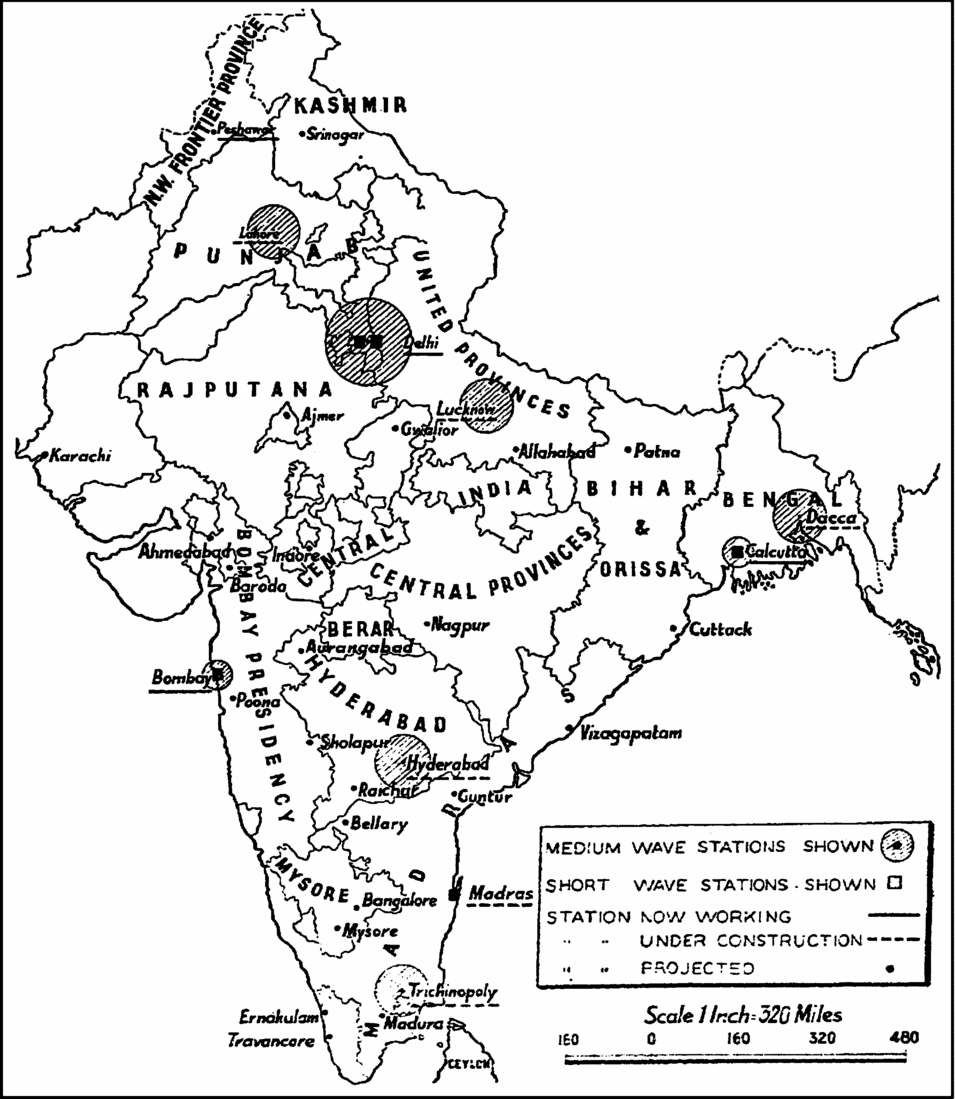
All the same, by the late 1930s (within the critical space of about eight years following the Empire Service's inauguration) wireless broadcasting in India appears to have undergone a significant change, and, at last, seemed to have found its evolutionary path from ‘infancy’ to ‘maturity’.Footnote 53 By the year's end of 1939 licence subscriptions totalled almost 74,000 – a tenfold increase over the 1932 figure. Listeners could hear programming redirected from transmitters located across the sub-continent; from Peshawar and Lahore in the Northwest Provinces, through Delhi and Lucknow (United Provinces), to Calcutta and Dacca in Bengal. Further south, shortwave (SW) and mediumwave (MW) transmissions from Bombay and Madras broadcast out over large sections of central and southern India with a radio network that catered for both urban and rural audiences (Figure 1). For all this development, though, India was still languishing behind its ‘western’ counterparts: Footnote 54
Compared with Western countries broadcasting in India is very backward. The closest parallel to India and Indian conditions in area, population, and variety of races, religions and languages is Russia. And Russia, which began to broadcast in earnest in 1926 has today some 75 transmitters and 3 million receivers. Europe, excluding Russia, is the same size as India and has over 275 transmitters, with a total aerial power exceeding 6,000 kw and 25 million receivers.
India's chain of Broadcasting Stations actual and prospective, and the areas covered (1937).59

Nonetheless, questionnaires issued to listeners suggested a significantly improved audience ‘reach’: 50 per cent of licence-holders in Delhi, and 44 per cent in Bombay, for example, listened to European oriented programming while 85 per cent (an overwhelming majority) of respondents preferred listening to ‘Indian light’ and ‘Indian classical’ music. In the Bengal circle (incorporating Calcutta and Dacca) more precise figures are available. During 1939, 15,000 licence subscribers had been registered, 9,000 of whom were Indians and 6,000 ‘Europeans’. In the Lahore circle, where this trend was even more marked, ‘Europeans’ held only 22 per cent of radio licences.Footnote 55 More than that, however, listeners had not just been linked into a system of national (Indian) broadcasting; they had also been integrated into the broader soundscape of Empire, through which the provinces, colonies, and dominions under the British flag could be brought closer to the imperial core.
These were noteworthy developments, particularly given broadcasting's troubled infancy in India. And yet there is a problem here to be explained. When Lionel Fielden departed India in 1939 for a period of recuperation in the UK (having been Controller of broadcasting for almost five years, during which time Indian broadcasting had been provided a solid footing) he was not simply struggling with the effects of physical ill health. He had also grown deeply – even pathologically – disillusioned with the progress of Indian broadcasting and its treatment by the GoI. As he later recollected:
Four years of hard labour had produced fourteen transmitters and a competent staff – and in four years the four hundred million people of India had bought exactly eighty five thousand wireless sets. It was enough to make a cat laugh. It was the biggest flop of all time.Footnote 56
Fielden's sense of failure and frustration was not simply derived from such statistical considerations – or even from All India Radio's (AIR's) distinct urban bias apparent from the 1937 broadcasting map (see again Figure 1). His 1960 autobiography The Natural Bent stands as a broader account of what he regarded as the gross incompetence – and, at times, rank ‘stupidity’ – of the GoI in their failure to grasp the enormous political potentialities of radio during his term at the helm of Indian broadcasting. The period between 1935 and 1940 (Fielden's tenure) proved to be some of the most (geo)politically and socially turbulent of all the years of British history in IndiaFootnote 57 and yet, curiously, the government of India – the defenders of the “jewel in the British imperial crown” – were unable, unprepared, or unwilling to utilise radio in either the service of empire or in the service of the Indian public.Footnote 58
The BBC, British India and Colonial Broadcasting
When, in 1927, I had managed to squeeze myself past the shaggy eyebrows of Mr Reith, and becoming a member of the BBC, Eric Dunstan, the ‘golden-voiced announcer’ of his day, was just leaving England to take charge of Indian broadcasting. I envied him in spite of the low value which we attached to broadcasting in those days. I envied him in India; I envied what I conceived to be the business of transmitting barbaric music on jewelled instruments to a population of Indian princes in the intervals of holding profound converse with sages of charm and infinite wisdom. In 1930 he was back, mortified, humiliated and enraged; and Indian broadcasting had gone bankrupt. This was a puzzle to me; and although I forgot about India in the breathless task of feeding the ever-hungrier microphone of Britain, it remained at the back of my mind, a puzzle which I intended to solve. And if one's intentions are even moderately firm and consistent, they are often realized.Footnote 60
The BBC's (or rather Sir John Reith's) interest in the question of broadcasting in India, which seems to have waned considerably during the ‘low years’ of the IBC/ISBS debacle, was substantially reinvigorated during the years from 1932 to 1935. This was, at least in part, provoked by a somewhat tangential enquiry from Lord Lothian on behalf of the Marconi Company (2 February 1932) regarding the technological feasibility of hand-powered radio receiving equipment.Footnote 61 Unbeknown to Lothian, his request for information was, in fact, propitiously timed – and resonated strongly with growing calls in ‘London circles’ for the re-examination of the previously neglected issue of broadcasting ‘in the Indian Village’.Footnote 62
C.F. Strickland (formerly an official in the Punjab) of the Indian Village Welfare Association wrote and lectured extensively on the subject in and around London during 1933/34, and evidently had some impact within the corridors of power. His writings seem to have been circulated widely in both London and Delhi, and were certainly known within the halls and broadcasting studios of the BBC, which republished his treatise on Broadcasting in Rural India in the Corporation's 1934 yearbook:
The peasant of the Indian villages – 300,000,000 peasants in 700,000 villages – are industrious but simple, kindly yet inflammable, naturally intelligent but so depressed by the isolation and dullness of their surroundings that they seek relief in excessive expenditure on weddings and in futile litigation about nothing at all. The country and population are so huge that money and staff far in excess of what can be afforded would be necessary if schools, medical assistance, agricultural instruction, and recreation were to be spread throughout the rural areas in near future.
The position would be entirely changed if those lonely masses could be advised, taught, and amused by means of broadcasting. Soviet Russia, finding itself in face of a somewhat similar problem, has installed countless receivers in schoolrooms or other accessible spots in villages, and conveys to people not only its own political propaganda but also a stream of genuine adult education. Weather news, market prices, agricultural advice, health advice, information about Russia and the world, culture and lighter items, all these enlarge and brighten the village, and mould the mind of the mujik. Is it not practicable to follow the same policy in India?Footnote 63
Strickland's article is an important one, clearly stating as it does the underlying social and cultural – and even geographic, demographic and economic – issues that might be transformed by wireless broadcasting in rural India. It also invokes the spectre of Soviet Russia – and, significantly, propaganda broadcasting – as the model for the future of the Indian broadcasting experience.Footnote 64 Speaking on the theme Broadcasting in the Indian Village in an address to the East India Association (London) Strickland developed this idea still further, suggesting that; “the most closely comparable example [to that of India] is that of Soviet Russia”:Footnote 65
[G]eographically, economically, and culturally India bears a resemblance in many respects to Soviet Russia. The Indian area is vast, the standard of living low, illiteracy widespread, and the culture of the rural population takes the form of folklore, religious stories, and familiar songs.Footnote 66
In such functional matters comparisons with the Soviet Union were not entirely inappropriate. After all India and Russia each covered vast geographical regions, the landscape occupied by predominantly illiterate populations clustered into villages. Agriculture was pursued on the same near-subsistence level and, as Zivin has noted on a rather more political level:
Like India's colonial regime, the Soviet counterpart was faced with the challenge of disseminating messages of state to populations previously outside the elite range of reception.Footnote 67
More surprising than these synergies, though, was the way in which the proponents of rural broadcasting in India – in particular Strickland, but equally the BBC and other supporting institutions – were content to promote such Russian connections without any apparent unease at the coercive, propagandist nature of the Soviet model.Footnote 68 While Strickland stressed that his rural broadcasting scheme would not permit listening to “undesirable foreign programmes” (in a clear reference to the Soviet programming of Radio Moscow), he was nevertheless prepared to see the same undesirable system replicated within British India.Footnote 69 The BBC's stance was no less contradictory, practicing (and evangelising) an editorially independent public service model at home while seeming to support proposals for government led propaganda in the colonies.Footnote 70 But if this was a contradiction it was not necessarily a new one. An internal BBC discussion document from 1927 (filed as Empire Service Policy) reveals very real concerns over the potency of Bolshevik propaganda, particularly to Empire audiences, and the need for the BBC to provide a determined riposte:Footnote 71
The continuance or destruction of civilisation will depend upon whether these very active Bolshevist propagandists fail or succeed in wrecking the established political system. The greatest political and moral stronghold in the world is the commonwealth of English-speaking peoples. If this can be held together it is unlikely that civilisation will succumb to the effects of those who desire its destruction. On the other hand, if it is allowed to disintegrate the influence of British ideals will become far less effective because those ideals will cease to be backed by power. The constitution of the civilised world may then become too weak to withstand the Bolshevic disease . . . This is a strong argument in favour of using every possible means of maintaining a consolidated British Empire. Footnote 72
This consolidation could be achieved, it was suggested, through a new service of direct communication between the institutions and peoples of the Empire. As the document concluded:
It follows, therefore, that some consolidating influence is necessary, and it needs to be an influence which reaches every man, woman and child. The influence needed is not propaganda in the ordinary sense of the term. It is a means of intercourse which will bring about familiarity with the everyday affairs of Empire. This is where an Imperial Broadcasting Service will prove to be so valuable. It cannot fail to stimulate and keep alive interest in the affairs of Empire, and it will, to a very large extent, prevent the imperial ideal from being swamped by local nationalism.Footnote 73
The proposed Imperial Broadcasting Service was not to be out-and-out propaganda in the Soviet sense, but a more subtle presence, quietly reinforcing the imperial ideal; the Soviet model refined, perhaps, and made palatable to British tastes and traditions. Nonetheless, emerging nationalisms were still to be counteracted and foreign ideologies, particularly that of Soviet Russia, undermined. While Empire unity and familiarity were undoubtedly the central tenets of the IBS plan, they were very much promoted in defensive reaction to the perceived threats of Soviet ideological propaganda and emergent nationalist sentiment in the colonies and dominions.Footnote 74 The BBC's Empire Service (the inheritor of such IBS discussions) was not simply the product of sentimental visions of imperial hand-holding and “homely chats” to British ex-patriots, but, critically, was complicit in the geopolitical struggles and tensions that marked the twilight years of Empire.
Nowhere was this role more obvious than in India where, as we have seen, the BBC's influence stretched well beyond that of proprietor of Empire broadcasting. The corporation had selected Eric Dunstan to take charge of the fledgling IBC in 1926 (following several representations by John Reith), and by 1933–34 was advancing the possibilities of rural/village broadcasting networks across the sub-continent. At about the same time, John Reith was establishing direct contact with the Viceroy, H.E. Lord Willingdon, to promote the idea of reinvigorating Indian broadcasting at state level. Fortunately for Reith's ambitions (and surprisingly, given the track record), Willingdon was much more amenable to the concept of wireless broadcasting than many of his predecessors – including, despite his warm words at the IBC's inauguration, Lord Irwin – and agreed to take up the issue with the governing Executive Council. “You and I will pull this through”, he informed Reith in the summer of 1934.Footnote 75 Pull it through he did.
By September 1934, Willingdon was in a position to write to John Reith confirming definite progress and, following the tradition set by Dunstan's secondment to the IBC in 1926, asking for his help in selecting an ‘expert’ for a five-year contract:Footnote 76
His role in the future development of broadcasting in India will be of the very greatest importance, and I hope you will help us to get the very best man available. I realise very clearly that the assistance and co-operation of the BBC will be invaluable to us, and I would like to have your goodwill at home supplemented out here by the guidance of one your best lieutenants . . . He will not have an easy task, but he will have a wonderful field to work in. He will need great tact, and a complete sympathy with the Indian point of view and with Indian aesthetic standards which may at first be strange to him. He will be brought into contact with all conditions of people and far greater variety than he meets in England, and will have to have the right word for each of them. Also, he will have to make the best at the outset of what may seem to him somewhat indifferent material, for broadcasting in India has been starved in the past; and even in the future he must be content with a good deal of improvisation.Footnote 77
The Viceroy's letter was read with some consternation by Home Department officials within both the Government of India (Delhi) and in the India Office in London.Footnote 78 The GoI's Director of Public Information, I.M. Stephens, was prepared to be ‘indiscreet’ on the subject in writing to his India Office counterpart, H. MacGregor. Contesting the Viceroy's requirements, Stephens considered:
The man we need as our Controller of Broadcasting is someone with an adaptable mind, who is capable of feeling at home in India and being keenly interested in her problems, but we definitely want to avoid a man with ‘a complete sympathy with the Indian point of view’ as I fear this phrase might be interpreted in the BBC offices. Personally, I would prefer what might be described as ‘a concealed die-hard’.Footnote 79
Whatever the official concerns in London and Delhi, its intended recipient received Willingdon's letter with considerable excitement and anticipation. Reith's reaction to the letter, which was dictated to him via the telephone to Cape Town (where he was drafting a broadcasting constitution for the Union of South AfricaFootnote 80), makes for not only one of the most remarkable entries in his autobiography, but also a rather startling revelation in the history of British broadcasting. Reith's immediate reaction was not to delegate the role, but to attend to it himself:
I was indeed prepared to meet this appeal. So convinced that broadcasting might be the determining factor in the future of India – the integrator – as to feel that perhaps I ought to go there myself; and for good. Indicated this to Whitely on the telephone from the Cape. No; he was sure it was my greater duty to stay at home, especially with the government inquiry about the BBC next year; I must see them through that. So I thought no more about it. More truthfully, I have thought about it many times since; and wondered.Footnote 81
The fact that Reith had considered, however briefly, leaving the BBC to accept the mantle of Indian broadcasting is clearly a significant point of note. Even more noteworthy, however, was the justification he offered for this near overwhelming conviction, in particular his brief that broadcasting could be the determining factor in the future of India; “the integrator”, presumably of religions, of castes, of distant villages and urban centres, possibly even of coloniser and colonised.Footnote 82 This certainly corresponded with Reith's belief that if broadcasting had been taken seriously in 1924, “subsequent events in India might have been very different”.Footnote 83 It also exposes though, a latent innocence – even naivety – over the real potentialities of the wireless medium of influencing attitudes and human behaviour that prevailed during the 1920s/30s. The growing reach of Radio Moscow and organised Soviet programming, along with the rise of Nazi radio propaganda (and its implication in the Saarland plebiscite of 1935) dramatically heightened conceptions of ‘radio power’ causing many national governments (and broadcasting institutions) to attach more importance to propaganda than it warranted.Footnote 84 Viewed with hindsight, over seventy years later, it seems likely that Reith's immediate reaction to the Vice-Regal communiqué was similarly coloured.Footnote 85 Nevertheless, Willingdon had unquestionably broken radio's deadlock in India; had proposed high ideals in the way forward and called upon a ‘superman’ to see the vision through.
The ‘superman’ chosen from the ranks of the BBC was Lionel Fielden; “brilliant but impetuous . . . [o]ne of those very highly imaginative, creative individuals whom the BBC was sometimes alleged to look on with disfavour”.Footnote 86 Nonetheless, as Reith recognised; “The loss to the BBC was such, on this occasion and many similar occasions, as it was a duty to incur”.Footnote 87 For Fielden, though, his selection was the resolution of a longstanding ambition, which had been sparked in 1926 by Eric Dunstan's departure for the subcontinent.Footnote 88 It was clear that Fielden would require sizeable authority (as well as imagination and creativity) to see through the Reith/Willingdon proposal – an authority that could only be granted through a revision to the Government of India Bill presently undergoing parliamentary review. This constitutional settlement, itself, represented a new vision for the future of the British administration in India. Longstanding notions of all-India unity, already being challenged by burgeoning nationalist movements, were to be refocused in the promotion of ‘provincial autonomy’ within a federated system of government.Footnote 89 In this way, ‘provincialisation’ might also “deflect all-India challenges to British authority”.Footnote 90
In broadcasting too, the provinces were to have “almost complete autonomy” with only technical aspects being preserved under central control.Footnote 91 Again, it was down to Reith and the BBC to impress the British model on the Government of India, and urge hasty reconsideration:
In the following March the Secretary of State moved an amendment to the India bill to have broadcasting reserved for control at the centre; the decision, he said, had been made after consultation from the Government of India, the provincial Governments and the BBC. Though the provinces were to have considerable latitude in programmes, broadcasting was to be a federal subject; policy would be controlled from the centre, with the Viceroy holding the balance.Footnote 92
The path had thus been cleared for a centralised approach to Indian broadcasting with authority, again, vested in the Industries and Labour Department (following the status-quo established in 1930). It was made clear to Reith, after a series of discussions with the India Office, that there was no prospect of a self-governing corporation on the model of the BBC, although there was still the outstanding promise of BBC intervention in the shape of Lionel Fielden as Controller of Broadcasting.Footnote 93 Unbeknown to Fielden, the BBC, or the Viceroy however, in clearing the way for an all-India approach to wireless, the government had already laid the foundation-stones for the hurdles and frustrations that would define only the following five years. As Fielden later reflected, this was, “an adventure that would end in explosion”.Footnote 94 The touch-paper had, it would seem, been ignited long before Fielden set foot on Indian soil.
‘A clumsy title’: All India Radio and the ‘fantasy’ of Sonic India
The beginning of the telegraph in India [in 1852] illustrates the key problems involved in the transfer of a European technology to a colony. First, a person of reputation in the basic understanding of the project under consideration is needed. Preferably, this person should be an experienced colonial in order to have the authority of an on-the-spot observer. Such a person must not only be technically competent, but must have an enthusiastic vision of the benefits to be derived from the completed work, as well as the ability to express his views in a forceful and persuasive manner. Additionally, this person must be capable of making all necessary adaptations. He need not be an inventor or innovator, but he must be able to visualise the performance of the home technology in a foreign environment. He should realise that it is never possible to import a technological system into an undeveloped area without making some significant changes.Footnote 95
Reith almost certainly hoped that Lionel Fielden would live up to the same high standards and expectations that had defined Sir William O'Shaughnessy's considerable achievements with the electric telegraph during the 1850s. It is clear, though, from the correspondence sent between the Director General and his appointed ‘superman’ prior to his departure for India that, while hopes were undoubtedly high, expectations were rather more guarded:
You certainly realized the supreme responsibility which is committed to you, and what you have it in your power to do. I don't know that anyone – not excluding the Viceroy – can do for India what you can . . . Don't mind my urging you again to tread like Agag – very delicately – and to be wary. Perhaps the less you say the better for many months to come. I know what it will be – the suffering of fools, to say the least; but one gets that in every walk of life and it is always hard for men, like you, of quick intelligence and eager disposition. Impatience and such qualities are gifts of the Gods and they're also instruments of the devil.Footnote 96
Fielden was undoubtedly eager to the point of impatience. His autobiography is testament to the ruptures that developed between himself, as Controller of Broadcasting, the Government of India and the Indian Civil Service (ICS), each of whom he regarded as devoid of “decency and initiative”. “India”, Fielden recorded, “was a Paradise for those who were willing to sell the pass in the sense of supporting, over numerous whiskies-and-sodas, an imperialist oligarchy which was as dead as a dodo, and failing to realize that the real Britain might be a close friend to the real India”.Footnote 97 The wireless, as the BBC's Empire Service had illustrated, could be engaged in creating and sustaining such a dialogue. Indian radio could do the same and become – perhaps not the great “integrator” of Reith's imagination – but a unifying influence with an “All-India Personality” nonetheless.Footnote 98 These questions of ‘radio power’ and ‘influence’, along with the impending prospect of war and propaganda broadcasting, dominated Fielden's tenure of Indian broadcasting, exposing contradictions in government thinking and legislation.Footnote 99
Fielden, for all his impatience, quickly learnt a form of pragmatism regarding the broadcasting landscape he had entered. Even before embarking for India his perceived notions for Indian broadcasting had been forced to undergo rapid revaluation. The trigger was paradoxically the very government legislation that had brought his new role into existence. “I despaired quite a lot over the Government of India Act . . . It was too like the BBC, faces in the Tube, pinstripe trousers; not a flicker of humanity in its august pages”. He continued:
Painstakingly I searched for a reference to broadcasting; for surely, I thought, as problem after problem was unfolded, examined, and placed on its appropriate shelf, surely, in this immense, sprawling, illiterate country, broadcasting could educate, unify, and direct as no other medium could. The spoken word could run like fire once again through India. But the grey volumes said no, we don't deal in fire, and we don't like new things; our findings are based on a careful study of the status-quo and how it can be maintained without upsetting imperial traditions in these upsetting days when natives have the face to object to being called natives, and we actually have to change the name of Imperial Delhi, which we built with twenty million pounds of good Indian money, and call it New Delhi. So don't, said the grey volumes, talk about broadcasting and unity, because unity, except as a pious aspiration, is a dangerous thing; and that's just why the benevolent British Raj finds all these problems so very difficult to solve.Footnote 100
This exposes some of the internal contradictions at the heart of the 1935 constitutional settlement. ‘Provincialisation’, after all, had been (in the crudest terms) designed as a policy of ‘divide and rule’, redirecting national loyalties and ambitions towards more mundane (i.e. less threatening) regional-level discussion. That broadcasting had been set apart from this process and had found its way into the hands of someone like Fielden only escalated the latent fears within the GoI and ICS with regard to its ‘unifying’ properties. Indeed, in a curious political and ideological u-turn, the very same “great opportunities” identified by Lord Irwin in 1927 (i.e. social, educational development, and mass entertainment)Footnote 101 were, by the mid-1930s, seen as “great dangers” within the Indian administration. As Zivin has recognised:
The very instrument of modernity that Fielden brought with him posed great dangers to imperial prerogatives. The distances that broadcasting could cover and the boundaries it could transgress, the mass society which it was expected to cultivate, and the novel expertise it demanded (from outsiders like Fielden) all violated what little was left of the ‘Imperial idea’.Footnote 102
Fielden did little to appease these brewing concerns. This became particularly obvious (not least to GoI members) following an unscheduled, although not necessarily unplanned, encounter between the Controller of Broadcasting and the Viceroy, Lord Linlithgow.Footnote 103
Fielden had long been troubled by the title ISBS (Indian State Broadcasting Service) and had sought a re-designation that would lend Indian broadcasting the ‘all-India personality’ he desired.Footnote 104 The Secretariat, though, rejected his choice of ‘All India Radio’ out of hand and thought ISBS perfectly serviceable. Unusually, this seemed only to inspire “a little unnatural tact” in the customarily impetuous Director of Broadcasting. By the end of the meeting, not only did Fielden have the name change he desired, but seems also to have persuaded Linlithgow that the idea had come from the viceregal imagination:
I cornered Lord Linlithgow after a Viceregal banquet, and said plaintively that I was in great difficulty and needed his advice. (He usually responded well to such an opening). I said I was sure that he agreed with me that the ISBS was a clumsy title. After a slight pause, he nodded his long head wisely. Yes, it was rather a mouthful. I said that it was perhaps a pity to use the word broadcasting at all, since all Indians had to say ‘broadcasting’ – broad for them was an unpronounceable word. But I could not, I said, think of another title; could he help me? ‘Indian State’, I said was a term which, as he knew, hardly fitted into the 1935 Act. It should be something general. He rose beautifully to the bait, ‘All India’? I expressed my astonishment and admiration. The very thing. But surely not ‘Broadcasting’? After some thought he suggested ‘Radio’? Splendid, I said – and what beautiful initials’. The Viceroy concluded that he had invented it, and their was no more trouble. His pet name must be adopted. Thus All India Radio was born.Footnote 105
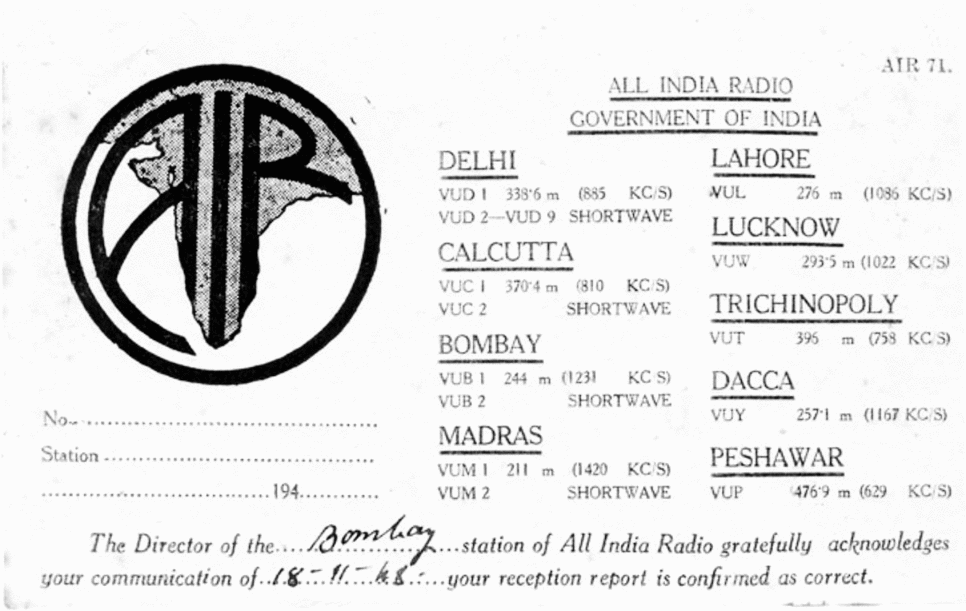
AIR Call Card (1948), illustrating AIR logo and regional stations/transmitters.Footnote 106

While Fielden had successfully secured a new identity for Indian broadcasting, the tug of war between AIR and the ICS only escalated in 1936. A set of strict editorial ground rules (quickly established between the Home Department and Industries & Labour) attempted to wrest control over the broad issue of AIR's news service, particularly on their most controversial of radio issues – political broadcasting and ‘broadcast talks’. Government servants would, for example, be allowed to talk about their work, but – critically – had to avoid lapsing into matters of Propaganda.Footnote 107 Political talks on the other hand had to be closely censored and all discussions maintained within ‘reasonable bounds’. ‘Violent controversies’ were to be avoided, and the political parties were banned from making any use of the news service. In addition, the GoI also undertook “not to use the service for political purposes”.Footnote 108
AIR's news broadcasting was thus systematically depoliticised in terms of overt political content. India's political parties (i.e. Gandhi/Nehru's Congress) had been prohibited from engaging in ‘potentially subversive’ transmissions, and even the most balanced of political debates on the radio. Curiously, though, in their race to grasp the nettle of political sedition, the GoI also seem to have legislated away much of their own ability (and that of its ‘servants’) to communicate with the Indian public – as it, too, had been inscribed into new editorial procedures.
As one might expect, the government's interventions provoked censure from the Controller of Broadcasting, who had hoped to encourage radio's political engagement with listeners in India's regional languages.Footnote 109 Fielden found tacit support for his cause back in London. This was heightened still further when, during the campaigns for provincial assembly elections in 1937, Maurice Hallett (Home Member) imposed a blanket ban on all broadcasting with political content, fearing, it would see, the rapid re-nationalisation of provincial politics.Footnote 110 The Undersecretary of State for India (in the India Office) R. A. Butler, viewed this decision with some notable disquiet:
I can see the force of the arguments in Mr Hallett's letter to Mr Fielden but would have thought it possible for one leader from each main political or communal group in a Province to use the wireless in much the same way as our political leaders do here . . . the theory that they might ‘disseminate sedition’ seems to show a misapprehension of the objects of the new Constitution which, among others, are to encourage Indians to blackguard each other (as we do in politics at home) and not us as a nation.Footnote 111
Hallett's somewhat paranoiac mistrust of broadcasting had exposed a significant rift between the GoI and the India Office, and had effectively ruled political discourse out of Indian broadcasting in the near term. In fact, Hallett's editorial principles were to stand, guiding the GoI's policy on broadcasting until India's independence in 1947. Fielden's belief in his broadcasting project, and British rule in India more broadly, had meanwhile been profoundly shaken by his official encounters, and he quickly began to struggle with the effects of misery and frustration.Footnote 112 Isolated from civil service circles, and fearing that his own staff were informing on him, he sought support and reassurance from two rather unexpected sources; the leading lights of Congress, Mohandas Gandhi and Jawaharlal Nehru.Footnote 113
This is not to attempt a biography of Fielden's life in India, but to expose some of the ruptures that had developed within the administrative hierarchies of Indian broadcasting during the late 1930s.Footnote 114 Nehru's reply to this cry for help encapsulates the situation.
Your letter reached me and it made painful reading. I am afraid you are a misfit in that job or in India: but then all of us are. What is one to do about it? You blame others including innocent me but does not the fault lie really in the environment, in circumstances which are bigger than individuals, in the unhealthy relation between India and England, in the topsy-turvy world itself? Broadcasting is a great thing, I believe in it. But it is after all a part of a much larger whole, and if the body is sick how can you treat a finger or a limb? Footnote 115
Given Fielden's increasing animosity towards the GoI – apparent in several self-penned (but anonymous) and highly critical articles published in The Times (London) along with a high presence in India's nationalist publications (for which he received an official letter of censure) – it would be easy to imagine that Fielden parted India with a final condemnatory ‘bang’. The reality was, in the event, rather less climactic. With his health deteriorating steadily during the summer of 1939, Fielden returned to London on medical leave, and while he returned briefly to India later in 1940 his term fizzled out with rather less political venom than it had started.Footnote 116
Conclusions
Lionel Fielden's experiences, together with those of Indian broadcasting more generally from the 1920s onwards, provide a vivid sense of the inherent challenges in developing new forms of social and cultural communication in late-colonial India. While the subcontinent seemed to promise considerable “natural opportunities” for the application of radio technologies and broadcasting practices, governmental inertia and official unwillingness to unsettle or undermine the Raj's evolving constitutional/legal relationship with India (i.e. ‘provincialisation’ and the Government of India Act) conspired to undermine radio's commercial viability and, subsequently, its potential for an independent ‘public service’ role. Unbeknown at the time, these early decisions would have implications for radio's future development in post-colonial India and post-partition South Asia – many of which are still being negotiated sixty years after Britain's South Asian withdrawal.
India's ‘radio geopolitics’ equally exposed latent tensions – and competing priorities/aspirations – between the two chief branches of the Indian administration; the GoI's reluctance to seize upon radio's political potentialities in New Delhi, flying in the face of the perceived wisdom and experience – all too obvious in London – of India Office ministers and officials. Communications with the BBC and Sir John Reith expanded these important colonial (and personal) connections still further and gave rise to critical and not uncontroversial institutional (and even colonial) encounters between the Indian state broadcaster (ISBS/AIR) and the BBC, under both Eric Dunstan and Lionel Fielden. During Fielden's tenure, in particular (and despite his nationalist sympathies), the structure and system of Indian broadcasting – and its connection with the BBC – was bitterly attacked and condemned as “the dumping ground for British refuse”.Footnote 117 Radio was, thus, a thoroughly contested medium even if its potential was widely unrealised.
It would, though, be quite wrong to leave Fielden's critical self-analysis of his tenure, and AIR's development after 1935, unchallenged. By 1940, the “flop” of Fielden's imagination, was a wide-ranging and professional system of colonial broadcasting, driven by 14 high-powered transmitting stations across the subcontinent, and transmitting in multiple languages and cultural traditions (by October 1940, news was broadcast in Tamil, Telugu, Gujerati, Marathi and Pashto).Footnote 118 Fielden's labour had, as Zivin has recognised, also produced the next generation of Indian broadcasters (including the future, and first, Director General of Radio Pakistan, Zulfaqar Bokhari) and in so doing had laid the groundwork – however politically compromised – for radio's postcolonial, post-partition emergence.Footnote 119 Thus, as this article has sought to demonstrate, any account of the geopolitics of British-Indian radio has to be mindful not only of those personal and institutional networks and relationships but also generous in spirit to those early pioneers of broadcasting.
Even with independence India's radio systems struggled to live up to the high expectations laid out by the former Viceroy, Lord Irwin, in 1927. Indeed, the “special opportunities” provided by India's distances and vast open spaces would continue to prove a near unassailable financial and technical challenge until the dawn of the transistor revolution in the mid-1960s – at just the moment when South Asia's airwaves were facing a renewed geopolitical struggle for Cold War cultural (and technological) superiority. As the 1965 Indo-Pakistan conflict would aptly demonstrate, AIR and Radio Pakistan faced fresh competition for the ‘hearts and minds’ of the Indian subcontinent as the broadcasting triumvirate of Radio Moscow, Voice of America and the BBC World Service sought to (re)exert their aerial influence across the region.Footnote 120