


Introduction
The once neglected hoarding evidence base has advanced to the stage that DSM-5 contains a Hoarding Disorder (HD) diagnosis. To meet diagnostic threshold a patient would need to display: (a) persistent difficulties with discard of possessions, due to strong urges to save and/or distress concerning such discard; (b) an accumulation of clutter in living spaces preventing the normal use of those living spaces; (c) clinically significant distress or impairment; (d) hoarding symptoms not due to a general medical condition; and (e) the hoarding symptoms being restricted to the symptoms of another mental disorder (DSM-5, American Psychiatric Association, 2013).
In terms of psychological risk factors for hoarding, there is growing evidence that developmental factors may play a role in vulnerable individuals. Adverse and traumatic childhood events have particularly been highlighted as a putative risk factor (Alonso et al., Reference Alonso, Menchon, Mataix-Cols, Pifarre, Urretavizcaya and Crespo2004). Hoarders report a greater number and frequency of different types of trauma during childhood (Hartl, Duffany, Allen, Steketee and Frost, Reference Hartl, Duffany, Allen, Steketee and Frost2005), with the presence of such trauma being associated with greater hoarding symptom severity (Cromer, Schmidt and Murphy, Reference Cromer, Schmidt and Murphy2007). A consequence of such childhood adversity can be disruption to attachment relationships and the development of insecure or disordered attachment (Bifulco, Moran, Ball and Lillie, Reference Bifulco, Moran, Ball and Lillie2002). Childhood attachment affects behaviours throughout the life cycle and effective childhood attachment facilitates the confident use of adult relationships, interpersonal intimacy and dependence (Waters and Cummings, Reference Waters and Cummings2000).
In terms of evidence of social impairment, Grisham, Steketee and Frost (Reference Grisham, Steketee and Frost2008) compared hoarders (N = 30), with non-hoarding anxious/depressed patients (N = 30) and non-clinical community controls (N = 30) concerning interpersonal issues. Hoarders reported similar levels of interpersonal distress to non-hoarding anxious/depressed patients and had significantly greater interpersonal problems than community controls. Nedelisky and Steele (Reference Nedelisky and Steele2009) investigated attachment to people and inanimate objects in a sample of OCD patients (N = 14 hoarders and N = 16 non-hoarders), who were compared on responses to a measure of reciprocal attachment and a 5-minute speech segment. Hoarders were found to have significantly higher levels of emotional over-involvement with inanimate possessions and lower levels of emotional involvement with people.
The hypotheses for the current study were as follows: (1) hoarders will report higher levels of attachment anxiety/avoidance and lower levels of social support in comparison to controls; (2) attachment and social support will predict hoarding; and (3) the relationship between hoarding and social support will be moderated by attachment. ANOVA tested the first hypothesis, whilst multiple regressions were used to test the second and third hypotheses.
Method
Design and participant categorization
Approval for the study was granted by the local research ethics committee. Data were gathered via an internet based survey and utilised a cross-sectional quantitative design. OCD charities were also approached to advertise the project. The advert for the study emphasized the voluntary nature of participation and that the researchers were interested in participants’ interpersonal attachment styles. The advert stated “we are interested in attachment styles (how you relate to people) and social support (the degree to which you have people around you that support and help you).” N = 2061 initially accessed the study website, with N = 1429 (69.30%) completing all measures; 73.70% (1053) females and 26.00% (371) males (N = 5 unstated gender). Ages ranged between 18–87, with a mean age of 31 (SD 13.39). Of the N = 1429 who completed measures, 276 (19.3%) self-identified as “community hoarders”, 601 (42.1%) self-identified as “students”, 223 (15.6%) self-identified as “student hoarders” and 329 (23%) self-identified as “community controls”. To identify hoarders, only those participants scoring beyond the clinical cut-off score on the SI-R were used (SI-R > 41). In the original self-identified hoarding group N = 203 (73.60 %) met caseness, in self-identified student hoarders N = 112 (50.20 %) met caseness, in the self-identified community group N = 23 (7.00%) met caseness, and in the self-identified student group N = 42 (7.00%) met caseness. Three study groups were then created based on SI-R caseness scores and whether participants self-labeled as students. This resulted in a final research sample of: (1) hoarders (N = 380) with an average age of 36.66 (SD = 15.17); (2) community controls (N = 379) with an average age of 40.18 (SD = 11.71); and (3) student controls (N = 670) with an average age of 22.93 (SD = 6.67). To ensure study groups were heterogeneous in terms of hoarding, ANOVA was conducted on total SI-R scores indicating a significant difference between the three study groups (F = 39.40, p <.001). The final hoarding sample comprised N = 305 females (80.26%) and N = 75 males (19.74%).
Measures
The Saving Inventory-Revised (SI-R; Frost, Steketee and Grisham, Reference Frost, Steketee and Grisham2004, current α = .96) produces a full-scale score and three factor analytically defined subscales: (1) difficulty discarding; (2) excessive clutter; and (3) compulsive acquisition.
The Relationship Questionnaire (RQ; Bartholomew and Horowitz, Reference Bartholomew and Horrowitz1991, current α = .96) assesses the adult attachment style dimensions of Model of Self (Anxiety) and Model of Other (Avoidance).
The Social Provisions Scale (SPS; Cutrona and Russell, Reference Cutrona, Russell, Jones and Perlman1987, current α = .93) produces a full-scale plus and 6-factor analytically derived subscales: (1) attachment; (2) social integration; (3) reassurance of worth; (4) reliable alliance; (5) guidance; and (6) opportunity for nurturance. The self-identified hoarders were also asked to report hoarding age of onset.
Results
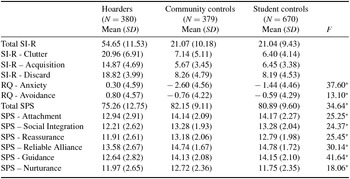
Age of onset for hoarding was 13.68 (SD = 8.83) and Table 1 reports scale scores for hoarders and control samples to test the first hypothesis. Attachment anxiety significantly differed between groups. Tukey HSD tests showed that attachment anxiety scores for hoarders, community and student controls all differed significantly from one another, indicating that hoarders reported significantly higher levels of attachment anxiety. There were significant differences on attachment avoidance (using the Welch F statistic) between hoarders and controls. The Games-Howell test indicated that the attachment avoidance mean score for hoarders was significantly higher than community and student controls. Study groups also significantly differed (using the Welch F statistic) from each other in terms of total social support. The Games-Howell test indicated that hoarders perceived significantly lower levels of social support than community and student controls.
Scores of hoarding, social support and attachment in the study groups

p < .01
Standard multiple regressions (completed solely on hoarders) tested the second hypothesis. The variance in total SI-R score explained by attachment and social support was 11%, with both factors explaining 10.50% of clutter, 4.50% of discarding, and 4.90% of acquisition variance. More specifically, only total SPS scores made a statistically significant “unique” contribution to total hoarding, clutter and acquisition. Attachment avoidance made the only statistically significant unique contribution to discard. Two further multiple regression analyses then explored whether attachment acted as a moderator (hypothesis 3) between social support and hoarding. These regressions included the interaction terms between (a) attachment avoidance and social support and (b) attachment anxiety and social support. Attachment avoidance did not moderate the effect of social support on hoarding (interaction t (329) = −.852, p = .395). However, attachment anxiety did significantly moderate the effect of social support on hoarding (interaction t(329) = −2.66, p = .008).
Discussion
Results suggest that hoarders experience problematic relationships with others in terms of establishing close relationships and cope with the anxiety created via behavioural avoidance. Hoarders in the current study were shown to experience lower levels of social support than control groups, suggesting that low social support may play some role in maintaining hoarding. Possessions can be non-threatening, unchanging and predictable (if discard is avoided), whereas relationships can contain more threatening themes of ambivalence, dependence and conflict. The amount of variance explained by attachment and social support was much higher for clutter, than acquisition or discard. It may be the case that hoarders are painfully aware of the excessive clutter in their homes, which may therefore create a reticence to attach to others and gain from associated social support. Attachment anxiety (but not avoidance) significantly moderated the relationship between social support and hoarding. As attachment anxiety increased, the inverse relationship between perceived social support and hoarding became stronger. The implication of this finding is that the more hoarders have disturbed attachment relationships with people, the more disturbed their relationships with possessions.
In terms of methodological weaknesses, the study was compromised by: (1) the lack of diagnostic certainty regarding the hoarding sample due to the absence of domiciliary access and clinical interviewing; (2) the absence of assessment of any co-morbidity; (3) all measures being self-report; (4) the lack of a clinical control group and (5) the cross-sectional nature of the methodology, which precluded any examination of causality. The significant differences observed on the SI-R in the initial self-identified hoarding group illustrates that a proportion (over one-quarter of the initial self-identified hoarding group) regarded themselves as a “hoarder” and yet had sub-clinical hoarding symptoms. Researchers and clinicians need to use the SI-R as a routine screening measure to rule out such “false-positives”. Clinically, whilst de-cluttering is a vital outcome, if this can be achieved alongside connecting more successfully with others, then this would presumably have a better clinical prognosis. Hoarding remains a significant challenge for both researchers and clinicians.



Comments
No Comments have been published for this article.