1. Introduction
We consider the question of the manner of the internalization of the geometry and topology of physical space in the mind, both the mechanism of internalization and precisely what structures are internalized. Though we will not argue for the point here, we agree with the long tradition which holds that an understanding of this issue is crucial for addressing many metaphysical and epistemological questions concerning space.
In particular we will discuss the views of two important—noncontemporary—thinkers on this topic, Henri Poincaré and Roger Shepard. While they differ in a number of ways, what they share in common is the view that we internalize not just the metrical structure of Euclidean space, but the structure of the group of rigid Euclidean transformations. (Even here Poincaré and Shepard differ, for as we shall see the former identifies the algebra of the group as the internalized structure, while the latter focuses on the geometric properties of the six-dimensional space of Euclidean transformations.) Of course geometries can be classified by their symmetry groups, so we will have to make clear in each case the sense in which internalizing the group is distinct from internalizing the metrical properties.
Since it is the idea that links them, it is worth starting by reviewing some properties of the Euclidean group, E +. The natural representation of the group is in terms of rigid transformations involving a rotation and a translation: in a Cartesian coordinate frame the group elements are pairs of rotation matrices O and vectors b, (O, b) whose action on an arbitrary vector v is

Of relevance to Shepard's work is that the group is not the direct product of the groups of Euclidean rotations and translations (
 $SO(3) \times R^{3}$
) but only the semi-direct product (
 $SO(3) \thinspace{:}\thinspace R^{3}$
). That is, while

so the sequence of a pure rotation, followed by pure translation, followed by the inverse rotation is itself a translation,

for any rotation
 $O^{\prime }$
. (Technically, while R 3 is normal in E +, SO(3) is not.)
2. Poincaré
In this section we discuss the first argument that it is specifically the spatial group—not manifold—that is internalized. This view is Poincaré's, laid out in Chapter IV of Science and Hypothesis—“Space and Geometry” (Poincaré Reference Poincaré1952). By itself the position is quite clear, but Poincaré's work carries a great deal of interpretational baggage, most of it mistaken, which greatly obscures his views on internalization. Hence we will also use this section to outline the correct way to understand Poincaré, placing his views in their proper context. Note that although there is much that is problematic in Poincaré's views by the light of contemporary psychology and philosophy, the limitations of space prevent us from making any lengthy criticism.
2.1. Space and Geometry
What everyone knows from Chapter IV is of course the ‘non-Euclidean world’ example (we will use Poincaré's phrase, though it is often described as the ‘heated plate/ball’). Indeed, the example is typically the interpretational focus of this chapter; we will show that this is a mistake. Such interpretations fall into two main kinds.
First, following Reichenbach (Reference Reichenbach1958), one could take the non-Euclidean world as an argument against an experimental conception of geometry, of the kind advocated by Mill. That is, a problem for the view that mathematical geometry is an experimental science, open to verification or falsification by geometric measurements using rulers, light rays, and the like, is that geometry is (allegedly) underdetermined by such experiments—they could merely be the result of systematic variations in the physical objects involved. Second, the non-Euclidean world is often (for instance, by Sklar Reference Sklar1974, 89–91) also taken as an argument against Kant's view that geometry is synthetic a priori, with its a priori character explained transcendentally by the theory of sensible forms. That is, the existence of a manifestly possible world in which physical objects are experienced to move as if space were non-Euclidean demonstrates the a posteriori character of spatial experience.
While Poincaré undoubtedly rejected both of these views, it is a serious confusion to think that either is the target of the non-Euclidean world in Chapter IV of Science and Hypothesis. Poincaré has two main lines of attack on the experimental account; first, at the end of Chapter III (an argument repeated at the end of Chapter IV) he argues that so understood geometry is false—for geometry is the study of solids, and there are no rigid solids in nature! (Perhaps a better way to understand his point is to say that it is a category error to treat geometry as an empirical science because there are no rigid bodies to which it might apply.) Second, in Chapter V he gives an underdetermination argument, in which he indeed invokes the non-Euclidean world, though only as a secondary example. But it is clear that he thinks that he has already given a powerful objection to the experimentalists in Chapter III, with a clarification of the difficulties in Chapter V; there is simply no need to deal with them in Chapter IV (except at the very end, as we shall note).
The second interpretation of the non-Euclidean world is more sophisticated in one way—the Kantians really are the target of the chapter—but argumentatively it is terribly confused. While the example does show a kind of underdetermination, as we shall show later, and as Poincaré saw, it is simply not a counterexample to the Kantian account. Thus what we will describe is an alternative reading of the non-Euclidean world that evaluates it in the context of the goals and arguments of the whole chapter: an explanation of the origin of our knowledge of geometry. We shall see that the spatial group plays a crucial role in this genetic story.
At the end of Chapter III not only does Poincaré refute the experimentalists, he also argues that geometry is not a priori; for him, the conceivability of logically incompatible non-Euclidean geometries suffices. He famously concludes that geometry is a convention or definition (for an account of Poincaré's conventionalism as a post-Gauss reformulation of Kant, see Friedman Reference Friedman, Greffe, Heinzmann and Lorenz1996). However, in Chapter IV he returns to the Kantian account, for two reasons: first to give a more detailed and irresistible refutation, which specifically attacks the theory of sensible forms, and second because the rejection of both the a priori and experimental accounts leaves the question of how geometry arises. In particular, since Poincaré believes that exactly one is ‘correct’ in some sense, he has the question of what leads us to one rather than another if the matter is not settled a priori or experimentally.
Poincaré starts Chapter IV with a teaser for the non-Euclidean world, and then identifies his target: “It is often said that the images we form of external objects are localised in space, and even that they can only be so formed on this condition. It is also said that this space, which thus serves as a kind of framework ready prepared for our sensations and representations, is identical with the space of the geometers, having all the properties of that space” (46). Although his name does not appear in this chapter (only the previous one) the view described is clearly Kantian, composed of three doctrines: (a) that ‘impressions’ are located in an internal space of a particular geometry, (b) that they are necessarily so located, and (c) that this space and the space of mathematical geometry are identical (Poincaré seems to intend, with Kant, numerical identity, but for his argument qualitative identity would suffice). (a)–(c) constitute the theory of sensible forms for space—the innate geometry is a sensible form—and explain the a priori character of geometry: its axioms are those appropriate to the geometry of the internal space (Euclidean, according to Kant).
Poincaré attacks point (c); he argues that it is manifestly false if one considers carefully the space in which we experience and represent—what he calls ‘representative space’. On the one hand, geometric space is, according to Poincaré, continuous, infinite, three-dimensional, homogeneous, and isotropic. (Note that aside from being infinite, these properties are held in common by all the geometries, so Poincaré's demonstration shows that none can be a sensible form.) On the other, representative space, effectively the Cartesian product of the spaces of various modes of sense, has none of these properties. Poincaré discusses in particular the spaces in which visual, tactile, and motor (i.e., muscular) sensations occur. For instance, visual space he takes to be the product of (approximately) a two-dimensional space conformal to a retina and the one-dimensional space of accommodation (the muscular sensation of focusing the eye's lens) or equivalently of angular convergence of the two eyes. Since the retina is not continuous, infinite, or homogeneous, neither is visual space; and since one dimension is of a different character to the other two, visual space is not isotropic. (Poincaré also argues that since it is only contingent that accommodation and convergence are correlated, it is only contingent that visual space is three-dimensional.) Similarly for the other representative spaces.
Since by definition the representative spaces are the spaces in which we experience, the theory of forms collapses; innate, representative space answers none of the geometries considered by Poincaré at all, and so (a)—and a fortiori (b)—falls with (c). That is the argument in Chapter IV against the Kantians; as can be clearly seen it involves no reference at all to the non-Euclidean world. Indeed, the non-Euclidean world is no threat at all to the Kantian position that Poincaré describes. Jumping ahead, Poincaré is clear that each temporally individual experience in the non-Euclidean world is consistent with any geometry, and so with (a)–(c). Further, he says that if “geometric space were a framework imposed on each of our representations considered individually, it would be impossible to represent to ourselves an image without this framework, and we should be quite unable to change our geometry” (55). That is, if (a)–(c) held, then even in the non-Euclidean world representations and geometry would necessarily be Euclidean.
Now Poincaré goes on, “But this is not the case” (55), which one is tempted to read as denying the impossibility of non-Euclidean representations and geometry, and hence a modus tolens with the preceding quotation as the major premise and with the non-Euclidean world demonstrating the minor premise. But reading on shows that ‘this’ instead refers to the idea that geometry is imposed on individual representations; “geometry is only the summary of the laws by which these images succeed each other.” That is, only if we have already given up the Kantian theory of sensible forms does the non-Euclidean world show the possibility of alternative geometries; Poincaré explicitly denies that the example refutes Kant.
To emphasize this important point of interpretation, let us make it another way. According to Poincaré, if human sensibility were as Kant supposed then humans would experience and adopt Euclidean geometry in the non-Euclidean world; however, Poincaré's analysis of representative space refutes Kant's account. What the example does is illustrate how, according to Poincaré's proposal for geometry and perception, humans in the non-Euclidean world would adopt non-Euclidean geometry—because geometry is diachronic, not synchronic. (For Poincaré, because of the mismatch between representative and geometrical space it is misleading to say that humans experience space to have a geometry at all; we will return to this point below.)
2.2. Groups in Mind I
So before we can understand the non-Euclidean world, we need to return to the main point of this section: Poincaré's account of the internalization of spatial geometry (and of course topology). Having refuted the Kantians, Poincaré faces a question: “if the concept of geometrical space is not imposed upon our minds, and if on the other hand, none of our sensations can furnish us with that concept, how then did it ever come into existence?” (50). (Presumably, since representative space has no geometry, individual experiences cannot produce the concept—note that this is not an argument against Mill's experimentalism, since comparative measurements presuppose the motion of rulers, light rays, and the like, and hence sequences of experiences.)
In the section entitled “Changes of State and Changes of Position” Poincaré first states the general solution: geometry is derived from the laws governing which sequences of experiences are possible—in particular those laws relating to changes of position. So the problematic is as follows. An individual experience can be thought of as a collection of points and fields in the various spaces of the modes of sensation: for instance, a field of colors patches, with associated depths, a localized region of pressure (which we learn to interpret as corresponding to the soles of our feet), and in a point in motor space (with as many axes as muscles, and the coordinates of each measuring the strain on the corresponding muscle). Sequences of such experiences are given, and from them we are to infer the laws relating to changes of position; clearly the difficulty is to single out from all the changes that are occurring in representative space, just the relevant ones. In Science and Hypothesis Poincaré proposes a way that individual humans, as part of their cognitive development, solve this problem (and it is a proposal, not a transcendental argument). (It's worth pointing out that Poincaré tacitly assumes some crucial cognitive abilities: for instance, the ability to recognize sensations as being the same on different occasions, the ability to determine the state of each of the modes of sensation individually, and the ability to infer powerful subjunctive conclusions.)
First, we can distinguish changes in the ‘aggregate of impressions’ that are both involuntary and unaccompanied by changes in motor space (i.e., not involving muscular changes) from those which are both voluntary and accompanied by such changes. These we interpret as arising from the changes of external bodies and of our own bodies (or ‘internal’), respectively. The crucial point is of course that the difference is drawn solely in terms of the different characters of the experiences, not by assuming anything about physical bodies.
Second, we learn from experience that some of the changes in representative space thus characterized as external are correctable by internal changes (approximately, at any rate): the cat-shaped region of my visual field shrinks without my wishing it and without any change in motor space, but I can get back to the original impressions if I choose, via a suitable series of impressions, including some changes in motor space. As sophisticated, mature humans, knowing geometry we understand the changes as the result of first Otto moving away then our walking toward him, but geometry comes at the end of the story. At the present stage the unsophisticated, immature human simply learns from experience that certain external changes can be corrected by certain internal ones (and vice versa of course). He also learns of course that not all changes can be so compensated—those which the sophisticate interprets as bodies changing shape or color or temperature, for instance. Those that can be corrected Poincaré calls ‘displacements’, though they do not have the geometric interpretation that term implies until later in the story. (Note that we can also use the term ‘rigid’ to refer to the bodies that undergo such displacements, again without any geometric interpretation.)
Next, consider the correctable changes, internal and external. As sequences of experiences, any two correctable changes that differ in what is being experienced—a nearby cat or dog, or far away cat or dog—must be distinct, and yet we derive from such experiences an understanding of space according to which any number of different things may suffer the same geometric displacement. (Similarly, the same geometric displacement may be made along different paths, again corresponding to different changes.) Thus Poincaré proposes a way of partitioning correctable changes into equivalence classes: place any two correctable changes in the same partition if they are correctable (approximately) by the same internal change (i.e., series of muscular sensations)—in sophisticated terms, by the same motion of one's body. Strictly, it is these classes that he calls displacements; they still have no geometric interpretation. (Since they do correspond to geometric displacements, and since there are clearly infinitely many possible changes in each class, our power of telling what would correct changes if they were to occur is needed here.)
However, experience teaches us that these classes satisfy certain ‘laws’: they have an algebraic structure with composition as the product. Most simply, there is the bare fact that (approximately) any two correctable external changes that begin and end with the same aggregates of impressions are correctable by the same internal change. More generally, experience shows that certain sequences of displacements are identical to other sequences of displacements; more specifically and precisely, that displacements form a group.
Great care is needed at this point, for the terminology tempts one to imagine that we are already discussing a geometry, with its symmetries and their group. But we have been at pains to follow Poincaré in keeping clear that the ‘displacements’ and their ‘laws’ are so far in the developmental story to be interpreted simply in terms of the character of experience: as the regularities satisfied by the correctable changes quotiented over the relation correctable-by-the-same-internal-change. However, as a matter of experimental fact, in this world the group of displacements is homomorphic to the group of rigid geometric displacements in Euclidean space. And so, although it is logically possible to pick any geometry as the geometry for space, the simplest choice for us, with the group of displacements that we extract from experience, is of course Euclidean geometry. (The reader is again referred to Friedman for an authoritative account of Poincaré's conventionalism.)
With his proposal for the cognitive origins of geometry in hand, we can finally understand exactly what Poincaré's non-Euclidean world shows. That there is no logical necessity for geometry to be Euclidean (or non-Euclidean) is demonstrated in Chapter III; that representative space is not geometric shows that geometry is not a matter of transcendental necessity either. But that still leaves it unclear whether Euclidean geometry is contingent as practical matter, whether there are any circumstances in which humans would adopt non-Euclidean geometry by convention. (Note that for Poincaré ‘geometry is (non-)Euclidean’ always means ‘is by convention’.) The non-Euclidean world shows, given Poincaré's account of the origin of geometry in experience and convention, that the answer is ‘yes’. The key feature of the world is of course the different diachronic laws governing changes in the aggregate of impressions; humans having such experiences would learn that the group of displacements is homomorphic to the group of rigid displacements in ‘Lobachevskian space’. (It might well appear at this point that geometry is experimental after all; thus at the end of the chapter Poincaré repeats the argument that geometry cannot be experimental, because there are no rigid bodies to experiment on. It should be clear that in his account of the origins of geometry all we can ever find is that the experiences approximately satisfy the laws.)
We should finish our discussion of Poincaré with some reflections on how the properties of space are internalized according to his account. First, intrinsically space has no geometry to be internalized. Poincaré makes no distinction between the ‘space of the geometers’—the one true mathematical geometry—and what we would call ‘physical space’; since they are identical, and the former is purely conventional, so is the latter.
Second, it is extremely misleading to suggest that Poincaré's is an account of how an internal spatial representation is constructed (as Ben-Menahem Reference Ben-Menahem2001, 479–482) does in an otherwise enlightening article) or thus to think that we experience the geometry of space by localizing impressions in such a representation—as if Poincaré were replacing Kant's innate form of spatial sensibility with a derived one (different for us and the inhabitants of the non-Euclidean world). Poincaré says that “representations are only reproductions of sensations” (50) and therefore can only occur in our innate representative space: as images in the retinal plane with depth for instance. Thus we cannot literally represent or experience bodies as being in physical/geometric space at all; all we can do is represent—create a facsimile of—the sequences of muscular sensations—that is, paths in motor space—that would take us to various bodies.
So, finally, for Poincaré the only thing that can possibly be ‘internalized’ is the group of the equivalence classes of correctable changes; we learn some powerful laws governing the ways that aggregates of impressions change. We of course use knowledge of the group to reason about aggregates of impressions and how they will or could change under various circumstances, and of course to do so is to reason as if physically rigid bodies were geometrically rigid and as if (in our world) space were Euclidean. But in no literal sense is that to have an internal Euclidean manifold in which we represent the motions of bodies to ourselves. That is, to understand Poincaré it is crucial to appreciate that it is specifically the group that is internalized; we shall see that the same is true for Shepard, though in a rather different sense.
3. Shepard
Roger Shepard is a psychologist who has made important contributions to a number of different areas of psychological research. He is probably best known among philosophers for his work on mental imagery. Shepard's more recent work has been largely concerned with investigating the idea that some pervasive features of the environments in which animals (including human beings) live will have been ‘internalized’ (Shepard Reference Shepard2001). It is not easy to say exactly what Shepard means by saying that these features have been “internalized” but, at the least, it means that our psychological mechanisms have features that mirror those (locally) universal principles that have been ‘internalized’. One of the features of the environment that Shepard thinks has been internalized is the (locally) Euclidean structure of physical space, and it is this aspect of Shepard's work that will be our focus here.
On the surface, Shepard's concerns are very different from those of Poincaré. The latter is interested in the epistemological and metaphysical status of geometry, which is what connects him to the long-standing philosophical debates about the nature of physical space and our knowledge of it. Shepard, on the other hand, is interested in the evolved structure of our cognitive systems, an issue that on the face of it is empirical, not philosophical or mathematical. However, in the course of his discussion, Poincaré makes a relatively concrete proposal as to the cognitive processes that underlie our knowledge of space. As we will see, it is this proposal that is related to Shepard's work, and our hope is that by comparing the two it will become clearer what each has in mind.
3.1. Internalized Principles of Motion
One source of empirical evidence for the claim that the structure of Euclidean space has been internalized derives from the experience of motion when there is no relevant external stimulus. One kind of example, and the focus of Shepard's research and our discussion, is known as apparent motion. The basic apparent motion scenario involves presentation of a simple shape at one spatial location, a short time delay, and the presentation of the same shape at a different location. If the presentation times, time delay, and distance between the two locations are appropriate, observers experience a visual illusion of a single shape moving from one location to the other. When, as is usually the case, the sequence cycles continuously one has the impression of a single object moving back and forth rather than two objects flashing in and out of existence. With more complicated objects, motions other than a simple translation in the plane can be experienced. If the shapes are asymmetrical, rotation, either in or out of the plane, can be experienced. If three-dimensional stimuli are used, combinations of translation and rotation can be experienced (Farrell and Shepard Reference Farrell and Shepard1981; Shepard Reference Shepard1984; for further citations, see Shepard Reference Shepard2001, §1).Footnote 1
The existence of apparent motion raises two questions. First, why do we experience motion where there is none? The timing and distances are such that, unlike the rapid sequences of images in film or video, the two stimuli are easily discriminable. Shepard's answer is that there is an internalized principle of object conservation (Shepard Reference Shepard2001, 582–583). The visual system operates on the assumption that it is much more likely that a single object has moved from one place to another than that an object has appeared and then gone out of existence at one location and a short time later a different but similar object has appeared at another location. Object conservation is clearly true of our environment (in general) and Shepard's explanation is plausible. What this explanation does not address is why, out of the infinitely many possible rigid motions connecting the two object positions and orientations, we experience the particular motions that we do.
One initially plausible idea is that the apparent motion which we perceive is that required by Newtonian mechanics. Of course, a specific trajectory requires a specific set of forces but no plausible set of forces matches the data: apparent motion generally takes place along curved paths rather than straight inertial trajectories; rotations don't occur around the apparent center of mass; and, as we'll see, the trajectories are not those of motion in a constant gravitational field. Shepard's proposal is that it is the geometry rather than the physics that has been internalized.
3.2. What Is Internalized?
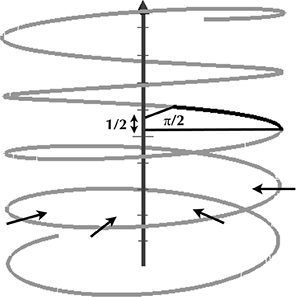
We now turn to the question of exactly what structure has been internalized according to Shepard: as for Poincaré, it is not simply R 3 but the Euclidean group E +. Shepard's motivations are not however (psychologically questionable) views about representation but an empirical hypothesis about mental processes; in short that mental rigid transformations—revealed in the experiments discussed above—correspond to the ‘geometrically simplest’ paths in Euclidean space. In the first place, these can be understood via Chasles’ theorem: the result of any rigid transformation of a body in Euclidean space is identical to a helical motion about some (unique) axis. However, there is a ‘deeper’ understanding of Chasles’ transformations in terms of the group structure and geometry of the Euclidean group, for these helical paths correspond to the one-parameter subgroups of E + (parameterized by the distance moved along the axis at a given rate of rotation) and to geodesics of the six-dimensional manifold formed by the elements of E + (see Figure 1).Footnote 2 Thus it is in the sense that the geodesics of E + (not of R 3) play a psychologically significant role that the Euclidean group, not just Euclidean geometry, is internalized.Footnote 3 The following should make the point clearer.
Figure 1 shows two things about helical motion. First, that it can be parameterized either by angle around (an angle of π/2 is indicated) or by distance along the axis (here 1/2 in suitable units)—assuming a fixed rate of rotations (here π/unit). Second, an arrow is shown at different positions along a helical trajectory, to help indicate how the orientation of a body changes during a helical motion: the tangent to the helix maintains a fixed orientation through a body as the body moves.

The parametrization of each geodesics of E + suggests a possible psychological hypothesis. One way to understand the corresponding helical trajectories in R 3 is that they are generated by repeated iterations of a small helical path—that is, a single element of the one-parameter subgroup—so that distance along the trajectory—that is, the value of the (sub)group parameter—is proportional to the number of iterations. If the psychological mechanism responsible for apparent motion generates trajectories by iterating in this way, one would expect the duration of experienced motion to vary linearly with distance traveled along the trajectory: with the value of the parameter for the corresponding one-parameter subgroup of E +.Footnote 4 One measure of the duration of an apparent motion is the time interval between the presentation of the first stimulus and the presentation of the second stimulus (stimulus onset asynchrony, SOA) required for the experience of motion. Only if the SOA is consistent with the time required to transition between the two object positions will there be an experience of motion. There is evidence to support this interpretation. For motion experienced as a pure translation the critical SOA is a linear function of separation (Miller and Shepard Reference Miller and Shepard1993), and for rotations the critical SOA is a linear function of angular difference (Shepard and Judd Reference Shepard and Judd1976; Farrell and Shepard Reference Farrell and Shepard1981). The motion generated by our internal psychological mechanisms not only follows the trajectories through space corresponding to the geodesics of the Euclidean group but exhibits temporal behavior appropriate to the transformations that generate them.
4. Shepard and Poincaré
Both Shepard and Poincaré, in different ways, make the Euclidean group of transformations fundamental, rather than the geometry of physical space. For Poincaré, it has to be the group because basic features of our psychology and of geometry rule out the possibility of an internal Euclidean space. For Shepard's theory, it is the data that point to E + and its geometry. Natural selection has produced psychological mechanisms that perform mental transformations by the iteration of basic transformations.
There is a certain symmetry between the two uses of the group machinery. Poincaré aims to derive the group algebra from data concerning coincidence in experience (plus his internal-external distinction), whereas Shepard takes the group as given and postulates its use to predict possible coincidences in experience. The problem of predicting coincidences plausibly requires selecting a particular subset of transformations from the group; checking every possible transformation is impossible. Shepard postulates that humans have internalized the helical transformations (which by Chasles’ theorem are exhaustive). Hence he relies not merely on the algebra of the Euclidean group but—since these are its geodesics—also on its geometry.